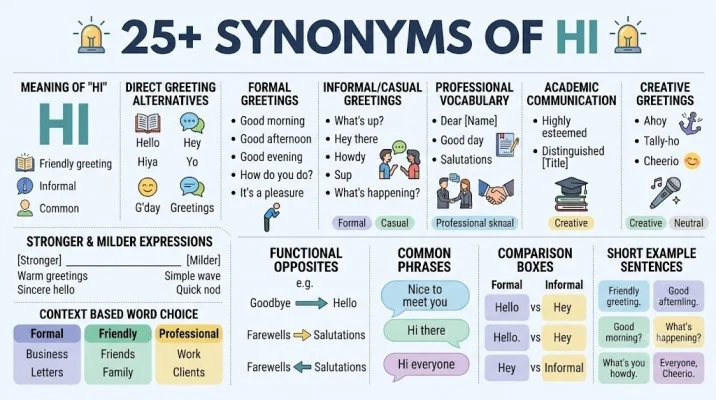
You are writing an email, caption, essay, or message and notice that you keep starting every conversation with the same word: “Hi.” Searching for synonyms of hi can help you find greetings that sound warmer, more professional, more casual, or more natural for a specific audience.
The best alternative depends on the situation. “Hello” works in almost any setting, “hey” feels relaxed and friendly, “greetings” sounds more formal, and expressions such as “good morning” or “how are you?” create a more specific tone. Choosing the right greeting can make your first words feel more natural and appropriate.
What Are the Best Synonyms of “Hi”?
Hi is a friendly, informal greeting used to acknowledge someone or begin a conversation. The best alternatives include hello for neutral or formal situations, hey for casual conversations, greetings for formal writing, howdy for a friendly regional style, and good morning or good evening when the time of day matters.
Meaning, Tone, and Context
Simple Definition
Hi is a common greeting used when meeting someone, beginning a conversation, answering a message, or getting another person’s attention.
It is one of the simplest ways to acknowledge another person without sounding overly formal.
Part of Speech
Hi is primarily used as an interjection.
It can also function as a greeting in written communication, including emails, text messages, social media posts, and online chats.
Overall Tone
The tone of hi is generally:
| Quality | Description |
|---|---|
| Tone | Friendly and neutral |
| Emotional level | Mild |
| Formality | Informal to neutral |
| Feeling | Warm and approachable |
| Common setting | Everyday conversation |
| Typical audience | Friends, coworkers, classmates, acquaintances |
Positive, Neutral, or Negative?
Hi is generally neutral to positive.
It does not normally communicate strong emotion by itself. The feeling can change depending on punctuation, surrounding words, and context.
For example:
“Hi.”
This can sound simple and neutral.
“Hi! Great to see you.”
This sounds warm and enthusiastic.
“Hi, could we talk for a minute?”
This sounds polite and direct.
Formality Level
Hi is informal to neutral.
It is perfectly natural in text messages, everyday conversations, casual emails, and many workplace emails. In highly formal correspondence, alternatives such as “Dear” or “Greetings” may be more appropriate.
Common Uses
Native English speakers commonly use hi in:
- Text messages
- Social media conversations
- Casual emails
- Workplace chats
- Customer communication
- Conversations with friends
- Introductions
- Online meetings
- Group messages
- Everyday face to face conversations
Word Forms
Unlike many vocabulary words, hi does not have a useful set of noun, verb, adjective, and adverb forms.
Related greeting expressions include:
| Expression | Function |
|---|---|
| Hi | Informal greeting |
| Hello | General greeting |
| Hey | Casual greeting |
| Greeting | Act or expression of welcoming someone |
| Greetings | Formal or traditional greeting |
| Goodbye | Parting expression |
When and How to Use “Hi”
Use hi when you want to greet someone in a friendly, simple, and natural way. It works particularly well when the relationship is familiar or the setting is relaxed.
Professional
“Hi Jordan, I wanted to follow up on yesterday’s meeting.”
Why it works:
“Hi” is common in modern workplace emails when the communication is friendly but still professional.
Academic
“Hi Professor Miller, I am writing about the assignment deadline.”
Why it works:
It can work with a familiar instructor, although “Dear Professor Miller” may be safer for formal academic correspondence.
Workplace
“Hi everyone, the meeting will begin at 10 a.m.”
Why it works:
It creates a friendly opening for a group message.
Personal
“Hi! It was great seeing you yesterday.”
Why it works:
The greeting is warm without sounding overly formal.
“Hi Sarah, thanks for sending the documents.”
Why it works:
It is one of the most natural openings for everyday professional email.
Resume
A resume itself usually does not begin with “hi.” However, the word can appear in a related networking message.
“Hi, I recently applied for the marketing position and wanted to introduce myself.”
Why it works:
The greeting belongs in the accompanying message rather than the resume.
Social Media
“Hi everyone! Thanks for joining the conversation.”
Why it works:
It sounds approachable and works naturally for an online audience.
Best Synonyms of “Hi”
No greeting is identical to hi in every situation. Some alternatives are direct replacements, while others are greeting expressions that communicate a similar purpose with a different level of formality, warmth, or personality.
Professional Writing: Hello
Hello is usually the safest alternative to hi in professional communication.
Example:
“Hello Ms. Carter, thank you for your message.”
It sounds polite, neutral, and professional without being overly formal.
Academic Writing: Greetings or Hello
For academic emails, hello is suitable for many everyday messages. In more formal correspondence, a direct salutation such as “Dear Professor Smith” is usually more appropriate than either “hi” or “greetings.”
Business Communication: Hello
Hello provides a polished opening for business emails, customer communication, and professional messages.
Example:
“Hello David, I am following up regarding your request.”
Casual Conversation: Hey
Hey is one of the most natural casual alternatives to hi.
Example:
“Hey, how are you doing?”
It works especially well with friends, classmates, coworkers you know well, and people in relaxed settings.
Emotional Writing: Hi there
Hi there feels warmer and more personal than a plain “hi.”
Example:
“Hi there! I was so happy to hear from you.”
Creative Writing: Howdy
Howdy can give dialogue a friendly, informal, or regional flavor.
Example:
“Howdy, folks! Welcome to the ranch.”
It should not be used as a universal replacement for “hi,” especially in formal writing.
Resume Writing: Hello
A resume itself generally does not need a greeting. In a cover email or networking message, hello is a professional choice.
Workplace Communication: Hi
Interestingly, hi itself is often one of the best workplace greetings. In modern office communication, replacing it with a more formal word is not always an improvement.
Stronger or Warmer Meaning: Great to See You
“Great to see you” communicates more warmth than a simple “hi.”
Example:
“Great to see you again. How have you been?”
Softer or More Neutral Meaning: Hello
Hello is a useful middle ground. It is less casual than “hey” but usually less formal than traditional salutations.
When Not to Use “Hi”
Although hi is extremely flexible, it is not always the best choice.
When the Situation Is Highly Formal
A formal letter may require a more traditional salutation.
Less suitable:
“Hi Dr. Anderson,”
Better:
“Dear Dr. Anderson,”
Why:
“Dear” is more conventional for formal letters and official correspondence.
When You Need a More Professional Tone
A customer complaint, legal letter, or highly formal business document may benefit from a more formal opening.
Less suitable:
“Hi, I am writing about my complaint.”
Better:
“Dear Customer Service Team, I am writing regarding my recent order.”
When You Want to Sound More Casual
Sometimes hi can sound slightly neutral when the relationship is very relaxed.
Less lively:
“Hi, what’s going on?”
More casual:
“Hey, what’s going on?”
Why:
“Hey” creates a more conversational feeling.
When the Time of Day Matters
Instead of using a general greeting, specify the time.
Less specific:
“Hi everyone.”
More specific:
“Good morning, everyone.”
Why:
The second version immediately establishes a time appropriate greeting.
When You Want to Sound Warm
A simple “hi” may not communicate enough warmth for a special reunion or personal message.
Less expressive:
“Hi, it’s good to see you.”
Warmer:
“It is so good to see you again.”
When Writing Very Formal Correspondence
In formal letters, applications, and official documents, “hi” may sound too informal.
Better options can include:
- “Dear Hiring Manager”
- “Dear Professor Williams”
- “Dear Members of the Committee”
Words Commonly Confused With “Hi”
Hello
Difference:
Hello and hi are both general greetings, but hello is slightly more versatile in formal situations.
When to Use It:
Use hello when you want a safe, neutral greeting.
Example:
“Hello, how can I help you?”
Hey
Difference:
Hey is generally more casual and conversational than hi.
When to Use It:
Use hey with friends, familiar coworkers, and people in relaxed settings.
Example:
“Hey, are you free this afternoon?”
Greetings
Difference:
Greetings sounds more formal, traditional, or ceremonial than hi.
When to Use It:
Use it in formal messages, announcements, or stylized communication.
Example:
“Greetings, everyone. Thank you for attending.”
Howdy
Difference:
Howdy is a casual greeting with a regional or playful flavor, especially associated with American English.
When to Use It:
Use it in informal conversation or creative writing when the style fits.
Example:
“Howdy, partner!”
Good Morning
Difference:
Good morning is connected specifically to the morning, while hi can be used throughout the day.
When to Use It:
Use it in morning conversations, meetings, and professional messages.
Example:
“Good morning, everyone. Let’s begin the meeting.”
Aloha
Difference:
Aloha is a culturally specific Hawaiian expression that can function as both a greeting and a farewell.
When to Use It:
Use it when the cultural context makes it appropriate.
Example:
“Aloha! Welcome to Hawaii.”
Best Synonyms of “Hi” by Context
| Context | Best Synonym | Why It Works | Example |
|---|---|---|---|
| Formal writing | Hello | Neutral and polite | “Hello, Dr. Brown.” |
| Academic writing | Hello | Appropriate for many ordinary academic emails | “Hello Professor Lee.” |
| Professional communication | Hello | Polished and approachable | “Hello, James.” |
| Business emails | Hello | Professional without sounding stiff | “Hello Maria, thank you for your email.” |
| Resume communication | Hello | Works in networking messages | “Hello, I recently applied for the position.” |
| Workplace communication | Hi | Friendly and widely accepted | “Hi team, here is the update.” |
| Casual conversation | Hey | Relaxed and natural | “Hey, how’s it going?” |
| Everyday speaking | Hi | Simple and versatile | “Hi, nice to meet you.” |
| Creative writing | Howdy | Adds personality or regional flavor | “Howdy, folks!” |
| Storytelling | Hello there | Creates a conversational voice | “Hello there, stranger.” |
| Emotional writing | Hi there | Warm and personal | “Hi there, I have missed you.” |
| Strong emphasis | Hey! | Can attract attention | “Hey! Watch out!” |
| Mild tone | Hello | Calm and neutral | “Hello, everyone.” |
| Social media captions | Hey everyone | Friendly for groups | “Hey everyone, welcome back!” |
| American English | Hi | Very common and natural | “Hi, how are you?” |
| British English | Hi | Also common and natural | “Hi, nice to meet you.” |
How to Choose the Best Synonym of “Hi”
Choosing a greeting is simple when you consider a few practical factors.
Consider the Meaning
If you simply want to acknowledge someone, hi or hello works well.
If you want to ask how someone is doing, expressions such as how are you or how’s it going may be more useful.
Consider the Tone
- Choose hey for a relaxed tone.
- Choose hello for a neutral tone.
- Choose greetings for a more formal or traditional tone.
- Choose hi there for a warmer tone.
Consider Your Audience
A friend may respond naturally to:
“Hey!”
A professor may be better addressed with:
“Hello Professor Adams.”
A formal letter may require:
“Dear Professor Adams.”
Consider Emotional Strength
A basic greeting communicates acknowledgment.
A warmer expression communicates connection.
Compare:
“Hi.”
with:
“It’s so good to see you!”
The second greeting carries much more emotion.
Consider the Writing Purpose
- For business email, use hello or hi.
- For texting, use hi, hey, or what’s up.
- For formal correspondence, use an appropriate salutation.
For creative dialogue, choose the greeting that fits the character’s personality.
Consider Formality
| Level | Suitable Greeting |
|---|---|
| Very formal | Dear |
| Formal | Greetings |
| Neutral | Hello |
| Friendly | Hi |
| Casual | Hey |
| Very casual | Yo, Sup |
Consider Natural Usage
The best synonym is not necessarily the most sophisticated word.
If “hi” sounds natural in a workplace message, replacing it with “salutations” can make the message sound unnatural. Good vocabulary choices should improve communication, not make simple messages unnecessarily complicated.
Real Life Examples of “Hi”
School
Original:
“Hi, can you help me understand this assignment?”
Alternative:
“Hey, can you help me understand this assignment?”
The second version sounds slightly more casual.
College
Original:
“Hi Professor Brown, I wanted to ask about the exam.”
More formal:
“Hello Professor Brown, I wanted to ask about the exam.”
Workplace
Original:
“Hi team, the presentation has been updated.”
Alternative:
“Hello team, the presentation has been updated.”
Both can work in professional communication.
Business
Original:
“Hi Mr. Davis, thank you for contacting us.”
Alternative:
“Hello Mr. Davis, thank you for contacting us.”
“Hello” gives the message a slightly more polished tone.
Original:
“Hi Sarah, thanks for your help.”
Warmer:
“Hi Sarah, it was great speaking with you.”
Resume and Networking
Instead of putting a greeting on a resume, use one in an accompanying networking message:
“Hello, I recently applied for the content strategist position and wanted to introduce myself.”
Conversation
“Hey, how’s it going?”
This is more casual than:
“Hello, how are you?”
Storytelling
“Hello there,” she said as she entered the quiet room.
This greeting can help establish a character’s voice.
Blogging
“Hi everyone, today we’re looking at five simple writing techniques.”
This works well for an approachable blog introduction.
Social Media
“Hey everyone! Here are some quick tips for improving your vocabulary.”
The greeting feels friendly and suited to a broad online audience.
25 Best Synonyms of “Hi”
Because hi is a greeting rather than a descriptive word, not every alternative has exactly the same meaning. The following list includes direct greeting equivalents and established greeting expressions that can replace hi in appropriate contexts.
| Synonym or Greeting | Simple Meaning | Best Used For | Example Sentence |
|---|---|---|---|
| Hello | General greeting | Neutral and professional settings | “Hello, how can I help you?” |
| Hey | Casual greeting | Friends and familiar people | “Hey, are you free tonight?” |
| Greetings | Formal greeting | Formal or stylized communication | “Greetings, everyone.” |
| Hi there | Friendly greeting | Casual and warm messages | “Hi there, nice to meet you.” |
| Hello there | Warm general greeting | Conversations and creative writing | “Hello there, welcome in.” |
| Hey there | Friendly casual greeting | Informal conversations | “Hey there, how have you been?” |
| Hiya | Very informal form of hi | Casual speech and texting | “Hiya, good to see you!” |
| Heya | Playful form of hey | Informal chats | “Heya, what’s new?” |
| Howdy | Friendly regional greeting | Casual American English | “Howdy, folks!” |
| Yo | Very casual greeting | Informal speech | “Yo, what’s up?” |
| What’s up | Casual greeting and inquiry | Friends and relaxed chats | “What’s up? How have you been?” |
| Sup | Short slang form of what’s up | Very casual texting | “Sup? You coming over?” |
| How’s it going | Friendly greeting | Casual conversation | “How’s it going at work?” |
| How are you | Greeting with a wellness question | Polite everyday conversation | “Hi, how are you?” |
| Good morning | Morning greeting | Morning conversations | “Good morning, everyone.” |
| Good afternoon | Afternoon greeting | Professional and everyday settings | “Good afternoon, Mr. Lee.” |
| Good evening | Evening greeting | Formal and polite evening settings | “Good evening, ladies and gentlemen.” |
| Morning | Short morning greeting | Casual conversation | “Morning, everyone.” |
| Good day | Polite daytime greeting | Formal or traditional contexts | “Good day, sir.” |
| Aloha | Hawaiian greeting | Hawaiian cultural contexts | “Aloha, welcome to the island.” |
| Shalom | Traditional greeting in Hebrew contexts | Appropriate cultural or religious contexts | “Shalom, it is wonderful to meet you.” |
| Salutations | Formal greeting expression | Formal or playful writing | “Salutations, fellow readers.” |
| Ahoy | Nautical or playful greeting | Nautical and creative contexts | “Ahoy, sailors!” |
| Heyo | Playful version of hey | Informal online communication | “Heyo, everyone!” |
| Great to see you | Warm greeting | Personal and professional relationships | “Great to see you again!” |
Synonyms of “Hi” by Usage
Professional vs Personal Synonyms
Professional communication usually benefits from hello, hi, good morning, or good afternoon.
Personal conversations offer more freedom. Friends may naturally use hey, hiya, what’s up, how’s it going, or yo.
The most professional choice is not always the most formal one. In many modern workplaces, “Hi” is completely appropriate and can sound more natural than a stiff greeting.
Formal vs Conversational Synonyms
Reports
Formal reports usually do not need conversational greetings. If a greeting is necessary, hello or a formal salutation may be appropriate.
Essays
Academic essays generally do not begin with “hi.” They usually move directly into the subject matter.
Business Writing
Hello and hi are both common in modern business email.
Presentations
“Good morning, everyone” or “Good afternoon, everyone” sounds natural for formal presentations.
Emails
“Hi” is often appropriate for regular professional email.
Casual Conversations
“Hey” and “what’s up” are common choices.
Texting
“Hi,” “hey,” “hiya,” “sup,” and “yo” can all work depending on the relationship.
Academic Synonyms
Academic writing rarely needs a synonym for hi because essays and research papers generally do not use conversational greetings.
However, academic communication such as emails to professors may use:
Hello
“Hello Professor Davis, I am writing about tomorrow’s assignment.”
Good morning
“Good morning Professor Davis, I wanted to clarify the submission requirements.”
Dear
“Dear Professor Davis, I am writing regarding the research project.”
For formal academic communication, the recipient’s title and name are often more important than finding an elaborate synonym for “hi.”
Professional and Business Synonyms
Resumes
Do not begin a resume with “hi.” A resume should start with professional information rather than a greeting.
Interviews
In person, “Hello” or “Hi” can both be appropriate.
“Hello, it is nice to meet you.”
Meetings
“Good morning, everyone” works well for formal meetings.
“Hi everyone” works well for friendly workplace meetings.
Presentations
Use good morning, good afternoon, or hello everyone.
Performance Reviews
A written review generally does not need a greeting. If an email accompanies the review, hello or hi can work.
Client Communication
Hello is often a safe choice when communicating with a new client.
Business Emails
Use hi for familiar professional relationships and hello when you want a slightly more formal tone.
Creative and Literary Synonyms
Creative writing gives greetings a chance to reveal character and setting.
Storytelling
“Hello there” can sound friendly and curious.
Fiction
“Howdy” can suggest a particular regional or character style.
Poetry
“Greetings” may create a ceremonial or stylized effect.
Descriptive Writing
“Good evening” can establish the time and atmosphere of a scene.
Speeches
“Good morning, everyone” immediately identifies the audience and occasion.
The best creative greeting is the one that fits the speaker’s personality, setting, and emotional state.
Slang or Modern Synonyms
Several informal alternatives to hi are common in modern conversation and online communication.
Yo
“Yo” is highly casual. It works with friends and in relaxed settings but should generally be avoided in formal professional communication.
Sup
“Sup” is a shortened form of “what’s up.” It is strongly informal and more common in texting or casual online conversation.
Heyo
“Heyo” is playful and informal. It can make an online message feel energetic, but it is not suitable for formal writing.
Hiya
“Hiya” is an informal, friendly greeting. It can sound warm and conversational.
Strongest to Mildest Synonyms
Greetings do not have a true intensity scale in the same way that adjectives such as “important” do. Instead, their differences are mainly related to formality, friendliness, energy, and emotional warmth.
| Level | Greeting | Effect |
|---|---|---|
| Mild | Hello | Calm and neutral |
| Mild | Hi | Simple and friendly |
| Moderate | Hi there | Warmer |
| Moderate | Hello there | Friendly and expressive |
| Moderate | Hey | Casual and energetic |
| Stronger casual energy | Heyo | Playful |
| Stronger casual energy | Yo | Very informal |
| Warm | Great to see you | Clearly personal |
| Warm | So good to see you | Strong emotional warmth |
A stronger greeting does not necessarily mean a more formal greeting. “Yo” is highly energetic but very informal, while “good morning” is polite without being emotionally strong.
Emotional vs Neutral Synonyms
Emotional Synonyms
These greetings can communicate more warmth or enthusiasm:
- Great to see you
- So good to see you
- Hi there
- Hello there
- Hey!
They work well when the relationship or situation calls for warmth.
Neutral Synonyms
These greetings communicate acknowledgment without adding much emotion:
- Hi
- Hello
- Good morning
- Good afternoon
- Good evening
- Greetings
Neutral greetings are useful when you want your message to remain polite and straightforward.
Antonyms of “Hi”
Strictly speaking, hi does not have a direct lexical antonym. It is a greeting, so its functional opposite is a parting expression, such as “goodbye” or “farewell.”
The following 15 expressions are therefore best understood as functional opposites rather than dictionary antonyms.
| Antonym or Functional Opposite | Meaning | Example Sentence |
|---|---|---|
| Goodbye | General farewell | “Goodbye, everyone. See you tomorrow.” |
| Bye | Casual farewell | “Bye, I’ll call you later.” |
| Farewell | Formal or emotional goodbye | “Farewell, old friend.” |
| See you | Promise or expectation of meeting again | “See you after work.” |
| See you later | Casual promise to meet again later | “See you later, everyone.” |
| See you soon | Indicates another meeting soon | “Thanks for coming. See you soon.” |
| Take care | Friendly farewell wishing well | “Take care and have a safe trip.” |
| Good night | Evening farewell | “Good night, sleep well.” |
| So long | Informal farewell | “So long, everyone.” |
| Until next time | Farewell until another occasion | “Until next time, thanks for joining us.” |
| Catch you later | Very casual farewell | “Catch you later!” |
| Later | Very informal shortened farewell | “Later, man.” |
| Have a good day | Polite daytime farewell | “Thanks for your help. Have a good day.” |
| Have a good night | Polite evening farewell | “I’ll talk to you tomorrow. Have a good night.” |
| Fare thee well | Archaic or literary farewell | “Fare thee well, traveler.” |
Comparison: “Hi” vs Similar Words
Hi vs Hello
Main Difference
Hi and hello both function as general greetings. “Hi” is slightly more casual, while “hello” has a wider range of formality.
Which Is Stronger?
Neither is substantially stronger. Hello can sound slightly more deliberate.
Which Is More Formal?
Hello is generally more formal.
When to Use Each
Use hi for everyday communication. Use hello when you want a neutral or slightly more professional opening.
Examples
Hi:
“Hi, Sarah. How are you?”
Hello:
“Hello, Sarah. Thank you for contacting us.”
Hi vs Hey
Main Difference
Hey is more casual and conversational than hi.
Which Is Stronger?
Hey can sound more energetic or attention getting.
Which Is More Formal?
Hi is slightly more formal.
When to Use Each
Use hi for friendly general communication. Use hey with friends and familiar people.
Examples
Hi:
“Hi, Tom. Nice to meet you.”
Hey:
“Hey, Tom! What’s going on?”
Hi vs Greetings
Main Difference
Greetings sounds more formal, traditional, or stylized.
Which Is Stronger?
Greetings has a stronger formal tone, not necessarily stronger emotion.
Which Is More Formal?
Greetings is more formal.
When to Use Each
Use hi in normal conversation. Use greetings when the setting or writing style calls for something more formal or playful.
Examples
Hi:
“Hi everyone.”
Greetings:
“Greetings, everyone. Welcome to today’s event.”
Hi vs Howdy
Main Difference
Howdy is a regional or stylistic American greeting, while hi is broadly neutral.
Which Is Stronger?
Howdy can feel more expressive and playful.
Which Is More Formal?
Hi is more appropriate for professional communication.
When to Use Each
Use howdy when the casual regional flavor fits the situation.
Examples
Hi:
“Hi, welcome to our store.”
Howdy:
“Howdy, folks! Welcome to Texas.”
Hi vs Good Morning
Main Difference
Hi can be used at almost any time. Good morning is specifically tied to the morning.
Which Is Stronger?
Neither is stronger emotionally.
Which Is More Formal?
Good morning can sound more polished in professional settings.
When to Use Each
Use good morning when greeting someone in the morning or opening a morning meeting.
Examples
Hi:
“Hi everyone.”
Good morning:
“Good morning, everyone. Let’s get started.”
Hi vs Goodbye
Main Difference
Hi begins or opens an interaction, while goodbye ends it.
Which Is Stronger?
Neither has greater intensity. They perform opposite conversational functions.
Which Is More Formal?
Both have neutral versions and formal alternatives.
When to Use Each
Use hi when meeting or contacting someone. Use goodbye when ending the interaction.
Examples
Hi:
“Hi, thanks for joining us.”
Goodbye:
“Goodbye, everyone. Thanks for coming.”
Common Phrases and Expressions with “Hi”
Hi There
Meaning:
A friendly and slightly warmer version of “hi.”
Example:
“Hi there, thanks for stopping by.”
Hi Everyone
Meaning:
A greeting addressed to a group.
Example:
“Hi everyone, let’s begin the meeting.”
Hi Again
Meaning:
A greeting used when speaking to someone again after an earlier interaction.
Example:
“Hi again! I wanted to follow up on our conversation.”
Hi Folks
Meaning:
A friendly greeting for a group.
Example:
“Hi folks, welcome to today’s workshop.”
Hi Team
Meaning:
A common workplace greeting for coworkers.
Example:
“Hi team, here is the updated schedule.”
Hi Friend
Meaning:
A warm greeting directed toward a friend or friendly acquaintance.
Example:
“Hi friend, I hope you’re doing well.”
Hi Stranger
Meaning:
A playful greeting for someone you have not seen for a while.
Example:
“Hi stranger! It’s been ages.”
Common Mistakes to Avoid
Mistake 1: Using a Very Casual Greeting in Formal Writing
Incorrect
“Yo, Professor Smith. I have a question about the exam.”
Better
“Hello Professor Smith. I have a question about the exam.”
Why:
“Yo” is highly informal and can sound inappropriate when addressing a professor.
Mistake 2: Assuming Every Greeting Is a Direct Synonym
Incorrect
“Goodbye is another word for hi.”
Better
“Goodbye is the functional opposite of hi.”
Why:
Hi begins an interaction, while goodbye ends one. They serve different conversational functions.
Mistake 3: Using a Formal Greeting in a Casual Text
Incorrect
“Greetings, Mike. Are you coming over?”
Better
“Hey, Mike. Are you coming over?”
Why:
The second greeting better matches the relaxed relationship.
Mistake 4: Using Slang With a Professional Client
Incorrect
“Sup, Mr. Johnson?”
Better
“Hello, Mr. Johnson.”
Why:
Professional clients generally expect a polite and appropriate greeting.
Mistake 5: Overthinking Simple Workplace Greetings
Incorrect
“Salutations, team members.”
Better
“Hi team.”
Why:
A more complicated word does not automatically make communication better. “Hi team” is clearer and more natural.
Mistake 6: Ignoring the Time of Day
Incorrect
“Hi everyone” at the opening of a formal morning conference.
Better
“Good morning, everyone.”
Why:
The time specific greeting sounds polished and fits the occasion.
Mistake 7: Using Cultural Greetings Without Understanding Their Context
Incorrect
Using “shalom” or “aloha” simply because it sounds interesting.
Better
Use culturally specific greetings when the cultural context makes them appropriate.
Why:
Greetings can carry cultural meaning beyond their basic function as alternatives to “hi.”
Frequently Asked Questions
What are the best synonyms of “hi”?
The best synonyms of hi include hello, hey, greetings, hi there, hello there, and good morning. The ideal choice depends on whether you want a formal, neutral, casual, warm, or time specific greeting.
What are the best formal synonyms of “hi”?
The best formal alternatives include hello, greetings, good morning, good afternoon, and good evening. In highly formal correspondence, however, a salutation such as “Dear Professor Smith” is usually more appropriate.
What are common informal synonyms of “hi”?
Common informal alternatives include hey, hiya, heya, howdy, yo, sup, and what’s up. These expressions work best in relaxed conversations, texting, social media, and communication with familiar people.
What is another word for “hi” in professional writing?
Hello is usually the safest professional alternative to hi. “Good morning” and “good afternoon” are also excellent choices for formal workplace meetings, presentations, and business correspondence when the time of day is relevant.
What is the difference between “hi” and “hello”?
Hi and hello are both general greetings, but hi is slightly more casual. Hello works across a broader range of situations, including professional communication, while hi is especially common in friendly everyday interactions.
What is the opposite of “hi”?
There is no strict dictionary antonym for hi because it is a greeting. Its functional opposites are parting expressions such as goodbye, bye, farewell, see you later, and take care.
Conclusion
Hi is a simple, friendly, and widely used English greeting. It works naturally in everyday conversations, texts, social media, workplace chats, and many professional emails, but the best alternative depends on the audience and setting.
Among the synonyms of hi, hello is the most versatile, hey is more casual, greetings is more formal, and expressions such as good morning, good afternoon, and good evening provide useful time specific alternatives. Warmer expressions such as “great to see you” can add emotion, while slang such as “yo” and “sup” should be reserved for very informal situations.
The key vocabulary tip is simple: do not choose a greeting merely because it sounds more sophisticated. Choose the word or expression that naturally matches your relationship, audience, purpose, and level of formality.
Read More Related Articles:
Synonyms for Thus | Meaning, Examples, and Better Word …
50+ Synonyms of Show | Meanings, Uses, Examples, and …