Writers often notice the same problem when editing emails, essays, captions, resumes, and everyday messages: the word bunch appears again and again. While it is perfectly natural in casual American English, using the same word repeatedly can make your writing less precise.
Learning the bunch of synonym options gives you more control over meaning and tone. Depending on the context, you might choose group, collection, cluster, set, bundle, or batch. The best choice depends on what you are describing, how the items are arranged, and whether your writing is formal, casual, professional, academic, or creative.
What Are the Best Synonyms of “Bunch”?
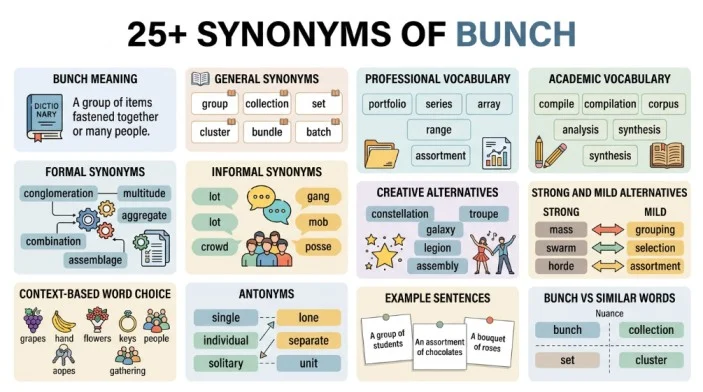
Bunch usually means a group or collection of similar things gathered together. The best synonyms include group for general use, collection for items gathered together, cluster for things close together, bundle for things tied or held together, and batch for items processed or handled together.
Meaning, Tone, and Context
Simple Definition
Bunch is a flexible English word that usually describes a group of things or people considered together. It can describe objects that are physically gathered, such as flowers or grapes, as well as people or abstract things in informal speech.
For example:
She bought a bunch of flowers.
Here, bunch refers to several flowers gathered together.
The word can also describe a large or unspecified number:
I have a bunch of emails to answer.
In this sentence, the exact number is not important. The speaker simply means there are many emails.
Part of Speech
Bunch can function mainly as a:
Noun:
“She gave me a bunch of flowers.”
Verb:
“His shirt began to bunch around the waist.”
The noun form is much more common when people search for synonyms of bunch.
Overall Tone
The tone of bunch depends on context.
As a noun referring to a physical group, it is usually neutral.
When it means “a lot of” or “many,” it is more informal and conversational.
For example:
We invited a bunch of friends.
This sounds natural in everyday American English, but a formal report would probably use:
We invited a large group of guests.
Formality Level
Bunch is generally informal to neutral.
It is perfectly acceptable in everyday conversation, casual emails, social media posts, and friendly writing. More formal alternatives include group, collection, series, set, batch, and assembly, depending on the context.
Common Uses
Native English speakers commonly use bunch with:
- Flowers
- Grapes
- People
- Friends
- Keys
- Bananas
- Documents
- Questions
- Ideas
- Problems
- Messages
- Tasks
- Objects
- Things
The correct synonym changes depending on the type of group.
Word Forms
| Form | Example |
|---|---|
| Noun | “A bunch of flowers sat on the table.” |
| Verb | “The fabric began to bunch at the waist.” |
| Plural noun | “Several bunches of grapes were displayed.” |
The most useful form for vocabulary replacement is the noun bunch.
When and How to Use “Bunch”
Use bunch when you want to describe several similar things together without specifying an exact number. It is especially natural when the group feels informal, loosely defined, or physically gathered.
Professional
“We received a bunch of useful suggestions from the team.”
For formal professional writing, group or set may sound more polished.
Academic
“The researcher examined a bunch of related responses.”
A better academic version would be:
“The researcher examined a set of related responses.”
Workplace
“I have a bunch of tasks to finish this afternoon.”
This is natural in conversation between coworkers.
Personal
“A bunch of my friends came over for dinner.”
Here, bunch sounds friendly and informal.
“I attached a bunch of documents for you to review.”
For a professional email, consider:
“I attached several documents for your review.”
Resume
The word bunch is generally too informal for a resume.
Instead of:
“Handled a bunch of customer accounts.”
Write:
“Managed a portfolio of customer accounts.”
Social Media
“A bunch of great memories from our trip.”
This sounds natural because social media captions often use conversational language.
Best Synonyms of “Bunch”
No synonym for bunch works perfectly in every sentence. The word you choose should reflect the relationship between the items in the group.
Professional Writing: Group
Group is the safest professional alternative because it is broad, clear, and neutral.
“The manager divided the employees into three groups.”
Academic Writing: Set
Set works well when the items are related or treated as a defined collection.
“The researchers analyzed a set of survey responses.”
Business Communication: Batch
Batch is useful when items are produced, processed, delivered, or handled together.
“The system processed the next batch of orders.”
Casual Conversation: Group
Group is natural, although bunch remains perfectly acceptable.
“A group of friends met at the restaurant.”
Emotional Writing: Collection
Collection works when individual items have personal or sentimental value.
“She kept a collection of letters from her childhood.”
Creative Writing: Cluster
Cluster can create a stronger visual sense of things gathered closely together.
“A cluster of stars appeared above the horizon.”
Resume Writing: Portfolio
When describing professional work, portfolio can be more precise than bunch if the items are projects, clients, investments, or examples of work.
“Managed a diverse portfolio of client accounts.”
Workplace Communication: Set
Set is useful when referring to related tasks, documents, requirements, or materials.
“Please review the complete set of documents.”
Stronger Meaning: Large Number
When bunch means many things rather than a physical group, large number or large quantity may be clearer.
“The company received a large number of applications.”
Softer Meaning: Few
When the intended meaning is a small number, few is more precise.
“I only have a few questions.”
When Not to Use “Bunch”
- When the Writing Is Highly Formal
Bunch can sound too conversational in legal, academic, or formal business writing.
Less Effective:
“The report contains a bunch of useful findings.”
Better:
“The report contains several significant findings.”
When You Need an Exact Relationship
A bunch does not explain why the items belong together.
Less Precise:
“We received a bunch of applications.”
Better:
“We received a batch of applications.”
Use batch when the applications are being processed together.
When You Need to Show Physical Arrangement
Sometimes cluster is more informative than bunch.
Less Precise:
“A bunch of stars filled the sky.”
Better:
“A cluster of stars appeared in the sky.”
When Describing Professional Experience
Avoid bunch on resumes and formal profiles.
Less Effective:
“Worked with a bunch of major clients.”
Better:
“Managed relationships with a portfolio of major clients.”
When “Many” Is the Real Meaning
If bunch simply means a large number, replace it with a quantity expression.
Less Precise:
“There were a bunch of complaints.”
Better:
“There were numerous complaints.”
Words Commonly Confused With “Bunch”
Group
Difference: A group is a general collection of people or things considered together.
When to Use It: Use it when you need a neutral, widely applicable term.
Example:
“A group of students visited the museum.”
Cluster
Difference: A cluster usually suggests that things are physically close together.
When to Use It: Use it for stars, buildings, objects, cells, or other things gathered closely.
Example:
“A cluster of houses stood near the river.”
Bundle
Difference: A bundle often refers to things gathered, wrapped, tied, or packaged together.
When to Use It: Use it for clothing, papers, cables, sticks, or packaged products.
Example:
“He carried a bundle of newspapers.”
Batch
Difference: A batch refers to things produced, processed, prepared, or handled together.
When to Use It: Use it in manufacturing, cooking, computing, and business processes.
Example:
“The bakery prepared a fresh batch of cookies.”
Collection
Difference: A collection emphasizes that items have been gathered, saved, or accumulated.
When to Use It: Use it for books, artwork, objects, memories, or related materials.
Example:
“She has a large collection of vintage postcards.”
Set
Difference: A set usually describes items that belong together or form a particular combination.
When to Use It: Use it for tools, data, questions, documents, or matching objects.
Example:
“The teacher prepared a set of practice questions.”
Best Synonyms of “Bunch” by Context
| Context | Best Synonym | Why It Works | Example |
|---|---|---|---|
| Formal writing | Group | Neutral and broadly applicable | The study examined a group of participants. |
| Academic writing | Set | Suggests related items treated together | Researchers analyzed a set of responses. |
| Professional communication | Group | Clear and professional | A group of employees attended the meeting. |
| Business emails | Several | Gives a clearer quantity | I attached several documents. |
| Resume writing | Portfolio | Shows a professional collection | Managed a portfolio of client accounts. |
| Workplace communication | Set | Works for related tasks or materials | Review the set of requirements. |
| Casual conversation | Bunch | Natural and conversational | A bunch of friends came over. |
| Everyday speaking | Group | Simple and widely understood | A group of people was waiting. |
| Creative writing | Cluster | Creates a visual sense of closeness | A cluster of stars appeared. |
| Storytelling | Collection | Suggests gathered or treasured items | He discovered a collection of old letters. |
| Emotional writing | Collection | Can suggest sentimental value | She treasured her collection of photographs. |
| Strong emphasis | Large number | Clearly communicates quantity | A large number of people attended. |
| Mild tone | Few | Indicates a smaller quantity | I have a few questions. |
| Social media captions | Bunch | Casual and friendly | A bunch of memories from summer. |
| American English | Bunch | Very natural in casual speech | I bought a bunch of bananas. |
British English also uses bunch naturally, particularly for physically gathered objects such as flowers and grapes. The main difference is usually not meaning but the wider regional style and surrounding vocabulary.
How to Choose the Best Synonym of “Bunch”
Choosing another word for bunch becomes easier when you identify what the group actually represents.
If You Mean People
Use group, crowd, team, committee, or assembly, depending on the situation.
“A group of students entered the room.”
Do not automatically use crowd because it suggests a larger gathering.
If You Mean Physical Objects Close Together
Use cluster, bundle, or clump.
“A cluster of balloons floated near the ceiling.”
If You Mean Items Processed Together
Use batch.
“The software processed a new batch of files.”
If You Mean Related Items
Use set, collection, or series.
“The teacher assigned a set of exercises.”
If You Mean Many Things Informally
You can keep bunch, especially in conversation.
“I have a bunch of things to do.”
In formal writing, replace it with several, numerous, many, or a more specific noun.
Consider Your Audience
A friend may appreciate:
“I have a bunch of questions.”
A professor may prefer:
“I have several questions.”
A business client may receive:
“I have several questions regarding the proposal.”
Consider Emotional Strength
Bunch is usually emotionally neutral. Words such as collection can sound more deliberate, while crowd can suggest a larger or more active gathering.
Consider Formality
- For casual speech, bunch is natural.
- For professional writing, group, set, several, or portfolio may be better.
- For academic writing, set, group, series, or collection usually provides greater precision.
Real Life Examples of “Bunch”
School
Instead of:
“The teacher gave us a bunch of questions.”
Try:
“The teacher gave us a set of questions.”
The revised version sounds more appropriate for schoolwork.
College
Instead of:
“The researcher collected a bunch of responses.”
Try:
“The researcher collected a set of responses.”
Workplace
Casual:
“I have a bunch of tasks to finish.”
More professional:
“I have several tasks to complete.”
Business
Less precise:
“We received a bunch of orders.”
Better:
“We received a large number of orders.”
Casual:
“I’ve attached a bunch of files.”
Professional:
“I’ve attached several files for your review.”
Resume
Weak:
“Worked with a bunch of clients.”
Stronger:
“Managed a portfolio of client accounts.”
Conversation
“A bunch of us went out for dinner.”
This is completely natural in casual American English.
Storytelling
“A cluster of lights appeared beyond the trees.”
Cluster creates a more visual description than bunch.
Blogging
This guide covers a set of practical strategies for improving your writing.”
The phrase sounds more organized and professional than a bunch of strategies.
Social Media
“A **bunch of unforgettable moments from our weekend trip.”
Here, the informal word adds a friendly conversational feel.
25 Best Synonyms of “Bunch”
| Synonym | Simple Meaning | Best Used For | Example Sentence |
|---|---|---|---|
| Group | Several people or things together | General use | A group of students joined the discussion. |
| Collection | Items gathered together | Objects and personal items | She owns a collection of rare books. |
| Set | Related items considered together | Questions, tools, documents | The instructor provided a set of exercises. |
| Cluster | Things positioned closely together | Physical objects | A cluster of balloons hung from the ceiling. |
| Bundle | Items gathered or tied together | Papers, cables, goods | He carried a bundle of newspapers. |
| Batch | Items handled or produced together | Orders, files, food | The system processed another batch of applications. |
| Clump | Objects growing or gathered closely | Plants, grass, soil | A clump of flowers grew beside the fence. |
| Pack | Things grouped or packaged together | Products or animals | She bought a pack of batteries. |
| Series | Related things arranged or occurring together | Events, articles, programs | The website published a series of interviews. |
| Assortment | A varied selection of things | Products and objects | The store offered an assortment of snacks. |
| Selection | A chosen group of items | Products and options | We reviewed a selection of proposals. |
| Array | A broad or impressive arrangement | Formal and technical writing | The museum displayed an array of artifacts. |
| Assembly | People or things gathered together | Formal contexts | The assembly of delegates began at noon. |
| Gathering | People or things brought together | Events and people | A small gathering took place at her home. |
| Crowd | A large group of people | Public gatherings | A crowd gathered outside the stadium. |
| Grouping | Items organized together | Data and categories | The software created a useful grouping of records. |
| Aggregate | A combined collection | Technical and academic writing | The report examined the aggregate data. |
| Cluster | A close arrangement | Science and physical objects | Scientists observed a cluster of stars. |
| Portfolio | A collection of professional items | Work, clients, investments | She manages a diverse portfolio of accounts. |
| Range | A variety or selection | Products and choices | The store carries a wide range of products. |
| Variety | Several different types | Mixed items | The market sells a variety of fresh produce. |
| Heap | A pile or large amount | Informal physical descriptions | A heap of clothes covered the chair. |
| Pile | Things placed one over another | Papers, books, objects | There was a pile of books on the desk. |
| Host | A large number or collection | Formal and literary contexts | The article addresses a host of related issues. |
| Multitude | A very large number | Formal or literary writing | A multitude of factors influenced the decision. |
The strongest choices depend on context. Group is the safest general synonym, cluster describes close physical arrangement, bundle suggests items held together, batch indicates shared processing, and collection emphasizes accumulated items.
Synonyms of “Bunch” by Usage
Professional vs Personal Synonyms
In professional writing, prioritize precision.
Use:
- Group
- Set
- Batch
- Portfolio
- Collection
- Several
In personal communication, bunch remains completely natural.
“A bunch of my friends are visiting this weekend.”
The informal tone makes the sentence sound relaxed rather than careless.
Formal vs Conversational Synonyms
For reports, essays, and business writing, choose:
- Group
- Collection
- Set
- Series
- Batch
- Several
- Numerous
For conversations and texting, use:
- Bunch
- Group
- Pack
- A lot
- A bunch of
The key difference is precision and formality.
Academic Synonyms
Academic writing benefits from terms that identify the relationship between items.
Set works for related data points, questions, or materials.
Group works for participants or categories.
Series works for connected studies or events.
Collection works for gathered materials.
Aggregate works when multiple data points are combined.
Professional and Business Synonyms
- For resumes, use portfolio, group, range, or collection based on what you are describing.
- For interviews, conversational group usually sounds natural.
- For meetings, use group or team when describing people.
- For presentations, set, series, or range can make the content more precise.
- For performance reviews, describe specific achievements rather than saying a bunch of accomplishments.
- For client communication, several, multiple, or a portfolio of often works better.
- For business emails:
“I’ve attached several documents.”
is generally stronger than:
“I’ve attached a bunch of documents.”
Creative and Literary Synonyms
Creative writing allows more expressive choices.
Cluster emphasizes physical closeness.
Heap can create an image of disorder.
Host suggests abundance.
Multitude emphasizes a very large number.
Gathering works particularly well for people.
For example:
“A multitude of stars shimmered above the quiet valley.”
This creates a more vivid image than:
“A bunch of stars were in the sky.”
Slang or Modern Synonyms
There is no single slang word that perfectly replaces bunch in every situation.
Expressions such as a lot, tons of, and a whole bunch of are common in informal American English.
“I have a whole bunch of work to finish.”
These expressions should generally be avoided in academic papers, formal reports, resumes, and highly professional correspondence.
Strongest to Mildest Synonyms
Because bunch can mean either a group or an unspecified quantity, its alternatives do not form one perfect intensity scale. However, when the intended meaning is “many,” these choices can roughly move from smaller to larger quantities.
Mild
Few, several, small group
“Several students stayed after class.”
Moderate
Group, collection, set, bunch
“A group of students attended the event.”
Strong
Large number, multitude, host
“A large number of visitors attended.”
Very Strong
Vast number, multitude, great many
These expressions emphasize quantity rather than physical arrangement.
Emotional vs Neutral Synonyms
Emotional Synonyms
Some alternatives can create a warmer or more expressive feeling.
Collection
“She treasured her collection of family photographs.”
Gathering
“The family enjoyed a warm gathering around the fireplace.”
Multitude
“A multitude of memories returned to him.”
Neutral Synonyms
For objective writing, choose:
- Group
- Set
- Batch
- Series
- Collection
- Several
- Multiple
These terms communicate information without adding unnecessary emotion.
Antonyms of “Bunch”
Bunch does not have 15 perfect dictionary antonyms because it can describe either a physical group or an unspecified quantity. The following words and concepts represent genuine opposites of the grouping sense, although some are contextual rather than direct one word antonyms.
| Antonym | Meaning | Example Sentence |
|---|---|---|
| Individual | A single person or thing | Each individual was evaluated separately. |
| Single | One item rather than a group | She purchased a single flower. |
| One | A quantity of exactly one | Only one student remained. |
| Singleton | A single item or member | The system identified one singleton in the dataset. |
| Solitary | Existing alone | A solitary tree stood in the field. |
| Alone | Without others | He traveled alone. |
| Separate | Kept apart from others | Keep the documents separate. |
| Separated | Divided from a group | The samples were separated for testing. |
| Isolated | Kept apart from others | The isolated item was examined carefully. |
| Scattered | Spread apart rather than grouped | The papers were scattered across the desk. |
| Dispersed | Spread over an area | The crowd quickly dispersed. |
| Divided | Split into different parts | The students were divided into separate rooms. |
| Fragmented | Broken into separate pieces | The original collection became fragmented. |
| Disconnected | Not joined or grouped | The files remained disconnected from the main system. |
| Unattached | Not connected to another item | Each component remained unattached. |
These alternatives should be selected according to the specific sense of bunch being discussed. For example, single is the clearest opposite when bunch means several items, while scattered or dispersed works better when the focus is physical arrangement.
Comparison: “Bunch” vs Similar Words
Bunch vs Group
Main Difference
Bunch is generally more casual and can suggest an informal collection. Group is neutral and works across almost every type of communication.
Which Is Stronger?
Neither is inherently stronger.
Which Is More Formal?
Group is more formal and versatile.
When to Use Each
Use bunch in casual conversation and group in professional or academic writing.
Examples
Bunch:
“A bunch of friends came over.”
Group:
“A group of students attended the workshop.”
Bunch vs Cluster
Main Difference
Cluster emphasizes physical closeness.
Which Is Stronger?
Neither is stronger, but cluster gives more information about arrangement.
Which Is More Formal?
Cluster is more suitable for technical and descriptive writing.
When to Use Each
Use cluster for stars, buildings, flowers, cells, or objects positioned close together.
Examples
Bunch:
“A bunch of flowers decorated the table.”
Cluster:
“A cluster of flowers grew near the wall.”
Bunch vs Bundle
Main Difference
A bundle usually suggests items gathered, wrapped, tied, or held together.
Which Is Stronger?
Neither.
Which Is More Formal?
Both are neutral, although bundle is more specific.
When to Use Each
Use bundle for cables, papers, clothes, sticks, and packaged products.
Examples
Bunch:
“He carried a bunch of papers.”
Bundle:
“He carried a bundle of papers tied with string.”
Bunch vs Batch
Main Difference
A batch consists of items produced, prepared, processed, or handled together.
Which Is Stronger?
Neither.
Which Is More Formal?
Batch is more technical and professional.
When to Use Each
Use batch in manufacturing, computing, food production, and business operations.
Examples
Bunch:
“There are a bunch of files here.”
Batch:
“The program processed a batch of files.”
Bunch vs Collection
Main Difference
A collection emphasizes accumulated or intentionally gathered items.
Which Is Stronger?
Neither.
Which Is More Formal?
Collection is more formal and precise.
When to Use Each
Use collection for books, art, photographs, research materials, and personal possessions.
Examples
Bunch:
“I found a bunch of old photographs.”
Collection:
“I found a collection of old family photographs.”
Bunch vs Set
Main Difference
A set usually consists of items that are related or intended to belong together.
Which Is Stronger?
Neither.
Which Is More Formal?
Set is more precise in academic, technical, and professional contexts.
When to Use Each
Use set for questions, data, tools, documents, rules, and matching items.
Examples
Bunch:
“The teacher gave us a bunch of exercises.”
Set:
“The teacher gave us a set of exercises.”
Common Phrases and Expressions with “Bunch”
A Bunch of
Meaning: Several or many people or things.
Example Sentence:
“I have a bunch of emails to answer.”
A Whole Bunch of
Meaning: A large or noticeable amount, usually in casual speech.
Example Sentence:
“We received a whole bunch of useful suggestions.”
Bunch of Flowers
Meaning: Several flowers gathered together.
Example Sentence:
“He brought her a bunch of flowers.”
Bunch of Grapes
Meaning: Grapes growing or gathered together on a stem.
Example Sentence:
“She bought a bunch of grapes at the market.”
Bunch of Keys
Meaning: Several keys held together, often on a key ring.
Example Sentence:
“He pulled a bunch of keys from his pocket.”
Bunch of Friends
Meaning: A group of friends, usually in casual conversation.
Example Sentence:
“A bunch of friends joined us for dinner.”
Bunch Up
Meaning: To gather or become crowded closely together.
Example Sentence:
“The fabric began to bunch up around her knees.”
Bunch Together
Meaning: To gather people or things into one group.
Example Sentence:
“Don’t bunch the boxes together because they need to be sorted.”
Common Mistakes to Avoid
Choosing “Bunch” When a Precise Word Exists
Incorrect:
“The software handled a bunch of files.”
Better:
“The software handled a batch of files.”
Why:
Batch tells the reader that the files were handled as a processing unit.
Using Bunch in Formal Writing
Incorrect:
“The study examined a bunch of participants.”
Better:
“The study examined a group of participants.”
Why:
Group is more appropriate for academic writing.
Confusing Bunch With Cluster
Incorrect:
“A cluster of friends met for dinner.”
Better:
“A group of friends met for dinner.”
Why:
Cluster often suggests physical closeness rather than a social group.
Using Bunch on a Resume
Incorrect:
“Worked with a bunch of customers.”
Better:
“Managed relationships with a portfolio of customers.”
Why:
The revised version sounds more professional and specific.
Using a Dramatic Synonym Without a Reason
Incorrect:
“A multitude of three documents was attached.”
Better:
“Three documents were attached.”
Why:
A dramatic quantity word is unnecessary when the exact number is known.
Repeating Bunch Too Often
Incorrect:
“We saw a bunch of birds, a bunch of flowers, and a bunch of people.”
Better:
“We saw a flock of birds, a group of flowers, and a crowd of people.”
Why:
Specific collective terms create clearer and more natural descriptions.
Using Informal Language in Professional Communication
Incorrect:
“I have a bunch of questions about the contract.”
Better:
“I have several questions about the contract.”
Why:
Several sounds concise and professional without changing the basic meaning.
Frequently Asked Questions
1. What are the best synonyms of “bunch”?
The best synonyms of bunch include group, collection, set, cluster, bundle, and batch. The best option depends on whether you mean people, physical objects, related items, or things processed together.
2. What are the best formal synonyms of “bunch”?
The best formal alternatives include group, collection, set, series, batch, assembly, and aggregate. Choose the word that describes the relationship between the items rather than replacing bunch automatically.
3. What are common informal synonyms of “bunch”?
Common informal alternatives include group, lot, a lot of, and a whole bunch of. In casual American English, bunch itself is natural and widely understood.
4. What is another word for “bunch” in professional writing?
Group is the safest professional alternative to bunch. Depending on the context, set, batch, collection, portfolio, or several may be more precise and effective.
5. What is the difference between “bunch” and “group”?
Bunch is generally more informal and can mean several or many things considered together. Group is neutral and works naturally in casual, professional, academic, and formal communication.
6. What is the opposite of “bunch”?
There is no single perfect opposite of bunch for every meaning. Depending on context, useful opposites include individual, single, solitary, separate, scattered, dispersed, and isolated.
Conclusion
Bunch is a flexible and natural word that usually describes several people or things considered together. It is especially common in conversational American English, but it can become vague or overly informal in academic, professional, and formal writing.
The best alternative depends on the exact meaning. Use group for a general collection, cluster for things positioned closely together, bundle for items held together, batch for things processed together, set for related items, and collection for things intentionally gathered or accumulated.
There is no single perfect replacement for every use of bunch. When choosing among the bunch of synonym options, focus on meaning, audience, tone, and purpose. A useful vocabulary habit is to ask what relationship connects the items before selecting a synonym.
Read More Related Articles:
25+ Synonyms, Meanings, Uses, Examples, and Best …
Meaning, Uses, Examples, and the Best Synonym of Complain
25+ Synonyms of Frequency | Meanings, Uses, Examples …