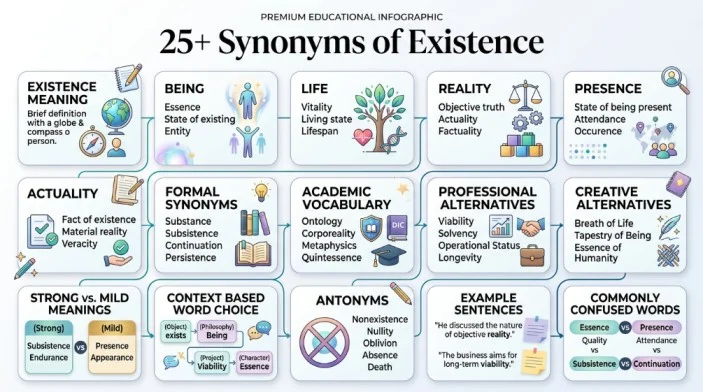
Finding the right synonym of existence can make your writing more precise, natural, and expressive. The word existence can describe the state of being alive, the fact that something is real, or simply the presence of something in a particular place or situation. Because its meaning changes with context, no single alternative works perfectly in every sentence. Words such as being, presence, life, reality, and actuality may overlap with existence, but each carries a slightly different meaning and tone.
Choosing an accurate synonym requires more than replacing one word with another. Good word choice depends on grammar, context, tone, and the idea you want to communicate. In academic writing, being or presence may sound more precise, while life can work better when discussing living organisms. This guide explores the most useful alternatives to synonym of existence, with clear meanings, examples, and practical usage so you can choose the right word with confidence.
What Are the Best Synonyms of “Existence”?
The best synonym of existence depends on context. Being, reality, and actuality work well when discussing the fact of existing. Presence fits physical or noticeable existence, while life describes living existence. In formal or philosophical writing, being, actuality, and subsistence can be useful choices.
Meaning, Tone, and Context
Simple Definition
Existence means the state or fact of existing. It can describe the fact that a person, object, idea, condition, or organization is real or present. It can also refer to a particular way of living.
Cambridge Dictionary defines existence as the fact of someone or something existing and also recognizes a second sense involving a particular way of life.
For example:
“Scientists are investigating the existence of life on other planets.”
Here, existence means the fact that something may actually be real.
In another sentence:
“She lived a quiet existence in the countryside.”
Here, existence refers to a way of living.
Part of Speech
Existence is a noun.
It normally refers to a state, condition, or fact rather than an action.
Overall Tone
The word existence is generally neutral. It can become philosophical, academic, literary, or emotional depending on the surrounding language.
Compare these examples:
“The organization has been in existence for ten years.”
- This is neutral and factual.
“He spent years questioning the meaning of existence.”
- This is philosophical.
“Her existence became increasingly difficult.”
This is more emotional and serious.
Formality Level
Existence is a neutral to formal word. It works naturally in:
- Academic writing
- Philosophy
- Science
- Business reports
- News writing
- Essays
- Professional communication
- Everyday conversation
- Creative writing
It is not normally considered slang or highly informal.
Common Uses
Native English speakers commonly use existence when discussing:
- The existence of a person or thing
- The existence of a problem
- The existence of evidence
- The existence of a relationship
- The existence of an organization
- Human existence
- Animal existence
- The existence of life
- The meaning of existence
- The beginning of existence
- Continued existence
- Threats to existence
- A difficult existence
- A peaceful existence
Word Forms
| Word | Part of Speech | Example |
|---|---|---|
| Existence | Noun | “The existence of the species remains uncertain.” |
| Exist | Verb | “Some rare plants exist only in this region.” |
| Existing | Adjective / participle | “The existing system needs improvement.” |
| Existent | Adjective | “The theory is based on existent evidence.” |
| Existential | Adjective | “The novel explores existential questions.” |
| Existentially | Adverb | “The character struggles existentially with the decision.” |
The most common related forms in everyday English are exist, existing, and existential. Cambridge also identifies exist as a verb meaning to be or to be real, with another sense relating to living, especially under difficult conditions.
When and How to Use “Existence”
Use existence when you want to talk about the fact that something is real, the state of being present, or a particular way of living.
Professional
“The report confirms the existence of several unresolved compliance issues.”
Here, existence is precise and appropriate because the sentence concerns whether specific issues are present.
Academic
“The researchers examined evidence supporting the existence of the species.”
This usage works well because academic writing often discusses whether something can be demonstrated as real.
Workplace
“The team was unaware of the existence of the updated policy.”
The word sounds neutral and professional in workplace communication.
Personal
“Her existence changed dramatically after she moved to a new city.”
Here, existence refers broadly to her life and circumstances.
“Please confirm the existence of any additional documents related to the project.”
This is more formal than simply saying, “Please confirm whether there are any other documents.”
Resume
“Helped identify gaps in the existing customer support process.”
In resume writing, existing is usually more natural than existence because the sentence describes something already present.
Social Media
“Sometimes we get so busy that we forget to appreciate the simple things that make life meaningful.”
In casual social media writing, life often sounds more natural than existence unless the post has a philosophical or reflective tone.
Best Synonyms of “Existence”
No single synonym works perfectly in every sentence because existence has several related meanings. The best replacement depends on whether you are talking about reality, presence, life, continued survival, or philosophical being.
Professional Writing: Presence
Use presence when you mean that something is present, available, or noticeable in a particular place or situation.
Example:
“The audit confirmed the presence of several reporting errors.”
This is more precise than existence when the focus is on something being present.
Academic Writing: Being
Being is useful in philosophy, metaphysics, and academic discussions about what it means to exist.
Example:
“The philosopher examined the relationship between being and consciousness.”
It is more specialized than existence, so it should not be used simply to make ordinary writing sound academic.
Business Communication: Presence
When discussing a company’s activity or representation in a market, presence is usually better.
Example:
“The company has established a strong presence in the Midwest.”
Saying “a strong existence” would sound unnatural in this context.
Casual Conversation: Life
When existence means a person’s everyday way of living, life is generally more natural.
Example:
“She wants a quieter life after years of working in a busy city.”
Emotional Writing: Life
Life is usually warmer and more personal than existence.
Example:
“Her kindness brought new meaning to my life.”
The word existence would sound more distant in this sentence.
Creative Writing: Being
Being can create a reflective or philosophical tone in literary writing.
Example:
“The character spent years wondering about the nature of his own being.”
Resume Writing: Presence
For professional contexts involving market activity, visibility, or representation, presence is more effective.
Example:
“Expanded the company’s digital presence across three major platforms.”
Workplace Communication: Continuance
When discussing something that remains active or operational, continuance can work in formal contexts, although continuation or continued operation is often more natural.
Example:
“The project’s continuance depends on additional funding.”
Stronger Meaning: Survival
Use survival when continued existence is threatened or difficult.
Example:
“The organization’s survival depends on securing new funding.”
Survival adds a sense of danger or struggle that existence does not necessarily convey.
Softer Meaning: Presence
Presence can be less abstract than existence when you simply want to say that something is there.
Example:
“The presence of flowers made the room feel warmer.”
When Not to Use “Existence”
Although existence is grammatically correct in many situations, it can sometimes be too abstract or formal.
When It Sounds Too General
If you mean someone’s everyday life, life is usually clearer.
Less Natural:
“She wanted to improve her existence.”
Better:
“She wanted to improve her life.”
Why:
Life directly communicates a person’s lived experience.
When It Sounds Too Vague
If you mean that something is physically or visibly present, use presence.
Less Precise:
“The existence of security guards was noticeable.”
Better:
“The presence of security guards was noticeable.”
Why:
Presence specifically communicates that the guards were there.
When It Sounds Too Philosophical
In ordinary conversation, existence can sound unnecessarily abstract.
Less Natural:
“I’m thinking about the meaning of my existence because I had a difficult day.”
More Natural:
“I’m thinking about the meaning of my life because I had a difficult day.”
Why:
Life is more natural for personal reflection.
When It Sounds Too Weak
If continued existence is threatened, survival communicates the situation more effectively.
Less Effective:
“The company’s existence depends on new investment.”
Stronger:
“The company’s survival depends on new investment.”
Why:
Survival clearly suggests that the organization may not continue without support.
When It Sounds Too Formal
In a casual conversation, use life or being there when appropriate.
Formal:
“Her existence in the village was unknown to the authorities.”
More Natural:
“No one knew she was living in the village.”
Why:
The second version sounds more direct and conversational.
When a More Specific Word Is Available
Do not use existence when a more precise noun communicates the intended meaning.
Less Precise:
“The existence of the company in the market has grown.”
Better:
“The company’s market presence has grown.”
Why:
Market presence specifically describes visibility and activity in a market.
Words Commonly Confused With “Existence”
Being
Difference:
Being can mean existence itself, but it can also refer to a living individual or entity. It is especially common in philosophical discussions.
When to Use It:
Use it when discussing identity, consciousness, philosophy, or the nature of existence.
Example:
“Human beings have long questioned the nature of being.”
Life
Difference:
Life can mean existence as a living organism or a person’s way of living. It usually sounds more personal than existence.
When to Use It:
Use it for people, living things, experiences, and everyday circumstances.
Example:
“She built a peaceful life near the coast.”
Presence
Difference:
Presence focuses on being in a particular place or being noticeable, rather than simply being real.
When to Use It:
Use it for people, objects, organizations, influences, and things that can be detected or observed.
Example:
“The company’s presence in the region has increased.”
Reality
Difference:
Reality focuses on what is real or actual. Existence focuses more directly on the state or fact of existing.
When to Use It:
Use it when contrasting what is real with what is imagined, theoretical, or false.
Example:
“The discovery changed our understanding of reality.”
Actuality
Difference:
Actuality emphasizes real or concrete fact, especially in formal or philosophical contexts.
When to Use It:
Use it when contrasting actual conditions with possibilities or assumptions.
Example:
“The theory is interesting, but its actuality remains uncertain.”
Survival
Difference:
Survival means continued existence, especially despite danger, hardship, or threat.
When to Use It:
Use it when something continues to exist under difficult circumstances.
Example:
“The species’ survival depends on protecting its habitat.”
Best Synonyms of “Existence” by Context
| Context | Best Synonym | Why It Works | Example |
|---|---|---|---|
| Formal writing | Being | Works well for abstract or philosophical discussion. | “The debate concerns the nature of being.” |
| Academic writing | Reality | Useful when discussing what is objectively real. | “The experiment challenged assumptions about reality.” |
| Professional communication | Presence | Clearly describes something active or represented. | “The company has a growing presence overseas.” |
| Business emails | Presence | Natural when discussing availability or representation. | “Please confirm the presence of the required documents.” |
| Resume writing | Presence | Common for market, brand, or digital activity. | “Strengthened the firm’s online presence.” |
| Workplace communication | Continuation | Better for something remaining active. | “The continuation of the project requires approval.” |
| Casual conversation | Life | Natural when existence means everyday living. | “I want a simpler life.” |
| Everyday speaking | Being there | Direct and conversational when discussing presence. | “Thanks for being there when I needed help.” |
| Creative writing | Being | Adds philosophical or reflective depth. | “He questioned the meaning of his being.” |
| Storytelling | Life | Fits narratives about personal experience. | “Her life changed after the journey.” |
| Emotional writing | Life | Sounds warmer and more personal. | “You gave new meaning to my life.” |
| Strong emphasis | Survival | Implies threatened continued existence. | “Their survival depends on cooperation.” |
| Mild tone | Presence | Focuses on something simply being there. | “The presence of music changed the mood.” |
| Social media captions | Life | More natural and relatable. | “Grateful for this beautiful life.” |
| American English | Existence / being / life | All are natural, depending on meaning. | “The question concerns human existence.” |
| British English | Existence / being / life | The same core choices generally apply. | “They lived a quiet existence.” |
How to Choose the Best Synonym of “Existence”
Choosing an alternative starts with identifying exactly what existence means in your sentence.
If You Mean “The Fact of Being Real”
Choose reality, actuality, or being.
“The researchers questioned the existence of the phenomenon.”
Can become:
“The researchers questioned the reality of the phenomenon.”
If You Mean “Being Somewhere”
Choose presence.
“The existence of several officials was confirmed at the event.”
Better:
“The presence of several officials was confirmed at the event.”
If You Mean “A Person’s Life”
Choose life.
“He wanted to change his existence.”
Better:
“He wanted to change his life.”
If You Mean “Continued Existence Under Threat”
Choose survival.
“The existence of the species is threatened.”
Better:
“The survival of the species is threatened.”
If You Mean “Philosophical Existence”
Choose being.
“The philosopher explored the nature of existence.”
Possible alternative:
“The philosopher explored the nature of being.”
If You Mean “Ongoing Operation”
Choose continuation, continuance, or continued operation, depending on the sentence.
“The existence of the program depends on funding.”
More precise:
“The continuation of the program depends on funding.”
A Simple Decision Guide
| Ask Yourself | Choose |
|---|---|
| Do I mean simply being real? | Reality |
| Do I mean being present somewhere? | Presence |
| Do I mean someone’s lived experience? | Life |
| Do I mean philosophical existence? | Being |
| Do I mean continued existence despite danger? | Survival |
| Do I mean actual fact? | Actuality |
| Do I mean something continuing? | Continuation |
| Do I want a neutral general term? | Existence |
Real Life Examples of “Existence”
School
Basic:
“The essay discusses the existence of different forms of life.”
More precise:
“The essay examines evidence for the presence of different forms of life.”
College
Basic:
“The philosopher questioned the meaning of human existence.”
Alternative:
“The philosopher questioned the meaning of human being.”
Here, being creates a more philosophical tone.
Workplace
Basic:
“The manager confirmed the existence of a problem.”
Alternative:
“The manager confirmed the presence of a problem.”
The second version sounds more direct when discussing an identifiable issue.
Business
Basic:
“The company’s existence depends on its ability to adapt.”
Stronger:
“The company’s survival depends on its ability to adapt.”
The alternative makes the risk clearer.
Basic:
“We were unaware of the existence of the additional file.”
Better:
“We were unaware that the additional file was available.”
The rewritten version is more natural for ordinary business communication.
Resume
Basic:
“Improved the existence of the company’s brand online.”
Better:
“Strengthened the company’s online presence.”
Online presence is much more precise for a resume.
Conversation
Basic:
“I want to change my existence.”
Natural:
“I want to change my life.”
The second version sounds much more natural in everyday American English.
Storytelling
Basic:
“His existence changed after the accident.”
Creative:
“His life changed completely after the accident.”
The second sentence creates a more direct emotional connection.
Blogging
Basic:
“The existence of misinformation makes online research difficult.”
Better:
“The presence of misinformation makes online research difficult.”
This emphasizes that misinformation is currently present.
Social Media
Basic:
“Enjoy every moment of your existence.”
Natural:
“Enjoy every moment of your life.”
The second version is warmer and more conversational.
25 Best Synonyms of “Existence”
Because existence covers several related senses, not every alternative can replace it in every sentence. The table below focuses on direct synonyms, established contextual equivalents, and closely matching expressions that native English speakers can use when the intended sense is clear.
| Synonym or Alternative | Simple Meaning | Best Used For | Example Sentence |
|---|---|---|---|
| Being | The state of existing or a living entity | Philosophy and abstract writing | “The book explores the nature of human being.” |
| Life | Living existence or a way of living | Personal and everyday writing | “She wanted a quieter life.” |
| Reality | The condition of being real | Philosophy and factual discussion | “The evidence supports the reality of the phenomenon.” |
| Presence | The state of being present | Physical or noticeable existence | “The presence of mold was confirmed.” |
| Actuality | The condition of being actual or real | Formal and philosophical writing | “The theory differs from its actuality in practice.” |
| Subsistence | Continued existence or maintenance of life | Formal and economic contexts | “The crops provided basic subsistence.” |
| Survival | Continued existence despite difficulty | Threatened life or organizations | “The species’ survival is uncertain.” |
| Continuance | The act or state of continuing to exist | Formal contexts | “The project’s continuance depends on funding.” |
| Continuation | The state of continuing | Programs, activities, and institutions | “The continuation of the program requires approval.” |
| Persistence | Continued presence or existence | Problems, conditions, or phenomena | “The persistence of the issue surprised the team.” |
| Living | The state of being alive | Biological and everyday contexts | “The study examines conditions for living organisms.” |
| Being present | Existing in a particular place or situation | Direct everyday explanations | “Her being present changed the outcome.” |
| State of being | The condition of existing | Philosophy and education | “The course examines different states of being.” |
| Fact of being | The fact that something exists | Formal explanation | “The argument begins with the fact of being.” |
| State of living | A particular condition of life | Descriptions of life circumstances | “The report describes their difficult state of living.” |
| Continued being | Ongoing existence | Philosophical or literary writing | “The poem reflects on continued being.” |
| Continued presence | Remaining present | Organizations, effects, or people | “The continued presence of the species was unexpected.” |
| Ongoing existence | Existence that continues | Formal and analytical writing | “The evidence supports the ongoing existence of the tradition.” |
| Continued existence | Existence that has not ended | Formal and factual writing | “The study documents the species’ continued existence.” |
| Realness | The quality of being real | Informal or philosophical discussion | “The story makes readers question its realness.” |
| Material existence | Physical existence | Science and philosophy | “The theory concerns the material existence of objects.” |
| Existence as life | Existence understood as living | Explanatory and educational writing | “The poem treats existence as life rather than status.” |
| Mode of being | A particular way of existing | Philosophy and literary analysis | “The novel examines another mode of being.” |
| Way of life | A particular manner of living | Social and personal contexts | “The community has a peaceful way of life.” |
| State of existence | A particular condition of being | Formal and philosophical writing | “The character struggles with his state of existence.” |
Important usage note: Some entries above are context specific rather than perfect one word replacements. For example, presence means being present, survival means continued existence under threat, and life often means existence as a living person. Treating every synonym as interchangeable would make the writing less accurate.
Synonyms of “Existence” by Usage
Professional vs Personal Synonyms
Professional writing often requires precision, while personal writing usually benefits from warmer and simpler vocabulary.
For professional communication, choose presence, continuation, existing, or actuality when they accurately express the intended meaning.
For personal writing, life, being, and way of life are often more natural.
Professional:
“The company expanded its digital presence.”
Personal:
“She wanted a more peaceful life.”
The two sentences communicate related ideas, but the vocabulary matches the context.
Formal vs Conversational Synonyms
Formal writing can support abstract terms such as being, actuality, and subsistence.
Conversational English usually favors life, being there, living, or a direct sentence using exist.
Formal:
“The study investigates the actuality of the proposed phenomenon.”
Conversational:
“Does this thing actually exist?”
Direct language is often preferable to forcing an elaborate synonym into a simple sentence.
Academic Synonyms
Academic writing benefits from precise vocabulary rather than unnecessarily complicated words.
Useful options include:
- Being
- Reality
- Actuality
- Presence
- Persistence
- Existence
- State of being
For example:
“The researchers investigated the existence of microbial life.”
If the focus is whether the life is actually real, reality may be more precise:
“The researchers investigated the reality of the reported phenomenon.”
Professional and Business Synonyms
Business writing often uses presence more naturally than existence.
Consider:
“The company has a strong presence in the healthcare market.”
This communicates market activity and visibility.
For continued operation, continuation can work:
“The continuation of the partnership depends on the new agreement.”
For risk situations, survival is stronger:
“The survival of the business depends on controlling costs.”
Creative and Literary Synonyms
Creative writing allows more expressive choices.
Being can create philosophical depth.
Life can create emotional warmth.
Way of life can describe a culture or character.
Mode of being can create an introspective literary tone.
For example:
“He had spent years searching for a way to understand his own being.”
This sounds more reflective than:
“He had spent years thinking about his existence.”
Slang or Modern Synonyms
There is no reliable slang synonym that universally replaces existence.
In casual modern English, speakers usually avoid the noun and choose a simpler expression.
Instead of:
“I am questioning my existence.”
A casual speaker might say:
“I’m questioning my life.”
Or:
“I’m wondering what I’m doing with my life.”
Expressions such as being here, being alive, or living may also work in informal contexts, but they are not exact synonyms in every sentence.
Strongest to Mildest Synonyms
Unlike words such as happy or angry, existence does not have a simple emotional intensity scale. Its alternatives become stronger or more specific because of the additional meaning they carry.
Mild or Neutral
Presence, being, life
These generally describe existence without suggesting danger or urgency.
Moderate
Reality, actuality, continuation, persistence
These alternatives add a clearer focus on reality or ongoing existence.
Strong
Survival, subsistence
These can suggest that continued existence depends on difficult conditions or basic necessities.
Very Specific
Mode of being, state of existence, ongoing existence
These expressions are especially useful when discussing philosophical, academic, or analytical ideas.
The important point is that stronger does not always mean better. The most accurate word is the one that expresses the intended meaning without adding unnecessary emotion.
Emotional vs Neutral Synonyms
Emotional Synonyms
These alternatives can create a more personal or expressive effect:
- Life
- Survival
- Way of life
- Being
- Meaningful life
Example:
“She fought to protect the life she had built.”
This is more emotional than:
“She protected her existence.”
Neutral Synonyms
These alternatives are better for factual communication:
- Existence
- Presence
- Reality
- Actuality
- Continuation
- Persistence
Example:
“The researchers confirmed the presence of the chemical.”
This is objective and specific.
Antonyms of “Existence”
The opposite of existence is not always one single word because the intended meaning can involve reality, life, presence, or continuation. The following terms represent genuine opposites or strong contextual contrasts.
| Antonym | Meaning | Example Sentence |
|---|---|---|
| Nonexistence | The state of not existing | The theory considers the possibility of nonexistence. |
| Absence | The state of not being present | The absence of evidence raised concerns. |
| Nothingness | A state of having no thing or being | The philosopher wrote about nothingness. |
| Unreality | The condition of not being real | The character struggled to distinguish reality from unreality. |
| Inexistence | Lack of existence | The argument depends on the inexistence of the alleged object. |
| Death | The end of biological life | The story explores the transition from life to death. |
| Extinction | The complete disappearance of a species or group | Habitat loss can lead to extinction. |
| Disappearance | The state of no longer being visible or present | The sudden disappearance of the documents caused concern. |
| Cessation | The stopping or ending of something | The cessation of activity affected the community. |
| Termination | The formal ending of something | The agreement ended with its termination. |
| End | The point at which something stops | The project reached its end in December. |
| Eradication | Complete removal or destruction | The program aims for the eradication of the disease. |
| Destruction | The act of causing something to cease existing | The fire resulted in the destruction of the building. |
| Absorption | Loss of separate identity through being taken into something else | The smaller group faced absorption into the larger organization. |
| Dissolution | The process of formally ending or breaking apart | The board approved the dissolution of the organization. |
Comparison: “Existence” vs Similar Words
Existence vs Being
Main Difference
Existence refers to the fact or state of existing. Being can mean existence itself, but it can also refer to an individual or the nature of something that exists.
Which Is Stronger?
Neither is inherently stronger. Being often sounds more philosophical.
Which Is More Formal?
Both can be formal, but being is especially common in philosophical writing.
When to Use Each
Use existence for general statements about something being real. Use being for philosophical discussions about existence, identity, or consciousness.
Examples
Existence:
“The evidence supports the existence of the species.”
Being:
“The philosopher explored the nature of human being.”
Existence vs Life
Main Difference
Existence is broader. Life usually refers to living organisms or the experience of living.
Which Is Stronger?
Neither is stronger.
Which Is More Formal?
Existence generally sounds more abstract and formal.
When to Use Each
Use life for personal experiences and living conditions. Use existence for abstract or factual discussions.
Examples
Existence:
“The question concerns the existence of life beyond Earth.”
Life:
“She wanted to build a better life.”
Existence vs Presence
Main Difference
Existence means being real or existing. Presence specifically means being in a place, situation, or detectable state.
Which Is Stronger?
Neither.
Which Is More Formal?
Both are appropriate in professional writing.
When to Use Each
Use presence when location or detectability matters.
Examples
Existence:
“The study investigates the existence of the phenomenon.”
Presence:
“The test confirmed the presence of the substance.”
Existence vs Reality
Main Difference
Existence concerns the state of existing. Reality emphasizes what is real as opposed to imagined, hypothetical, or false.
Which Is Stronger?
Reality can carry stronger emphasis when the question is whether something is genuinely real.
Which Is More Formal?
Both are suitable for academic and professional writing.
When to Use Each
Use reality when contrasting fact with illusion or possibility.
Examples
Existence:
“The researchers questioned the existence of the object.”
Reality:
“The researchers questioned the reality of the reported event.”
Existence vs Actuality
Main Difference
Actuality focuses on the condition of being actual rather than merely possible.
Which Is Stronger?
Neither is simply stronger, but actuality can sound more technical.
Which Is More Formal?
Actuality is more formal and philosophical.
When to Use Each
Use existence for general statements about being. Use actuality when discussing actual conditions or outcomes.
Examples
Existence:
“The existence of the organization is documented.”
Actuality:
“The theory has not been tested against its practical actuality.”
Existence vs Survival
Main Difference
Survival means continuing to exist despite danger, difficulty, or a threat.
Which Is Stronger?
Survival is more intense because it implies a challenge to continued existence.
Which Is More Formal?
Both are suitable for formal writing.
When to Use Each
Use survival when something may cease to exist unless it overcomes a problem.
Examples
Existence:
“The species has existed for thousands of years.”
Survival:
“The species’ survival depends on habitat protection.”
Common Phrases and Expressions with “Existence”
In Existence
Meaning: Something currently exists or continues to exist.
Example:
“The organization has been in existence for more than fifty years.”
Come Into Existence
Meaning: To begin to exist.
Example:
“The new organization came into existence after the merger.”
Bring Into Existence
Meaning: To cause something to begin existing.
Example:
“The agreement brought a new partnership into existence.”
Question the Existence of
Meaning: To doubt whether something exists.
Example:
“Researchers continue to question the existence of the alleged phenomenon.”
Prove the Existence of
Meaning: To demonstrate that something exists.
Example:
“The evidence helped prove the existence of the previously unknown species.”
Threaten the Existence of
Meaning: To create a serious risk that something will cease to exist.
Example:
“Climate change may threaten the existence of vulnerable ecosystems.”
Meaning of Existence
Meaning: The purpose or significance of being alive or existing.
Example:
“The novel explores the meaning of existence.”
Human Existence
Meaning: The condition and experience of being human.
Example:
“The author examines several difficult questions about human existence.”
Common Mistakes to Avoid
1. Treating Every Synonym as Interchangeable
Incorrect:
“The presence of life is being questioned.”
Better:
“The existence of life is being questioned.”
Why:
Existence is better when the question concerns whether life is real at all. Presence focuses more on being present in a particular place or situation.
2. Using “Existence” When You Mean “Life”
Incorrect:
“She wanted to improve her existence.”
Better:
“She wanted to improve her life.”
Why:
Life is more natural when discussing personal experiences, relationships, goals, and everyday living.
3. Using “Existence” Instead of “Presence”
Incorrect:
“The existence of security officers was obvious at the entrance.”
Better:
“The presence of security officers was obvious at the entrance.”
Why:
The sentence is about people physically being there, so presence is more precise.
4. Using “Survival” Without a Threat
Incorrect:
“The survival of the company has been successful for twenty years.”
Better:
“The company has been in existence for twenty years.”
Why:
Survival suggests difficulty or danger. If there is no threat, existence is more neutral.
5. Using Overly Philosophical Language
Incorrect:
“The being of the new software platform was announced yesterday.”
Better:
“The launch of the new software platform was announced yesterday.”
Why:
Being is not a natural substitute for existence in every context. A specific business word often communicates the idea better.
6. Using “Existence” Repeatedly
Incorrect:
“The existence of the issue affects the existence of the program, and the existence of the program affects the existence of the team.”
Better:
“The problem threatens the program, which could ultimately affect the team.”
Why:
Rewriting the sentence can eliminate repetition instead of replacing every occurrence with another synonym.
7. Choosing a Formal Word Simply to Sound Intelligent
Incorrect:
“The actuality of the dinner was enjoyable.”
Better:
“The dinner was enjoyable.”
Why:
Good vocabulary is not about using the most complicated word. It is about selecting the clearest and most natural expression.
Frequently Asked Questions
What are the most common synonyms of existence?
Common synonyms of existence include being, presence, life, reality, actuality, survival, and continuance.
What is another word for existence?
Another word for existence is being. Depending on context, presence, life, reality, or survival can also work.
What is a synonym for existence in English?
A synonym for existence can be being, presence, reality, life, or actuality, depending on the sentence and intended meaning.
What is अस्तित्व का पर्यायवाची?
अस्तित्व का पर्यायवाची शब्द होना, सत्ता, विद्यमानता, मौजूदगी, और स्थिति हो सकते हैं।
What is astitva ka paryayvachi shabd?
Astitva ka paryayvachi shabd includes hona, satta, vidyamanata, maujoodgi, and sthiti, depending on the context.
What is astitva ka paryayvachi?
Astitva ka paryayvachi can be satta, hona, vidyamanata, or maujoodgi. The best choice depends on the intended meaning.
What are the best synonyms of “existence”?
The best synonyms of existence include being, life, reality, presence, actuality, and subsistence. The best option depends on whether you mean reality, physical presence, living, or philosophical being.
What are the best formal synonyms of “existence”?
Formal alternatives include being, actuality, subsistence, continuance, and state of being. These are especially useful in philosophical, academic, analytical, and formal writing when their specific meanings fit the sentence.
What are common informal synonyms of “existence”?
There is no single casual synonym that replaces existence in every context. Life is the most natural choice when existence means someone’s everyday experience, while being there can describe simple presence.
What is another word for “existence” in professional writing?
Presence is often the best professional alternative when discussing visibility, location, or market activity. For example, “online presence” and “market presence” are much more natural than “online existence” or “market existence.”
What is the difference between “existence” and “presence”?
Existence means that something is real or exists. Presence means that something or someone is present in a particular place, situation, or detectable condition. Therefore, presence is more specific.
What is the opposite of “existence”?
The clearest opposite is nonexistence, meaning the state of not existing. Depending on context, absence, nothingness, death, extinction, or disappearance can express more specific forms of nonexistence.
Conclusion
Existence refers to the fact or state of existing, and it can also describe a particular way of living. Its best alternatives depend on the intended meaning. Being suits philosophical discussions, reality emphasizes what is real, presence focuses on being somewhere, life works naturally for personal experience, and survival highlights continued existence under threat.
There is no single perfect synonym of existence for every sentence. The strongest vocabulary choice depends on meaning, audience, tone, and purpose. Instead of replacing the word automatically, identify exactly what you want to communicate, then select the alternative that expresses that idea most clearly.
A useful vocabulary habit is to ask yourself whether you mean being real, being present, living, continuing, or surviving before choosing a synonym. That small distinction can make your writing much more precise.
Read More Related Articles:
- Synonyms for Thus | Meaning, Examples, and Better Word …
- 25+ Synonyms of Generic: Meanings, Uses, Examples, and …
- Synonyms for Empty | Meaning, Examples, and Better Word …











1 thought on “Synonym of Existence | Meaning, Alternatives, Examples & Deeper Word Choices in 2026”