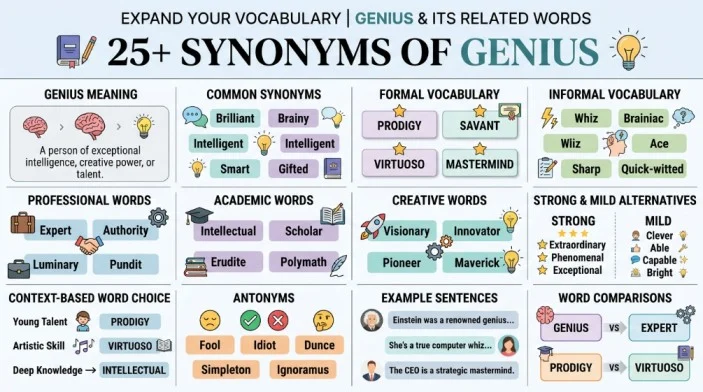
Calling someone a “genius” can be powerful, but it is not always the most precise choice. Depending on the context, you may need a word that highlights exceptional intelligence, creative thinking, expertise, talent, or extraordinary ability. Synonyms of Genius give writers, students, professionals, and English learners more flexibility to express these ideas naturally. A carefully chosen alternative can make a sentence sound more specific, polished, and meaningful.
Language experts generally distinguish between words that describe intelligence and those that emphasize talent, originality, skill, or exceptional achievement. Terms such as brilliant, gifted, brilliant-minded, prodigy, and mastermind can carry different shades of meaning and levels of formality. Understanding these differences helps you choose a word that fits the person, situation, and tone. This guide explores useful synonyms of genius, their meanings, nuances, examples, and the contexts where each alternative works best.
What Are the Best Synonyms of “Genius”?
A genius is a person with exceptional intelligence, creativity, talent, or ability. The best alternatives include prodigy for exceptional young talent, mastermind for brilliant planning, savant for specialized knowledge, intellectual for advanced thinking, virtuoso for exceptional artistic skill, and visionary for original ideas and future focused thinking.
Meaning, Tone, and Context
Simple Definition
The noun genius commonly describes a person whose intellectual ability, creativity, or talent is exceptionally high. It can also describe an unusually brilliant idea, invention, solution, or quality.
For example:
“Marie was considered a genius in mathematics.”
The word can also describe an impressive act or idea:
“The simplicity of the design was pure genius.”
Part of Speech
Genius is primarily a noun.
It can refer to:
- A person with exceptional intellectual ability.
- An exceptionally talented or creative person.
- Exceptional intelligence or creative ability.
- An unusually clever idea, method, or solution.
Overall Tone
The word genius is generally positive and strongly complimentary. It communicates admiration and suggests an unusually high level of intelligence, creativity, talent, or problem solving ability.
Formality Level
Genius is a neutral word that works in both formal and informal English.
It can appear naturally in:
- Academic writing
- Professional communication
- Everyday conversation
- Journalism
- Creative writing
- Social media
- Personal descriptions
However, some alternatives are more precise for specific contexts.
Common Uses
Native English speakers commonly use genius when describing:
- Exceptional intelligence
- Mathematical ability
- Scientific achievement
- Artistic talent
- Creative problem solving
- Innovative ideas
- Strategic thinking
- Extraordinary accomplishments
- Highly talented people
- Clever solutions
Examples:
“She is a genius at solving complex problems.”
“That was a genius marketing strategy.”
“His genius changed the way people understood the subject.”
Word Forms
| Form | Word | Example |
|---|---|---|
| Noun | Genius | “He is a musical genius.” |
| Plural noun | Geniuses | “Several geniuses worked on the project.” |
| Adjective | Genius | “That was a genius idea.” |
| Related adjective | Brilliant | “She gave a brilliant presentation.” |
| Related noun | Brilliance | “His brilliance was obvious.” |
The adjective genius is especially common in informal English when describing an idea, decision, or solution.
When and How to Use “Genius”
Use genius when you want to express an unusually high level of intelligence, creativity, talent, or cleverness. The word is strongest when the person or idea clearly stands out from ordinary ability.
Professional Context
“Her ability to simplify complex processes is a sign of real genius.”
Here, genius praises exceptional problem solving ability.
Academic Context
“The professor described the theory as an example of scientific genius.”
The word adds strong admiration and emphasis.
Workplace Context
“That automation system was a genius solution to a recurring problem.”
This is natural when praising an unusually clever workplace solution.
Personal Context
“My brother is a genius when it comes to fixing computers.”
This informal sentence emphasizes natural ability.
Email Context
“Your suggestion was genius. It solved the issue much faster than expected.”
This is conversational and complimentary rather than highly formal.
Resume Context
On a resume, simply calling yourself a “genius” is usually too subjective.
Instead of:
“I am a genius at data analysis.”
Use:
“Developed innovative data analysis solutions that improved reporting efficiency.”
Specific achievements are more credible in professional writing.
Social Media Context
“Whoever came up with this idea is a genius.”
This is a natural informal use that expresses strong admiration.
Best Synonyms of “Genius”
No single synonym works perfectly in every situation. The best choice depends on whether you want to emphasize intelligence, creativity, youth, expertise, artistic ability, leadership, innovation, or clever planning.
Professional Writing: Brilliant
Brilliant is a flexible alternative that works well when describing exceptional thinking, performance, or ideas.
“She developed a brilliant solution to the problem.”
It sounds complimentary without being as absolute as genius.
Academic Writing: Intellectual
Intellectual is useful when describing someone deeply engaged with ideas, knowledge, reasoning, or scholarship.
“The author was an influential intellectual of his generation.”
It is more precise than genius when the focus is serious thinking rather than extraordinary ability in general.
Business Communication: Mastermind
Mastermind works well when someone has developed or directed an impressive plan.
“She was the mastermind behind the company’s successful campaign.”
It emphasizes strategic planning rather than raw intelligence.
Casual Conversation: Whiz
Whiz is a natural informal word for someone who is exceptionally skilled at something.
“He’s a computer whiz.”
It is especially common in phrases such as computer whiz or math whiz.
Emotional Writing: Brilliant Mind
Brilliant mind expresses admiration while sounding warmer and more descriptive.
“She was a brilliant mind whose work inspired an entire generation.”
Creative Writing: Visionary
Visionary is effective when describing someone whose ideas are original, imaginative, and ahead of their time.
“The visionary designer transformed the industry.”
Resume Writing: Innovator
Innovator is often better than genius on a resume because it describes observable professional behavior.
“Recognized as an innovator in sustainable product design.”
Workplace Communication: Expert
Expert is useful when the emphasis is advanced knowledge or skill rather than extraordinary intelligence.
“She is an expert in cybersecurity.”
Stronger Meaning: Mastermind
When you want to emphasize exceptional strategic thinking, mastermind can be stronger and more specific than genius.
“He was the mastermind behind the successful expansion.”
Softer Meaning: Talented Thinker
For a less dramatic description, talented thinker communicates ability without making an absolute claim about someone’s intelligence.
“She is a talented thinker with a practical approach to complex problems.”
When Not to Use “Genius”
Although genius is versatile, there are situations where a more precise word produces better writing.
When “Genius” Is Too General
Less precise:
“He is a genius in technology.”
Better:
“He is a leading expert in artificial intelligence.”
Why:
Expert tells the reader what kind of ability the person has.
When “Genius” Is Too Vague
Less precise:
“She had a genius idea.”
Better:
“She developed an innovative solution that reduced processing time.”
Why:
The second sentence explains the actual value of the idea.
When “Genius” Sounds Too Informal
Less suitable for a formal report:
“The team came up with a genius solution.”
Better:
“The team developed an innovative solution.”
Why:
Innovative sounds more objective and professional.
When “Genius” Sounds Too Strong
Less suitable:
“He is a genius at writing emails.”
Better:
“He is highly skilled at professional communication.”
Why:
Genius suggests an exceptional level of ability that may be unnecessary for ordinary competence.
When “Genius” Is Too Emotional
Less neutral:
“Her genius changed everything.”
Better:
“Her innovative approach significantly changed the process.”
Why:
The revised sentence communicates impact without excessive praise.
When Describing Young Talent
Less precise:
“The eight year old is a genius musician.”
Better:
“The eight year old is a musical prodigy.”
Why:
Prodigy specifically highlights exceptional ability at a young age.
When Describing Specialized Knowledge
Less precise:
“He is a genius in ancient languages.”
Better:
“He is a renowned scholar of ancient languages.”
Why:
Scholar identifies advanced knowledge and academic specialization.
Words Commonly Confused With “Genius”
Prodigy
Difference: A prodigy is someone, usually a child or young person, who demonstrates exceptional ability at an unusually early age.
When to Use It: Use prodigy when age and early achievement are important.
Example:
“The young pianist was recognized as a prodigy.”
Savant
Difference: A savant is a person with exceptional knowledge or ability in a particular area. The term can have a specialized meaning in discussions of savant syndrome.
When to Use It: Use it carefully when describing extraordinary specialized ability.
Example:
“He is a mathematical savant with an extraordinary memory for numbers.”
Expert
Difference: An expert has advanced knowledge or skill, but being an expert does not necessarily mean having extraordinary intelligence.
When to Use It: Use expert for professional qualifications and specialized knowledge.
Example:
“She is an expert in environmental policy.”
Intellectual
Difference: An intellectual is someone deeply interested in ideas, knowledge, reasoning, and intellectual discussion.
When to Use It: Use intellectual for scholarship, ideas, and serious thought.
Example:
“The writer became an influential intellectual.”
Mastermind
Difference: A mastermind is someone who creates or directs an exceptionally clever plan.
When to Use It: Use mastermind when strategy and planning are central.
Example:
“She was the mastermind behind the campaign.”
Virtuoso
Difference: A virtuoso is a person with exceptional technical skill, especially in music or another performing art.
When to Use It: Use it when extraordinary artistic performance is the focus.
Example:
“The young violinist performed like a virtuoso.”
Best Synonyms of “Genius” by Context
| Context | Best Synonym | Why It Works | Example |
|---|---|---|---|
| Formal writing | Brilliant | Strong praise without sounding overly casual | “She developed a brilliant theory.” |
| Academic writing | Intellectual | Focuses on advanced thought and ideas | “He became a respected intellectual.” |
| Professional communication | Expert | Emphasizes proven knowledge | “She is an expert in finance.” |
| Business emails | Brilliant | Natural for praising an idea | “That was a brilliant suggestion.” |
| Resume writing | Innovator | Focuses on demonstrated innovation | “Recognized as an innovator in product design.” |
| Workplace communication | Expert | Appropriate for specialized skills | “He is an expert in network security.” |
| Casual conversation | Whiz | Friendly and informal | “She’s a computer whiz.” |
| Everyday speaking | Brain | Informal way to praise intelligence | “Ask Daniel. He’s the brain around here.” |
| Creative writing | Visionary | Highlights imaginative ideas | “The visionary artist challenged convention.” |
| Storytelling | Mastermind | Adds strategic emphasis | “He was the mastermind behind the plan.” |
| Emotional writing | Brilliant mind | Expresses admiration warmly | “Her brilliant mind inspired others.” |
| Strong emphasis | Prodigy | Strong when exceptional young ability is involved | “The young athlete was a prodigy.” |
| Mild tone | Talented | Praises ability without exaggeration | “She is a talented designer.” |
| Social media captions | Whiz | Short, casual, and expressive | “Absolute coding whiz.” |
| American English | Genius | Common and versatile | “That idea is genius.” |
| British English | Brilliant | Very natural as an expression of praise | “That was brilliant.” |
How to Choose the Best Synonym of “Genius”
Choosing the right word becomes easier when you identify exactly what you want to praise.
If You Mean Exceptional Intelligence
Use:
Brilliant, intellectual, brainiac, whiz
Example:
“She is a brilliant mathematician.”
If You Mean Exceptional Young Talent
Use:
Prodigy
Example:
“The young pianist is a musical prodigy.”
If You Mean Specialized Knowledge
Use:
Expert, savant, scholar
Example:
“He is an expert in renewable energy.”
If You Mean Strategic Intelligence
Use:
Mastermind
Example:
“She was the mastermind behind the project.”
If You Mean Artistic Skill
Use:
Virtuoso
Example:
“The pianist performed like a virtuoso.”
If You Mean Original Ideas
Use:
Visionary, innovator, trailblazer
Example:
“The visionary engineer introduced a new approach to transportation.”
If You Want a Casual Word
Use:
Whiz, brain, brainiac
Example:
“He’s a real computer whiz.”
If You Want a Professional Word
Use:
Expert, innovator, specialist
Example:
“She is an accomplished specialist in data science.”
Always consider meaning, audience, emotional strength, purpose, formality, and natural sounding usage before choosing a synonym.
Real Life Examples of “Genius”
School
Basic:
“Maria is a genius at solving math problems.”
More precise:
“Maria is a brilliant math student who solves complex problems quickly.”
College
Basic:
“His genius was obvious in his research.”
More academic:
“His intellectual ability was evident in the originality of his research.”
Workplace
Basic:
“She’s a genius at organizing projects.”
More professional:
“She is an exceptionally skilled project manager with outstanding organizational abilities.”
Business
Basic:
“The CEO’s idea was genius.”
More precise:
“The CEO’s innovative strategy gave the company a significant competitive advantage.”
Basic:
“That was a genius suggestion.”
Natural professional version:
“That was a brilliant suggestion. It gives us a much simpler way to handle the issue.”
Resume
Basic:
“I am a marketing genius.”
Better:
“Developed innovative marketing strategies that increased customer engagement.”
Conversation
“My cousin is a computer whiz. He can usually fix a technical problem in minutes.”
Storytelling
“Everyone underestimated the quiet inventor until her visionary design changed the entire industry.”
Blogging
“The creator was not simply talented. His innovative approach changed how people thought about online education.”
Social Media
“Whoever designed this feature is a genius.”
25 Best Synonyms of “Genius”
| Synonym | Simple Meaning | Best Used For | Example Sentence |
|---|---|---|---|
| Brilliant | Exceptionally intelligent or impressive | General praise | “She has a brilliant mind.” |
| Prodigy | Exceptionally talented young person | Young talent | “The pianist was a musical prodigy.” |
| Savant | Person with exceptional specialized ability | Specialized knowledge | “He is a savant in mathematics.” |
| Mastermind | Person behind a clever plan | Strategy | “She was the mastermind behind the campaign.” |
| Intellectual | Person focused on advanced ideas | Academic thought | “He became a respected intellectual.” |
| Expert | Person with advanced knowledge or skill | Professional writing | “She is an expert in cybersecurity.” |
| Whiz | Person exceptionally skilled at something | Casual speech | “He’s a computer whiz.” |
| Brainiac | Highly intelligent person | Informal conversation | “Her classmates called her a brainiac.” |
| Brain | Very intelligent person | Informal speech | “He’s the brain behind the operation.” |
| Virtuoso | Person with exceptional artistic skill | Music and arts | “The violinist performed like a virtuoso.” |
| Visionary | Person with original future focused ideas | Innovation | “The visionary leader transformed the industry.” |
| Innovator | Person who introduces new ideas or methods | Business and technology | “She is a leading innovator in clean energy.” |
| Trailblazer | Person who creates a new path or approach | Leadership and innovation | “She was a trailblazer in digital education.” |
| Luminary | Highly respected and influential person | Formal writing | “The conference attracted several industry luminaries.” |
| Polymath | Person knowledgeable in many fields | Academic and intellectual writing | “The polymath studied mathematics, music, and philosophy.” |
| Scholar | Highly knowledgeable academic | Education and research | “The scholar published several influential studies.” |
| Thinker | Person known for thoughtful ideas | Writing and philosophy | “He was an original thinker.” |
| Wizard | Person exceptionally skilled at something | Informal and creative writing | “She’s a software wizard.” |
| Ace | Highly skilled person | Informal and professional contexts | “He’s an ace programmer.” |
| Specialist | Person with advanced knowledge in one area | Professional writing | “She is a specialist in robotics.” |
| Talented person | Person with strong natural ability | General description | “He is a talented designer.” |
| Master | Person with exceptional command of a skill | Arts and crafts | “She is a master of classical composition.” |
| Phenomenon | Person with extraordinary ability or success | Informal and media writing | “The young athlete became a sporting phenomenon.” |
| Pro | Highly skilled professional | Casual and professional speech | “She’s a pro at negotiating contracts.” |
| Exceptional thinker | Person with unusually strong reasoning ability | Formal and professional writing | “He is an exceptional thinker with creative solutions.” |
Synonyms of “Genius” by Usage
Professional vs Personal Synonyms
Professional writing should generally favor words that describe observable skills or accomplishments.
Use expert, specialist, innovator, brilliant, and visionary in professional contexts.
Personal conversations allow more expressive choices such as whiz, brainiac, brain, and wizard.
For example:
Professional: “She is an expert in machine learning.”
Personal: “She’s a machine learning whiz.”
Both sentences communicate strong ability, but their tones are different.
Formal vs Conversational Synonyms
For reports, essays, and formal business writing, choose:
- Brilliant
- Intellectual
- Expert
- Specialist
- Scholar
- Innovator
- Visionary
For casual conversation and texting, choose:
- Whiz
- Brainiac
- Brain
- Wizard
- Ace
- Pro
The formal choices tend to sound more measured, while the conversational choices create a friendlier tone.
Academic Synonyms
Academic writing benefits from words that identify a specific type of intellectual ability.
Intellectual works when discussing ideas and scholarship.
Scholar works when the person’s academic expertise is central.
Polymath works when someone has substantial knowledge across multiple disciplines.
Savant can describe exceptional specialized ability, but it should be used carefully because it also has a specific clinical and psychological sense in terms such as savant syndrome.
Example:
“The polymath contributed to several fields of study.”
This is more informative than simply calling the person a genius.
Professional and Business Synonyms
For resumes, interviews, meetings, presentations, performance reviews, client communication, and business emails, focus on evidence rather than exaggerated praise.
Resume: Innovator, specialist, expert
Interview: Skilled professional, expert
Meeting: Brilliant thinker, strategic thinker
Presentation: Visionary, innovator
Performance review: Exceptional performer, expert
Client communication: Specialist, expert
Business email: Brilliant, excellent
Instead of saying:
“She is a genius at sales.”
A professional version is:
“She is an exceptional sales strategist with a strong record of exceeding targets.”
The second sentence provides useful information instead of relying on a broad compliment.
Creative and Literary Synonyms
Creative writing allows more expressive choices.
Visionary emphasizes imagination and future focused thinking.
Mastermind creates a sense of strategic intelligence.
Virtuoso highlights extraordinary artistic performance.
Brilliant mind expresses admiration.
Luminary gives a prestigious and literary tone.
Example:
“The visionary inventor saw possibilities where everyone else saw limitations.”
Slang or Modern Synonyms
There are several informal alternatives, but they should not be treated as exact replacements in every context.
Whiz: A person highly skilled at something.
“She’s a coding whiz.”
Brainiac: An informal term for a highly intelligent person.
“He’s a total brainiac.”
Wizard: A person exceptionally skilled in a particular field.
“She’s a spreadsheet wizard.”
Brain: An informal way to describe the person who provides the intelligence behind a group or operation.
“He’s the brain behind the project.”
Avoid these terms in formal academic writing unless they appear in a quotation or deliberately informal context.
Strongest to Mildest Synonyms
There is no scientifically fixed intensity scale for these words, because strength depends on context. Still, the following guide is useful for everyday writing.
| Intensity | Useful Alternatives | Main Effect |
|---|---|---|
| Mild | Talented, skilled, capable | Praises ability without exaggeration |
| Moderate | Expert, specialist, brilliant | Shows strong ability or knowledge |
| Strong | Prodigy, virtuoso, visionary | Suggests exceptional ability |
| Very Strong | Genius, mastermind, savant | Communicates extraordinary ability in a particular sense |
Use stronger words when the evidence supports them. Calling every skilled employee a genius can make the word lose its impact.
Emotional vs Neutral Synonyms
Emotional Synonyms
These words often communicate admiration or excitement.
- Brilliant
- Genius
- Remarkable
- Visionary
- Phenomenon
- Mastermind
Example:
“That was a brilliant idea.”
Neutral Synonyms
These words communicate ability more objectively.
- Expert
- Specialist
- Scholar
- Intellectual
- Innovator
- Skilled professional
Example:
“She is an expert in molecular biology.”
For professional and academic writing, neutral vocabulary is usually safer because it allows the reader to focus on evidence rather than praise.
Antonyms of “Genius”
Strictly speaking, genius does not have fifteen perfect one word antonyms because its meaning changes according to context. The following terms function as genuine opposites when genius refers to exceptional intelligence, creativity, ability, or achievement.
| Antonym | Meaning | Example Sentence |
|---|---|---|
| Unintelligent | Lacking strong intellectual ability | The character is portrayed as unintelligent. |
| Foolish | Showing poor judgment or reasoning | It was a foolish decision. |
| Stupid | Showing very poor intelligence or judgment | Calling the plan stupid was unnecessarily harsh. |
| Dull | Slow to understand or lacking mental sharpness | The lesson seemed dull to him. |
| Dim witted | Slow to understand things | The character is presented as dim witted rather than clever. |
| Slow witted | Taking longer than usual to understand | He is sometimes slow witted when solving unfamiliar problems. |
| Unimaginative | Lacking creativity or original ideas | The proposal was practical but unimaginative. |
| Uncreative | Lacking creative ability | The final design felt uncreative and repetitive. |
| Mediocre | Only average in quality or ability | His performance was competent but mediocre. |
| Ordinary | Not exceptional or outstanding | She was an ordinary student who worked hard. |
| Average | Typical rather than exceptional | His mathematical ability was average. |
| Inept | Lacking skill or competence | The manager was inept at handling the situation. |
| Ignorant | Lacking knowledge about a subject | He was ignorant of the basic rules. |
| Incompetent | Lacking the necessary ability or skill | The incompetent approach created additional problems. |
| Simple minded | Lacking complexity in thought or understanding | The argument was criticized as overly simple minded. |
Comparison: “Genius” vs Similar Words
Genius vs Prodigy
Main Difference
A genius can be any person with extraordinary ability, while a prodigy specifically emphasizes exceptional talent at a young age.
Which Is Stronger?
Neither is universally stronger. Prodigy is more specific because it includes the idea of unusually early achievement.
Which Is More Formal?
Both are acceptable in formal writing when used accurately.
When to Use Each
Use genius for exceptional ability generally. Use prodigy when the person’s young age is important.
Examples
Genius:
“The scientist was considered a genius.”
Prodigy:
“The twelve year old pianist was already recognized as a prodigy.”
Genius vs Savant
Main Difference
Genius is broad. Savant emphasizes exceptional specialized knowledge or ability.
Which Is Stronger?
Savant can sound more specialized, but it is not simply a stronger version of genius.
Which Is More Formal?
Savant can sound more technical or specialized.
When to Use Each
Use savant only when the context supports its specialized meaning.
Examples
Genius:
“She was a genius at mathematics.”
Savant:
“He demonstrated extraordinary mathematical ability and was described as a savant.”
Genius vs Expert
Main Difference
A genius has extraordinary intellectual or creative ability. An expert has advanced knowledge or skill developed through education, training, or experience.
Which Is Stronger?
Genius makes a stronger claim about exceptional ability.
Which Is More Formal?
Expert is generally more useful in professional writing.
When to Use Each
Use expert when you need to establish credible professional competence.
Examples
Genius:
“He was a genius who transformed the field.”
Expert:
“He is an expert in data security.”
Genius vs Brilliant
Main Difference
Brilliant can describe a person, idea, performance, or solution. Genius more strongly identifies exceptional intelligence or extraordinary ability.
Which Is Stronger?
Genius usually makes the stronger claim about a person.
Which Is More Formal?
Both can work in formal contexts, but brilliant is often easier to use naturally.
When to Use Each
Use brilliant when praising a particular idea or performance.
Examples
Genius:
“She is a genius in theoretical physics.”
Brilliant:
“She developed a brilliant solution.”
Genius vs Intellectual
Main Difference
An intellectual is someone deeply involved with ideas and serious thought. A genius has exceptional ability.
Which Is Stronger?
Genius suggests greater exceptional ability.
Which Is More Formal?
Intellectual is often more appropriate in academic and cultural writing.
When to Use Each
Use intellectual when discussing scholarship, ideas, or intellectual culture.
Examples
Genius:
“He was a genius in mathematics.”
Intellectual:
“He became an influential intellectual and writer.”
Genius vs Mastermind
Main Difference
A mastermind is specifically associated with clever planning or directing an operation.
Which Is Stronger?
Mastermind is stronger when strategic intelligence is the focus.
Which Is More Formal?
Both can appear in formal writing, but mastermind is often more dramatic.
When to Use Each
Use mastermind when someone is responsible for designing or coordinating a complex plan.
Examples
Genius:
“Her genius was evident in her creative work.”
Mastermind:
“She was the mastermind behind the successful campaign.”
Common Phrases and Expressions with “Genius”
Genius at Something
Meaning: Someone is exceptionally skilled at a particular activity.
Example:
“He is a genius at solving technical problems.”
Genius Idea
Meaning: An extremely clever or effective idea.
Example:
“Using recycled materials was a genius idea.”
Genius Move
Meaning: A very clever decision or action.
Example:
“Hiring an experienced editor was a genius move.”
Pure Genius
Meaning: Something viewed as exceptionally clever, creative, or brilliant.
Example:
“The simple design is pure genius.”
Stroke of Genius
Meaning: An unusually brilliant idea or creative insight.
Example:
“The final adjustment was a stroke of genius.”
Creative Genius
Meaning: Exceptional creative ability.
Example:
“The artist was celebrated for her creative genius.”
Musical Genius
Meaning: Exceptional musical ability or creativity.
Example:
“The composer was regarded as a musical genius.”
Genius Mind
Meaning: A mind considered exceptionally intelligent or creative.
Example:
“The project required a truly exceptional mind.”
Common Mistakes to Avoid
1. Treating Every Skilled Person as a Genius
Incorrect:
“He is a genius because he knows how to use Excel.”
Better:
“He is highly skilled at using Excel.”
Why:
Knowing a useful skill does not automatically indicate extraordinary intelligence.
2. Confusing Genius With Expert
Incorrect:
“She is a genius in accounting because she has twenty years of experience.”
Better:
“She is an accounting expert with twenty years of experience.”
Why:
Experience and specialized knowledge support expert, while genius makes a much broader claim.
3. Using Informal Vocabulary in Formal Writing
Incorrect:
“The researcher had a genius idea.”
Better:
“The researcher developed an innovative approach.”
Why:
Innovative approach sounds more objective and appropriate for academic work.
4. Overusing Dramatic Language
Incorrect:
“Our manager is a genius because she scheduled the meeting efficiently.”
Better:
“Our manager is highly effective at organizing meetings.”
Why:
The second version matches the actual level of achievement more accurately.
5. Repeating the Same Word
Incorrect:
“The genius scientist created a genius invention using genius techniques.”
Better:
“The brilliant scientist developed an innovative invention using an advanced approach.”
Why:
Strategic variation improves readability and adds meaning.
6. Using “Prodigy” for Adults
Incorrect:
“The forty five year old engineer is a prodigy.”
Better:
“The engineer is an exceptional innovator.”
Why:
Prodigy normally emphasizes unusually advanced ability at a young age.
7. Using “Savant” as a Casual Replacement for Genius
Incorrect:
“My friend is a savant because he is good at video games.”
Better:
“My friend is a video game whiz.”
Why:
Savant has specialized meanings and should not be used casually whenever someone is simply talented.
Frequently Asked Questions
What is a good synonym for genius?
Good synonyms include brilliance, intellect, prodigy, mastermind, and wizard, depending on the context.
What is another word for genius?
Another word for genius can be brilliant person, mastermind, prodigy, intellectual, or expert.
What does genius mean?
Genius describes exceptional intellectual ability, creativity, or someone with outstanding talent in a particular field.
What are some common genius synonyms?
Common genius synonyms include brilliance, intelligence, intellect, talent, giftedness, and ingenuity.
What is another word for a genius idea?
For a genius idea, you can use brilliant idea, inspired idea, clever solution, breakthrough, or innovative concept.
What is the synonym of geniuses?
Depending on context, synonyms for geniuses include brilliant minds, intellectuals, prodigies, masterminds, and visionaries.
What are the best synonyms of “genius”?
The best synonym depends on the meaning. Brilliant works broadly, prodigy describes exceptional young talent, mastermind emphasizes strategy, expert highlights knowledge, and visionary focuses on original ideas.
What are the best formal synonyms of “genius”?
Formal alternatives include intellectual, expert, scholar, innovator, visionary, luminary, and polymath. Choose the word that describes the person’s specific strength instead of using a broad label.
What are common informal synonyms of “genius”?
Common informal alternatives include whiz, brainiac, brain, wizard, and ace. These words are suitable for conversations, casual writing, social media, and informal descriptions.
What is another word for “genius” in professional writing?
In professional writing, expert, innovator, specialist, visionary, or brilliant may work better than genius. These alternatives can communicate specific professional strengths without making an exaggerated claim.
What is the difference between “genius” and “prodigy”?
A genius is someone with exceptional intelligence, creativity, or ability, while a prodigy is someone who demonstrates exceptional talent unusually early, usually during childhood or youth.
What is the opposite of “genius”?
Depending on the meaning, opposites include unintelligent, unimaginative, mediocre, ordinary, inept, incompetent, and slow witted. The best antonym depends on whether intelligence, creativity, or skill is being contrasted.
Conclusion
Genius describes exceptional intelligence, creativity, talent, or ability, but the best alternative depends on exactly what you want to communicate. Brilliant is versatile, prodigy emphasizes exceptional young talent, expert highlights specialized knowledge, mastermind focuses on strategy, virtuoso suits exceptional artistic skill, and visionary emphasizes original ideas.
No single synonym works perfectly in every sentence. Strong vocabulary comes from choosing a word that matches the audience, context, tone, and specific quality you want to highlight.
A useful vocabulary habit is to ask what makes someone or something exceptional before choosing a replacement. That small step will help you select a more accurate synonym of genius and make your writing clearer and more natural.
Read More Related Articles:
- Synonyms for Thus | Meaning, Examples, and Better Word …
- 25+ Synonyms of Generic: Meanings, Uses, Examples, and …
- Synonyms for Empty | Meaning, Examples, and Better Word …







1 thought on “25+ Synonyms of Genius | Smart, Powerful & Precise Word Choices for Every Context in 2026”