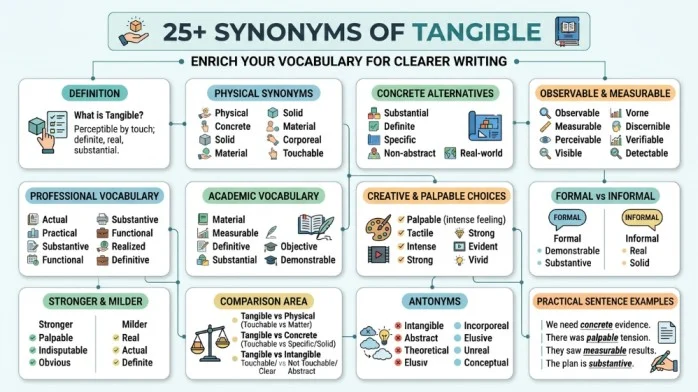
When writing an essay, email, business report, resume, or blog post, the word “tangible” can sometimes feel too repetitive or too general. Finding the right alternative depends on whether you mean something physical, clearly noticeable, measurable, real, or easy to prove.
Learning the synonyms of tangible can make your writing more precise and natural. Words such as physical, concrete, material, palpable, measurable, and observable overlap with tangible, but they are not interchangeable in every sentence. Understanding these small differences helps you choose vocabulary that communicates exactly what you mean.
What Are the Best Synonyms of “Tangible”?
The best synonyms of tangible include physical, concrete, material, palpable, touchable, perceptible, substantial, measurable, observable, and real. Physical works best for things that exist in material form, while concrete emphasizes something definite or specific. In professional and academic writing, measurable, substantial, concrete, and demonstrable can be useful depending on context.
Meaning, Tone, and Context
Simple Definition
Tangible describes something that can be touched, physically experienced, or clearly recognized as real and concrete. It can also describe something that produces a definite, measurable result.
For example, a physical object such as a chair is tangible because you can touch it. A measurable improvement in sales can also be described as tangible because the result can be clearly identified.
The word therefore has both a physical sense and a broader figurative sense.
Part of Speech
Tangible is an adjective.
“Workers need tangible evidence of progress.”
“The museum contains many tangible objects from the past.”
“Tangible results helped justify the investment.”
Overall Tone
Tangible usually has a neutral to positive tone.
It is not inherently emotional. Its meaning depends heavily on context.
When describing an object, it emphasizes physical existence. When describing an outcome, it often suggests something concrete, definite, measurable, or demonstrable.
Formality Level
Tangible is a neutral to moderately formal word.
It works naturally in:
Academic writing
Business communication
Professional reports
Essays
Presentations
News writing
It is especially common when discussing results, evidence, benefits, assets, objects, and outcomes.
Common Uses
Native English speakers commonly use tangible with words such as:
- Tangible evidence
- Tangible benefits
- Tangible results
- Tangible assets
- Tangible objects
- Tangible products
- Tangible rewards
- Tangible progress
- Tangible proof
- Tangible impact
- Tangible value
The exact synonym depends on what tangible describes.
For example, “physical” is usually better for an object, while “measurable” may be better for a result.
Word Forms
Tangible is an adjective.
The related noun is tangibility, although it is much less common in everyday English.
The adverb tangibly is also possible, especially in formal writing.
Examples:
“The benefits were tangibly demonstrated.”
“The tangibility of the product helped customers understand its value.”
The most useful form for everyday writing remains tangible.
When and How to Use “Tangible”
Use tangible when you want to emphasize that something has a physical presence or can be clearly identified, observed, measured, or demonstrated.
The word is especially useful when contrasting something concrete with something abstract.
Professional
“The company needs tangible evidence that the new strategy is working.”
Here, tangible means evidence that can be clearly demonstrated.
Academic
“The researchers found tangible improvements in student performance.”
In this context, tangible emphasizes results that are clearly observable or measurable.
Workplace
“The training program produced tangible benefits for employees.”
The word highlights benefits that can be recognized rather than merely promised.
Personal
“Receiving a handwritten letter gave her a tangible reminder of their friendship.”
Here, tangible has a physical meaning because the letter is something she can hold.
“We need tangible results before expanding the project.”
This tells the reader that measurable or definite outcomes are expected.
Resume
“Delivered tangible improvements in customer retention through targeted support strategies.”
In a resume, tangible emphasizes results that can be demonstrated.
Social Media
“It’s rewarding to see tangible progress after months of hard work.”
Here, tangible means noticeable and real rather than merely theoretical.
Best Synonyms of “Tangible”
No synonym for tangible works perfectly in every situation. The best alternative depends on whether you are talking about physical existence, measurable results, clear evidence, or something that feels real and definite.
Professional Writing: Concrete
Concrete is an excellent alternative when you want to describe something definite, practical, or clearly established.
Example:
“The proposal provides concrete recommendations for improving productivity.”
Why it works:
Concrete sounds precise and professional without necessarily suggesting physical touch.
Academic Writing: Observable
Observable works well when discussing something that can be seen, detected, or identified through observation.
Example:
“The experiment produced observable changes in plant growth.”
Why it works:
It emphasizes evidence that can be noticed or recorded.
Business Communication: Measurable
Measurable is especially useful when tangible refers to results, progress, benefits, or performance.
Example:
“The new system delivered measurable improvements in efficiency.”
Why it works:
It tells the reader that the result can be assessed using evidence or data.
Casual Conversation: Real
Real is a simple and natural alternative when tangible means genuine or actually existing.
Example:
“We finally saw real progress after months of planning.”
Why it works:
Real sounds natural in everyday speech and avoids unnecessary formality.
Emotional Writing: Palpable
Palpable can describe something that feels strongly present, especially an atmosphere, emotion, or tension.
Example:
“There was a palpable sense of excitement in the room.”
Why it works:
It adds intensity and sensory feeling rather than simply stating that something exists.
Creative Writing: Material
Material can work when tangible refers to something physical or made from physical matter.
Example:
“The artist transformed ordinary material into a striking sculpture.”
Why it works:
It gives the description a physical and sensory quality.
Resume Writing: Demonstrable
Demonstrable is useful when describing achievements, skills, or results that can be supported by evidence.
Example:
“Delivered demonstrable improvements in customer satisfaction.”
Why it works:
It emphasizes proof and makes professional claims sound more specific.
Workplace Communication: Concrete
Concrete is often stronger than tangible when discussing plans, recommendations, goals, or actions.
Example:
“We need concrete steps to solve the problem.”
Why it works:
Concrete communicates practicality and specificity.
Stronger Meaning: Substantial
Substantial can express a strong sense of size, value, amount, or importance.
Example:
“The organization achieved substantial growth.”
Why it works:
It suggests that the result is meaningful and significant, although it does not always mean physically tangible.
Softer Meaning: Noticeable
Noticeable is appropriate when something can be observed without suggesting that it is physically present or highly significant.
Example:
“There was a noticeable improvement in the team’s performance.”
Why it works:
It gives moderate emphasis without exaggerating the result.
When Not to Use “Tangible”
Tangible is useful, but it can become awkward when the intended meaning is more specific. Choosing a more precise synonym can make your sentence clearer.
When Tangible Is Too General
Sentence:
“The company achieved tangible success.”
Better:
“The company achieved measurable growth.”
Why:
Success can mean many things. Growth is more specific, and measurable tells the reader that the result can be evaluated.
When Tangible Is Too Vague
Sentence:
“We need tangible progress.”
Better:
“We need measurable progress in customer retention.”
Why:
The improved sentence explains what kind of progress matters.
When Tangible Sounds Too Formal
Sentence:
“I have a tangible feeling that something is wrong.”
Better:
“I have a strong feeling that something is wrong.”
Why:
Tangible is not normally used for an ordinary personal feeling. Strong feeling is much more natural.
When Tangible Is Too Weak
Sentence:
“The project made a tangible difference.”
Better:
“The project made a substantial difference.”
Why:
Substantial emphasizes a larger or more meaningful effect.
When Tangible Is Too Strong
Sentence:
“The discussion produced tangible results.”
If the discussion only created a useful idea, a softer option may be better:
“The discussion produced useful ideas.”
Why:
Tangible can imply that the result is definite or demonstrable. Useful is safer when the outcome has not yet been established.
When a More Precise Word Exists
Sentence:
“The research found tangible changes.”
Better:
“The research found observable changes in behavior.”
Why:
Observable directly explains how the changes were identified.
When the Meaning Is Emotional
Sentence:
“She felt a tangible sense of happiness.”
Better:
“She felt a powerful sense of happiness.”
Why:
Tangible is usually not the natural choice for ordinary emotional states. Palpable can sometimes work when describing an atmosphere or emotion that is strongly noticeable.
Words Commonly Confused With “Tangible”
Physical
Difference:
Physical specifically relates to the body, material objects, or the physical world.
When to Use It:
Use physical when you mean something that exists materially rather than digitally or conceptually.
Example:
“The store sells physical copies of the book.”
Concrete
Difference:
Concrete can mean physically existing, but it also means definite, specific, and practical.
When to Use It:
Use concrete when discussing evidence, plans, examples, recommendations, or facts.
Example:
“The manager provided concrete steps for improving performance.”
Material
Difference:
Material generally relates to physical matter, substances, or resources. It can also describe something that has practical importance.
When to Use It:
Use material for physical substances, goods, assets, or resources.
Example:
“The sculpture was made from recycled material.”
Palpable
Difference:
Palpable traditionally relates to something that can be physically felt, but it is also commonly used figuratively for emotions or atmospheres that are strongly noticeable.
When to Use It:
Use palpable for strong tension, excitement, fear, or atmosphere.
Example:
“The tension in the room was palpable.”
Abstract
Difference:
Abstract refers to ideas, concepts, qualities, or thoughts that are not physical or directly concrete.
When to Use It:
Use abstract when contrasting concepts with physical examples.
Example:
“Freedom is an abstract idea.”
Substantial
Difference:
Substantial emphasizes considerable size, amount, value, or importance rather than physical existence.
When to Use It:
Use substantial for significant improvements, amounts, benefits, or changes.
Example:
“The company made substantial progress.”
Best Synonyms of “Tangible” by Context
| Context | Best Synonym | Why It Works | Example |
|---|---|---|---|
| Formal writing | Concrete | Expresses definite meaning clearly | The report contains concrete evidence. |
| Academic writing | Observable | Focuses on what can be identified or observed | The study found observable changes. |
| Professional communication | Demonstrable | Highlights evidence that can be shown | The team achieved demonstrable results. |
| Business emails | Measurable | Works well for results and performance | We need measurable improvements. |
| Resume writing | Demonstrable | Supports achievement based language | Delivered demonstrable cost savings. |
| Workplace communication | Concrete | Emphasizes practical action | We need concrete solutions. |
| Casual conversation | Real | Natural and easy to understand | We need real results. |
| Everyday speaking | Physical | Clearly describes material things | I prefer a physical copy. |
| Creative writing | Palpable | Adds sensory or emotional force | A palpable tension filled the room. |
| Storytelling | Material | Helps describe physical things | The box contained valuable material. |
| Emotional writing | Palpable | Describes strongly felt emotions or atmosphere | A palpable sense of relief spread through the crowd. |
| Strong emphasis | Substantial | Suggests considerable value or size | The project delivered substantial benefits. |
| Mild tone | Noticeable | Provides moderate emphasis | There was a noticeable improvement. |
| Social media captions | Real | Sounds natural and accessible | Seeing real progress feels amazing. |
| American English | Concrete | Commonly used for definite ideas and evidence | We need concrete examples. |
| British English | Concrete | Also natural in comparable contexts | The proposal needs concrete evidence. |
How to Choose the Best Synonym of “Tangible”
Choosing the right alternative starts with identifying what you actually mean by tangible.
If You Mean Something You Can Touch
Choose:
Physical
Touchable
Material
Corporeal
Example:
“Tangible evidence” may mean evidence in a physical form, so “physical evidence” can be more precise in some contexts.
If You Mean Something Clearly Defined
Choose:
Concrete
Definite
Specific
Clear
Example:
“We need a tangible plan” can often become “We need a concrete plan.”
If You Mean Something That Can Be Measured
Choose:
Measurable
Quantifiable
Demonstrable
Verifiable
Example:
“The campaign produced tangible results” can become “The campaign produced measurable results.”
If You Mean Something That Can Be Strongly Perceived
Choose:
Palpable
Perceptible
Noticeable
Observable
Example:
“The tension was tangible” can become “The tension was palpable.”
If You Mean Something That Is Real
Choose:
Real
Actual
Genuine
Concrete
Example:
“The project created tangible value” can become “The project created real value.”
Consider Your Audience
- For academic readers, choose precise words such as observable, measurable, concrete, or demonstrable.
- For business readers, measurable, concrete, substantial, and demonstrable are usually more useful.
- For casual readers, physical, real, noticeable, and clear often sound more natural.
Consider Emotional Strength
Palpable is stronger and more expressive than noticeable.
Substantial is stronger than modest.
Concrete sounds precise rather than emotional.
Physical is neutral and descriptive.
Consider Your Writing Purpose
- Use concrete for plans and evidence.
- Use physical for objects.
- Use measurable for results.
- Use palpable for emotions and atmosphere.
- Use demonstrable for achievements.
- Use substantial for considerable results or benefits.
The best synonym is the one that communicates the exact idea without adding unintended meaning.
Real Life Examples of “Tangible”
School
Original:
“Students need tangible examples to understand the concept.”
Improved:
“Students need concrete examples to understand the concept.”
Why:
Concrete is more natural when referring to clear examples.
College
Original:
“The research produced tangible findings.”
Improved:
“The research produced measurable findings.”
Why:
Measurable is more precise when findings can be assessed using evidence.
Workplace
Original:
“The training created tangible benefits.”
Improved:
“The training created measurable benefits for employees.”
Why:
Measurable makes the business outcome clearer.
Business
Original:
“The new strategy produced tangible results.”
Improved:
“The new strategy produced substantial improvements in sales.”
Why:
The revised sentence identifies the type and scale of the result.
Original:
“We need tangible evidence before approving the request.”
Improved:
“We need concrete evidence before approving the request.”
Why:
Concrete is a natural professional alternative for definite evidence.
Resume
Original:
“Achieved tangible improvements in customer service.”
Improved:
“Delivered demonstrable improvements in customer satisfaction.”
Why:
Demonstrable emphasizes achievements that can be supported with evidence.
Conversation
Original:
“I finally saw tangible progress.”
Improved:
“I finally saw real progress.”
Why:
Real sounds more natural in casual conversation.
Storytelling
Original:
“The fear became tangible.”
Improved:
“The fear became palpable.”
Why:
Palpable gives the sentence a stronger emotional and sensory effect.
Blogging
Original:
“Readers want tangible benefits from a guide.”
Improved:
“Readers want practical, measurable benefits from a guide.”
Why:
Practical and measurable explain what kind of benefits readers can expect.
Social Media
Original:
“It’s exciting to see tangible progress.”
Improved:
“It’s exciting to see real progress after all this work.”
Why:
Real is conversational and fits the informal style of social media.
25 Best Synonyms of “Tangible”
| Synonym | Simple Meaning | Best Used For | Example Sentence |
|---|---|---|---|
| Physical | Existing in material form | Objects and goods | The company provides a physical product. |
| Concrete | Definite, clear, or specific | Ideas, evidence, plans | We need concrete evidence before deciding. |
| Material | Relating to physical matter | Objects, substances, assets | The artist selected durable material. |
| Palpable | Strongly noticeable or physically felt | Emotions, atmosphere | The excitement was palpable. |
| Touchable | Able to be touched | Physical objects | The museum displays objects that are touchable. |
| Perceptible | Able to be noticed or detected | Changes, sensations | The difference was barely perceptible. |
| Observable | Able to be seen or identified | Research and behavior | The study recorded observable changes. |
| Measurable | Able to be measured | Results and progress | The campaign produced measurable growth. |
| Demonstrable | Able to be shown or proven | Achievements and evidence | The program delivered demonstrable benefits. |
| Substantial | Considerable in size, amount, or value | Results and benefits | The company made substantial progress. |
| Real | Actually existing or genuine | Everyday communication | The project created real value. |
| Actual | Existing in fact | Facts and circumstances | The actual results exceeded expectations. |
| Definite | Clearly established or certain | Plans and information | We need a definite answer by Friday. |
| Specific | Clearly identified and precise | Instructions and examples | Please provide specific evidence. |
| Evident | Clearly visible or understandable | Results and conditions | The improvement was evident within weeks. |
| Noticeable | Easy enough to observe | Changes and differences | There was a noticeable improvement. |
| Perceptible | Capable of being sensed | Small changes and effects | A perceptible shift occurred in the tone. |
| Corporeal | Having a physical body or form | Formal and literary writing | The story contrasts corporeal life with memory. |
| Substantive | Having real substance or meaningful content | Formal and professional writing | The meeting produced substantive recommendations. |
| Quantifiable | Able to be expressed in numbers | Data and results | The project delivered quantifiable savings. |
| Verifiable | Able to be checked or confirmed | Evidence and claims | The report contains verifiable information. |
| Practical | Related to real application | Solutions and benefits | The course offers practical skills. |
| Tangible in form | Existing in a definite material form | Formal descriptions | The artwork has a tangible form. |
| Touch-based | Relating to physical contact | Specialized descriptions | The device provides touch-based feedback. |
| Substantial in effect | Producing a noticeable real result | Formal analysis | The policy had substantial effects on employment. |
Some entries above overlap with tangible only in particular contexts. Words such as practical, substantive, quantifiable, and verifiable are better understood as context based alternatives rather than universal replacements. This distinction matters because a good synonym should preserve the intended meaning, not simply resemble the original word.
Synonyms of “Tangible” by Usage
Professional vs Personal Synonyms
Professional writing often requires precise words that explain what makes something tangible.
- Use concrete when discussing plans, evidence, or solutions.
- Use measurable when discussing results or performance.
- Use demonstrable when describing achievements that can be supported by evidence.
- Use substantial when discussing meaningful amounts or improvements.
Personal writing can use simpler alternatives.
Real works well in everyday conversation.
Physical is useful when describing an object.
Palpable works well when describing a strong atmosphere or emotion.
A professional sentence might say:
“The strategy produced measurable improvements.”
A personal sentence might say:
“I can finally see real progress.”
Both communicate the same general idea, but the vocabulary matches the audience.
Formal vs Conversational Synonyms
Reports often benefit from concrete, measurable, demonstrable, substantial, or observable.
Essays can use concrete, observable, measurable, and definite.
Business writing often favors measurable, demonstrable, concrete, and substantial.
Presentations can use concrete, clear, measurable, and significant alternatives depending on the message.
Emails generally work well with concrete or measurable.
Casual conversations usually sound better with real, physical, clear, or noticeable.
Texting favors simple language such as real, physical, or noticeable.
The goal is not to use the most sophisticated word. The goal is to use the word that sounds natural for the situation.
Academic Synonyms
Academic writing often requires evidence based language.
Observable is useful when something can be detected through observation.
Measurable is appropriate when data can be used to evaluate an outcome.
Concrete works well for examples, evidence, arguments, and explanations.
Demonstrable is useful when a claim can be supported by evidence.
Quantifiable is appropriate when results can be represented numerically.
Substantive works well when describing meaningful content, discussion, or changes.
For example:
Weak:
“The study found tangible differences.”
More precise:
“The study found measurable differences between the two groups.”
The second sentence tells readers exactly what kind of evidence is involved.
Professional and Business Synonyms
- For resumes, demonstrable and measurable are particularly useful because professional achievements should ideally be supported by clear evidence.
- For interviews, concrete is useful when explaining examples from previous work.
- For meetings, concrete helps describe specific actions or recommendations.
- For presentations, measurable works well for performance indicators.
- For performance reviews, demonstrable and substantial can describe documented achievements.
- For client communication, concrete and measurable can clarify expectations.
- For business emails, concrete is often the safest replacement when discussing evidence, plans, or solutions.
Example:
Instead of:
“We need tangible improvements.”
Try:
“We need measurable improvements in response time.”
The second version is stronger because it identifies how success can be evaluated.
Creative and Literary Synonyms
Creative writing gives tangible a wider range of possibilities.
Palpable can describe emotions, tension, excitement, or atmosphere.
Material can describe physical objects and substances.
Corporeal can create a more literary tone when discussing the physical body.
Physical can create contrast with spiritual, emotional, or imaginary experiences.
Concrete can make an abstract idea feel more specific.
Example:
“The tension was tangible.”
More expressive:
“The tension was palpable.”
The second version creates a stronger emotional impression.
Slang or Modern Synonyms
There is no widely accepted slang word that universally replaces tangible.
In casual modern English, people may simply use:
Real
Physical
Actual
Clear
Concrete
For example:
“We need tangible proof.”
In casual speech:
“We need real proof.”
However, real does not always mean physically tangible. It can mean genuine or authentic. Therefore, context still matters.
Strongest to Mildest Synonyms
Tangible itself does not have a fixed emotional intensity scale because its meaning changes according to context. However, some alternatives create stronger emphasis when describing results or evidence.
Mild
Noticeable
Perceptible
Evident
These words indicate that something can be detected without necessarily suggesting major importance.
Moderate
Concrete
Definite
Observable
Measurable
These words emphasize clarity, evidence, or detectability.
Strong
Substantial
Demonstrable
Quantifiable
These alternatives can suggest stronger evidence, greater impact, or more clearly established results.
Very Strong
Palpable
Indispensable
Highly substantial
These are not universal synonyms for tangible, so they should only be used when their specific meaning fits the sentence.
The safest approach is to choose based on meaning rather than trying to make every synonym sound stronger.
Emotional vs Neutral Synonyms
Emotional Synonyms
Palpable
Real
Meaningful
Powerful
Striking
These alternatives may add emotional or subjective force, depending on context.
Example:
“There was a palpable sense of relief after the announcement.”
Palpable creates a stronger emotional effect than tangible.
Neutral Synonyms
Physical
Concrete
Observable
Measurable
Demonstrable
Definite
Material
These words are more appropriate when the goal is to communicate information objectively.
Example:
“The researchers recorded measurable changes in behavior.”
Neutral vocabulary is usually preferable in academic and professional writing.
Antonyms of “Tangible”
Tangible has two major meanings, so its opposites depend on whether you mean physically existing or clearly concrete.
| Antonym | Meaning | Example Sentence |
|---|---|---|
| Intangible | Not physically touchable | Goodwill is an intangible business asset. |
| Abstract | Existing mainly as an idea or concept | Justice is an abstract concept. |
| Immaterial | Not physical or material | The discussion focused on immaterial concerns. |
| Nonphysical | Not existing in physical form | The service provides a nonphysical benefit. |
| Conceptual | Existing primarily as an idea | The project remains conceptual at this stage. |
| Theoretical | Based mainly on ideas rather than practical evidence | The proposal is still theoretical. |
| Imaginary | Existing only in the imagination | The character lives in an imaginary world. |
| Unreal | Not actually existing or genuine | The situation seemed unreal to everyone. |
| Hypothetical | Based on an imagined situation | The discussion considered a hypothetical scenario. |
| Insubstantial | Lacking physical substance or solid reality | The evidence was too insubstantial to support the claim. |
| Invisible | Not able to be seen | Some forms of radiation are invisible. |
| Spiritual | Relating primarily to nonphysical matters | The experience had deep spiritual meaning. |
| Ideational | Relating to ideas rather than physical things | The research explores ideational factors. |
| Virtual | Existing primarily in a digital environment | The event was held in a virtual space. |
| Ephemeral | Existing for only a short time | The celebration created an ephemeral sense of excitement. |
Not every antonym works in every context. For example, invisible is not the opposite of tangible in every sentence because some tangible objects can be invisible. Intangible and abstract are generally safer opposites when discussing nonphysical ideas, assets, benefits, or qualities.
Comparison: “Tangible” vs Similar Words
Tangible vs Physical
Main Difference
Physical focuses directly on the material world or the body. Tangible can mean physical, but it can also describe something that is clearly real, measurable, or demonstrable.
Which Is Stronger?
Neither is inherently stronger.
Which Is More Formal?
Both are neutral. Tangible often sounds slightly more analytical.
When to Use Each
Use physical for objects, products, bodies, or material spaces.
Use tangible for physical things or definite results and benefits.
Examples
Tangible:
“The project produced tangible benefits.”
Physical:
“The company sells physical products.”
Tangible vs Concrete
Main Difference
Concrete can describe physical objects, but it is also commonly used for ideas, evidence, plans, and examples that are definite or specific.
Which Is Stronger?
Neither is universally stronger.
Which Is More Formal?
Concrete is extremely common in academic and professional writing.
When to Use Each
Use concrete for specific ideas, evidence, examples, and plans.
Use tangible for physical existence or definite results.
Examples
Tangible:
“The company offered tangible rewards.”
Concrete:
“The manager provided concrete recommendations.”
Tangible vs Material
Main Difference
Material usually relates to physical matter, substances, or resources. Tangible has a broader meaning and can describe results or benefits.
Which Is Stronger?
Neither.
Which Is More Formal?
Material can sound more technical depending on the context.
When to Use Each
Use material for physical substances, goods, assets, or resources.
Use tangible for physical things and clearly identifiable outcomes.
Examples
Tangible:
“The organization achieved tangible results.”
Material:
“The building requires expensive construction materials.”
Tangible vs Palpable
Main Difference
Palpable often describes something that can be physically felt or strongly sensed. It is especially effective for emotions, tension, and atmosphere.
Which Is Stronger?
Palpable often creates stronger sensory or emotional emphasis.
Which Is More Formal?
Both can appear in formal writing, but palpable is more expressive.
When to Use Each
Use tangible for physical things or definite outcomes.
Use palpable for strong feelings, tension, excitement, or atmosphere.
Examples
Tangible:
“The program produced tangible results.”
Palpable:
“The excitement was palpable.”
Tangible vs Intangible
Main Difference
Tangible refers to something physical or clearly concrete. Intangible describes something that lacks physical form, such as goodwill, knowledge, reputation, or an idea.
Which Is Stronger?
Neither is stronger. They represent contrasting concepts.
Which Is More Formal?
Both are common in business and academic writing.
When to Use Each
Use tangible for physical assets or clearly measurable outcomes.
Use intangible for nonphysical qualities, benefits, or assets.
Examples
Tangible:
“The company owns several tangible assets.”
Intangible:
“The company has valuable intangible assets such as its reputation.”
Tangible vs Substantial
Main Difference
Substantial means considerable in amount, size, value, or importance. Tangible means physical, concrete, or clearly demonstrable.
Which Is Stronger?
Substantial often suggests greater magnitude.
Which Is More Formal?
Both are appropriate for professional and academic writing.
When to Use Each
Use tangible when emphasizing reality or demonstrability.
Use substantial when emphasizing scale or significance.
Examples
Tangible:
“The policy produced tangible benefits.”
Substantial:
“The policy produced substantial financial benefits.”
Common Phrases and Expressions with “Tangible”
Tangible Benefits
Meaning:
Benefits that can be clearly identified, measured, or experienced.
Example:
“The new software provides tangible benefits for small businesses.”
Tangible Results
Meaning:
Definite results that can be observed or demonstrated.
Example:
“The campaign produced tangible results within six months.”
Tangible Evidence
Meaning:
Evidence that is concrete, physical, or clearly demonstrable.
Example:
“The investigators searched for tangible evidence.”
Tangible Assets
Meaning:
Physical assets that have material form.
Example:
“Buildings and equipment are common tangible assets.”
Tangible Value
Meaning:
Clearly recognizable or measurable value.
Example:
“The training program provides tangible value to employees.”
Tangible Impact
Meaning:
An impact that can be clearly observed or demonstrated.
Example:
“The initiative had a tangible impact on local businesses.”
Tangible Progress
Meaning:
Progress that can be clearly seen, measured, or demonstrated.
Example:
“The team has made tangible progress this month.”
Tangible Reward
Meaning:
A physical or clearly identifiable reward.
Example:
“Employees received tangible rewards for reaching their targets.”
Common Mistakes to Avoid
Mistake 1: Treating Every Similar Word as an Exact Synonym
Incorrect:
“The tension was physical.”
Better:
“The tension was palpable.”
Why:
Physical does not naturally describe emotional atmosphere. Palpable is a better fit for a strongly felt emotional state.
Mistake 2: Using Tangible for Every Kind of Feeling
Incorrect:
“She had a tangible feeling of happiness.”
Better:
“She had a strong feeling of happiness.”
Why:
Tangible is generally better for physical things or clearly demonstrable outcomes. Strong feeling is more natural for personal emotion.
Mistake 3: Using Physical When Concrete Is Intended
Incorrect:
“We need physical recommendations for the project.”
Better:
“We need concrete recommendations for the project.”
Why:
The recommendations are not physical objects. Concrete means specific and practical in this context.
Mistake 4: Using Palpable for Ordinary Physical Objects
Incorrect:
“The table was palpable.”
Better:
“The table was physical.”
Why:
Palpable is normally used for things that can be physically felt or strongly sensed, especially sensations and atmospheres.
Mistake 5: Using Tangible When Measurable Is More Precise
Incorrect:
“The company achieved tangible growth.”
Better:
“The company achieved measurable growth.”
Why:
Measurable directly communicates that the growth can be assessed using data.
Mistake 6: Using a Stronger Synonym Without Checking Its Meaning
Incorrect:
“The company made a palpable profit.”
Better:
“The company made a substantial profit.”
Why:
Palpable is associated with physical sensation or strongly perceived conditions. Substantial is more natural for financial amounts.
Mistake 7: Assuming Intangible Means Unimportant
Incorrect:
“Brand reputation is intangible, so it has little value.”
Better:
“Brand reputation is intangible, but it can have significant business value.”
Why:
Intangible describes the lack of physical form. It does not mean worthless or unimportant.
Frequently Asked Questions
What are the best synonyms of “tangible”?
The best synonyms of tangible include physical, concrete, material, palpable, measurable, observable, demonstrable, substantial, definite, and real. The best choice depends on whether you mean physical existence, measurable results, clear evidence, or something strongly perceived.
What are the best formal synonyms of “tangible”?
Formal synonyms of tangible include concrete, demonstrable, measurable, observable, substantial, definite, material, and quantifiable. These alternatives work especially well in academic papers, professional reports, business communication, and analytical writing.
What are common informal synonyms of “tangible”?
Common informal alternatives include physical, real, clear, and noticeable. These words are easier to understand in everyday conversation, although they do not always carry exactly the same meaning as tangible.
What is another word for “tangible” in professional writing?
Concrete, measurable, demonstrable, and substantial are strong professional alternatives. Choose concrete for plans or evidence, measurable for results, demonstrable for achievements, and substantial when emphasizing considerable value or impact.
What is the difference between “tangible” and “physical”?
Physical directly describes something related to the material world or body. Tangible can also describe physical objects, but it may refer more broadly to results, benefits, or evidence that are clearly real or demonstrable.
What is the opposite of “tangible”?
The most common opposite of tangible is intangible. Other context based opposites include abstract, immaterial, nonphysical, conceptual, theoretical, imaginary, and hypothetical, especially when discussing ideas or qualities that lack physical form.
Conclusion
Tangible describes something that has physical form or can be clearly recognized, observed, measured, or demonstrated. The best alternative depends on the exact meaning you want to communicate.
Use physical for material objects, concrete for definite ideas or evidence, measurable for results, demonstrable for achievements, palpable for strong sensations or emotions, and substantial when emphasizing considerable value or impact.
There is no single synonym that works perfectly in every sentence. When choosing among the synonyms of tangible, consider your audience, tone, purpose, and the specific meaning you want the reader to understand.
Read More Related Articles:
Synonyms for Pros and Cons | Meaning, Examples, and Better …
50+ Synonyms of Show | Meanings, Uses, Examples, and …










1 thought on “25+ Synonyms of Tangible | Meanings, Uses, Examples, and Best Alternatives”