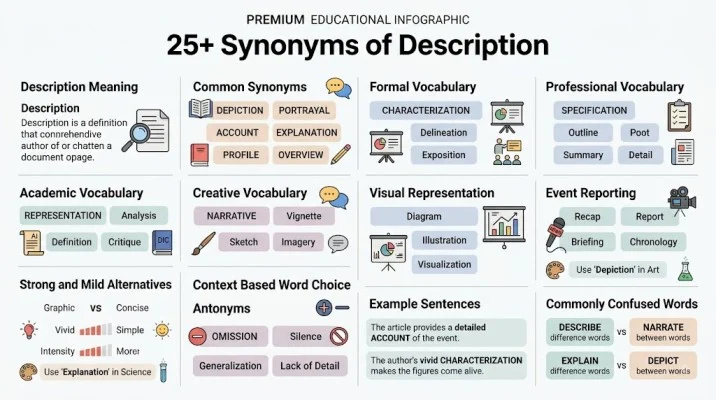
Writers often notice the problem when an email, essay, blog post, or school assignment uses the word description several times. Repeating the same word can make otherwise strong writing feel flat, especially when a more precise alternative would better explain a scene, person, idea, or event. Learning the right synonym of description can make your vocabulary more varied and your meaning easier to understand.
The best alternative depends on what you are describing and why. A depiction works well for a visual or artistic portrayal, an account suits an explanation of events, a profile summarizes a person or organization, and a characterization focuses on personality or traits. Choosing the right word is not simply about avoiding repetition. It is about communicating the exact idea you intend.
What Is the Best Synonym of “Description”?
A description is an account or representation that explains what something looks like, means, or is like. Common alternatives include depiction, portrayal, account, explanation, representation, profile, characterization, outline, sketch, and narrative. The best choice depends on whether you are describing appearance, events, people, ideas, or details.
Meaning, Tone, and Context
Simple Definition
Description refers to words or information used to explain the characteristics, appearance, qualities, details, or nature of something.
For example:
“The writer gave a detailed description of the old house.”
Here, description refers to the words used to help the reader understand what the house looked like.
The word can also refer to an explanation of an event, person, process, or idea:
“Her description of the meeting helped me understand what happened.”
Part of Speech
Description is a noun.
It commonly refers to:
- An account of something
- A portrayal of appearance
- An explanation of characteristics
- A summary of features
- A written or spoken representation
- Information that identifies or distinguishes something
Overall Tone
Description has a neutral tone.
It does not automatically communicate approval, criticism, excitement, or emotion. The tone comes from the surrounding words.
For example:
“His description of the accident was factual.”
The sentence sounds neutral.
“Her vivid description of the sunset was beautiful.”
Here, vivid and beautiful create the emotional effect.
Formality Level
Description is a neutral and widely accepted word.
It works naturally in:
- Academic writing
- Professional communication
- Business documents
- Emails
- Everyday conversations
- Creative writing
- Journalism
- Technical writing
- Product content
Some alternatives are more formal, literary, technical, or conversational, so replacing description requires attention to context.
Common Uses
Native English speakers commonly use description when discussing:
- A person
- A place
- A product
- An event
- A process
- A photograph
- A scene
- A character
- An experience
- A job
- A service
- A problem
- An idea
- A document
- A situation
“The job description explains the main responsibilities.”
“The author provides a detailed description of the city.”
“Can you give me a description of the person you saw?”
Word Forms
| Word | Part of Speech | Example |
|---|---|---|
| Description | Noun | The description was detailed. |
| Describe | Verb | Please describe the scene. |
| Descriptive | Adjective | The article uses descriptive language. |
| Descriptively | Adverb | The author writes descriptively. |
The most useful related forms are describe, descriptive, and description.
When and How to Use “Description”
Use description when you need a general, neutral word for information that explains what something is like or what happened.
It is especially useful when you do not need to emphasize a particular aspect such as artistic representation, personal interpretation, or technical detail.
Professional
“The position description outlines the responsibilities and required qualifications.”
Here, description sounds clear and professional.
Academic
“The paper includes a detailed description of the research method.”
This use is appropriate because academic writing often requires objective explanations.
Workplace
“Please read the project description before joining the meeting.”
The word clearly identifies explanatory information.
Personal
“He gave me a detailed description of his new apartment.”
This is natural in everyday conversation.
“I have attached a brief description of the proposed changes.”
This sounds professional without being overly formal.
Resume
“The job description helped me identify the skills required for the position.”
Here, description refers to information about a job.
Social Media
“I added a short description to explain the story behind the photo.”
This is natural for digital content and social media.
Best Synonyms of “Description”
No synonym of description works perfectly in every context. The best alternative depends on what the original word is doing in the sentence.
Professional Writing: Profile
Profile works particularly well when describing a person, company, organization, industry, or subject in a structured way.
“The report includes a detailed profile of the company.”
It sounds polished and organized without being unnecessarily formal.
Academic Writing: Account
Account is useful when describing an explanation or report of events, experiences, or findings.
“The researcher provides an account of the events.”
It often sounds more analytical than the general word description.
Business Communication: Overview
Overview works when you want to present the main points without extensive detail.
“The document provides an overview of the new marketing strategy.”
It is particularly useful for reports, presentations, and business emails.
Casual Conversation: Explanation
Explanation is a natural choice when someone is trying to make an idea, event, or situation understandable.
“Thanks for the explanation. Now I understand what happened.”
Emotional Writing: Portrayal
Portrayal works well when describing how someone, something, or an experience is presented, especially when interpretation or emotion is involved.
“The novel offers a moving portrayal of family relationships.”
Creative Writing: Depiction
Depiction is especially useful for artistic, literary, photographic, or visual representation.
“The painting is a vivid depiction of rural life.”
Resume Writing: Profile
For resumes, profile is often more natural when introducing a person’s professional background.
“The professional profile highlights her leadership experience.”
Workplace Communication: Outline
Outline works when the description provides the main points, structure, or essential information.
“The project outline explains the major stages of development.”
Stronger Meaning: Detailed Account
When you need to emphasize depth and completeness, detailed account is stronger than simply description.
“The journalist provided a detailed account of the investigation.”
Softer Meaning: Overview
When only the basic information is needed, overview is less detailed and less demanding than description.
“The presentation gives a brief overview of the proposal.”
When Not to Use “Description”
Although description is flexible, sometimes another word communicates the intended meaning more accurately.
When “Description” Is Too General
If you are specifically discussing a person’s professional background, description may be too broad.
Less Precise:
“The website contains a description of the CEO.”
Better:
“The website contains a professional profile of the CEO.”
Why:
Profile immediately tells readers that the content covers a person’s background and characteristics.
When “Description” Is Too Vague
If you are summarizing the main points of a long topic, overview can be clearer.
Less Precise:
“The report includes a description of the project.”
Better:
“The report includes an overview of the project.”
Why:
Overview signals that the reader will receive the main points rather than every detail.
When “Description” Is Too Weak for Creative Writing
Creative writing often needs a word that suggests representation or artistic presentation.
Less Effective:
“The novel gives a description of poverty.”
Better:
“The novel offers a powerful portrayal of poverty.”
Why:
Portrayal suggests that the author presents the subject through a particular perspective.
When “Description” Is Too Formal for Conversation
In casual conversation, description can sometimes sound more formal than necessary.
Formal:
“Can you provide a description of what happened?”
More Natural:
“Can you explain what happened?”
Why:
Explain sounds more conversational and direct.
When a Visual Representation Is Meant
When the subject is a picture, artwork, or visual representation, depiction may be more precise.
General:
“The painting provides a description of the landscape.”
Better:
“The painting provides a depiction of the landscape.”
Why:
Depiction directly emphasizes representation through an artistic or visual medium.
When the Content Is Mainly an Event Report
If the text explains what happened, account may be stronger.
General:
“She gave a description of the accident.”
Better:
“She gave an account of the accident.”
Why:
Account naturally refers to someone’s report or explanation of events.
Words Commonly Confused With “Description”
| Word | Difference | When to Use It | Example |
|---|---|---|---|
| Explanation | Focuses on making something understandable. | Ideas, reasons, processes, problems. | “His explanation clarified the mistake.” |
| Depiction | Focuses on representing something through words, images, or art. | Art, literature, photography. | “The film offers a realistic depiction of city life.” |
| Portrayal | Focuses on how a person, situation, or idea is presented. | Literature, media, personal representation. | “Her portrayal of the character was convincing.” |
| Account | Focuses on reporting events or experiences. | News, history, personal experiences. | “He gave an honest account of the incident.” |
| Profile | Focuses on a person’s or organization’s characteristics and background. | Business, journalism, resumes. | “The magazine published a profile of the scientist.” |
| Overview | Focuses on the main points rather than complete detail. | Reports, presentations, introductions. | “The guide provides an overview of the process.” |
Best Synonyms of “Description” by Context
| Context | Best Synonym | Why It Works | Example |
|---|---|---|---|
| Formal writing | Account | Sounds precise and objective. | The report provides an account of the investigation. |
| Academic writing | Explanation | Clearly communicates ideas and reasoning. | The paper offers an explanation of the findings. |
| Professional communication | Profile | Works well for people and organizations. | The report contains a company profile. |
| Business emails | Overview | Efficiently presents main information. | Here is a brief overview of the proposal. |
| Resume writing | Profile | Fits professional introductions. | Her profile emphasizes project management skills. |
| Workplace communication | Outline | Presents structure and key points. | The outline explains the project’s next stages. |
| Casual conversation | Explanation | Sounds natural when clarifying something. | His explanation made the situation clearer. |
| Everyday speaking | Account | Useful for recounting events. | She gave me an account of the trip. |
| Creative writing | Portrayal | Adds a literary sense of representation. | The story gives a vivid portrayal of grief. |
| Storytelling | Narrative | Emphasizes a sequence of events. | The narrative follows a family across three generations. |
| Emotional writing | Portrayal | Can convey feelings and perspective. | The novel’s portrayal of loss is powerful. |
| Strong emphasis | Detailed account | Signals depth and completeness. | The article provides a detailed account of the event. |
| Mild tone | Overview | Gives only essential information. | The page offers an overview of the topic. |
| Social media captions | Explanation | Helps clarify context. | The caption includes an explanation of the photograph. |
| American English | Description | The standard neutral choice. | The product description is easy to understand. |
| British English | Description | Also natural and standard. | The website includes a detailed description of the property. |
How to Choose the Best Synonym of “Description”
Choosing the right alternative becomes easier when you identify what kind of information you are communicating.
If You Are Explaining an Idea
Choose explanation.
“The teacher gave a clear explanation of the concept.”
If You Are Reporting Events
Choose account.
“The witness gave an account of what happened.”
If You Are Presenting a Person
Choose profile or characterization.
“The article includes a detailed profile of the author.”
If You Are Representing Something Visually
Choose depiction or representation.
“The photograph is an accurate depiction of the building.”
If You Are Presenting Main Points
Choose overview or outline.
“The presentation begins with an overview of the project.”
If You Are Writing Creatively
Choose portrayal, depiction, rendering, or word picture depending on the effect you want.
If You Need Strong Detail
Choose detailed account, elaboration, or delineation when the context supports a more precise or formal expression.
Consider Your Audience
A technical report may benefit from specification or delineation, while a casual conversation usually calls for explanation or simply description.
Consider Emotional Strength
Words such as portrayal and depiction can carry more interpretive weight than the neutral word description. If you want completely objective language, description, account, or overview may be better.
Consider Formality
For academic and professional writing, account, profile, overview, representation, and delineation can be useful. In everyday speech, description and explanation are usually more natural.
Choose Natural English First
Do not replace description simply because another word sounds more sophisticated. The best synonym is the one that communicates the intended meaning naturally and precisely.
Real Life Examples of “Description”
School
Basic:
“The assignment asks for a description of your favorite place.”
More specific:
“The assignment asks for a detailed portrayal of your favorite place.”
The second version can work in creative writing when the student’s goal is to create an image for the reader.
College
“The research paper includes an account of the study’s methodology.”
Account works because the writer is reporting information in an organized way.
Workplace
“The project outline explains the tasks that each team member will complete.”
Outline is better than description when the focus is structure and key points.
Business
“The proposal begins with an overview of the company’s growth strategy.”
Overview tells the reader that only the major points will be covered.
“I’ve included a brief explanation of the changes below.”
Explanation is natural when the goal is to clarify why something changed.
Resume
“Her professional profile highlights experience in marketing and customer relations.”
Profile is more precise than description for a resume introduction.
Conversation
“Can you give me a quick account of what happened?”
The word account is useful when someone is recounting events.
Storytelling
“The author’s vivid portrayal of the village makes the setting feel real.”
Portrayal adds a creative and interpretive quality.
Blogging
“The article provides a practical overview of the new software.”
This is effective when the blog gives readers the major features rather than every technical detail.
Social Media
“I added a short explanation to the caption so readers would understand the photo.”
Here, explanation is more natural because the caption provides context.
25 Best Synonyms of “Description”
| Synonym | Simple Meaning | Best Used For | Example Sentence |
|---|---|---|---|
| Depiction | A representation of something | Art, literature, images | The painting is a vivid depiction of rural life. |
| Portrayal | The way something or someone is presented | Creative writing, media | Her portrayal of the character felt authentic. |
| Account | A report of events or experiences | Reports, history, conversations | He gave an honest account of the incident. |
| Explanation | Information that makes something clear | Ideas, processes, conversations | The teacher gave a simple explanation of the rule. |
| Profile | A summary of someone’s or something’s characteristics | People, companies, resumes | The article contains a profile of the entrepreneur. |
| Overview | A summary of the main points | Reports, presentations | The presentation provides an overview of the project. |
| Outline | A general presentation of key points or structure | Plans, essays, projects | The outline covers the main stages of the research. |
| Characterization | The way a character’s qualities are presented | Fiction, literature | The novel’s characterization of the villain is complex. |
| Representation | A way of showing or presenting something | Art, media, academic writing | The photograph is a representation of modern city life. |
| Narrative | An account arranged as a story or sequence | Storytelling, history | The book presents a compelling narrative of migration. |
| Sketch | A brief or general description | Writing, journalism, conversation | The article gives a brief sketch of the region. |
| Rendering | A particular presentation or interpretation | Art, design, creative writing | The artist created a detailed rendering of the building. |
| Exposition | A detailed explanation or presentation | Academic and literary writing | The opening chapter provides exposition about the setting. |
| Delineation | A clear description or marking of boundaries or features | Formal and technical writing | The report offers a careful delineation of responsibilities. |
| Specification | Precise information about features or requirements | Technical and professional writing | The product specification lists the required dimensions. |
| Illustration | An example or representation that clarifies something | Education, writing, visual media | The diagram provides an illustration of the process. |
| Presentation | The way something is shown or communicated | Business, media, creative work | The presentation of the evidence was convincing. |
| Elaboration | Additional detail that develops an idea | Academic and explanatory writing | The author provides further elaboration on the central argument. |
| Character sketch | A brief portrayal of a person’s personality | Literature, journalism | The writer creates a memorable character sketch of the teacher. |
| Verbal portrait | A vivid description created with words | Creative writing | The author paints a verbal portrait of the busy marketplace. |
| Word picture | A description that creates a mental image | Creative and descriptive writing | The poem creates a beautiful word picture of the ocean. |
| Recital | A detailed reporting of events or facts | Formal reporting | His recital of the events was remarkably clear. |
| Statement | A clear expression of information or facts | Professional and formal writing | The statement provides basic information about the policy. |
| Report | An organized account of information or events | Business, journalism, academics | The report gives a thorough account of the findings. |
| Presentation of details | A way of communicating specific information | Formal and explanatory writing | The presentation of details made the instructions easier to follow. |
Synonyms of “Description” by Usage
Professional vs Personal Synonyms
Professional writing benefits from precise words that identify the type of information being presented.
Use profile for people and organizations, overview for summaries, account for events, outline for plans, and specification for technical details.
Personal communication can use simpler alternatives such as description, explanation, account, and story when appropriate.
For example:
“Can you give me a description of the restaurant?”
sounds neutral and natural.
“Can you give me an account of what happened?”
focuses more specifically on events.
Formal vs Conversational Synonyms
Formal writing may use account, delineation, exposition, representation, or specification when the context supports them.
Conversational English usually favors description, explanation, overview, or account.
For texting, avoid unnecessarily formal choices such as delineation or exposition. Natural communication is more important than impressive vocabulary.
Academic Synonyms
Academic writing benefits from precise alternatives such as:
- Account
- Explanation
- Analysis
- Representation
- Characterization
- Delineation
- Exposition
- Overview
These words help identify what the academic text is actually doing.
For example:
“The study provides an account of the participants’ experiences.”
is more precise than:
“The study provides a description of the participants’ experiences.”
The original sentence is not incorrect, but account more clearly emphasizes reported experiences.
Professional and Business Synonyms
- For resumes, use profile.
- For interviews, use account when discussing an experience.
- For meetings, use overview.
- For presentations, use outline or overview.
- For performance reviews, use assessment when evaluation is actually intended.
- For client communication, use explanation when clarifying an issue.
- For business emails, use overview, summary, or explanation according to the content.
Creative and Literary Synonyms
Creative writing allows more expressive alternatives.
Portrayal emphasizes presentation.
Depiction emphasizes representation.
Characterization focuses on personality.
Rendering can suggest an artistic interpretation.
Verbal portrait and word picture emphasize vivid imagery.
For example:
“The writer creates a vivid verbal portrait of the crowded market.”
This creates a stronger literary effect than simply saying:
“The writer gives a description of the market.”
Slang or Modern Synonyms
There is no widely accepted slang word that directly replaces description in all situations.
Casual expressions such as the rundown can sometimes mean a short explanation or summary.
“Can you give me the rundown?”
This is conversational and natural in informal American English.
Avoid rundown in academic papers, formal reports, resumes, and official documents. Use overview, summary, or explanation instead.
Strongest to Mildest Synonyms
Unlike words that describe emotions or physical intensity, description does not have a strict intensity scale. The difference is usually based on detail, precision, and depth.
| Level | Useful Alternatives | Typical Effect |
|---|---|---|
| Mild | Overview, sketch, outline | Gives basic information. |
| Moderate | Description, account, profile | Provides meaningful information. |
| Strong | Detailed account, exposition, delineation | Gives greater depth or precision. |
| Very Specific | Specification, characterization, detailed portrayal | Focuses on a particular type of information. |
A word is not necessarily “stronger” simply because it sounds more formal. Specification, for example, is more precise than description in technical contexts, but it is not a stronger version in every sentence.
Emotional vs Neutral Synonyms
Emotional Synonyms
Some alternatives can create stronger emotional or artistic associations.
- Portrayal
- Depiction
- Characterization
- Verbal portrait
- Word picture
- Rendering
Example:
“The author’s portrayal of loneliness is deeply moving.”
These words are useful when the writer wants to emphasize interpretation, imagery, or emotional effect.
Neutral Synonyms
For objective communication, choose:
- Description
- Account
- Overview
- Explanation
- Outline
- Profile
- Specification
- Representation
Example:
“The report provides an objective account of the incident.”
Neutral vocabulary works especially well in academic, business, and technical contexts.
Antonyms of “Description”
Description does not have 15 exact dictionary opposites. It is a noun for an act or result of explaining or representing something, so words such as silence, omission, and concealment can function as contextual opposites, but they are not interchangeable dictionary antonyms.
For practical vocabulary learning, the following terms represent situations where information is withheld, left unclear, or not communicated.
| Contextual Opposite | Meaning | Example Sentence |
|---|---|---|
| Silence | Absence of spoken information | His silence gave us no information about the decision. |
| Omission | Leaving information out | The omission of key details made the report incomplete. |
| Concealment | Deliberately keeping information hidden | The concealment of the facts created confusion. |
| Withholding | Choosing not to provide information | Withholding important details made the situation harder to understand. |
| Secrecy | Keeping information hidden from others | The project was surrounded by unnecessary secrecy. |
| Vagueness | Lack of clear detail | The vagueness of the instructions caused problems. |
| Ambiguity | Uncertainty caused by unclear meaning | The ambiguity of the statement confused readers. |
| Obscurity | A state of being difficult to understand or know | The obscurity of the wording weakened the explanation. |
| Incompleteness | Lack of necessary information | The incompleteness of the description left several questions unanswered. |
| Uncertainty | Lack of definite information | The uncertainty surrounding the event made planning difficult. |
| Confusion | Lack of clarity or understanding | The confusing instructions created unnecessary confusion. |
| Silence | Failure to communicate verbally | Her silence prevented the team from understanding her concerns. |
| Noncommunication | Absence of communication | Noncommunication between departments caused delays. |
| Suppression | Deliberately preventing information from being shared | The suppression of relevant information affected the investigation. |
| Misdirection | Communication that leads someone away from the truth | The misleading statement created misdirection rather than clarity. |
Comparison: “Description” vs “Explanation”
Main Difference
A description tells readers what something is like, while an explanation helps them understand why something happens, how something works, or what something means.
Which Is Stronger?
Neither is inherently stronger. They serve different purposes.
Which Is More Formal?
Both are neutral and appropriate for formal writing.
When to Use Each
Use description for characteristics and appearance.
Use explanation for reasons, processes, and meaning.
Examples
Description:
“The report includes a description of the damaged building.”
Explanation:
“The report includes an explanation of why the building was damaged.”
Comparison: “Description” vs “Depiction”
Main Difference
A description communicates details, while a depiction emphasizes representation through words, images, art, film, or other forms.
Which Is Stronger?
Depiction can sound more expressive or interpretive.
Which Is More Formal?
Both work in formal writing, but depiction is particularly common in discussions of art and media.
When to Use Each
Use description for general information.
Use depiction for artistic or visual representation.
Examples
Description:
“The article includes a detailed description of the painting.”
Depiction:
“The painting is a powerful depiction of poverty.”
Comparison: “Description” vs “Portrayal”
Main Difference
A portrayal focuses on the way someone or something is presented, while a description focuses more generally on the details provided.
Which Is Stronger?
Portrayal can carry more interpretive and emotional weight.
Which Is More Formal?
Both can appear in formal writing, although portrayal is especially common in literary and media analysis.
When to Use Each
Use portrayal when discussing perspective or representation.
Examples
Description:
“The book contains a description of the main character.”
Portrayal:
“The author’s portrayal of the main character is complex.”
Comparison: “Description” vs “Account”
Main Difference
An account usually reports events, experiences, or information, while a description can focus on appearance, qualities, or characteristics.
Which Is Stronger?
Neither is universally stronger.
Which Is More Formal?
Account can sound slightly more formal in reporting contexts.
When to Use Each
Use account for events and experiences.
Use description for characteristics and appearance.
Examples
Description:
“She gave a description of the room.”
Account:
“She gave an account of what happened inside the room.”
Comparison: “Description” vs “Profile”
Main Difference
A profile is a structured presentation of a person, organization, product, or subject, often including background and key characteristics.
Which Is Stronger?
Neither is stronger. Profile is more specific.
Which Is More Formal?
Both can be professional, but profile is especially common in business and journalism.
When to Use Each
Use profile for people, organizations, companies, and professional backgrounds.
Examples
Description:
“The website contains a description of the company.”
Profile:
“The website contains a detailed company profile.”
Comparison: “Description” vs “Overview”
Main Difference
An overview presents the main points, while a description can include much more detail.
Which Is Stronger?
Description can provide more detail.
Which Is More Formal?
Both are suitable for professional and academic writing.
When to Use Each
Use overview when you want a concise summary.
Examples
Description:
“The manual contains a detailed description of the equipment.”
Overview:
“The first chapter provides an overview of the equipment.”
Common Phrases and Expressions with “Description”
Detailed Description
Meaning: A description containing substantial information.
Example:
“The listing provides a detailed description of the property.”
Brief Description
Meaning: A short explanation or presentation.
Example:
“Please include a brief description of your experience.”
Job Description
Meaning: A document or section explaining the duties, responsibilities, and requirements of a job.
Example:
“The job description lists three years of required experience.”
Product Description
Meaning: Information explaining a product’s features and characteristics.
Example:
“The product description includes dimensions and materials.”
Written Description
Meaning: Information communicated through writing.
Example:
“The application requires a written description of the project.”
Accurate Description
Meaning: Information that correctly represents the subject.
Example:
“The report provides an accurate description of the incident.”
Vivid Description
Meaning: A description that creates a strong mental image.
Example:
“The novelist uses vivid description to bring the setting to life.”
Brief Description
Meaning: A concise presentation of essential information.
Example:
“Add a brief description below the photograph.”
Common Mistakes to Avoid
Mistake 1: Treating Every Synonym as Interchangeable
Incorrect:
“The painting gave an account of the landscape.”
Better:
“The painting gave a depiction of the landscape.”
Why:
Account normally reports information or events. Depiction is more appropriate for artistic representation.
Mistake 2: Using “Explanation” for Every Description
Incorrect:
“The museum displayed an explanation of the ancient statue.”
Better:
“The museum displayed a description of the ancient statue.”
Why:
The museum is providing information about the statue rather than necessarily explaining a reason or process.
Mistake 3: Using Informal Language in Academic Writing
Incorrect:
“The paper gives the rundown on the experiment.”
Better:
“The paper provides an overview of the experiment.”
Why:
Rundown is conversational. Overview is more appropriate for academic writing.
Mistake 4: Choosing an Overly Formal Word
Incorrect:
“Can you provide a delineation of your weekend?”
Better:
“Can you give me a description of your weekend?”
Why:
Delineation sounds unnecessarily formal for ordinary conversation.
Mistake 5: Confusing Description With Evaluation
Incorrect:
“The report gives a description that the product is excellent.”
Better:
“The report provides an evaluation of the product.”
Why:
An evaluation judges quality. A description simply provides information.
Mistake 6: Repeating “Description” Too Often
Incorrect:
“The description of the room gives a description of the furniture and a description of the lighting.”
Better:
“The description of the room covers the furniture and provides a detailed account of the lighting.”
Why:
Strategic variation improves readability while preserving meaning.
Mistake 7: Using a Synonym That Changes the Meaning
Incorrect:
“The employee profile explains why the machine stopped working.”
Better:
“The employee explanation explains why the machine stopped working.”
Why:
Profile normally describes a person, organization, or subject. Explanation is appropriate for reasons or causes.
Frequently Asked Questions
What are the best synonyms of “description”?
The best synonyms of description include depiction, portrayal, account, explanation, profile, overview, outline, characterization, representation, and narrative. The best choice depends on whether you are describing appearance, events, people, ideas, or artistic representation.
What are the best formal synonyms of “description”?
Formal alternatives include account, representation, delineation, exposition, specification, characterization, and depiction. However, the appropriate choice depends on context. Academic and technical writing should prioritize precision rather than simply using more formal vocabulary.
What are common informal synonyms of “description”?
In casual English, explanation, account, overview, and expressions such as the rundown can work depending on meaning. Description itself is also completely natural in everyday conversation and does not always need replacement.
What is another word for “description” in professional writing?
Profile, overview, account, outline, explanation, and specification are useful professional alternatives. Choose profile for people or companies, overview for summaries, outline for plans, and specification for technical requirements.
What is the difference between “description” and “explanation”?
A description tells someone what a person, object, place, or situation is like. An explanation focuses on meaning, reasons, causes, or processes. For example, you describe a building but explain why it was damaged.
What is the opposite of “description”?
There is no single exact opposite of description. Depending on context, possible contrasts include silence, omission, concealment, vagueness, ambiguity, and withholding, especially when information is not communicated clearly or completely.
Conclusion
Description is a flexible, neutral noun used for information that explains what something is like, what happened, or what characteristics something has. The best alternative depends on the specific purpose of the sentence.
Use depiction for visual representation, portrayal for presentation or interpretation, account for events, profile for people or organizations, overview for main points, explanation for ideas and reasons, and outline for structure or plans. More specialized terms such as specification, delineation, and characterization can provide greater precision when the context calls for them.
There is no single perfect synonym of description for every sentence. Before replacing the word, consider your audience, intended meaning, level of formality, and the type of information you are communicating. A useful vocabulary habit is to identify the exact job a word performs before choosing its replacement.
Read More Related Articles:
50+ Synonyms of Change | Meanings, Uses, Examples, and …
50+ Synonyms of Infinitive | Meanings, Uses, Examples, and …










1 thought on “Synonym of Description | 25+ Synonyms, Meanings, Uses, and Best Alternatives”