When people search for synonyms for danger, they usually want more than a list of similar words. They want to know which alternative fits their sentence, sounds natural, and matches the level of seriousness they want to express.
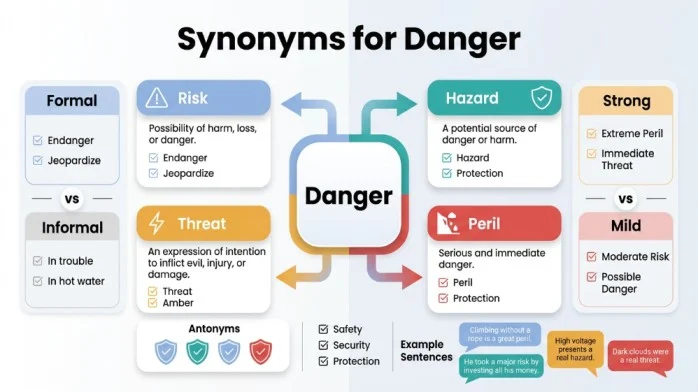
The best synonym for danger depends on context, tone, and intensity. In many situations, risk, hazard, threat, and peril are excellent alternatives. While these words all relate to the possibility of harm, they are not always interchangeable. Some are better suited to formal writing, while others work naturally in everyday conversation.
This guide explains the meaning of danger, highlights its most useful synonyms, and shows how to choose the right word with confidence.
Best Synonyms for Danger
The best synonyms for danger are risk, hazard, threat, and peril. The right choice depends on tone, context, and intensity.
Here’s a quick overview:
| Synonym | Best Used For |
|---|---|
| Risk | Possibility of harm or loss |
| Hazard | Dangerous conditions or objects |
| Threat | Someone or something likely to cause harm |
| Peril | Serious or life-threatening danger |
If you’re writing casually, risk often sounds the most natural. In professional, legal, or safety-related writing, hazard is usually more precise. For dramatic or literary situations, peril adds stronger emotional impact.
What Does Danger Mean?
Danger is the possibility that someone or something may suffer harm, injury, damage, or loss. It refers to situations where negative consequences are likely if proper care is not taken.
Part of Speech:
Noun
The word can describe physical harm, financial loss, emotional distress, environmental threats, or any circumstance that puts people or property at risk.
Examples
- The firefighters entered the building despite the danger.
- Children should stay away from areas that present serious danger.
In everyday English, danger is commonly used to warn people about unsafe situations or describe conditions that require caution.
Core Meaning of Danger
At its heart, danger means the possibility of being harmed.
That harm can come from many different sources:
- Physical injury
- Natural disasters
- Crime
- Disease
- Financial problems
- Emotional situations
- Unsafe environments
The word does not always mean that harm has already happened. Instead, it often refers to the chance or likelihood that something harmful could occur.
For example:
- Walking on thin ice is dangerous because there is a chance it could break.
- Investing without research carries financial danger because money could be lost.
- Ignoring a medical condition may create greater danger over time.
Because danger is such a broad word, different synonyms emphasize different aspects of harm. Some focus on uncertainty, while others highlight immediate threats or severe consequences.
Grammar and Usage Notes
Understanding how danger functions in a sentence makes it easier to replace it with the right synonym.
Part of Speech
Danger is primarily used as a countable or uncountable noun.
Examples:
- There is danger ahead.
- The hikers faced many dangers during their expedition.
Common Sentence Patterns
Danger frequently appears in these sentence structures:
- danger of + noun
- danger of + verb (-ing)
- in danger
- out of danger
- pose a danger
- represent a danger
- place someone in danger
- warn of danger
Examples:
- There is a danger of flooding.
- The patient is now out of danger.
- Smoking poses a serious danger to health.
- Loud machinery can present a danger to workers.
Common Collocations
Native speakers often pair danger with words such as:
- immediate danger
- serious danger
- grave danger
- potential danger
- hidden danger
- real danger
- mortal danger
- constant danger
- public danger
- environmental danger
Using these combinations helps your writing sound natural and fluent.
When “Danger” Sounds Natural
The word danger works well when referring to a general possibility of harm without focusing on the exact cause.
Examples include:
- safety instructions
- news reports
- everyday conversation
- school writing
- health advice
- emergency situations
When a Synonym May Work Better
Sometimes another word communicates your meaning more precisely.
Choose:
- Risk when discussing probability or uncertainty.
- Hazard when describing unsafe conditions.
- Threat when referring to an active source of harm.
- Peril when emphasizing extreme seriousness.
- Jeopardy in legal, financial, or formal contexts.
- Menace when highlighting ongoing harmful behavior.
Selecting the right synonym improves clarity and helps readers understand exactly what kind of danger you mean.
Best Synonyms for Danger
| Synonym | Meaning | Tone | Best Use Case | Example Sentence |
|---|---|---|---|---|
| Risk | Possibility of harm or loss | Neutral | Everyday writing, business, health | Investing without research carries significant risk. |
| Hazard | A source of possible harm | Formal | Workplace safety, engineering, science | Wet floors create a slipping hazard. |
| Threat | Something likely to cause harm | Neutral to Strong | Security, health, environment | The storm became a serious threat to nearby towns. |
| Peril | Extreme or life-threatening danger | Dramatic | Literature, news, storytelling | The sailors faced great peril at sea. |
| Jeopardy | Exposure to possible harm or loss | Formal | Legal and professional writing | Budget cuts placed the project in jeopardy. |
| Menace | A persistent source of harm | Strong | Crime, public safety | Illegal dumping has become a menace to the community. |
| Unsafe Condition | Situation lacking safety | Neutral | Safety reports | The inspection found several unsafe conditions. |
| Exposure | Being subject to harmful conditions | Technical | Medical and environmental writing | Long-term chemical exposure increases health risks. |
| Vulnerability | State of being open to harm | Formal | Cybersecurity, healthcare | Older adults have greater vulnerability during heat waves. |
| Uncertainty | Lack of predictable safety | Mild | Finance and planning | Economic uncertainty creates investment risks. |
Common Synonyms for Danger
These are the words people most often use instead of danger in everyday English.
Risk
Meaning: The chance that something harmful or undesirable may happen.
Best Context: Health, finance, sports, travel, and everyday decisions.
Example:
There is a high risk of heavy rain this afternoon.
Hazard
Meaning: Something that can cause injury or damage.
Best Context: Workplace safety, construction, science, and public health.
Example:
Broken glass is a serious hazard for children.
Threat
Meaning: A person, event, or condition that could cause harm.
Best Context: Weather, security, health, and politics.
Example:
Wildfires remain a major threat to nearby communities.
Peril
Meaning: Extreme or immediate danger.
Best Context: Stories, journalism, and dramatic descriptions.
Example:
The climbers survived despite the peril of the steep mountain.
Jeopardy
Meaning: Exposure to serious loss, harm, or failure.
Best Context: Business, legal writing, and formal communication.
Example:
The company’s reputation was placed in jeopardy after the incident.
Menace
Meaning: A continuing source of harm, fear, or trouble.
Best Context: Public safety, crime, and environmental issues.
Example:
Air pollution has become a growing menace in large cities.
Pitfall
Meaning: A hidden problem that may lead to failure or difficulty rather than direct physical harm.
Best Context: Business, education, planning, and decision-making.
Example:
One common pitfall is ignoring important details before signing a contract.
Exposure
Meaning: Being subjected to something harmful.
Best Context: Medicine, science, and environmental discussions.
Example:
Long-term exposure to loud noise can damage hearing.
Vulnerability
Meaning: The condition of being more likely to experience harm.
Best Context: Technology, healthcare, security, and psychology.
Example:
Weak passwords increase a system’s vulnerability to cyberattacks.
Endangerment
Meaning: The act or condition of putting someone or something at risk.
Best Context: Legal, environmental, and wildlife discussions.
Example:
Habitat destruction has led to the endangerment of many animal species.
Formal Synonyms for Danger
Formal alternatives are useful in academic papers, business communication, legal documents, technical reports, and professional writing. These words often sound more precise than danger and may highlight a specific type of risk or harm.
Hazard
Meaning: A source or condition that could cause injury, illness, or damage.
Best for: Safety manuals, workplace policies, engineering reports, and scientific writing.
Example:
Loose electrical wires are a significant hazard in the workplace.
Jeopardy
Meaning: Exposure to possible harm, failure, or loss.
Best for: Legal, financial, and business writing.
Example:
Poor planning placed the entire project in jeopardy.
Vulnerability
Meaning: A state of being open to harm or attack.
Best for: Cybersecurity, healthcare, psychology, and risk assessments.
Example:
The audit revealed several security vulnerabilities in the system.
Exposure
Meaning: The condition of being subjected to harmful substances or situations.
Best for: Medical, environmental, and scientific contexts.
Example:
Long-term exposure to harmful chemicals should be avoided.
Endangerment
Meaning: The act or condition of placing someone or something at risk.
Best for: Environmental law, wildlife conservation, and legal writing.
Example:
Illegal hunting has contributed to the endangerment of several species.
Liability
Meaning: A condition that may create legal, financial, or practical risk.
Best for: Business, insurance, and legal documents.
Example:
Ignoring safety standards can increase a company’s liability.
Informal Synonyms for Danger
In everyday conversations, people often choose simpler words instead of danger. These alternatives sound natural in casual speech, text messages, blogs, and social media.
Risk
The most common everyday alternative.
Example:
There’s a real risk of getting caught in traffic.
Trouble
Used when a situation may lead to problems rather than serious harm.
Example:
If we leave now, we could be in trouble.
Hot Water
An idiom meaning serious difficulty.
Example:
He’ll be in hot water if he misses another deadline.
Sticky Situation
Describes a difficult or risky circumstance.
Example:
We found ourselves in a pretty sticky situation after the car broke down.
Dicey Situation
Means uncertain or risky.
Example:
Driving during the storm was a bit dicey.
Bad Spot
A simple conversational expression.
Example:
Running out of fuel left us in a bad spot.
These informal alternatives work best when writing naturally for friends, family, blogs, or social media. They usually sound too casual for academic or professional documents.
Strong Synonyms for Danger
Some situations involve immediate or severe harm. In these cases, stronger synonyms communicate a greater sense of urgency or seriousness.
Peril
Suggests extreme or life-threatening danger.
Best use: Adventure stories, news reports, and dramatic writing.
Example:
The explorers faced great peril during the expedition.
Menace
Refers to a continuing source of danger or harm.
Example:
The criminal organization became a serious menace to the community.
Mortal Danger
Emphasizes the possibility of death.
Example:
The injured climber remained in mortal danger until rescued.
Grave Risk
Highlights an exceptionally serious possibility of harm.
Example:
Ignoring the warning would create a grave risk to public safety.
Extreme Hazard
Describes highly dangerous conditions.
Example:
The chemical spill created an extreme hazard for nearby residents.
Threat
Often sounds stronger than danger because it points to an active source of harm.
Example:
The approaching wildfire posed an immediate threat.
When Strong Words May Be Too Much
Avoid stronger synonyms when the situation is only mildly risky.
For example:
- “There is a risk of rain.” ✔
- “There is mortal peril of rain.” ✘
Choosing an overly dramatic word can make your writing sound exaggerated or unrealistic.
Mild Synonyms for Danger
Sometimes you want to describe a situation that requires caution without suggesting severe harm. Mild synonyms help create a balanced tone.
Risk
The safest general replacement.
Example:
There is a slight risk of delays.
Concern
Used when discussing potential problems.
Example:
Road conditions remain a concern after the snowfall.
Caution
Focuses on careful behavior rather than the danger itself.
Example:
Drivers should exercise caution in heavy fog.
Possibility
Highlights uncertainty instead of immediate harm.
Example:
There is a possibility of flooding later today.
Challenge
Useful when the situation is difficult but not necessarily dangerous.
Example:
Finding a parking space can be a real challenge downtown.
Uncertainty
Common in financial, economic, and planning contexts.
Example:
Market uncertainty has slowed investment decisions.
Mild wording is often the better choice when you want to avoid sounding overly alarming or dramatic.
Synonyms for Danger by Context
Different situations call for different words. Choosing the right synonym makes your writing more accurate and natural.
Everyday Conversation
In casual speech, simple words are usually the best choice.
Recommended synonyms:
- Risk
- Trouble
- Bad spot
- Dicey situation
Examples
- There’s a risk we’ll miss the train.
- We could get into trouble if we’re late again.
Professional Writing
Business and workplace communication benefits from clear, precise language.
Recommended synonyms:
- Hazard
- Risk
- Liability
- Exposure
- Jeopardy
Examples
- The report identified several workplace hazards.
- Delays may place the project in jeopardy.
Academic Writing
Academic writing often requires objective and technical vocabulary.
Recommended synonyms:
- Hazard
- Vulnerability
- Exposure
- Risk
- Endangerment
Examples
- Researchers examined environmental hazards.
- The study measured patient vulnerability.
Creative Writing
Stories often call for vivid language that builds suspense.
Recommended synonyms:
- Peril
- Menace
- Threat
- Grave danger
Examples
- Every step deeper into the cave increased their peril.
- A silent threat waited beyond the trees.
Marketing Copy
Marketing usually avoids frightening language unless emphasizing safety.
Recommended synonyms:
- Risk
- Concern
- Protection
- Threat
Examples
- Reduce the risk of identity theft.
- Protect your family from online threats.
Personal Communication
When talking with friends or family, natural language is usually best.
Recommended synonyms:
- Risk
- Trouble
- Concern
Examples
- I don’t want you taking that risk.
- We might have some trouble finding parking.
Another Word for Danger in a Sentence
Here are natural examples showing how different synonyms can replace danger depending on the situation.
- Crossing the river after heavy rain carries a serious risk.
- Broken equipment created a workplace hazard.
- The approaching storm became an immediate threat to the town.
- The sailors survived despite the peril of rough seas.
- Budget reductions placed the project in jeopardy.
- Long-term smoke exposure can damage lung health.
- Weak security increased the company’s vulnerability to cyberattacks.
- The abandoned building has become a public menace.
- Drivers should use extra caution during icy conditions.
- There is only a slight possibility of flooding this evening.
- Ignoring the warning signs could lead to serious trouble.
- Wildlife endangerment remains a growing environmental concern.
- Investors accepted the financial risk in exchange for higher returns.
- Scientists carefully evaluated every potential hazard before beginning the experiment.
- The rescue team acted quickly because lives were in grave peril.
Danger Synonyms Compared
Many synonyms for danger are closely related, but they are not identical. Choosing the right one depends on the situation, tone, and level of seriousness.
| Word | Meaning | Tone | Intensity | Best Use Case |
|---|---|---|---|---|
| Danger | General possibility of harm | Neutral | Medium | Everyday writing, warnings |
| Risk | Chance that harm or loss may occur | Neutral | Mild to Medium | Health, finance, decisions |
| Hazard | A source of possible harm | Formal | Medium | Safety, science, engineering |
| Threat | Someone or something likely to cause harm | Neutral to Strong | High | Security, weather, health |
| Peril | Extreme or life-threatening danger | Dramatic | Very High | Literature, journalism |
| Jeopardy | Exposure to loss or failure | Formal | Medium to High | Business, legal writing |
| Menace | A continuing source of harm | Strong | High | Crime, environmental issues |
Risk vs. Danger
Although these words are often used interchangeably, they emphasize different ideas.
- Danger refers to a harmful situation or condition.
- Risk focuses on the possibility or probability that harm may occur.
Examples
- Swimming during a storm is dangerous.
- There is a high risk of lightning strikes.
Hazard vs. Danger
A hazard is the specific thing that causes danger.
Example
- Wet paint is not the danger itself.
- The slippery floor is the hazard that creates the danger.
Threat vs. Danger
A threat usually has an active source.
Examples
- A dangerous road creates danger.
- A violent storm is a threat because it may cause damage.
Peril vs. Danger
Peril is much stronger and often suggests immediate or life-threatening harm.
Examples
- The hikers were in danger during the storm.
- The hikers were in peril after becoming trapped on the mountain.
Jeopardy vs. Risk
Both involve possible loss, but jeopardy sounds more formal.
Examples
- The investment carries some risk.
- The company’s future is in jeopardy.
Words Similar to Danger
Some words belong to the same semantic field as danger but are not exact synonyms. They relate to unsafe situations without always replacing the word directly.
Warning
A warning is a notice about possible danger rather than the danger itself.
Example
The weather service issued a warning before the hurricane.
Safety
Safety is the opposite condition of danger, but discussions about danger often include safety measures.
Example
The new equipment improves worker safety.
Emergency
An emergency is a serious situation that often results from danger but is not a synonym for it.
Example
Call emergency services immediately.
Crisis
A crisis is a difficult or unstable situation. It may involve danger but can also describe financial, political, or personal problems.
Example
The company faced a financial crisis.
Fear
Fear is the emotional response to danger rather than the danger itself.
Example
His fear disappeared once he reached safety.
Caution
Caution means acting carefully because danger might exist.
Example
Exercise caution when crossing the road.
Uncertainty
Uncertainty describes situations where outcomes are unknown. It may involve risk but does not always involve danger.
Example
Economic uncertainty affected business decisions.
These words are useful because they help describe situations related to danger, even though they cannot always replace the word in a sentence.
Antonyms of Danger
Antonyms express the opposite meaning of danger by describing safety, protection, or security.
| Antonym | Meaning | Example Sentence |
|---|---|---|
| Safety | Freedom from harm | The children reached safety after the storm. |
| Security | Protection from danger | Good lighting improves neighborhood security. |
| Protection | Keeping someone safe from harm | Helmets provide protection during cycling. |
| Shelter | A safe place | The hikers found shelter before the storm arrived. |
| Peace | A calm, conflict-free condition | After the rescue, the family finally felt peace. |
| Stability | A secure and steady state | Economic stability benefits businesses. |
How to Choose the Right Synonym for Danger
The best synonym depends on more than just the dictionary definition. Consider these practical tips before replacing danger.
Match the Context
Think about what kind of danger you’re describing.
- Workplace → Hazard
- Finance → Risk
- Security → Threat
- Adventure story → Peril
Match the Tone
Formal writing often needs precise language.
- Business report → Jeopardy
- Safety manual → Hazard
- Scientific article → Exposure
For everyday conversation, simpler words like risk usually sound more natural.
Check the Intensity
Not every situation deserves dramatic language.
A wet sidewalk may create a risk or hazard, but calling it mortal peril would sound exaggerated.
Think About the Reader
Choose words your audience will immediately understand.
For general readers:
- risk
- danger
- threat
For specialists:
- vulnerability
- exposure
- liability
Make Sure It’s an Exact Synonym
Related words are not always interchangeable.
For example:
- Warning is not another word for danger.
- Emergency is not another word for danger.
- Fear is not another word for danger.
Each has a different meaning.
Keep the Sentence Natural
Sometimes the original word is still the best choice.
Replacing every occurrence of danger simply to avoid repetition can make writing sound forced.
Common Mistakes When Using Synonyms for Danger
Even experienced writers occasionally choose the wrong synonym. Avoid these common mistakes.
Using the Wrong Tone
A formal report usually shouldn’t say someone was in a bad spot.
Instead, write:
- at risk
- in jeopardy
- facing hazards
Choosing a Word That’s Too Strong
Words like peril or mortal danger should be reserved for genuinely serious situations.
Avoid unnecessary exaggeration.
Using Formal Words in Casual Conversation
People rarely say:
“The picnic is in jeopardy.”
Most would naturally say:
“The picnic might be canceled.”
Using Casual Words in Professional Writing
Avoid slang or informal expressions in reports.
Instead of:
“The machine is kind of sketchy.”
Write:
“The machine presents a safety hazard.”
Replacing Danger Without Checking Meaning
Not every synonym fits every sentence.
For example:
“The chemical spill created a danger.”
can become
“The chemical spill created a hazard.”
But it should not become
“The chemical spill created uncertainty.”
because the meaning changes.
Treating Related Words as Synonyms
Words like warning, fear, crisis, and emergency relate to danger but describe different ideas.
Always check whether the replacement preserves the original meaning.
Making the Sentence Sound Unnatural
Don’t replace a common word simply because a thesaurus suggests it.
Natural writing is almost always better than overly complicated wording.
Quick Synonym List for Danger
Common Synonyms
- Risk
- Hazard
- Threat
- Peril
- Jeopardy
- Menace
Formal Synonyms
- Hazard
- Jeopardy
- Exposure
- Vulnerability
- Liability
- Endangerment
Informal Synonyms
- Risk
- Trouble
- Sticky situation
- Dicey situation
- Bad spot
Strong Synonyms
- Peril
- Menace
- Grave danger
- Mortal danger
- Serious threat
Mild Synonyms
- Risk
- Concern
- Caution
- Possibility
- Uncertainty
Related Words
- Warning
- Emergency
- Crisis
- Safety
- Fear
- Protection
FAQs
What is the best synonym for danger?
Risk is usually the best synonym for danger. It works in many situations and sounds natural in both speech and writing. For more serious situations, words like hazard, threat, or peril may be more appropriate.
What is another word for danger?
Another word for danger is risk, hazard, threat, peril, jeopardy, or menace. The best choice depends on the context and how serious the situation is.
What is a formal synonym for danger?
Hazard and jeopardy are among the most common formal synonyms. They are widely used in business, legal, academic, and technical writing.
What is an informal synonym for danger?
Risk and trouble are common informal alternatives. They sound natural in everyday conversations and personal writing.
What is a stronger word for danger?
Peril is a stronger word than danger. It usually describes immediate, severe, or life-threatening situations.
What is a milder word for danger?
Risk or concern can be milder alternatives. They suggest the possibility of harm without sounding overly dramatic.
What words are similar to danger?
Related words include warning, crisis, emergency, fear, caution, and safety. While connected to the same topic, they are not always direct synonyms.
What is the opposite of danger?
Safety is the most common opposite of danger. Other antonyms include security, protection, stability, and peace.
How do I choose the right synonym for danger?
Choose a synonym that matches the meaning, tone, context, and intensity of your sentence. A workplace report may call for hazard, while an adventure story may be better suited to peril.
Conclusion
Choosing the best synonyms for danger involves more than finding words with similar meanings. Each alternative carries its own tone, level of intensity, and preferred context.
For everyday situations, risk is often the most natural choice. Hazard works well in technical and safety-related writing, threat emphasizes an active source of harm, jeopardy fits formal communication, and peril is ideal for describing extreme or life-threatening situations.
Before replacing danger, think about what you want to communicate, who your audience is, and the synonym truly matches your intended meaning. Careful word choice makes your writing clearer, more precise, and more engaging.
Read More Related Articles:
Synonyms for Know | Meaning, Examples, and Better Word …
Synonyms for Pathetic | Meaning, Examples, and Better Word Choices