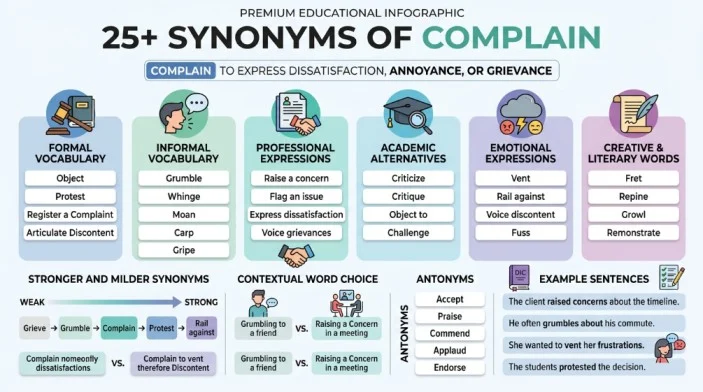
You may notice the word complain appearing again and again in emails, essays, customer messages, workplace conversations, or social media posts. While the word is perfectly natural, repeating it can make your writing sound less precise. Finding the right synonym of complain can help you express dissatisfaction, concern, criticism, or frustration more accurately.
The best alternative depends on what you actually mean. You might object to a decision, criticize a policy, protest an action, voice a concern in a professional email, or grumble about something casually. Understanding these differences helps you choose language that matches your audience, purpose, and emotional tone.
What Are the Best Synonyms of “Complain”?
The best synonyms of complain include object, protest, criticize, express dissatisfaction, voice a concern, grumble, whine, moan, and raise an issue. For formal writing, use object or express dissatisfaction. For professional communication, raise a concern works well. Casual speech may use grumble, while stronger situations may call for protest or object.
Meaning, Tone, and Context
Simple Definition
Complain means to express that you are unhappy, dissatisfied, annoyed, or concerned about something. It can also mean making a formal statement about a problem, especially when asking someone to address it.
For example:
“The customer complained about the delayed delivery.”
Here, complained tells us that the customer expressed dissatisfaction with the service.
The word can describe anything from a mild expression of annoyance to a serious formal grievance. Context determines how strong the complaint is.
Part of Speech
Complain is primarily a verb.
Examples:
“Several customers complained about the service.”
“She complained that the room was too noisy.”
The related noun is complaint.
“The manager received a complaint from a customer.”
Overall Tone
Complain generally has a negative or dissatisfied tone because it involves expressing unhappiness or criticism.
However, the word itself is not always extremely negative. The emotional intensity depends on the situation.
Compare:
“He complained about the cold weather.”
with:
“The residents protested against the proposed closure.”
The first expresses everyday dissatisfaction. The second suggests a stronger and more organized response.
Formality Level
Complain is a neutral word. It works in casual conversations, professional emails, customer service situations, academic writing, and formal documents.
Some alternatives have a more specific level of formality.
| Word or Expression | Formality |
|---|---|
| Complain | Neutral |
| Grumble | Informal |
| Whine | Informal and critical |
| Object | Formal or neutral |
| Protest | Neutral to formal |
| Criticize | Neutral to formal |
| Voice a concern | Professional |
| Express dissatisfaction | Formal |
| Lodge a complaint | Formal |
| Raise an issue | Professional |
Common Uses
Native English speakers commonly use complain when discussing:
- Poor customer service
- Delays
- Workplace problems
- Unfair treatment
- Noise
- Prices
- Product defects
- Policies
- Decisions
- Personal frustrations
- Physical discomfort
- Problems with services
- Disagreements
- Unpleasant experiences
Examples:
“The passengers complained about the delay.”
“She complained that the instructions were unclear.”
“Employees complained about the new schedule.”
Word Forms
| Form | Word | Example |
|---|---|---|
| Verb | Complain | “Customers complain about delays.” |
| Noun | Complaint | “We received a complaint.” |
| Related noun | Complainer | “He has a reputation as a frequent complainer.” |
| Past tense | Complained | “She complained about the noise.” |
| Present participle | Complaining | “They are complaining about the service.” |
The most useful related form for formal communication is complaint.
“I would like to make a complaint about the service.”
When and How to Use “Complain”
Use complain when someone openly expresses dissatisfaction, annoyance, or concern. It is especially natural when the speaker is unhappy about a situation and wants someone to know about the problem.
The word can be followed by about, of, or a clause introduced by that, depending on the sentence.
Professional
“Several employees complained about the lack of clear communication.”
This is appropriate when describing workplace dissatisfaction.
Academic
“Participants complained that the survey instructions were difficult to understand.”
This works when reporting what participants said.
Workplace
“The team complained about the outdated software.”
This describes an internal workplace concern in a straightforward way.
Personal
“My brother always complains about the weather.”
Here, complains sounds natural in casual conversation.
“I am writing to complain about the damaged product I received.”
This is understandable, although a more polished customer service email might say:
“I am writing to raise a concern about the damaged product I received.”
Resume
The verb complain is rarely a good choice on a resume because resumes normally focus on achievements and constructive actions.
Instead of:
“Employees complained about scheduling problems.”
A professional description could be:
“Addressed employee concerns regarding scheduling and workflow.”
Social Media
“Many customers are complaining about the recent price increase.”
This sounds natural in an informal online context.
Best Synonyms of “Complain”
No synonym of complain has exactly the same meaning in every situation. Some alternatives describe dissatisfaction, while others emphasize disagreement, criticism, protest, or repeated annoyance.
Professional Writing: Raise a Concern
Raise a concern is one of the most useful professional alternatives.
It sounds constructive rather than aggressive and works particularly well in workplace emails, reports, meetings, and client communication.
“I would like to raise a concern about the proposed deadline.”
This sounds more diplomatic than:
“I want to complain about the deadline.”
Academic Writing: Criticize
Criticize is useful when discussing weaknesses, limitations, or problems with an idea, argument, policy, or method.
“Several researchers criticized the study’s methodology.”
It is more analytical than simply saying that researchers complained.
Business Communication: Express Dissatisfaction
Express dissatisfaction is a formal phrase that works well when describing customer or client concerns.
“The customer expressed dissatisfaction with the response time.”
It clearly communicates unhappiness without sounding overly emotional.
Casual Conversation: Grumble
Grumble is natural when someone complains quietly or repeatedly about relatively minor problems.
“He always grumbles about getting up early.”
It is more informal than complain.
Emotional Writing: Vent
Vent focuses on releasing frustration or strong emotions.
“She called her friend to vent about her difficult day.”
Unlike complain, vent does not necessarily mean the person wants a problem solved.
Creative Writing: Moan
Moan can describe repeated complaints, especially in informal or expressive writing.
“He spent the entire evening moaning about his bad luck.”
It often carries a critical or slightly humorous tone.
Resume Writing: Raise Concerns
Instead of saying someone complained on a resume, describe the constructive action that followed.
“Raised concerns about workflow inefficiencies and recommended process improvements.”
This presents communication as a professional contribution rather than simple dissatisfaction.
Workplace Communication: Flag an Issue
Flag an issue is a useful modern professional expression.
“I wanted to flag an issue with the latest report.”
It is less confrontational than complain and focuses attention on a specific problem.
Stronger Meaning: Protest
Protest is stronger when someone openly opposes an action, decision, policy, or situation.
“Residents protested against the proposed construction project.”
It suggests active opposition rather than ordinary dissatisfaction.
Softer Meaning: Mention a Concern
Mention a concern is softer and more diplomatic.
“I wanted to mention a concern about the current schedule.”
It works well when you want to discuss a problem without making the conversation sound confrontational.
When Not to Use “Complain”
Although complain is a useful and common word, another expression may communicate your meaning more accurately in certain situations.
When the Situation Is Professional and Sensitive
Saying:
“I want to complain about my manager.”
can sound confrontational.
A more diplomatic option is:
“I would like to raise a concern about my manager’s communication style.”
Why:
Raise a concern focuses on the issue rather than sounding like an attack.
When You Mean Formal Opposition
If someone is actively opposing a policy, complain may be too weak.
Less precise:
“The workers complained about the new policy.”
Stronger:
“The workers protested against the new policy.”
Why:
Protest suggests active opposition.
When You Mean Analytical Criticism
If you are evaluating weaknesses in an argument, complain is usually too informal or subjective.
Less effective:
“The researchers complained about the study.”
Better:
“The researchers criticized the study’s methodology.”
Why:
Criticized tells the reader that the researchers identified weaknesses.
When You Mean Emotional Release
If someone is simply expressing frustration without seeking a solution, vent may be more accurate.
Less precise:
“She complained to her friend about work.”
More specific:
“She vented to her friend about work.”
Why:
Vent emphasizes emotional release.
When You Mean a Formal Customer Complaint
For official procedures, lodge a complaint or file a complaint can be more precise.
Less formal:
“I complained about the service.”
More formal:
“I filed a complaint about the service.”
When You Mean Repeated Minor Annoyance
If someone repeatedly expresses small frustrations, grumble may capture the tone better.
“He grumbled about the long wait.”
This sounds more conversational and suggests mild irritation.
Words Commonly Confused With “Complain”
Object
Difference: To object means to express disagreement with something specific, such as a decision, proposal, rule, or action.
When to Use It: Use object when you want to emphasize opposition rather than general dissatisfaction.
Example:
“Several employees objected to the proposed changes.”
Criticize
Difference: To criticize means to point out faults, weaknesses, or problems.
When to Use It: Use it for evaluating ideas, policies, performances, products, or behavior.
Example:
“The reviewer criticized the company for poor customer service.”
Protest
Difference: To protest means to strongly express opposition, often publicly or collectively.
When to Use It: Use it for policies, decisions, laws, actions, or situations that people actively oppose.
Example:
“Residents protested against the planned highway expansion.”
Whine
Difference: To whine means to complain in an irritating, childish, or overly persistent way.
When to Use It: Use it mostly in informal contexts when criticizing someone’s manner of complaining.
Example:
“He kept whining about having too much homework.”
Grumble
Difference: To grumble means to complain quietly or in a low, dissatisfied manner.
When to Use It: Use it for minor frustrations and everyday annoyances.
Example:
“She grumbled about the long commute.”
Vent
Difference: To vent means to release strong emotions, especially frustration or anger.
When to Use It: Use it when someone needs to express feelings rather than formally report a problem.
Example:
“He called his friend to vent after the meeting.”
Best Synonyms of “Complain” by Context
| Context | Best Synonym | Why It Works | Example |
|---|---|---|---|
| Formal writing | Express dissatisfaction | Sounds objective and professional | “The client expressed dissatisfaction with the service.” |
| Academic writing | Criticize | Focuses on weaknesses or limitations | “The authors criticized the previous approach.” |
| Professional communication | Raise a concern | Diplomatic and constructive | “I would like to raise a concern about the schedule.” |
| Business emails | Flag an issue | Direct but professional | “I wanted to flag an issue with the invoice.” |
| Resume writing | Raise concerns | Shows constructive communication | “Raised concerns about workflow inefficiencies.” |
| Workplace communication | Voice a concern | Professional and clear | “Employees voiced concerns about the new policy.” |
| Casual conversation | Grumble | Natural and informal | “He grumbled about the traffic.” |
| Everyday speaking | Complain | Simple and widely understood | “She complained about the wait.” |
| Creative writing | Moan | Expressive and conversational | “He moaned about his terrible luck.” |
| Storytelling | Protest | Stronger opposition | “The villagers protested against the decision.” |
| Emotional writing | Vent | Focuses on releasing feelings | “She vented about her stressful week.” |
| Strong emphasis | Protest | Shows active opposition | “The workers protested against the policy.” |
| Mild tone | Mention a concern | Soft and diplomatic | “I wanted to mention a concern.” |
| Social media captions | Call out | Publicly points to a problem | “Customers called out the company for the delay.” |
| American English | Complain | Common and natural | “Customers complained about the price.” |
| British English | Complain | Also completely natural | “Several passengers complained about the delay.” |
How to Choose the Best Synonym of “Complain”
Choosing the right alternative becomes easier when you identify exactly what the speaker is doing.
If You Are Simply Expressing Dissatisfaction
Use complain.
“Customers complained about the long wait.”
This is the broadest and most neutral option.
If You Are Identifying a Problem Professionally
Use raise a concern or flag an issue.
“I would like to raise a concern about the delivery schedule.”
These phrases sound constructive.
If You Are Pointing Out Weaknesses
Use criticize.
“The report criticized the company’s hiring practices.”
This works well for analytical writing.
If You Are Strongly Opposing Something
Use object or protest.
“Several board members objected to the proposal.”
“Residents protested against the new development.”
If You Are Expressing Frustration
Use vent.
“She needed to vent after a stressful day.”
If You Are Complaining Casually
Use grumble.
“He grumbled about having to work late.”
If You Want a More Formal Expression
Use express dissatisfaction or lodge a complaint.
“The customer expressed dissatisfaction with the service.”
“The customer lodged a formal complaint.”
A Simple Decision Guide
| What You Mean | Best Choice |
|---|---|
| General dissatisfaction | Complain |
| Professional concern | Raise a concern |
| Specific problem | Flag an issue |
| Formal dissatisfaction | Express dissatisfaction |
| Weakness or fault | Criticize |
| Disagreement | Object |
| Strong opposition | Protest |
| Emotional release | Vent |
| Quiet irritation | Grumble |
| Persistent irritating complaint | Whine |
| Formal customer report | Lodge a complaint |
Real Life Examples of “Complain”
School
Instead of:
“Students complained about the difficult assignment.”
A more precise sentence might be:
“Students raised concerns about the amount of time required to complete the assignment.”
This sounds more constructive in a school report.
College
“Several students criticized the course materials for lacking current examples.”
Here, criticized is better than complained because the students identified a specific weakness.
Workplace
“Employees voiced concerns about the new scheduling system.”
This is more professional than saying:
“Employees complained about the new scheduling system.”
Business
“Several customers expressed dissatisfaction with the company’s response time.”
The phrase works well in a formal business report.
“I am writing to raise a concern about the billing error on my latest invoice.”
This sounds professional and solution focused.
Resume
Instead of:
“Complained about inefficient processes.”
Use:
“Identified inefficient processes and recommended practical improvements.”
This presents the same underlying concern in a more constructive way.
Conversation
“My friend kept grumbling about the traffic.”
Grumbling sounds natural because the situation is casual and the frustration is relatively minor.
Storytelling
“After hours of waiting, the passengers began to protest against the sudden cancellation.”
Protest creates a stronger sense of collective opposition.
Blogging
“Readers often criticize websites that make important information difficult to find.”
This is more precise than saying readers complain because the sentence describes an evaluation.
Social Media
“Customers have been calling out the brand for poor communication.”
Calling out is informal and fits social media when someone publicly points out a problem.
25 Best Synonyms of “Complain”
| Synonym | Simple Meaning | Best Used For | Example Sentence |
|---|---|---|---|
| Object | Express disagreement | Decisions and proposals | “Several members objected to the plan.” |
| Protest | Strongly oppose something | Public or serious opposition | “Residents protested against the policy.” |
| Criticize | Point out faults | Reviews and analysis | “The report criticized the outdated system.” |
| Grumble | Complain quietly | Casual frustrations | “He grumbled about the early meeting.” |
| Whine | Complain in an irritating way | Informal criticism | “She kept whining about the homework.” |
| Moan | Complain repeatedly | Informal conversation | “He moaned about the long commute.” |
| Mutter | Speak complaints quietly | Narrative writing | “He muttered about the unfair decision.” |
| Lament | Express sadness or regret | Formal and literary writing | “The community lamented the loss of its historic building.” |
| Decry | Publicly condemn | Formal criticism | “Advocates decried the lack of affordable housing.” |
| Condemn | Strongly express disapproval | Serious criticism | “Officials condemned the violent behavior.” |
| Challenge | Question or dispute something | Professional and formal contexts | “The employees challenged the fairness of the policy.” |
| Object | State opposition | Formal disagreement | “She objected to the proposed changes.” |
| Critique | Analyze and identify weaknesses | Academic and professional writing | “The article critiques the traditional approach.” |
| Dispute | Challenge the truth or validity | Formal disagreements | “The company disputed the accuracy of the report.” |
| Question | Express doubt or concern | Meetings and discussions | “The manager questioned the need for the expense.” |
| Flag | Draw attention to a problem | Workplace communication | “I want to flag an issue with the contract.” |
| Raise | Bring a concern to attention | Professional settings | “She raised concerns about the deadline.” |
| Voice | Express an opinion or concern | Formal and professional writing | “Employees voiced concerns about safety.” |
| Express dissatisfaction | State that something is unsatisfactory | Formal complaints | “The customer expressed dissatisfaction with the service.” |
| Lodge a complaint | Make a formal complaint | Customer service and official processes | “She lodged a complaint with the company.” |
| File a complaint | Submit a formal complaint | Legal and official settings | “The tenant filed a complaint with the housing office.” |
| Vent | Release frustration | Emotional and casual speech | “He vented about his stressful day.” |
| Call out | Publicly identify a problem | Social media and informal speech | “Users called out the company for poor communication.” |
| Carp | Complain repeatedly about small faults | Informal and literary use | “He spent the afternoon carping about minor problems.” |
| Bemoan | Complain or express regret | Formal and literary writing | “The article bemoaned the decline of local businesses.” |
The list includes words with different shades of meaning. Not every alternative can replace complain in every sentence. For example, condemn is much stronger than complain, while flag is more professional and solution oriented.
Synonyms of “Complain” by Usage
Professional vs Personal Synonyms
Professional communication usually benefits from neutral, constructive expressions. Personal conversations allow more informal vocabulary.
For professional situations, consider:
- Raise a concern
- Voice a concern
- Flag an issue
- Express dissatisfaction
- Criticize
- Lodge a complaint
For personal situations, natural choices include:
- Complain
- Grumble
- Moan
- Whine
- Vent
Compare:
“I want to complain about the new policy.”
with:
“I would like to raise a concern about the new policy.”
The second version sounds more constructive and appropriate for a workplace.
Formal vs Conversational Synonyms
Reports
Use criticize, express dissatisfaction, voice concerns, or decry, depending on the situation.
Essays
Use criticize, question, challenge, or object when discussing disagreement with an idea or argument.
Business Writing
Use raise a concern, flag an issue, or express dissatisfaction.
Presentations
Use identify a problem, raise concerns, or question.
Emails
Use raise a concern when you want to remain diplomatic.
Casual Conversations
Use complain, grumble, moan, or whine when appropriate.
Texting
Simple expressions such as complain, grumble, and vent are generally more natural than formal phrases.
Academic Synonyms
Academic writing requires precision. The word complain can sometimes sound too informal because academic writers often need to describe exactly what people disagreed with or identified as a weakness.
Criticize
Use when an academic source identifies problems with an argument, method, or conclusion.
“The researchers criticized the study’s limited sample size.”
Challenge
Use when scholars question an established idea or interpretation.
“Several scholars challenged the traditional interpretation.”
Question
Use when someone expresses doubt about an assumption or conclusion.
“The authors questioned the reliability of the available data.”
Dispute
Use when someone directly challenges the truth or validity of a claim.
“The researchers disputed the accuracy of the earlier findings.”
Object
Use when someone expresses disagreement with a proposal, position, or decision.
“Several scholars objected to the proposed classification.”
These alternatives provide more information than the broad verb complain.
Professional and Business Synonyms
Resumes
Avoid presenting yourself as someone who simply complains.
Instead of:
“Complained about inefficient procedures.”
Use:
“Identified workflow inefficiencies and recommended improvements.”
Interviews
If asked about a workplace problem, use constructive language.
“I raised the issue with my manager and suggested several solutions.”
This communicates professionalism.
Meetings
Use raise a concern or flag an issue.
“I’d like to flag an issue with the current timeline.”
Presentations
Use identify a problem or highlight a concern.
“The analysis highlights several concerns with the current process.”
Performance Reviews
Use raise concerns when discussing organizational issues.
“Employees raised concerns about inconsistent training.”
Client Communication
Use express dissatisfaction when reporting a customer’s reaction.
“The client expressed dissatisfaction with the revised timeline.”
Business Emails
Use a diplomatic phrase when possible.
“I would like to raise a concern regarding the latest invoice.”
This is generally more professional than an emotionally worded complaint.
Creative and Literary Synonyms
Creative writing often benefits from more expressive alternatives.
Moan
Adds a conversational or slightly humorous quality.
“He moaned about the miserable weather.”
Grumble
Suggests quiet irritation.
“She grumbled as she packed her suitcase.”
Lament
Adds sadness, regret, or a reflective quality.
“The old residents lamented the disappearance of the neighborhood shops.”
Bemoan
Works well in literary or formal prose when expressing regret or dissatisfaction.
“The villagers bemoaned the loss of their traditional market.”
Protest
Adds dramatic opposition.
“The crowd protested against the sudden decision.”
The best creative choice depends on whether you want the scene to feel humorous, emotional, serious, or dramatic.
Slang or Modern Synonyms
There is no single slang word that universally replaces complain. However, several informal expressions are common in modern American English.
Call Out
Meaning: Publicly identify or criticize a problem, person, or organization.
Acceptable: Social media, informal conversations, online discussions.
Avoid: Formal academic papers and highly formal business documents.
“Customers called out the company for ignoring their concerns.”
Vent
Meaning: Release frustration or strong emotions.
Acceptable: Conversations, texts, social media, personal writing.
Avoid: Formal reports unless discussing emotional behavior.
“I just need to vent about what happened at work.”
Be a Pain
This does not directly mean complain, but in informal speech it can describe someone who is being difficult or troublesome.
It should not be treated as an exact synonym.
Strongest to Mildest Synonyms
The emotional intensity of complaint related vocabulary varies considerably.
| Intensity | Words |
|---|---|
| Mild | Mention a concern, grumble |
| Moderate | Complain, raise an issue, voice a concern |
| Strong | Criticize, object, challenge |
| Very Strong | Protest, condemn, decry |
A useful distinction is that intensity is not always the same as formality.
For example, voice a concern is formal but not especially aggressive. Protest can be less formal in some contexts but much stronger in meaning.
Emotional vs Neutral Synonyms
Emotional Synonyms
These expressions can communicate stronger feelings.
- Vent
- Whine
- Moan
- Grumble
- Lament
- Bemoan
Examples:
“She vented about the stressful meeting.”
“He grumbled about the long wait.”
These words are useful when emotion is an important part of the message.
Neutral Synonyms
These alternatives communicate dissatisfaction or disagreement more objectively.
- Complain
- Criticize
- Object
- Raise a concern
- Flag an issue
- Express dissatisfaction
- Question
- Dispute
These are usually better for professional and academic communication.
Antonyms of “Complain”
Because complain means to express dissatisfaction or objection, its opposites often involve approval, acceptance, praise, satisfaction, or silence. Some are contextual opposites rather than exact dictionary antonyms.
| Antonym | Meaning | Example Sentence |
|---|---|---|
| Praise | Express approval | “Customers praised the excellent service.” |
| Approve | Show agreement or acceptance | “The board approved the proposal.” |
| Accept | Receive something without objection | “She accepted the decision calmly.” |
| Agree | Share the same opinion | “Most employees agreed with the new policy.” |
| Appreciate | Recognize value or quality | “We appreciate your helpful response.” |
| Thank | Express gratitude | “The customer thanked the staff for their assistance.” |
| Compliment | Express admiration | “The manager complimented her work.” |
| Endorse | Publicly support something | “Several experts endorsed the recommendation.” |
| Support | Give approval or assistance | “The team supported the proposed changes.” |
| Celebrate | Express positive feeling about something | “The community celebrated the successful project.” |
| Admire | Regard someone or something positively | “She admired the team’s dedication.” |
| Satisfy | Meet expectations or needs | “The new service satisfied most customers.” |
| Rejoice | Express great happiness | “The community rejoiced after the announcement.” |
| Praise highly | Express strong approval | “Critics praised the performance highly.” |
| Remain satisfied | Continue to feel content | “Most customers remained satisfied with the service.” |
Comparison: “Complain” vs Similar Words
Complain vs Criticize
Main Difference
Complain focuses on expressing dissatisfaction. Criticize focuses on identifying faults, weaknesses, or problems.
Which Is Stronger?
Criticize can sound stronger because it directly evaluates something negatively.
Which Is More Formal?
Criticize is generally more suitable for academic and analytical writing.
When to Use Each
Use complain for dissatisfaction with an experience. Use criticize when evaluating a person, idea, product, policy, or performance.
Examples
Complain:
“Customers complained about the delay.”
Criticize:
“Customers criticized the company for poor communication.”
Complain vs Object
Main Difference
Object specifically expresses disagreement or opposition.
Which Is Stronger?
Object is often stronger because it clearly indicates opposition.
Which Is More Formal?
Object works especially well in formal and professional contexts.
When to Use Each
Use object for decisions, proposals, rules, or actions you oppose.
Examples
Complain:
“Employees complained about the schedule.”
Object:
“Employees objected to the new schedule.”
Complain vs Protest
Main Difference
Protest suggests active opposition, often publicly or collectively.
Which Is Stronger?
Protest is substantially stronger.
Which Is More Formal?
Both can work in formal contexts, but protest is often associated with organized opposition.
When to Use Each
Use protest when dissatisfaction has developed into active opposition.
Examples
Complain:
“Residents complained about the construction.”
Protest:
“Residents protested against the construction project.”
Complain vs Grumble
Main Difference
Grumble suggests quiet, informal, or repeated dissatisfaction.
Which Is Stronger?
Neither is inherently stronger, but grumble often sounds less serious.
Which Is More Formal?
Complain is more suitable for formal contexts.
When to Use Each
Use grumble for minor everyday frustrations.
Examples
Complain:
“He complained about the service.”
Grumble:
“He grumbled about waiting so long.”
Complain vs Whine
Main Difference
Whine suggests an irritating or overly persistent style of complaining.
Which Is Stronger?
Whine is more judgmental.
Which Is More Formal?
Complain is more neutral and formal.
When to Use Each
Use whine when describing how someone complains rather than simply stating that they complained.
Examples
Complain:
“She complained about the assignment.”
Whine:
“She kept whining about the assignment.”
Complain vs Vent
Main Difference
Vent means to release emotions, especially frustration. It does not necessarily involve making a formal complaint.
Which Is Stronger?
Vent can express stronger emotion, but it does not necessarily indicate stronger opposition.
Which Is More Formal?
Complain is more appropriate in professional and formal writing.
When to Use Each
Use vent for emotional conversations with friends or people you trust.
Examples
Complain:
“He complained about the manager.”
Vent:
“He vented to his friend about his manager.”
Common Phrases and Expressions with “Complain”
Complain About Something
Meaning: Express dissatisfaction with something.
Example:
“Customers complained about the long wait.”
Complain That
Meaning: State that something is causing dissatisfaction.
Example:
“She complained that the instructions were unclear.”
Complain To Someone
Meaning: Tell a person about a problem or dissatisfaction.
Example:
“He complained to the manager about the service.”
Complain Of
Meaning: State that you are experiencing a problem, discomfort, or symptom.
Example:
“The patient complained of severe back pain.”
Have Nothing to Complain About
Meaning: Have no significant reason to be dissatisfied.
Example:
“The hotel was excellent, so we had nothing to complain about.”
Stop Complaining
Meaning: Stop expressing repeated dissatisfaction.
Example:
“Instead of complaining, let’s find a solution.”
Complain Loudly
Meaning: Express dissatisfaction in a noticeable or forceful way.
Example:
“Several passengers complained loudly about the cancellation.”
Complain Repeatedly
Meaning: Express the same dissatisfaction again and again.
Example:
“He complained repeatedly about the new schedule.”
Common Mistakes to Avoid
1. Using “Complain” When You Mean “Criticize”
Incorrect
“The reviewer complained about the movie’s weak storyline.”
Better
“The reviewer criticized the movie’s weak storyline.”
Why
The reviewer is evaluating a weakness, so criticized is more precise.
2. Using Informal Vocabulary in Formal Writing
Incorrect
“The client was whining about the delay.”
Better
“The client expressed dissatisfaction with the delay.”
Why
Whining sounds judgmental and informal.
3. Using “Protest” for Every Complaint
Incorrect
“I protested about the slow internet.”
Better
“I complained about the slow internet.”
Why
A routine service problem usually does not require the stronger word protest.
4. Using “Complain” When You Mean “Raise a Concern”
Incorrect
“I want to complain about a problem with the project.”
Better
“I would like to raise a concern about the project.”
Why
The second version sounds more constructive and professional.
5. Repeating “Complain” Too Often
Incorrect
“Customers complained about the price. Employees complained about the schedule. Managers complained about the delays.”
Better
“Customers complained about the price. Employees raised concerns about the schedule, while managers criticized the delays.”
Why
Using contextually appropriate alternatives prevents repetitive writing.
6. Choosing an Overly Dramatic Synonym
Incorrect
“The customer protested because the delivery arrived ten minutes late.”
Better
“The customer complained because the delivery arrived ten minutes late.”
Why
Protested suggests stronger opposition than the situation requires.
7. Confusing Emotional Release With Formal Complaint
Incorrect
“She vented a formal complaint to the company.”
Better
“She filed a formal complaint with the company.”
Why
Vent describes emotional expression, while file a complaint describes an official action.
Frequently Asked Questions
What are the best synonyms of “complain”?
The best synonyms of complain include criticize, object, protest, grumble, voice a concern, raise an issue, express dissatisfaction, and vent. The most accurate choice depends on whether the situation is formal, professional, casual, emotional, or strongly oppositional.
What are the best formal synonyms of “complain”?
The strongest formal alternatives include express dissatisfaction, raise a concern, voice a concern, lodge a complaint, file a complaint, object, and criticize. These options work well in business communication, official correspondence, reports, and academic writing.
What are common informal synonyms of “complain”?
Common informal alternatives include grumble, whine, moan, vent, and call out. These expressions are useful in conversations, texting, social media, and personal writing, but some can sound judgmental or overly casual in professional settings.
What is another word for “complain” in professional writing?
In professional writing, raise a concern is one of the safest alternatives to complain. Flag an issue, voice a concern, and express dissatisfaction also work well when you want to communicate a problem clearly and diplomatically.
What is the difference between “complain” and “criticize”?
Complain means to express dissatisfaction, while criticize means to identify faults or weaknesses. A customer may complain about poor service, while a reviewer may criticize the service for being slow or ineffective.
What is the opposite of “complain”?
Common opposites of complain include praise, approve, appreciate, accept, support, thank, compliment, and endorse. The best opposite depends on whether the intended contrast involves satisfaction, approval, gratitude, agreement, or positive evaluation.
Conclusion
Complain is a flexible, neutral verb used when someone expresses dissatisfaction, frustration, disagreement, or concern. However, the best synonym of complain depends on the exact message you want to communicate.
Use raise a concern or flag an issue for professional situations, criticize for analytical writing, object for disagreement, protest for stronger opposition, grumble for minor frustrations, and vent when emotional release is the main purpose.
No synonym works perfectly in every situation. The strongest vocabulary choice depends on your audience, tone, purpose, and the exact kind of dissatisfaction you want to describe. A useful vocabulary habit is to ask yourself what the speaker is actually doing, expressing frustration, identifying a weakness, opposing a decision, or formally reporting a problem. That answer will usually point you toward the most accurate word.
Read More Related Articles:
50+ Synonyms of Change | Meanings, Uses, Examples, and …
50+ Synonyms of Infinitive | Meanings, Uses, Examples, and …











4 thoughts on “25+ Synonyms of Complain | Meaning, Uses, Examples, and the Best Synonym of Complain”