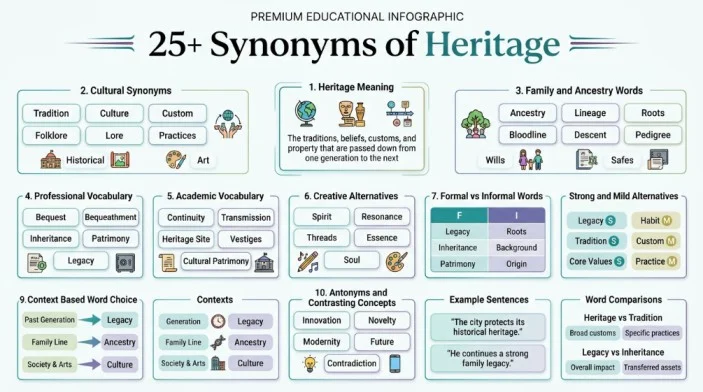
Heritage is more than something handed down from the past. It can describe cultural traditions, family history, historic places, shared values, or even a legacy that continues to shape the present. Choosing the right synonym for heritage depends on what you are trying to express. A word like legacy can highlight what someone leaves behind, while tradition focuses more on customs and practices passed through generations. Understanding these differences makes your writing more precise and natural.
This guide to synonyms of heritage brings together accurate alternatives with their meanings, tones, and practical uses. Whether you are writing about culture, history, family, architecture, identity, or personal legacy, the right word can add depth to your message. You will also see clear examples that show how each alternative works in real English.
What Are the Best Synonyms of “Heritage”?
Heritage means the history, culture, traditions, property, values, or characteristics passed from earlier generations to later ones. The best alternatives include legacy for something handed down, ancestry for family origins, tradition for customs, lineage for family descent, and patrimony for inherited cultural or historical assets.
For formal writing, legacy and patrimony can work well. Academic writing often uses cultural inheritance, ancestry, or lineage. Casual conversation usually favors roots, background, or traditions, while emotional and creative writing can use legacy, roots, or ancestral traditions.
Meaning, Tone, and Context
Simple Definition
Heritage refers to something inherited or passed down from previous generations. It can include family history, cultural traditions, language, beliefs, historic buildings, land, art, customs, values, or other features that connect people with their past.
The meaning changes slightly depending on context. In a family discussion, heritage may refer to ancestry or cultural background. History or tourism, it may refer to historic places and cultural traditions. In personal writing, it can describe the identity and values a person receives from earlier generations.
Part of Speech
Heritage is a noun.
It is normally used as an uncountable noun when referring to culture, history, or traditions in a general sense.
Examples:
- “The city is proud of its cultural heritage.”
- “She enjoys learning about her family heritage.”
- “The building is an important part of the nation’s heritage.”
Overall Tone
Heritage is generally neutral to positive.
It often carries a respectful or appreciative tone when discussing culture, history, family, traditions, and achievements passed between generations.
The word can also appear in neutral historical or academic contexts.
Formality Level
Heritage is a neutral to semi formal word.
It works naturally in:
- Academic essays
- Historical writing
- Government publications
- Tourism content
- Museum descriptions
- Business communication
- Personal writing
- Everyday conversation
Some alternatives, such as patrimony, are more formal. Others, such as roots, are more conversational.
Common Uses
Native English speakers commonly use heritage when discussing:
- Cultural heritage
- Family heritage
- National heritage
- Historical heritage
- Architectural heritage
- Religious heritage
- Artistic heritage
- Indigenous heritage
- Musical heritage
- Literary heritage
- Culinary heritage
- Ancestral heritage
- Natural heritage
- World heritage
Word Forms and Related Forms
| Form | Example |
|---|---|
| Noun | heritage |
| Related noun | inheritance |
| Related noun | heir |
| Related adjective | hereditary |
| Related adjective | ancestral |
| Related adjective | cultural |
There is no simple verb form of heritage that functions as a direct equivalent in ordinary English.
When and How to Use “Heritage”
Use heritage when you want to describe something connected to the past that has been inherited, preserved, or passed from one generation to another.
Professional
“Protecting the company’s heritage while adapting to new markets remains a major priority.”
Here, heritage refers to the organization’s history, identity, and established values.
Academic
“The study examines how migration influences cultural heritage.”
This usage is suitable for research because it refers broadly to culture and historical identity.
Workplace
“Our team values the company’s heritage and the principles established by its founders.”
Here, heritage describes the organization’s historical identity.
Personal
“I have always been interested in learning more about my family heritage.”
In this sentence, heritage refers to family background and origins.
“We are preparing a presentation about the cultural heritage of the region.”
This sounds natural in professional or educational communication.
Resume
“Developed educational materials highlighting local cultural heritage.”
This example works when describing experience related to history, culture, education, or tourism.
Social Media
“Proud to celebrate the heritage, traditions, and stories that shaped our community.”
Here, heritage has an emotional and community focused meaning.
Best Synonyms of “Heritage”
No alternative to heritage is identical in every situation. The most accurate choice depends on what aspect of heritage you mean.
Professional Writing: Legacy
Legacy is one of the strongest alternatives when you mean something valuable handed down from an earlier generation.
Example:
“The organization continues to honor the legacy of its founder.”
It works especially well when discussing achievements, values, influence, or long lasting contributions.
Academic Writing: Cultural Inheritance
Cultural inheritance is useful when discussing beliefs, practices, knowledge, language, and customs passed between generations.
Example:
“Language plays a central role in preserving cultural inheritance.”
It makes the cultural transmission aspect especially clear.
Business Communication: Legacy
Businesses often use legacy to describe a company’s history, reputation, traditions, or long standing influence.
Example:
“The company has built a strong legacy of innovation.”
Casual Conversation: Roots
Roots is a natural conversational alternative when talking about family or cultural origins.
Example:
“She moved back home to reconnect with her roots.”
It sounds warmer and less formal than heritage.
Emotional Writing: Ancestral Legacy
Ancestral legacy emphasizes the emotional connection between present generations and their ancestors.
Example:
“She felt a deep responsibility to protect her family’s ancestral legacy.”
Creative Writing: Legacy
Legacy can add emotional depth when describing what people leave behind.
Example:
“His greatest legacy was the kindness he showed to everyone around him.”
Resume Writing: Background
Background is often more natural than heritage when describing personal experience or cultural knowledge on a professional document.
Example:
“My multicultural background has strengthened my ability to work with diverse teams.”
Workplace Communication: Tradition
Tradition works when the heritage being discussed consists mainly of established practices or customs.
Example:
“Our annual celebration is a long standing tradition within the company.”
Stronger Meaning: Legacy
Legacy can carry a stronger sense of lasting influence than heritage when discussing a person’s achievements or historical impact.
Example:
“Her legacy continues to influence generations of artists.”
Softer Meaning: Background
Background is broader and often less emotionally loaded than heritage.
Example:
“His cultural background influenced his approach to food and family.”
When Not to Use “Heritage”
Although heritage is versatile, it is not always the most precise word. A more specific alternative can make the meaning clearer.
When You Mean Family Descent
Less precise:
“She researched her heritage.”
More precise:
“She researched her ancestry.”
Why:
Ancestry specifically focuses on family descent and the people from whom someone is descended.
When You Mean a Person’s Achievements
Less precise:
“His heritage continues to influence young musicians.”
Better:
“His legacy continues to influence young musicians.”
Why:
Legacy is more appropriate when discussing lasting influence or accomplishments.
When You Mean Customs
Less precise:
“The community protects its heritage.”
More specific:
“The community protects its traditions.”
Why:
Traditions specifically refer to practices, beliefs, or customs passed through generations.
When You Mean Family Origins in Casual Speech
Less natural:
“I want to learn more about my heritage.”
More conversational:
“I want to learn more about my roots.”
Why:
Roots is a common, natural expression for personal or family origins.
When You Mean Inherited Property
Less precise:
“The family received its heritage from their parents.”
Better:
“The family received an inheritance from their parents.”
Why:
Inheritance directly refers to money, property, or possessions received after someone dies, although heritage can sometimes include inherited property in a broader historical sense.
When You Mean a Formal Cultural Asset
Possible:
“The museum protects the country’s heritage.”
More specialized:
“The museum protects the nation’s patrimony.”
Why:
Patrimony is a more formal term for property, cultural resources, or traditions regarded as inherited from earlier generations.
Words Commonly Confused With “Heritage”
| Word | Difference | When to Use It | Example |
|---|---|---|---|
| Legacy | Focuses on what previous people or generations leave behind, especially influence, achievements, or values. | Historical influence, achievements, organizations, family values. | “Her legacy continues to inspire young artists.” |
| Ancestry | Focuses specifically on family descent and one’s ancestors. | Genealogy and family history. | “He researched his ancestry through old records.” |
| Tradition | Refers to customs, practices, or beliefs passed through generations. | Cultural practices and recurring customs. | “The festival is a beloved local tradition.” |
| Lineage | Focuses on direct family descent or succession. | Family history, genealogy, royal or professional succession. | “The family can trace its lineage back several centuries.” |
| Inheritance | Usually refers to property, money, possessions, or characteristics received from earlier generations. | Legal, financial, and biological contexts. | “She received an inheritance from her grandfather.” |
| Roots | A conversational expression for family, cultural, or geographic origins. | Personal identity and everyday speech. | “He returned to his roots after many years abroad.” |
Best Synonyms of “Heritage” by Context
| Context | Best Synonym | Why It Works | Example |
|---|---|---|---|
| Formal writing | Patrimony | Carries a formal cultural and historical meaning. | “The government protects national patrimony.” |
| Academic writing | Cultural inheritance | Clearly describes culture passed across generations. | “Language is part of cultural inheritance.” |
| Professional communication | Legacy | Works well for institutional history and values. | “The company is protecting its legacy.” |
| Business emails | Tradition | Natural when discussing established organizational practices. | “This tradition remains central to our annual event.” |
| Resume writing | Background | Describes cultural experience naturally and professionally. | “Her diverse background supports effective community outreach.” |
| Workplace communication | Tradition | Fits established workplace customs. | “The tradition began with the company’s founders.” |
| Casual conversation | Roots | Warm and natural for family or cultural origins. | “I want to reconnect with my roots.” |
| Everyday speaking | Background | Broad and easy to understand. | “His cultural background shaped his interests.” |
| Creative writing | Legacy | Creates a sense of lasting influence. | “She carried her grandmother’s legacy forward.” |
| Storytelling | Ancestral legacy | Connects a character to previous generations. | “He protected his family’s ancestral legacy.” |
| Emotional writing | Roots | Suggests belonging and identity. | “Her roots gave her a strong sense of belonging.” |
| Strong emphasis | Legacy | Highlights lasting impact and influence. | “His legacy transformed the community.” |
| Mild tone | Background | Communicates origins without strong emotional emphasis. | “Her cultural background is diverse.” |
| Social media captions | Roots | Short, familiar, and expressive. | “Celebrating my roots today.” |
| American English | Heritage | Common and broadly understood. | “We are proud of our cultural heritage.” |
| British English | Heritage | Also natural and widely used in British English. | “The town is known for its rich heritage.” |
How to Choose the Best Synonym of “Heritage”
The best synonym depends on the exact meaning you want to communicate.
If You Mean Family Origins
Choose ancestry, lineage, or roots.
Use ancestry for factual family descent, lineage for a traceable family line, and roots for a more personal or conversational tone.
If You Mean Cultural Practices
Choose tradition, customs, or cultural inheritance.
These words make it clear that you are discussing practices, beliefs, celebrations, language, food, or social habits passed between generations.
If You Mean Lasting Influence
Choose legacy.
This is especially effective when discussing a leader, artist, organization, historical figure, or family whose actions continue to affect later generations.
If You Mean Property or Assets
Choose inheritance or patrimony, depending on the context.
Inheritance is more suitable for legal or personal property. Patrimony is more formal and often relates to cultural or historical assets.
If You Mean Personal Identity
Choose roots, background, or cultural identity.
These alternatives help explain how a person’s family, culture, language, or community contributes to their sense of identity.
If You Are Writing Academically
Prefer precise terms such as ancestry, lineage, cultural inheritance, tradition, or legacy.
Do not replace heritage automatically. First identify the specific aspect of heritage your sentence is discussing.
Real Life Examples of “Heritage”
School
Basic:
“Students learned about the heritage of their community.”
More precise:
“Students learned about the history and traditions of their community.”
The revised sentence explains exactly what the students studied.
College
Basic:
“The paper explores African American heritage.”
More precise:
“The paper explores African American cultural traditions, history, and identity.”
The expanded wording is useful when an academic assignment requires precision.
Workplace
Basic:
“The company wants to preserve its heritage.”
Stronger:
“The company wants to preserve its legacy and traditions.”
The alternatives distinguish the company’s history from its established practices.
Business
Basic:
“The brand’s heritage attracts loyal customers.”
Stronger:
“The brand’s long history and legacy attract loyal customers.”
This version makes the source of the brand’s appeal clearer.
Basic:
“We are preparing an event celebrating local heritage.”
More specific:
“We are preparing an event celebrating the area’s history and cultural traditions.”
Resume
Basic:
“Experienced in promoting cultural heritage.”
More specific:
“Experienced in promoting cultural history, traditions, and community programs.”
The revised version gives employers more useful information.
Conversation
Basic:
“I want to learn about my heritage.”
Natural:
“I want to learn more about my family roots.”
The second version sounds especially natural in casual conversation.
Storytelling
Basic:
“She wanted to protect her heritage.”
Creative:
“She wanted to protect the legacy her ancestors had left behind.”
The second version creates stronger emotional imagery.
Blogging
Basic:
“Food is an important part of our heritage.”
Improved:
“Food is a powerful part of our cultural tradition and identity.”
This version explains what heritage means in the context of food.
Social Media
Basic:
“Proud of my heritage.”
Alternative:
“Proud of my roots, traditions, and the stories passed down through my family.”
The expanded version creates a warmer and more personal message.
25 Best Synonyms of “Heritage”
Some terms below are close contextual alternatives rather than perfect substitutes in every sentence. This distinction matters because heritage covers several related ideas, including culture, history, ancestry, traditions, identity, and inherited assets.
| Synonym | Simple Meaning | Best Used For | Example Sentence |
|---|---|---|---|
| Legacy | Something valuable or influential left by earlier generations. | Achievements, values, influence, organizations. | “Her legacy continues to shape modern education.” |
| Ancestry | A person’s family descent and ancestral origins. | Genealogy and family history. | “His ancestry includes several generations of farmers.” |
| Tradition | A custom or practice passed through generations. | Cultural practices and celebrations. | “The ceremony follows an old family tradition.” |
| Lineage | A person’s direct family line or descent. | Genealogy and historical families. | “The family documented its lineage carefully.” |
| Inheritance | Something received from a previous generation. | Property, money, possessions, or inherited traits. | “The house was part of her inheritance.” |
| Roots | A person’s family, cultural, or geographic origins. | Casual and personal writing. | “The trip helped him reconnect with his roots.” |
| Patrimony | Cultural, historical, or inherited property and resources. | Formal historical writing. | “The museum preserves the nation’s patrimony.” |
| Background | A person’s cultural, family, or social origins. | Professional and personal contexts. | “Her cultural background influences her work.” |
| Customs | Established practices of a community or culture. | Cultural behavior and traditions. | “Visitors learned about local customs.” |
| Culture | Shared beliefs, practices, values, arts, and ways of life. | Broad cultural discussion. | “The region has a rich culture.” |
| Identity | The characteristics that define a person or community. | Cultural and personal identity. | “Language plays a role in cultural identity.” |
| Origins | The place, people, or circumstances from which something began. | History and family background. | “The festival has ancient origins.” |
| History | Events and experiences from the past. | Historical discussions. | “The city has a fascinating history.” |
| Folklore | Traditional stories, beliefs, and legends of a community. | Literature and cultural studies. | “Local folklore explains the origin of the celebration.” |
| Culture history | The development of cultural practices over time. | Academic and educational contexts. | “The museum explores the area’s culture history.” |
| Ancestral legacy | Values, traditions, or influence left by ancestors. | Emotional and historical writing. | “She wanted to honor her ancestral legacy.” |
| Cultural legacy | Cultural elements passed from earlier generations. | Academic and cultural writing. | “Music remains an important cultural legacy.” |
| Cultural inheritance | Culture transmitted from one generation to another. | Academic discussions. | “Language is a major part of cultural inheritance.” |
| Family legacy | Values, achievements, or traditions passed through a family. | Personal and family writing. | “The scholarship continues her family’s legacy.” |
| Historical legacy | Lasting influence of past events or people. | History and public discussion. | “The war left a complicated historical legacy.” |
| Birthright | A right or possession inherited by birth. | Legal, historical, and literary contexts. | “The land was considered his birthright.” |
| Hereditary tradition | A practice or characteristic passed through generations. | Historical and cultural contexts. | “The craft became a hereditary tradition.” |
| Ancestral tradition | A custom inherited from one’s ancestors. | Family and cultural writing. | “The family continues its ancestral traditions.” |
| Cultural tradition | A practice or belief passed through a culture. | Education and cultural discussions. | “The dance is an important cultural tradition.” |
| Historical inheritance | Elements from the past retained by later generations. | Historical and academic contexts. | “The region’s architecture reflects its historical inheritance.” |
Synonyms of “Heritage” by Usage
Professional vs Personal Synonyms
Professional writing usually benefits from precise terms such as legacy, cultural inheritance, historical legacy, and patrimony.
Personal writing can sound more natural with roots, family legacy, ancestry, or background.
For example:
Professional:
“The institution is committed to preserving its historical legacy.”
Personal:
“I am proud of my family roots.”
The second sentence is warmer and more conversational.
Formal vs Conversational Synonyms
For reports, essays, and formal documents, consider:
- Patrimony
- Cultural inheritance
- Historical legacy
- Ancestry
- Lineage
- Cultural heritage
For casual conversation, consider:
- Roots
- Background
- Family history
- Traditions
- Family legacy
Avoid using patrimony in ordinary conversation unless the context specifically calls for formal language.
Academic Synonyms
Academic writing requires careful distinctions.
Ancestry works when discussing family descent.
Lineage works when tracing direct descent or succession.
Cultural inheritance works when discussing the transmission of cultural knowledge, beliefs, language, and practices.
Tradition works when the focus is on customs and practices.
Legacy works when discussing the lasting effects of people, institutions, or historical events.
Professional and Business Synonyms
Resumes
Use background, cultural experience, or legacy depending on what you are describing.
Example:
“My multicultural background supports effective communication across diverse teams.”
Interviews
Background is usually more natural than heritage when discussing personal experience.
Example:
“My cultural background has influenced my interest in community development.”
Meetings
Use legacy when discussing organizational history.
Example:
“We want to preserve the company’s legacy while modernizing its operations.”
Presentations
Use heritage, tradition, or legacy based on the subject.
Example:
“This presentation explores the brand’s heritage and evolution.”
Performance Reviews
Legacy can work when discussing long term organizational contribution.
Example:
“Her leadership has strengthened the team’s legacy of innovation.”
Client Communication
Use heritage or tradition when discussing a brand’s history.
Example:
“Our products reflect the company’s heritage of craftsmanship.”
Business Emails
Choose straightforward language.
Example:
“We are proud to continue a tradition that has served our customers for generations.”
Creative and Literary Synonyms
Creative writing often benefits from words that suggest identity, memory, and emotional connection.
Legacy can represent what a character leaves behind.
Roots can symbolize belonging.
Ancestral tradition can connect a character to previous generations.
Folklore can introduce stories and beliefs from a community.
Origins can help explore how a family, place, or tradition began.
Example:
“She carried the stories of her ancestors like a quiet inheritance, preserving them for a generation that had never known the old village.”
Slang or Modern Synonyms
There is no exact slang synonym for heritage that should replace it in all contexts.
However, roots is a widely understood informal expression.
Roots
Meaning: Family, cultural, or geographic origins.
Acceptable in:
- Conversations
- Personal essays
- Social media
- Interviews
- Informal writing
Avoid when:
- A highly technical academic definition is required
- Legal precision is necessary
- The exact concept is inheritance or property
Example:
“I’m proud of my roots.”
This is more conversational than:
“I’m proud of my heritage.”
Strongest to Mildest Synonyms
Heritage does not have a strict intensity scale because its alternatives emphasize different concepts rather than simply expressing more or less importance.
A useful practical scale based on emphasis is:
| Level | Word or Phrase | Typical Effect |
|---|---|---|
| Mild | Background | Neutral description of origins. |
| Mild | Origins | Focuses on where something began. |
| Moderate | Tradition | Highlights inherited practices. |
| Moderate | Ancestry | Focuses on family descent. |
| Strong | Heritage | Broad connection with inherited culture or history. |
| Strong | Cultural inheritance | Emphasizes transmission across generations. |
| Strong | Legacy | Highlights lasting influence. |
| Very Strong | Ancestral legacy | Creates a particularly strong sense of inherited identity and responsibility. |
These words should not be treated as interchangeable. The correct choice depends on the specific idea being communicated.
Emotional vs Neutral Synonyms
Emotional Synonyms
These expressions can create a stronger feeling of identity, belonging, memory, or connection.
- Roots
- Ancestral legacy
- Family legacy
- Ancestral tradition
- Cultural identity
- Family history
Example:
“She returned to her roots after many years away.”
This sentence carries more personal feeling than a neutral statement about ancestry.
Neutral Synonyms
These terms are more suitable when the goal is factual communication.
- Ancestry
- Lineage
- Tradition
- Cultural inheritance
- Historical legacy
- Background
- Origins
- Patrimony
Example:
“The study examines the ancestry of several regional populations.”
This sounds objective and academic.
Antonyms of “Heritage”
Heritage does not have 15 direct antonyms in standard English. It is a broad noun describing inherited culture, history, identity, traditions, or assets, so forcing unrelated words into an antonym list would be misleading.
For clarity, the following are 15 contrasting concepts, not strict dictionary antonyms. They represent ideas that can contrast with inherited culture, historical continuity, or ancestral connection.
| Contrasting Concept | Meaning | Example Sentence |
|---|---|---|
| Novelty | Something new or unfamiliar. | “The design emphasizes novelty rather than historical tradition.” |
| Innovation | The introduction of new ideas or methods. | “Innovation transformed the industry.” |
| Modernity | The condition of being modern. | “The city balances heritage with modernity.” |
| Newness | The quality of being recently created or introduced. | “The project’s appeal comes from its newness.” |
| Discontinuity | A break in an established sequence or tradition. | “The reform created a period of cultural discontinuity.” |
| Rupture | A serious break from an earlier state or tradition. | “The revolution caused a rupture with the old system.” |
| Rootlessness | A lack of strong connection to a place, culture, or community. | “Migration sometimes created feelings of rootlessness.” |
| Cultural erasure | The removal or suppression of cultural identity and traditions. | “The community worked to prevent cultural erasure.” |
| Assimilation | Adoption of another culture, often at the expense of one’s original cultural practices. | “Rapid assimilation changed the community’s traditions.” |
| Forgetting | Failure to retain memories, knowledge, or traditions. | “Forgetting can weaken connections with the past.” |
| Abandonment | The act of giving up or leaving something behind. | “The abandonment of old customs changed the community.” |
| Loss | The disappearance of something previously possessed or preserved. | “The loss of traditional knowledge concerned local historians.” |
| Detachment | A lack of emotional or cultural connection. | “His detachment from family traditions surprised his relatives.” |
| Disconnection | Lack of connection with a person, place, or tradition. | “Disconnection from cultural practices can affect identity.” |
| Departure | A move away from an established practice or pattern. | “The new style represented a departure from tradition.” |
Comparison: “Heritage” vs Similar Words
Heritage vs Legacy
Main Difference
Heritage usually describes what is inherited from previous generations, including culture, history, traditions, and identity. Legacy often emphasizes what a person, group, or institution leaves behind and how it continues to influence the future.
Which Is Stronger?
Legacy can sound stronger when discussing lasting influence or achievement.
Which Is More Formal?
Both are appropriate in formal writing.
When to Use Each
Use heritage for inherited culture or history.
Use legacy for lasting influence, achievements, values, or reputation.
Examples
Heritage:
“The museum protects the region’s cultural heritage.”
Legacy:
“Her scientific legacy continues to influence researchers.”
Heritage vs Ancestry
Main Difference
Heritage can include culture, traditions, history, and identity. Ancestry specifically concerns family descent and ancestors.
Which Is Stronger?
Neither is inherently stronger.
Which Is More Formal?
Both are suitable for formal and academic contexts.
When to Use Each
Use ancestry for genealogy.
Use heritage for a broader cultural or historical connection.
Examples
Heritage:
“She is proud of her cultural heritage.”
Ancestry:
“He researched his ancestry through historical records.”
Heritage vs Tradition
Main Difference
Heritage is broader. Tradition specifically refers to customs, practices, or beliefs passed down through generations.
Which Is Stronger?
Neither.
Which Is More Formal?
Both are widely used.
When to Use Each
Use tradition when discussing a specific custom or practice.
Examples
Heritage:
“The city is known for its rich cultural heritage.”
Tradition:
“The family follows a tradition of gathering every summer.”
Heritage vs Inheritance
Main Difference
Inheritance often refers to money, property, possessions, or traits received from an earlier generation. Heritage has a broader cultural and historical meaning.
Which Is Stronger?
Neither.
Which Is More Formal?
Inheritance is especially common in legal and financial contexts.
When to Use Each
Use inheritance for assets or legally transferred property.
Examples
Heritage:
“The building forms part of the city’s architectural heritage.”
Inheritance:
“She used her inheritance to purchase a home.”
Heritage vs Lineage
Main Difference
Lineage describes direct descent through a family line. Heritage can include family history but also encompasses culture, traditions, places, and collective history.
Which Is Stronger?
Neither.
Which Is More Formal?
Lineage can sound more specialized or formal in genealogy.
When to Use Each
Use lineage when tracing family descent.
Examples
Heritage:
“The community protects its cultural heritage.”
Lineage:
“The family can trace its lineage to the eighteenth century.”
Heritage vs Background
Main Difference
Background is a broad term for someone’s personal, family, cultural, educational, or professional circumstances. Heritage specifically suggests something inherited from previous generations.
Which Is Stronger?
Heritage often carries a stronger connection to history and identity.
Which Is More Formal?
Both can be used formally.
When to Use Each
Use background when discussing a person’s broader experience.
Examples
Heritage:
“Her heritage influenced her interest in traditional art.”
Background:
“Her international background helped her communicate with diverse clients.”
Common Phrases and Expressions with “Heritage”
Cultural Heritage
Meaning: The traditions, beliefs, arts, language, practices, and historical elements associated with a culture.
Example:
“The organization works to preserve the region’s cultural heritage.”
Family Heritage
Meaning: The history, traditions, and background inherited through a family.
Example:
“He enjoys sharing stories about his family heritage.”
National Heritage
Meaning: Historical and cultural features regarded as belonging to a nation.
Example:
“The government created programs to protect national heritage.”
World Heritage
Meaning: A term commonly used for places and cultural or natural features recognized for exceptional international value.
Example:
“The ancient site attracts visitors interested in world heritage.”
Cultural Heritage Site
Meaning: A place valued for its cultural or historical significance.
Example:
“The temple has become an important cultural heritage site.”
Rich Heritage
Meaning: A phrase describing a place, group, or person with a long or diverse cultural or historical background.
Example:
“The city has a rich heritage of music and architecture.”
Preserve Our Heritage
Meaning: To protect cultural, historical, or traditional elements from being lost.
Example:
“Local organizations are working together to preserve our heritage.”
Proud of Our Heritage
Meaning: Expressing appreciation or pride in one’s inherited culture or history.
Example:
“The festival gives residents a chance to celebrate and feel proud of their heritage.”
Common Mistakes to Avoid
Mistake 1: Treating “Heritage” and “Ancestry” as Exact Synonyms
Incorrect:
“My heritage only means the people in my family tree.”
Better:
“My ancestry refers to the people and family lines from which I descend.”
Why:
Ancestry is specifically about descent. Heritage can include ancestry, but it can also include language, traditions, values, art, food, places, and cultural identity.
Mistake 2: Using “Legacy” for Every Meaning of Heritage
Incorrect:
“The family’s legacy includes its traditional clothing and language.”
Better:
“The family’s heritage includes its traditional clothing and language.”
Why:
Heritage is broader when discussing inherited cultural elements. Legacy is more naturally associated with lasting influence, achievements, or what someone leaves behind.
Mistake 3: Using an Informal Word in Academic Writing
Incorrect:
“The study examines people’s roots in relation to migration.”
Better:
“The study examines people’s ancestry and cultural heritage in relation to migration.”
Why:
Roots is natural in conversation, but ancestry and cultural heritage provide greater academic precision.
Mistake 4: Using “Inheritance” for Culture
Incorrect:
“Music is a financial inheritance from previous generations.”
Better:
“Music is an important part of our cultural inheritance.”
Why:
Inheritance often suggests property or assets. Cultural inheritance clearly communicates the transmission of culture.
Mistake 5: Overusing “Heritage”
Incorrect:
“Our heritage includes our heritage, heritage buildings, heritage food, and heritage traditions.”
Better:
“Our cultural identity includes traditional food, historic buildings, and long standing customs.”
Why:
Replacing repeated uses with precise terms makes the writing more readable.
Mistake 6: Using an Overly Formal Synonym
Incorrect:
“My family celebrates its patrimony every year.”
Better:
“My family celebrates its heritage every year.”
Why:
Patrimony can sound unnecessarily formal in ordinary family communication.
Mistake 7: Confusing Heritage With Tradition
Incorrect:
“The tradition of the community includes its entire historical identity.”
Better:
“The community’s heritage includes its history, traditions, language, and cultural identity.”
Why:
Tradition is only one part of heritage.
Frequently Asked Questions
What is a good heritage synonym?
A good heritage synonym depends on context. Common choices include legacy, inheritance, tradition, ancestry, culture, and roots.
What are the best synonyms of heritage?
Common synonyms of heritage include legacy, inheritance, ancestry, tradition, culture, and birthright.
What is another word for heritage?
Legacy is often the best another word for heritage, especially when referring to something valuable passed down through generations.
What does family roots mean?
Family roots refers to a person’s family background, ancestry, origins, and connections to previous generations.
What is a heritage thesaurus used for?
A heritage thesaurus helps you find related words and alternatives based on the specific meaning and context of heritage.
Are heritage and legacy synonyms?
They can be synonyms in some contexts. Heritage often emphasizes what is inherited, while legacy commonly refers to what is passed down or left behind.
What is the difference between heritage and ancestry?
Heritage can include culture, traditions, history, and inherited values. Ancestry specifically refers to a person’s family lineage or descent.
What are the best synonyms of “heritage”?
The best synonyms of heritage depend on context. Legacy works for lasting influence, ancestry for family descent, tradition for customs, lineage for family lines, and roots for personal or cultural origins.
What are the best formal synonyms of “heritage”?
Formal alternatives include patrimony, cultural inheritance, historical legacy, lineage, and ancestry. The best option depends on whether the subject is cultural history, family descent, inherited property, or lasting influence.
What are common informal synonyms of “heritage”?
Roots, background, family history, and traditions are natural alternatives in casual English. Roots is especially common when someone is talking about their family, culture, birthplace, or personal identity.
What is another word for “heritage” in professional writing?
Legacy is often an effective professional alternative, especially when discussing a company’s history, reputation, values, or influence. Background, tradition, and cultural identity may be better for other contexts.
What is the difference between “heritage” and “legacy”?
Heritage usually describes culture, history, traditions, identity, or assets inherited from earlier generations. Legacy focuses more strongly on what a person, organization, or generation leaves behind and the influence that continues afterward.
What is the opposite of “heritage”?
Heritage has no single direct opposite. Depending on context, contrasting concepts include novelty, modernity, innovation, discontinuity, rootlessness, and cultural erasure, but these are contrasts rather than exact dictionary antonyms.
Conclusion
Heritage describes the history, culture, traditions, values, identity, or other elements passed from earlier generations to later ones. Because the word covers several related ideas, the best alternative depends on exactly what you mean.
Use legacy for lasting influence, ancestry for family descent, tradition for inherited customs, lineage for family lines, inheritance for transferred assets, and roots for a more personal or conversational expression of cultural or family origins.
The best synonyms of heritage are not interchangeable in every sentence. Before choosing an alternative, identify the specific meaning, audience, tone, and purpose. A useful vocabulary habit is to replace a general word only when the new word makes your intended meaning more precise.
Read More Related Articles:
- 25+ Synonyms, Meanings, Uses, Examples, and Best …
- Meaning, Uses, Examples, and the Best Synonym of Complain
- 25+ Synonyms of Frequency | Meanings, Uses, Examples …