The right tone can change how a message feels. A friendly sentence can sound warm, while the same idea written differently can feel cold, serious, or persuasive. That is why finding the right tone synonym matters when you want your writing to communicate the intended attitude clearly. In writing, tone describes the writer’s attitude toward the subject, audience, or message.
Depending on context, you may need another word for tone, such as mood, attitude, voice, style, or feeling. The best synonym for tone depends on what you are describing. In literature, for example, tone synonym literature searches often point to words that express a writer’s emotional or stylistic approach. Understanding these differences makes tone synonyms more accurate and useful, whether you need a formal tone synonym, are exploring tones synonyms, or simply want better synonyms for tone in everyday and professional writing.
What Are the Best Synonyms of “Tone”?
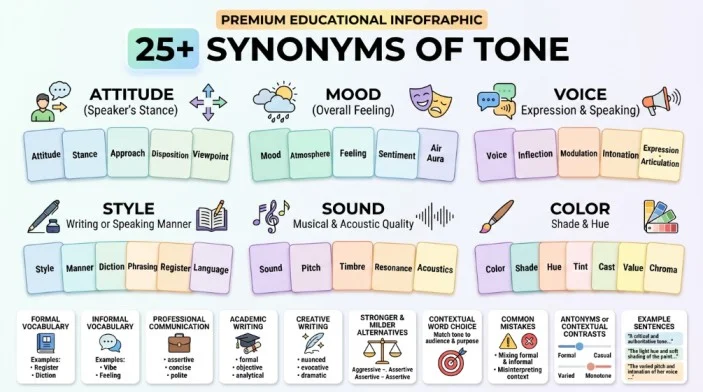
Tone can describe attitude, emotional feeling, style, sound quality, or a particular shade of color. The best synonyms include attitude, mood, voice, manner, style, feeling, pitch, inflection, timbre, shade, hue, and character. For formal writing, use attitude or manner; for creative writing, mood or voice often works better.
Meaning, Tone, and Context
Simple Definition
Tone is the quality, attitude, or feeling expressed through someone’s words, voice, writing, music, or artistic work. It can also describe the particular quality or shade of a color.
The exact meaning changes according to context. A person’s voice can have a warm tone, an email can have a professional tone, a novel can create a gloomy tone, and a wall can have a soft blue tone.
Part of Speech
Tone is primarily a noun.
Examples:
- “Her tone was friendly.”
- “The article has a serious tone.”
- “The guitar has a warm tone.”
- “The paint has a grayish tone.”
It can also function as a verb, especially when discussing color or adjusting the character of something.
Example:
- “The artist toned down the bright colors.”
Overall Tone
The word tone itself is neutral. It does not automatically mean positive or negative.
The tone being described can be positive, negative, or neutral.
| Type | Example |
|---|---|
| Positive | warm tone |
| Negative | hostile tone |
| Neutral | formal tone |
| Emotional | sentimental tone |
| Serious | solemn tone |
| Casual | relaxed tone |
Formality Level
Tone is a neutral and versatile word. It works naturally in academic writing, business communication, everyday speech, journalism, creative writing, music, art, and conversations.
Because the word has several meanings, context is essential.
Common Uses
Native English speakers commonly use tone when discussing:
- Writing
- Emails
- Conversations
- Speeches
- Interviews
- Customer service
- Academic papers
- Fiction
- Poetry
- Music
- Singing
- Instruments
- Voice quality
- Color
- Art and design
- Workplace communication
Word Forms
| Word | Form | Example |
|---|---|---|
| Tone | Noun | “The email has a professional tone.” |
| Tone | Verb | “The colors were toned down.” |
| Toned | Adjective or verb form | “The room has a toned-down appearance.” |
| Toning | Verb form | “She is toning the colors down.” |
Different Meanings of “Tone”
The most important thing to understand is that tone does not have one single meaning.
Tone as Attitude
This refers to the attitude communicated by someone’s words.
“His tone sounded dismissive.”
Here, attitude or manner may be suitable alternatives.
Tone as Emotional Quality
This refers to the emotional feeling created by writing, speech, music, or art.
“The story has a hopeful tone.”
Here, mood, feeling, or atmosphere may work.
Tone as Voice Quality
This refers to the quality or character of a person’s voice or a musical sound.
“Her voice had a gentle tone.”
Depending on the context, timbre, pitch, quality, or resonance may be more precise.
Tone as Color
In art and design, tone can describe a variation or quality of color.
“The designer chose a muted blue tone.”
Words such as shade, hue, or tint may be more appropriate depending on the exact color relationship.
When and How to Use “Tone”
Choose tone when you want to describe the overall character, attitude, feeling, or quality of communication, sound, or color.
Professional
“The manager used a respectful tone when discussing the employee’s performance.”
Academic
“The author adopts a formal tone throughout the research paper.”
Workplace
“Please keep your tone constructive during the team discussion.”
Personal
“I didn’t mean for my tone to sound angry.”
“Her email had a friendly but professional tone.”
Resume
“Use a confident tone when describing your accomplishments.”
Social Media
“The caption has a playful tone that matches the brand’s personality.”
Best Synonyms of “Tone”
No single synonym can replace tone in every situation because the word has several meanings. The best alternative depends on whether you are describing attitude, emotion, writing style, sound, or color.
Professional Writing: Attitude
Attitude is useful when discussing the position or feeling a writer or speaker communicates.
“The report has a confident attitude toward the proposed changes.”
However, tone is often more natural when referring specifically to writing style.
Academic Writing: Manner
Manner can describe the way something is expressed or presented.
“The researcher discusses the issue in a cautious manner.”
It works particularly well when you want to focus on how information is presented rather than the emotional quality.
Business Communication: Voice
Voice is especially useful when discussing a company’s communication personality or a person’s distinctive way of expressing ideas.
“The brand uses a clear and approachable voice.”
Casual Conversation: Attitude
When talking about someone’s behavior or way of speaking, attitude is often more natural than tone.
“I didn’t like his attitude.”
Emotional Writing: Mood
Mood works well when describing the emotional atmosphere created by a story, poem, scene, or piece of writing.
“The novel creates a tense and mysterious mood.”
Creative Writing: Voice
Voice is one of the strongest choices for creative writing because it describes the distinctive personality and expression of a writer or narrator.
“The author’s voice is humorous and conversational.”
Resume Writing: Style
When discussing how a resume communicates professionally, style can describe its overall presentation.
“Use a confident style without exaggerating your accomplishments.”
Workplace Communication: Manner
Manner is useful when describing how someone communicates in a professional environment.
“She handled the disagreement in a calm manner.”
Stronger Meaning: Attitude
If you want to emphasize someone’s position or behavioral stance, attitude can be stronger than the general word tone.
“His dismissive attitude frustrated the team.”
Softer Meaning: Feeling
Feeling is useful when you want to describe an emotional quality without making the description sound overly analytical.
“The message has a warm feeling.”
When Not to Use “Tone”
Although tone is extremely flexible, it is sometimes too broad. Replacing it with a more precise word can make your writing clearer.
When “Tone” Is Too General
Less precise:
“The speaker’s tone was interesting.”
Better:
“The speaker’s attitude was surprisingly skeptical.”
Why:
Interesting does not explain what kind of quality was present. Attitude identifies the speaker’s position more clearly.
When “Tone” Is Too Vague
Less precise:
“The music has a different tone.”
Better:
“The instrument has a warmer timbre.”
Why:
When discussing the character of a musical sound, timbre is more technically precise.
When “Tone” Is Too Formal
Less natural:
“I appreciated the tone of your message” in a very casual conversation.
Better:
“I liked the feeling of your message.”
Why:
Feeling can sound more relaxed and personal.
When “Tone” Is Too Informal
This is less common because tone itself is neutral. In highly technical discussions about sound, however, a more specific term may be preferable.
General:
“The violin has a beautiful tone.”
More technical:
“The violin has a rich timbre.”
When “Tone” Is Too Weak
If you need to identify a person’s behavior rather than merely describe communication, attitude may be stronger.
Less precise:
“His tone caused problems.”
Better:
“His hostile attitude caused problems during the meeting.”
When “Tone” Is Too Strong
Sometimes the word tone can make you focus too heavily on attitude when the real issue is simply emotional atmosphere.
Less precise:
“The novel has a dramatic tone.”
Better:
“The novel creates a dramatic mood.”
Why:
Mood focuses on the emotional atmosphere experienced by the reader.
Words Commonly Confused With “Tone”
Attitude
Difference: Attitude describes a person’s feelings, opinions, or behavioral position toward something.
When to Use It: Use it when discussing someone’s outlook or behavior.
Example:
“Her positive attitude helped the team stay motivated.”
Mood
Difference: Mood describes the emotional atmosphere created by a situation, story, place, or piece of art.
When to Use It: Use it for emotional atmosphere.
Example:
“The soft lighting created a peaceful mood.”
Voice
Difference: Voice refers to a person’s distinctive way of communicating or a brand’s recognizable communication personality.
When to Use It: Use it for authors, speakers, narrators, brands, and organizations.
Example:
“The company’s voice is friendly and trustworthy.”
Style
Difference: Style refers to the particular way something is written, designed, performed, or presented.
When to Use It: Use it when discussing overall presentation rather than emotional attitude alone.
Example:
“Her writing style is clear and conversational.”
Pitch
Difference: Pitch describes how high or low a sound is.
When to Use It: Use it for voices, music, and sound frequency.
Example:
“His pitch rose when he became excited.”
Timbre
Difference: Timbre describes the distinctive character or quality of a sound, even when two sounds have the same pitch.
When to Use It: Use it in music and technical discussions about sound.
Example:
“The singer has a warm, recognizable timbre.”
Best Synonyms of “Tone” by Context
| Context | Best Synonym | Why It Works | Example |
|---|---|---|---|
| Formal writing | Manner | Describes how ideas are presented | “The issue was discussed in a cautious manner.” |
| Academic writing | Attitude | Identifies the author’s position | “The author’s attitude is critical.” |
| Professional communication | Voice | Describes communication personality | “The company uses a professional voice.” |
| Business emails | Manner | Keeps the focus on communication style | “Use a respectful manner in client emails.” |
| Resume writing | Style | Describes overall presentation | “Use a confident style throughout the resume.” |
| Workplace communication | Attitude | Useful for behavioral context | “His attitude remained constructive.” |
| Casual conversation | Attitude | Sounds natural for personal behavior | “I didn’t like her attitude.” |
| Everyday speaking | Feeling | Expresses emotional quality naturally | “The message had a warm feeling.” |
| Creative writing | Voice | Captures distinctive expression | “The narrator has a playful voice.” |
| Storytelling | Mood | Describes emotional atmosphere | “The scene creates a mysterious mood.” |
| Emotional writing | Feeling | Highlights emotional quality | “The letter carries a hopeful feeling.” |
| Strong emphasis | Attitude | Can clearly express behavioral stance | “His hostile attitude was obvious.” |
| Mild tone | Manner | Sounds neutral and restrained | “She responded in a polite manner.” |
| Social media captions | Voice | Fits personal or brand identity | “The caption uses a playful voice.” |
| American English | Tone | Broad, natural, and widely understood | “The email has a professional tone.” |
| British English | Tone | Also natural and widely used | “The article maintains a formal tone.” |
How to Choose the Best Synonym of “Tone”
Choosing the right synonym starts with identifying what tone means in your sentence.
1. Identify the Meaning
Ask whether you are talking about:
- Attitude
- Emotion
- Writing style
- Communication personality
- Sound quality
- Pitch
- Color
This is the most important step because synonyms for one meaning may not work for another.
2. Consider the Audience
A teacher, business client, friend, and social media follower may interpret the same vocabulary differently.
For professional readers, manner, attitude, voice, and style are often useful.
For casual readers, feeling, mood, and attitude may sound more natural.
3. Consider Formality
Use manner, attitude, or register when you need a more formal analytical description.
Use feeling, mood, or voice when the context is more personal or creative.
4. Consider Emotional Strength
Words such as mood and feeling emphasize emotion.
Attitude can emphasize a person’s behavioral or psychological position.
Style is usually more neutral.
5. Consider Writing Purpose
- For an essay, you might write:
“The author’s attitude toward technology is skeptical.”
- For a novel:
“The chapter creates a tense mood.”
- For branding:
“The company’s voice is friendly and confident.”
- For music:
“The instrument has a rich timbre.”
6. Choose Natural Usage
Do not replace tone simply to avoid repetition. A synonym is useful only when it preserves the intended meaning.
If tone is already the most accurate word, keep it.
Real Life Examples of “Tone”
School
Original:
“The student’s tone in the essay was too casual.”
Improved:
“The student’s style in the essay was too conversational for an academic assignment.”
College
Original:
“The author’s tone toward social media is critical.”
Improved:
“The author’s attitude toward social media is critical.”
Workplace
Original:
“His tone during the meeting sounded defensive.”
Improved:
“His attitude during the meeting sounded defensive.”
Business
Original:
“The company’s tone should be more professional.”
Improved:
“The company’s voice should sound more professional and trustworthy.”
Original:
“Your email has an angry tone.”
Improved:
“Your email has a confrontational tone, which could make the recipient defensive.”
Resume
Original:
“The tone of the resume should be confident.”
Improved:
“The resume’s style should be confident, concise, and professional.”
Conversation
Original:
“Her tone changed suddenly.”
Improved:
“Her attitude changed suddenly.”
Storytelling
Original:
“The story has a dark tone.”
Improved:
“The story creates a dark mood.”
Blogging
Original:
“The blog uses a friendly tone.”
Improved:
“The blog uses a friendly voice that makes complex topics easier to understand.”
Social Media
Original:
“The brand’s tone is playful.”
Improved:
“The brand’s voice is playful and approachable.”
25 Best Synonyms of “Tone”
Because tone has several meanings, this list includes words that accurately replace or closely represent specific senses of the word. The best choice depends on context.
| Synonym | Simple Meaning | Best Used For | Example Sentence |
|---|---|---|---|
| Attitude | A person’s feeling or position | Communication and behavior | “Her attitude toward the project was positive.” |
| Mood | Emotional atmosphere | Stories, art, situations | “The music created a peaceful mood.” |
| Voice | Distinctive way of communicating | Writing and branding | “The writer has a confident voice.” |
| Manner | Way something is expressed | Formal communication | “He answered in a respectful manner.” |
| Style | Characteristic way of presenting something | Writing and design | “Her writing style is direct and engaging.” |
| Feeling | Emotional quality | Personal and creative writing | “The message has a warm feeling.” |
| Pitch | Highness or lowness of sound | Speech and music | “Her pitch became higher when she laughed.” |
| Timbre | Distinctive character of sound | Music and voice | “The flute has a delicate timbre.” |
| Inflection | Change in voice during speech | Spoken communication | “His rising inflection made the statement sound uncertain.” |
| Quality | Character or nature of something | Sound and general description | “The recording has a warm quality.” |
| Character | Distinctive nature or character | Sound, writing, art | “The instrument has a unique character.” |
| Resonance | Richness or depth of sound | Music and speech | “Her voice has remarkable resonance.” |
| Register | Level or variety of language | Linguistics and writing | “The formal register suits the audience.” |
| Tenor | General character or direction | Formal writing | “The tenor of the discussion remained positive.” |
| Spirit | Underlying feeling or attitude | Speeches and creative writing | “The spirit of the speech was hopeful.” |
| Air | An impression or quality | Literary description | “The room had an air of mystery.” |
| Atmosphere | Emotional environment | Stories and settings | “The film creates a tense atmosphere.” |
| Ambience | Overall surrounding feeling | Places and experiences | “The restaurant has a relaxed ambience.” |
| Expression | Way a feeling is communicated | Art and communication | “Her facial expression revealed concern.” |
| Shade | Variation of a color | Art and design | “The designer selected a darker shade of blue.” |
| Hue | Particular color family | Art and design | “The painting uses a warm golden hue.” |
| Tint | Lighter version of a color | Art and design | “A pale pink tint softened the room.” |
| Cast | General color quality | Visual description | “The photograph has a blue cast.” |
| Feel | Overall impression | Informal writing and design | “The website has a modern feel.” |
| Characteristic | Distinctive quality | General description | “The sound has a bright characteristic that stands out.” |
Synonyms of “Tone” by Usage
- Professional vs Personal Synonyms
Professional communication often requires words that clearly describe how information is delivered.
Professional choices:
- Manner
- Attitude
- Voice
- Register
- Style
Personal choices:
- Feeling
- Mood
- Attitude
- Air
- Feel
For example, a manager might discuss an employee’s attitude, while a friend might simply say, “I didn’t like the feeling of that conversation.”
Formal vs Conversational Synonyms
- For reports, essays, and formal analysis, attitude, manner, register, and style are useful.
- For emails and everyday conversation, tone, attitude, voice, and feeling are usually more natural.
- For texting, expressions such as attitude, vibe, and feeling may appear in informal contexts. However, vibe is not a complete synonym for tone in every situation.
Academic Synonyms
Academic writers often need to identify an author’s position or the emotional character of a text.
Attitude
Useful for describing how an author approaches a subject.
“The author’s attitude toward the policy is skeptical.”
Register
Useful when discussing the level or variety of language.
“The article uses a formal register.”
Manner
Useful for describing how an argument is presented.
“The researcher presents the findings in a cautious manner.”
Style
Useful when analyzing writing techniques and presentation.
“The author’s analytical style strengthens the argument.”
Professional and Business Synonyms
Resumes
Use style, voice, or manner when discussing presentation.
“The resume uses a confident and professional style.”
Interviews
Attitude is useful when discussing a candidate’s approach.
“The candidate maintained a positive attitude.”
Meetings
Use manner or attitude when describing communication behavior.
“She addressed the concern in a calm manner.”
Presentations
Style and voice work well.
“The speaker’s confident voice kept the audience engaged.”
Performance Reviews
Attitude can describe workplace behavior.
“His collaborative attitude contributes to a positive team environment.”
Client Communication
Tone remains highly useful because it directly describes how the communication sounds.
“Keep the tone professional and solution-focused.”
Business Emails
Use tone when discussing the overall impression of the message.
“The email’s tone should remain respectful.”
Creative and Literary Synonyms
Storytelling
Mood is useful for the emotional atmosphere.
“The opening scene establishes a mysterious mood.”
Fiction
Voice describes the narrator’s distinctive expression.
“The narrator’s voice is witty and observant.”
Poetry
Feeling and mood can describe emotional qualities.
“The poem creates a feeling of quiet sadness.”
Descriptive Writing
Atmosphere can describe the emotional environment.
“The fog created an eerie atmosphere.”
Speeches
Voice, spirit, and attitude can describe expressive qualities.
“The speech had an optimistic spirit.”
Slang or Modern Synonyms
There is no single slang word that accurately replaces tone in every context.
Vibe
Vibe is a casual word for the general feeling or impression created by a person, place, message, or situation.
“The restaurant has a relaxed vibe.”
It works well in casual conversation and social media.
Avoid using vibe in formal academic writing when you need precise language.
Energy
In casual modern speech, energy can describe the feeling someone or something gives off.
“Her presentation had great energy.”
This is useful in informal contexts, but it is not a universal synonym for tone.
Strongest to Mildest Synonyms
Unlike words such as important, tone does not have a reliable universal intensity scale because its synonyms describe different aspects of communication.
A useful contextual scale is:
| Level | Useful Words | Typical Effect |
|---|---|---|
| Mild | Feel, manner, quality | General description |
| Moderate | Style, voice, mood | Clear characterization |
| Strong | Attitude, atmosphere, spirit | More interpretive meaning |
| Highly Specific | Inflection, pitch, timbre, register | Precise technical description |
The key point is that stronger does not always mean better. A technical term may be more precise without being more emotionally intense.
Emotional vs Neutral Synonyms
Emotional Synonyms
These words are useful when you want to highlight feelings or atmosphere.
- Mood
- Feeling
- Atmosphere
- Spirit
- Air
- Ambience
- Vibe
Example:
“The scene has a gloomy atmosphere.”
Neutral Synonyms
These words are better when you want to analyze communication objectively.
- Style
- Manner
- Register
- Quality
- Character
- Attitude
- Voice
Example:
“The author’s style is formal and analytical.”
Antonyms of “Tone”
Tone does not have 15 universally accepted direct antonyms. Its meaning changes across writing, speech, music, and color, so presenting unrelated words as direct opposites would be misleading.
For practical vocabulary work, the following are contextual contrasts that oppose particular senses of tone. They should not all be treated as dictionary-level antonyms.
| Contextual Opposite | Meaning | Example Sentence |
|---|---|---|
| Silence | Absence of spoken sound | “The room fell into silence after the announcement.” |
| Flatness | Lack of expressive variation | “The speaker’s flatness made the presentation less engaging.” |
| Monotony | Lack of variation | “The monotony of the delivery made the speech difficult to follow.” |
| Dullness | Lack of liveliness or interest | “The writing suffered from dullness.” |
| Neutrality | Absence of a clearly emotional position | “The report maintains complete neutrality.” |
| Colorlessness | Lack of distinct color quality | “The design felt almost colorless.” |
| Blandness | Lack of distinctive character | “The message was criticized for its blandness.” |
| Expressionlessness | Lack of visible or vocal expression | “His expressionlessness made the reaction difficult to interpret.” |
| Uniformity | Lack of variation | “The design’s uniformity reduced visual contrast.” |
| Quietness | Low or absent sound | “The quietness of the room changed the atmosphere.” |
| Indifference | Lack of emotional concern | “Her indifference was clear from her response.” |
| Detachment | Lack of emotional involvement | “His detached response surprised everyone.” |
| Impassiveness | Lack of visible emotion | “Her impassiveness made the situation difficult to read.” |
| Discord | Lack of harmonious sound | “The discord disrupted the musical performance.” |
| Color neutrality | Absence of strong color emphasis | “The designer chose color neutrality for the background.” |
Comparison: “Tone” vs Similar Words
Tone vs Attitude
Main Difference
Tone describes how communication comes across, while attitude focuses more directly on someone’s feelings, opinions, or behavioral position.
Which Is Stronger?
Attitude can sound stronger when describing behavior or personal outlook.
Which Is More Formal?
Both are suitable for formal writing.
When to Use Each
Use tone for messages, speeches, and writing. Use attitude for people’s outlook or behavior.
Examples
Tone:
“The email has a respectful tone.”
Attitude:
“She has a respectful attitude toward her colleagues.”
Tone vs Mood
Main Difference
Tone often refers to the creator’s or speaker’s expressive quality. Mood usually describes the emotional atmosphere experienced by the audience or created by a situation.
Which Is Stronger?
Neither is inherently stronger.
Which Is More Formal?
Both work in literary and academic analysis.
When to Use Each
Use tone to discuss the author’s attitude. Use mood to discuss the feeling created.
Examples
Tone:
“The author’s tone is skeptical.”
Mood:
“The story creates a tense mood.”
Tone vs Voice
Main Difference
Voice refers to a distinctive way of expressing ideas. Tone refers to the attitude or feeling expressed in a particular communication.
Which Is Stronger?
Neither.
Which Is More Formal?
Both are widely used in professional and creative writing.
When to Use Each
Use voice for a writer, narrator, or brand’s recognizable communication identity.
Examples
Tone:
“The email has a friendly tone.”
Voice:
“The company has a friendly brand voice.”
Tone vs Style
Main Difference
Style describes the overall way something is created or presented. Tone focuses more specifically on attitude or emotional quality.
Which Is Stronger?
Neither.
Which Is More Formal?
Both are common in academic analysis.
When to Use Each
Use style for writing techniques, structure, or presentation. Use tone for attitude.
Examples
Tone:
“The article has a serious tone.”
Style:
“The article uses a formal writing style.”
Tone vs Pitch
Main Difference
Pitch describes how high or low a sound is. Tone can describe the overall quality or character of that sound.
Which Is Stronger?
Neither.
Which Is More Formal?
Pitch is more technically precise when discussing sound frequency.
When to Use Each
Use pitch when discussing highness or lowness. Use tone when discussing overall sound character.
Examples
Tone:
“The singer has a warm tone.”
Pitch:
“The singer raised her pitch.”
Tone vs Timbre
Main Difference
Timbre refers specifically to the distinctive character of a sound, while tone has a much broader meaning.
Which Is Stronger?
Neither.
Which Is More Formal?
Timbre is more specialized and technical.
When to Use Each
Use timbre in music, acoustics, and technical descriptions.
Examples
Tone:
“The guitar has a rich tone.”
Timbre:
“The guitar’s timbre is warm and resonant.”
Common Phrases and Expressions with “Tone”
Tone of Voice
Meaning: The way someone’s voice communicates an attitude or emotion.
Example:
“Her tone of voice sounded frustrated.”
Professional Tone
Meaning: A communication style that is respectful, clear, and appropriate for work.
Example:
“Keep a professional tone when responding to the client.”
Friendly Tone
Meaning: A warm and approachable way of communicating.
Example:
“The newsletter uses a friendly tone.”
Formal Tone
Meaning: A serious and structured communication style.
Example:
“The report maintains a formal tone throughout.”
Casual Tone
Meaning: A relaxed and conversational style.
Example:
“The blog uses a casual tone that appeals to younger readers.”
Serious Tone
Meaning: A style that communicates gravity or importance.
Example:
“The speaker adopted a serious tone when discussing safety.”
Change in Tone
Meaning: A noticeable shift in attitude, emotion, or communication style.
Example:
“There was a sudden change in tone after the manager entered the room.”
Strike the Right Tone
Meaning: Communicate in a way that is appropriate for the situation.
Example:
“The campaign needs to strike the right tone between confidence and friendliness.”
Common Mistakes to Avoid
1. Treating Every Synonym as Identical
Incorrect:
“The author’s pitch is sarcastic.”
Better:
“The author’s tone is sarcastic.”
Why:
Pitch refers to the highness or lowness of sound. Tone can describe attitude in writing.
2. Confusing Tone With Mood
Incorrect:
“The author’s mood is sarcastic.”
Better:
“The author’s tone is sarcastic.”
Why:
Sarcasm usually describes the author’s expressive attitude, while mood describes the emotional atmosphere created for the reader.
3. Using Vibe in Formal Writing
Incorrect:
“The research paper has a serious vibe.”
Better:
“The research paper has a serious tone.”
Why:
Vibe is casual and conversational. Tone is more appropriate for academic analysis.
4. Using Dramatic Vocabulary Without a Reason
Incorrect:
“The email has a hostile atmosphere.”
Better:
“The email has a firm tone.”
Why:
Hostile atmosphere suggests a broader environment of conflict. Firm tone may better describe one person’s communication.
5. Repeating Tone Too Often
Incorrect:
“The tone is friendly. The tone is welcoming.”
Better:
“The message has a friendly, professional voice that feels welcoming.”
Why:
Using related vocabulary reduces unnecessary repetition.
6. Confusing Tone With Pitch
Incorrect:
“Her tone became higher when she asked the question.”
Better:
“Her pitch became higher when she asked the question.”
Why:
Pitch is the accurate term for how high or low a voice sounds.
7. Using Color Synonyms for Communication
Incorrect:
“The email has a blue hue.”
Better:
“The email has a calm tone.”
Why:
Hue describes color, while tone can describe communication style or emotional quality.
Frequently Asked Questions
What Is a Good Tone Synonym?
Common options include attitude, mood, manner, style, voice, and character, depending on the context.
What Is Another Word for Tone in Writing?
Voice, style, mood, and attitude can work as another word for tone in writing, depending on the writer’s intended meaning.
What Is a Synonym for Tone?
A synonym for tone can be mood, attitude, voice, manner, or style. The best choice depends on the context.
What Is a Formal Tone Synonym?
For formal writing, professional, serious, respectful, objective, or authoritative can describe a formal tone.
What Are Tone Synonyms in Literature?
Mood, voice, attitude, atmosphere, and style are common tone synonyms in literature, although each can have a slightly different meaning.
What Are the Synonyms for Tone?
Useful synonyms for tone include attitude, mood, voice, manner, style, feeling, and character.
What Is Another Word for Tone?
Depending on the context, another word for tone can be mood, attitude, voice, style, manner, or quality.
What Does Toning Mean?
Toning usually refers to adjusting or changing something, such as the tone of writing, speech, or communication, to create a particular effect.
What Are the Synonyms for Tones?
Tones synonyms include moods, attitudes, voices, styles, feelings, and manners, depending on what type of tone is being described.
Conclusion
Tone is a flexible word that can describe attitude, emotional quality, writing style, sound character, or color. Because its meaning changes with context, the best alternative may be attitude, mood, voice, style, manner, pitch, timbre, shade, or hue.
The strongest vocabulary choice depends on your audience, purpose, and intended meaning. Use attitude for someone’s outlook, mood for emotional atmosphere, voice for distinctive communication, style for overall presentation, pitch for highness or lowness of sound, and timbre for distinctive sound quality.
Instead of replacing every occurrence automatically, identify what you actually mean first. That simple habit will help you choose more precise synonyms of tone and make your writing clearer, more natural, and more effective.
Read More Related Articles:
- Synonyms for Empty | Meaning, Examples, and Better Word …
- Synonyms for Creativity | Meaning, Examples, and Better …
- Synonyms for Pros and Cons | Meaning, Examples, and Better …











9 thoughts on “Synonyms of Tone |25+ Meaning, Uses, Examples & the Right Word for Every Context in 2026”