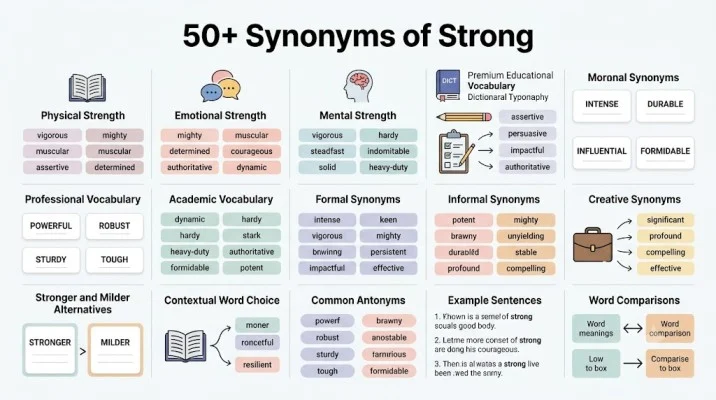
A writer may use the word strong several times in one email, essay, resume, caption, or conversation without realizing how many different meanings it can carry. A strong argument, a strong person, a strong coffee, and a strong relationship all describe different kinds of strength.
Learning the synonyms of strong helps you make those distinctions more clearly. Words such as powerful, sturdy, robust, forceful, resilient, intense, and influential can communicate specific kinds of strength instead of relying on one broad adjective. The best choice depends on what you are describing, how strong it is, and whether your writing is formal, casual, academic, professional, emotional, or creative.
What Are the Best Synonyms of “Strong”?
Strong generally means having great physical power, force, intensity, effectiveness, influence, or resistance. The best synonym depends on context. Use powerful for force or influence, sturdy for physical structure, robust for health or systems, forceful for arguments, resilient for recovery, and intense for feelings, flavors, or experiences.
Meaning, Tone, and Context
Simple Definition
The word strong describes something that has a high degree of physical power, force, intensity, effectiveness, influence, durability, or resistance.
Its meaning changes significantly depending on the noun it modifies.
For example:
- A strong athlete has physical power.
- A strong argument is convincing.
- A strong economy is performing well.
- A strong smell is intense.
- A strong relationship is stable and well connected.
- A strong coffee has a powerful flavor or high concentration.
- A strong leader has authority and influence.
- A strong material can resist breaking or damage.
This flexibility makes strong extremely useful, but it can also make the word too general when precision matters.
Part of Speech
Strong is primarily an adjective.
Examples:
- She is a strong athlete.
- The bridge is strong enough to support the weight.
- He presented a strong argument.
Its related forms include:
- Strength, noun
- Strongly, adverb
- Strengthen, verb
- Strongest, superlative form
- Stronger, comparative form
Overall Tone
Strong is usually neutral, although its emotional effect depends on context.
It can have a positive tone when describing:
- strength
- confidence
- health
- leadership
- relationships
- arguments
- performance
- determination
It can also be neutral or negative when describing:
- strong odors
- strong criticism
- strong reactions
- strong pain
- strong opposition
- strong winds
Formality Level
Strong is a neutral word that works naturally in formal, semi formal, and informal English.
It is appropriate for:
- Academic writing
- Business communication
- Professional emails
- Resumes
- Conversations
- Social media
- Creative writing
- News writing
However, a more precise synonym can make formal writing more sophisticated.
For example:
“She has strong leadership skills.”
can become:
“She has exceptional leadership skills.”
The second version gives the reader more information about the degree of ability.
Common Uses
Native English speakers commonly use strong to describe:
- Physical strength
- Mental strength
- Emotional strength
- Strong arguments
- Strong opinions
- Strong relationships
- Strong leadership
- Strong performance
- Strong evidence
- Strong results
- Strong demand
- Strong growth
- Strong winds
- Strong flavors
- Strong smells
- Strong emotions
- Strong resistance
- Strong materials
- Strong passwords
- Strong connections
When and How to Use “Strong”
Use strong when you want to communicate a high degree of ability, force, intensity, durability, influence, or effectiveness.
The important point is that strong does not always mean physically powerful. Its meaning is determined by context.
Professional
“She has strong communication skills and consistently works well with clients.”
Here, strong means highly developed or effective.
Academic
“The study provides strong evidence that regular exercise improves overall health.”
In this context, strong means convincing or well supported.
Workplace
“Our team has built a strong working relationship with the new department.”
Here, strong describes stability and trust.
Personal
“She remained strong during a difficult period in her life.”
In this sentence, strong refers to emotional resilience.
“We have a strong interest in discussing a potential partnership.”
Here, the word communicates serious or substantial interest.
Resume
“Developed strong client relationships that contributed to higher retention.”
In a resume, strong describes effective professional ability or results.
Social Media
“Starting this new chapter with a strong mindset and a clear sense of purpose.”
Here, strong conveys confidence and determination.
Best Synonyms of “Strong”
No synonym for strong works perfectly in every situation because the word has many meanings. A synonym that works for physical power may sound unnatural when describing coffee, emotions, evidence, or relationships.
Professional Writing: Robust
Robust is useful when describing systems, organizations, processes, health, or performance that are strong and capable of handling difficulty.
Example:
“The company has developed a robust quality control system.”
Why it works:
It sounds professional and suggests strength combined with reliability.
Academic Writing: Compelling
Compelling works particularly well when describing evidence, arguments, explanations, or reasons that are convincing.
Example:
“The researchers presented compelling evidence to support their conclusion.”
Why it works:
It explains the nature of the strength rather than simply repeating the broad word strong.
Business Communication: Powerful
Powerful is effective when discussing influence, impact, technology, leadership, or results.
Example:
“The campaign created a powerful connection with its target audience.”
Why it works:
It emphasizes noticeable influence or impact.
Casual Conversation: Tough
Tough is natural when describing someone who can handle difficulty, pressure, or hardship.
Example:
“She’s tough and won’t give up easily.”
Why it works:
It sounds conversational and emphasizes resilience.
Emotional Writing: Resilient
Resilient is especially useful when describing someone who recovers from setbacks.
Example:
“Her resilient spirit helped her move forward after the setback.”
Why it works:
It communicates emotional strength with greater precision.
Creative Writing: Fierce
Fierce can add energy and emotional intensity to descriptions of determination, passion, loyalty, or courage.
Example:
“She protected her family with a fierce determination.”
Why it works:
It creates a more vivid emotional image than the general word strong.
Resume Writing: Exceptional
Exceptional can describe skills or performance that are notably above the expected level.
Example:
“Demonstrated exceptional leadership during a major organizational transition.”
Why it works:
It gives a stronger impression of performance than simply saying strong leadership.
Workplace Communication: Reliable
Reliable is often better than strong when the intended meaning is dependable or consistently effective.
Example:
“We need a reliable process for handling customer complaints.”
Why it works:
It identifies the specific type of strength that matters in a workplace.
Stronger Meaning: Powerful
When you want to emphasize considerable force, influence, or effect, powerful is usually stronger than general strong.
Example:
“The speaker delivered a powerful message about community responsibility.”
Softer Meaning: Solid
Solid can communicate dependable quality without sounding overly dramatic.
Example:
“She has a solid understanding of basic accounting.”
Why it works:
It suggests competence and reliability without exaggerating.
When Not to Use “Strong”
The word strong is useful, but it is sometimes too broad. A more precise synonym can make your sentence communicate exactly what you mean.
When “Strong” Is Too General
Sentence:
“She is a strong employee.”
Better:
“She is a reliable employee who consistently meets deadlines.”
Why:
The word strong does not explain what makes the employee effective. Reliable provides a clearer quality.
When “Strong” Is Too Vague
Sentence:
“He has strong skills.”
Better:
“He has advanced analytical skills.”
Why:
The phrase strong skills is broad. Naming the specific ability gives the reader more useful information.
When “Strong” Is Too Informal
In some highly technical or academic contexts, strong may sound less precise than another term.
Sentence:
“The study has strong results.”
Better:
“The study produced significant findings.”
Why:
Significant findings sounds more natural in research writing.
When “Strong” Is Too Weak
If you need to emphasize extraordinary ability, strong may not provide enough impact.
Sentence:
“She is a strong leader.”
Better:
“She is an exceptional leader who consistently delivers results.”
Why:
Exceptional indicates a level beyond ordinary competence.
When “Strong” Is Too Strong
Sometimes a softer word is more accurate.
Sentence:
“He has a strong interest in attending the event.”
Better:
“He has a genuine interest in attending the event.”
Why:
Strong interest suggests considerable enthusiasm. Genuine interest can communicate sincere interest without exaggerating its intensity.
When “Strong” Creates the Wrong Meaning
Sentence:
“The restaurant serves strong food.”
Better:
“The restaurant serves boldly flavored food.”
Why:
Strong food is not a natural expression for describing rich or intense flavor. A more specific phrase communicates the intended meaning.
When a More Precise Word Is Available
Sentence:
“The company has a strong system.”
Better:
“The company has a robust security system.”
Why:
Robust communicates strength, reliability, and the ability to handle demanding conditions.
Words Commonly Confused With “Strong”
Powerful
Difference:
Powerful emphasizes the ability to produce force, influence, or a significant effect.
When to Use It:
Use it for people, speeches, machines, arguments, emotions, or social influence.
Example:
“Her speech delivered a powerful message.”
Tough
Difference:
Tough often describes the ability to withstand difficulty, pain, pressure, or harsh treatment.
When to Use It:
Use it for people, materials, situations, or difficult conditions.
Example:
“This material is tough enough for outdoor equipment.”
Sturdy
Difference:
Sturdy mainly describes physical objects that are solid, stable, and unlikely to break.
When to Use It:
Use it for furniture, buildings, equipment, structures, or physical objects.
Example:
“We bought a sturdy wooden table.”
Forceful
Difference:
Forceful emphasizes the use of considerable force, energy, or conviction.
When to Use It:
Use it for arguments, speech, movements, personalities, or actions.
Example:
“She gave a forceful response to the criticism.”
Robust
Difference:
Robust suggests strength combined with health, reliability, durability, or the ability to perform under difficult conditions.
When to Use It:
Use it for systems, businesses, economies, health, processes, and technology.
Example:
“The software has a robust security system.”
Resilient
Difference:
Resilient describes the ability to recover after difficulty, damage, stress, or failure.
When to Use It:
Use it for people, communities, organizations, materials, and systems that recover well.
Example:
“The community proved highly resilient after the storm.”
Best Synonyms of “Strong” by Context
| Context | Best Synonym | Why It Works | Example |
|---|---|---|---|
| Formal writing | Robust | Sounds precise and professional | The organization has a robust framework. |
| Academic writing | Compelling | Works well for convincing evidence or arguments | The paper presents compelling evidence. |
| Professional communication | Powerful | Highlights impact or influence | The presentation delivered a powerful message. |
| Business emails | Significant | Communicates substantial importance or effect | We have seen significant growth this quarter. |
| Resume writing | Exceptional | Highlights unusually high ability | Demonstrated exceptional leadership skills. |
| Workplace communication | Reliable | Focuses on dependability | We need a reliable reporting process. |
| Casual conversation | Tough | Natural for people who handle difficulty | He’s a tough person. |
| Everyday speaking | Solid | Suggests dependable quality | That’s a solid plan. |
| Creative writing | Fierce | Adds energy and emotional force | She had a fierce determination to succeed. |
| Storytelling | Powerful | Creates emotional or dramatic impact | The experience left a powerful impression. |
| Emotional writing | Resilient | Expresses recovery and inner strength | Her resilient spirit inspired others. |
| Strong emphasis | Powerful | Clearly communicates force or impact | It was a powerful argument. |
| Mild tone | Solid | Communicates competence without exaggeration | He has a solid understanding of the subject. |
| Social media captions | Fierce | Creates energetic, expressive language | Feeling fierce and ready for what’s next. |
| American English | Strong | The general term remains highly natural | She has a strong work ethic. |
| British English | Robust | Often used naturally in formal and professional contexts | The company has a robust strategy. |
How to Choose the Best Synonym of “Strong”
Choosing a synonym becomes easier when you first identify what kind of strength you mean.
If You Mean Physical Power
Use:
- Powerful
- Muscular
- Mighty
- Brawny
- Sturdy
Example:
“He is a powerful athlete.”
If You Mean Durability
Use:
- Sturdy
- Durable
- Tough
- Robust
- Resilient
Example:
“The company uses durable materials in its products.”
If You Mean Mental or Emotional Strength
Use:
- Resilient
- Tough
- Determined
- Steadfast
- Courageous
Example:
“She remained steadfast despite the criticism.”
If You Mean Influence
Use:
- Powerful
- Influential
- Dominant
- Potent
- Forceful
Example:
“He became an influential voice in the industry.”
If You Mean a Convincing Argument
Use:
- Compelling
- Convincing
- Persuasive
- Forceful
- Sound
Example:
“The attorney presented a compelling argument.”
If You Mean Intensity
Use:
- Intense
- Fierce
- Powerful
- Extreme
- Potent
Example:
“The storm brought intense winds.”
If You Mean Good Performance
Use:
- Excellent
- Robust
- Impressive
- Exceptional
- Solid
Example:
“The company reported robust quarterly growth.”
Consider Your Audience
- For academic readers, choose precise words such as compelling, robust, and significant.
- For professionals, powerful, reliable, exceptional, and strategic can work well.
- For casual conversations, tough, solid, and powerful usually sound more natural.
Consider Emotional Strength
Words such as fierce, intense, and powerful add emotion.
Words such as solid, reliable, and robust are more neutral.
Consider Formality
A formal report might say:
“The organization implemented a robust security framework.”
A casual speaker might say:
“The company has a strong security system.”
Both are correct, but they create different impressions.
Real Life Examples of “Strong”
School
Basic:
“Students need strong study habits.”
Improved:
“Students need consistent study habits to maintain good academic performance.”
The word consistent is more precise because it identifies what makes the habits effective.
College
Basic:
“The paper presents a strong argument.”
Improved:
“The paper presents a compelling argument supported by recent evidence.”
Workplace
Basic:
“She has strong communication skills.”
Improved:
“She has excellent communication skills and explains complex ideas clearly.”
Business
Basic:
“The company has strong growth.”
Improved:
“The company has experienced robust growth over the past year.”
Basic:
“We have a strong interest in working together.”
Improved:
“We have a significant interest in exploring a potential partnership.”
Resume
Basic:
“Strong leadership skills.”
Improved:
“Demonstrated exceptional leadership while managing a cross functional team.”
Conversation
Basic:
“He’s a strong person.”
Improved:
“He’s tough and handles difficult situations calmly.”
Storytelling
Basic:
“She had a strong desire to succeed.”
Improved:
“She carried a fierce determination to succeed despite every setback.”
Blogging
Basic:
“A strong introduction keeps readers interested.”
Improved:
“A compelling introduction gives readers a clear reason to continue.”
Social Media
Basic:
“Starting the week strong.”
Improved:
“Starting the week with a powerful mindset and clear goals.”
20 Best Synonyms of “Strong”
| Synonym | Simple Meaning | Best Used For | Example Sentence |
|---|---|---|---|
| Powerful | Having great force or influence | People, arguments, machines, messages | The speaker gave a powerful presentation. |
| Robust | Strong, healthy, reliable, or durable | Systems, businesses, health, processes | The company built a robust security system. |
| Sturdy | Solid and unlikely to break | Furniture, buildings, objects | The shelf is sturdy enough for heavy books. |
| Tough | Able to withstand difficulty or damage | People, materials, situations | This fabric is surprisingly tough. |
| Forceful | Expressing strong force or conviction | Arguments, speech, actions | She made a forceful case for reform. |
| Resilient | Able to recover from difficulty | People, communities, systems | The team remained resilient after the loss. |
| Intense | Extremely strong in feeling or degree | Emotions, experiences, flavors | The workout was intense but rewarding. |
| Compelling | Very convincing or persuasive | Arguments, evidence, stories | The report provides compelling evidence. |
| Influential | Able to affect people or decisions | Leaders, writers, organizations | She became an influential voice in education. |
| Mighty | Having great power or strength | People, forces, literary descriptions | The river moved with mighty force. |
| Durable | Able to last without damage | Products, materials, equipment | The boots are made from durable leather. |
| Potent | Having a powerful effect | Medicine, chemicals, ideas, emotions | The organization launched a potent campaign. |
| Firm | Strong, steady, or not easily changed | Decisions, beliefs, physical objects | She remained firm in her decision. |
| Steadfast | Firm and determined | Character, loyalty, beliefs | His steadfast support never changed. |
| Vigorous | Full of energy and strength | Activity, movement, health | She took part in a vigorous training session. |
| Solid | Dependable and reasonably strong | Skills, plans, performance | He has a solid understanding of finance. |
| Fierce | Extremely intense or determined | Emotions, competition, determination | She showed fierce determination. |
| Mighty | Very powerful or impressive | Literary and expressive writing | The army faced a mighty opponent. |
| Brawny | Physically muscular and strong | People, physical descriptions | The brawny athlete lifted the heavy bar. |
| Formidable | Powerful enough to cause respect or difficulty | Opponents, challenges, abilities | The team faced a formidable competitor. |
Synonyms of “Strong” by Usage
Professional vs Personal Synonyms
Professional writing often needs precision, while personal communication can use more expressive or conversational vocabulary.
For professional settings, useful choices include:
- Robust
- Reliable
- Powerful
- Exceptional
- Compelling
- Significant
Example:
“The company has a robust operational structure.”
For personal situations, these words may sound more natural:
- Tough
- Fierce
- Resilient
- Solid
- Powerful
Example:
“She stayed resilient when things became difficult.”
Formal vs Conversational Synonyms
Formal writing often benefits from words that identify the exact type of strength.
Reports
Use:
- Robust
- Significant
- Substantial
- Compelling
Example:
“The findings provide compelling evidence.”
Essays
Use:
- Compelling
- Persuasive
- Significant
- Fundamental
Example:
“The author makes a persuasive argument.”
Business Writing
Use:
- Robust
- Powerful
- Strategic
- Significant
Example:
“The organization has a robust growth strategy.”
Presentations
Use:
- Powerful
- Compelling
- Persuasive
- Influential
Example:
“The presentation made a powerful impression on investors.”
Emails
Use:
- Strong
- Significant
- Genuine
- Clear
Example:
“We have a genuine interest in continuing the discussion.”
Casual Conversations
Use:
- Tough
- Big
- Solid
- Powerful
Example:
“That’s a solid idea.”
Texting
Simple expressions usually sound most natural.
Example:
“That’s a strong move.”
or:
“That’s a powerful message.”
Academic Synonyms
Academic writing should distinguish between physical strength, argumentative strength, evidence, statistical significance, and influence.
Compelling
Use compelling when evidence or reasoning strongly persuades the reader.
“The researchers presented compelling evidence.”
Robust
Use robust when describing a method, system, analysis, or finding that is reliable or resistant to weaknesses.
“The researchers used a robust analytical method.”
Persuasive
Use persuasive when an argument successfully convinces an audience.
“The author provides a persuasive explanation.”
Significant
Use significant when something has notable importance or impact. In statistical writing, it can also have a more specific technical meaning, so it should not be used casually as a replacement for every instance of strong.
“The study found a significant difference between the groups.”
Professional and Business Synonyms
Resumes
Strong resume alternatives include:
- Exceptional
- Proven
- Effective
- Robust
- Influential
Instead of:
“Strong leadership skills.”
Try:
“Proven leadership skills with experience managing cross functional teams.”
Interviews
Use:
- Confident
- Capable
- Resilient
- Effective
Example:
“I have a proven ability to manage competing priorities.”
Meetings
Use:
- Compelling
- Persuasive
- Forceful
- Clear
Example:
“She presented a compelling case for changing the process.”
Presentations
Use:
- Powerful
- Engaging
- Persuasive
- Impactful
Example:
“The presentation delivered a powerful message about customer needs.”
Performance Reviews
Use:
- Consistent
- Reliable
- Exceptional
- Effective
Example:
“He has demonstrated consistent performance throughout the year.”
Client Communication
Use:
- Reliable
- Valuable
- Effective
- Strong
Example:
“We have developed a reliable process for handling client requests.”
Business Emails
Use precise expressions rather than simply repeating strong.
Instead of:
“We have a strong desire to expand.”
Use:
“We have a clear commitment to expanding our services.”
Creative and Literary Synonyms
Creative writing gives you more freedom to choose words based on imagery and emotion.
Fierce
Useful for determination, loyalty, passion, competition, and emotional intensity.
“She carried a fierce determination that refused to disappear.”
Mighty
Useful for dramatic descriptions of nature, people, forces, or battles.
“The mighty waves crashed against the rocks.”
Powerful
Useful for emotional experiences and memorable moments.
“His words had a powerful effect on everyone in the room.”
Intense
Useful when an experience, emotion, or atmosphere feels unusually strong.
“An intense silence filled the room.”
Formidable
Useful when describing an opponent, challenge, or force that commands respect.
“She was a formidable opponent on the debate stage.”
These choices give creative writing more texture than repeatedly using strong.
Slang or Modern Synonyms
There is no single slang word that replaces strong across all its meanings.
However, casual American English uses several expressions depending on context.
Beast
Meaning:
A person who performs exceptionally well or demonstrates impressive physical ability.
Acceptable In:
Casual conversation, sports, gaming, and social media.
Avoid In:
Academic papers, formal reports, professional resumes, and formal emails.
Example:
“He’s a beast at the gym.”
Solid
Meaning:
Dependable, good, or effective.
Acceptable In:
Conversation, texting, workplace speech, and informal writing.
Avoid In:
Highly formal academic contexts when a more precise term is available.
Example:
“That’s a solid plan.”
Strongest to Mildest Synonyms
Strength is not a single scale because different synonyms describe different types of strength. Still, an approximate intensity guide can help.
| Level | Useful Words | General Effect |
|---|---|---|
| Mild | Solid, Firm, Sturdy | Dependable or reasonably strong |
| Moderate | Tough, Durable, Robust | Able to withstand pressure |
| Strong | Powerful, Forceful, Vigorous | Clearly high in force or energy |
| Very Strong | Fierce, Mighty, Formidable | Exceptional force, intensity, or difficulty |
For emotional situations:
Firm can sound controlled.
Tough suggests resilience.
Powerful suggests high impact.
Fierce suggests intense determination or emotion.
Formidable suggests considerable power that others must respect.
Emotional vs Neutral Synonyms
Emotional Synonyms
These alternatives add feeling or intensity:
- Fierce
- Powerful
- Mighty
- Intense
- Formidable
- Resilient
Example:
“She showed fierce determination throughout the competition.”
The word fierce creates a stronger emotional image than strong.
Neutral Synonyms
These alternatives communicate strength without adding much emotion:
- Robust
- Sturdy
- Durable
- Firm
- Solid
- Reliable
Example:
“The company has a robust internal reporting system.”
Neutral vocabulary is usually better for professional and academic writing.
Antonyms of “Strong”
Because strong has many meanings, its opposites also vary according to context.
| Antonym | Meaning | Example Sentence |
|---|---|---|
| Weak | Lacking physical or general strength | His grip was weak after the injury. |
| Fragile | Easily broken or damaged | The package contained fragile glassware. |
| Feeble | Lacking energy or force | He gave a feeble attempt to move the heavy box. |
| Frail | Physically delicate or weak | The elderly man appeared frail. |
| Powerless | Lacking power or control | The workers felt powerless to change the decision. |
| Flimsy | Not strong enough to withstand pressure | The chair looked flimsy. |
| Delicate | Easily damaged or affected | The flowers have delicate petals. |
| Mild | Not intense or forceful | The sauce has a mild flavor. |
| Faint | Weak in intensity or strength | We heard a faint sound in the distance. |
| Ineffective | Not producing a strong or useful result | The treatment proved ineffective. |
| Unstable | Not firm, secure, or dependable | The structure became unstable after the storm. |
| Vulnerable | Easily harmed or affected | Young plants are particularly vulnerable to frost. |
| Soft | Lacking hardness or force | The material feels soft to the touch. |
| Timid | Lacking confidence or assertiveness | He was too timid to speak during the meeting. |
| Subdued | Reduced in intensity or force | The room had a subdued atmosphere. |
Comparison: “Strong” vs Similar Words
Strong vs Powerful
Main Difference
Strong is broader and can describe physical ability, durability, intensity, health, or effectiveness. Powerful focuses more on force, influence, or impact.
Which Is Stronger?
Powerful often sounds stronger when describing influence or effect.
Which Is More Formal?
Both are neutral and suitable for formal writing.
When to Use Each
Use strong when the meaning is broad.
Use powerful when something produces a significant effect.
Examples
Strong:
“She has a strong personality.”
Powerful:
“She is a powerful public speaker.”
Strong vs Tough
Main Difference
Strong can describe many forms of strength. Tough emphasizes resistance to difficulty, damage, pain, or pressure.
Which Is Stronger?
Neither is universally stronger.
Which Is More Formal?
Strong is more neutral. Tough is often more conversational.
When to Use Each
Use tough when the ability to withstand difficulty is the main idea.
Examples
Strong:
“He is a strong athlete.”
Tough:
“He is a tough competitor.”
Strong vs Sturdy
Main Difference
Sturdy mainly describes physical objects that are solid and stable.
Which Is Stronger?
For physical structures, sturdy is more specific.
Which Is More Formal?
Both are neutral.
When to Use Each
Use sturdy for furniture, buildings, equipment, and objects.
Examples
Strong:
“The material is strong.”
Sturdy:
“The table is sturdy and stable.”
Strong vs Robust
Main Difference
Robust combines strength with reliability, health, durability, or the ability to function under difficult conditions.
Which Is Stronger?
Robust often sounds more specific in professional contexts.
Which Is More Formal?
Robust is more common in formal and professional writing.
When to Use Each
Use robust for systems, organizations, economies, methods, and technology.
Examples
Strong:
“The company has a strong system.”
Robust:
“The company has a robust security system.”
Strong vs Forceful
Main Difference
Forceful focuses on the way someone expresses an idea or uses physical or verbal force.
Which Is Stronger?
Forceful is stronger when describing an argument, speech, or action.
Which Is More Formal?
Both can work in formal writing.
When to Use Each
Use forceful for arguments, statements, speeches, movements, and personalities.
Examples
Strong:
“She made a strong argument.”
Forceful:
“She made a forceful argument.”
Strong vs Resilient
Main Difference
Resilient specifically describes the ability to recover after difficulty or failure.
Which Is Stronger?
Neither is stronger in every situation. They express different qualities.
Which Is More Formal?
Resilient is especially useful in professional, academic, and psychological contexts.
When to Use Each
Use resilient when recovery is the key idea.
Examples
Strong:
“She remained strong after the setback.”
Resilient:
“She remained resilient and rebuilt her career.”
Common Phrases and Expressions with “Strong”
Strong Argument
Meaning:
A convincing argument supported by good reasoning or evidence.
Example:
“The lawyer presented a strong argument in court.”
Strong Evidence
Meaning:
Evidence that provides substantial support for a conclusion.
Example:
“The researchers found strong evidence supporting the theory.”
Strong Opinion
Meaning:
A firmly held belief or view.
Example:
“She has a strong opinion about the proposed changes.”
Strong Relationship
Meaning:
A stable connection based on trust, cooperation, or affection.
Example:
“The two companies have built a strong relationship over the years.”
Strong Leadership
Meaning:
Effective leadership that provides direction, confidence, and stability.
Example:
“The organization needs strong leadership during the transition.”
Strong Demand
Meaning:
A high level of desire or need for a product or service.
Example:
“The company is experiencing strong demand for its new product.”
Strong Performance
Meaning:
Results that are better than average or notably successful.
Example:
“The team delivered a strong performance this quarter.”
Strong Flavor
Meaning:
A flavor that is powerful or highly noticeable.
Example:
“This cheese has a strong flavor.”
Common Mistakes to Avoid
1. Using “Strong” When a More Precise Word Is Better
Incorrect:
“She has strong computer skills.”
Better:
“She has advanced programming skills.”
Why:
The improved sentence identifies the exact ability instead of relying on a broad adjective.
2. Confusing “Strong” With “Powerful”
Incorrect:
“The chair is powerful.”
Better:
“The chair is sturdy.”
Why:
Powerful describes force or influence, while sturdy is more appropriate for a stable physical object.
3. Using Informal Vocabulary in Formal Writing
Incorrect:
“The company is really tough.”
Better:
“The company has demonstrated resilience during market changes.”
Why:
The second sentence communicates the idea in a more professional way.
4. Choosing an Overly Dramatic Synonym
Incorrect:
“The student gave a mighty answer.”
Better:
“The student gave a strong answer.”
Why:
Mighty is expressive and often literary. It can sound unnatural in ordinary academic communication.
5. Repeating “Strong” Too Often
Incorrect:
“She has strong skills, strong experience, and a strong background.”
Better:
“She has advanced skills, extensive experience, and a solid professional background.”
Why:
Using precise alternatives prevents repetitive writing.
6. Using the Wrong Emotional Tone
Incorrect:
“He showed a strong fear.”
Better:
“He felt intense fear.”
Why:
Intense is a more natural collocation for a powerful emotional experience.
7. Using Slang in Professional Writing
Incorrect:
“He’s a beast at managing teams.”
Better:
“He is an exceptional team leader.”
Why:
Beast can work as casual slang, but it is inappropriate for most professional documents.
Frequently Asked Questions
What are the best synonyms of “strong”?
The best synonyms of strong depend on meaning. Powerful works for force or influence, sturdy for objects, robust for systems, resilient for recovery, forceful for arguments, and intense for feelings or experiences.
What are the best formal synonyms of “strong”?
Useful formal synonyms include robust, powerful, forceful, compelling, resilient, substantial, and formidable. The best choice depends on whether you are describing evidence, systems, people, arguments, performance, or physical strength.
What are common informal synonyms of “strong”?
Common informal alternatives include tough, solid, powerful, and sometimes beast in slang. These choices work best in casual conversation, texting, sports, gaming, and social media rather than academic or formal professional writing.
What is another word for “strong” in professional writing?
Robust is an excellent professional alternative when describing systems, processes, businesses, or performance. Compelling, reliable, powerful, and exceptional may be better when describing evidence, people, communication, or achievements.
What is the difference between “strong” and “powerful”?
Strong is a broad word that describes many types of strength. Powerful more specifically emphasizes force, influence, or impact, so it often works better for speeches, arguments, leaders, machines, and emotional experiences.
What is the opposite of “strong”?
The most common opposite is weak, but the best antonym depends on context. Fragile describes easily damaged objects, powerless describes a lack of control, feeble describes low force, and mild can oppose strong intensity.
Conclusion
The word strong is highly versatile, but its broad meaning can sometimes make writing less precise. The best synonyms of strong depend on the kind of strength you want to express, whether that means physical power, durability, emotional resilience, persuasive ability, influence, intensity, or reliability.
Use powerful for force and impact, sturdy for physical objects, robust for systems and professional contexts, resilient for recovery, compelling for arguments and evidence, and intense for strong feelings or experiences. In casual English, tough and solid can sound more natural.
No synonym works perfectly in every sentence. The strongest vocabulary choice is the one that matches your meaning, audience, tone, and purpose. A useful habit is to identify the exact type of strength you mean before replacing the word strong.
Read More Related Articles:
50+ Best List of Synonyms | for Better Writing and …
50+ Synonyms of Love | Powerful Words to Express Every …
Synonyms for Thus | Meaning, Examples, and Better Word …











1 thought on “50+ Synonyms of Strong | Meanings, Uses, Examples, and Best Alternatives”