The right words can transform ordinary writing into clear, engaging, and memorable communication. Whether you’re creating academic papers, professional emails, blog posts, or creative content, having a reliable list of synonyms helps you replace repetitive words with fresh alternatives that improve readability and strengthen your message. Expanding your vocabulary also makes your writing sound more natural and polished.
A carefully organized list of synonyms allows you to choose words that match the exact tone, meaning, and context you need. Instead of using the same expressions repeatedly, you can write with greater precision, confidence, and variety while keeping every sentence meaningful and easy to understand.
This guide brings together practical synonym collections, clear explanations, and real examples to help you find the best word for every situation. From formal writing to everyday conversations, you’ll discover vocabulary choices that make your content more effective, engaging, and impactful.
What Are the Best Synonyms of “List”?
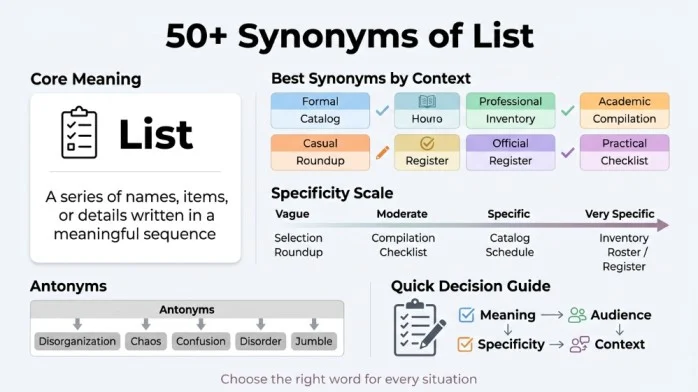
A list is a series of names, items, or details written or printed in a meaningful sequence. The best synonyms include catalog, inventory, roster, register, schedule, directory, index, record, agenda, catalogue, checklist, tally, enumeration, compilation, and digest. Choose catalog for organized collections, inventory for stock or supplies, roster for people, register for official records, schedule for timetables, and checklist for tasks to complete.
Meaning, Tone, and Context
Simple Definition
The word list describes a series of names, items, or details written or printed in a meaningful sequence. It can also refer to the act of making such a series.
Part of Speech
List can be used as a noun or a verb.
Overall Tone
The word usually has a neutral to practical tone. It highlights organization and clarity without adding strong emotion.
Formality Level
List is considered neutral, making it suitable for both formal and informal communication. It appears naturally in business writing, academic papers, workplace discussions, everyday conversations, emails, and presentations.
Common Uses
Native English speakers commonly use list when talking about:
- Grocery list
- To-do list
- Guest list
- Mailing list
- Reading list
- Shopping list
- Checklist
- Waitlist
- Contact list
- Playlist
- Bucket list
- Shortlist
Word Forms
| Form | Word |
|---|---|
| Noun | list |
| Verb | list |
| Adjective | listless (unrelated) |
| Related Form | listing |
| Opposite Form | unlisted |
When and How to Use “List”
The word list works well whenever you want to show that you have organized information in a clear sequence. However, choosing a more specific synonym can make your message clearer and more impactful.
Professional
“Please review the list of attendees for the upcoming conference.”
Academic
“The reference list includes all sources cited in the research paper.”
Workplace
“The team prepared a list of action items for the next quarter.”
Personal
“I made a list of all the books I want to read this year.”
“Attached is a list of all the documents required for the application.”
Resume
“Created a list of key performance indicators to track team progress.”
Social Media
“Here is my list of the top five destinations I want to visit.”
Best Synonyms of List
The word list is useful because it fits almost every type of writing, but no single synonym works perfectly in every situation. Some alternatives emphasize organization, while others highlight official records, collections, or schedules. Choosing the right synonym helps your writing sound more natural and precise.
Professional Writing: Catalog
Catalog is one of the strongest professional alternatives to list. It suggests a systematic and often detailed collection of items.
Example:
“The company maintains a comprehensive catalog of all available products.”
Why it works:
Business writing benefits from precise language, and catalog suggests thorough organization.
Academic Writing: Compilation
In essays, research papers, and reports, compilation is often a better choice than list because it highlights the effort of gathering information.
Example:
“The compilation of research data took several months to complete.”
Why it works:
It sounds objective, formal, and academically appropriate.
Business Communication: Inventory
Inventory emphasizes a detailed record of goods, supplies, or assets.
Example:
“The inventory of office supplies revealed shortages in several departments.”
Why it works:
It immediately communicates thorough counting and organization.
Casual Conversation: Roundup
For everyday speaking, roundup sounds natural without becoming overly formal.
Example:
“Let me give you a roundup of everything that happened this week.”
Why it works:
Native English speakers frequently use roundup to describe a summary list.
Emotional Writing: Roll Call
When discussing people, roll call is usually more expressive than list.
Example:
“The roll call of honored guests included many familiar faces.”
Why it works:
It emphasizes people and their significance.
Creative Writing: Inventory
Creative writing often benefits from descriptive vocabulary. Inventory helps create a sense of thoroughness.
Example:
“She took an inventory of her belongings before moving across the country.”
Why it works:
It captures the reader’s attention and adds depth to storytelling.
Resume Writing: Index
Recruiters frequently see the word index because it quickly highlights organizational skills.
Example:
“Created a comprehensive index of all company policies and procedures.”
Why it works:
It sounds concise, professional, and achievement-focused.
Workplace Communication: Roster
Roster emphasizes a list of people assigned to specific tasks or duties.
Example:
“The duty roster for the holiday weekend was posted on the bulletin board.”
Why it works:
It communicates assignment and organization while maintaining a professional tone.
Stronger Meaning: Enumeration
When you need stronger emphasis, enumeration is one of the best replacements for list.
Example:
“The enumeration of all expenses was necessary for the budget review.”
Why it works:
It suggests a detailed, point-by-point accounting.
Softer Meaning: Selection
Sometimes you want to acknowledge a group without making it sound exhaustive.
Example:
“Here is a selection of the best options available.”
Why it works:
It gives balanced emphasis without exaggeration.
When Not to Use “List”
Although list is versatile, it is not always the most effective word. In many situations, a more specific synonym communicates your message more clearly.
When It Sounds Too General
Sometimes list is too broad and fails to explain the purpose or organization.
Less Effective
“Here is a list of all employees.”
Better
“Here is the complete roster of all full-time employees.”
Why
Roster clearly explains that this is an official assignment list.
When Greater Specificity Is Needed
If the situation requires specifying the type of collection, list may sound too vague.
Less Effective
“The list of supplies was accurate.”
Better
“The inventory of office supplies was accurate.”
Why
Inventory specifies that this is a count of supplies or stock.
In Academic Writing
Academic writing usually favors more precise vocabulary.
Less Effective
“The list of references was extensive.”
Better
“The bibliography included more than fifty sources.”
Why
Bibliography is more precise and commonly used in academic writing.
On a Resume
General wording often reduces the impact of your achievements.
Less Effective
“Managed the list of clients.”
Better
“Managed a comprehensive client roster of over 200 accounts.”
Why
Roster immediately highlights the scale and importance.
In Creative Writing
Using list repeatedly can make storytelling feel flat.
Less Effective
“She made a list of all her fears.”
Better
“She took inventory of all her fears.”
Why
Inventory creates stronger imagery and leaves a lasting impression.
When Expressing Official Information
If something is official or authoritative, choose a more formal word.
Less Effective
“The list of attendees was verified.”
Better
“The official register of attendees was verified.”
Why
Register is more formal and authoritative than list.
Words Commonly Confused with “List”
| Word | Difference | When to Use It | Example |
|---|---|---|---|
| Catalog | A systematic collection of items. | Organized collections, products. | “The catalog contains thousands of products.” |
| Inventory | A detailed record of goods or supplies. | Stock, supplies, assets. | “The inventory showed a shortage of paper.” |
| Roster | A list of people assigned to duties. | People, assignments. | “The duty roster is posted on the board.” |
| Register | An official record or list. | Official documents, attendance. | “The register of births was updated.” |
| Schedule | A list of planned events or times. | Timetables, appointments. | “The schedule for the conference was posted.” |
| Directory | A list of names and contact information. | Phone books, contacts. | “The employee directory is online.” |
Best Synonyms of List by Context
| Context | Best Synonym | Why It Works | Example |
|---|---|---|---|
| Formal Writing | Catalog | Sounds precise and professional. | “The catalog of resources was extensive.” |
| Academic Writing | Compilation | Fits research and essays naturally. | “The compilation of data was thorough.” |
| Professional Communication | Inventory | Highlights organization and detail. | “An inventory of supplies was conducted.” |
| Business Emails | Schedule | Concise and professional. | “Please review the attached schedule.” |
| Resume Writing | Roster | Emphasizes organization. | “Managed a roster of 50 employees.” |
| Workplace Communication | Checklist | Stresses task completion. | “Use this checklist to ensure quality.” |
| Casual Conversation | Roundup | Sounds natural in daily speech. | “Here is a roundup of the news.” |
| Everyday Speaking | Catalog | Common informal alternative. | “I have a catalog of excuses.” |
| Creative Writing | Inventory | Adds vivid description. | “She took inventory of her life.” |
| Storytelling | Roll Call | Shows a specific event. | “The roll call of heroes was inspiring.” |
| Emotional Writing | Catalogue | Expresses personal collection. | “He catalogued all his memories.” |
| Strong Emphasis | Enumeration | Indicates detailed listing. | “The enumeration of offenses was lengthy.” |
| Mild Tone | Selection | Gives moderate emphasis. | “Here is a selection of options.” |
| Social Media Captions | Roundup | Sounds engaging and natural. | “Friday roundup of my favorite posts!” |
| American English | Catalog | Frequently used in business. | “Browse our online catalog.” |
| British English | Catalogue | Common in formal and everyday usage. | “The library catalogue is online.” |
Synonyms of List by Usage
The word list works in almost every situation, but choosing a more specific synonym makes your writing stronger and more natural. The sections below explain which alternatives fit different types of communication.
Professional vs Personal Synonyms
- Professional communication requires precise vocabulary, while personal conversations sound better with simpler, more relatable words.
Professional Synonyms
| Synonym | Best Used For | Why It Works |
|---|---|---|
| Inventory | Reports, stock | Shows detailed organization. |
| Roster | Employee records | Highlights assignment of people. |
| Schedule | Timetables, appointments | Organizes time and events. |
| Register | Official records | Adds authority and formality. |
| Catalog | Collections, products | Shows systematic organization. |
Recommendation
Use inventory, roster, catalog, or register in resumes, business emails, presentations, and reports because they sound more precise than list.
Personal Synonyms
| Synonym | Best Used For | Example |
|---|---|---|
| Roundup | Summaries | “Here is a roundup of events.” |
| Compilation | Collections | “I made a compilation of my photos.” |
| Inventory | Personal belongings | “I took an inventory of my wardrobe.” |
| Selection | Choices | “Here is a selection of my favorites.” |
Recommendation
In conversations with friends and family, natural words like roundup, compilation, and selection often sound better than overly formal alternatives.
Formal vs Conversational Synonyms
Choosing the right level of formality helps your writing match the audience.
| Situation | Best Synonyms |
|---|---|
| Reports | Inventory, Catalog |
| Essays | Compilation, Bibliography |
| Business Writing | Register, Roster |
| Presentations | Agenda, Outline |
| Professional Emails | Schedule, Attachments |
| Casual Conversations | Roundup, Selection |
| Text Messages | List, Selection |
Example
Formal:
“The inventory of assets was completed last week.”
Conversational:
“Here is a selection of my favorite movies.”
Academic Synonyms
Academic writing benefits from vocabulary that sounds precise and objective.
Compilation
Commonly used when discussing gathered information.
Example
“The compilation of research data was a lengthy process.”
Bibliography
Best for listing sources in academic writing.
Example
“The bibliography includes all sources cited in the paper.”
Index
Ideal for organizing information in a reference work.
Example
“The index at the back of the book lists all key terms.”
Catalogue
Appropriate for organized collections in academic contexts.
Example
“The library catalogue contains thousands of scholarly works.”
Enumeration
Useful when emphasizing a point-by-point listing.
Example
“The enumeration of all variables was necessary for the study.”
Recommendation
For essays and research papers, compilation, bibliography, and catalogue usually sound stronger and more authoritative than list.
Professional and Business Synonyms
Business communication often requires concise and specific language.
Inventory
Perfect for tracking stock and supplies.
Example
“The inventory of office supplies showed a shortage of printer paper.”
Roster
Highlights people assigned to tasks.
Example
“The duty roster was posted on the employee notice board.”
Schedule
Describes planned events or appointments.
Example
“The project schedule was updated to reflect the new deadline.”
Catalog
Shows a systematic collection of items.
Example
“The product catalog was updated for the new season.”
Register
Indicates an official record.
Example
“The register of all transactions was audited.”
Recommendation
Use these words in resumes, interviews, meetings, presentations, business emails, and client communication to sound more professional.
Creative and Literary Synonyms
Creative writing benefits from expressive vocabulary that creates emotion and imagery.
Inventory
Adds depth when describing personal belongings or memories.
Example
“She took inventory of her life and decided to make changes.”
Compilation
Suggests thoughtful gathering of items.
Example
“The compilation of letters told the story of their love.”
Enumeration
Creates a sense of thoroughness and detail.
Example
“The enumeration of her fears revealed the depth of her anxiety.”
Catalogue
Suggests a comprehensive collection.
Example
“His mind was a catalogue of all the books he had ever read.”
Roll Call
Emphasizes people and their significance.
Example
“The roll call of fallen heroes brought tears to everyone’s eyes.”
These words make stories, speeches, and descriptive writing more engaging.
Slang or Modern Synonyms
There are very few true slang synonyms for list, but native speakers often use casual expressions.
| Expression | Meaning | Appropriate For | Avoid In |
|---|---|---|---|
| Run-down | A brief list or summary | Everyday conversations | Academic papers |
| Roundup | A summary list | Friends, social media | Business reports |
| Selection | A chosen list | Casual speech | Formal writing |
Example
Casual:
“Give me a quick run-down of what happened.”
Formal:
“Please provide a comprehensive compilation of the key findings.”
Strongest to Mildest Synonyms
The following scale shows how different synonyms express different levels of organization or detail.
| Specificity | Synonyms |
|---|---|
| Vague | Selection, Roundup |
| Moderate | Compilation, Checklist, Record |
| Specific | Catalog, Schedule, Directory |
| Very Specific | Inventory, Roster, Register, Enumeration |
Understanding the Scale
- Selection implies a partial or chosen list.
- Roundup suggests a summary list.
- Compilation suggests gathered items.
- Checklist suggests items to be completed.
- Schedule suggests time-based organization.
- Catalog suggests a systematic collection.
- Inventory suggests a detailed count.
- Roster suggests people assigned to duties.
- Register suggests an official record.
- Enumeration suggests a point-by-point listing.
Emotional vs Neutral Synonyms
Some synonyms express feelings, while others simply communicate information.
Emotional Synonyms
| Synonym | Best Used For |
|---|---|
| Roll Call | Honoring people |
| Inventory | Personal reflection |
| Compilation | Sentimental collections |
| Catalog | Personal memories |
These words add emotion and help readers connect with the message.
Neutral Synonyms
| Synonym | Best Used For |
|---|---|
| Register | Official records |
| Roster | Assignments |
| Schedule | Timetables |
| Inventory | Stock |
| Catalog | Collections |
Neutral words communicate information without adding unnecessary emotion.
Antonyms of List
| Antonym | Meaning | Example Sentence |
|---|---|---|
| Disorganization | Lack of order | The disorganization of the files was frustrating. |
| Scatter | To spread randomly | The papers were scattered across the desk. |
| Disarray | State of disorder | The disarray of the documents made them difficult to find. |
| Randomness | Lack of order | The randomness of the items was confusing. |
| Chaos | Complete disorder | The chaos of the office was overwhelming. |
| Confusion | Lack of clarity | The confusion of the records made no sense. |
| Mishmash | A confused mixture | The mishmash of papers was unhelpful. |
| Disorder | Lack of arrangement | The disorder of the books made them impossible to locate. |
| Hodgepodge | A confused mixture | The hodgepodge of notes was unintelligible. |
| Unorganized | Not arranged | The unorganized files were difficult to navigate. |
| Jumble | A disorganized collection | The jumble of clothes in the closet needed sorting. |
| Medley | A mixture of things | The medley of items had no clear order. |
| Assortment | A variety of items | The assortment of tools was not organized. |
| Potpourri | A mixture of various things | The potpourri of topics was hard to follow. |
| Mélange | A mixture | The mélange of ideas was confusing. |
Comparison: “List” vs Similar Words
Although list is a versatile word, several similar words carry different shades of meaning. Understanding these differences helps you choose the most accurate word for each situation.
List vs Catalog
Main Difference
List is a general word for a series of items. Catalog suggests a systematic, often comprehensive collection.
Which Is Stronger?
Catalog is stronger because it implies organization and detail.
Which Is More Formal?
Catalog is more common in professional and academic writing.
When to Use Each
Use list for general sequences.
Use catalog for organized, detailed collections.
Examples
List:
“I made a list of groceries.”
Catalog:
“The library catalog contains thousands of titles.”
List vs Inventory
Main Difference
List is a general term. Inventory refers specifically to a count of goods or supplies.
Which Is Stronger?
Inventory is more specific and practical.
Which Is More Formal?
Inventory is common in business and professional contexts.
When to Use Each
Use list for general items.
Use inventory for stock or supplies.
Examples
List:
“Here is a list of office supplies.”
Inventory:
“We conducted an inventory of all office supplies.”
List vs Roster
Main Difference
List is general. Roster specifically refers to a list of people assigned to duties.
Which Is Stronger?
Roster is more specific.
Which Is More Formal?
Roster is common in workplace and professional contexts.
When to Use Each
Use list for general items.
Use roster for people and assignments.
Examples
List:
“Here is a list of employees.”
Roster:
“Here is the duty roster for this weekend.”
List vs Schedule
Main Difference
List is general. Schedule refers specifically to a list of planned events or times.
Which Is Stronger?
Schedule is more specific.
Which Is More Formal?
Schedule is widely used in professional contexts.
When to Use Each
Use list for general items.
Use schedule for appointments and timetables.
Examples
List:
“Here is a list of appointments.”
Schedule:
“Here is the schedule for the conference.”
List vs Register
Main Difference
List is general. Register suggests an official, formal record.
Which Is Stronger?
Register is more authoritative.
Which Is More Formal?
Register is commonly used in legal and official contexts.
When to Use Each
Use list for general sequences.
Use register for official records.
Examples
List:
“The list of attendees was incomplete.”
Register:
“The official register of births was updated.”
List vs Checklist
Main Difference
List is general. Checklist specifically refers to items to be completed or verified.
Which Is Stronger?
Checklist is more practical and action-oriented.
Which Is More Formal?
Checklist is widely used in workplace and professional contexts.
When to Use Each
Use list for general sequences.
Use checklist for tasks to complete.
Examples
List:
“I made a list of tasks.”
Checklist:
“I used a safety checklist to verify all procedures.”
Common Phrases and Expressions with “List”
| Phrase | Meaning | Example Sentence |
|---|---|---|
| To-do list | Tasks to complete | I crossed everything off my to-do list. |
| Guest list | People invited | The guest list for the wedding is final. |
| Mailing list | Email or contact addresses | Please add me to your mailing list. |
| Reading list | Books to read | The teacher gave us a summer reading list. |
| Bucket list | Things to do before you die | Climbing a mountain is on my bucket list. |
| Shortlist | A small list of candidates | She made the shortlist for the job. |
| Grocery list | Items to buy | I forgot my grocery list at home. |
| Waiting list | People waiting for something | We added our name to the waiting list. |
| Playlist | Songs in a sequence | I made a playlist for the road trip. |
| Shopping list | Items to purchase | I left my shopping list on the kitchen counter. |
Common Mistakes to Avoid
1. Using a General Word Instead of a Specific One
Incorrect
“Here is a list of all employees.”
Better
“Here is the complete roster of all full-time employees.”
Why
Roster is more precise and professional.
2. Using Informal Words in Formal Writing
Incorrect
“Give me a quick roundup of the attendees.”
Better
“Please provide a list of the attendees.”
Why
Formal documents require precise and professional vocabulary.
3. Choosing an Overly Specific Synonym
Incorrect
“The grocery inventory was short.”
Better
“The grocery list was short.”
Why
Inventory sounds too formal for a simple shopping list.
4. Repeating “List” Too Often
Incorrect
“The list of employees was long. The list of tasks was also long.”
Better
“The employee roster was long. The task schedule was also extensive.”
Why
Using varied vocabulary improves readability and style.
5. Confusing “List” with “Register”
Incorrect
“The list of births was updated.”
Better
“The register of births was updated.”
Why
Register is more appropriate for official records.
6. Using Emotional Words in Academic Writing
Incorrect
“The roll call of sources was impressive.”
Better
“The enumeration of sources was thorough.”
Why
Academic writing generally prefers objective language.
7. Overusing Formal Synonyms
Incorrect
“The inventory of my groceries was extensive.”
Better
“The list of groceries was extensive.”
Why
Inventory sounds too formal for a simple grocery list.
Frequently Asked Questions
What are the best synonyms of “list”?
The best synonyms of list include catalog, inventory, roster, register, schedule, directory, checklist, and compilation. The right choice depends on your audience, tone, and writing purpose.
What are the best formal synonyms of “list”?
Strong formal alternatives include inventory, catalog, register, enumeration, and compilation. These words work well in academic papers, reports, and business communication.
What are common informal synonyms of “list”?
Common informal alternatives include roundup, selection, run-down, and collection. These expressions sound natural in everyday conversations and social media posts.
What is another word for “list” in professional writing?
In professional communication, excellent alternatives include inventory, roster, catalog, schedule, and register. These words make reports, emails, resumes, and presentations sound more precise and polished.
What is the difference between “list” and “catalog”?
List is a general term for a series of items. Catalog suggests a systematic, often comprehensive collection that is organized for easy reference.
What is the opposite of “list”?
The most common opposites include disorganization, scatter, chaos, confusion, jumble, and disorder. Each describes a lack of arrangement or order.
Conclusion
The word list is one of the most common nouns in English, but using it repeatedly can make your writing feel repetitive. Learning the best synonyms of list helps you express your ideas with greater accuracy, stronger style, and better clarity.
You’re writing an essay, preparing a business presentation, updating your resume, or having a casual conversation. No single synonym fits every situation. Words like catalog, inventory, roster, register, schedule, and checklist each carry unique meanings and should be chosen based on your audience, tone, and purpose.
A simple way to improve your vocabulary is to pause before writing list and ask yourself what kind of collection you mean. Choosing the most appropriate synonym will make your writing more engaging, professional, and natural.
Read More Related Articles:
Synonyms for Involved | Meaning, Examples, and Better Word Choices
Synonyms for Liked| Meaning, Examples, and Better Word …