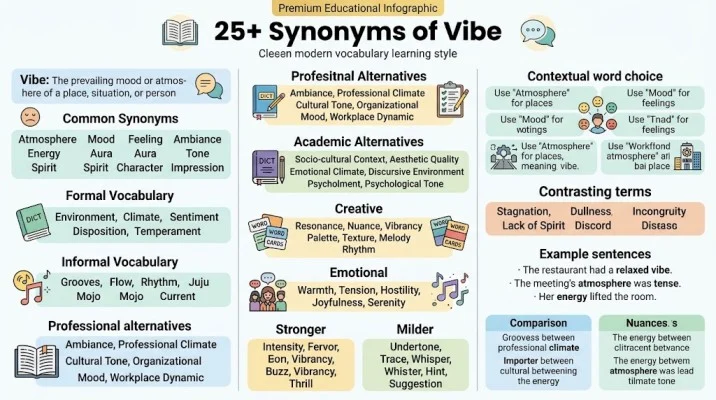
When the word vibe starts appearing in every email, caption, conversation, or piece of creative writing, the message can quickly feel repetitive. Finding the right synonym of vibe gives you more precise ways to describe a place, person’s presence, emotional atmosphere, or overall feeling.
The best alternative depends on what you actually mean. Mood works well for emotional states, atmosphere fits places and events, aura can describe a person’s presence, while energy is natural in casual and social settings. Understanding these differences helps you choose words that sound natural instead of simply replacing one word with another.
What Are the Best Synonyms of “Vibe”?
A vibe is the overall feeling, atmosphere, mood, or impression created by a person, place, situation, or experience. The best synonyms include mood, atmosphere, ambiance, feeling, energy, aura, tone, spirit, character, impression, and air. Formal writing often favors atmosphere or tone, while casual speech commonly uses energy, feeling, or mood.
Meaning, Tone, and Context
Simple Definition
Vibe refers to the feeling or atmosphere that a person, place, situation, or experience seems to create.
For example, if a coffee shop feels calm, warm, and welcoming, you might say:
“This café has a relaxing vibe.”
The word can describe something you can clearly sense even when you cannot easily explain exactly why it feels that way.
Part of Speech
Vibe is mainly used as a noun in modern American English.
It can refer to:
- The atmosphere of a place
- The mood of an event
- A person’s overall impression
- A feeling created by someone’s behavior
- The emotional quality of an experience
- An intuitive sense about a situation
The verb vibe is also used informally, especially in the expression vibe with, meaning to connect well with someone or something.
Overall Tone
The word vibe is generally neutral, although the specific expression can be positive or negative.
For example:
- “The restaurant has a friendly vibe.” Positive
- “The office has a tense vibe.” Negative
- “I got a strange vibe from him.” Negative or uncertain
- “The concert had an incredible vibe.” Positive
The word itself does not automatically communicate approval or disapproval. The surrounding language provides that meaning.
Formality Level
Vibe is generally informal to neutral.
It is extremely common in:
- Casual conversations
- Social media
- Text messages
- Lifestyle writing
- Entertainment discussions
- Music discussions
- Personal blogs
- Modern marketing
In highly formal academic or professional writing, words such as atmosphere, mood, tone, character, impression, or ambiance may be more appropriate.
Common Uses
Native English speakers commonly use vibe to describe:
- A restaurant’s atmosphere
- A city’s character
- A person’s presence
- A party’s mood
- A song’s feeling
- A brand’s personality
- A workplace atmosphere
- A social interaction
- A vacation destination
- A creative project
Examples include:
“I love the relaxed vibe of this neighborhood.”
“She gives off a confident vibe.”
“The song has a nostalgic vibe.”
“There was a strange vibe in the room.”
Word Forms
| Form | Usage | Example |
|---|---|---|
| Vibe | Noun | “I like the vibe here.” |
| Vibes | Plural noun | “The restaurant has great vibes.” |
| Vibe | Informal verb | “We really vibe with each other.” |
| Vibing | Informal present participle | “We’re just vibing to the music.” |
| Vibed | Informal past form | “The group vibed well together.” |
When and How to Use “Vibe”
Use vibe when you want to describe an overall feeling that is sensed rather than formally measured. It is especially useful when a single word such as mood or atmosphere does not fully capture the informal, intuitive quality of the experience.
Professional
“The new office has a more collaborative vibe.”
This works in conversational workplace communication, but atmosphere may sound more polished in a formal report.
Academic
“The classroom developed a supportive vibe during the discussion.”
In an academic paper, atmosphere or classroom climate would usually be more precise.
Workplace
“The team has a positive vibe, which makes collaboration easier.”
Here, vibe sounds natural in a casual workplace conversation.
Personal
“I got a good vibe from her when we first met.”
This means the person created a positive intuitive impression.
“The event should have a relaxed vibe that encourages people to connect.”
This can work in a friendly marketing or event planning email. For a highly formal email, atmosphere may be better.
Resume
“Helped create a welcoming vibe for customers.”
For a resume, a more specific phrase is usually stronger:
“Created a welcoming customer experience.”
The second version describes an actual professional outcome instead of relying on an informal expression.
Social Media
“Loving the cozy vibe of this little bookstore.”
This is a very natural use of vibe because social media language is often conversational and expressive.
Best Synonyms of “Vibe”
No single synonym of vibe works perfectly in every situation. The word can describe emotional mood, physical atmosphere, personal presence, general character, or an intuitive impression, so the best replacement depends on the exact meaning.
Professional Writing: Atmosphere
Atmosphere is usually the safest professional alternative when vibe refers to the overall feeling of a place or environment.
“The redesigned office creates a more welcoming atmosphere.”
It sounds polished without becoming unnecessarily formal.
Academic Writing: Tone
Tone works especially well when discussing the emotional or stylistic quality of writing, speech, communication, or a discussion.
“The author’s tone creates a sense of uncertainty.”
For physical spaces, atmosphere is usually more suitable.
Business Communication: Atmosphere
When discussing customer experience, workplace culture, or an event, atmosphere often sounds more professional than vibe.
“The restaurant’s atmosphere encourages customers to stay longer.”
Casual Conversation: Feeling
Feeling is one of the most flexible alternatives in everyday speech.
“I got a good feeling about this place.”
It sounds natural and does not feel overly formal.
Emotional Writing: Feeling
When vibe refers to an emotional response, feeling often provides a clearer and warmer expression.
“The house gave me a comforting feeling.”
Creative Writing: Aura
Aura can work well when describing a distinctive quality surrounding a person or place.
“The old theater had an unmistakable aura of mystery.”
It adds a more expressive and literary quality.
Resume Writing: Character
For resumes, it is usually better to replace vibe with a specific professional quality. Character can work when describing an organization, community, or environment.
“Helped strengthen the positive character of the customer experience.”
Even better, describe the measurable action or result whenever possible.
Workplace Communication: Energy
Energy is a natural alternative in casual workplace discussions.
“The team brought great energy to the project.”
It suggests enthusiasm and momentum rather than simply atmosphere.
Stronger Meaning: Atmosphere or Energy
When you want to emphasize a clearly noticeable quality, atmosphere or energy can be more specific than vibe.
“The event had an electric energy.”
Softer Meaning: Feeling
Feeling is a gentle alternative when you want to describe an impression without making the statement sound too definite.
“I had a strange feeling about the situation.”
When Not to Use “Vibe”
When the Word Is Too General
The word vibe can be vague when the reader needs specific information.
Less precise:
“The company has a good vibe.”
Better:
“The company has a collaborative and supportive atmosphere.”
The second sentence tells readers what makes the environment positive.
When Academic Precision Matters
Academic writing usually benefits from more specific terminology.
Less suitable:
“The study created a different vibe among participants.”
Better:
“The study created a different emotional atmosphere among participants.”
The improved version makes the intended meaning clearer.
When Professional Language Is Expected
A formal business report may sound less polished if it relies heavily on vibe.
Less suitable:
“The new store has a modern vibe.”
Better:
“The new store has a modern atmosphere and contemporary design.”
When You Mean a Specific Emotion
If you know exactly what the feeling is, name it.
Less precise:
“The movie had a sad vibe.”
Better:
“The movie had a melancholic tone.”
The second sentence communicates a more specific emotional quality.
When You Mean Someone’s Behavior
Sometimes vibe is used when the writer actually means attitude, demeanor, or behavior.
Less precise:
“His vibe was rude.”
Better:
“His demeanor seemed dismissive.”
This gives the reader a clearer description of what was observed.
When You Mean Physical Appearance
A person’s vibe can refer to the impression created by their appearance, but sometimes a more exact word is better.
Less precise:
“She has a professional vibe.”
Better:
“She has a polished and professional appearance.”
When You Need to Explain Evidence
Vibe often describes an intuition rather than evidence.
Less precise:
“The business seemed trustworthy because of its vibe.”
Better:
“The business appeared trustworthy because its staff were transparent, responsive, and professional.”
The improved version explains the actual reasons behind the impression.
Words Commonly Confused With “Vibe”
| Word | Difference | When to Use It | Example |
|---|---|---|---|
| Mood | Refers mainly to an emotional state or emotional atmosphere. | Use it for people, groups, events, or settings. | “The mood became more relaxed after lunch.” |
| Atmosphere | Describes the overall feeling of a place or environment. | Use it for restaurants, offices, events, and locations. | “The restaurant has a warm atmosphere.” |
| Tone | Refers to the emotional or stylistic quality of communication. | Use it for writing, speeches, messages, and conversations. | “Her email had a friendly tone.” |
| Aura | Suggests a distinctive quality surrounding a person or place. | Use it when describing an unusual or noticeable presence. | “The building has an aura of mystery.” |
| Energy | Suggests liveliness, enthusiasm, intensity, or emotional force. | Use it for people, groups, performances, and events. | “The crowd brought incredible energy.” |
| Impression | Refers to the idea or feeling formed in someone’s mind. | Use it when describing how someone or something appears to you. | “He made a strong first impression.” |
Best Synonyms of “Vibe” by Context
| Context | Best Synonym | Why It Works | Example |
|---|---|---|---|
| Formal writing | Atmosphere | Clear and professional | “The atmosphere was welcoming.” |
| Academic writing | Tone | Precise for communication and writing | “The author’s tone is reflective.” |
| Professional communication | Atmosphere | Describes an environment clearly | “The workplace atmosphere is collaborative.” |
| Business emails | Atmosphere | More polished than vibe | “The event will have a relaxed atmosphere.” |
| Resume writing | Character | Can describe organizational or experiential quality | “Contributed to the positive character of the team.” |
| Workplace communication | Energy | Natural for enthusiasm and momentum | “The team has positive energy.” |
| Casual conversation | Feeling | Flexible and natural | “I got a good feeling about it.” |
| Everyday speaking | Mood | Familiar and easy to understand | “What’s the mood tonight?” |
| Creative writing | Aura | Adds mystery and expression | “The room carried an eerie aura.” |
| Storytelling | Atmosphere | Helps describe a setting | “The atmosphere became tense.” |
| Emotional writing | Feeling | Expresses personal response | “The place gave me a peaceful feeling.” |
| Strong emphasis | Energy | Communicates intensity | “The crowd had incredible energy.” |
| Mild tone | Impression | Sounds less definite | “It left me with a positive impression.” |
| Social media captions | Energy | Modern and expressive | “Weekend energy.” |
| American English | Vibe | Extremely natural in casual use | “I love the vibe here.” |
How to Choose the Best Synonym of “Vibe”
Start by asking what kind of vibe you mean. This one step usually makes the right synonym much easier to identify.
If You Mean the Feeling of a Place
Choose atmosphere or ambiance.
“The hotel has a peaceful atmosphere.”
If You Mean an Emotional State
Choose mood or feeling.
“The mood at the party was relaxed.”
If You Mean Someone’s Presence
Choose aura, presence, or impression.
“She has a calm presence.”
If You Mean Enthusiasm
Choose energy or spirit.
“The volunteers brought tremendous energy to the event.”
If You Mean the Style of Communication
Choose tone.
“The message had a reassuring tone.”
If You Mean an Intuitive Reaction
Choose feeling or impression.
“I had a strange feeling about the proposal.”
If You Want a Casual Expression
Simply use vibe.
“I really like the vibe of this place.”
If You Want Formal Language
Choose atmosphere, tone, character, or impression, depending on the context.
If You Want Creative Language
Try aura, spirit, essence, or character.
The strongest choice is not always the most sophisticated word. The best synonym is the one that communicates the intended meaning naturally and accurately.
Real Life Examples of “Vibe”
School
Original:
“The classroom has a good vibe.”
More precise:
“The classroom has a positive atmosphere that encourages students to participate.”
College
Original:
“The campus has a relaxed vibe.”
Alternative:
“The campus has a relaxed and welcoming atmosphere.”
Workplace
Original:
“Our office has a friendly vibe.”
Alternative:
“Our office has a friendly and collaborative atmosphere.”
Business
Original:
“The store has a luxury vibe.”
Alternative:
“The store has an elegant atmosphere.”
Original:
“We want the event to have a fun vibe.”
Alternative:
“We want the event to have a lively and welcoming atmosphere.”
Resume
Original:
“Created a positive vibe for customers.”
Stronger:
“Created a welcoming customer experience that encouraged repeat visits.”
The second version is stronger because it describes an actual professional contribution.
Conversation
“I like her vibe.”
A more specific version could be:
“I like her energy.”
or:
“She gives me a really positive impression.”
Storytelling
“The house had a strange vibe.”
A more descriptive version is:
“The house carried an eerie atmosphere that made everyone uneasy.”
Blogging
“This neighborhood has a creative vibe.”
A more polished version is:
“This neighborhood has a creative atmosphere filled with independent shops, galleries, and cafés.”
Social Media
“Beach vibes all weekend.”
This casual expression works naturally as a social media caption.
A more descriptive caption could be:
“Relaxed beach energy all weekend.”
25 Best Synonyms of “Vibe”
Because vibe covers several related meanings, these alternatives are not interchangeable in every sentence. Each one is included because it can naturally express a particular sense of atmosphere, feeling, presence, character, or impression.
| Synonym | Simple Meaning | Best Used For | Example Sentence |
|---|---|---|---|
| Atmosphere | The overall feeling of a place or situation | Formal and professional writing | “The restaurant has a warm atmosphere.” |
| Ambiance | The mood and character created by a setting | Restaurants, hotels, events | “The café has a cozy ambiance.” |
| Mood | An emotional state or quality | People, groups, events | “The mood changed after the announcement.” |
| Feeling | An emotional or intuitive response | Everyday speech | “I got a good feeling about the place.” |
| Energy | A quality of enthusiasm, intensity, or liveliness | People, events, social settings | “The crowd had amazing energy.” |
| Aura | A distinctive quality surrounding someone or something | Creative and descriptive writing | “The building has an aura of mystery.” |
| Tone | The emotional or stylistic quality of communication | Writing, speech, messages | “The email had a reassuring tone.” |
| Spirit | The emotional character or attitude of a person or group | Teams, communities, events | “The team showed a strong spirit.” |
| Character | The distinctive qualities of something | Places, organizations, experiences | “The neighborhood has plenty of character.” |
| Impression | The feeling or idea formed in someone’s mind | People, places, first encounters | “She made a positive impression.” |
| Air | A noticeable quality or appearance | Literary and descriptive writing | “The room had an air of elegance.” |
| Essence | The central or most defining quality | Creative and reflective writing | “The song captures the essence of summer.” |
| Presence | The noticeable quality created by someone’s appearance or manner | People and leadership | “She has a calm presence.” |
| Quality | A particular characteristic or feature | Formal descriptions | “The space has a peaceful quality.” |
| Feel | The general character or sensation of something | Informal and everyday language | “I love the feel of this neighborhood.” |
| Flavor | A distinctive quality or style, especially figuratively | Creative and cultural writing | “The festival has a unique local flavor.” |
| Temper | The emotional character of a situation | Formal or literary descriptions | “The discussion had a serious temper.” |
| Characterization | The way qualities or personality are presented | Literary analysis | “The characterization gives the scene a darker quality.” |
| Climate | The general emotional or social condition | Workplace and social analysis | “The organization has a supportive climate.” |
| Environment | The surrounding conditions that affect experience | Professional and academic writing | “The learning environment feels welcoming.” |
| Setting | The surroundings and conditions of an event or story | Storytelling and descriptions | “The setting creates a peaceful feeling.” |
| Demeanor | A person’s outward behavior and manner | Professional descriptions | “His calm demeanor reassured the clients.” |
| Disposition | A person’s usual attitude or temperament | Formal descriptions of people | “She has a friendly disposition.” |
| Atmospheric quality | The distinctive feeling produced by a setting | Descriptive writing | “The atmospheric quality of the room was intimate.” |
| Overall impression | The combined feeling something creates | Reviews and evaluations | “The overall impression was warm and inviting.” |
Synonyms of “Vibe” by Usage
Professional vs Personal Synonyms
In professional communication, choose words that explain the specific quality you mean.
Professional choices:
- Atmosphere
- Environment
- Climate
- Tone
- Character
- Impression
For example:
“The company has a positive workplace climate.”
This is more specific than:
“The company has a good vibe.”
In personal conversations, simpler alternatives are usually more natural.
Personal choices:
- Feeling
- Mood
- Energy
- Aura
- Vibe
- Spirit
For example:
“I really like her energy.”
This sounds natural in casual American English.
Formal vs Conversational Synonyms
For reports, essays, and formal presentations, prefer atmosphere, tone, environment, climate, character, or impression.
For emails, the choice depends on the relationship with the recipient. A friendly workplace email may comfortably use vibe, while a formal client communication usually benefits from atmosphere or tone.
For casual conversations and texting, vibe, mood, feeling, energy, and feel are highly natural.
Academic Synonyms
Academic writing requires careful attention to the exact meaning.
Atmosphere
Use atmosphere when discussing the emotional quality of a physical or social environment.
“The classroom atmosphere encouraged open discussion.”
Tone
Use tone when analyzing language, writing, speeches, or communication.
“The author’s tone becomes increasingly critical.”
Climate
Use climate when discussing the broader social or organizational environment.
“The school developed a supportive academic climate.”
Character
Use character when analyzing the distinctive qualities of a place, organization, or cultural setting.
“The neighborhood’s character has changed over the past decade.”
Impression
Use impression when discussing how something is perceived.
“The participants formed a positive impression of the program.”
These alternatives are more useful academically because they identify the specific relationship between the subject and the feeling being described.
Professional and Business Synonyms
Resumes
Avoid vague statements such as:
“Created a positive vibe.”
Instead, identify what you actually achieved:
“Improved the customer experience through friendly, responsive service.”
Interviews
In an interview, atmosphere, culture, energy, or environment can be useful.
“I was impressed by the collaborative atmosphere during my visit.”
Meetings
Use tone when discussing communication.
“The tone of the meeting remained constructive.”
Presentations
Use energy when discussing engagement.
“The speaker brought positive energy to the presentation.”
Performance Reviews
Use attitude, demeanor, or team spirit when describing behavior.
“She consistently contributes positive energy to team discussions.”
Client Communication
Use tone or impression.
“The message creates a professional and reassuring impression.”
Business Emails
Use tone when referring to the communication itself.
“I wanted to keep the tone friendly and professional.”
Use atmosphere when discussing an event or physical environment.
Creative and Literary Synonyms
Creative writing gives you more freedom to replace vibe with expressive vocabulary.
Aura
Useful for mystery or unusual presence.
“An aura of secrecy surrounded the old mansion.”
Spirit
Useful for communities, traditions, and groups.
“The spirit of the town remained unchanged.”
Essence
Useful when describing the deepest quality of an experience.
“The poem captures the essence of childhood.”
Air
Useful for subtle atmosphere.
“An air of uncertainty filled the room.”
Character
Useful for settings and locations.
“The old neighborhood had a character all its own.”
These words can make descriptions more vivid because they tell readers what kind of quality they should imagine.
Slang or Modern Synonyms
There are several informal expressions related to vibe, but they are not exact replacements in every context.
Vibe Check
Meaning: An informal way to assess the mood, atmosphere, or general feeling of a person or situation.
Acceptable in:
- Social media
- Texting
- Casual conversation
- Pop culture writing
Avoid in:
- Academic papers
- Formal reports
- Official business documents
Example:
“The first few minutes of the meeting felt like a quick vibe check.”
Good Vibes
Meaning: A positive, pleasant feeling or atmosphere.
Example:
“This place is all about good vibes.”
Bad Vibes
Meaning: An uncomfortable or negative feeling.
Example:
“I got bad vibes from that situation.”
Vibe With
Meaning: To connect well with someone or enjoy something.
Example:
“We really vibe with each other.”
These expressions are strongly associated with informal modern English.
Strongest to Mildest Synonyms
There is no universal intensity ranking because the synonyms emphasize different qualities rather than simply different levels of strength. Still, a practical scale can help when choosing language.
Mild
- Feel
- Impression
- Quality
- Mood
These usually describe a general sense without making a strong claim.
Moderate
- Atmosphere
- Ambiance
- Character
- Tone
- Spirit
These give a clearer description of the overall quality.
Strong
- Energy
- Aura
- Presence
- Essence
These can emphasize a distinctive or noticeable quality.
Very Strong
- Powerful presence
- Electric energy
- Strong atmosphere
- Overwhelming feeling
These expressions add intensity and should be used when the situation genuinely supports them.
Emotional vs Neutral Synonyms
Emotional Synonyms
These words can carry stronger personal or expressive associations:
- Feeling
- Aura
- Energy
- Spirit
- Essence
- Presence
Example:
“The place had a peaceful energy.”
Neutral Synonyms
These are better when you want to describe something objectively:
- Atmosphere
- Tone
- Mood
- Character
- Environment
- Impression
- Climate
Example:
“The workplace has a supportive environment.”
For professional and academic writing, neutral alternatives are usually safer because they make fewer subjective claims.
Antonyms of “Vibe”
Unlike words such as happy or important, vibe does not have a single direct antonym. It is a flexible noun describing an overall impression or atmosphere. For search usefulness, the following terms represent contrasting states or qualities rather than strict dictionary antonyms.
| Contrasting Term | Meaning | Example Sentence |
|---|---|---|
| Discomfort | A feeling of unease | “The interaction created noticeable discomfort.” |
| Tension | A strained or uneasy atmosphere | “Tension filled the room.” |
| Awkwardness | An uncomfortable social quality | “There was obvious awkwardness after the comment.” |
| Unease | A feeling that something is not right | “She felt a sense of unease.” |
| Hostility | An unfriendly or aggressive attitude | “The conversation was marked by hostility.” |
| Coldness | A lack of warmth or friendliness | “His response had an unexpected coldness.” |
| Indifference | Lack of interest or emotional concern | “The audience responded with indifference.” |
| Disconnection | A lack of emotional connection | “The conversation ended in a sense of disconnection.” |
| Negativity | A generally negative emotional quality | “The constant negativity affected the team.” |
| Chaos | A state lacking order or calm | “The event descended into chaos.” |
| Dullness | A lack of excitement or liveliness | “The room had a sense of dullness.” |
| Isolation | A state of being separated or disconnected | “The environment created a feeling of isolation.” |
| Strain | Pressure or difficulty within a relationship or situation | “There was visible strain between the teams.” |
| Animosity | Strong dislike or hostility | “Animosity developed between the two groups.” |
| Emptiness | A lack of emotional substance or feeling | “The abandoned building had a sense of emptiness.” |
Comparison: “Vibe” vs Similar Words
Vibe vs Mood
Main Difference
Mood usually describes an emotional state, while vibe can describe a broader impression involving atmosphere, energy, appearance, or intuition.
Which Is Stronger?
Neither is inherently stronger. They describe slightly different ideas.
Which Is More Formal?
Mood is more neutral and generally more suitable for formal writing.
When to Use Each
Use mood for emotional states. Use vibe for broader, informal impressions.
Examples
Vibe:
“The restaurant has a romantic vibe.”
Mood:
“The mood became romantic after the lights were dimmed.”
Vibe vs Atmosphere
Main Difference
Atmosphere usually refers to the overall feeling of a place or environment. Vibe is broader and more informal.
Which Is Stronger?
Neither is inherently stronger.
Which Is More Formal?
Atmosphere is clearly more suitable for formal and academic writing.
When to Use Each
Use atmosphere for professional descriptions of spaces. Use vibe in casual communication.
Examples
Vibe:
“I love the vibe of this café.”
Atmosphere:
“The café has a relaxed atmosphere.”
Vibe vs Aura
Main Difference
Aura suggests a distinctive quality surrounding a person or place. Vibe is more general.
Which Is Stronger?
Aura can sound more mysterious or expressive.
Which Is More Formal?
Both can appear in creative writing, but aura can sound more literary.
When to Use Each
Use aura when describing a distinctive presence.
Examples
Vibe:
“The room has a strange vibe.”
Aura:
“The room has an eerie aura.”
Vibe vs Energy
Main Difference
Energy often suggests liveliness, enthusiasm, intensity, or emotional force. Vibe can refer to any overall feeling.
Which Is Stronger?
Energy can sound stronger when describing excitement or intensity.
Which Is More Formal?
Neither is especially formal in this sense.
When to Use Each
Use energy for people, performances, crowds, and dynamic situations.
Examples
Vibe:
“The concert had a great vibe.”
Energy:
“The crowd had incredible energy.”
Vibe vs Tone
Main Difference
Tone is closely connected to communication and style. Vibe can describe the broader feeling surrounding a situation.
Which Is Stronger?
Neither is stronger.
Which Is More Formal?
Tone is more appropriate for academic and professional analysis.
When to Use Each
Use tone for writing, emails, speeches, and conversations.
Examples
Vibe:
“The meeting had a relaxed vibe.”
Tone:
“The meeting had a relaxed tone.”
Vibe vs Impression
Main Difference
An impression is the idea or feeling formed in someone’s mind. A vibe is the quality that seems to create that reaction.
Which Is Stronger?
Neither is stronger.
Which Is More Formal?
Impression is more appropriate for formal writing.
When to Use Each
Use impression when discussing perception or evaluation.
Examples
Vibe:
“I liked the vibe of the company.”
Impression:
“The company made a strong first impression.”
Common Phrases and Expressions with “Vibe”
Good Vibes
Meaning: A positive or pleasant atmosphere.
Example:
“The café is full of good vibes on Saturday mornings.”
Bad Vibes
Meaning: An uncomfortable or negative feeling.
Example:
“I got bad vibes from the conversation.”
Vibe Check
Meaning: An informal assessment of the mood or general feeling.
Example:
“Before making plans, let’s do a quick vibe check.”
Vibe With Someone
Meaning: To connect naturally or get along well with someone.
Example:
“We met at college and immediately vibed with each other.”
Vibe With Something
Meaning: To enjoy, understand, or connect with something.
Example:
“I really vibe with this style of music.”
Set the Vibe
Meaning: To create a particular atmosphere or mood.
Example:
“Soft lighting helps set the vibe for the dinner.”
Get a Vibe
Meaning: To form an intuitive impression.
Example:
“I got a good vibe from the new manager.”
Vibe Out
Meaning: To relax and enjoy a peaceful or enjoyable experience.
Example:
“We spent the evening listening to music and vibing out.”
Common Mistakes to Avoid
1. Treating Every Synonym as Identical
Incorrect:
“The author’s aura was serious.”
Better:
“The author’s tone was serious.”
Why:
Tone specifically describes the emotional quality of communication, while aura usually refers to a distinctive surrounding quality.
2. Using “Vibe” in Highly Formal Writing
Incorrect:
“The organization has a positive vibe.”
Better:
“The organization has a positive workplace atmosphere.”
Why:
Atmosphere sounds more professional and communicates the intended meaning clearly.
3. Choosing “Energy” When You Mean Emotional Mood
Incorrect:
“The sad energy of the film made me cry.”
Better:
“The sad mood of the film made me cry.”
Why:
Energy emphasizes intensity or liveliness, while mood more directly describes emotional quality.
4. Using “Aura” for Every Type of Vibe
Incorrect:
“The office has a productive aura.”
Better:
“The office has a productive atmosphere.”
Why:
Aura can sound mysterious or literary. Atmosphere is more natural for workplace environments.
5. Repeating “Vibe” Too Often
Incorrect:
“The café has a cozy vibe, the music has a relaxing vibe, and the staff have a friendly vibe.”
Better:
“The café has a cozy atmosphere, the music feels relaxing, and the staff create a friendly environment.”
Why:
Using related words improves variety while making each description more precise.
6. Using “Vibe” When Specific Evidence Is Available
Incorrect:
“The company has a professional vibe.”
Better:
“The company has clear policies, responsive staff, and a professional work environment.”
Why:
Specific details are more informative than a vague overall impression.
7. Using Slang in Academic Writing
Incorrect:
“The experiment had a weird vibe.”
Better:
“The experimental setting created an unusual atmosphere.”
Why:
The second sentence fits academic language and communicates the observation more objectively.
Frequently Asked Questions
What is a synonym for vibe?
A synonym for vibe can be feeling, atmosphere, mood, energy, or impression, depending on the context.
What is another word for vibe?
Another word for vibe is mood, feeling, aura, atmosphere, or energy. The best choice depends on the situation.
What are some vibes synonyms?
Common vibes synonyms include energy, mood, atmosphere, feeling, aura, tone, and ambiance.
What are the best synonyms for vibe?
The best synonyms for vibe include atmosphere for places, mood for emotional settings, and energy for a person’s presence or behavior.
What is a vibes synonym for a positive feeling?
Words such as energy, warmth, positivity, excitement, and good feeling can work as vibes synonyms for a positive feeling.
What are common vibe synonyms?
Common vibe synonyms include feeling, mood, atmosphere, energy, aura, tone, and impression.
What are other words for vibe?
Other words for vibe include ambiance, atmosphere, mood, feeling, aura, energy, and character.
What are some types of vibes with examples?
Common types of vibes include positive vibes, chill vibes, romantic vibes, friendly vibes, mysterious vibes, and negative vibes.
What are the main synonyms of vibe?
The main synonyms of vibe are feeling, mood, atmosphere, energy, aura, ambiance, and impression.
1. What are the best synonyms of “vibe”?
The best synonyms of vibe include atmosphere, mood, feeling, ambiance, energy, aura, tone, spirit, character, and impression. The best choice depends on whether you mean a place’s atmosphere, emotional state, personal presence, or general impression.
2. What are the best formal synonyms of “vibe”?
The best formal alternatives include atmosphere, tone, environment, climate, character, and impression. Use the specific word that matches your intended meaning rather than replacing vibe automatically.
3. What are common informal synonyms of “vibe”?
Common informal alternatives include feeling, mood, energy, feel, and aura. In casual American English, vibe itself is also completely natural, especially when discussing places, people, music, or social situations.
4. What is another word for “vibe” in professional writing?
Atmosphere is often the best professional alternative when discussing a place or environment. For communication, tone may be more accurate, while impression works well when describing how someone or something is perceived.
5. What is the difference between “vibe” and “mood”?
A mood is primarily an emotional state or emotional atmosphere. A vibe can be broader, describing an overall impression that may include mood, energy, appearance, atmosphere, personality, or intuition.
6. What is the opposite of “vibe”?
There is no single exact opposite of vibe. Depending on the context, contrasting concepts include tension, discomfort, awkwardness, hostility, indifference, negativity, disconnection, and emptiness.
Conclusion
The word vibe is a flexible and highly natural part of modern American English. It can describe the atmosphere of a place, the mood of a situation, the energy of a group, the presence of a person, or an intuitive impression.
The best synonym of vibe depends on the meaning you want to communicate. Choose atmosphere for places and professional writing, mood for emotional states, tone for communication, energy for enthusiasm, aura for distinctive presence, and feeling for everyday or personal reactions.
No alternative works perfectly in every situation. The easiest way to improve your vocabulary is to identify exactly what the vibe represents before choosing a replacement. Once you understand whether you mean mood, atmosphere, energy, tone, or impression, your word choice becomes much more precise.
Read More Related Articles:
- 50+ Synonyms of Autonomy | Meanings, Uses, Examples, and …
- Synonyms for Pros and Cons | Meaning, Examples, and Better …
- 25+ Synonyms, Meanings, Uses, and Best Alternatives










45 thoughts on “Synonym of Vibe |25+ Meaning, Best Alternatives, and the Feeling Behind the Word 2026”