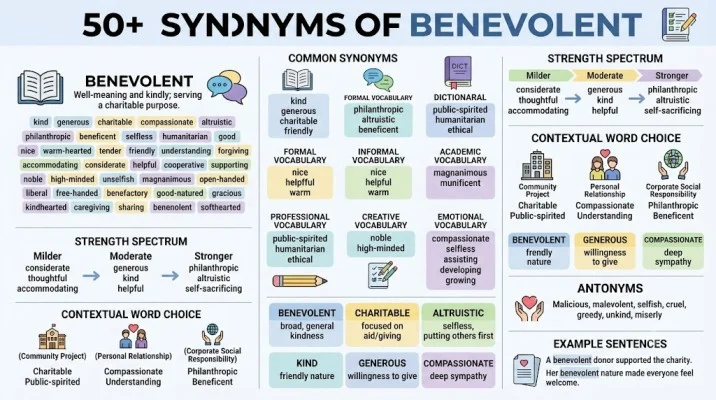
The right benevolent synonym can make your writing sound warmer, more precise, and more natural. The word benevolent describes someone who is kind, generous, and genuinely concerned about the well-being of others. Understanding its exact tone helps you choose the best alternative instead of using every similar word interchangeably. This guide explores the benevolent meaning, common benevolent synonyms, and the synonyms of benevolent used in everyday, professional, and formal writing.
If you need another word for benevolent, options such as kindhearted, charitable, compassionate, and generous may fit, depending on context. We also explain the difference between a benevolent critic and someone who is simply complimentary, along with a useful benevolence synonym and another word for benevolence. To complete the picture, you’ll also learn the opposite of benevolent and when each synonym for benevolent works best.
What Are the Best Synonyms of “Benevolent”?
Benevolent means kind, generous, and well intentioned, especially toward other people. The best synonyms include kind, generous, charitable, compassionate, altruistic, and philanthropic. Use beneficent for formal writing, charitable for giving, compassionate for emotional care, and altruistic when emphasizing selfless concern for others.
Meaning, Tone, and Context
Simple Definition
Benevolent describes a person, action, attitude, or organization that is intended to do good or provide help to others.
A benevolent person generally wants to improve another person’s situation rather than harm, exploit, or ignore them. The word can describe kindness, generosity, charitable behavior, or a general desire to promote well-being.
For example:
“The benevolent donor funded scholarships for students from low-income families.”
Here, benevolent suggests both generosity and a positive intention toward others.
Part of Speech
Benevolent is an adjective.
It modifies a noun by describing a person’s character, an action, an organization, or an attitude.
Examples:
- a benevolent leader
- a benevolent organization
- a benevolent donor
- a benevolent gesture
- a benevolent attitude
Overall Tone
Benevolent has a strongly positive tone.
It usually communicates kindness, generosity, goodwill, compassion, or a sincere desire to help. It does not normally describe simple politeness. Instead, it suggests a deeper concern for the welfare of others.
Formality Level
Benevolent is generally formal to neutral.
It appears naturally in:
- Academic writing
- Formal essays
- Literature
- Professional descriptions
- Historical discussions
- Nonprofit writing
- Discussions of leadership
- Descriptions of charitable behavior
In casual conversation, speakers often choose simpler alternatives such as kind, generous, or goodhearted.
Common Uses
Native English speakers commonly use benevolent when describing:
- Charitable donors
- Generous organizations
- Kind leaders
- Helpful institutions
- Philanthropic individuals
- Acts of generosity
- Positive intentions
- Compassionate behavior
- Support for people in need
- Organizations that promote public welfare
Word Forms
The main related forms include:
| Word | Part of Speech | Meaning |
|---|---|---|
| Benevolent | Adjective | Kind and well intentioned |
| Benevolence | Noun | The quality of being kind and helpful |
| Benevolently | Adverb | In a benevolent manner |
The opposite concept is commonly expressed through words such as malevolent, cruel, or unkind, depending on the context.
When and How to Use “Benevolent”
Use benevolent when you want to describe genuine goodwill, generosity, or a desire to benefit others. It works especially well when describing a person’s character or an action that provides meaningful help.
Professional
“The company is known for its benevolent approach to supporting local communities.”
Here, benevolent describes an organization that actively promotes the welfare of others.
Academic
“The study examines how benevolent leadership can influence employee relationships.”
The word works well in academic writing when discussing positive intentions and behavior.
Workplace
“Our manager took a benevolent approach when an employee faced a personal emergency.”
This suggests the manager responded with kindness and understanding.
Personal
“Her benevolent nature made her the person everyone turned to for help.”
The word describes a lasting character trait rather than one isolated action.
“We sincerely appreciate your benevolent support of our community program.”
This is formal and respectful, making it more appropriate for a charitable or institutional message than an ordinary workplace email.
Resume
“Supported benevolent initiatives that provided educational resources to underserved communities.”
In a resume, benevolent can work when describing charitable or community-focused activities, although charitable or community-focused may sometimes sound more concrete.
Social Media
“Grateful for the benevolent people who helped make this community project possible.”
The word creates a warm, appreciative tone, although kind or generous may sound more conversational.
Best Synonyms of “Benevolent”
No synonym of benevolent has exactly the same meaning in every situation. The best choice depends on whether you want to emphasize kindness, generosity, compassion, selflessness, charitable giving, or a desire to improve other people’s lives.
Professional Writing: Beneficent
Beneficent is a strong choice for formal professional writing when the emphasis is on doing good or producing beneficial results.
Example:
“The foundation has a beneficent role in supporting rural education.”
Academic Writing: Altruistic
Altruistic works well when discussing selfless concern for other people, particularly in psychology, ethics, sociology, and related academic subjects.
Example:
“The research explored altruistic behavior among community volunteers.”
Business Communication: Generous
Generous is often more natural than benevolent in business communication when discussing donations, support, resources, or favorable treatment.
Example:
“The company made a generous contribution to the relief fund.”
Casual Conversation: Kind
Kind is the most natural everyday alternative when you simply want to describe someone who treats others well.
Example:
“She is one of the kindest people I’ve ever met.”
Emotional Writing: Compassionate
Compassionate emphasizes understanding another person’s suffering and responding with care.
Example:
“His compassionate response helped the family through a difficult period.”
Creative Writing: Goodhearted
Goodhearted gives a story a warm, personal quality and works particularly well when describing a character.
Example:
“The goodhearted shopkeeper quietly helped struggling families throughout the winter.”
Resume Writing: Charitable
Charitable is more specific than benevolent when describing volunteer work, donations, fundraising, or nonprofit activities.
Example:
“Coordinated charitable programs supporting families in need.”
Workplace Communication: Supportive
Supportive works well when the behavior involves encouragement, assistance, or understanding rather than financial generosity.
Example:
“She created a supportive environment for new employees.”
Stronger Meaning: Altruistic
Altruistic emphasizes selfless concern for others, especially when someone acts without expecting personal benefit.
Example:
“His altruistic decision placed the community’s needs ahead of his own.”
Softer Meaning: Kind
Kind is a softer and more broadly applicable alternative. It does not necessarily suggest major charitable action.
Example:
“She was kind to everyone she met.”
When Not to Use “Benevolent”
Although benevolent is accurate in many situations, it can sometimes sound too formal, too broad, or less natural than a more specific alternative.
When the Word Is Too General
If you want to emphasize financial giving, benevolent may not communicate enough detail.
Less Precise:
“The organization is benevolent.”
Better:
“The organization is charitable and provides food and housing assistance.”
Why:
Charitable clearly identifies the type of positive activity involved.
When You Mean Emotional Understanding
Benevolent behavior is not necessarily based on understanding someone’s pain.
Less Precise:
“She gave a benevolent response to the grieving family.”
Better:
“She gave a compassionate response to the grieving family.”
Why:
Compassionate directly communicates sensitivity to another person’s suffering.
When You Mean Selfless Action
If the key idea is acting for others without personal gain, altruistic is more precise.
Less Precise:
“His decision was benevolent.”
Better:
“His decision was altruistic because he gave up his own opportunity to help others.”
When the Word Sounds Too Formal
In ordinary conversation, benevolent can sound literary or formal.
Less Natural:
“My neighbor was very benevolent when she helped me move.”
More Natural:
“My neighbor was very kind when she helped me move.”
Why:
Kind is much more common in everyday American English.
When You Mean Financial Generosity
If someone gives a large amount of money or resources, generous is often the clearest choice.
Less Precise:
“The company was benevolent with its donation.”
Better:
“The company made a generous donation.”
When You Need a Stronger Moral Emphasis
When the focus is on selflessness rather than general goodwill, choose altruistic.
Less Precise:
“She made a benevolent sacrifice.”
Better:
“She made an altruistic sacrifice.”
When a Simpler Word Is Better
In basic writing, using a sophisticated synonym can make a sentence unnecessarily difficult.
Less Natural:
“The benevolent teacher helped the student.”
More Natural:
“The kind teacher helped the student.”
The simpler word is often the better choice when clarity matters more than formality.
Words Commonly Confused With “Benevolent”
| Word | Difference | When to Use It | Example |
|---|---|---|---|
| Charitable | Focuses on giving help, money, or resources to people in need. | Donations and nonprofit activity. | “The charitable foundation supports homeless families.” |
| Altruistic | Emphasizes selfless concern for others without focusing on kindness alone. | Ethics, psychology, selfless actions. | “Her altruistic decision benefited the entire team.” |
| Compassionate | Focuses on understanding suffering and responding with care. | Healthcare, personal support, emotional situations. | “The compassionate nurse comforted the patient.” |
| Generous | Emphasizes giving more than expected, especially money, time, or resources. | Donations, gifts, hospitality. | “He was generous with his time.” |
| Philanthropic | Usually refers to organized support for social, educational, cultural, or charitable causes. | Foundations, donors, large-scale giving. | “The philanthropic foundation funds scholarships.” |
| Kind | Broad, everyday word for treating others well. | Casual and general communication. | “She was kind to the new student.” |
Best Synonyms of “Benevolent” by Context
| Context | Best Synonym | Why It Works | Example |
|---|---|---|---|
| Formal writing | Beneficent | Clearly emphasizes doing good. | “The beneficent organization funded medical care.” |
| Academic writing | Altruistic | Precisely describes selfless behavior. | “Altruistic behavior can benefit entire communities.” |
| Professional communication | Generous | Natural when discussing support or resources. | “The company made a generous contribution.” |
| Business emails | Charitable | Useful for donations and community programs. | “Thank you for your charitable support.” |
| Resume writing | Charitable | Clearly communicates community involvement. | “Led charitable fundraising campaigns.” |
| Workplace communication | Supportive | Focuses on helping and encouragement. | “She maintains a supportive work environment.” |
| Casual conversation | Kind | Natural and widely understood. | “He’s always kind to others.” |
| Everyday speaking | Generous | Common when describing helpful giving. | “That was very generous of you.” |
| Creative writing | Goodhearted | Adds warmth to character descriptions. | “The goodhearted baker fed hungry families.” |
| Storytelling | Compassionate | Adds emotional depth. | “The compassionate doctor stayed late to help.” |
| Emotional writing | Warmhearted | Communicates warmth and affection. | “Her warmhearted nature touched everyone.” |
| Strong emphasis | Altruistic | Highlights selflessness. | “His altruistic actions inspired others.” |
| Mild tone | Kind | Communicates goodness without exaggeration. | “She was kind to her neighbors.” |
| Social media captions | Generous | Sounds natural and appreciative. | “Thankful for everyone’s generous support.” |
| American English | Kind | Highly natural in everyday use. | “He is a kind and thoughtful person.” |
| British English | Kind | Also natural and widely understood. | “She is known for being kind to others.” |
How to Choose the Best Synonym of “Benevolent”
Choosing the right alternative starts with identifying exactly what you mean.
If You Mean General Kindness
Choose kind.
“She is a kind person.”
This is the safest everyday alternative.
If You Mean Giving
Choose generous.
“He was generous with his time.”
This works especially well for money, gifts, time, attention, and resources.
If You Mean Giving to People in Need
Choose charitable.
“The organization supports charitable causes.”
This makes the purpose of the giving clearer.
If You Mean Concern for Suffering
Choose compassionate.
“The doctor was compassionate toward the patient’s family.”
This emphasizes emotional understanding.
If You Mean Selflessness
Choose altruistic.
“Her altruistic actions helped the entire community.”
This highlights putting others’ interests before one’s own.
If You Mean Large-Scale Giving
Choose philanthropic.
“The philanthropic foundation supports education.”
This is particularly useful for major donors and organized charitable work.
If You Mean a Formal Act of Doing Good
Choose beneficent.
“The beneficent program provided essential resources.”
This is formal and less common in everyday speech.
If You Mean Warm Personal Character
Choose goodhearted or warmhearted.
“The goodhearted volunteer spent weekends helping elderly residents.”
These alternatives are especially effective in personal and creative writing.
Consider Your Audience
- For children and general readers, use kind or generous.
- For academic readers, consider altruistic, philanthropic, or beneficent, depending on the exact meaning.
- For business readers, generous, charitable, and supportive are often more natural.
Consider Emotional Strength
A word such as kind is relatively mild. Compassionate adds emotional depth, while altruistic emphasizes a stronger form of selflessness.
Consider Natural Usage
Do not choose a synonym simply because it sounds sophisticated. The strongest vocabulary choice is the one that communicates your intended meaning naturally.
Real Life Examples of “Benevolent”
School
Basic:
“The teacher was benevolent toward the students.”
More Natural:
“The teacher was kind and supportive toward students who needed extra help.”
The second version sounds more natural in everyday school communication.
College
“The university received a generous donation that created scholarships for first-generation students.”
Here, generous is more specific than benevolent because the sentence focuses on financial support.
Workplace
“The manager took a compassionate approach when an employee experienced a family emergency.”
Compassionate works because the situation involves emotional difficulty.
Business
“The company has a philanthropic program that supports education and community development.”
Philanthropic fits organized corporate giving.
“Thank you for your generous contribution to our community fundraiser.”
Generous sounds more natural than benevolent in this type of email.
Resume
“Organized charitable events that raised funds for local food banks.”
The word charitable immediately communicates the purpose of the work.
Conversation
“She’s incredibly kind and always checks on her neighbors.”
Kind is the most natural everyday choice.
Storytelling
“The goodhearted farmer secretly left baskets of food outside the homes of struggling families.”
Goodhearted adds warmth and character to the story.
Blogging
“Small acts of kindness can create stronger connections within a community.”
A simple word can be more effective than a formal alternative in accessible blog writing.
Social Media
“Grateful for the generous people who donated their time and resources to this project.”
The sentence sounds natural and appreciative for a social media audience.
20 Best Synonyms of “Benevolent”
| Synonym | Simple Meaning | Best Used For | Example Sentence |
|---|---|---|---|
| Kind | Caring and considerate toward others | Everyday communication | “She is kind to everyone she meets.” |
| Generous | Willing to give freely | Money, time, resources | “He was generous with his time.” |
| Charitable | Giving help to people in need | Donations and nonprofit work | “The charitable group provides meals to families.” |
| Compassionate | Caring about another person’s suffering | Emotional and personal situations | “The compassionate counselor listened carefully.” |
| Altruistic | Selflessly concerned with others | Ethics and selfless behavior | “Her altruistic actions benefited the community.” |
| Philanthropic | Supporting charitable or social causes | Foundations and large donations | “The philanthropic family funded a new library.” |
| Humane | Showing concern for people’s welfare | Treatment of people and animals | “The shelter follows humane practices.” |
| Beneficent | Doing good or providing benefits | Formal writing | “The beneficent organization improved local healthcare.” |
| Magnanimous | Generous and forgiving, especially toward others | Character and forgiveness | “She was magnanimous after her rival apologized.” |
| Munificent | Extremely generous | Formal descriptions of major gifts | “The museum received a munificent donation.” |
| Selfless | Putting others before oneself | Personal sacrifice | “His selfless service inspired his coworkers.” |
| Unselfish | Not focused on personal advantage | Personal behavior | “Her unselfish support helped the team succeed.” |
| Kindhearted | Naturally kind and caring | Character descriptions | “The kindhearted volunteer welcomed every visitor.” |
| Warmhearted | Friendly, caring, and affectionate | Personal and emotional writing | “The warmhearted host made everyone feel welcome.” |
| Goodhearted | Having a naturally good and caring character | Stories and casual writing | “The goodhearted neighbor helped repair the house.” |
| Gracious | Kind, polite, and generous in manner | Social and professional situations | “The gracious host thanked every guest.” |
| Humanitarian | Focused on improving human welfare | Aid and social causes | “The humanitarian organization delivered emergency supplies.” |
| Openhanded | Very willing to give | Informal descriptions of generosity | “Her openhanded support helped the struggling family.” |
| Public spirited | Concerned with the welfare of the community | Civic and community contexts | “His public spirited work benefited the neighborhood.” |
| Bighearted | Very generous and caring | Informal and emotional writing | “The bighearted donor supported several local programs.” |
Synonyms of “Benevolent” by Usage
Professional vs Personal Synonyms
- Professional settings usually benefit from precise words that explain the type of positive behavior involved.
Professional choices:
- Beneficent
- Charitable
- Philanthropic
- Generous
- Supportive
- Humanitarian
Personal choices:
- Kind
- Goodhearted
- Warmhearted
- Bighearted
- Compassionate
- Selfless
For a business report, “philanthropic” may be more informative than “benevolent.” For a personal story, “kindhearted” may sound warmer and more natural.
Formal vs Conversational Synonyms
Formal vocabulary works best when precision and professionalism matter.
Reports:
Use significant, beneficent, philanthropic, or humanitarian depending on the context.
Essays:
Use altruistic, compassionate, beneficent, or charitable.
Business writing:
Use generous, charitable, philanthropic, or supportive.
Presentations:
Use generous, philanthropic, or humanitarian when describing specific contributions.
Emails:
Use generous, kind, or charitable depending on the situation.
Casual conversations:
Use kind, generous, selfless, or goodhearted.
Texting:
Use kind, sweet, generous, or bighearted when appropriate. These are generally more natural than benevolent in informal messages.
Academic Synonyms
Academic writing requires more precision than simply replacing one adjective with another.
Altruistic
Use altruistic when discussing behavior motivated by concern for others.
“The researchers examined altruistic behavior among volunteers.”
Philanthropic
Use philanthropic when discussing organized charitable giving.
“The study analyzed philanthropic contributions to higher education.”
Beneficent
Use beneficent when the focus is on an action or institution that produces good.
“The article examines the beneficent role of public institutions.”
Humanitarian
Use humanitarian when discussing efforts to protect or improve human welfare.
“Humanitarian organizations provided assistance after the disaster.”
Compassionate
Use compassionate when emotional understanding or care is central to the discussion.
“Compassionate leadership may influence how employees respond to organizational stress.”
These words are not interchangeable in every academic sentence. The best option depends on the exact behavior being described.
Professional and Business Synonyms
Resumes
Use charitable, humanitarian, or philanthropic when describing community involvement.
“Coordinated charitable fundraising campaigns for local nonprofits.”
Interviews
Use compassionate, supportive, or generous when describing interpersonal qualities.
“I try to maintain a supportive environment where team members feel comfortable sharing ideas.”
Meetings
Use constructive, supportive, or generous depending on what you want to communicate.
“The team leader offered generous feedback on the proposal.”
Presentations
Use philanthropic for organized giving and humanitarian for social welfare initiatives.
“The foundation’s philanthropic efforts have expanded access to education.”
Performance Reviews
Use supportive, compassionate, or generous when describing leadership behavior.
“She has developed a supportive approach to mentoring new employees.”
Client Communication
Use generous when discussing an offer, contribution, or accommodation.
“We appreciate your generous cooperation during the transition.”
Business Emails
Use kind or generous for ordinary professional interactions.
“Thank you for your generous assistance with the project.”
Creative and Literary Synonyms
Creative writing often benefits from words that reveal personality rather than simply stating that someone is benevolent.
Goodhearted
This creates an immediately warm impression.
“The goodhearted stranger left food at the family’s doorstep.”
Warmhearted
This emphasizes affection and emotional warmth.
“The warmhearted grandmother welcomed every child in the neighborhood.”
Kindhearted
This suggests a naturally caring personality.
“The kindhearted mechanic repaired the old bicycle without charging the family.”
Magnanimous
This is especially effective when a character responds generously after conflict.
“Despite the insult, the magnanimous leader offered his former rival a second chance.”
Compassionate
This is useful when the story involves suffering, grief, or hardship.
“The compassionate nurse stayed beside the frightened child.”
These alternatives allow a writer to communicate different shades of benevolence instead of repeating the same adjective.
Slang or Modern Synonyms
There is no single slang word that perfectly replaces benevolent.
In informal American English, people may use expressions such as bighearted, goodhearted, or a good person to communicate a similar idea.
Bighearted
Meaning: Very generous and caring.
Acceptable in: Casual conversation, social media, personal writing.
Avoid in: Academic papers and highly formal reports.
Example:
“She’s a bighearted person who is always helping others.”
Goodhearted
Meaning: Naturally kind and caring.
Acceptable in: Conversation, storytelling, personal descriptions.
Avoid in: Technical or highly formal writing.
Example:
“He is a goodhearted guy who volunteers every weekend.”
Strongest to Mildest Synonyms
There is no perfectly objective strength ranking because different synonyms emphasize different qualities. Still, a practical scale can help.
| Level | Useful Synonyms | Main Emphasis |
|---|---|---|
| Mild | Kind, Gracious | General goodness and consideration |
| Moderate | Generous, Compassionate, Charitable | Giving or caring behavior |
| Strong | Selfless, Altruistic, Philanthropic | Significant concern for others |
| Very Strong | Munificent, Magnanimous | Exceptional generosity or character |
Kind is broad and relatively mild.
Generous adds a stronger sense of giving.
Compassionate adds emotional depth.
Selfless emphasizes putting others first.
Altruistic strongly emphasizes acting for others rather than oneself.
Munificent describes exceptional generosity and is much more formal.
Emotional vs Neutral Synonyms
Emotional Synonyms
These words add warmth, personal feeling, or character.
- Goodhearted
- Warmhearted
- Kindhearted
- Compassionate
- Bighearted
- Selfless
Use them in stories, personal essays, tributes, social posts, and emotionally focused writing.
Neutral Synonyms
These words communicate the idea more objectively.
- Charitable
- Philanthropic
- Humanitarian
- Beneficent
- Generous
- Altruistic
These are often better for reports, academic writing, professional descriptions, and informational content.
Antonyms of “Benevolent”
| Antonym | Meaning | Example Sentence |
|---|---|---|
| Malevolent | Intending to cause harm | “The character had a malevolent desire to hurt his rivals.” |
| Cruel | Deliberately causing pain or suffering | “The cruel ruler punished innocent people.” |
| Unkind | Not considerate or caring | “His unkind comments upset the new employee.” |
| Malicious | Intending to harm or cause trouble | “The malicious rumor damaged her reputation.” |
| Selfish | Focused mainly on one’s own interests | “His selfish decision ignored the needs of his team.” |
| Greedy | Wanting more wealth or resources than one needs | “The greedy investor refused to share any profits.” |
| Stingy | Unwilling to give or spend money | “He was too stingy to contribute to the fundraiser.” |
| Miserly | Extremely unwilling to spend or give | “The miserly landlord refused to repair the building.” |
| Callous | Showing little concern for others’ feelings | “Her callous response made the situation worse.” |
| Heartless | Lacking sympathy or compassion | “The heartless decision left many families without support.” |
| Ruthless | Showing no pity while pursuing a goal | “The ruthless competitor ignored the damage caused by his actions.” |
| Spiteful | Wanting to hurt someone because of resentment | “His spiteful behavior continued long after the disagreement.” |
| Inhumane | Lacking basic compassion or humane treatment | “The prisoners were subjected to inhumane conditions.” |
| Uncharitable | Unwilling to give help or show generosity | “The organization was criticized for its uncharitable response.” |
| Hostile | Unfriendly or openly antagonistic | “The hostile response ended the negotiations.” |
Comparison: “Benevolent” vs Similar Words
Benevolent vs Kind
Main Difference
Benevolent often suggests an active desire to do good or promote another person’s welfare. Kind is broader and can describe ordinary considerate behavior.
Which Is Stronger?
Benevolent can sound stronger or more intentional because it often implies a deliberate desire to help.
Which Is More Formal?
Benevolent is more formal.
When to Use Each
Use kind for everyday situations. Use benevolent for formal descriptions of character, institutions, or charitable intentions.
Examples
Benevolent:
“The benevolent foundation supports disadvantaged families.”
Kind:
“She was kind to the new employee.”
Benevolent vs Generous
Main Difference
Generous specifically emphasizes giving money, time, attention, resources, or opportunities. Benevolent focuses more broadly on goodwill and doing good.
Which Is Stronger?
Neither is always stronger. The emphasis is different.
Which Is More Formal?
Benevolent is more formal.
When to Use Each
Use generous when someone gives freely. Use benevolent when describing a broader good intention.
Examples
Benevolent:
“The benevolent leader supported several community programs.”
Generous:
“The donor made a generous contribution.”
Benevolent vs Charitable
Main Difference
Charitable usually relates to helping people in need, especially through donations or organized causes.
Which Is Stronger?
Neither is inherently stronger.
Which Is More Formal?
Both can be formal, but benevolent has a more elevated tone.
When to Use Each
Use charitable when the action involves donations, nonprofit work, or aid.
Examples
Benevolent:
“Her benevolent nature made her a trusted community leader.”
Charitable:
“The foundation supports charitable organizations.”
Benevolent vs Altruistic
Main Difference
Altruistic emphasizes selflessness and acting for the benefit of others without expecting personal gain.
Which Is Stronger?
Altruistic can suggest a stronger form of selflessness.
Which Is More Formal?
Both are formal enough for academic writing.
When to Use Each
Use altruistic when motivation and selflessness matter. Use benevolent for general goodwill.
Examples
Benevolent:
“The benevolent organization helped local families.”
Altruistic:
“Her altruistic choice put other people’s needs before her own.”
Benevolent vs Compassionate
Main Difference
Compassionate specifically involves sensitivity to suffering and a caring response.
Which Is Stronger?
Compassionate is stronger when emotional suffering is involved.
Which Is More Formal?
Both can appear in formal writing.
When to Use Each
Use compassionate for healthcare, grief, hardship, and emotional support.
Examples
Benevolent:
“The benevolent donor funded a community center.”
Compassionate:
“The compassionate doctor listened carefully to the patient.”
Benevolent vs Philanthropic
Main Difference
Philanthropic usually refers to organized charitable giving, especially by individuals, foundations, or organizations.
Which Is Stronger?
Philanthropic is more specific rather than stronger.
Which Is More Formal?
Philanthropic is highly suitable for professional and academic writing.
When to Use Each
Use philanthropic when discussing structured giving or support for social causes.
Examples
Benevolent:
“The benevolent leader supported the community.”
Philanthropic:
“The philanthropic foundation funded several educational programs.”
Common Phrases and Expressions with “Benevolent”
Benevolent Person
Meaning: A person who genuinely wants to help others or promote their well-being.
Example Sentence:
“The benevolent person quietly paid the family’s medical expenses.”
Benevolent Leader
Meaning: A leader who governs or manages with concern for others.
Example Sentence:
“The benevolent leader introduced programs to improve working conditions.”
Benevolent Organization
Meaning: An organization established or operated to benefit people.
Example Sentence:
“The benevolent organization provides food and shelter to families in need.”
Benevolent Donor
Meaning: Someone who gives money or resources to help others.
Example Sentence:
“A benevolent donor funded scholarships for local students.”
Benevolent Gesture
Meaning: An action intended to help or benefit someone.
Example Sentence:
“Offering free meals was a benevolent gesture during the crisis.”
Benevolent Nature
Meaning: A naturally kind and generous character.
Example Sentence:
“Her benevolent nature was evident in the way she treated strangers.”
Benevolent Act
Meaning: An action performed to benefit another person.
Example Sentence:
“The volunteer’s benevolent act inspired others to participate.”
Benevolent Intentions
Meaning: Good intentions toward other people.
Example Sentence:
“Although the plan had benevolent intentions, it needed better organization.”
Common Mistakes to Avoid
1. Treating Every Synonym as Identical
Incorrect:
“His philanthropic response showed that he understood her pain.”
Better:
“His compassionate response showed that he understood her pain.”
Why:
Philanthropic relates primarily to charitable giving, while compassionate describes emotional understanding.
2. Using “Benevolent” for Every Kind Action
Incorrect:
“The waiter was benevolent when he brought us extra water.”
Better:
“The waiter was kind when he brought us extra water.”
Why:
The situation involves ordinary helpfulness, not necessarily a significant benevolent quality.
3. Using an Informal Synonym in Academic Writing
Incorrect:
“The researcher described the scientist as bighearted.”
Better:
“The researcher described the scientist as altruistic.”
Why:
Bighearted is informal, while altruistic is more suitable for academic discussion.
4. Choosing a Word That Is Too Dramatic
Incorrect:
“She made a munificent offer to lend me a pencil.”
Better:
“She made a generous offer to help me.”
Why:
Munificent suggests exceptional generosity and is excessive for such a small favor.
5. Confusing “Benevolent” With “Benign”
Incorrect:
“The benevolent tumor was harmless.”
Better:
“The benign tumor was harmless.”
Why:
Benign commonly describes something that is not harmful, especially in medical contexts. It does not normally mean generous or charitable.
6. Repeating “Benevolent” Too Often
Incorrect:
“The benevolent donor supported a benevolent organization through benevolent programs.”
Better:
“The generous donor supported a charitable organization through community programs.”
Why:
Using precise alternatives prevents repetitive writing and clarifies the type of positive action involved.
7. Choosing “Generous” When Selflessness Matters
Incorrect:
“Her generous decision put everyone else’s needs before her own.”
Better:
“Her selfless decision put everyone else’s needs before her own.”
Why:
Selfless directly communicates the idea of prioritizing others over personal benefit.
Frequently Asked Questions
What is the meaning of benevolent?
Benevolent means kind, generous, and willing to help others.
What is another word for benevolent?
Common alternatives include kind, charitable, compassionate, generous, and good-hearted.
What is a synonym for benevolent?
A close synonym for benevolent is kind, especially when describing someone who shows goodwill toward others.
What are the synonyms of benevolent?
Common synonyms include kind, generous, charitable, compassionate, altruistic, humane, and philanthropic.
What is a benevolence synonym?
Common synonyms for benevolence include kindness, generosity, charity, goodwill, compassion, and goodwill toward others.
What is another word for benevolence?
Another word for benevolence is kindness. Depending on context, charity, generosity, compassion, or goodwill may also fit.
What is a benevolent critic?
A benevolent critic gives honest feedback while remaining supportive, respectful, and focused on helping someone improve.
What is the opposite of benevolent?
The opposite of benevolent is generally malevolent, meaning having harmful or evil intentions.
What are the best synonyms of “benevolent”?
The best synonyms of benevolent include kind, generous, charitable, compassionate, altruistic, philanthropic, and beneficent. The best option depends on whether you mean kindness, giving, compassion, or selflessness.
What are the best formal synonyms of “benevolent”?
The strongest formal synonyms include beneficent, philanthropic, altruistic, humanitarian, charitable, and magnanimous. Each has a slightly different meaning, so select one according to the specific type of positive behavior.
What are common informal synonyms of “benevolent”?
Common informal alternatives include kind, goodhearted, warmhearted, bighearted, and generous. These words sound more natural than benevolent in casual conversations, texts, personal messages, and everyday American English.
What is another word for “benevolent” in professional writing?
Generous, charitable, philanthropic, and supportive are useful professional alternatives. Choose generous for contributions, charitable for aid, philanthropic for organized giving, and supportive for workplace relationships.
What is the difference between “benevolent” and “kind”?
Benevolent usually suggests a deliberate desire to do good or improve others’ welfare, while kind is broader and more common. Kind works for everyday behavior, whereas benevolent sounds more formal.
What is the opposite of “benevolent”?
The clearest opposite of benevolent is malevolent, meaning intentionally harmful or hostile. Other antonyms include cruel, malicious, unkind, selfish, callous, and heartless, depending on the context.
Conclusion
Benevolent describes someone or something characterized by goodwill, kindness, generosity, and a desire to benefit others. It is a positive word with a relatively formal tone, making it especially useful in essays, professional descriptions, literature, and discussions of charitable behavior.
The best alternative depends on the exact meaning you want to express. Use kind for everyday situations, generous for giving, charitable for helping people in need, compassionate for emotional care, altruistic for selflessness, and philanthropic for organized charitable support.
No synonym works perfectly in every sentence. Before replacing a word, consider your audience, tone, purpose, and the specific quality you want to emphasize. A useful vocabulary habit is to ask yourself what kind of goodness you mean, then choose the word that communicates that idea most precisely. Understanding the synonyms of benevolent can make your writing clearer, more varied, and more natural.
Read More Related Articles:
- 50+ Best List of Synonyms | for Better Writing and …
- 50+ Synonyms of Love | Powerful Words to Express Every …
- Synonyms for Thus | Meaning, Examples, and Better Word …