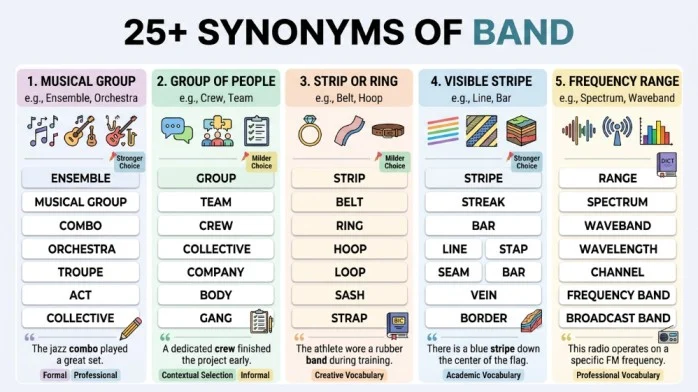
You write “band” in an essay, email, article, or caption, then realize the word can mean several completely different things. It might describe a group of musicians, a group of people, a strip of material, a ring, or a range of frequencies. Finding the right synonyms of band therefore depends on the exact meaning you intend.
The best alternative can make your writing much more precise. A music writer might choose ensemble or combo, while a technical writer may need range or waveband. Understanding these differences helps English learners, students, writers, professionals, and content creators avoid awkward substitutions and choose words that sound natural in context.
What Are the Best Synonyms of “Band”?
The best synonym for band depends on its meaning. A musical group, use ensemble, musical group, combo, or orchestra when appropriate. For a group of people, consider group, company, troop, or association. A strip or ring, use strip, belt, loop, ring, or bandage. A frequency range, range, spectrum, or waveband may fit.
Meaning, Tone, and Context
Simple Definition
The word band is a highly versatile noun with several meanings. It can describe a group of musicians, a group of people working or acting together, a narrow strip or ring of material, a visible stripe, or a defined range of frequencies or values.
Because these meanings are different, there is no single synonym that can replace band in every sentence. Context determines which alternative is accurate.
Part of Speech
Band can function primarily as a noun and also as a verb.
As a noun:
“She plays guitar in a local band.”
As a verb:
“The volunteers banded together to help the community.”
The verb band means to gather or unite, often in the expression band together.
Overall Tone
The tone of band is generally neutral. It is an ordinary, widely used English word that can appear in casual conversation, academic writing, professional communication, journalism, technical writing, and creative work.
Its tone can change slightly depending on the meaning.
For example:
“The band performed last night.”
Here, band sounds completely neutral.
“A band of criminals entered the building.”
Here, the phrase has a negative association because of the context.
Formality Level
Band is primarily a neutral word.
It works naturally in:
- Everyday conversation
- Academic writing
- Professional communication
- News writing
- Music journalism
- Technical descriptions
- Creative writing
- Social media
Some alternatives may be more formal or specialized. For example, ensemble can sound more formal in music writing, while combo is more informal and strongly associated with smaller musical groups, especially in jazz.
Common Uses
Native English speakers commonly use band in several ways.
Musical group
“The band released a new album.”
Group of people
“A band of volunteers helped clean the park.”
Strip or ring
“She wore a silver band around her wrist.”
Stripe or visible strip
“The bird has a dark band across its chest.”
Frequency range
“The station broadcasts on a different frequency band.”
Verb meaning unite
“The communities banded together after the storm.”
These different senses are recognized by major dictionaries, which list musical groups, groups of people, strips, rings, ranges, and the verb meaning “to unite” among the established uses of band.
Word Forms
| Form | Example |
|---|---|
| Noun | The band played three songs. |
| Verb | The residents banded together. |
| Present participle | The groups are banding together. |
| Past tense | The volunteers banded together. |
| Plural noun | Several bands performed. |
| Related noun | Banding can describe the process of marking or grouping with bands. |
When and How to Use “Band”
Choose band when the surrounding context makes its meaning clear. If readers could misunderstand which sense you mean, a more specific synonym can improve the sentence.
Professional
“The company created a small band of specialists to handle the project.”
Here, team or group may sound more natural in modern professional communication.
Academic
“The researchers observed a narrow band of wavelengths.”
In this technical context, range may be a suitable alternative, depending on the scientific meaning.
Workplace
“Our band of volunteers completed the event setup.”
A more conventional workplace choice would usually be team or group.
Personal
“My friends and I started a band in college.”
Here, band clearly means a musical group.
“Our band will perform at the company celebration next Friday.”
If the recipients know that you mean the musical group, the word is direct and natural.
Resume
“Performed with a five member jazz band at regional events.”
For a resume, musical ensemble could provide a slightly more formal alternative.
Social Media
“Excited to see my favorite band live tonight!”
In casual social media writing, band is usually more natural than a formal alternative such as ensemble.
Best Synonyms of “Band”
No synonym of band works in every context because the word itself has several meanings. The strongest replacement depends on whether you are describing musicians, people, material, a visible stripe, or a technical range.
Professional Writing: Group
When band refers to people working together, group is usually a safer professional alternative.
Example:
“The company formed a group of specialists to review the proposal.”
Why it works: Group is broad, neutral, and appropriate for professional communication.
Academic Writing: Range
When band refers to a defined set of frequencies, values, or wavelengths, range can be more accessible to general academic readers.
Example:
“The instrument detects a broad range of frequencies.”
Why it works: Range clearly communicates limits or variation.
Business Communication: Group
For business writing, group is generally more natural than band when describing people.
Example:
“A group of managers reviewed the new policy.”
Why it works: Group avoids the informal or unusual feel that band of managers might create.
Casual Conversation: Group
In everyday conversation, group is usually the easiest alternative when band means several people.
Example:
“A group of friends met us for dinner.”
Why it works: It is simple, familiar, and widely understood.
Emotional Writing: Circle
When describing people connected by friendship or shared feelings, circle can add a more personal tone.
Example:
“She relied on a close circle of friends during difficult times.”
Why it works: Circle emphasizes social connection rather than merely counting people.
Creative Writing: Ensemble
When describing performers, ensemble can sound polished and expressive.
Example:
“The ensemble filled the theater with warm, layered harmonies.”
Why it works: It highlights coordinated performance and artistic unity.
Resume Writing: Ensemble
For musicians, ensemble can be a useful professional alternative to band.
Example:
“Performed with a professional jazz ensemble at regional festivals.”
Why it works: It sounds polished while accurately describing a coordinated musical group.
Workplace Communication: Team
Although team is not a universal synonym for band, it is often the best replacement when band means people working toward a shared objective.
Example:
“The team completed the project ahead of schedule.”
Why it works: Team specifically communicates cooperation and a shared task.
Stronger Meaning: Collective
Collective can emphasize a group acting or creating as a unified whole.
Example:
“The artists formed a creative collective.”
Why it works: It focuses on shared identity and purpose.
Softer Meaning: Group
Group is often the safest mild alternative because it simply identifies several people or things without adding emotional or stylistic meaning.
Example:
“A group of students attended the workshop.”
Why it works: It is neutral and does not exaggerate the relationship among the members.
When Not to Use “Band”
When “Band” Sounds Too General
If you are describing employees working together, band may be less precise than team.
Less effective:
“The band completed the project.”
Better:
“The team completed the project.”
Why: Team clearly indicates people cooperating toward a goal.
When “Band” Is Too Vague
If you are discussing a technical frequency range, simply saying band may leave some readers looking for more information.
Less effective:
“The device operates across a wide band.”
Better:
“The device operates across a wide frequency range.”
Why: Frequency range immediately clarifies the technical meaning.
When “Band” Sounds Too Informal
In a formal discussion of musicians, ensemble may sound more polished.
Less effective:
“The band delivered a coordinated performance.”
Better:
“The ensemble delivered a coordinated performance.”
Why: Ensemble is especially suitable for formal discussions of musical performance.
When “Band” Is Too Informal for a Professional Group
Less effective:
“A band of analysts reviewed the report.”
Better:
“A team of analysts reviewed the report.”
Why: Team is the conventional workplace term.
When “Band” Is Too Weak
Sometimes the intended meaning is more specific than simply saying band.
Less effective:
“A band of experts advised the organization.”
Better:
“An expert panel advised the organization.”
Why: Panel identifies a group selected for expertise and formal discussion.
When “Band” Is Too Strong or Unusual
The expression “a band of people” can sometimes sound literary or old fashioned, depending on the sentence.
Less effective:
“A band of employees gathered near the entrance.”
Better:
“A group of employees gathered near the entrance.”
Why: Group sounds more natural in ordinary workplace communication.
When a More Specific Technical Word Is Available
Less effective:
“The signal moved into another band.”
Better:
“The signal moved into another frequency range.”
Why: The longer phrase gives readers immediate technical context.
Words Commonly Confused With “Band”
Group
Difference: Group is a broad word for people or things considered together. Band can also mean a group, but it often carries a more specific musical, social, or literary meaning.
When to Use It: Use group when you want a neutral general term.
Example: “A group of students organized the event.”
Team
Difference: Team usually implies cooperation toward a shared objective. Band does not necessarily imply a common task.
When to Use It: Use team for workplaces, sports, projects, and organized collaboration.
Example: “The marketing team developed the campaign.”
Ensemble
Difference: Ensemble commonly refers to performers working together, especially musicians, and can sound more formal than band.
When to Use It: Use it for formal musical or artistic contexts.
Example: “The chamber ensemble performed beautifully.”
Orchestra
Difference: An orchestra is a specific type of large musical organization involving sections of instruments. It is not a universal synonym for every band.
When to Use It: Use orchestra only when the musical group actually fits that description.
Example: “The orchestra performed Beethoven’s Fifth Symphony.”
Strip
Difference: Strip refers to a narrow, elongated piece or area of material. It can replace band when band means a narrow strip, but not when it means a musical group.
When to Use It: Use it for material, color, land, or other elongated areas.
Example: “A strip of blue fabric was sewn onto the jacket.”
Ring
Difference: Ring describes a circular object or shape. Band can refer to a ring, especially a plain ring such as a wedding band.
When to Use It: Use ring when the circular form is the main feature.
Example: “He wore a simple gold ring.”
Best Synonyms of “Band” by Context
| Context | Best Synonym | Why It Works | Example |
|---|---|---|---|
| Formal writing | Ensemble | Polished term for performers | “The ensemble performed brilliantly.” |
| Academic writing | Range | Clear for technical limits | “The study examined a broad range of frequencies.” |
| Professional communication | Group | Neutral and broadly useful | “The group reviewed the proposal.” |
| Business emails | Team | Natural for coworkers | “The team will respond tomorrow.” |
| Resume writing | Ensemble | Professional for musicians | “Performed with a jazz ensemble.” |
| Workplace communication | Team | Shows shared responsibility | “The team completed the assignment.” |
| Casual conversation | Group | Simple and natural | “A group of friends joined us.” |
| Everyday speaking | Group | Easy to understand | “A group was waiting outside.” |
| Creative writing | Ensemble | Adds artistic tone | “The ensemble moved as one.” |
| Storytelling | Circle | Highlights social connection | “A close circle gathered around her.” |
| Emotional writing | Circle | Suggests closeness | “Her circle of friends supported her.” |
| Strong emphasis | Collective | Stresses unified identity | “The artists worked as a collective.” |
| Mild tone | Group | Neutral and uncomplicated | “A group of visitors arrived.” |
| Social media captions | Band | Most natural for musicians | “My favorite band is touring again.” |
| American English | Band | Standard term for a musical group | “The band is playing tonight.” |
| British English | Band | Also standard for musical groups | “The band are touring this summer.” |
The core meanings of band are broadly shared across American and British English, although some grammatical patterns can differ, especially subject verb agreement with collective nouns in British usage.
How to Choose the Best Synonym of “Band”
The first step is to identify which meaning of band you are using.
If You Mean Musicians
Choose:
- Band
- Ensemble
- Musical group
- Combo
- Orchestra, only when technically appropriate
Use band for everyday music writing. Use ensemble when you want a more formal or artistic tone.
If You Mean People
Choose:
- Group
- Team
- Company
- Association
- Collective
- Circle
Use team when members work toward a shared objective. Use group when you simply need a neutral description.
If You Mean a Strip
Choose:
- Strip
- Belt
- Binding
- Bandage
- Stripe
Use strip for a general narrow piece of material. Use stripe when the feature is primarily a visible line or area of contrasting color.
If You Mean a Ring
Choose:
- Ring
- Loop
- Hoop
Use ring when describing a circular piece worn or placed around something.
If You Mean a Frequency or Value Range
Choose:
- Range
- Spectrum
- Waveband
- Frequency range
Use the most specific technical term available when accuracy matters.
Consider Your Audience
For general readers, choose familiar terms such as group, team, strip, and range.
For specialists, technical alternatives such as waveband may be more precise.
Consider Emotional Strength
Words such as group are neutral. Words such as collective can suggest shared identity, while circle can imply friendship or closeness.
Consider Formality
- Use ensemble in formal musical writing.
- Use group or team in ordinary professional communication.
- Use band freely in casual discussions about musicians.
Consider Natural Usage
A synonym is useful only if native speakers would naturally use it in that context. Replacing every occurrence of band with a more sophisticated word can make writing less natural rather than better.
Real Life Examples of “Band”
School
Original:
“Our school band performed at the annual ceremony.”
Improved:
“Our school ensemble performed at the annual ceremony.”
Why: Ensemble works well in a formal description of a musical performance.
College
Original:
“I joined a band during my first year of college.”
Improved:
“I joined a campus music group during my first year of college.”
Why: Music group makes the meaning immediately clear to readers who may not know the group.
Workplace
Original:
“A band of employees worked on the presentation.”
Improved:
“A team of employees worked on the presentation.”
Why: Team better communicates shared workplace responsibility.
Business
Original:
“A band of specialists reviewed the proposal.”
Improved:
“A panel of specialists reviewed the proposal.”
Why: Panel is more precise when experts are selected to evaluate something.
Original:
“The band will perform at our event.”
Improved:
“The musical group will perform at our event.”
Why: Musical group can be clearer for recipients who may not know the performers.
Resume
Original:
“Performed with a local band at community events.”
Improved:
“Performed with a local musical ensemble at community events.”
Why: Musical ensemble gives the resume a more polished professional tone.
Conversation
Original:
“I saw my favorite band last night.”
Improved:
“I saw my favorite group last night.”
Why: Although group is possible, band is actually more natural here because the musical meaning is already clear.
Storytelling
Original:
“A band of travelers arrived before sunset.”
Improved:
“A small company of travelers arrived before sunset.”
Why: Company can give narrative writing a more literary feel when describing people traveling together.
Blogging
Original:
“The band combines rock and electronic sounds.”
Improved:
“The musical group combines rock and electronic sounds.”
Why: Musical group removes any possibility of confusion for readers encountering the topic without background context.
Social Media
Original:
“My favorite band just announced a new tour!”
Improved:
“My favorite musical group just announced a new tour!”
Why: The original is actually better for social media. Band is shorter, more natural, and immediately recognizable.
25 Best Synonyms of “Band”
Because band is polysemous, the following list includes synonyms and close equivalents for its different established senses. They should not be treated as interchangeable in every sentence.
| Synonym | Simple Meaning | Best Used For | Example Sentence |
|---|---|---|---|
| Ensemble | A group performing together | Music | “The ensemble performed three original pieces.” |
| Musical group | People who perform music together | Music | “The musical group released its first album.” |
| Combo | A small musical group | Jazz and popular music | “The jazz combo played until midnight.” |
| Orchestra | A large organized group of instrumentalists | Orchestral music | “The orchestra opened the festival.” |
| Group | Several people or things together | People | “A group of volunteers arrived early.” |
| Team | People working toward a shared goal | Workplace | “The team completed the project.” |
| Company | A group of people together | People and literary contexts | “A company of travelers crossed the valley.” |
| Troop | An organized group | People, especially historical or military contexts | “A troop of scouts entered the forest.” |
| Association | An organized group with a shared purpose | Organizations | “The association represents local musicians.” |
| Collective | A group sharing an identity or purpose | Artists and communities | “The writers formed a creative collective.” |
| Circle | A close social group | Friends and relationships | “She has a supportive circle of friends.” |
| Party | A group gathered for a purpose | People | “A party of hikers reached the summit.” |
| Gang | A group, often with a negative association | Informal or criminal contexts | “A gang of thieves was arrested.” |
| Strip | A narrow piece or area | Material | “A strip of leather covered the edge.” |
| Belt | A strip worn around or placed around something | Clothing and objects | “The machine uses a rubber belt.” |
| Binding | Material used to hold or join things | Books and materials | “The binding kept the pages together.” |
| Bandage | Material used to cover or support an injury | Medical use | “The nurse wrapped a bandage around his wrist.” |
| Ring | A circular band or object | Jewelry and circular objects | “She wore a silver ring.” |
| Loop | A curved or circular section | Cords and materials | “Make a loop with the ribbon.” |
| Hoop | A circular or ring shaped object | Sports and physical objects | “The wire was shaped into a hoop.” |
| Stripe | A long narrow area of contrasting color | Color and appearance | “The flag has a white stripe.” |
| Streak | A long narrow mark | Color and natural patterns | “A bright streak crossed the sky.” |
| Range | A set of values between limits | Technical contexts | “The sensor works across a wide range.” |
| Spectrum | A continuous range of related values | Science and abstract ranges | “The device measures a broad spectrum of frequencies.” |
| Waveband | A defined range of wavelengths or frequencies | Radio and technical writing | “The receiver operates on a different waveband.” |
Several of these alternatives correspond directly to dictionary listed senses. For example, Merriam Webster lists loop, ring, hoop, belt, and circle among synonyms for the material sense of band, while Collins identifies ensemble, group, orchestra, combo, strip, and belt across relevant senses.
Synonyms of “Band” by Usage
Professional vs Personal Synonyms
Professional writing usually favors precise, neutral terms.
For people:
- Team
- Group
- Association
- Panel
- Collective
For personal relationships:
- Circle
- Group
- Company
Example:
Professional:
“The project team reviewed the proposal.”
Personal:
“My close circle of friends helped me through the experience.”
The key difference is purpose. Team emphasizes collaboration, while circle emphasizes personal connection.
Formal vs Conversational Synonyms
Formal contexts:
- Ensemble
- Association
- Collective
- Range
- Spectrum
Conversational contexts:
- Band
- Group
- Combo
- Team
- Ring
For a report:
“The musical ensemble performed several compositions.”
In conversation:
“The band played three songs.”
The conversational sentence is shorter and more natural.
Academic Synonyms
Academic writing requires precision because band can represent different technical concepts.
- Use range when discussing values.
- Use spectrum when discussing a continuous set of related frequencies, wavelengths, or characteristics.
- Use waveband when discussing a defined frequency or wavelength region.
- Use ensemble when discussing musicians or performers.
Example:
“The researchers measured the signal across a broad frequency range.”
This is clearer than using band without technical context.
Professional and Business Synonyms
- For resumes:
- Team
- Group
- Ensemble
- Collective
- For interviews:
- Team
- Group
- Organization
- For meetings:
- Team
- Group
- Panel
- For presentations:
- Team
- Ensemble, when discussing performers
- Group
- For performance reviews:
- Team
- Department
- Group
- For client communication:
- Team
- Organization
- Group
- For business emails, team is often the strongest choice when describing coworkers because it communicates collaboration clearly.
Creative and Literary Synonyms
Creative writing allows more expressive alternatives.
Company can describe a group of travelers or companions.
Circle can suggest friendship.
Collective can suggest shared identity.
Ensemble can describe coordinated performers.
Troop can suggest an organized group, particularly in historical or adventure writing.
Example:
“A small company of travelers disappeared into the morning mist.”
Here, company gives the sentence a more literary quality than simply saying group.
Slang or Modern Synonyms
There is no single slang word that universally replaces band.
For musical groups, combo is a recognized informal term, particularly for a small group of musicians.
Example:
“The club booked a jazz combo for Friday night.”
Use combo when discussing a small musical group. Avoid it in formal academic writing unless the musical term itself is relevant.
For groups of people, expressions such as crew may be used casually in some contexts, but crew is not a universal synonym for band. It often suggests coworkers, friends, or people working together.
Example:
“My crew is meeting at the café tonight.”
This should not be substituted for band in a formal document.
Strongest to Mildest Synonyms
There is no universal intensity scale for band because its meanings are not all about emotional strength. A musical group, strip of material, and frequency range cannot meaningfully be ranked from mild to strong.
For the group of people sense, however, the following progression can help with tone:
| Tone | Word | Effect |
|---|---|---|
| Mild | Group | Neutral and general |
| Mild to moderate | Company | Slightly literary or organized |
| Moderate | Collective | Emphasizes shared identity |
| Moderate | Association | Emphasizes formal organization |
| Strongly negative | Gang | Can suggest criminal or threatening behavior |
The word gang should not be used as a neutral replacement in professional writing because it can strongly suggest criminal activity.
Emotional vs Neutral Synonyms
Emotional Synonyms
These alternatives can add social or expressive meaning.
Circle
Suggests closeness and friendship.
“Her circle of friends supported her.”
Collective
Can suggest shared identity or purpose.
“The artists worked as a collective.”
Gang
Can create an informal or negative tone.
“A gang of thieves escaped.”
Company
Can create a literary or historical feeling.
“A company of travelers crossed the mountains.”
Neutral Synonyms
These are safer for straightforward communication.
Group
“A group of students attended the lecture.”
Team
“The team completed the assignment.”
Range
“The device operates across a wide range.”
Strip
“A strip of paper covered the label.”
Ensemble
“The ensemble performed at the concert.”
Choose neutral words when your goal is accuracy rather than emotional effect.
Antonyms of “Band”
Unlike words such as important or happy, band does not have one universal set of antonyms. The reason is that band has several unrelated senses, including a musical group, a group of people, a strip or ring, and a frequency range. Major dictionaries treat these as distinct meanings.
For that reason, providing exactly 15 supposed antonyms would require inventing relationships that are not genuine lexical opposites. For example, individual can contrast with group in some contexts, but it is not the direct antonym of band in its musical or material senses.
The most accurate contrasts by meaning are:
| Meaning of “Band” | Useful Contrast | Example |
|---|---|---|
| Musical group | Solo performer | “The solo performer appeared without a band.” |
| Group of people | Individual | “The decision was made by one individual, not a group.” |
| Group working together | Separate individuals | “The members worked separately rather than as a team.” |
| Strip or band of material | Unmarked surface | “The design used a plain surface instead of a contrasting strip.” |
| Frequency band | Single frequency | “The receiver was tuned to a single frequency.” |
These are contextual contrasts, not 15 dictionary antonyms. This distinction is important for accurate vocabulary guidance.
Comparison: “Band” vs Similar Words
Band vs Group
Main Difference
Band can mean a group, but it has additional meanings. Group is much broader and usually carries less specialized meaning.
Which Is Stronger?
Neither is inherently stronger.
Which Is More Formal?
Group is often more neutral and flexible in professional writing.
When to Use Each
Use band for musicians or when the group has a specific stylistic context.
Use group for general collections of people or things.
Examples
Band:
“The band played at the festival.”
Group:
“A group of students attended the festival.”
Band vs Team
Main Difference
A team is a group organized around a shared goal. A band does not necessarily imply that type of cooperation.
Which Is Stronger?
Neither is stronger, but team gives a clearer sense of shared responsibility.
Which Is More Formal?
Both are neutral, but team is more natural in workplace writing.
When to Use Each
Use team for employees, sports, projects, and coordinated work.
Use band for musicians or certain literary descriptions of groups.
Examples
Band:
“The band rehearsed before the show.”
Team:
“The team prepared for the presentation.”
Band vs Ensemble
Main Difference
An ensemble is a coordinated group of performers, especially musicians. Band is a broader and more common everyday term for many musical groups.
Which Is Stronger?
Neither is stronger.
Which Is More Formal?
Ensemble often sounds more formal or artistic.
When to Use Each
Use band in ordinary music discussions.
Use ensemble in formal music, performance, or artistic writing.
Examples
Band:
“The band released a new single.”
Ensemble:
“The ensemble performed a complex arrangement.”
Band vs Orchestra
Main Difference
An orchestra is a particular type of large instrumental group. Not every band is an orchestra.
Which Is Stronger?
Neither.
Which Is More Formal?
Orchestra is a specific musical term rather than simply a more formal version of band.
When to Use Each
Use orchestra only when the group fits that musical category.
Examples
Band:
“The rock band opened the concert.”
Orchestra:
“The orchestra performed the symphony.”
Band vs Strip
Main Difference
A strip is a narrow piece or area of material. A band can have this meaning when it forms a narrow surrounding or contrasting section.
Which Is Stronger?
Neither.
Which Is More Formal?
Both are neutral.
When to Use Each
Use strip when emphasizing the shape or narrowness.
Use band when emphasizing a surrounding, decorative, or contrasting section.
Examples
Band:
“The shirt has a red band around the waist.”
Strip:
“A strip of red fabric was sewn onto the shirt.”
Band vs Ring
Main Difference
A ring is circular, while a band can refer to a simple circular ring, especially jewelry.
Which Is Stronger?
Neither.
Which Is More Formal?
Both are neutral.
When to Use Each
Use ring for circular objects generally.
Use band for simple ring designs, especially wedding jewelry.
Examples
Band:
“She wore a plain wedding band.”
Ring:
“He gave her a silver ring.”
Common Phrases and Expressions with “Band”
Band Together
Meaning: To unite for a shared purpose.
Example Sentence:
“The neighbors banded together to repair the damaged playground.”
Rock Band
Meaning: A musical group that performs rock music.
Example Sentence:
“The rock band announced a new tour.”
Brass Band
Meaning: A musical group centered on brass instruments, often with percussion.
Example Sentence:
“The brass band played during the parade.”
Big Band
Meaning: A large jazz ensemble, traditionally associated with sections of brass, woodwinds, and rhythm instruments.
Example Sentence:
“The big band performed classic swing arrangements.”
Band Member
Meaning: A person who belongs to a musical band.
Example Sentence:
“Each band member contributed to the new album.”
Band Leader
Meaning: A person who leads a musical group.
Example Sentence:
“The band leader introduced the next song.”
Frequency Band
Meaning: A defined range of frequencies.
Example Sentence:
“The device can detect signals across a wide frequency band.”
Band Together for a Cause
Meaning: To unite in support of a shared goal.
Example Sentence:
“Residents banded together for a local environmental campaign.”
The expression band together is a standard verb phrase meaning to unite, and dictionaries explicitly recognize this use.
Common Mistakes to Avoid
Mistake 1: Treating Every Synonym as Interchangeable
Incorrect:
“The orchestra released a new rock album.”
Better:
“The rock band released a new album.”
Why: Orchestra identifies a specific type of musical group and is not a general replacement for band.
Mistake 2: Using “Band” for Every Workplace Group
Incorrect:
“A band of employees discussed the project.”
Better:
“A team of employees discussed the project.”
Why: Team is the conventional workplace term for people cooperating toward a goal.
Mistake 3: Using “Combo” for Every Musical Group
Incorrect:
“The 80 member symphony orchestra is a jazz combo.”
Better:
“The 80 member orchestra performed a jazz arrangement.”
Why: Combo normally suggests a smaller musical group and is especially associated with jazz.
Mistake 4: Confusing “Band” and “Strip”
Incorrect:
“She cut a band of fabric for the costume.”
Better:
“She cut a strip of fabric for the costume.”
Why: Strip focuses on a narrow piece of material. Band may be appropriate when the piece forms a surrounding or decorative band.
Mistake 5: Using “Gang” as a Neutral Synonym
Incorrect:
“A gang of employees attended the meeting.”
Better:
“A group of employees attended the meeting.”
Why: Gang can carry a strong informal or negative association and is unsuitable for most professional contexts.
Mistake 6: Replacing a Technical “Band” With an Unclear Word
Incorrect:
“The equipment operates within a broad band.”
Better:
“The equipment operates within a broad frequency range.”
Why: Frequency range immediately tells the reader what kind of band is being discussed.
Mistake 7: Assuming “Ensemble” Always Means Band
Incorrect:
“The ensemble is definitely a rock band.”
Better:
“The ensemble includes several instrumentalists.”
Why: Ensemble is broader within music and performance. It describes coordinated performers without necessarily identifying their musical style or exact organization.
Frequently Asked Questions
What are the best synonyms of “band”?
The best synonyms of band depend on meaning. musicians, use ensemble, musical group, or combo. For people, use group, team, or collective. For material, use strip, belt, or ring.
What are the best formal synonyms of “band”?
Formal alternatives depend on context. Ensemble works well for musical groups, group or association for people, and range, spectrum, or waveband for technical meanings involving frequencies or values.
What are common informal synonyms of “band”?
For a musical group, combo can be an informal alternative, particularly for a small jazz group. For people, group is common, while expressions such as crew may work in casual contexts but are not universal synonyms.
What is another word for “band” in professional writing?
For musicians, ensemble can sound professional. workplace groups, team or group is usually better. For technical contexts, choose a precise term such as frequency range, spectrum, or waveband.
What is the difference between “band” and “group”?
Band can mean a group, but it has more specialized meanings, including a musical group, strip, ring, and frequency range. Group is broader and generally refers to people or things considered together.
What is the opposite of “band”?
There is no single universal opposite of band because the word has several unrelated meanings. Depending on context, individual can contrast with a band as a group, while single frequency can contrast with a frequency band.
Conclusion
The word band is more flexible than it first appears. It can refer to a musical group, a collection of people, a strip or ring of material, a visible stripe, or a technical range of frequencies or values. Because of these different meanings, the best synonym must always match the context.
The most useful vocabulary habit is to identify the exact meaning of a word before searching for a replacement. When choosing among the synonyms of band, consider the audience, tone, subject, and specific sense you want to communicate.
Read More Related Articles:
Synonyms for Thus | Meaning, Examples, and Better Word …
50+ Synonyms of Show | Meanings, Uses, Examples, and …











7 thoughts on “25+ Synonyms of Band | Meanings, Uses, Examples, and Best Alternatives”