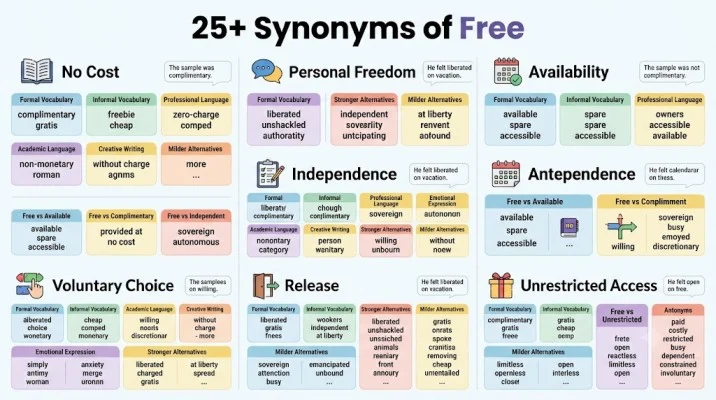
Choosing the right word for “free” is not always as simple as it seems. The word can describe freedom, zero cost, available time, independence, or something released from control. That is why the best alternative depends on the meaning, tone, and situation. This guide to Synonyms of Free explores practical alternatives with clear meanings, examples, and context-based usage. Whether you are writing an email, improving your vocabulary, preparing a resume, or creating polished content, the right synonym can make your message more precise and natural.
Strong vocabulary is not about using complicated words. It is about choosing the word that communicates your exact idea. From everyday expressions such as “available” and “liberated” to professional choices such as “complimentary” and “independent,” each alternative carries a slightly different meaning. These Synonyms of Free help you write with greater clarity, confidence, and purpose in 2026.
What Are the Best Synonyms of “Free”?
The best synonym for free depends on its meaning. For no cost, use complimentary or costless. For personal independence, use independent or unrestricted. Availability, use available or vacant. For release, use liberated or released. In professional writing, complimentary, available, and independent are often more precise than the general word free.
Meaning, Tone, and Context
The word free is unusually flexible because it has several common meanings. It can describe something that costs nothing, a person who is not controlled or imprisoned, something that is available, an action performed voluntarily, or something that has been released.
Simple Definition
Free generally describes a person or thing that is not subject to a particular cost, restriction, obligation, control, or confinement.
For example:
“The museum offers free admission.”
Here, free means there is no charge.
In:
“She felt free to make her own decision.”
Free refers to independence and the absence of restriction.
In:
“The bird was finally free.”
the word means released from confinement.
Part of Speech
Free is primarily an adjective, but it can also function as a verb and an adverb.
- As an adjective:
“The service is free.”
- As a verb:
“The organization worked to free the animals.”
- As an adverb:
“The horses were allowed to run free.”
Overall Tone
The tone of free is usually neutral or positive.
It can create a positive feeling when it refers to:
- No financial cost
- Personal independence
- Choice
- Opportunity
- Liberation
- Open access
- Lack of restrictions
The emotional effect depends heavily on context.
Formality Level
Free is a neutral word that works in almost every type of communication.
It is natural in:
- Academic writing
- Professional communication
- Business emails
- Casual conversations
- Advertising
- Social media
- Personal writing
- Creative writing
More formal alternatives may be preferable when you need greater precision.
For example, instead of:
“The company gives free services.”
a professional document may say:
“The company provides complimentary services.”
Common Uses
Native English speakers commonly use free to describe:
- Free products
- Free services
- Free admission
- Free time
- Free space
- Free speech
- Free choice
- Free access
- Free movement
- Free resources
- Free people
- Free individuals
- Free animals
- Free information
- Free software
- Free samples
- Free delivery
- Free offers
Important Meaning Differences
The meaning of free changes according to the sentence.
| Meaning of Free | Example | Suitable Alternatives |
|---|---|---|
| No cost | “The app is free.” | Complimentary, costless |
| Not imprisoned | “The prisoner is free.” | Released, liberated |
| Independent | “She is free to choose.” | Independent, unrestricted |
| Available | “Are you free this afternoon?” | Available, unoccupied |
| Without restriction | “The animals can move free.” | Unrestricted, unconstrained |
| Voluntary | “Participation is free.” | Voluntary, optional |
| Not occupied | “Is this seat free?” | Available, vacant |
| Without something unwanted | “The product is free of chemicals.” | Clear of, without |
| Released | “He was freed from captivity.” | Released, liberated |
Word Forms
| Form | Word | Example |
|---|---|---|
| Adjective | Free | “The course is free.” |
| Verb | Free | “They freed the animal.” |
| Adverb | Freely | “She spoke freely.” |
| Noun | Freedom | “Everyone deserves freedom.” |
| Past form | Freed | “The prisoners were freed.” |
| Comparative | Freer | “The new rules give employees freer access.” |
| Superlative | Freest | “It was one of the freest societies of its time.” |
When and How to Use “Free”
Use free when the surrounding context makes the intended meaning obvious. It is especially useful when you want a simple, direct word that most readers will immediately understand.
However, when several meanings are possible, a more precise synonym can prevent confusion.
Professional
“I am free to attend the meeting after 2 p.m.”
Here, free means available.
Academic
“Students are free to select a topic that interests them.”
Here, free communicates permission or choice.
Workplace
“The conference room is free after lunch.”
Here, free means unoccupied or available.
Personal
“I finally have some free time this weekend.”
Here, free means time that is not committed to another activity.
“Please let me know when you are free for a brief call.”
Here, available may be a more professional alternative.
Resume
“Developed free educational resources for local students.”
Here, free means available without payment.
Social Media
“Free resources can help students learn new skills without spending money.”
Here, free clearly means no cost.
Best Synonyms of “Free”
No synonym can replace free in every sentence because the word has several meanings. The best alternative depends on whether you are describing price, freedom, availability, choice, release, or the absence of restrictions.
Professional Writing: Complimentary
Use complimentary when something is provided without charge, especially in business, hospitality, marketing, and customer service.
“Guests receive complimentary breakfast with their reservation.”
It sounds more polished than free in professional contexts.
Academic Writing: Voluntary
When free means something is done by choice rather than obligation, voluntary is often more precise.
“Participation in the survey was voluntary.”
Business Communication: Complimentary
For products or services offered at no cost, complimentary is a strong professional choice.
“The company provides complimentary consultations to new clients.”
Casual Conversation: Available
When someone asks whether you are free, available is a natural alternative.
“Are you available tonight?”
Emotional Writing: Liberated
When free describes relief from control, fear, or confinement, liberated can express the emotional meaning more strongly.
“She felt liberated after leaving the unhealthy environment.”
Creative Writing: Unrestrained
For creative descriptions of movement, expression, or emotion without limits, unrestrained can add depth.
“His laughter was wild and unrestrained.”
Resume Writing: Independent
When free means self directed or not dependent on another person, independent is usually more professional.
“Worked independently while managing multiple client projects.”
Workplace Communication: Available
When discussing schedules, available is more precise than free.
“I am available for a meeting after 3 p.m.”
Stronger Meaning: Unrestricted
When you want to emphasize the absence of limits or controls, use unrestricted.
“Employees have unrestricted access to the training library.”
Softer Meaning: Open
When you simply want to indicate availability or opportunity, open may sound more natural.
“We still have a few open positions.”
When Not to Use “Free”
Although free is common and useful, it can sometimes be too broad. A more specific word can make your sentence clearer and more professional.
When Free Is Too General
Consider:
“The service is free.”
This tells the reader there is no cost, but it does not explain whether the service is complimentary, publicly available, or temporarily offered at no charge.
A more precise sentence is:
“The consultation is complimentary for new customers.”
When Free Is Too Vague
Consider:
“I am free tomorrow.”
The reader may understand that you are available, but available is more precise in professional communication.
Better:
“I am available tomorrow afternoon.”
When Free Sounds Too Informal
In some business situations, free can sound less polished.
Less formal:
“We offer a free consultation.”
More professional:
“We offer a complimentary consultation.”
The second version is particularly appropriate for client facing communication.
When Free Sounds Too Weak
If someone has escaped strict control, free may not fully communicate the emotional strength of the situation.
Less expressive:
“She felt free after leaving.”
Stronger:
“She felt liberated after leaving.”
When Free Sounds Too Strong
Sometimes free suggests complete independence when the situation involves only limited choice.
Less precise:
“Employees are free to change the schedule.”
Better:
“Employees may request changes to the schedule.”
This avoids suggesting unlimited authority.
When Free Is the Wrong Meaning
Consider:
“The seat is free.”
This could mean the seat costs nothing or that nobody is sitting there.
If you mean availability:
“The seat is available.”
If you mean no cost:
“The seat is complimentary.”
Context determines the correct synonym.
Words Commonly Confused With “Free”
Available
Difference: Available means ready for use, accessible, or not occupied. It does not normally mean something costs nothing.
When to Use It: Use it for schedules, spaces, resources, products, and opportunities.
Example:
“The manager is available after lunch.”
Independent
Difference: Independent describes someone or something that is not controlled by another person or organization.
When to Use It: Use it for people, businesses, decisions, and systems.
Example:
“She became an independent consultant.”
Voluntary
Difference: Voluntary means something is done by choice rather than required.
When to Use It: Use it for participation, work, contributions, and actions.
Example:
“Attendance at the workshop is voluntary.”
Complimentary
Difference: Complimentary means provided without charge, especially as a courtesy.
When to Use It: Use it in hospitality, business, customer service, and promotional settings.
Example:
“Each guest receives a complimentary drink.”
Liberated
Difference: Liberated emphasizes release from control, oppression, or confinement.
When to Use It: Use it when the emotional or political meaning of freedom matters.
Example:
“The movement helped people feel liberated.”
Unrestricted
Difference: Unrestricted means not limited or controlled by rules, conditions, or boundaries.
When to Use It: Use it for access, movement, information, and permissions.
Example:
“Members receive unrestricted access to the online library.”
Best Synonyms of “Free” by Context
| Context | Best Synonym | Why It Works | Example |
|---|---|---|---|
| Formal writing | Complimentary | Clearly communicates no financial charge | “The hotel offers complimentary parking.” |
| Academic writing | Voluntary | Clearly expresses choice | “Participation was voluntary.” |
| Professional communication | Available | Precise for schedules | “I am available after 2 p.m.” |
| Business emails | Complimentary | Sounds polished when discussing services | “We offer a complimentary consultation.” |
| Resume writing | Independent | Communicates self directed work | “Worked independently on client projects.” |
| Workplace communication | Available | Natural for schedules and meetings | “I am available for a meeting.” |
| Casual conversation | Free | Simple and natural | “Are you free tonight?” |
| Everyday speaking | Open | Useful for spaces and opportunities | “Is this seat open?” |
| Creative writing | Unrestrained | Adds expressive meaning | “Her imagination was unrestrained.” |
| Storytelling | Liberated | Conveys emotional release | “He finally felt liberated.” |
| Emotional writing | Liberated | Stronger emotional effect | “She felt liberated from her fears.” |
| Strong emphasis | Unrestricted | Highlights absence of limits | “The team has unrestricted access.” |
| Mild tone | Available | Avoids unnecessary emphasis | “The room is available.” |
| Social media captions | Free | Short and immediately understood | “Free resources for new learners.” |
| American English | Free | Extremely common across meanings | “Are you free this weekend?” |
| British English | Free | Also standard and widely used | “Are you free this afternoon?” |
How to Choose the Best Synonym of “Free”
The easiest way to choose the right synonym is to identify what free means in your sentence before replacing it.
If You Mean No Cost
Choose:
- Complimentary
- Costless
- At no charge
Example:
“The hotel provides complimentary Wi Fi.”
If You Mean Available
Choose:
- Available
- Open
- Unoccupied
Example:
“The doctor is available at 4 p.m.”
If You Mean Independent
Choose:
- Independent
- Self governing
- Autonomous
Example:
“The organization operates independently.”
If You Mean Without Restrictions
Choose:
- Unrestricted
- Unconstrained
- Uncontrolled
Example:
“Members have unrestricted access.”
If You Mean Released
Choose:
- Released
- Liberated
- Set loose
Example:
“The rescued animals were released into the wild.”
If You Mean Done by Choice
Choose:
- Voluntary
- Optional
- Willing
Example:
“Participation is voluntary.”
Consider Your Audience
- For a friend:
“Are you free tonight?”
- For a manager:
“Are you available this evening?”
- For a business customer:
“We are pleased to offer a complimentary consultation.”
The underlying idea may be similar, but the vocabulary changes with the audience.
Consider Emotional Strength
- Use available for a neutral scheduling situation.
- Use independent for personal autonomy.
- Use liberated when emotional release matters.
- Use unrestricted when rules and limitations are the main concern.
Consider Your Writing Purpose
A resume usually needs independent or autonomous rather than free when describing self directed work.
An academic paper may prefer voluntary when discussing participation.
A marketing message may use complimentary when emphasizing a service offered without charge.
A personal story may use liberated when describing emotional freedom.
Real Life Examples of “Free”
School
Basic:
“Students can use the free study materials.”
Improved:
“Students can access the complimentary study materials online.”
Here, complimentary works when the materials are specifically provided at no cost.
College
Basic:
“Participation in the activity is free.”
Improved:
“Participation in the activity is voluntary.”
If the meaning is that students do not have to participate, voluntary is more accurate.
Workplace
Basic:
“I am free after 3 p.m.”
Improved:
“I am available after 3 p.m.”
Available sounds more professional when discussing schedules.
Business
Basic:
“We offer a free consultation.”
Improved:
“We offer a complimentary consultation to new clients.”
The revised version sounds more polished in customer communication.
Basic:
“Let me know when you are free.”
Improved:
“Please let me know when you are available.”
The second version is especially suitable for professional email.
Resume
Basic:
“Worked free from supervision.”
Improved:
“Worked independently with minimal supervision.”
The improved version communicates professional autonomy much more clearly.
Conversation
Basic:
“Are you free this weekend?”
Natural alternative:
“Are you available this weekend?”
Both work, but free is completely natural in casual conversation.
Storytelling
Basic:
“After years of control, he was finally free.”
More expressive:
“After years of confinement, he was finally liberated.”
Liberated gives the sentence stronger emotional weight.
Blogging
Basic:
“You can download this free guide.”
More precise:
“You can download this complimentary guide.”
The choice depends on the style of the blog and the intended audience.
Social Media
“Free resources can make learning more accessible to everyone.”
Here, free is short, clear, and more natural than a formal alternative.
25 Best Synonyms of “Free”
Because free has multiple meanings, these 25 alternatives represent different senses rather than being interchangeable in every sentence.
| Synonym | Simple Meaning | Best Used For | Example Sentence |
|---|---|---|---|
| Available | Ready for use or contact | Schedules, resources | “The manager is available after lunch.” |
| Complimentary | Given without payment | Business, hospitality | “Guests receive a complimentary breakfast.” |
| Independent | Not controlled by others | People, organizations | “She became an independent consultant.” |
| Voluntary | Done by personal choice | Participation, service | “The survey is voluntary.” |
| Unrestricted | Without limits or controls | Access, movement | “Members have unrestricted access.” |
| Unconstrained | Not limited or restrained | Ideas, actions | “The artist enjoyed unconstrained creativity.” |
| Liberated | Released from control | Emotional or social freedom | “She felt liberated after making the decision.” |
| Released | Let go from confinement | People, animals, objects | “The rescued birds were released.” |
| Unoccupied | Not currently being used | Rooms, seats, spaces | “The conference room is unoccupied.” |
| Open | Available for use or participation | Positions, spaces, opportunities | “The position is still open.” |
| Autonomous | Able to operate independently | Systems, organizations | “The region became more autonomous.” |
| Self governing | Able to govern itself | Political or organizational contexts | “The community became self governing.” |
| Uncontrolled | Not controlled or restrained | Movement, situations | “The vehicle began an uncontrolled slide.” |
| Unbound | Not physically or metaphorically restricted | Creative and literary writing | “Her imagination seemed unbound.” |
| Unconfined | Not kept within limits or boundaries | Physical or figurative freedom | “The animals enjoyed an unconfined environment.” |
| Unrestricted | Not subject to limitations | Access and permissions | “The archive provides unrestricted access.” |
| Unattached | Not connected or committed | Personal or social contexts | “He remained unattached to any political group.” |
| Willing | Ready to act by choice | Cooperation, decisions | “She was willing to help.” |
| Optional | Not required | Activities, choices | “The training session is optional.” |
| Costless | Having no financial cost | Economic contexts | “The basic service is costless.” |
| Gratis | Provided without charge | Formal or specialized contexts | “The organization offers legal advice gratis.” |
| At liberty | Free to act or decide | Formal and legal contexts | “You are at liberty to leave at any time.” |
| Unrestrictedly | Without limitation | Rare formal usage | “The information could not be shared unrestrictedly.” |
| Unhampered | Not prevented or obstructed | Movement, progress | “The team continued its work unhampered.” |
| Unrestrained | Without restraint or limitation | Creative and emotional writing | “She expressed her opinion in an unrestrained way.” |
Synonyms of “Free” by Usage
Professional vs Personal Synonyms
Professional writing benefits from precise terms that identify the exact meaning of free.
- For schedules, use available.
“I am available for a meeting tomorrow.”
- For independent work, use independent.
“The employee completed the assignment independently.”
- For services provided at no cost, use complimentary.
“Clients receive a complimentary consultation.”
Personal communication can remain simpler.
“Are you free tonight?”
“I finally have some free time.”
The general word free is often preferable in casual speech because it sounds natural and direct.
Formal vs Conversational Synonyms
Formal writing often requires precision.
| Situation | Recommended Word |
|---|---|
| Reports | Unrestricted, independent |
| Essays | Voluntary, independent |
| Business writing | Complimentary |
| Presentations | Available, independent |
| Emails | Available |
| Casual conversations | Free |
| Texting | Free, available |
For example:
Casual:
“Are you free tomorrow?”
Professional:
“Are you available tomorrow?”
Business:
“We are offering a complimentary consultation.”
Academic:
“Participation in the study was voluntary.”
Academic Synonyms
- Academic writing should avoid ambiguity. The best synonym depends on the specific meaning of free.
Voluntary
Use this when participation or action is based on choice.
“Participation in the research was voluntary.”
Independent
Use this when describing work, thought, or decision making that is not controlled by another person.
“Students were encouraged to develop independent arguments.”
Unrestricted
Use this when discussing access, movement, or limitations.
“The researchers were given unrestricted access to the database.”
Autonomous
Use this when describing systems, organizations, or decision making that operates independently.
“The institution developed an autonomous research program.”
Unconstrained
Use this when discussing ideas, creativity, or theoretical possibilities without limitations.
“The model allows unconstrained exploration of possible outcomes.”
Professional and Business Synonyms
Resumes
Use independent when describing work performed without constant supervision.
“Managed client accounts independently.”
Interviews
Use available when discussing scheduling.
“I am available to begin next month.”
Meetings
Use available rather than free in formal workplace communication.
“I am available for the 10 a.m. meeting.”
Presentations
Use unrestricted when describing access or permission.
“Participants received unrestricted access to the resource center.”
Performance Reviews
Use independent when describing self directed performance.
“Completed complex assignments independently.”
Client Communication
Use complimentary when discussing no cost services.
“We provide a complimentary initial consultation.”
Business Emails
Use available for schedules and complimentary for services.
“Please let me know when you are available.”
“We would be happy to provide a complimentary assessment.”
Creative and Literary Synonyms
Creative writing often benefits from alternatives that carry emotional or visual meaning.
Liberated
This word suggests emotional release or freedom from control.
“For the first time, she felt liberated.”
Unrestrained
This emphasizes a lack of control or limitation.
“His imagination was completely unrestrained.”
Unbound
This has a literary quality and suggests freedom from limits.
“Her dreams remained unbound by fear.”
Unconfined
This focuses on the absence of physical or figurative boundaries.
“The child’s curiosity was unconfined.”
Released
This works especially well when a character or animal moves from confinement into freedom.
“At sunrise, the horses were released.”
Slang or Modern Synonyms
There is no single slang word that accurately replaces free across all of its meanings.
However, casual English sometimes uses no charge, on the house, and freebie when discussing something that costs nothing.
No Charge
Meaning: Available without payment.
Acceptable in customer service and casual communication.
“The replacement was provided at no charge.”
On the House
Meaning: Provided free by a business.
Usually used in restaurants, bars, hotels, and hospitality.
“The manager gave us dessert on the house.”
Avoid this expression in academic writing and formal reports.
Freebie
Meaning: A free item, sample, or benefit.
It is informal and common in marketing and casual conversation.
“They gave everyone a freebie at the event.”
Strongest to Mildest Synonyms
The intensity of free depends on the meaning being expressed. There is no universal scale because free can describe price, availability, independence, or release.
Mild
- Available
- Open
- Optional
- Unoccupied
These words usually communicate practical availability or choice without strong emotion.
Moderate
- Independent
- Voluntary
- Complimentary
- Unrestricted
These words provide a more specific meaning.
Strong
- Unconstrained
- Unrestrained
- Unconfined
- Unhampered
These emphasize the absence of limitations.
Very Strong
- Liberated
- Unbound
- At liberty
These can communicate a deeper sense of personal, emotional, or social freedom.
Emotional vs Neutral Synonyms
Emotional Synonyms
These alternatives can communicate stronger feelings about freedom.
- Liberated
- Unbound
- Unrestrained
- Unconfined
- Unhampered
Example:
“She felt liberated after years of pressure.”
These words work particularly well in personal essays, speeches, storytelling, and emotional writing.
Neutral Synonyms
These alternatives communicate practical information without adding strong emotion.
- Available
- Open
- Complimentary
- Voluntary
- Independent
- Optional
- Unoccupied
Example:
“The room is available at 2 p.m.”
Neutral vocabulary is usually preferable for professional and academic writing.
Antonyms of “Free”
Because free has several meanings, its opposites also vary by context. The following words represent genuine opposites for its major senses.
| Antonym | Meaning | Example Sentence |
|---|---|---|
| Expensive | Costing a lot of money | “The premium package is expensive.” |
| Costly | Requiring substantial payment | “The repair was costly.” |
| Paid | Requiring or involving payment | “This is a paid subscription.” |
| Restricted | Limited by rules or conditions | “Access to the archive is restricted.” |
| Confined | Kept within a limited space | “The animal remained confined.” |
| Imprisoned | Kept in prison or captivity | “The prisoner was imprisoned for several years.” |
| Captive | Unable to leave or escape | “The animal remained captive.” |
| Controlled | Directed or regulated by another | “The system is tightly controlled.” |
| Dependent | Relying on another person or thing | “The organization became dependent on outside funding.” |
| Obligated | Required to do something | “Employees are obligated to follow the policy.” |
| Required | Necessary or compulsory | “Attendance is required.” |
| Occupied | Being used or taken | “The conference room is occupied.” |
| Unavailable | Not accessible or ready for use | “The manager is unavailable today.” |
| Bound | Restricted or tied to a condition | “The agreement left the company legally bound.” |
| Prohibited | Officially not allowed | “Parking is prohibited in this area.” |
Comparison: “Free” vs Similar Words
Free vs Available
Main Difference
Free can mean available, but it can also mean no cost or unrestricted. Available specifically focuses on something being ready, accessible, or not occupied.
Which Is Stronger?
Neither is inherently stronger. They express different meanings.
Which Is More Formal?
Available is often more suitable for professional communication.
When to Use Each
Use free in casual conversations.
Use available for schedules, rooms, appointments, and resources.
Examples
Free:
“Are you free this afternoon?”
Available:
“Are you available this afternoon?”
Free vs Independent
Main Difference
Free can mean having personal freedom, while independent specifically means not controlled or dependent on another.
Which Is Stronger?
Independent is more precise when discussing self reliance.
Which Is More Formal?
Independent is generally more suitable for professional and academic writing.
When to Use Each
Use free for broad personal freedom.
Use independent for people, organizations, decisions, and work.
Examples
Free:
“She felt free to choose her own path.”
Independent:
“She became an independent researcher.”
Free vs Complimentary
Main Difference
Free can mean no cost. Complimentary specifically means something is provided without charge, usually as a courtesy.
Which Is Stronger?
Neither is stronger.
Which Is More Formal?
Complimentary is more polished in business communication.
When to Use Each
Use free in general communication.
Use complimentary for professional services, hospitality, and customer offers.
Examples
Free:
“The guide is free.”
Complimentary:
“Guests receive a complimentary guide.”
Free vs Voluntary
Main Difference
Free may describe freedom of choice, while voluntary specifically means something is done by choice rather than obligation.
Which Is Stronger?
Neither is stronger.
Which Is More Formal?
Voluntary is more precise and formal for academic and professional contexts.
When to Use Each
Use voluntary for participation, contributions, and actions.
Examples
Free:
“Students are free to participate.”
Voluntary:
“Student participation is voluntary.”
Free vs Liberated
Main Difference
Free is broad and neutral. Liberated emphasizes release from control, oppression, fear, or confinement.
Which Is Stronger?
Liberated is emotionally stronger.
Which Is More Formal?
Both can work in formal writing, but liberated is more expressive.
When to Use Each
Use free for general freedom.
Use liberated when emotional or social release is important.
Examples
Free:
“She was finally free.”
Liberated:
“She felt liberated after leaving the restrictive environment.”
Free vs Unrestricted
Main Difference
Free can have many meanings. Unrestricted specifically means not limited by rules, conditions, or boundaries.
Which Is Stronger?
Unrestricted provides stronger emphasis on the absence of limitations.
Which Is More Formal?
Unrestricted is more precise in professional and technical writing.
When to Use Each
Use unrestricted for access, movement, permissions, and rules.
Examples
Free:
“Members are free to use the resources.”
Unrestricted:
“Members have unrestricted access to the resources.”
Common Phrases and Expressions with “Free”
Free of Charge
Meaning: Provided without payment.
Example:
“The consultation is available free of charge.”
Free Time
Meaning: Time when you do not have planned responsibilities.
Example:
“I like to read during my free time.”
Free Choice
Meaning: The ability to choose without being forced.
Example:
“Everyone should have the freedom of free choice.”
Feel Free
Meaning: A polite way to give someone permission to do something.
Example:
“Feel free to contact me if you need assistance.”
Free Speech
Meaning: The ability to express opinions without improper restriction.
Example:
“Free speech is an important principle in many democratic societies.”
Free Will
Meaning: The ability to make choices voluntarily.
Example:
“The decision was made according to his own free will.”
Free Access
Meaning: Access without payment or significant restriction.
Example:
“Students receive free access to the digital library.”
Free of Charge
Meaning: Available without requiring payment.
Example:
“Delivery is free of charge for orders over $50.”
Common Mistakes to Avoid
Mistake 1: Treating Every Meaning as the Same
Incorrect:
“The manager is free, so the meeting costs nothing.”
Better:
“The manager is available, so we can schedule the meeting.”
Why:
Free can mean available, but it does not automatically mean something costs nothing.
Mistake 2: Using Free When You Mean Available
Incorrect:
“Is the conference room free at 2 p.m.?”
Better:
“Is the conference room available at 2 p.m.?”
Why:
Available clearly communicates that the room is not occupied.
Mistake 3: Using Free Instead of Voluntary
Incorrect:
“Attendance at the research study is free.”
Better:
“Participation in the research study is voluntary.”
Why:
The intended meaning is that participants are not required to take part.
Mistake 4: Using Casual Vocabulary in Business Writing
Incorrect:
“We will give you a free consultation.”
Better:
“We will provide you with a complimentary consultation.”
Why:
Complimentary can sound more polished in client communication.
Mistake 5: Overusing Strong Emotional Words
Incorrect:
“She felt liberated when she finished her homework.”
Better:
“She felt free when she finished her homework.”
Why:
Liberated is usually too emotionally strong for an ordinary situation.
Mistake 6: Confusing Free With Independent
Incorrect:
“He is a free employee who works without supervision.”
Better:
“He is an independent employee who works with minimal supervision.”
Why:
Independent more clearly communicates professional autonomy.
Mistake 7: Using Slang in Formal Writing
Incorrect:
“The restaurant gave us dessert on the house.”
Better:
“The restaurant provided complimentary dessert.”
Why:
On the house is informal and conversational, while complimentary suits formal customer communication better.
Frequently Asked Questions
What is a good free synonym?
Common options include available, independent, unrestricted, liberated, complimentary, and gratis, depending on the context.
What are other words for free?
Other words for free include available, open, unrestricted, independent, liberated, and costless.
What is a synonym for “free of”?
Useful alternatives include without, clear of, exempt from, and devoid of, depending on the sentence.
What is another word for free?
Another word for free can be available, independent, unrestricted, complimentary, or liberated, depending on the intended meaning.
What is the synonym of freely?
Common synonyms for freely include openly, willingly, voluntarily, readily, and without restriction.
What are synonyms for “I am free”?
Depending on the meaning, you can say I am available, I have time, I am not busy, or I am available now.
What are the best synonyms of “free”?
The best synonyms of free depend on the intended meaning. Use complimentary for no cost, available for scheduling, independent for autonomy, voluntary for choice, and liberated for emotional freedom.
What are the best formal synonyms of “free”?
Formal alternatives include complimentary, available, independent, voluntary, unrestricted, autonomous, and liberated. The best choice depends on whether free refers to cost, availability, independence, choice, or freedom from restrictions.
What are common informal synonyms of “free”?
In casual English, available, open, big deal, and expressions such as no charge can work depending on the meaning. However, free itself is often the most natural everyday choice.
What is another word for “free” in professional writing?
In professional writing, use available for schedules, complimentary for no cost, independent for self directed work, and unrestricted for access without limitations. These alternatives are more precise than the general word free.
What is the difference between “free” and “available”?
Free has several meanings, including no cost and personal freedom. Available specifically means ready for use, accessible, or not occupied, making it the better choice for schedules, appointments, rooms, and resources.
What is the opposite of “free”?
The opposite of free depends on its meaning. Common antonyms include expensive or paid for cost, restricted for limited access, confined for physical freedom, and unavailable for scheduling.
Conclusion
The word free can describe many different ideas, including having no cost, being available, acting independently, making a voluntary choice, or escaping restrictions. Because of these different meanings, the best synonym depends on the exact message you want to communicate.
Use complimentary when something costs nothing, available when discussing schedules or access, independent when describing autonomy, voluntary when emphasizing choice, and liberated when expressing emotional or social freedom. More specialized words such as unrestricted, autonomous, and unconstrained can add precision in formal and professional contexts.
No single synonym works perfectly in every situation. When choosing among the synonyms of free, first identify the meaning, then consider your audience, tone, purpose, and level of formality. A useful vocabulary habit is to ask yourself what free specifically means in your sentence before selecting an alternative.
Read More Related Articles:
- Synonyms for Thus | Meaning, Examples, and Better Word …
- Synonyms for Pros and Cons | Meaning, Examples, and Better …