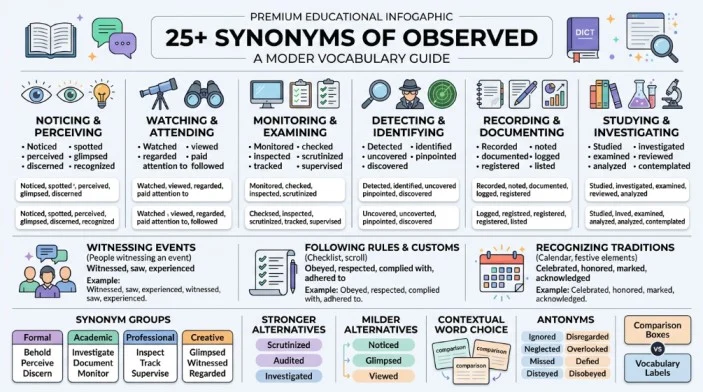
A writer may use observed several times in an essay, research report, email, or story without realizing how repetitive it sounds. Finding the right synonym of observed can make the sentence more precise because observed has several meanings, including noticed, watched, recorded, followed, and formally recognized.
The best alternative depends on what actually happened. A scientist may have detected a change, a teacher may have noticed a student’s behavior, a researcher may have recorded a result, or someone may have followed a rule. Choosing the right word improves clarity, tone, and accuracy instead of simply replacing one word with another.
What Are the Best Synonyms of “Observed”?
Observed usually means noticed, watched carefully, recorded, or followed a rule or tradition. The best synonyms include noticed for everyday use, detected for research, monitored for professional contexts, recorded for formal reports, watched for casual speech, and followed when referring to rules, practices, or customs.
Meaning, Tone, and Context
Simple Definition
Observed is the past tense and past participle of observe. Its meaning changes slightly depending on context.
Most commonly, it means that someone noticed or saw something carefully. It can also mean that someone watched an activity, recorded or studied something, or followed a rule, practice, custom, or tradition.
For example:
“The researcher observed changes in the patient’s behavior.”
Here, observed means noticed or studied.
In another sentence:
“The employees observed the company’s safety procedures.”
Here, observed means followed or complied with.
A third example shows another meaning:
“The community observed the holiday with a special ceremony.”
Here, observed means formally recognized or celebrated the occasion.
Part of Speech
Observed is a verb form.
It can function as:
- The past tense of observe
- The past participle of observe
- Part of a passive construction
Examples:
“She observed the experiment carefully.”
“Several unusual patterns were observed during the study.”
Overall Tone
Observed is generally neutral and objective.
It does not normally express strong emotion. That makes it especially useful in academic, scientific, professional, and factual writing.
Formality Level
Observed is a neutral to formal word.
It works naturally in:
- Academic papers
- Research reports
- Scientific writing
- Workplace documents
- Business reports
- News writing
- Professional communication
- Everyday speech
In casual conversation, simpler words such as saw, noticed, or watched may sound more natural.
Common Uses
Native English speakers use observed in several important ways.
- To notice something:
“She observed a change in his behavior.”
- To watch something carefully:
“The students observed the demonstration.”
- To study something:
“Researchers observed the animals in their natural environment.”
- To record a finding:
“A significant increase was observed during the experiment.”
- To follow a rule or practice:
“All employees observed the safety regulations.”
- To recognize a holiday or occasion:
“The country observed a national day of mourning.”
Word Forms
| Form | Word | Example |
|---|---|---|
| Base verb | Observe | “Researchers observe the participants.” |
| Past tense | Observed | “Researchers observed the participants.” |
| Past participle | Observed | “The participants were observed.” |
| Present participle | Observing | “The team is observing the experiment.” |
| Noun | Observation | “The observation was recorded.” |
| Adjective | Observant | “She is an observant student.” |
| Adverb | Observantly | “He watched observantly.” |
When and How to Use “Observed”
Use observed when you want to communicate that someone noticed, watched, studied, recorded, or followed something. It is particularly useful when the writer wants to sound objective rather than emotional.
Professional
“The manager observed a decline in customer satisfaction during the final quarter.”
Here, observed presents the finding in a professional and objective way.
Academic
“Researchers observed a clear difference between the two groups.”
This use is appropriate because academic writing often describes what researchers saw or identified during a study.
Workplace
“The supervisor observed several employees using the new software.”
The word suggests that the supervisor watched or noticed the employees’ actions.
Personal
“I observed that my friend seemed quieter than usual.”
In personal writing, noticed would often sound more conversational, while observed gives the sentence a more deliberate tone.
“We observed an unusual increase in website traffic this week.”
This wording works well in a professional email because it sounds factual and measured.
Resume
“Observed customer behavior and identified opportunities to improve service efficiency.”
On a resume, observed can work when describing research, analysis, monitoring, or evaluation.
Social Media
“Observed one of the most beautiful sunsets I’ve ever seen.”
This is grammatically possible, but watched or experienced would usually sound more natural in a casual social media caption.
Best Synonyms of “Observed”
No single synonym works in every sentence because observed has several meanings. The best alternative depends on whether you mean noticed, watched, studied, recorded, followed, or formally recognized something.
Professional Writing: Monitored
Monitored is a strong choice when someone regularly watches a process, activity, system, or situation.
“The team monitored customer activity throughout the campaign.”
It suggests ongoing attention rather than a single moment of noticing.
Academic Writing: Noted
Noted works well when a researcher or writer identifies a particular finding or detail.
“The researchers noted a substantial difference between the groups.”
It is concise and natural in academic reports.
Business Communication: Detected
Detected is useful when something was discovered through observation, analysis, or a monitoring process.
“The system detected an unusual pattern in customer activity.”
It emphasizes discovery rather than simply looking.
Casual Conversation: Noticed
Noticed is usually more natural than observed in everyday speech.
“I noticed that you changed your hairstyle.”
It sounds friendly and conversational.
Emotional Writing: Saw
Saw can make personal writing feel direct and natural.
“I saw the excitement on her face.”
It is simpler and more immediate than observed.
Creative Writing: Watched
Watched is useful when describing sustained attention to an event, person, or scene.
“He watched the rain gather against the window.”
It creates a more visual feeling than the formal word observed.
Resume Writing: Monitored
Monitored can be effective when describing responsibility for processes, performance, systems, or activity.
“Monitored inventory levels and identified supply issues before they affected operations.”
It sounds practical and action oriented.
Workplace Communication: Noted
Noted is useful when reporting a finding without making the statement unnecessarily formal.
“We noted several recurring issues during the review.”
Stronger Meaning: Detected
Detected can be stronger than observed when the sentence focuses on discovering something that was not immediately obvious.
“The analysis detected an early warning sign.”
Softer Meaning: Noticed
Noticed is often a softer and more conversational alternative.
“I noticed a small change in the schedule.”
When Not to Use “Observed”
Although observed is versatile, it can sometimes be less effective than a more specific word.
When “Observed” Is Too General
If you know exactly what happened, choose a more precise verb.
Less precise:
“The researcher observed a problem.”
Better:
“The researcher detected a problem.”
Why:
Detected makes it clear that the researcher identified something that required attention.
When “Observed” Is Too Vague
The reader may not know whether someone saw, watched, measured, or recorded something.
Less precise:
“The team observed the process.”
Better:
“The team monitored the process throughout the afternoon.”
Why:
Monitored clearly suggests continuous attention.
When “Observed” Sounds Too Formal
In casual conversation, observed can sound unnecessarily formal.
Less natural:
“I observed that you were tired.”
More natural:
“I noticed that you were tired.”
Why:
Noticed is more conversational.
When “Observed” Is Too Weak
If the sentence involves discovering something significant, a stronger word may be more useful.
Less precise:
“The test observed an error.”
Better:
“The test detected an error.”
Why:
Tests do not normally “observe” errors in natural English. Detected better describes identifying a problem.
When “Observed” Is Too Strong
Sometimes the writer only means that something was briefly seen.
Overly formal:
“I observed a bird outside my window.”
Natural:
“I saw a bird outside my window.”
Why:
Saw is simple and appropriate for a brief visual experience.
When “Observed” Is Used for Following a Rule
When the meaning is compliance, use a synonym that makes the idea unmistakable.
Less clear:
“The workers observed the instructions.”
Clearer:
“The workers followed the instructions.”
Why:
Followed clearly communicates compliance.
Words Commonly Confused With “Observed”
Noticed
Difference: Noticed means became aware of something, often through seeing, hearing, or recognizing it.
When to Use It: Use it for everyday observations and discoveries.
Example:
“She noticed a mistake in the report.”
Watched
Difference: Watched usually involves looking at something for a period of time.
When to Use It: Use it for people, events, activities, performances, or moving objects.
Example:
“We watched the children play in the park.”
Saw
Difference: Saw usually refers to visual perception and does not necessarily suggest careful attention.
When to Use It: Use it for simple visual experiences.
Example:
“I saw your message this morning.”
Monitored
Difference: Monitored suggests continued or systematic observation.
When to Use It: Use it for systems, patients, employees, projects, performance, or changing conditions.
Example:
“The technician monitored the equipment for several hours.”
Detected
Difference: Detected emphasizes discovering something, especially something that may not have been obvious.
When to Use It: Use it for errors, problems, changes, patterns, signals, or unusual conditions.
Example:
“The software detected a security problem.”
Followed
Difference: Followed can mean obeyed a rule, instruction, procedure, or tradition.
When to Use It: Use it when observed means complied with something.
Example:
“All employees followed the updated safety procedures.”
Best Synonyms of “Observed” by Context
| Context | Best Synonym | Why It Works | Example |
|---|---|---|---|
| Formal writing | Noted | Concise and objective | “The report noted several changes.” |
| Academic writing | Recorded | Emphasizes documented findings | “The researchers recorded the results.” |
| Professional communication | Monitored | Suggests systematic attention | “The team monitored performance.” |
| Business emails | Noted | Sounds professional and measured | “We noted a delay in delivery.” |
| Resume writing | Monitored | Shows responsibility and active involvement | “Monitored daily inventory levels.” |
| Workplace communication | Noticed | Clear and natural | “We noticed an issue with the schedule.” |
| Casual conversation | Noticed | Sounds conversational | “I noticed your new haircut.” |
| Everyday speaking | Saw | Simple and direct | “I saw the message.” |
| Creative writing | Watched | Creates a visual sense | “She watched the clouds drift away.” |
| Storytelling | Witnessed | Emphasizes direct experience | “He witnessed the dramatic event.” |
| Emotional writing | Saw | Feels personal and immediate | “She saw the joy in his eyes.” |
| Strong emphasis | Detected | Highlights discovery | “The scan detected an abnormality.” |
| Mild tone | Noticed | Less formal and less forceful | “I noticed a small difference.” |
| Social media captions | Saw | Natural for casual posts | “Saw the most amazing sunset tonight.” |
| American English | Noticed | Common in everyday usage | “I noticed something unusual.” |
How to Choose the Best Synonym of “Observed”
The easiest way to choose the right word is to identify exactly what observed means in your sentence.
If You Mean “Became Aware Of”
Choose noticed.
“She noticed a change in his behavior.”
If You Mean “Looked At”
Choose saw or watched.
“We watched the performance.”
If You Mean “Watched Over Time”
Choose monitored.
“The nurse monitored the patient’s condition.”
If You Mean “Discovered”
Choose detected.
“The software detected an error.”
If You Mean “Wrote Down”
Choose recorded.
“The researcher recorded every response.”
If You Mean “Reported”
Choose noted.
“The report noted a decline in sales.”
If You Mean “Experienced Directly”
Choose witnessed.
“Several people witnessed the accident.”
If You Mean “Followed a Rule”
Choose followed.
“The staff followed the required procedure.”
If You Mean “Recognized a Holiday”
Choose celebrated, recognized, or commemorated, depending on the occasion.
“The country commemorated the anniversary.”
The best synonym of observed is therefore determined by meaning first, followed by tone, audience, and level of formality.
Real Life Examples of “Observed”
School
Original:
“The students observed the experiment.”
More specific:
“The students watched the experiment carefully.”
Why:
Watched is natural when students are looking at a demonstration.
College
Original:
“The researcher observed a difference between the groups.”
Improved:
“The researcher noted a difference between the groups.”
Why:
Noted fits academic reporting when presenting a finding.
Workplace
Original:
“The manager observed employee performance.”
Improved:
“The manager monitored employee performance.”
Why:
Monitored indicates an ongoing responsibility.
Business
Original:
“The company observed a decline in sales.”
Improved:
“The company recorded a decline in sales.”
Why:
Recorded emphasizes the documented business result.
Original:
“We observed an unusual increase in orders.”
Improved:
“We noticed an unusual increase in orders.”
Why:
Both are correct, but noticed can sound more direct in an ordinary business email.
Resume
Original:
“Observed inventory levels.”
Improved:
“Monitored inventory levels and identified supply issues.”
Why:
The improved version communicates responsibility and action more clearly.
Conversation
Original:
“I observed that you seemed upset.”
Natural:
“I noticed that you seemed upset.”
Why:
Noticed is much more natural in ordinary conversation.
Storytelling
Original:
“She observed the storm from the window.”
Improved:
“She watched the storm from the window.”
Why:
Watched creates a stronger sense of sustained visual attention.
Blogging
Original:
“We observed several changes in online shopping behavior.”
Improved:
“We noticed several changes in online shopping behavior.”
Why:
Noticed gives general informational writing a more accessible tone.
Social Media
Original:
“Observed an incredible sunset on my evening walk.”
Natural:
“Saw an incredible sunset on my evening walk.”
Why:
Saw feels much more natural in a casual caption.
25 Best Synonyms of “Observed”
The following list covers the major meanings of observed, including noticing, watching, studying, recording, witnessing, following, and recognizing.
| Synonym | Simple Meaning | Best Used For | Example Sentence |
|---|---|---|---|
| Noticed | Became aware of something | Everyday and professional writing | “She noticed a change in the schedule.” |
| Saw | Perceived something visually | Casual conversation | “I saw the new sign outside.” |
| Watched | Looked at something for a period of time | Events and activities | “They watched the birds near the lake.” |
| Monitored | Watched something continuously | Workplace and technical contexts | “The team monitored the system overnight.” |
| Detected | Discovered something | Research and technology | “The device detected a small error.” |
| Noted | Identified or mentioned a detail | Academic and formal writing | “The report noted several concerns.” |
| Recorded | Documented what happened | Research and business | “The assistant recorded each response.” |
| Witnessed | Personally saw an event happen | Events and storytelling | “Several people witnessed the accident.” |
| Examined | Looked at something carefully | Research and analysis | “The doctor examined the test results.” |
| Inspected | Checked something closely | Safety and quality control | “The engineer inspected the equipment.” |
| Studied | Examined carefully to understand | Academic contexts | “Researchers studied the behavior of the animals.” |
| Surveyed | Examined or reviewed broadly | Research and analysis | “The team surveyed the available data.” |
| Reviewed | Looked over something carefully | Business and professional writing | “The manager reviewed the report.” |
| Identified | Recognized or determined something | Research and analysis | “The study identified several risk factors.” |
| Recognized | Became aware of or identified | General and formal contexts | “She recognized a familiar pattern.” |
| Perceived | Became aware through the senses or mind | Formal and academic writing | “The participants perceived a difference.” |
| Witnessed | Experienced an event directly | Formal and narrative writing | “The town witnessed a major transformation.” |
| Followed | Acted according to a rule or instruction | Procedures and regulations | “The workers followed the safety guidelines.” |
| Complied with | Acted according to a requirement | Legal and professional contexts | “The company complied with the new regulations.” |
| Adhered to | Followed a rule or standard closely | Formal and professional writing | “The team adhered to the established procedure.” |
| Kept | Followed or honored a rule, promise, or occasion | Traditions and commitments | “The family kept the traditional ceremony.” |
| Celebrated | Marked an occasion with activities | Holidays and events | “The community celebrated the annual festival.” |
| Commemorated | Honored the memory of an event or person | Formal and historical writing | “The city commemorated the anniversary.” |
| Recognized | Formally acknowledged something | Official contexts | “The organization recognized the achievement.” |
| Honored | Showed respect or recognition | Ceremonies and personal writing | “The ceremony honored local volunteers.” |
Synonyms of “Observed” by Usage
Professional vs Personal Synonyms
Professional writing benefits from words that explain the exact nature of the observation.
Use monitored, recorded, detected, noted, and identified in professional contexts.
“The quality team monitored production throughout the shift.”
Personal communication usually benefits from simpler words.
Use noticed, saw, and watched in everyday situations.
“I noticed that the room was unusually quiet.”
A useful rule is to choose the simplest word that accurately describes what happened.
Formal vs Conversational Synonyms
Formal writing often favors precise alternatives.
Reports
Use noted, recorded, detected, or identified.
“The report recorded a decline in annual revenue.”
Essays
Use noted, observed, identified, or examined.
“The author noted several similarities between the two arguments.”
Business Writing
Use monitored, recorded, identified, or detected.
“The department identified several areas for improvement.”
Presentations
Use noted or observed when introducing findings.
“As observed in the previous quarter, customer demand has increased.”
Emails
Use noticed, noted, or observed, depending on formality.
“We noticed a discrepancy in the latest invoice.”
Casual Conversations
Use saw, noticed, or watched.
“I noticed you got a new laptop.”
Texting
Simple language is usually best.
“I saw your message.”
There is rarely a reason to use observed in a casual text unless the word is intentionally humorous or formal.
Academic Synonyms
Academic writing often requires distinctions between seeing something, identifying a result, and documenting evidence.
Noted
Useful for presenting an observation or finding.
“The researchers noted a gradual increase in participation.”
Recorded
Best when information was formally documented.
“The researchers recorded each participant’s response.”
Detected
Useful when an instrument, analysis, or researcher discovers something.
“The analysis detected a previously overlooked pattern.”
Identified
Useful when researchers determine what a particular feature or problem is.
“The study identified several factors associated with the outcome.”
Examined
Best when the researchers actively analyzed something.
“The researchers examined the relationship between sleep and academic performance.”
These alternatives make academic writing more specific because they describe the actual research action.
Professional and Business Synonyms
Resumes
For resumes, monitored, identified, recorded, and analyzed can be stronger than simply saying observed.
“Monitored inventory levels and reduced supply shortages.”
Interviews
When discussing professional experience, use a word that shows what you actually did.
“I monitored customer feedback and identified recurring service issues.”
Meetings
Use noted when reporting something discussed or recognized.
“The team noted several concerns during the meeting.”
Presentations
Use observed or noted when presenting a finding.
“We observed a steady increase in customer engagement.”
Performance Reviews
Use identified, noted, or monitored depending on the meaning.
“The supervisor identified areas where additional training was needed.”
Client Communication
Use noticed, identified, or observed.
“We noticed a discrepancy in the information provided.”
Business Emails
Use the most direct option.
“We noticed an issue with the latest order.”
This usually sounds clearer than using observed simply to appear formal.
Creative and Literary Synonyms
Creative writing benefits from verbs that create a visual or emotional experience.
Watched
“She watched the last light disappear behind the mountains.”
Witnessed
“He witnessed the town change from a quiet village into a busy city.”
Saw
“She saw the fear in his eyes.”
Perceived
“He perceived a faint movement beyond the trees.”
Noticed
“She noticed a single light glowing in the distance.”
For storytelling, watched, saw, and witnessed are often more vivid than observed.
Slang or Modern Synonyms
There is no single true slang synonym that replaces observed across its meanings.
In casual modern English, people may use saw, spotted, or caught depending on the context.
Spotted
Meaning: Quickly noticed or saw something.
Acceptable In: Casual conversation, social media, informal writing.
“I spotted your car outside the office.”
Avoid In: Academic papers, formal reports, and highly professional documents unless the context genuinely calls for informal language.
Caught
Meaning: Saw or noticed something, often unexpectedly.
Acceptable In: Informal conversation.
“I caught him looking at the clock.”
Avoid In: Formal academic writing when a more precise word is available.
Strongest to Mildest Synonyms
Because observed has several meanings, intensity depends on the sense being used.
Mild
Saw, noticed
These words can describe simple awareness without suggesting deep analysis.
Moderate
Watched, noted, reviewed, examined
These suggest more deliberate attention.
Strong
Monitored, inspected, detected, identified
These words suggest systematic attention or active discovery.
Very Strong or Highly Specific
Investigated, analyzed, scrutinized
These words go beyond simple observation and suggest detailed examination.
The important distinction is that stronger words should not be used merely to make a sentence sound impressive. They should accurately describe the level of attention or analysis involved.
Emotional vs Neutral Synonyms
Emotional Synonyms
Some alternatives can add a personal or dramatic quality.
Witnessed
“She witnessed the emotional reunion.”
Saw
“He saw the happiness on his daughter’s face.”
Watched
“They watched the final performance together.”
These words often feel more immediate in personal writing.
Neutral Synonyms
Neutral alternatives are better for factual communication.
Noted
“The report noted several inconsistencies.”
Recorded
“The researchers recorded the measurements.”
Monitored
“The team monitored the system.”
Detected
“The software detected an error.”
Neutral vocabulary is especially useful when the writer wants to communicate information without adding emotional interpretation.
Antonyms of “Observed”
Because observed has multiple meanings, its opposites also depend on context. The following words represent genuine contrasts across its main senses.
| Antonym | Meaning | Example Sentence |
|---|---|---|
| Overlooked | Failed to notice | “The reviewer overlooked a small error.” |
| Ignored | Chose not to pay attention | “He ignored the warning signs.” |
| Missed | Failed to see or recognize | “She missed an important detail.” |
| Disregarded | Treated something as unworthy of attention | “The team disregarded the early warning.” |
| Unnoticed | Not seen or recognized | “The change went unnoticed.” |
| Neglected | Failed to give proper attention | “The issue was neglected for several months.” |
| Violated | Failed to follow a rule or requirement | “The company violated the safety regulations.” |
| Broke | Failed to obey a rule or agreement | “The employee broke the workplace policy.” |
| Disobeyed | Refused to follow an instruction or rule | “The worker disobeyed the supervisor’s instructions.” |
| Rejected | Refused to accept or recognize | “The committee rejected the proposed standard.” |
| Denied | Refused to acknowledge something | “The official denied the reported problem.” |
| Forgot | Failed to remember something that should have been observed or followed | “He forgot the required procedure.” |
| Negated | Made something ineffective or invalid | “The later evidence negated the earlier assumption.” |
| Concealed | Kept something from being seen | “The report concealed the underlying problem.” |
| Suppressed | Prevented information from being revealed or recognized | “The organization suppressed the findings.” |
Comparison: “Observed” vs Similar Words
Observed vs Noticed
Main Difference
Observed can imply careful attention, while noticed simply means becoming aware of something.
Which Is Stronger?
Observed often suggests more deliberate attention.
Which Is More Formal?
Observed is more formal.
When to Use Each
Use noticed in everyday communication. Use observed when the attention was deliberate or when writing formally.
Examples
Observed:
“The researcher observed changes in behavior.”
Noticed:
“I noticed a change in your behavior.”
Observed vs Watched
Main Difference
Watched emphasizes sustained visual attention. Observed can mean watching, but it can also mean noticing, studying, or analyzing.
Which Is Stronger?
Neither is automatically stronger. They emphasize different things.
Which Is More Formal?
Observed is more formal.
When to Use Each
Use watched for movies, performances, people, animals, and events. Use observed for research and formal descriptions.
Examples
Observed:
“Scientists observed the animals.”
Watched:
“The children watched the animals.”
Observed vs Saw
Main Difference
Saw usually describes visual perception. Observed often implies greater attention.
Which Is Stronger?
Observed can suggest more deliberate attention.
Which Is More Formal?
Observed is more formal.
When to Use Each
Use saw for simple visual experiences. Use observed when the act of looking is purposeful.
Examples
Observed:
“The technician observed unusual behavior in the machine.”
Saw:
“I saw the machine in the workshop.”
Observed vs Monitored
Main Difference
Monitored means watching something over time, usually to track changes or performance.
Which Is Stronger?
Monitored is more specific when continuous attention is involved.
Which Is More Formal?
Both are professional, but monitored is especially common in workplace and technical contexts.
When to Use Each
Use monitored for ongoing supervision. Use observed for a broader range of situations.
Examples
Observed:
“The researcher observed the participants.”
Monitored:
“The researcher monitored the participants throughout the study.”
Observed vs Detected
Main Difference
Observed focuses on seeing or identifying something. Detected emphasizes discovering something that may not have been obvious.
Which Is Stronger?
Detected can sound more precise when a hidden problem or change is discovered.
Which Is More Formal?
Both are suitable for formal writing.
When to Use Each
Use detected for errors, signals, changes, diseases, problems, and patterns.
Examples
Observed:
“The researchers observed a change.”
Detected:
“The instrument detected a small change.”
Observed vs Followed
Main Difference
Followed is appropriate when observed means obeyed or complied with a rule, procedure, tradition, or instruction.
Which Is Stronger?
Neither is stronger. They have different meanings.
Which Is More Formal?
Observed can sound more formal when referring to traditions or formal practices. Followed is more direct for rules and instructions.
When to Use Each
Use followed for instructions and procedures. Use observed when referring to customs, traditions, regulations, or formal practices.
Examples
Observed:
“The community observed the traditional ceremony.”
Followed:
“The employees followed the safety instructions.”
Common Phrases and Expressions with “Observed”
Observed a Difference
Meaning: Noticed that two things were not the same.
Example:
“The researchers observed a difference between the two groups.”
Observed a Change
Meaning: Noticed that something had become different.
Example:
“The team observed a change in customer behavior.”
Observed a Pattern
Meaning: Recognized a repeated or noticeable relationship.
Example:
“The analyst observed a pattern in the monthly sales data.”
Observed an Increase
Meaning: Noticed that something became greater.
Example:
“The company observed an increase in online orders.”
Observed a Decrease
Meaning: Noticed that something became smaller or lower.
Example:
“The researchers observed a decrease in response time.”
Observed During the Study
Meaning: Something was noticed while research was taking place.
Example:
“Several unexpected behaviors were observed during the study.”
Observed in Practice
Meaning: Something was noticed in a real situation rather than only in theory.
Example:
“The same problem was observed in practice.”
Observed the Rules
Meaning: Followed or complied with established rules.
Example:
“All participants observed the rules of the competition.”
Common Mistakes to Avoid
1. Treating Every Synonym as Identical
Incorrect:
“The scientist watched a chemical reaction with an instrument.”
Better:
“The instrument detected a chemical change.”
Why:
An instrument does not literally watch something. Detected describes the process more accurately.
2. Using “Saw” in Highly Technical Writing
Incorrect:
“The researchers saw a significant change in the data.”
Better:
“The researchers observed a significant change in the data.”
Why:
Observed sounds more appropriate when describing a formal research finding.
3. Using “Observed” in Casual Conversation
Incorrect:
“I observed that you bought a new phone.”
Better:
“I noticed that you bought a new phone.”
Why:
Noticed sounds more natural and conversational.
4. Using “Watched” for Every Meaning
Incorrect:
“The software watched a security problem.”
Better:
“The software detected a security problem.”
Why:
Watched describes visual attention, while detected describes identifying a problem.
5. Confusing Observation With Analysis
Incorrect:
“The researchers analyzed the birds sitting in the trees.”
Better:
“The researchers observed the birds sitting in the trees.”
Why:
If researchers simply watched the birds, observed is accurate. Analyzed implies deeper examination.
6. Using Informal Language in Formal Reports
Incorrect:
“The team saw a weird pattern.”
Better:
“The team detected an unusual pattern.”
Why:
The revised version is more precise and professional.
7. Choosing a Synonym With the Wrong Meaning
Incorrect:
“The employees observed the instructions.”
Better:
“The employees followed the instructions.”
Why:
When observed means obeyed, followed is usually the clearest choice.
Frequently Asked Questions
1. What are the best synonyms of “observed”?
The best synonym of observed depends on its meaning. Noticed works for everyday use, monitored for ongoing observation, detected for discovery, recorded for documentation, and followed when observed means obeyed.
2. What are the best formal synonyms of “observed”?
Formal alternatives include noted, recorded, detected, monitored, examined, identified, and witnessed. The best choice depends on whether the sentence describes noticing, studying, documenting, or directly experiencing something.
3. What are common informal synonyms of “observed”?
Common informal alternatives include saw, noticed, watched, and spotted. These words are especially natural in everyday conversations, casual writing, messages, and social media posts.
4. What is another word for “observed” in professional writing?
In professional writing, monitored, noted, recorded, identified, and detected are useful alternatives. Choose the word that describes the actual action rather than replacing observed simply for variety.
5. What is the difference between “observed” and “noticed”?
Observed often suggests deliberate or careful attention, while noticed simply means becoming aware of something. Observed is more formal, whereas noticed is more natural in everyday conversation.
6. What is the opposite of “observed”?
The opposite depends on the meaning. For noticing, alternatives include overlooked, ignored, and missed. When observed means followed, opposites include violated, broke, and disobeyed.
Conclusion
The word observed can mean noticed, watched, studied, recorded, witnessed, followed, or formally recognized, so the best alternative depends heavily on context. Noticed is usually best for everyday communication, monitored works well for ongoing professional observation, detected emphasizes discovery, and recorded highlights documentation.
In academic and professional writing, precise vocabulary is more useful than simply choosing a more complicated word. When you understand the exact meaning you want to express, selecting the right synonym of observed becomes much easier.
A simple vocabulary habit can make your writing stronger: before replacing a repeated word, identify the exact action it describes. Then choose the alternative that communicates that action most clearly.
Read More Related Articles:
25+ Synonyms, Meanings, Uses, Examples, and Best …
Meaning, Uses, Examples, and the Best Synonym of Complain
25+ Synonyms of Frequency | Meanings, Uses, Examples …










1 thought on “25+ Synonyms of Observed | Meanings, Uses, Examples, and Best Alternatives”