A writer may use the word ritual several times in an essay, blog post, or description and then realize that the repetition makes the writing feel flat. Searching for synonyms of ritual can help, but the best replacement depends on whether you mean a religious practice, a repeated habit, a formal ceremony, or a symbolic tradition.
Words such as ceremony, tradition, custom, practice, and routine overlap with ritual, but they are not interchangeable in every sentence. Understanding these differences lets you choose vocabulary that matches your meaning, audience, tone, and purpose without making your writing sound forced.
What Are the Best Synonyms of “Ritual”?
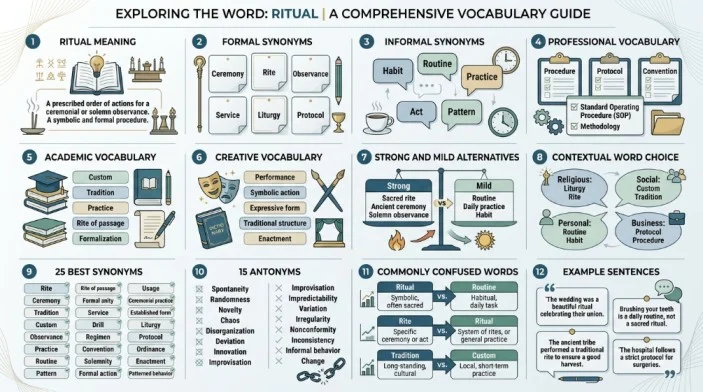
A ritual is a repeated action or established practice that often has symbolic, cultural, religious, or personal meaning. The best synonyms include ceremony for formal events, tradition for inherited practices, custom for cultural behavior, routine for repeated daily actions, and observance for religious or commemorative practices.
Meaning, Tone, and Context
Simple Definition
A ritual is a repeated action, series of actions, or established practice that follows a recognizable pattern. It often carries special meaning, especially in religious, cultural, social, or personal settings.
The word can describe something highly formal, such as a religious ritual, or something personal and ordinary, such as a morning ritual of drinking coffee while reading the news.
Part of Speech
Ritual can function as both a noun and an adjective.
As a noun:
“The ceremony included an ancient ritual.”
As an adjective:
“They followed a ritual practice before the ceremony.”
Overall Tone
The tone of ritual is usually neutral, but context can make it sound religious, cultural, traditional, personal, or even slightly negative.
For example:
“The wedding ritual brought the families together.”
Here, the word sounds respectful and cultural.
By contrast:
“Checking his phone had become a ritual.”
Here, it describes a repeated personal behavior.
Formality Level
Ritual is a neutral to moderately formal word. It works comfortably in academic writing, journalism, professional discussions, cultural descriptions, religious contexts, and everyday conversation.
Common Uses
Native English speakers commonly use ritual when discussing:
- Religious practices
- Cultural traditions
- Ceremonies
- Personal habits
- Daily routines
- Social customs
- Family traditions
- Ceremonial behavior
- Symbolic actions
- Repeated behaviors
- Memorial practices
- Spiritual observances
Word Forms
| Form | Word | Example |
|---|---|---|
| Noun | ritual | “The ritual takes place every spring.” |
| Adjective | ritual | “They performed a ritual ceremony.” |
| Plural noun | rituals | “Different cultures have different rituals.” |
Related words include ritualistic, ritually, and ritualize, although these words do not always function as direct synonyms.
When and How to Use “Ritual”
Choose ritual when you want to emphasize repetition combined with meaning, symbolism, tradition, or a recognizable pattern.
It is especially useful when a simple word such as habit does not fully express the significance attached to the action.
Professional Context
“The team developed a morning ritual of reviewing priorities before starting work.”
Here, ritual suggests a repeated practice that gives structure to the workday.
Academic Context
“The researcher examined the ritual practices of the community.”
This usage works well when discussing cultural, religious, or social behavior.
Workplace Context
“Our weekly planning ritual helps the team stay focused.”
The word suggests an established practice rather than an ordinary task.
Personal Context
“Reading for twenty minutes before bed has become my nightly ritual.”
This emphasizes that the action is repeated and personally meaningful.
Email Context
“The annual recognition ritual gives employees a chance to celebrate their achievements.”
This is suitable when describing a recurring workplace practice.
Resume Context
“Established a weekly team review ritual that improved communication and accountability.”
On a resume, ritual can work creatively, but process, practice, or routine may sound more conventional in highly formal contexts.
Social Media Context
“My morning coffee and quiet reading have become a favorite weekend ritual.”
This sounds natural and personal without being overly formal.
Best Synonyms of “Ritual”
No single synonym can replace ritual in every context. The right alternative depends on whether the original word emphasizes ceremony, tradition, repetition, religion, culture, or personal behavior.
Professional Writing: Practice
Practice is often the safest professional alternative because it describes an established way of doing something without adding unnecessary religious or ceremonial meaning.
“The company follows a regular safety practice.”
Use it when discussing workplace methods, procedures, or established behaviors.
Academic Writing: Observance
Observance works particularly well when discussing religious, cultural, or commemorative practices.
“The observance is held each year to honor the community’s history.”
It gives academic writing a precise and respectful tone.
Business Communication: Practice
Practice is generally more natural than ritual in business writing.
“The weekly review practice helps managers identify potential problems.”
It sounds systematic without suggesting that the process is ceremonial.
Casual Conversation: Routine
Routine is a natural choice when ritual refers mainly to repeated everyday behavior.
“My morning routine starts with coffee and a short walk.”
Emotional Writing: Tradition
Tradition is especially effective when the repeated action has been passed down through generations or connects people to family history.
“The holiday tradition brought everyone back to the family home.”
Creative Writing: Ceremony
Ceremony works when the ritual involves a formal or symbolic event.
“The ceremony began as the sun disappeared behind the mountains.”
Resume Writing: Practice
For resumes, practice, process, or procedure is usually more professional than ritual.
“Implemented a weekly review practice to improve project coordination.”
Workplace Communication: Routine
Routine works well for recurring workplace activities that do not necessarily have symbolic significance.
“The morning routine keeps the team aligned.”
Stronger Meaning: Observance
Observance can carry a stronger connection to religious or commemorative significance than the general word practice.
Softer Meaning: Habit
Habit is a softer and more everyday alternative when the main idea is simply repeated behavior.
“Checking the weather became a morning habit.”
When Not to Use “Ritual”
Although ritual is flexible, it is not always the clearest choice. Sometimes another word communicates the intended meaning more accurately.
When “Ritual” Is Too General
If you mean a formal public event, ceremony is more specific.
Less precise:
“The wedding ritual was beautiful.”
Better:
“The wedding ceremony was beautiful.”
Why:
Ceremony clearly identifies a formal event, while ritual focuses more on the symbolic actions within it.
When “Ritual” Is Too Vague
If you mean an everyday repeated behavior, routine may be clearer.
Less precise:
“My morning ritual is very simple.”
Better:
“My morning routine is very simple.”
Why:
Routine immediately communicates a regular sequence of daily activities.
When “Ritual” Sounds Too Formal
For ordinary repeated behavior, habit may sound more natural.
Less natural:
“Taking the dog for a walk is my daily ritual.”
More conversational:
“Taking the dog for a walk is my daily habit.”
Why:
Habit sounds simpler and more natural when there is no special symbolic meaning.
When “Ritual” Sounds Too Religious
If you are describing a cultural behavior rather than a religious practice, custom may be more appropriate.
Less precise:
“This ritual is common at family celebrations.”
Better:
“This custom is common at family celebrations.”
Why:
Custom emphasizes accepted social behavior rather than religious symbolism.
When “Ritual” Sounds Too Weak
If the action is a formal event with established procedures, ceremony may provide more clarity.
Less precise:
“The graduation ritual took place in June.”
Better:
“The graduation ceremony took place in June.”
When “Ritual” Sounds Too Strong
If you simply mean a normal repeated action, routine or habit may be less dramatic.
Stronger than necessary:
“Checking email is a ritual for employees.”
Better:
“Checking email is part of the daily routine.”
When a More Specific Cultural Term Is Needed
Sometimes tradition, custom, or observance provides information that ritual does not.
For example:
“Lighting candles is an important tradition in the family.”
This tells the reader that the practice has been passed down, something the word ritual does not necessarily imply.
Words Commonly Confused With “Ritual”
Ceremony
Difference: A ceremony is a formal event or occasion that often includes several symbolic actions.
When to Use It: Use it for weddings, graduations, religious events, awards, funerals, and other formal occasions.
Example:
“The graduation ceremony began at noon.”
Tradition
Difference: A tradition is a belief, practice, or custom passed from one generation or group to another.
When to Use It: Use it when continuity across generations or established cultural practice matters.
Example:
“Baking together is a family tradition.”
Custom
Difference: A custom is a commonly accepted way of behaving within a particular culture, community, or group.
When to Use It: Use it when describing social or cultural behavior.
Example:
“Removing your shoes before entering the home is a common custom in many cultures.”
Routine
Difference: A routine is a regular pattern of actions, usually without the symbolic meaning associated with a ritual.
When to Use It: Use it for daily schedules and repeated activities.
Example:
“Exercise is part of her morning routine.”
Habit
Difference: A habit is an action that someone repeatedly performs, often automatically.
When to Use It: Use it for individual behavior rather than formal or cultural practices.
Example:
“He has a habit of checking his phone before bed.”
Observance
Difference: An observance is an act of following or honoring a religious, cultural, or commemorative practice.
When to Use It: Use it for holidays, religious events, memorials, and special days.
Example:
“The community held a special observance to remember those who were lost.”
Best Synonyms of “Ritual” by Context
| Context | Best Synonym | Why It Works | Example |
|---|---|---|---|
| Formal writing | Ceremony | Clearly describes a formal event. | “The ceremony began at sunset.” |
| Academic writing | Observance | Works well for religious and cultural practices. | The observance has deep cultural meaning.” |
| Professional communication | Practice | Describes an established method clearly. | “The review practice improves consistency.” |
| Business emails | Routine | Sounds practical and natural. | “This routine helps us prepare for weekly meetings.” |
| Resume writing | Practice | More professional than a figurative use of ritual. | “Introduced a review practice for project teams.” |
| Workplace communication | Routine | Fits recurring work activities. | “The morning routine keeps everyone organized.” |
| Casual conversation | Habit | Sounds natural for personal behavior. | “Reading before bed is a habit.” |
| Everyday speaking | Routine | Best for repeated daily actions. | “That’s part of my morning routine.” |
| Creative writing | Ceremony | Adds a formal and visual quality. | “The ceremony unfolded beneath the old trees.” |
| Storytelling | Tradition | Highlights inherited practices. | “The tradition had survived for generations.” |
| Emotional writing | Tradition | Connects the practice with memory and family. | “The tradition reminds us of our grandparents.” |
| Strong emphasis | Observance | Suggests meaningful formal or religious practice. | “The observance holds deep spiritual meaning.” |
| Mild tone | Habit | Keeps the description simple. | “It became a quiet habit.” |
| Social media captions | Routine | Familiar and conversational. | “Sunday morning routine.” |
| American English | Ritual | Commonly used for both symbolic and personal repeated actions. | “Coffee is my morning ritual.” |
| British English | Ritual | The core meaning and common usage are also familiar in British English. | “The annual ritual continues each year.” |
How to Choose the Best Synonym of “Ritual”
Choosing the right synonym starts with identifying what you actually mean.
If You Mean a Formal Event
Choose ceremony.
“The award ceremony attracted hundreds of guests.”
If You Mean an Inherited Practice
Choose tradition.
“Decorating the house is a family tradition.”
If You Mean a Cultural Behavior
Choose custom.
“The custom has been practiced for centuries.”
If You Mean a Religious Practice
Choose observance or keep ritual, depending on the sentence.
“The religious observance takes place every spring.”
If You Mean a Daily Pattern
Choose routine.
“Exercise is part of my morning routine.”
If You Mean Repeated Personal Behavior
Choose habit.
“She developed a habit of writing before breakfast.”
If You Mean an Established Way of Doing Something
Choose practice.
“The company has a practice of reviewing customer feedback every Friday.”
Consider Your Audience
A school essay may benefit from tradition, custom, or observance. A business report may sound more natural with practice, routine, or procedure.
Consider Emotional Strength
Habit is relatively neutral. Tradition can suggest heritage and emotional connection. Ritual often suggests repetition with symbolic meaning.
Consider Natural Usage
Do not replace ritual simply because another word appears in a thesaurus. First determine what the sentence is trying to communicate, then select the word that preserves that meaning most accurately.
Real Life Examples of “Ritual”
School
Original:
“The school has a morning ritual.”
Improved:
“The school has a morning routine that helps students prepare for the day.”
Why: Routine is clearer when the activity is simply repeated every morning.
College
“The annual graduation ceremony marked the end of the students’ college journey.”
Why: Ceremony is more precise for a formal event.
Workplace
“The weekly team review has become an established practice.”
Why: Practice sounds professional and practical.
Business
“The company follows a regular customer feedback routine.”
Why: Routine emphasizes repetition rather than symbolism.
“Our Friday review practice helps the team identify issues before the weekend.”
Why: Practice fits professional email writing.
Resume
“Established a weekly reporting process that improved project visibility.”
Why: Process is generally more conventional than ritual on a resume.
Conversation
“Morning coffee is a little ritual I never skip.”
Why: Ritual sounds natural here because the repeated action has personal meaning.
Storytelling
“Every winter, the family gathered around the fireplace as part of an old tradition.”
Why: Tradition emphasizes the practice’s connection to family history.
Blogging
“A quiet morning reading ritual can create a peaceful start to the day.”
Why: Ritual works well in lifestyle writing because it can make an ordinary habit feel intentional.
Social Media
“Sunday morning coffee, a good book, and a little quiet time. My favorite weekend ritual.”
Why: The word adds a personal and cozy quality that fits social media language.
25 Best Synonyms of “Ritual”
| Synonym | Simple Meaning | Best Used For | Example Sentence |
|---|---|---|---|
| Ceremony | A formal event with established actions | Weddings, graduations, formal events | “The award ceremony began after dinner.” |
| Tradition | A practice passed through generations | Families and cultures | “The tradition has remained part of the family.” |
| Custom | An accepted cultural or social practice | Communities and cultures | “The custom is common during local celebrations.” |
| Practice | An established way of doing something | Professional and academic contexts | “Regular review is a useful practice.” |
| Routine | A regular pattern of actions | Daily life and workplaces | “Her morning routine begins with exercise.” |
| Habit | A repeated personal behavior | Everyday life | “Reading before bed became a habit.” |
| Observance | An act of honoring a religious or special occasion | Religion and commemorations | “The observance takes place each year.” |
| Rite | A formal or traditional ceremonial act | Religious and cultural contexts | “The rite marked an important stage of life.” |
| Ceremony | A formal occasion involving symbolic actions | Formal events | “The ceremony honored the community’s leaders.” |
| Commemoration | An act of remembering an important event or person | Memorial events | “The commemoration took place at the monument.” |
| Celebration | An event or activity honoring something | Festivals and milestones | “The celebration continued throughout the evening.” |
| Observance | A practice that honors a special event or belief | Religious and cultural contexts | “The annual observance brought the community together.” |
| Procedure | An established series of steps | Workplaces and organizations | “The safety procedure must be followed carefully.” |
| Regimen | A structured and regular program of activity | Health, training, and self discipline | “Her morning fitness regimen is carefully planned.” |
| Pattern | A repeated or recognizable way of acting | Behavior and analysis | “The pattern became noticeable over time.” |
| Sequence | A set of actions occurring in an established order | Formal processes | “The ceremony follows a fixed sequence.” |
| Formality | An established formal action or requirement | Official situations | “The introduction was more than a simple formality.” |
| Observance practice | A repeated act connected with honoring something | Cultural and religious writing | “The observance practice is taught to younger members.” |
| Ceremony practice | A repeated formal action | Formal cultural contexts | “The ceremony practice varies between communities.” |
| Customary practice | A commonly accepted way of behaving | Cultural writing | “The customary practice is followed during the festival.” |
| Repetition | Doing something again and again | General descriptions | “The repetition gave the performance a rhythmic quality.” |
| Discipline | A controlled and regular practice | Personal development | “Daily meditation became a form of discipline.” |
| Regimen | A planned set of repeated activities | Health and training | “The athlete follows a demanding training regimen.” |
| Devotion | Deep commitment shown through repeated action | Religious and emotional contexts | “Her daily prayer reflected her devotion.” |
| Ceremonial practice | A formal symbolic activity | Religious and cultural writing | “The ceremonial practice is reserved for special occasions.” |
Note: Some terms in this table overlap with ritual only in particular contexts. Words such as ceremony, tradition, custom, routine, and habit are usually better direct alternatives when their specific meaning matches the original sentence.
Synonyms of “Ritual” by Usage
Professional vs Personal Synonyms
Professional writing usually favors practical words such as practice, routine, procedure, and process.
For example:
“The company follows a regular review process.”
Personal writing has more freedom to use expressive words such as ritual, habit, tradition, and routine.
“Reading with my children has become a treasured family ritual.”
The second sentence works because the repeated action has emotional value.
Formal vs Conversational Synonyms
- For reports and academic essays, consider observance, practice, tradition, custom, or ceremony depending on context.
- For presentations and business emails, practice, routine, and procedure are usually clearer.
- For casual conversation and texting, habit, routine, and ritual all sound natural.
“Coffee before work is my daily ritual.”
This is a common conversational use because the word suggests both repetition and personal significance.
Academic Synonyms
Academic writing requires careful distinctions.
Observance
Use observance when discussing religious holidays, commemorations, or formal acts of honoring.
Tradition
Use tradition when historical continuity or generational transmission is important.
Custom
Use custom when describing culturally accepted behavior.
Practice
Use practice when discussing an established activity without emphasizing symbolism.
Rite
Use rite when referring to a formal ceremonial or religious act.
For example:
“The rite functions as a symbolic transition into adulthood.”
This is more precise than using ritual when the specific idea is a formal ceremonial act.
Professional and Business Synonyms
Resumes
Use practice, process, or procedure.
“Developed a quality control process that reduced reporting errors.”
Interviews
Use practice when explaining established professional behavior.
“I follow a consistent review practice before submitting client proposals.”
Meetings
Use routine or practice.
“Our meeting routine begins with a review of open action items.”
Presentations
Use key practice, established practice, or process when explaining how an organization operates.
Performance Reviews
Use practice or process.
“The company uses a structured performance review process.”
Client Communication
Use procedure or process when describing formal business operations.
Business Emails
Use routine, practice, or process depending on what you mean.
These choices generally communicate business meaning more directly than the figurative use of ritual.
Creative and Literary Synonyms
Creative writing gives you more freedom to choose expressive alternatives.
Tradition
Useful for family history and inherited customs.
“The old tradition survived every change the village experienced.”
Ceremony
Useful for formal, visual scenes.
“The ceremony began beneath a sky filled with stars.”
Rite
Useful when the scene has religious or symbolic significance.
“The rite marked the beginning of a new chapter in her life.”
Habit
Useful for intimate character details.
“He had a habit of humming whenever he felt nervous.”
Ritual
Useful when repetition itself creates atmosphere.
“Every evening, she repeated the same quiet ritual before opening her journal.”
The strongest creative choice is not necessarily the most formal word. It is the word that creates the exact image or feeling the reader needs.
Slang or Modern Synonyms
There is no single modern slang word that functions as a complete synonym for ritual.
In casual American English, expressions such as my thing, routine, or habit may sometimes replace the word depending on context, but they do not carry exactly the same meaning.
For example:
“Coffee and a podcast are my morning thing.”
This is casual and suitable for conversation or social media. It would not be appropriate in a research paper or formal business report.
Strongest to Mildest Synonyms
The intensity of a synonym for ritual depends less on emotional strength and more on the degree of formality, symbolism, and repetition.
Mild
Habit, routine, pattern
These usually describe repeated behavior without suggesting deep symbolism.
Moderate
Practice, custom, tradition
These can suggest an established social or cultural pattern.
Strong
Ritual, observance, rite
These words can suggest symbolic, religious, or ceremonial significance.
Very Strong in Formal or Symbolic Contexts
Rite, ceremonial practice, religious observance
These expressions can communicate a highly formal or symbolic action.
The key point is that stronger does not always mean better. Choose the word that matches the actual meaning.
Emotional vs Neutral Synonyms
Emotional Synonyms
Words such as tradition, devotion, ritual, and celebration can carry emotional or symbolic associations.
“The family tradition kept their memories alive.”
This sentence creates a stronger emotional connection than a simple statement about a routine.
Neutral Synonyms
Words such as routine, practice, procedure, pattern, and habit are usually more neutral.
“The team follows the same procedure every Monday.”
These words are useful when you want to communicate information without adding emotional or cultural associations.
Antonyms of “Ritual”
Because ritual describes a repeated or established practice, its opposites are often contextual rather than perfect dictionary opposites. The following terms represent genuine contrasts when the intended meaning is spontaneity, irregularity, or lack of established procedure.
| Antonym | Meaning | Example Sentence |
|---|---|---|
| Spontaneity | Acting without a fixed plan | “The trip was driven by spontaneity rather than a schedule.” |
| Improvisation | Creating actions as you go | “The performance relied on improvisation.” |
| Randomness | Lack of predictable order | “Randomness replaced the usual pattern.” |
| Irregularity | Lack of consistent repetition | “The irregularity made the schedule difficult to predict.” |
| Novelty | The quality of being new | “The novelty made the experience exciting.” |
| Change | Movement away from an established pattern | “The team welcomed change instead of repeating the same process.” |
| Flexibility | Ability to adapt rather than follow a fixed pattern | “Flexibility is useful when plans change.” |
| Variation | A difference from the usual form | “The festival included several variations on the traditional event.” |
| Unpredictability | Lack of a predictable pattern | “The unpredictability kept everyone alert.” |
| Informality | Lack of formal structure | “The meeting was intentionally informal.” |
| Disruption | An interruption of an established pattern | “The storm caused a disruption to the daily schedule.” |
| Innovation | Introduction of a new approach | “Innovation replaced the company’s old method.” |
| Freedom | Absence of restrictive structure | “The artist valued freedom over strict procedure.” |
| Novel approach | A new way of doing something | “The team adopted a novel approach to the problem.” |
| Unstructured behavior | Action without an established sequence | “The activity encouraged unstructured behavior and creativity.” |
Comparison: “Ritual” vs Similar Words
Ritual vs Ceremony
Main Difference
A ritual is a repeated symbolic action or established practice. A ceremony is a formal event that may contain one or more rituals.
Which Is Stronger?
Neither is inherently stronger. Ceremony emphasizes the event, while ritual emphasizes the actions or practice.
Which Is More Formal?
Ceremony often sounds more formal when describing public events.
When to Use Each
Use ritual for repeated symbolic actions. Use ceremony for formal occasions.
Examples
Ritual:
“Lighting candles was part of the ritual.”
Ceremony:
“The award ceremony began at seven.”
Ritual vs Tradition
Main Difference
A ritual focuses on repeated symbolic action. A tradition focuses on a practice or belief passed through generations.
Which Is Stronger?
Neither is automatically stronger.
Which Is More Formal?
Both can work in formal writing.
When to Use Each
Choose tradition when heritage or continuity matters.
Examples
Ritual:
“The candle lighting ritual lasted several minutes.”
Tradition:
“The candle lighting tradition has continued for generations.”
Ritual vs Custom
Main Difference
A custom is a socially accepted way of behaving. A ritual often involves repetition and symbolic meaning.
Which Is Stronger?
Ritual often carries more symbolic weight.
Which Is More Formal?
Both are suitable for academic and cultural writing.
When to Use Each
Use custom for social behavior. Use ritual for symbolic repeated actions.
Examples
Ritual:
“The prayer was part of the evening ritual.”
Custom:
“It is a local custom to greet visitors with food.”
Ritual vs Routine
Main Difference
A routine is a regular pattern of actions. A ritual can be a routine with additional personal, symbolic, or emotional meaning.
Which Is Stronger?
Ritual often suggests more significance.
Which Is More Formal?
Both are neutral.
When to Use Each
Use routine for schedules and repeated tasks. Use ritual when the repetition feels meaningful.
Examples
Ritual:
“Writing in her journal was her evening ritual.”
Routine:
“Writing in her journal was part of her evening routine.”
Ritual vs Habit
Main Difference
A habit is a repeated behavior, often performed automatically. A ritual may be intentional and symbolic.
Which Is Stronger?
Ritual can carry greater symbolic meaning.
Which Is More Formal?
Both are neutral, although ritual can sound more formal depending on context.
When to Use Each
Use habit for automatic personal behavior. Use ritual when meaning or intention matters.
Examples
Ritual:
“Their evening tea became a cherished ritual.”
Habit:
“He has a habit of checking the clock.”
Ritual vs Practice
Main Difference
A practice is an established way of doing something. A ritual usually adds a sense of repetition or symbolic meaning.
Which Is Stronger?
Ritual generally has stronger symbolic associations.
Which Is More Formal?
Practice is especially useful in professional and academic writing.
When to Use Each
Use practice for professional methods and established activities. Use ritual when the activity has symbolic or personal significance.
Examples
Ritual:
“The team began the meeting with a familiar ritual.”
Practice:
“The team follows a regular review practice.”
Common Phrases and Expressions with “Ritual”
Morning Ritual
Meaning: A repeated set of activities performed at the beginning of the day.
Example:
“My morning ritual includes coffee, reading, and a short walk.”
Daily Ritual
Meaning: A repeated action or practice performed every day.
Example:
“Journaling became part of her daily ritual.”
Religious Ritual
Meaning: A formal or symbolic practice connected with religious belief.
Example:
“The religious ritual was observed by members of the community.”
Ritual Practice
Meaning: An established action with symbolic, cultural, or religious meaning.
Example:
“The ritual practice has been studied by historians and anthropologists.”
Ritual Ceremony
Meaning: A formal event involving established symbolic actions.
Example:
“The ritual ceremony brought members of the community together.”
Family Ritual
Meaning: A repeated family activity that carries personal or emotional meaning.
Example:
“Sunday dinner became a cherished family ritual.”
Morning Ritual
Meaning: A familiar sequence of morning activities.
Example:
“Reading the newspaper is part of his morning ritual.”
Cultural Ritual
Meaning: A repeated symbolic practice associated with a particular culture.
Example:
“The cultural ritual reflects the community’s values and history.”
Common Mistakes to Avoid
Mistake 1: Treating Every Synonym as Identical
Incorrect
“The graduation routine took place in the auditorium.”
Better
“The graduation ceremony took place in the auditorium.”
Why:
A graduation is a formal event, so ceremony is more precise than routine.
Mistake 2: Using “Ritual” When You Mean “Routine”
Incorrect
“My morning ritual includes brushing my teeth.”
Better
“My morning routine includes brushing my teeth.”
Why:
Routine is more straightforward when describing ordinary daily activities.
Mistake 3: Using Informal Vocabulary in Academic Writing
Incorrect
“The community’s daily thing was interesting.”
Better
“The community’s daily practice was significant.”
Why:
Practice is clearer and more appropriate for academic discussion.
Mistake 4: Making an Ordinary Habit Sound Too Symbolic
Incorrect
“Checking my email is a sacred ritual.”
Better
“Checking my email is part of my daily routine.”
Why:
The original sentence creates unnecessary dramatic or religious associations.
Mistake 5: Confusing Tradition With Ritual
Incorrect
“The family ritual has been passed down for generations,” when the writer wants to emphasize the inherited custom itself.
Better
“The family tradition has been passed down for generations.”
Why:
Tradition directly emphasizes transmission across generations.
Mistake 6: Using “Ritual” for Every Formal Event
Incorrect
“The awards ritual began at six.”
Better
“The awards ceremony began at six.”
Why:
Ceremony is the natural word for a formal awards event.
Mistake 7: Choosing a Synonym Without Checking Context
Incorrect
“The company introduced a new religious observance for employee meetings.”
Better
“The company introduced a new meeting practice for employee meetings.”
Why:
Observance can imply religious or commemorative meaning, so it is inappropriate for an ordinary business process.
Frequently Asked Questions
1. What are the best synonyms of “ritual”?
The best synonyms of ritual depend on context. Ceremony fits formal events, tradition suits inherited practices, custom describes cultural behavior, routine covers repeated daily actions, and observance works well for religious or commemorative practices.
2. What are the best formal synonyms of “ritual”?
Formal alternatives include ceremony, observance, rite, custom, and practice. The best choice depends on meaning. Use observance for religious occasions, ceremony for formal events, and practice for established methods.
3. What are common informal synonyms of “ritual”?
Common informal alternatives include routine, habit, and sometimes thing in casual speech. Routine is useful for repeated daily activities, while habit works better when describing personal behavior.
4. What is another word for “ritual” in professional writing?
Practice, routine, procedure, and process are usually stronger professional alternatives. Practice works for established methods, while procedure is better when a specific sequence of required steps is involved.
5. What is the difference between “ritual” and “routine”?
A ritual is often a repeated action with symbolic, personal, cultural, or religious meaning. A routine is simply a regular pattern of activities. For ordinary daily schedules, routine is usually the clearer choice.
6. What is the opposite of “ritual”?
There is no single perfect opposite in every context. Depending on the meaning, contrasts include spontaneity, improvisation, randomness, irregularity, and unpredictability, especially when the original idea involves a fixed repeated pattern.
Conclusion
A ritual is more than something that happens repeatedly. Depending on context, it can describe a symbolic action, religious observance, cultural custom, personal practice, or meaningful routine.
The best synonyms of ritual include ceremony, tradition, custom, practice, routine, habit, observance, and rite, but each carries a different shade of meaning. Use ceremony for formal events, tradition for inherited practices, routine for repeated daily activities, and observance for religious or commemorative contexts.
The most useful vocabulary habit is to identify what you really mean before replacing a word. Ask whether you are describing repetition, symbolism, culture, formality, or personal meaning, then choose the synonym that communicates that idea most clearly.
Read More Related Articles:
- 25+ Synonyms of Resume | Meanings, Uses, Examples, and …
- 25+ Synonyms of Bridge | Meanings, Uses, Examples, and …
- 25+ Synonyms of Sincerely | Meanings, Uses, Examples, and …