A writer may use the word anarchy several times while describing political instability, social disorder, or a situation without effective authority. In an essay, article, news report, or conversation, repeating the same word can make the writing feel limited. Learning the synonyms of anarchy gives you more precise ways to describe lawlessness, disorder, chaos, or the absence of government.
The best alternative depends on what you actually mean. Lawlessness emphasizes a lack of respect for laws, chaos highlights confusion and disorder, while statelessness focuses on the absence of a functioning state. Choosing carefully helps your writing communicate the exact situation instead of treating every form of disorder as identical.
What Are the Best Synonyms of “Anarchy”?
Anarchy generally means a condition where there is no effective government, authority, or established order. The best synonyms include lawlessness for broken authority, chaos for severe disorder, disorder for lack of organization, and statelessness for the absence of a functioning state. Formal writing often favors lawlessness or statelessness, while casual writing commonly uses chaos.
Meaning, Tone, and Context
Simple Definition
Anarchy refers to a condition in which established government, authority, or social control is absent or ineffective. It can also describe widespread disorder or lawlessness resulting from the breakdown of authority.
The word has two closely connected uses. In political discussion, it can describe a society without a governing authority. In everyday writing, it is often used more broadly for a situation that appears completely uncontrolled or disorderly.
Part of Speech
Anarchy is a noun.
Example:
“The collapse of the government created a period of anarchy.”
Overall Tone
The tone of anarchy is generally negative when it describes social disorder, violence, lawlessness, or institutional breakdown.
However, the word can have a more neutral or theoretical meaning in political and philosophical discussions about societies organized without centralized government.
Formality Level
Anarchy is a neutral to formal word. It is appropriate in academic writing, political analysis, journalism, history, essays, and serious discussions.
It can also appear in everyday conversation, especially when someone uses it figuratively to describe extreme disorder.
Common Uses
Native English speakers commonly use anarchy when discussing:
- Political instability
- Government collapse
- Civil disorder
- Lawlessness
- Social breakdown
- Absence of authority
- Failed institutions
- Historical conflicts
- Political philosophy
- Uncontrolled situations
Word Forms
| Form | Word |
|---|---|
| Noun | anarchy |
| Adjective | anarchic |
| Noun referring to a person | anarchist |
| Related noun | anarchism |
| Adverb | anarchically |
Example:
“The region descended into anarchy.”
“The city experienced an anarchic period after the collapse of central authority.”
When and How to Use “Anarchy”
Use anarchy when you want to describe a serious breakdown of authority, government, law, or established social order. It is stronger and more specific than simply saying that something is messy or disorganized.
Professional
“The organization could descend into anarchy without clear leadership and accountability.”
Here, anarchy emphasizes a complete breakdown of effective control.
Academic
“Political theorists have examined whether societies can maintain order without centralized authority.”
When discussing political theory, anarchy can refer to the absence of a central governing authority.
Workplace
“Without clear procedures, the project quickly turned into anarchy.”
This is a figurative use describing severe organizational disorder.
Personal
“Trying to organize the children without a schedule felt like anarchy.”
This informal use exaggerates the lack of control for effect.
“We need a clear approval process to prevent confusion and anarchy within the workflow.”
In professional email writing, a more precise term such as disorder may be preferable depending on the seriousness of the situation.
Resume
“Established standardized procedures that replaced an unstructured workflow with consistent processes.”
On a resume, anarchy is usually not the best choice. Professional language such as disorganization, inefficiency, or lack of structure is generally clearer.
Social Media
“The comments section turned into complete anarchy within minutes.”
Here, anarchy is used informally and figuratively to describe uncontrolled activity.
Best Synonyms of “Anarchy”
No synonym for anarchy works perfectly in every sentence. The best choice depends on whether you are emphasizing the absence of government, broken laws, confusion, social instability, or a lack of control.
Professional Writing: Lawlessness
Lawlessness is a strong choice when the main issue is widespread disregard for laws or legal authority.
“The region experienced increasing lawlessness after the collapse of local institutions.”
Academic Writing: Statelessness
Statelessness is useful when discussing a political situation in which effective state authority is absent.
“The study examines how statelessness affects access to public institutions.”
Business Communication: Disorder
Disorder works better than anarchy when describing a workplace or organizational situation.
“The new procedures reduced disorder across the department.”
Casual Conversation: Chaos
Chaos is the most natural informal alternative when you mean extreme confusion or lack of control.
“The house was complete chaos after the party.”
Emotional Writing: Turmoil
Turmoil works when you want to emphasize intense disturbance, uncertainty, or emotional instability.
“The country struggled through years of political turmoil.”
Creative Writing: Mayhem
Mayhem can create a vivid sense of violent or uncontrolled activity.
“The marketplace erupted into mayhem as the crowd rushed toward the exits.”
Resume Writing: Disorganization
Disorganization is generally better than anarchy on a resume because it identifies an organizational problem without sounding dramatic.
“Implemented systems that reduced disorganization and improved workflow efficiency.”
Workplace Communication: Lack of Structure
This phrase is useful when the problem involves unclear procedures, responsibilities, or systems.
“The team struggled because of a lack of structure.”
Stronger Meaning: Lawlessness
When the intended meaning involves the collapse of legal control, lawlessness is more precise than general disorder.
Softer Meaning: Disorder
If you only mean that something lacks organization or control, disorder is less dramatic than anarchy.
When Not to Use “Anarchy”
When You Simply Mean Messiness
Anarchy can sound too strong for a messy room, disorganized desk, or poorly arranged file.
Less effective:
“My desk is in complete anarchy.”
Better:
“My desk is in complete disarray.”
Why:
Disarray describes poor organization without implying a breakdown of authority or social control.
When You Mean Simple Confusion
If people are confused but authority and rules still exist, confusion is more accurate.
Less effective:
“The new schedule caused anarchy.”
Better:
“The new schedule caused confusion.”
When You Mean an Emotional Struggle
Anarchy is not the best word for personal emotional difficulty.
Less effective:
“She was experiencing anarchy after the breakup.”
Better:
“She was experiencing emotional turmoil after the breakup.”
When You Need a Neutral Academic Term
In some academic contexts, anarchy can carry stronger political implications than intended.
Less effective:
“The region had anarchy.”
Better:
“The region experienced political instability.”
When the Situation Is Only Mildly Disorganized
Anarchy suggests a much more serious loss of control.
Less effective:
“The filing system was anarchy.”
Better:
“The filing system was disorganized.”
When You Are Describing a Legal Concept Precisely
If the central issue is failure to follow laws, lawlessness may be more precise.
Less effective:
“The authorities struggled to control anarchy.”
Better:
“The authorities struggled to control lawlessness.”
Words Commonly Confused With “Anarchy”
| Word | Difference | When to Use It | Example |
|---|---|---|---|
| Chaos | Focuses on extreme confusion and lack of order. | Everyday and figurative descriptions. | “The emergency created chaos.” |
| Disorder | Describes a lack of organization, order, or control. | General writing and professional contexts. | “The office descended into disorder.” |
| Lawlessness | Specifically emphasizes disregard for laws. | Political and social discussions. | “The area suffered from widespread lawlessness.” |
| Turmoil | Focuses on serious disturbance or instability. | Political, social, and emotional contexts. | “The country faced political turmoil.” |
| Mayhem | Suggests violent or highly uncontrolled activity. | Dramatic or informal descriptions. | “The accident caused mayhem on the highway.” |
| Statelessness | Focuses on the absence of effective state authority. | Political and academic discussions. | “Statelessness can create serious institutional challenges.” |
Best Synonyms of “Anarchy” by Context
| Context | Best Synonym | Why It Works | Example |
|---|---|---|---|
| Formal writing | Lawlessness | Precisely describes the breakdown of legal control. | “Lawlessness spread after the institutions collapsed.” |
| Academic writing | Statelessness | Focuses on the absence of functioning state authority. | “Statelessness presents complex political challenges.” |
| Professional communication | Disorder | Sounds measured and practical. | “The new system reduced disorder.” |
| Business emails | Disorganization | Describes workplace problems without exaggeration. | “The process created unnecessary disorganization.” |
| Resume writing | Disorganization | Sounds professional and measurable. | “Reduced disorganization through standardized procedures.” |
| Workplace communication | Lack of structure | Clearly identifies an organizational problem. | “The team needs structure to avoid confusion.” |
| Casual conversation | Chaos | Natural and widely understood. | “The kitchen was chaos after dinner.” |
| Everyday speaking | Mess | Suitable for minor disorder. | “My room is a mess.” |
| Creative writing | Mayhem | Adds dramatic intensity. | “The streets erupted into mayhem.” |
| Storytelling | Turmoil | Highlights instability and disturbance. | “The kingdom entered a period of turmoil.” |
| Emotional writing | Turmoil | Works for intense emotional disturbance. | “He struggled through months of turmoil.” |
| Strong emphasis | Lawlessness | Suggests serious breakdown of legal authority. | “Widespread lawlessness threatened public safety.” |
| Mild tone | Disorder | Less dramatic than anarchy. | “The office showed signs of disorder.” |
| Social media captions | Chaos | Short, familiar, and expressive. | “Pure chaos at today’s event.” |
| American English | Chaos | Common in everyday figurative use. | “The meeting was complete chaos.” |
| British English | Disorder | Common and natural in formal descriptions. | “The incident resulted in public disorder.” |
How to Choose the Best Synonym of “Anarchy”
Choosing the right alternative starts with identifying the exact problem.
- If laws are being ignored, use lawlessness.
- If there is extreme confusion, use chaos.
- If something lacks organization, use disorder, disarray, or disorganization.
- If a country or region lacks effective government, use statelessness or a phrase such as absence of central authority.
- If people or institutions are experiencing instability, use turmoil or upheaval.
- If you are writing creatively about violent uncontrolled activity, mayhem can provide stronger imagery.
Consider Your Audience
Academic readers may expect precise political terminology. Casual readers generally understand chaos more quickly than specialized terms such as statelessness.
Consider Your Tone
Use neutral words when reporting facts. Use stronger terms only when the circumstances justify them.
Consider Emotional Strength
Disorder is relatively mild. Chaos is stronger. Mayhem can suggest intense or violent activity. Lawlessness emphasizes the failure of legal control.
Consider Natural Usage
Do not replace anarchy simply because another word sounds more sophisticated. The best synonym is the one that accurately communicates your intended meaning.
Real Life Examples of “Anarchy”
School
Original:
“The classroom became anarchy when the teacher left.”
Better:
“The classroom became chaotic when the teacher left.”
The second sentence is more natural because the situation involves temporary disorder rather than a true absence of government or authority.
College
“The debate explored whether a society could function without centralized authority.”
This is an appropriate academic context for the political meaning of anarchy.
Workplace
Original:
“The department was anarchy after the manager resigned.”
Better:
“The department fell into disorganization after the manager resigned.”
The revised sentence communicates the workplace problem more precisely.
Business
“The company introduced clear procedures to prevent operational disorder.”
Here, disorder is more professional than using anarchy figuratively.
“Without a clear approval process, the project could descend into chaos.”
This is a natural professional use of chaos.
Resume
Weak:
“Stopped anarchy in the department.”
Better:
“Introduced standardized procedures that improved organizational structure.”
The second version focuses on a concrete professional achievement.
Conversation
“The airport was chaos after the flight cancellations.”
This is a natural conversational use.
Storytelling
“After the king disappeared, the kingdom descended into lawlessness.”
Lawlessness works because the sentence focuses on the breakdown of legal authority.
Blogging
“Without clear rules, an online community can quickly descend into disorder.”
This provides a neutral, accessible description.
Social Media
“Five kids, one birthday cake, and complete chaos.”
This playful use is appropriate for an informal caption.
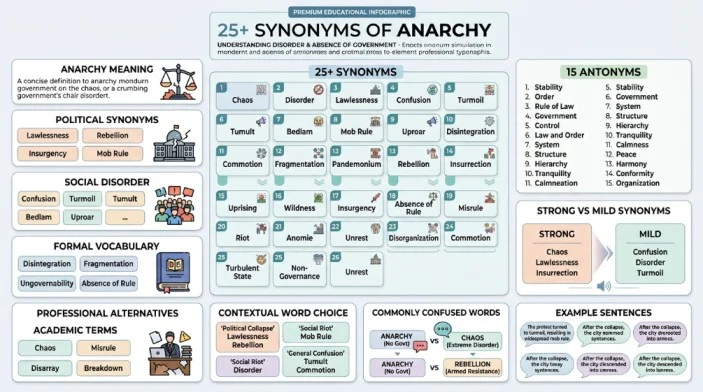
25 Best Synonyms of “Anarchy”
| Synonym | Simple Meaning | Best Used For | Example Sentence |
|---|---|---|---|
| Chaos | Extreme confusion or lack of order | Casual and general writing | The sudden cancellation caused chaos at the station. |
| Lawlessness | Failure to follow or enforce laws | Political and social writing | The region experienced growing lawlessness. |
| Disorder | Lack of order or organization | Formal and professional writing | Officials worked to restore public disorder to order. |
| Disarray | A state of poor organization | Workplace and everyday writing | The files were left in complete disarray. |
| Turmoil | Serious disturbance or instability | Political and emotional writing | The nation endured years of political turmoil. |
| Upheaval | Major disruption or change | Social and political writing | The revolution caused widespread social upheaval. |
| Mayhem | Violent or uncontrolled confusion | Informal and creative writing | The unexpected announcement created mayhem. |
| Confusion | Lack of clarity or understanding | Everyday communication | The new instructions caused confusion. |
| Disorganization | Lack of proper structure | Professional settings | Better planning reduced workplace disorganization. |
| Unruliness | Lack of obedience or discipline | Groups and behavior | The students’ unruliness disrupted the lesson. |
| Indiscipline | Lack of discipline or control | Formal and institutional writing | Poor leadership contributed to indiscipline. |
| Unrest | Public disturbance or dissatisfaction | Political and social writing | The policy sparked public unrest. |
| Instability | Lack of steadiness or security | Political and economic writing | Political instability affected investment. |
| Disruption | Interruption of normal activity | Business and professional writing | The strike caused major disruption. |
| Breakdown of order | Collapse of normal control | Formal explanation | The conflict led to a breakdown of order. |
| Breakdown of authority | Loss of effective leadership | Political analysis | The crisis produced a breakdown of authority. |
| Absence of government | No functioning governing authority | Political writing | The region faced an absence of government. |
| Absence of authority | Lack of effective control | Formal and academic writing | The absence of authority created uncertainty. |
| Lack of government | No effective governing system | Political discussion | The territory suffered from a lack of government. |
| Lack of control | Failure to maintain control | General and professional writing | The situation revealed a serious lack of control. |
| Lack of order | Failure to maintain order | General writing | The crowd created a lack of order. |
| Statelessness | Condition without an effective state | Academic and political writing | Statelessness raises difficult questions about governance. |
| Anomie | Breakdown or absence of shared social norms | Sociology and academic writing | The researcher examined social anomie during the crisis. |
| Uncontrolled disorder | Disorder without effective restraint | Formal and descriptive writing | The conflict produced uncontrolled disorder. |
| Social breakdown | Failure of normal social structures | Academic and political writing | The disaster contributed to social breakdown. |
Accuracy note: These alternatives overlap with anarchy in different ways. Some are close synonyms, while others describe a specific aspect of anarchy. For precise writing, choose the word that matches the exact situation rather than treating all 25 terms as interchangeable.
Synonyms of “Anarchy” by Usage
Professional vs Personal Synonyms
Professional writing generally benefits from precise and measured alternatives.
Use disorganization, disorder, instability, lack of structure, or lack of control when describing workplace problems.
Personal or casual communication can use chaos, mess, or mayhem when the tone allows exaggeration.
Professional:
“The department experienced significant disorganization.”
Personal:
“My kitchen is complete chaos.”
Formal vs Conversational Synonyms
Formal documents often benefit from lawlessness, statelessness, disorder, instability, or social breakdown.
Casual conversations usually sound more natural with chaos, mess, or mayhem.
For a research paper:
“Political instability contributed to institutional decline.”
For casual speech:
“The whole event was chaos.”
Academic Synonyms
Academic writing should distinguish between different types of disorder.
Statelessness is useful when discussing the absence of functioning state authority.
Lawlessness is appropriate when legal institutions or compliance are the central issue.
Anomie is useful in sociological discussions involving weakened or absent social norms.
Instability works when a system is unstable without necessarily being completely lawless.
These distinctions make academic arguments more precise.
Professional and Business Synonyms
- For resumes, use disorganization, inefficiency, or lack of structure rather than anarchy.
- For meetings, disorder or confusion may be appropriate.
- For client communication, disruption is often more professional.
- For business strategy, instability can describe uncertain conditions.
- For performance reviews, phrases such as lack of structure or inconsistent processes communicate workplace problems more constructively.
Creative and Literary Synonyms
Creative writing allows stronger imagery.
Mayhem suggests dramatic uncontrolled activity.
Turmoil creates a sense of instability and emotional disturbance.
Upheaval suggests major social or political change.
Chaos can create a broad sense of confusion.
Lawlessness works particularly well in stories involving collapsed authority.
Example:
“As the old regime disappeared, lawlessness spread through the streets.”
Slang or Modern Synonyms
There is no single modern slang word that precisely means anarchy.
However, informal English commonly uses chaos, a mess, and a free for all to describe situations that feel uncontrolled.
Chaos is acceptable in conversation, texting, captions, and informal posts.
Avoid these expressions in academic papers or formal reports unless they are part of a quotation or deliberately informal style.
Strongest to Mildest Synonyms
An exact intensity ranking is not possible because these words emphasize different aspects of disorder. A practical scale can still help writers understand their typical force.
| Level | Useful Terms | Main Emphasis |
|---|---|---|
| Mild | Disorganization, disarray, confusion | Lack of organization |
| Moderate | Disorder, disruption, instability | Breakdown of normal order |
| Strong | Chaos, unrest, turmoil, lawlessness | Serious disturbance |
| Very Strong | Mayhem, social breakdown, anarchy | Extreme uncontrolled conditions |
The strongest word is not always the best word. Lawlessness may be more accurate than anarchy if the central issue is crime and disregard for law.
Emotional vs Neutral Synonyms
Emotional Synonyms
These terms can create stronger imagery or emotional impact:
- Mayhem
- Turmoil
- Chaos
- Upheaval
- Social breakdown
They work well in storytelling, opinion writing, speeches, and emotionally charged descriptions.
Neutral Synonyms
These alternatives are more measured:
- Disorder
- Instability
- Disorganization
- Disruption
- Lack of structure
- Lack of control
- Statelessness
They are better suited to reports, academic writing, professional communication, and objective explanations.
Antonyms of “Anarchy”
| Antonym | Meaning | Example Sentence |
|---|---|---|
| Order | A condition of organized and controlled activity | The new system restored order to the community. |
| Government | An organized system that exercises public authority | The government established new rules. |
| Authority | Legitimate power to direct or control | The court has authority over the matter. |
| Governance | The process of managing and directing a society or organization | Effective governance promotes stability. |
| Law | Rules established and enforced by a governing system | Everyone must follow the law. |
| Rule of law | Principle that laws govern society rather than arbitrary power | The country strengthened its commitment to the rule of law. |
| Control | The ability to manage or direct something | Leaders regained control of the situation. |
| Regulation | Rules used to control activities | New regulation improved workplace safety. |
| Structure | An organized system or arrangement | The organization needs a clear structure. |
| Organization | A planned and orderly arrangement | Better organization improved productivity. |
| Discipline | Controlled and orderly behavior | Strong discipline helped the team succeed. |
| Stability | A condition of steadiness and security | Political stability encouraged investment. |
| Peace | A state without conflict or violence | The agreement brought peace to the region. |
| Security | Protection from danger or instability | The government increased security after the crisis. |
| Social order | Organized and stable functioning of society | Institutions help maintain social order. |
Comparison: “Anarchy” vs Similar Words
Anarchy vs Chaos
Main Difference
Anarchy can specifically involve the absence or breakdown of authority or government. Chaos is broader and refers to extreme confusion or disorder.
Which Is Stronger?
Both can be strong, but anarchy has a more specific political or social meaning.
Which Is More Formal?
Anarchy is generally more suitable for political or academic discussion. Chaos is extremely common in everyday English.
When to Use Each
Use anarchy when authority has broken down. Use chaos when the main issue is confusion or lack of order.
Examples
Anarchy:
“The collapse of central authority led to anarchy.”
Chaos:
“The sudden storm caused chaos at the airport.”
Anarchy vs Lawlessness
Main Difference
Lawlessness specifically emphasizes the failure to obey or enforce laws. Anarchy can refer more broadly to the absence of governing authority or order.
Which Is Stronger?
Neither is automatically stronger. The intended meaning determines the better choice.
Which Is More Formal?
Both are appropriate for formal writing.
When to Use Each
Use lawlessness when laws and enforcement are central to your point.
Examples
Anarchy:
“The region descended into anarchy.”
Lawlessness:
“Widespread lawlessness overwhelmed local authorities.”
Anarchy vs Disorder
Main Difference
Disorder simply means a lack of order. Anarchy can imply a deeper breakdown of authority or government.
Which Is Stronger?
Anarchy usually suggests a more serious condition.
Which Is More Formal?
Both work in formal writing, although disorder is often more neutral.
When to Use Each
Use disorder for general organizational problems.
Examples
Anarchy:
“The collapse of government produced anarchy.”
Disorder:
“The office suffered from administrative disorder.”
Anarchy vs Turmoil
Main Difference
Turmoil describes serious disturbance, confusion, or instability. It does not necessarily mean that government or authority has disappeared.
Which Is Stronger?
The words have different dimensions rather than a simple strength ranking.
Which Is More Formal?
Both are suitable for formal writing.
When to Use Each
Use turmoil for political, social, or emotional instability.
Examples
Anarchy:
“The country entered a period of anarchy.”
Turmoil:
“The country experienced years of political turmoil.”
Anarchy vs Mayhem
Main Difference
Mayhem emphasizes violent, chaotic, or uncontrolled activity. Anarchy focuses more on the breakdown or absence of authority and order.
Which Is Stronger?
Mayhem can sound more dramatic when describing immediate violence or confusion.
Which Is More Formal?
Anarchy is more suitable for academic and political writing.
When to Use Each
Use mayhem for vivid descriptions of uncontrolled events.
Examples
Anarchy:
“The fall of the regime created anarchy.”
Mayhem:
“The announcement caused mayhem among the crowd.”
Anarchy vs Rebellion
Main Difference
Rebellion means active resistance against an established authority. It does not necessarily result in anarchy.
Which Is Stronger?
Neither is inherently stronger. They describe different situations.
Which Is More Formal?
Both are suitable for historical and political writing.
When to Use Each
Use rebellion when people are actively opposing authority. Use anarchy when established authority has broken down or is absent.
Examples
Anarchy:
“The government collapsed, leaving the region in anarchy.”
Rebellion:
“The rebels launched an organized rebellion against the government.”
Common Phrases and Expressions with “Anarchy”
Descent Into Anarchy
Meaning: A transition from normal order into a condition of severe disorder or absent authority.
Example:
“The sudden collapse of the government led to a descent into anarchy.”
Fall Into Anarchy
Meaning: To lose established control and order.
Example:
“Without effective leadership, the organization could fall into anarchy.”
Descend Into Anarchy
Meaning: To gradually or suddenly become uncontrolled and disorderly.
Example:
“The region began to descend into anarchy after the conflict intensified.”
State of Anarchy
Meaning: A condition characterized by absent or ineffective authority.
Example:
“The novel portrays the city as existing in a state of anarchy.”
Political Anarchy
Meaning: A condition involving severe political disorder or the absence of effective government.
Example:
“Political anarchy made long term planning nearly impossible.”
Anarchy Reigns
Meaning: Disorder or lack of control dominates a situation.
Example:
“Once the rules disappeared, anarchy seemed to reign.”
Complete Anarchy
Meaning: An informal expression for extreme disorder or loss of control.
Example:
“The event became complete anarchy when the power failed.”
Common Mistakes to Avoid
1. Treating “Anarchy” and “Chaos” as Exact Synonyms
Incorrect:
“The room was anarchy because the books were scattered.”
Better:
“The room was in disarray because the books were scattered.”
Why:
The situation involves physical disorder, not a breakdown of authority.
2. Using “Anarchy” for Every Messy Situation
Incorrect:
“My inbox is anarchy.”
Better:
“My inbox is disorganized.”
Why:
Disorganized communicates the problem without exaggerating it.
3. Using “Chaos” When Lawlessness Is the Main Issue
Incorrect:
“The area suffered from chaos because criminal activity was widespread.”
Better:
“The area suffered from widespread lawlessness.”
Why:
Lawlessness identifies the failure to follow or enforce laws.
4. Using Informal Language in Academic Writing
Incorrect:
“The political situation was a complete mess.”
Better:
“The country experienced significant political instability.”
Why:
The revised version is more precise and academically appropriate.
5. Using “Anarchy” to Mean Rebellion
Incorrect:
“The citizens’ anarchy challenged the government.”
Better:
“The citizens’ rebellion challenged the government.”
Why:
Rebellion describes active resistance, while anarchy describes a condition of absent or broken authority.
6. Choosing an Overly Dramatic Synonym
Incorrect:
“The office experienced mayhem because two employees disagreed.”
Better:
“The office experienced tension after two employees disagreed.”
Why:
Mayhem suggests much more severe uncontrolled activity.
7. Using a Synonym Without Checking Its Exact Meaning
Incorrect:
“The government created anarchy by introducing new regulations.”
Better:
“The government created public frustration by introducing new regulations.”
Why:
Government regulation itself does not mean anarchy. The surrounding context must support the meaning of the chosen word.
Frequently Asked Questions
1. What are the best synonyms of “anarchy”?
The best synonyms of anarchy include lawlessness, chaos, disorder, statelessness, turmoil, and upheaval. Choose lawlessness for broken legal authority and chaos for general uncontrolled confusion.
2. What are the best formal synonyms of “anarchy”?
Formal alternatives include lawlessness, statelessness, disorder, instability, social breakdown, and absence of government. The best choice depends on whether the discussion concerns law, government, institutions, or social order.
3. What are common informal synonyms of “anarchy”?
Common informal alternatives include chaos, mayhem, mess, and a free for all. These expressions work best in conversations, captions, and informal writing rather than academic or professional documents.
4. What is another word for “anarchy” in professional writing?
Disorder, disorganization, instability, and lack of structure are often better professional alternatives. They communicate organizational problems clearly without suggesting an extreme political breakdown.
5. What is the difference between “anarchy” and “chaos”?
Anarchy can describe the absence or breakdown of government and authority, while chaos refers more broadly to extreme confusion or disorder. A chaotic situation does not necessarily involve the loss of authority.
6. What is the opposite of “anarchy”?
Common opposites include order, government, authority, governance, law, control, stability, organization, and social order. The best opposite depends on which aspect of anarchy is being discussed.
Conclusion
Anarchy describes a condition involving the absence or breakdown of effective authority, government, or established order. Depending on the context, useful alternatives include lawlessness, chaos, disorder, statelessness, turmoil, and upheaval.
The best synonyms of anarchy are not interchangeable in every situation. Use lawlessness when legal control is the focus, statelessness when effective state authority is absent, chaos for general confusion, and disorder for a more neutral description.
The simplest vocabulary improvement is to identify exactly what you mean before replacing a word. Ask whether you are describing broken laws, absent authority, confusion, instability, or poor organization, then choose the synonym that expresses that specific idea.
Read More Related Articles:
- 25+ Synonyms of Resume | Meanings, Uses, Examples, and …
- 25+ Synonyms of Bridge | Meanings, Uses, Examples, and …
- 25+ Synonyms of Sincerely | Meanings, Uses, Examples, and …