You may notice the word strange appearing again and again in an essay, email, story, caption, or conversation. While it is a useful everyday word, repeating it can make your writing feel flat, especially when you actually mean something more specific, such as unusual, bizarre, unfamiliar, or peculiar.
Learning the right synonym of strange gives you more control over your message. A word like unusual sounds neutral, bizarre suggests something much more surprising, and peculiar can describe something that feels oddly distinctive. The best choice depends on context, tone, audience, and the exact kind of strangeness you want to express.
What Are the Best Synonyms of “Strange”?
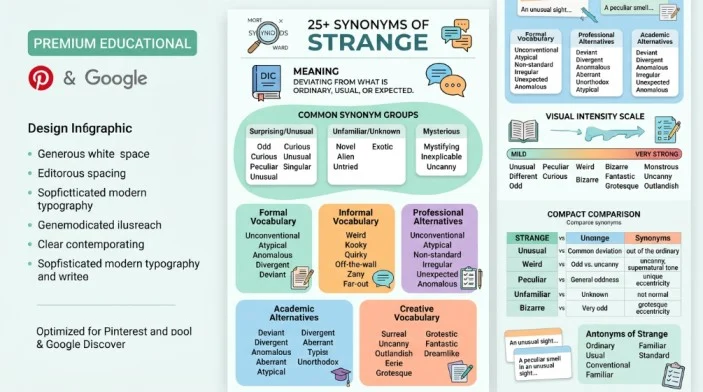
Strange generally means unusual, unfamiliar, unexpected, or difficult to understand. Common alternatives include unusual, odd, peculiar, weird, bizarre, unconventional, unfamiliar, eccentric, uncanny, and surreal. Use unusual for neutral writing, peculiar for a distinctive quality, bizarre for extreme oddness, and unfamiliar when something simply feels unknown.
Meaning, Tone, and Context
Simple Definition
Strange describes something that seems unusual, unexpected, unfamiliar, or different from what is normal or familiar.
The word can describe a person, object, behavior, sound, situation, feeling, idea, or experience. Its exact meaning changes slightly according to context.
For example:
“That is a strange idea.”
Here, strange means unusual or unexpected.
“I heard a strange noise outside.”
In this sentence, it means unfamiliar or unusual.
“He felt strange after taking the medication.”
Here, strange describes an unusual physical or emotional feeling.
Part of Speech
Strange is primarily an adjective.
It can modify nouns:
“She noticed a strange object.”
It can also appear after linking verbs:
“The situation seemed strange.”
Overall Tone
The tone of strange is usually neutral, but it can become positive or negative depending on context.
It may express:
- Mild curiosity
- Confusion
- Unfamiliarity
- Surprise
- Disapproval
- Suspicion
- Fascination
For example, strange in “a strange new design” may simply mean unusual, while “a strange man following me” can suggest concern or suspicion.
Formality Level
Strange is a neutral English word. It works naturally in:
- Everyday conversation
- School assignments
- Emails
- Essays
- Business communication
- Creative writing
- Social media
- Journalism
It is neither strongly formal nor strongly informal.
Common Uses
Native English speakers commonly use strange with words such as:
- Strange behavior
- Strange person
- Strange feeling
- Strange sound
- Strange smell
- Strange idea
- Strange situation
- Strange experience
- Strange place
- Strange coincidence
- Strange story
- Strange dream
Word Forms
| Form | Word |
|---|---|
| Adjective | strange |
| Noun | strangeness |
| Adverb | strangely |
| Related adjective | stranger, when used as the comparative form |
| Opposite ideas | normal, familiar, ordinary |
When and How to Use “Strange”
Use strange when something differs noticeably from what you normally expect. It is especially useful when you want to describe an unusual quality without specifying exactly why it seems unusual.
Professional
“The client reported a strange error in the software.”
Here, strange communicates that the error was unexpected or difficult to explain.
Academic
“The researchers observed a strange pattern in the data.”
For highly formal academic writing, unusual or anomalous may provide greater precision.
Workplace
“There was a strange issue with the scheduling system this morning.”
The word sounds natural in everyday workplace communication.
Personal
“I had a strange feeling that I had forgotten something.”
Here, strange describes an unusual personal sensation.
“Something strange happened when I tried to access the shared folder.”
This is appropriate for a normal workplace email.
Resume
The word strange is rarely useful on a resume because professional documents usually require more specific and positive vocabulary.
Instead of:
“Solved strange technical problems.”
Use:
“Resolved unusual technical issues affecting system performance.”
Social Media
“That was one of the strangest experiences I’ve ever had.”
This sounds natural and conversational.
Best Synonyms of “Strange”
No single synonym works perfectly in every situation. The best alternative depends on whether you mean unusual, unfamiliar, abnormal, mysterious, humorous, extreme, or distinctive.
Professional Writing: Unusual
Unusual is usually safer than strange in professional writing because it sounds objective and less judgmental.
“The team noticed an unusual pattern in customer behavior.”
Academic Writing: Anomalous
Anomalous works well when something differs from an expected pattern or standard.
“The researchers excluded the anomalous result from the final analysis.”
Business Communication: Unusual
Use unusual when describing an unexpected situation without sounding overly emotional.
“We identified an unusual increase in support requests.”
Casual Conversation: Weird
Weird is a natural conversational alternative to strange.
“That movie was really weird.”
It is informal, so avoid it in most academic and professional writing.
Emotional Writing: Uncanny
Uncanny works when something feels strangely familiar, eerie, or unsettling.
“There was something uncanny about the empty house.”
Creative Writing: Surreal
Surreal is useful when an experience feels dreamlike, unreal, or difficult to believe.
“The city looked surreal beneath the purple sky.”
Resume Writing: Unusual
On a resume, unusual can work when describing uncommon circumstances, but a more specific professional term is usually better.
“Developed solutions for unusual technical challenges.”
Workplace Communication: Peculiar
Peculiar can describe something noticeably unusual, although it may sound slightly more formal than strange.
“There is a peculiar issue with the new software update.”
Stronger Meaning: Bizarre
Bizarre suggests something extremely unusual or difficult to believe.
“The investigation uncovered a bizarre sequence of events.”
Softer Meaning: Unusual
Unusual is generally softer and more neutral than strange.
“The building has an unusual design.”
When Not to Use “Strange”
When the Word Is Too General
Sometimes strange does not tell the reader enough.
Less precise:
“The results were strange.”
Better:
“The results were anomalous.”
Why:
Anomalous specifically indicates that the results differed from the expected pattern.
When You Mean Unfamiliar
If something is new to you but not necessarily odd, strange may imply more than you intend.
Less precise:
“The food tasted strange.”
Better:
“The food tasted unfamiliar.”
Why:
Unfamiliar focuses on your lack of experience rather than suggesting that the food itself is abnormal.
When You Need Professional Language
In formal communication, strange can sometimes sound subjective.
Less effective:
“We noticed a strange change in sales.”
Better:
“We noticed an unusual change in sales.”
Why:
Unusual sounds more objective.
When You Mean Extremely Odd
If something is far outside normal expectations, strange may be too weak.
Less effective:
“It was a strange situation.”
Better:
“It was a bizarre situation.”
Why:
Bizarre communicates a much stronger degree of oddness.
When You Mean Eerie
If something feels unsettling or mysteriously familiar, strange may miss the emotional quality.
Less effective:
“The old house felt strange.”
Better:
“The old house felt uncanny.”
Why:
Uncanny conveys an eerie quality that ordinary strange does not always express.
When You Mean Dreamlike
Strange is not always the best choice for a surreal experience.
Less effective:
“The scene looked strange.”
Better:
“The scene looked surreal.”
Why:
Surreal suggests something dreamlike, unreal, or disconnected from ordinary reality.
When You Mean a Person Is Different
Calling a person strange can sound judgmental.
Less effective:
“She is a strange person.”
Better:
“She has an unconventional approach to life.”
Why:
Unconventional describes difference without automatically implying that the person is unpleasant or abnormal.
Words Commonly Confused With “Strange”
| Word | Difference | When to Use It | Example |
|---|---|---|---|
| Unusual | Something differs from what is normal or expected. | Neutral descriptions. | “The weather was unusual for June.” |
| Weird | Informal word for something very odd or difficult to explain. | Casual conversation. | “That was a weird dream.” |
| Unfamiliar | Something is not known or recognized by the person experiencing it. | New places, ideas, sounds, or experiences. | “The neighborhood felt unfamiliar.” |
| Peculiar | Something has a distinctive and unusual quality. | Formal or descriptive writing. | “She noticed a peculiar smell.” |
| Bizarre | Something is extremely unusual or difficult to believe. | Strong descriptions. | “The story took a bizarre turn.” |
| Uncanny | Something is strangely eerie, unsettling, or familiar. | Emotional and atmospheric writing. | “The resemblance was uncanny.” |
Best Synonyms of “Strange” by Context
| Context | Best Synonym | Why It Works | Example |
|---|---|---|---|
| Formal writing | Unusual | Neutral and objective. | “The report identified an unusual trend.” |
| Academic writing | Anomalous | Precise for unexpected results. | “The study contained an anomalous observation.” |
| Professional communication | Unusual | Avoids unnecessary judgment. | “We noticed an unusual pattern.” |
| Business emails | Unusual | Sounds clear and professional. | “There was an unusual delay.” |
| Resume writing | Unconventional | Can describe distinctive approaches positively. | “Used unconventional methods to solve complex problems.” |
| Workplace communication | Peculiar | Useful for specific unusual issues. | “We found a peculiar error in the system.” |
| Casual conversation | Weird | Natural and informal. | “That sounds weird.” |
| Everyday speaking | Odd | Short, familiar, and conversational. | “That’s a little odd.” |
| Creative writing | Surreal | Creates a dreamlike feeling. | “The landscape looked surreal.” |
| Storytelling | Bizarre | Adds dramatic intensity. | “A bizarre event changed everything.” |
| Emotional writing | Uncanny | Adds an eerie quality. | “The silence felt uncanny.” |
| Strong emphasis | Bizarre | Communicates extreme oddness. | “It was a bizarre coincidence.” |
| Mild tone | Unusual | Avoids strong judgment. | “She has an unusual hobby.” |
| Social media captions | Weird | Casual and expressive. | “What a weird day!” |
| American English | Strange | Very common and versatile. | “That seems strange to me.” |
| British English | Peculiar | Common and natural, especially in descriptive contexts. | “That’s a peculiar thing to say.” |
How to Choose the Best Synonym of “Strange”
The easiest way to select the right synonym is to identify what kind of strangeness you are describing.
If You Mean Simply Different
Choose unusual.
“She has an unusual hobby.”
This is neutral and does not strongly judge the hobby.
If You Mean Odd
Choose odd or peculiar.
“There was something peculiar about his explanation.”
These words suggest that something does not seem quite normal.
If You Mean Very Strange
Choose bizarre.
“The story became increasingly bizarre.”
This communicates strong unusualness.
If You Mean Unfamiliar
Choose unfamiliar.
“The terminology was unfamiliar to new students.”
This is about lack of knowledge or experience.
If You Mean Eerie
Choose uncanny.
“The empty hallway had an uncanny atmosphere.”
This adds an unsettling emotional quality.
If You Mean Dreamlike
Choose surreal.
“The landscape looked surreal after the storm.”
This is especially effective in creative descriptions.
If You Mean Different From Tradition
Choose unconventional.
“She took an unconventional approach to teaching.”
This can sound positive because it emphasizes originality.
If You Mean Extremely Unusual Behavior
Choose eccentric, abnormal, or bizarre, depending on context.
Be careful with abnormal because it can sound clinical or judgmental when describing people.
Real Life Examples of “Strange”
School
Instead of:
“The teacher gave us a strange assignment.”
Try:
“The teacher gave us an unusual assignment that required us to solve a real world problem.”
College
“The professor noticed an anomalous result in the experiment and asked the students to review their calculations.”
This is more precise than simply calling the result strange.
Workplace
“The team noticed an unusual drop in website traffic on Tuesday.”
The alternative sounds more objective and professional.
Business
“The company experienced an unexpected increase in demand after the product launch.”
Unexpected is often better than strange when the focus is on surprise rather than oddness.
“I noticed an unusual error when opening the document. Could you check the latest version?”
This sounds professional without sounding alarmist.
Resume
Instead of:
“Solved strange technical problems.”
Use:
“Resolved unusual technical issues and developed practical solutions under tight deadlines.”
Conversation
“That’s weird. I’ve never seen the app behave like that before.”
Weird sounds natural in casual speech.
Storytelling
“A peculiar silence filled the room as everyone waited for the door to open.”
Peculiar creates more atmosphere than the general word strange.
Blogging
“One unusual feature of the platform is its ability to organize large amounts of information automatically.”
Social Media
“What a weird morning. The power went out twice before breakfast.”
25 Best Synonyms of “Strange”
| Synonym | Simple Meaning | Best Used For | Example Sentence |
|---|---|---|---|
| Unusual | Different from what is normal | Neutral writing | “The city experienced an unusual amount of rain.” |
| Odd | Slightly strange or unexpected | Everyday conversation | “There was something odd about his answer.” |
| Peculiar | Noticeably unusual or distinctive | Descriptive writing | “A peculiar sound came from the attic.” |
| Weird | Very odd or difficult to explain | Casual speech | “That was a weird experience.” |
| Bizarre | Extremely unusual | Strong descriptions | “The case involved a bizarre series of events.” |
| Curious | Unusual or interesting in a surprising way | Formal and literary contexts | “It was a curious response to a simple question.” |
| Unconventional | Different from traditional methods | Professional and creative writing | “She developed an unconventional teaching method.” |
| Eccentric | Unusually different in personality or behavior | People and lifestyles | “The artist was known for his eccentric habits.” |
| Abnormal | Different from what is considered normal | Technical or medical contexts | “The test detected an abnormal reading.” |
| Atypical | Not typical of a particular group or pattern | Academic and professional writing | “The patient showed an atypical response.” |
| Anomalous | Different from an expected pattern | Research and data | “The analyst investigated an anomalous result.” |
| Outlandish | Extremely unusual or unreasonable | Ideas, claims, behavior | “He made an outlandish claim about the event.” |
| Extraordinary | Far beyond what is ordinary | Positive or dramatic descriptions | “She showed extraordinary determination.” |
| Unfamiliar | Not known or recognized | New experiences | “The unfamiliar surroundings made him nervous.” |
| Foreign | Unfamiliar or from another place | Places, cultures, languages | “The customs were foreign to the visitors.” |
| Alien | Completely unfamiliar or unlike what is known | Science fiction and strong descriptions | “The landscape looked alien to the explorers.” |
| Uncanny | Eerily unusual or strangely familiar | Emotional and atmospheric writing | “The empty building had an uncanny silence.” |
| Surreal | Dreamlike or unreal | Creative writing | “The entire scene felt surreal.” |
| Quirky | Unusually different in an appealing way | Personality and style | “The café has a quirky interior.” |
| Idiosyncratic | Unique to a particular person or thing | Formal descriptions | His idiosyncratic writing style became recognizable. |
| Singular | Remarkably unusual or distinctive | Formal and literary writing | “She had a singular talent for storytelling.” |
| Unexpected | Not anticipated | Everyday and professional writing | “The meeting took an unexpected turn.” |
| Unorthodox | Different from accepted methods or beliefs | Professional and academic contexts | “The researcher used an unorthodox approach.” |
| Inexplicable | Impossible to explain easily | Mysteries and unusual events | “The machine stopped for an inexplicable reason.” |
| Aberrant | Departing from the usual pattern | Technical and formal writing | “The system detected an aberrant data point.” |
Synonyms of “Strange” by Usage
Professional vs Personal Synonyms
Professional writing usually benefits from neutral and precise alternatives.
Best professional choices:
- Unusual
- Atypical
- Anomalous
- Unconventional
- Unexpected
- Peculiar
Personal communication allows more expressive words.
Best personal choices:
- Weird
- Odd
- Strange
- Quirky
- Bizarre
For example, a manager might write:
“We identified an unusual pattern in the report.”
A friend might say:
“That’s really weird.”
Both sentences communicate unusualness, but the tone is different.
Formal vs Conversational Synonyms
For reports and essays, prefer unusual, atypical, anomalous, unconventional, peculiar, or inexplicable when they accurately express your meaning.
For casual conversations and texting, weird, odd, and strange are more natural.
Avoid using weird in a formal research paper unless you are directly discussing informal language or quoting someone.
Academic Synonyms
Academic writing needs precise distinctions.
Anomalous is useful when data differs from an expected pattern.
Atypical means something does not represent the usual type.
Unusual provides a neutral general description.
Unconventional describes a method or approach that differs from accepted practice.
Aberrant is useful in technical contexts when something departs from an established pattern.
These choices make academic writing more precise because they explain what makes something different.
Professional and Business Synonyms
For resumes, interviews, meetings, presentations, performance reviews, client communication, and business emails, avoid describing people or situations as weird.
- Use unusual when you simply mean unexpected.
- Use unconventional when describing an innovative method.
- Use atypical when discussing patterns or behavior.
- Use unexpected when the outcome was not predicted.
- Use anomalous when discussing data or measurable results.
For example:
“We developed an unconventional approach that reduced processing time.”
This sounds much more professional than:
“We developed a strange approach.”
Creative and Literary Synonyms
- Creative writing gives you more freedom to express different shades of strangeness.
- Use peculiar for subtle oddness.
- Use uncanny for eerie or unsettling scenes.
- Use surreal for dreamlike imagery.
- Use bizarre for dramatic situations.
- Use quirky for charming or amusing differences.
- Use outlandish for exaggerated or unbelievable behavior.
The best literary synonym depends on the emotion you want the reader to experience.
Slang or Modern Synonyms
There is no single modern slang word that perfectly replaces strange in every situation.
Weird is the most common informal alternative.
It is acceptable in:
- Texting
- Casual conversation
- Social media
- Informal storytelling
- Friendly messages
Avoid it in:
- Academic essays
- Formal reports
- Professional resumes
- Formal business proposals
Example:
“That movie was weird.”
This is natural conversational English.
Strongest to Mildest Synonyms
The intensity of a synonym depends on context, but a useful general scale is:
Mild
Unusual, curious, unfamiliar
These words can describe something different without strongly judging it.
Moderate
Odd, peculiar, quirky, unconventional
These suggest a more noticeable difference.
Strong
Weird, eccentric, outlandish, uncanny
These create a stronger impression of unusualness.
Very Strong
Bizarre, surreal, alien, inexplicable
These words suggest something far outside ordinary experience or understanding.
Remember that intensity is not fixed. Context can make a normally mild word sound much stronger.
Emotional vs Neutral Synonyms
Emotional Synonyms
These alternatives add personality, feeling, surprise, or atmosphere.
- Weird
- Bizarre
- Uncanny
- Surreal
- Outlandish
- Quirky
- Eccentric
Use them in stories, conversations, creative writing, and expressive social media posts.
Neutral Synonyms
These communicate difference without adding much emotional judgment.
- Unusual
- Unfamiliar
- Unexpected
- Atypical
- Anomalous
- Unconventional
These are generally better for academic, professional, and informational writing.
Antonyms of “Strange”
Because strange has several related meanings, its opposite depends on context. The following words express genuine opposing ideas such as normality, familiarity, predictability, or conventionality.
| Antonym | Meaning | Example Sentence |
|---|---|---|
| Normal | Usual or expected | “Everything returned to normal after the storm.” |
| Ordinary | Not unusual or special | “It looked like an ordinary house.” |
| Usual | Common or normally expected | “She arrived at her usual time.” |
| Familiar | Known through previous experience | “The surroundings felt familiar.” |
| Typical | Representing what normally happens | “That behavior is typical for the species.” |
| Common | Frequently encountered | “This is a common problem.” |
| Conventional | Following accepted traditions or methods | “They chose a conventional approach.” |
| Expected | Anticipated or predicted | “The results were expected.” |
| Predictable | Easy to anticipate | “The ending was predictable.” |
| Ordinary | Normal and not distinctive | “It was an ordinary afternoon.” |
| Recognizable | Easy to identify or know | “The logo was instantly recognizable.” |
| Standard | Accepted as normal or typical | “The company follows standard procedures.” |
| Routine | Regular and repeated | “The inspection became a routine task.” |
| Typical | Characteristic of a normal example | “The response was typical of the group.” |
| Conventional | In accordance with established practice | “The school uses conventional teaching methods.” |
Comparison: “Strange” vs Similar Words
Strange vs Unusual
Main Difference:
Both describe something outside the norm, but unusual is generally more neutral.
Which Is Stronger?
Strange can sound slightly stronger or more subjective.
Which Is More Formal?
Unusual is usually better for formal writing.
When to Use Each:
Use strange when you want a more personal reaction. Use unusual when you want an objective description.
Examples:
Strange:
“The machine made a strange noise.”
Unusual:
“The machine produced an unusual sound during testing.”
Strange vs Weird
Main Difference:
They are close in meaning, but weird is more informal.
Which Is Stronger?
Weird can sound more expressive.
Which Is More Formal?
Strange is more appropriate in formal communication.
When to Use Each:
Use weird with friends and in casual speech. Use strange when you need a neutral alternative.
Examples:
Strange:
“The situation seemed strange.”
Weird:
“That situation was really weird.”
Strange vs Peculiar
Main Difference:
Peculiar often emphasizes a distinctive or noticeably unusual quality.
Which Is Stronger?
Neither is always stronger, although peculiar can sound more deliberate and descriptive.
Which Is More Formal?
Peculiar can sound more formal.
When to Use Each:
Use peculiar in descriptive or literary writing.
Examples:
Strange:
“I noticed a strange smell.”
Peculiar:
“I noticed a peculiar smell coming from the basement.”
Strange vs Unfamiliar
Main Difference:
Strange can mean unusual, while unfamiliar specifically means not known through previous experience.
Which Is Stronger?
Strange often carries more emotional judgment.
Which Is More Formal?
Unfamiliar works well in academic and professional writing.
When to Use Each:
Use unfamiliar when something is new to the person experiencing it.
Examples:
Strange:
“The neighborhood seemed strange.”
Unfamiliar:
“The neighborhood seemed unfamiliar because I had never visited it before.”
Strange vs Bizarre
Main Difference:
Bizarre describes something extremely unusual.
Which Is Stronger?
Bizarre is considerably stronger.
Which Is More Formal?
Neither is especially formal, but bizarre is common in journalism and storytelling.
When to Use Each:
Use bizarre when ordinary words such as strange or unusual do not express enough intensity.
Examples:
Strange:
“It was a strange coincidence.”
Bizarre:
“It was a bizarre coincidence that seemed almost impossible.”
Strange vs Unconventional
Main Difference:
Unconventional focuses on methods, ideas, behavior, or choices that differ from established practices.
Which Is Stronger?
Strange may sound more judgmental, while unconventional can be neutral or positive.
Which Is More Formal?
Unconventional is more suitable for professional and academic writing.
When to Use Each:
Use unconventional when describing originality or a departure from tradition.
Examples:
Strange:
“She used a strange method.”
Unconventional:
“She used an unconventional method to solve the problem.”
Common Phrases and Expressions with “Strange”
A Strange Feeling
Meaning: A feeling that is unusual or difficult to explain.
Example:
“I had a strange feeling that something was wrong.”
Strange Behavior
Meaning: Behavior that seems unusual or unexpected.
Example:
“The manager noticed some strange behavior from the employee.”
Strange Thing
Meaning: An unusual event, object, or fact.
Example:
“The strange thing is that nobody remembers seeing him leave.”
Strange Place
Meaning: A location that feels unfamiliar or unusual.
Example:
“I woke up in a strange place and had no idea where I was.”
Strange Experience
Meaning: An event that feels unusual or difficult to understand.
Example:
“Meeting my childhood teacher in another country was a strange experience.”
Strange Noise
Meaning: A sound that is unfamiliar or unexpected.
Example:
“We heard a strange noise coming from the garage.”
Strange Dream
Meaning: A dream with unusual or confusing content.
Example:
“I had a strange dream about an old house.”
Strange Coincidence
Meaning: An unexpected connection between events.
Example:
“It was a strange coincidence that we both arrived at the same time.”
Common Mistakes to Avoid
1. Using “Weird” in Formal Writing
Incorrect:
“The research produced a weird result.”
Better:
“The research produced an unusual result.”
Why:
Weird is informal. Unusual sounds more appropriate for academic and professional writing.
2. Using “Bizarre” for Ordinary Differences
Incorrect:
“She has a bizarre preference for tea.”
Better:
“She has an unusual preference for tea.”
Why:
Bizarre may exaggerate a harmless difference.
3. Confusing “Unfamiliar” With “Strange”
Incorrect:
“The foreign language was strange to me.”
Better:
“The foreign language was unfamiliar to me.”
Why:
The problem is lack of familiarity, not necessarily oddness.
4. Calling an Innovative Idea “Strange”
Incorrect:
“The company introduced a strange new strategy.”
Better:
“The company introduced an unconventional new strategy.”
Why:
Unconventional can describe innovation without implying that the idea is bad.
5. Overusing “Strange” in Creative Writing
Incorrect:
“She entered a strange room with strange furniture and heard a strange sound.”
Better:
“She entered a peculiar room filled with antique furniture and heard an uncanny sound from the hallway.”
Why:
Specific vocabulary creates atmosphere and avoids repetitive writing.
6. Using “Abnormal” Without a Clear Reason
Incorrect:
“He has an abnormal personality.”
Better:
“He has an unconventional personality.”
Why:
Abnormal can sound clinical or judgmental when describing a person. Use it only when its technical meaning is appropriate.
7. Choosing a Synonym Without Considering Tone
Incorrect:
“She has a bizarre sense of humor.”
Better:
“She has a quirky sense of humor.”
Why:
If you mean unusual in an amusing or appealing way, quirky communicates the intended tone more accurately.
Frequently Asked Questions
What are the best synonyms of “strange”?
The best synonyms of strange include unusual, odd, peculiar, weird, bizarre, unfamiliar, unconventional, uncanny, surreal, and atypical. The ideal choice depends on whether you mean unfamiliar, unusual, eerie, extreme, or distinctive.
What are the best formal synonyms of “strange”?
The best formal alternatives include unusual, peculiar, atypical, anomalous, unconventional, inexplicable, and aberrant. Choose based on context because each emphasizes a different type of difference or unusualness.
What are common informal synonyms of “strange”?
Common informal alternatives include weird and odd. Weird is especially common in casual American English, while odd can sound slightly softer and works comfortably in everyday conversation.
What is another word for “strange” in professional writing?
Unusual is usually the safest professional alternative because it sounds neutral and objective. Depending on the context, atypical, anomalous, unconventional, or unexpected can provide greater precision.
What is the difference between “strange” and “unusual”?
Both words describe something outside the ordinary, but unusual is generally more neutral. Strange can suggest a personal reaction, confusion, unfamiliarity, or discomfort, depending on the situation.
What is the opposite of “strange”?
Common opposites of strange include normal, ordinary, usual, familiar, typical, common, conventional, expected, and routine. The best antonym depends on whether strange means unusual, unfamiliar, or unconventional.
Conclusion
Strange is a flexible word that can describe something unusual, unfamiliar, unexpected, eerie, or difficult to understand. Because its meaning changes with context, the best synonym is the one that communicates the exact quality you want to describe.
Use unusual for neutral writing, odd for mild everyday descriptions, peculiar for distinctive qualities, weird for casual conversation, bizarre for extreme oddness, unfamiliar for something unknown, unconventional for nontraditional ideas, and uncanny or surreal when you need a stronger emotional or creative effect.
The most effective way to improve your vocabulary is not to replace every occurrence of strange with a more complicated word. Instead, identify what you actually mean, then choose the synonym that best matches your audience, tone, and purpose. This approach makes your synonym of strange choices more accurate and your writing more natural.
Read More Related Articles:
Meaning, Uses, Examples, and the Best Synonym of Complain
25+ Synonyms of Frequency | Meanings, Uses, Examples …
50+ Synonyms of This | Meanings, Uses, Examples, and Best …