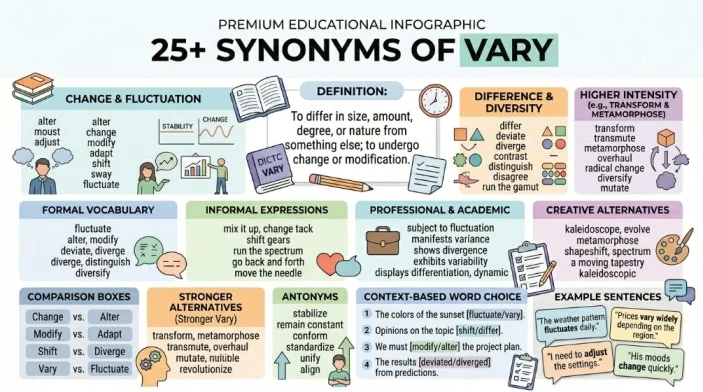
Finding the right vary synonym can make your writing clearer, more precise, and less repetitive. The word vary has several useful alternatives, but the best choice depends on meaning and context. If you need another word for vary in an essay, report, conversation, or professional message, words such as differ, change, fluctuate, and range may work but they are not always interchangeable. Understanding these small differences helps you choose words that sound natural and accurate.
This guide explores vary synonyms, including the synonyms of vary commonly used in English. It also explains vary meaning synonyms and shows how varies changes meaning in different sentences. Whether you need a synonym for vary, want to understand varies synonyms, or are searching for vary synonyms in English, you will find context-based examples and practical usage tips to help you select the right word confidently.
What Are the Best Synonyms of “Vary”?
Vary means to differ, change, or develop in different forms, amounts, or conditions. The best synonyms include differ for showing differences, change for general transformation, fluctuate for repeated rises and falls, alter for making a change, and diversify for creating greater variety. Formal writing often favors differ, fluctuate, or modify, while everyday speech commonly uses change.
Meaning, Tone, and Context
Simple Definition
Vary generally means to be different from something else, to change from one condition to another, or to make something different.
The exact meaning depends on how the word is used.
For example:
“Prices vary by location.”
Here, vary means that prices are different depending on location.
In another sentence:
“You can vary the recipe by adding different vegetables.”
Here, vary means to change or modify something.
The word can therefore describe either a difference that naturally exists or an intentional change made by someone.
Part of Speech
Vary is primarily a verb.
It can be used as an intransitive verb when something changes or differs:
“Results vary from person to person.”
It can also be used as a transitive verb when someone changes something:
“The chef varied the recipe to suit the guests.”
Overall Tone
Vary has a neutral tone.
It does not normally express positive or negative emotion. The surrounding sentence determines whether the variation is desirable, undesirable, expected, or simply factual.
Formality Level
Vary is a neutral and versatile word.
It works naturally in:
- Academic writing
- Business reports
- Professional emails
- Everyday conversation
- Technical writing
- Essays
- Blogs
- Presentations
- Descriptive writing
Common Uses
Native English speakers commonly use vary when discussing:
- Prices
- Costs
- Results
- Opinions
- Preferences
- Quality
- Size
- Quantity
- Methods
- Conditions
- Performance
- Experiences
- Availability
- Rates
- Requirements
- Patterns
Examples include:
“The results vary depending on the method.”
“Prices vary throughout the year.”
“People’s opinions vary on this issue.”
Word Forms
| Form | Word | Example |
|---|---|---|
| Verb | vary | “Results vary by location.” |
| Noun | variation | “There is considerable variation in the results.” |
| Adjective | varied | “The course offers a varied selection of topics.” |
| Adjective | variable | “Weather conditions are highly variable.” |
| Adverb | variously | “The term has been variously interpreted.” |
The noun variation is especially useful when discussing differences or changes in academic, scientific, and professional writing.
When and How to Use “Vary”
Use vary when you want to communicate that something is not fixed, uniform, or identical. It is particularly useful when differences occur across people, places, times, conditions, amounts, or situations.
Professional
“Project costs may vary depending on the selected materials.”
Here, vary efficiently communicates that the final cost is not identical in every case.
Academic
“The effects of the treatment may vary among participants.”
This sounds objective and appropriate for academic research.
Workplace
“Work schedules may vary from one department to another.”
The word clearly describes differences without suggesting that anything is wrong.
Personal
“My weekend plans vary depending on my workload.”
This is a natural way to describe changing circumstances.
“Delivery times may vary depending on your location.”
This wording is clear and professional.
Resume
“Adapted communication strategies to meet varying client needs.”
Here, varying describes different needs across clients.
Social Media
“Results may vary, but consistency usually makes the biggest difference.”
This sounds natural and accessible for a general audience.
Best Synonyms of “Vary”
No single synonym completely replaces vary in every sentence. The best choice depends on which sense of vary you want to express.
Professional Writing: Differ
Use differ when you want to emphasize that two or more things are not the same.
“Customer preferences differ across age groups.”
This is especially useful in reports, comparisons, and analytical writing.
Academic Writing: Differ
Differ is precise and objective when discussing distinctions between groups, results, opinions, or findings.
“The results differ significantly between the two groups.”
Business Communication: Fluctuate
Use fluctuate when an amount repeatedly rises and falls.
“Monthly sales fluctuate throughout the year.”
This is more precise than vary when the movement itself matters.
Casual Conversation: Change
Change is usually the most natural everyday alternative.
“Plans can change quickly.”
It is simple, familiar, and flexible.
Emotional Writing: Shift
Shift works well when describing a change in feelings, attitudes, priorities, or perspectives.
“Her feelings began to shift after the conversation.”
Creative Writing: Transform
Use transform when the change is substantial.
“The experience transformed his view of the world.”
Resume Writing: Adapt
Adapt is particularly effective when describing the ability to respond to changing circumstances.
“Adapted strategies to meet evolving customer needs.”
Workplace Communication: Adjust
Adjust suggests making a controlled or practical change.
“We adjusted the schedule to accommodate the new deadline.”
Stronger Meaning: Transform
Transform is stronger than vary because it suggests a substantial or fundamental change.
Softer Meaning: Differ
Differ can be a softer alternative when you simply want to point out that things are not identical.
When Not to Use “Vary”
Although vary is highly useful, there are situations where another word communicates the intended idea more accurately.
When “Vary” Is Too General
If you mean that something actually changes, change may be clearer.
Less Precise:
“The plan may vary.”
Better:
“The plan may change after the meeting.”
Why:
Change directly communicates modification, while vary can simply mean that different versions exist.
When You Mean Repeated Upward and Downward Movement
Use fluctuate when an amount repeatedly rises and falls.
Less Precise:
“Prices vary throughout the day.”
Better:
“Prices fluctuate throughout the day.”
Why:
Fluctuate specifically describes movement up and down.
When You Mean a Direct Difference
Use differ when comparing two or more things.
Less Precise:
“The two studies vary in their conclusions.”
Better:
“The two studies differ in their conclusions.”
Why:
Differ directly highlights the distinction.
When You Mean Intentional Modification
Use modify or alter when someone deliberately changes something.
Less Precise:
“The engineer varied the design.”
Better:
“The engineer modified the design.”
Why:
Modified makes intentional adjustment clearer.
When You Mean Greater Variety
Use diversify when the goal is to introduce different types, options, or sources.
Less Precise:
“The company varied its investments.”
Better:
“The company diversified its investments.”
Why:
Diversify specifically suggests expanding variety.
When You Mean a Major Transformation
Use transform when the change is substantial.
Less Precise:
“The experience varied his perspective.”
Better:
“The experience transformed his perspective.”
Why:
Transform communicates a deeper change.
Words Commonly Confused With “Vary”
Differ
Difference: Differ means to be unlike or not identical.
When to Use It: Use it when comparing people, things, opinions, results, or characteristics.
Example:
“The two approaches differ in several important ways.”
Change
Difference: Change is broader and can describe movement from one state, condition, or form to another.
When to Use It: Use it for general changes in plans, conditions, behavior, appearance, or circumstances.
Example:
“The weather may change later this afternoon.”
Fluctuate
Difference: Fluctuate describes repeated movement, especially upward and downward movement.
When to Use It: Use it for prices, temperatures, rates, numbers, and other measurable quantities.
Example:
“Gas prices often fluctuate during the summer.”
Alter
Difference: Alter means to make a change to something, often without completely replacing it.
When to Use It: Use it when someone deliberately changes a plan, design, document, or arrangement.
Example:
“We had to alter the schedule.”
Modify
Difference: Modify usually means making specific changes to improve, adapt, or adjust something.
When to Use It: It works particularly well in technical, academic, and professional contexts.
Example:
“The researchers modified the procedure.”
Diversify
Difference: Diversify means to increase variety or expand into different areas.
When to Use It: It is especially common in business, investing, education, and product development.
Example:
“The company plans to diversify its product range.”
Best Synonyms of “Vary” by Context
| Context | Best Synonym | Why It Works | Example |
|---|---|---|---|
| Formal writing | Differ | Clearly expresses distinctions. | “The findings differ across regions.” |
| Academic writing | Differ | Precise and objective. | “The outcomes differ between groups.” |
| Professional communication | Vary | Neutral and flexible. | “Requirements vary by position.” |
| Business emails | Change | Clear and familiar. | “The schedule may change.” |
| Resume writing | Adapt | Highlights flexibility. | “Adapted plans to meet changing needs.” |
| Workplace communication | Adjust | Shows practical modification. | “We adjusted the schedule.” |
| Casual conversation | Change | Natural everyday vocabulary. | “Things change over time.” |
| Everyday speaking | Differ | Useful for comparisons. | “Our opinions differ on that issue.” |
| Creative writing | Transform | Expresses major change. | “The journey transformed her.” |
| Storytelling | Shift | Describes gradual changes. | “His attitude shifted slowly.” |
| Emotional writing | Shift | Works well with feelings and attitudes. | “Her emotions shifted unexpectedly.” |
| Strong emphasis | Transform | Suggests substantial change. | “The discovery transformed the field.” |
| Mild tone | Differ | Simply indicates a difference. | “Their preferences differ slightly.” |
| Social media captions | Change | Simple and conversational. | “Plans change, and that’s okay.” |
| American English | Vary | Common and natural. | “Prices vary by location.” |
| British English | Vary | Also standard and natural. | “Prices vary by region.” |
How to Choose the Best Synonym of “Vary”
Choosing the right word becomes easier when you identify the exact type of variation you mean.
If You Mean “Be Different”
Choose differ.
“Opinions differ among experts.”
If You Mean “Become Different”
Choose change.
“The situation may change quickly.”
If You Mean “Rise and Fall Repeatedly”
Choose fluctuate.
“Interest rates fluctuate over time.”
If You Mean “Make a Change”
Choose alter or modify.
“The team modified the original design.”
If You Mean “Make Something More Diverse”
Choose diversify.
“The company diversified its services.”
If You Mean “Make a Practical Change”
Choose adjust.
“We adjusted the settings.”
If You Mean “Change Gradually”
Choose shift.
“Consumer preferences are shifting.”
If You Mean “Change Completely”
Choose transform.
“Technology has transformed the workplace.”
Consider Your Audience
- For general readers, change is usually the easiest option.
- For academic readers, differ, fluctuate, and modify can provide greater precision.
For business audiences, adjust, adapt, and diversify often communicate specific actions more effectively.
Consider Emotional Strength
- Use differ for a neutral comparison.
- Use shift for a noticeable change in attitude or feeling.
- Use transform when the change is substantial.
Consider Formality
Formal and academic writing may favor differ, alter, modify, and fluctuate.
Everyday communication often favors change.
Choose Natural Usage
Do not replace vary simply to avoid repetition. A synonym should improve the sentence, not merely make the vocabulary look more sophisticated.
For example:
“Prices vary by location.”
This sentence is already natural. Replacing vary with transform or shift would make the meaning incorrect.
Real Life Examples of “Vary”
School
Original:
“Students’ learning styles vary.”
Improved:
“Students’ learning preferences differ considerably.”
Why:
Differ works well when comparing groups or individuals.
College
Original:
“The results vary depending on the sample.”
Improved:
“The results differ depending on the sample.”
This version emphasizes the distinction between outcomes.
Workplace
Original:
“Working hours vary by department.”
Alternative:
“Working hours differ by department.”
Both are natural, although vary is particularly smooth when describing differences across categories.
Business
Original:
“Customer demand varies throughout the year.”
Improved:
“Customer demand fluctuates throughout the year.”
Use fluctuates when the demand repeatedly rises and falls.
Original:
“The delivery date may vary.”
Alternative:
“The delivery date may change.”
Change is simpler when you mean that the date may be different from the current plan.
Resume
Original:
“Varied marketing strategies for different customer groups.”
Improved:
“Adapted marketing strategies for different customer groups.”
Adapted highlights an active professional skill.
Conversation
Original:
“People’s opinions vary.”
Alternative:
“People’s opinions differ.”
Both work naturally in everyday speech.
Storytelling
Original:
“His feelings varied after the news.”
Improved:
“His feelings shifted after the news.”
Shifted creates a stronger sense of emotional movement.
Blogging
Original:
“The cost can vary depending on the service.”
Alternative:
“The cost can change depending on the service.”
Change is easy for general audiences to understand.
Social Media
Original:
“Life can vary from one season to another.”
Improved:
“Life can change from one season to another.”
The second version sounds more conversational.
25 Best Synonyms of “Vary”
Because vary has more than one sense, these alternatives are grouped according to the meaning they can express. Not every word is interchangeable with vary in every sentence.
| Synonym | Simple Meaning | Best Used For | Example Sentence |
|---|---|---|---|
| Differ | To be unlike | Comparisons and differences | “The two methods differ in their approach.” |
| Change | To become or make different | General situations | “Plans can change unexpectedly.” |
| Fluctuate | To rise and fall | Prices, rates, numbers | “Energy costs fluctuate throughout the year.” |
| Alter | To make a change | Plans and arrangements | “We altered the schedule.” |
| Modify | To make specific adjustments | Technical and formal writing | “The team modified the design.” |
| Adjust | To change slightly for a purpose | Settings and plans | “She adjusted the settings.” |
| Adapt | To change to suit new conditions | People, strategies, systems | “The company adapted its strategy.” |
| Diversify | To make more varied | Business and investments | “The company diversified its product line.” |
| Shift | To move or change gradually | Opinions, priorities, attitudes | “Public opinion shifted after the announcement.” |
| Transform | To change substantially | Major changes | “Technology transformed the industry.” |
| Evolve | To develop gradually | Ideas, systems, organizations | “The strategy evolved over time.” |
| Alternate | To switch between options | Repeated choices or states | “The team alternated between two approaches.” |
| Diversify | To introduce greater variety | Products and activities | “The program diversified its course offerings.” |
| Contrast | To differ noticeably | Comparisons | “The two designs contrast sharply.” |
| Depart | To move away from a standard | Rules and established patterns | “The new design departs from tradition.” |
| Deviate | To move away from a usual pattern | Formal and technical contexts | “The results deviated from the expected range.” |
| Range | To extend across different values | Quantities and categories | “Prices range from $20 to $100.” |
| Diversify | To expand into different types | Business strategy | “The company diversified its investments.” |
| Reform | To change to improve | Systems and institutions | “The organization reformed its policies.” |
| Revise | To change after review | Writing and plans | “The author revised the proposal.” |
| Remodel | To change the structure or appearance | Buildings and spaces | “They remodeled the kitchen.” |
| Rearrange | To change the order or position | Objects and information | “She rearranged the furniture.” |
| Customize | To change for a particular user or purpose | Products and services | “Customers can customize their orders.” |
| Vary in | To differ in a particular feature | Measurements and qualities | “The samples vary in size.” |
| Range across | To extend through different categories | Topics and values | “The course topics range across several disciplines.” |
Synonyms of “Vary” by Usage
Professional vs Personal Synonyms
Professional writing benefits from precise vocabulary.
- Use differ when comparing results or characteristics.
“Performance levels differ across departments.”
- Use fluctuate when describing changing numbers.
“Sales fluctuate during seasonal periods.”
- Use adapt when describing professional flexibility.
“Employees must adapt to changing customer expectations.”
In personal communication, change and shift often sound more natural.
“My plans changed.”
“Her attitude shifted.”
Formal vs Conversational Synonyms
Formal writing can use:
- Differ
- Fluctuate
- Alter
- Modify
- Deviate
- Diversify
Conversational English often prefers:
- Change
- Shift
- Adjust
- Switch
For example:
Formal:
“The researchers modified the procedure.”
Conversational:
“We changed the plan.”
Both communicate change, but the vocabulary matches different contexts.
Academic Synonyms
Academic writing requires precision. The best synonym depends on what kind of difference or change is being discussed.
Differ
Use when comparing findings, groups, or approaches.
“The findings differ across demographic groups.”
Fluctuate
Use when data moves upward and downward.
“Temperature levels fluctuated throughout the experiment.”
Deviate
Use when something moves away from an expected pattern, standard, or result.
“Several observations deviated from the predicted outcome.”
Modify
Use when researchers intentionally change a procedure, model, or method.
“The researchers modified the original methodology.”
Evolve
Use when describing gradual development over time.
“The theory evolved as additional evidence emerged.”
These words are more precise than repeatedly using vary.
Professional and Business Synonyms
Resumes
Use adapt, adjust, modify, and diversify when describing professional actions.
“Adapted marketing campaigns to meet regional customer needs.”
Interviews
Use adapt when discussing flexibility.
“I adapted quickly when the project requirements changed.”
Meetings
Use adjust when discussing practical modifications.
“We adjusted the timeline after reviewing the latest data.”
Presentations
Use differ when explaining distinctions.
“Customer needs differ across markets.”
Performance Reviews
Use adapt to highlight flexibility and problem solving.
“Consistently adapted to changing business priorities.”
Client Communication
Use vary or differ when describing differences without creating unnecessary complexity.
“Pricing may vary according to project scope.”
Business Emails
Use change when a simple explanation is more useful.
“The delivery date may change based on availability.”
Creative and Literary Synonyms
Creative writing benefits from alternatives that communicate the nature of a change rather than simply stating that something varies.
Shift
Useful for emotions, relationships, attitudes, and perspectives.
“The mood shifted as the sun disappeared.”
Transform
Useful for dramatic or fundamental change.
“The quiet town transformed after the storm.”
Evolve
Useful for gradual development.
“Their friendship evolved over many years.”
Contrast
Useful for creating visual or emotional differences.
“The bright walls contrasted with the dark wooden floor.”
Alternate
Useful when describing repeated movement between two states.
“Her expression alternated between hope and doubt.”
These words can make descriptive writing more vivid because they explain how the change occurs.
Slang or Modern Synonyms
There is no single slang word that universally replaces vary.
In casual American English, people commonly use simple words such as change, switch, or mix things up, depending on the intended meaning.
Change
“Things can change quickly.”
Suitable for almost any informal situation.
Switch
Use when moving from one option, method, or choice to another.
“We switched to a different plan.”
Mix Things Up
This informal expression means to introduce variety or make something different.
“Let’s mix things up and try a new approach.”
Avoid mix things up in academic papers, formal reports, resumes, and serious business communication.
Strongest to Mildest Synonyms
The intensity of a synonym depends on the sense of vary being used.
| Level | Useful Alternatives | Typical Meaning |
|---|---|---|
| Mild | Differ, adjust | Small difference or modification |
| Moderate | Change, alter, modify | Noticeable change |
| Strong | Shift, adapt, evolve | Meaningful development |
| Very Strong | Transform, reform | Major or fundamental change |
Not every synonym belongs to a strict intensity scale. For example, fluctuate describes a pattern of movement rather than simply indicating that a change is strong.
Emotional vs Neutral Synonyms
Emotional Synonyms
These words can add more feeling or expressive force:
- Shift
- Transform
- Evolve
- Alternate
Examples:
“Her feelings shifted dramatically.”
“The experience transformed his outlook.”
Neutral Synonyms
These words communicate information without adding much emotional meaning:
- Vary
- Differ
- Change
- Modify
- Adjust
- Fluctuate
Examples:
“Costs vary by region.”
“The results differ between groups.”
Use neutral alternatives for reports and factual explanations. Use more expressive choices when emotional or descriptive impact matters.
Antonyms of “Vary”
Because vary has several meanings, its opposites depend on the specific sense. The following words represent genuine contextual opposites when vary means to differ, change, or become less uniform.
| Antonym | Meaning | Example Sentence |
|---|---|---|
| Remain | Stay in the same condition | “The temperature remained stable.” |
| Stay | Continue without changing | “The instructions stayed the same.” |
| Maintain | Keep something in its existing state | “We maintained the original schedule.” |
| Preserve | Keep something unchanged or intact | “The policy preserves the existing structure.” |
| Stabilize | Become steady or less changeable | “Prices began to stabilize.” |
| Standardize | Make things uniform | “The company standardized its procedures.” |
| Fix | Set something so it does not change | “The price is fixed for all customers.” |
| Equal | Be the same in amount or value | “The two measurements are equal.” |
| Match | Be the same or correspond | “The results match the original estimate.” |
| Correspond | Agree or be consistent with something | “The figures correspond with the report.” |
| Conform | Follow an established standard | “The products conform to safety requirements.” |
| Agree | Be the same in opinion or position | “Their conclusions agree.” |
| Remain constant | Stay at the same level | “The pressure remained constant.” |
| Uniform | Be consistent throughout | “The color is uniform across the surface.” |
| Standardize | Remove unnecessary differences | “The team standardized the process.” |
Comparison: “Vary” vs Similar Words
Vary vs Differ
Main Difference
Vary can describe differences across several conditions or changes within a range. Differ directly emphasizes that two or more things are not the same.
Which Is Stronger?
Neither is inherently stronger.
Which Is More Formal?
Both are suitable for formal writing.
When to Use Each
Use vary for ranges, conditions, amounts, or changing circumstances.
Use differ for direct comparisons.
Examples
Vary:
“Prices vary by location.”
Differ:
“Prices differ between the two stores.”
Vary vs Change
Main Difference
Vary often describes differences or variation, while change broadly describes becoming different.
Which Is Stronger?
Neither is inherently stronger.
Which Is More Formal?
Both are neutral.
When to Use Each
Use change when something moves from one state to another.
Use vary when different versions, amounts, or conditions exist.
Examples
Vary:
“Requirements vary by position.”
Change:
“The requirements changed after the policy update.”
Vary vs Fluctuate
Main Difference
Fluctuate specifically suggests repeated movement, especially upward and downward movement.
Which Is Stronger?
Fluctuate is more specific, not necessarily stronger.
Which Is More Formal?
Both work well in professional and academic writing.
When to Use Each
Use fluctuate for prices, rates, numbers, and measurable conditions that repeatedly rise and fall.
Examples
Vary:
“Prices vary throughout the year.”
Fluctuate:
“Prices fluctuate throughout the year.”
Vary vs Alter
Main Difference
Alter usually describes an intentional change made to something.
Which Is Stronger?
Alter is more action focused.
Which Is More Formal?
Alter can sound slightly more formal than change.
When to Use Each
Use alter when someone deliberately modifies a plan, structure, or arrangement.
Examples
Vary:
“The designs vary in size.”
Alter:
“The designer altered the original plan.”
Vary vs Modify
Main Difference
Modify suggests making specific adjustments, often while retaining the basic structure.
Which Is Stronger?
Neither is necessarily stronger.
Which Is More Formal?
Modify is particularly common in technical and academic writing.
When to Use Each
Use modify for procedures, designs, documents, systems, and methods.
Examples
Vary:
“The methods vary across studies.”
Modify:
“The researchers modified the method.”
Vary vs Diversify
Main Difference
Diversify means deliberately increasing variety or expanding into different areas.
Which Is Stronger?
Diversify is more specific.
Which Is More Formal?
Both work in professional contexts.
When to Use Each
Use diversify for investments, products, markets, services, and activities.
Examples
Vary:
“The company varies its product offerings.”
Diversify:
“The company diversified its product portfolio.”
Common Phrases and Expressions with “Vary”
Vary Depending On
Meaning
This phrase means that something changes according to a particular condition or factor.
Example Sentence
“Prices vary depending on the size of the package.”
Vary From
Meaning
This expression identifies a difference between one thing and another.
Example Sentence
“Results vary from one study to another.”
Vary Between
Meaning
This phrase describes differences within two or more limits, choices, or conditions.
Example Sentence
“Temperatures vary between 60 and 75 degrees.”
Vary By
Meaning
This indicates the factor responsible for a difference.
Example Sentence
“Delivery times vary by location.”
Vary In Size
Meaning
It means that objects or groups differ in their physical dimensions.
Example Sentence
“The available rooms vary in size.”
Vary In Quality
Meaning
It indicates that quality is not consistent.
Example Sentence
“The products vary in quality.”
Vary Widely
Meaning
This means that differences are substantial.
Example Sentence
“Opinions vary widely on the subject.”
Vary Considerably
Meaning
This emphasizes a noticeable amount of difference.
Example Sentence
“Costs can vary considerably between providers.”
Common Mistakes to Avoid
Choosing a Vague Synonym Instead of a Precise One
Incorrect
“Prices change up and down throughout the month.”
Better
“Prices fluctuate throughout the month.”
Why
Fluctuate specifically describes repeated increases and decreases.
Confusing Vary With Differ
Incorrect
“The manager differed the schedule.”
Better
“The manager altered the schedule.”
Why
Differ is normally used to describe things that are unlike each other. It does not normally mean to deliberately change something.
Using an Informal Synonym in Formal Writing
Incorrect
“The researcher mixed things up in the experiment.”
Better
“The researcher modified the experimental procedure.”
Why
The formal version clearly describes an intentional methodological change.
Choosing an Overly Dramatic Synonym
Incorrect
“The company transformed its meeting time by ten minutes.”
Better
“The company adjusted its meeting time by ten minutes.”
Why
Transform suggests a much more substantial change.
Repeating “Vary” Too Often
Less Effective
“Prices vary by region, products vary by size, and services vary by provider.”
Better
“Prices differ by region, products range in size, and services change by provider.”
Why
Using carefully selected alternatives improves rhythm while preserving the intended meanings.
Choosing the Wrong Emotional Tone
Incorrect
“Her mood fluctuated dramatically when she received the letter.”
Better
“Her mood shifted dramatically when she received the letter.”
Why
Shifted works naturally for emotional or psychological changes, while fluctuated can sound more clinical.
Using Slang in Academic or Professional Writing
Incorrect
“The researchers mixed things up to get different results.”
Better
“The researchers modified the procedure to obtain different results.”
Why
The revised sentence is clearer and appropriate for formal communication.
Frequently Asked Questions
What is another word for vary?
Common alternatives include differ, change, fluctuate, shift, alternate, and deviate, depending on the context.
What are the best vary synonyms?
Useful vary synonyms include differ, fluctuate, change, alter, shift, and diverge.
What are vary meaning synonyms?
Vary can mean to change, differ, fluctuate, or be different in degree or form. The best synonym depends on the sentence.
What are the synonyms of vary in English?
Common synonyms of vary in English include change, differ, fluctuate, alter, shift, and deviate.
What is a synonym for varies?
Depending on the context, varies can be replaced with differs, changes, fluctuates, differs in degree, or depends.
What are the synonyms of varies?
Common varies synonyms include differs, changes, fluctuates, shifts, and alters.
What is a synonym for vary in formal writing?
For formal writing, alternatives such as differ, fluctuate, fluctuate according to, and demonstrate variation can work well.
What is another word for varying in an essay?
In an essay, differing, changing, fluctuating, diverse, or inconsistent may replace varying, depending on the intended meaning.
What are the best synonyms of “vary”?
The best synonyms of vary depend on meaning. Use differ for differences, change for general transformation, fluctuate for repeated rises and falls, modify for intentional changes, and diversify for increased variety.
What are the best formal synonyms of “vary”?
Formal alternatives include differ, fluctuate, alter, modify, deviate, and diversify. The best option depends on whether you are describing differences, measurable changes, intentional adjustments, or movement away from a standard.
What are common informal synonyms of “vary”?
In casual English, change, switch, and mix things up can replace vary in certain contexts. Change is the safest general alternative, while switch suggests moving from one option to another.
What is another word for “vary” in professional writing?
Differ, fluctuate, modify, adjust, and adapt are useful professional alternatives. Choose differ for comparisons, fluctuate for changing numbers, and adapt when describing responses to changing conditions.
What is the difference between “vary” and “change”?
Vary often describes differences among people, places, amounts, or conditions, while change broadly describes becoming different. For example, prices vary by location, while a company may change its pricing policy.
What is the opposite of “vary”?
The opposite of vary depends on its meaning. Common contextual opposites include remain, stay, maintain, preserve, stabilize, standardize, and remain constant, all of which suggest consistency rather than difference or change.
Conclusion
Vary is a flexible verb used to describe differences, changes, ranges, and changing conditions. The best synonym of vary depends on the exact meaning you want to communicate. Use differ for comparisons, change for general transformation, fluctuate for repeated movement, modify for deliberate adjustments, adapt for responding to new conditions, and diversify for creating greater variety.
No synonym works perfectly in every situation. The strongest word choice comes from considering your audience, tone, purpose, and the specific kind of difference or change you want to describe.
A useful vocabulary habit is to identify the exact action before replacing a repeated word. Something is simply different, choose differ. If it moves from one state to another, choose change. If it rises and falls repeatedly, choose fluctuate. This small distinction can make your writing much more precise.
Read More Related Articles:
- Meaning, Uses, Examples, and the Best Synonym of Complain
- 25+ Synonyms of Frequency | Meanings, Uses, Examples …
- 50+ Synonyms of This | Meanings, Uses, Examples, and Best …