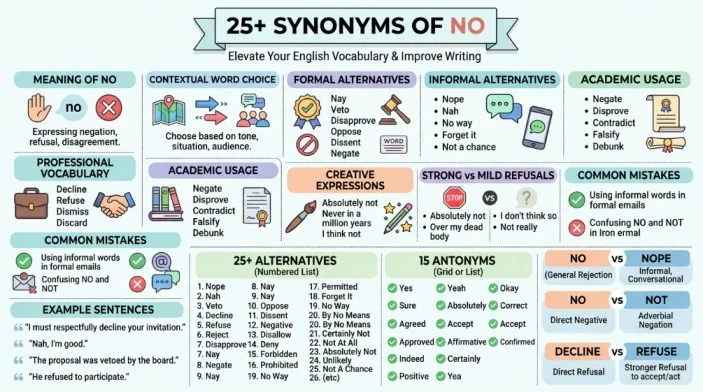
When writing an email, answering a question, declining an invitation, or responding to a request, using no repeatedly can make your communication sound blunt or repetitive. Finding the right synonym of no can help you refuse, disagree, or express a negative response while matching the situation and your intended tone.
The best alternative depends on what you want to communicate. Nope sounds casual, negative can sound professional, nay is formal or old fashioned, and expressions such as certainly not or absolutely not add stronger emphasis. Choosing carefully helps your writing and speech sound natural, respectful, clear, and appropriate for the audience.
What Are the Best Synonyms of “No”?
The best synonym of no depends on context. Nope and nah work in casual conversation, negative and decline suit professional situations, while nay is formal or literary. For strong refusal, use absolutely not or certainly not, and for polite communication, phrases such as I’m afraid not work better.
Meaning, Tone, and Context
Simple Definition
No is used to express a negative answer, refusal, disagreement, denial, or absence. It can also be used before a noun to show that something does not exist, is unavailable, or is not allowed.
For example:
“No, I don’t agree.”
Here, no directly rejects or disagrees with something.
It can also appear before a noun:
“There is no reason to worry.”
In this sentence, no indicates the absence of a reason.
Part of Speech
No can function in several grammatical ways.
| Function | Example |
|---|---|
| Determiner | “There is no evidence.” |
| Adverb | “The answer is no.” |
| Interjection | “No! Don’t touch that.” |
| Noun | “She answered with a firm no.” |
Its grammatical role depends on how it appears in the sentence.
Overall Tone
The basic word no is generally neutral, but its tone can change dramatically depending on delivery and context.
A simple “No” can sound calm and direct:
“No, thank you.”
The same word can sound harsh when spoken sharply:
“No! Stop doing that.”
Adding polite language can soften it:
“No, thank you. I really appreciate the offer.”
Positive, Neutral, or Negative?
No expresses a negative response, but the word itself is generally neutral in emotional tone.
It does not automatically communicate anger, disrespect, or hostility. The surrounding words, situation, and speaker’s tone determine how the refusal is perceived.
Formality Level
No is a neutral word that works across almost every level of communication.
It is appropriate for:
- Everyday conversations
- Emails
- Business communication
- Academic writing
- Professional meetings
- Personal messages
- Social media
- Formal statements
Some alternatives have more specific formality levels.
| Expression | Formality |
|---|---|
| No | Neutral |
| Nope | Informal |
| Nah | Very informal |
| Negative | Professional or formal |
| Nay | Formal, literary, or old fashioned |
| Certainly not | Formal or neutral |
| Absolutely not | Neutral with strong emphasis |
| I’m afraid not | Polite and professional |
Common Uses
Native English speakers commonly use no to:
- Reject an offer
- Answer a negative question
- Disagree with an idea
- Refuse permission
- Deny something
- State that something is unavailable
- Express disagreement
- Correct inaccurate information
- Set boundaries
- Indicate absence
Examples:
“No, I haven’t seen the report.”
“There are no seats available.”
“No, that’s not what I meant.”
“No, you cannot enter this area.”
Word Forms and Related Expressions
Unlike many adjectives, verbs, and nouns, no does not have a large family of standard word forms.
Useful related words and expressions include:
- No
- Nope
- Nah
- Negative
- Refusal
- Refuse
- Reject
- Decline
- Denial
- Deny
- Disagree
- Oppose
These words are related to negative responses, but they do not all work as direct grammatical replacements for no.
When and How to Use “No”
Use no when you need a clear negative answer, refusal, denial, or statement of absence. It is usually the safest choice because it is short, universally understood, and appropriate in both everyday and professional English.
Professional
“No, we cannot approve the request at this time.”
For a more polished professional response:
“Unfortunately, we are unable to approve the request at this time.”
Academic
“No, the evidence does not support that conclusion.”
In academic writing, a more precise construction may be preferable:
“The available evidence does not support that conclusion.”
Workplace
“No, I haven’t completed the report yet.”
A softer workplace version could be:
“Not yet. I expect to have it finished this afternoon.”
Personal
“No, I don’t want to go out tonight.”
A softer alternative:
“I think I’ll stay home tonight.”
“No, unfortunately, we cannot extend the deadline.”
A more professional version:
“Unfortunately, we are unable to extend the deadline.”
Resume
The word no is rarely useful as a direct synonym in resume writing because resumes usually describe qualifications positively.
Instead of:
“No experience in project management.”
Use:
“Currently developing project management experience through independent projects.”
Social Media
“No, I definitely wasn’t expecting that!”
For a casual and expressive tone:
“No way, I seriously didn’t expect that!”
Best Synonyms of “No”
No alternative is identical to no in every sentence. Some expressions are direct substitutes for a negative answer, while others communicate refusal, disagreement, denial, or rejection in a more specific way.
Professional Writing: Negative
Negative is useful in professional contexts when giving a short, direct response.
“The answer is negative.”
It can sound more formal and objective than simply saying “no.”
Academic Writing: Not
Not is often more appropriate than no when forming negative statements in academic writing.
“The study did not identify a clear relationship.”
This structure usually sounds more natural than forcing no into a formal sentence.
Business Communication: Decline
Decline is an excellent choice when politely refusing an offer, invitation, proposal, or request.
“We respectfully decline the proposal.”
It communicates refusal without sounding unnecessarily blunt.
Casual Conversation: Nope
Nope is a common informal alternative to no.
“Nope, I’m not going.”
It works well with friends, family, and casual messages but should generally be avoided in formal documents.
Emotional Writing: Absolutely Not
Absolutely not communicates a firm and emotionally strong refusal.
“Absolutely not. I won’t allow that to happen.”
It should be used when strong emphasis is genuinely intended.
Creative Writing: Nay
Nay can create a historical, dramatic, or literary effect.
“Nay, he would never abandon his people.”
It is not a natural replacement for no in ordinary modern conversation.
Resume Writing: No Direct Replacement
A resume usually benefits from rewriting the sentence instead of replacing no with another negative expression.
Instead of:
“No leadership experience.”
Use:
“Developed leadership skills through volunteer team projects.”
Workplace Communication: Unable
Unable can make a refusal sound more professional and less personal.
“We are unable to accommodate the request.”
This is often better than a blunt “No” in customer service and workplace communication.
Stronger Meaning: Absolutely Not
Absolutely not is much stronger than a simple no.
“Absolutely not. That option is not acceptable.”
Softer Meaning: I’m Afraid Not
I’m afraid not provides a polite way to communicate a negative response.
“I’m afraid not. The position has already been filled.”
It is especially useful when you want to preserve a respectful tone.
When Not to Use “No”
Although no is extremely useful, it is not always the best choice. The problem is usually not correctness. The issue is tone, precision, or context.
When “No” Sounds Too General
A simple no may not explain what you are rejecting.
Less Effective:
“No, that’s wrong.”
Better:
“No, that information is inaccurate.”
The second version explains the problem more precisely.
When “No” Sounds Too Blunt
A direct refusal may sound harsh in customer service or professional communication.
Less Effective:
“No, we can’t help you.”
Better:
“Unfortunately, we are unable to assist with that request.”
The revised sentence communicates the same decision more diplomatically.
When “No” Sounds Too Weak
Sometimes the situation requires stronger emphasis.
Less Effective:
“No, I won’t agree to that.”
Better:
“Absolutely not. I cannot agree to those terms.”
The stronger expression makes the firmness of the decision unmistakable.
When “No” Is Too Informal for the Structure
The problem may not be the word itself but the way the sentence is constructed.
Less Effective:
“No, the company doesn’t have that information.”
Better:
“The company does not currently have that information.”
The second version fits formal written communication better.
When “No” Creates Unnecessary Negativity
A negative statement can sometimes be rewritten more constructively.
Less Effective:
“No experience is required.”
Better:
“Previous experience is not required.”
Or:
“This position is open to candidates at all experience levels.”
The final version sounds more welcoming.
When “No” Is Not Precise Enough
If you are rejecting a proposal, decline or reject may communicate the action more accurately.
Less Effective:
“We said no to the proposal.”
Better:
“We declined the proposal after reviewing its terms.”
The alternative identifies the specific action.
Words Commonly Confused With “No”
Nope
Difference: Informal version of no.
When to Use It: Casual conversation, texting, and friendly messages.
Example:
“Nope, I haven’t finished it yet.”
Nah
Difference: Very informal and often more relaxed than no.
When to Use It: Friendly conversations and informal messages.
Example:
“Nah, I’m good. Thanks.”
Not
Difference: Not is a grammatical negative marker, while no can independently answer a question.
When to Use It: Negative statements and clauses.
Example:
“I do not agree with that conclusion.”
Negative
Difference: Negative can describe a refusal, unfavorable result, or opposite response.
When to Use It: Professional, technical, and formal contexts.
Example:
“The response from the committee was negative.”
Refuse
Difference: Refuse is a verb describing the act of rejecting or declining something.
When to Use It: When explaining someone’s action.
Example:
“She refused to sign the agreement.”
Decline
Difference: Decline usually expresses a polite refusal.
When to Use It: Invitations, offers, requests, and professional communication.
Example:
“He declined the invitation because he had another commitment.”
Best Synonyms of “No” by Context
| Context | Best Synonym | Why It Works | Example |
|---|---|---|---|
| Formal writing | Not | Fits formal negative sentence structures. | “The evidence does not support the claim.” |
| Academic writing | Not | Creates precise, objective statements. | “The study did not confirm the hypothesis.” |
| Professional communication | Negative | Sounds direct and objective. | “The response was negative.” |
| Business emails | Decline | Communicates refusal politely. | “We must respectfully decline the offer.” |
| Resume writing | Avoid direct negative | Positive phrasing is usually stronger. | “Developing leadership experience through team projects.” |
| Workplace communication | Unable | Softens a professional refusal. | “We are unable to approve the request.” |
| Casual conversation | Nope | Natural and informal. | “Nope, I haven’t seen it.” |
| Everyday speaking | No | Clear and universally natural. | “No, thanks.” |
| Creative writing | Nay | Adds literary or historical flavor. | “Nay, the journey had only begun.” |
| Storytelling | Never | Can create stronger narrative refusal. | “Never would she betray her friend.” |
| Emotional writing | Absolutely not | Expresses strong rejection. | “Absolutely not, I won’t give up.” |
| Strong emphasis | Certainly not | Firm but controlled refusal. | “Certainly not under these conditions.” |
| Mild tone | I’m afraid not | Makes refusal more polite. | “I’m afraid not, unfortunately.” |
| Social media captions | Nope | Casual and concise. | “Nope, not ready for Monday.” |
| American English | No, nope | Both are natural, depending on formality. | “No, thanks.” / “Nope, I’m good.” |
How to Choose the Best Synonym of “No”
Choosing another word for no starts with identifying what kind of negative response you want to give.
If You Simply Answer a Question
Use:
No
“Are you coming?”
“No.”
This is the clearest and most natural option.
If You Want to Sound Casual
Use:
Nope or nah
“Nope, I haven’t seen it.”
These expressions fit relaxed conversations.
If You Want to Sound Professional
Use:
decline, unable, or a formal negative construction with not.
“We are unable to approve the request.”
If You Want to Be Polite
Use:
I’m afraid not, unfortunately, or I don’t think so.
“I’m afraid not. The meeting has already been scheduled.”
If You Want to Sound Firm
Use:
absolutely not, certainly not, or definitely not.
“Absolutely not. That approach would create unnecessary risks.”
If You Want to Express Disagreement
Use:
I disagree, that’s incorrect, or I don’t agree.
“I disagree with that interpretation.”
If You Want to Describe Refusal
Use:
decline, reject, or refuse.
“The committee rejected the proposal.”
If You Want to Describe Absence
Use no or a negative structure with not.
“There is no evidence of fraud.”
This is different from refusing a request.
Real Life Examples of “No”
School
Basic:
“No, I don’t understand this question.”
Improved:
“I’m not sure I understand this question yet.”
The second version sounds more constructive in a classroom setting.
College
Basic:
“No, the article doesn’t support that idea.”
Improved:
“The article does not provide evidence to support that idea.”
The improved version is more suitable for academic discussion.
Workplace
Basic:
“No, we can’t finish it today.”
Improved:
“We won’t be able to finish it today, but we can complete it tomorrow.”
This version gives the reader useful information instead of ending with a simple refusal.
Business
Basic:
“No, we don’t accept those terms.”
Improved:
“We are unable to accept those terms as currently written.”
The second sentence sounds more professional.
Basic:
“No, I can’t attend the meeting.”
Improved:
“Unfortunately, I won’t be able to attend the meeting.”
The alternative is polite and appropriate for workplace communication.
Resume
Basic:
“No management experience.”
Improved:
“Developing management skills through team leadership and project coordination.”
Positive framing is generally more useful on a resume.
Conversation
Basic:
“No, I don’t want coffee.”
Improved:
“No, thanks. I’m fine for now.”
The second response sounds friendly and natural.
Storytelling
Basic:
“No, she would not leave.”
Improved:
“Never would she abandon the people who trusted her.”
The stronger construction creates more dramatic effect.
Blogging
Basic:
“No, this method isn’t effective for everyone.”
Improved:
This method does not work equally well for every situation.”
The revised sentence sounds more informative and objective.
Social Media
Basic:
“No, I’m not ready.”
Improved:
“Nope, I’m definitely not ready for this yet.”
The second version fits an informal social media voice.
25 Best Synonyms and Alternatives for “No”
Because no performs several grammatical jobs, not every item below can replace it in every sentence. These are 25 accurate alternatives or closely related negative expressions, selected according to their actual use.
| Synonym or Alternative | Simple Meaning | Best Used For | Example Sentence |
|---|---|---|---|
| No | A negative answer or refusal | General communication | “No, I can’t attend.” |
| Nope | Informal no | Casual conversation | “Nope, I’m staying home.” |
| Nah | Very informal no | Friendly conversation | “Nah, I don’t need one.” |
| Negative | A negative response | Professional communication | “The answer is negative.” |
| Nay | Formal or literary no | Formal or historical writing | “Nay, I cannot agree.” |
| Not | Expresses negation | Formal and academic sentences | “The evidence does not support it.” |
| Never | At no time | Strong rejection or timing | “I would never do that.” |
| No way | Strong refusal or disbelief | Casual conversation | “No way, that’s impossible.” |
| Absolutely not | Very firm refusal | Strong disagreement | “Absolutely not, that is unacceptable.” |
| Certainly not | Firm but controlled refusal | Formal communication | “Certainly not under these circumstances.” |
| Definitely not | Strong certainty about refusal | Everyday and professional speech | “I definitely won’t be attending.” |
| Not at all | Complete negative response | Polite conversation | “Not at all, you didn’t bother me.” |
| I don’t think so | Soft disagreement or refusal | Conversation | “I don’t think so, unfortunately.” |
| I’m afraid not | Polite negative response | Professional communication | “I’m afraid not, the position is filled.” |
| Unable | Not capable or permitted | Workplace communication | “We are unable to provide that service.” |
| Decline | Politely refuse | Business and professional writing | “We declined the invitation.” |
| Refuse | Reject or choose not to do something | Direct descriptions | “She refused to sign.” |
| Reject | Decide not to accept | Proposals and applications | “The board rejected the proposal.” |
| Disagree | Hold a different opinion | Discussions | “I disagree with that conclusion.” |
| Deny | State that something is untrue | Formal statements | “He denied the allegation.” |
| Oppose | Act against an idea or plan | Formal and political contexts | “Several members opposed the proposal.” |
| Dismiss | Reject something as unworthy | Formal analysis | “The panel dismissed the claim.” |
| Rule out | Decide something is not possible | Planning and analysis | “We cannot rule out that possibility.” |
| Forbid | Say something is not allowed | Rules and authority | “The policy forbids outside food.” |
| Prohibit | Officially prevent something | Formal rules | “The law prohibits unauthorized access.” |
Synonyms of “No” by Usage
Professional vs Personal Synonyms
Professional communication usually benefits from respectful and precise language.
Use decline, unable, not, and negative in workplace situations.
“We are unable to accept the proposal at this stage.”
In personal communication, no, nope, nah, and I don’t think so are more natural.
“Nah, I think I’ll stay home tonight.”
The key difference is not correctness. It is tone and audience.
Formal vs Conversational Synonyms
Reports
Use not, negative, declined, or rejected.
“The committee rejected the recommendation.”
Essays
Use negative grammatical structures with not.
“The evidence does not establish a direct connection.”
Business Writing
Use decline, unable, reject, or polite negative constructions.
“We must respectfully decline the proposal.”
Presentations
Use no when answering directly, but use precise wording when explaining the reason.
“No, the data does not support that assumption.”
Emails
Use unfortunately, unable, decline, or I’m afraid not when a polite refusal is needed.
Casual Conversations
Use no, nope, nah, or no way depending on intensity.
Texting
Informal expressions such as nope and nah are common, but their appropriateness depends on the relationship and situation.
Academic Synonyms
Academic writing rarely requires replacing every occurrence of no with a synonym. Instead, writers often create more precise negative constructions.
Not
“The research did not confirm the original prediction.”
This is usually more natural than trying to insert a direct synonym for no.
Reject
“The researchers rejected the initial hypothesis.”
Use reject when describing a decision based on evidence.
Deny
“The findings do not deny the possibility of another explanation.”
Deny is useful when discussing whether something has been stated as true or false.
Negative
“The experiment produced a negative result.”
Negative works especially well when discussing results, responses, or outcomes.
Professional and Business Synonyms
Resumes
Avoid beginning achievement statements with negative language.
Instead of:
“No previous leadership experience.”
Use:
“Developed leadership experience through volunteer team management.”
Interviews
A direct no is acceptable, but adding context makes your response more useful.
“No, I haven’t worked with that software, but I have experience with similar platforms.”
Meetings
Use I disagree when discussing opinions.
“I disagree with that recommendation.”
Presentations
Use not when explaining evidence.
“The current data does not indicate a decline in demand.”
Performance Reviews
Use constructive language rather than blunt negative statements.
Instead of:
“No improvement.”
Use:
“Further improvement is needed in this area.”
Client Communication
Use unable or unfortunately to soften refusals.
“Unfortunately, we are unable to meet that deadline.”
Business Emails
Use decline when refusing an offer or invitation.
“Thank you for the opportunity, but we must respectfully decline.”
Creative and Literary Synonyms
Creative writing gives authors more freedom to choose expressive alternatives.
Never
Never can make a refusal sound absolute.
“Never would he forget the promise he had made.”
Nay
Nay creates a formal, historical, or dramatic voice.
“Nay, you have misunderstood me.”
No way
This can create a modern conversational voice.
“No way,” she whispered, staring at the letter.
Absolutely not
This gives dialogue a strong emotional reaction.
“Absolutely not,” he said, stepping away from the door.
The best creative choice depends on the character’s personality, time period, and emotional state.
Slang or Modern Synonyms
There are no universal slang synonyms that replace no in every context. However, several informal expressions are common in modern American English.
Nope
Meaning: An informal version of no.
Acceptable in: Texting, casual conversations, social media, friendly messages.
Avoid in: Academic essays, formal reports, professional documents.
“Nope, I’m not interested.”
Nah
Meaning: A very casual negative response.
Acceptable in: Conversations with friends and informal messages.
Avoid in: Business communication and formal writing.
“Nah, that’s not really my thing.”
No way
Meaning: Strong informal refusal or disbelief.
Acceptable in: Casual speech and social media.
Avoid in: Formal documents.
“No way, you actually won?”
Strongest to Mildest Synonyms
There is no perfect universal intensity scale because the strength of a negative response depends heavily on context and tone. Still, these expressions can be grouped roughly by communicative force.
| Intensity | Examples | Typical Effect |
|---|---|---|
| Mild | I don’t think so, I’m afraid not | Softens disagreement or refusal |
| Moderate | No, not really, negative | Clear negative response |
| Strong | Definitely not, certainly not | Firm rejection |
| Very Strong | Absolutely not, no way | Strong refusal or disbelief |
Mild
“I’m afraid not.”
This is useful when preserving politeness matters.
Moderate
“No, I don’t agree.”
This gives a clear but controlled response.
Strong
“Certainly not.”
This leaves little room for uncertainty.
Very Strong
“Absolutely not.”
This should be reserved for situations where a firm boundary or strong rejection is intended.
Emotional vs Neutral Synonyms
Emotional Synonyms and Expressions
These choices can communicate stronger feelings.
- Absolutely not
- No way
- Never
- Definitely not
- Nah
- Nope
Example:
“No way! I can’t believe you did that.”
The expression communicates emotion as well as negation.
Neutral Alternatives
These are better for objective communication.
- No
- Not
- Negative
- Decline
- Unable
- Reject
- Deny
Example:
“The committee declined the request.”
The sentence communicates the decision without adding unnecessary emotion.
Antonyms of “No”
The opposite of no is most directly yes, but English has many affirmative words and expressions that can function as contextual opposites. The following alternatives express agreement, acceptance, permission, confirmation, or a positive response.
| Antonym | Meaning | Example Sentence |
|---|---|---|
| Yes | Positive answer | “Yes, I can help.” |
| Yeah | Informal yes | “Yeah, that sounds good.” |
| Yep | Casual yes | “Yep, I’m ready.” |
| Certainly | Definite agreement | “Certainly, we can arrange that.” |
| Absolutely | Strong agreement | “Absolutely, I agree.” |
| Definitely | Strong certainty | “Definitely, I’ll be there.” |
| Indeed | Confirmation or agreement | “Indeed, that is correct.” |
| Affirmative | Formal positive response | “The answer is affirmative.” |
| Agreed | Shows agreement | “Agreed, let’s proceed.” |
| Sure | Willing agreement | “Sure, I can help.” |
| Okay | Acceptance or agreement | “Okay, I’ll handle it.” |
| Aye | Yes, especially in historical or specific usage | “Aye, captain.” |
| Accepted | Shows agreement to an offer | “Your proposal has been accepted.” |
| Approved | Officially agreed to | “The request was approved.” |
| Consent | Agreement or permission | “She gave her consent.” |
Comparison: “No” vs Similar Words
No vs Nope
Main Difference
No is neutral, while nope is informal.
Which Is Stronger?
Neither is inherently stronger. Nope can sometimes sound more relaxed or dismissive.
Which Is More Formal?
No is more formal and broadly appropriate.
When to Use Each
Use no almost anywhere. Use nope with friends, family, or informal audiences.
Examples
No:
“No, thank you.”
Nope:
“Nope, I’m good.”
No vs Nah
Main Difference
Nah is more informal and often sounds relaxed or unconcerned.
Which Is Stronger?
Neither is stronger by definition.
Which Is More Formal?
No is more formal.
When to Use Each
Use nah only when the conversational setting is clearly informal.
Examples
No:
“No, I don’t need anything.”
Nah:
“Nah, I’m okay.”
No vs Not
Main Difference
No can stand alone as an answer or appear before nouns. Not usually works as part of a negative grammatical structure.
Which Is Stronger?
Neither is generally stronger.
Which Is More Formal?
Both are neutral, but not is often preferred for structured academic and formal sentences.
When to Use Each
Use no for direct answers and noun phrases. Use not to negate verbs, adjectives, adverbs, and clauses.
Examples
No:
“No, I don’t agree.”
Not:
“I do not agree.”
No vs Negative
Main Difference
No is an everyday negative response. Negative often describes a response, result, attitude, or outcome.
Which Is Stronger?
Neither is universally stronger.
Which Is More Formal?
Negative generally sounds more formal or technical.
When to Use Each
Use negative in professional, scientific, and analytical contexts.
Examples
No:
“No, the answer isn’t correct.”
Negative:
“The test produced a negative result.”
No vs Decline
Main Difference
No expresses a negative response. Decline specifically describes politely refusing an offer, invitation, or request.
Which Is Stronger?
No can sound more direct. Decline is usually more diplomatic.
Which Is More Formal?
Decline is more formal.
When to Use Each
Use decline when writing professional refusals.
Examples
No:
“No, I can’t attend.”
Decline:
“I must respectfully decline the invitation.”
No vs Refuse
Main Difference
No is a response. Refuse is a verb describing the act of rejecting something.
Which Is Stronger?
Refuse can sound stronger because it describes deliberate rejection.
Which Is More Formal?
Both can appear in formal writing, but refuse is more specific.
When to Use Each
Use refuse when explaining someone’s behavior or decision.
Examples
No:
“No, I won’t sign it.”
Refuse:
“She refused to sign the document.”
Common Phrases and Expressions with “No”
No problem
Meaning: Indicates that something is acceptable or causes no difficulty.
Example:
“No problem, I can send the file this afternoon.”
No way
Meaning: Shows strong refusal, disbelief, or surprise.
Example:
“No way, you actually met the author?”
No doubt
Meaning: Indicates strong confidence or certainty.
Example:
“There is no doubt that the decision was difficult.”
No longer
Meaning: Indicates that something has stopped being true.
Example:
“The company is no longer accepting applications.”
No matter
Meaning: Indicates that something remains true regardless of circumstances.
Example:
“No matter what happens, we’ll support you.”
No wonder
Meaning: Shows that something is understandable given the circumstances.
Example:
“No wonder she was tired after working all day.”
No doubt about it
Meaning: Expresses strong certainty.
Example:
“There is no doubt about it, she earned the promotion.”
No chance
Meaning: Indicates that something is considered impossible or extremely unlikely.
Example:
“There is no chance of finishing the project without additional help.”
Common Mistakes to Avoid
1. Treating Every Negative Word as a Direct Synonym
Incorrect:
“No, I refuse the invitation.”
Better:
“I decline the invitation.”
Why:
Decline directly describes politely refusing an invitation. No is a response, while decline identifies the action.
2. Using “Nope” in Formal Writing
Incorrect:
“Nope, the company cannot approve the request.”
Better:
“Unfortunately, the company cannot approve the request.”
Why:
Nope is informal and can sound too casual for business communication.
3. Using “Nah” With Professional Clients
Incorrect:
“Nah, we can’t do that.”
Better:
“Unfortunately, we are unable to accommodate that request.”
Why:
The revised version sounds respectful and professional.
4. Using “Absolutely Not” for Minor Issues
Incorrect:
“Absolutely not, you cannot choose the blue folder.”
Better:
“No, please use the approved folder.”
Why:
The strong expression creates unnecessary emotional intensity.
5. Repeating “No” Too Often
Incorrect:
“No, we don’t offer that service. No, we can’t change the date. No, we can’t provide a refund.”
Better:
“Unfortunately, we don’t offer that service. We also cannot change the date or provide a refund.”
Why:
Combining related information makes the communication smoother and less repetitive.
6. Confusing “No” With “Not”
Incorrect:
“I no agree with the proposal.”
Better:
“I do not agree with the proposal.”
Why:
Not is required to form the negative verb construction in this sentence.
7. Using Slang in Academic Writing
Incorrect:
“Nah, the experiment didn’t work.”
Better:
“The experiment did not produce the expected results.”
Why:
Academic writing requires a more objective and formal style.
Frequently Asked Questions
1. What are the best synonyms of “no”?
The best alternatives depend on context. Common choices include nope, nah, negative, nay, decline, unable, certainly not, and absolutely not. Not all can replace no grammatically in every sentence.
2. What are the best formal synonyms of “no”?
Formal alternatives include negative, decline, reject, unable, not, and certainly not. The best choice depends on whether you are refusing something, denying information, disagreeing, or describing a negative result.
3. What are common informal synonyms of “no”?
Common informal alternatives include nope, nah, and no way. Nope is a relaxed version of no, nah sounds more casual, and no way adds strong disbelief or refusal.
4. What is another word for “no” in professional writing?
In professional writing, consider unable, decline, negative, or a sentence using not. For example, “We are unable to approve the request” sounds more polished than a blunt “No.”
5. What is the difference between “no” and “nope”?
No is neutral and appropriate in almost any setting, while nope is informal. Both communicate a negative answer, but nope is better suited to casual conversations, texting, and friendly messages.
6. What is the opposite of “no”?
The most direct opposite of no is yes. Depending on context, alternatives include yeah, yep, certainly, absolutely, definitely, agreed, sure, affirmative, and approved.
Conclusion
The word no is one of the simplest and most useful ways to express refusal, disagreement, denial, or absence in English. However, the best alternative depends on the exact message you want to communicate. Nope and nah fit casual conversation, decline and unable work well professionally, while absolutely not and certainly not provide stronger emphasis.
There is no single synonym that works perfectly in every situation. Before replacing no, consider your audience, purpose, tone, and the type of negative response you need to express.
A useful vocabulary habit is to identify the reason behind your no. If you are refusing an invitation, use decline. If something is impossible, use unable. If you strongly disagree, use absolutely not. This small distinction can make your communication much clearer and more natural, especially when searching for the right synonym of no.
Read More Related Articles:
50+ Synonyms of Autonomy | Meanings, Uses, Examples, and …
Synonyms for Pros and Cons | Meaning, Examples, and Better …
25+ Synonyms, Meanings, Uses, and Best Alternatives