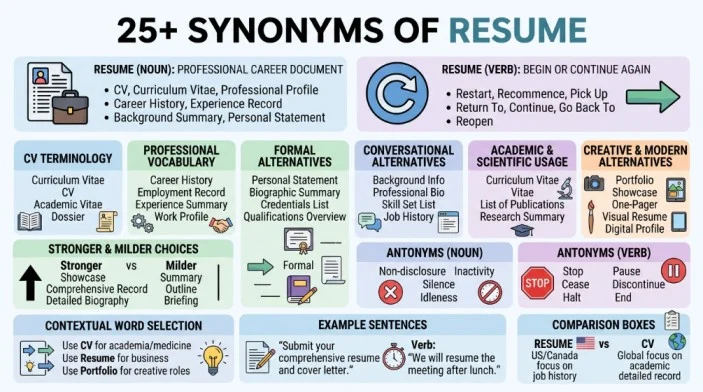
You may use the word resume in a job application, an email, an essay, or a sentence about starting something again. That creates an interesting vocabulary problem because synonym of resume can point to two different meanings. As a noun, a resume is a document that summarizes your education, skills, and work experience. As a verb, resume means to begin something again after it has stopped.
The best alternative depends entirely on which meaning you intend. For a job application, words such as CV, curriculum vitae, and professional profile may work. When resume means starting again, alternatives such as restart, continue, recommence, and renew may be more accurate. Understanding these differences helps you avoid awkward word choices and communicate your exact meaning.
What Are the Best Synonyms of “Resume”?
The best synonym of resume depends on its meaning. For the noun referring to a job document, use CV, curriculum vitae, or professional profile. For the verb meaning to start again, use restart, continue, recommence, renew, or return to. Formal writing favors recommence and continue, while everyday speech usually prefers restart or continue.
Meaning, Tone, and Context
The word resume has two common meanings in American English. Knowing which sense you are using is essential because its synonyms are not interchangeable.
Simple Definition
As a noun, a resume is a document that presents a person’s education, employment history, skills, qualifications, and relevant achievements, usually for employment purposes.
Example:
“I updated my resume before applying for the marketing position.”
As a verb, resume means to begin an activity again after an interruption or pause.
Example:
“The meeting will resume after lunch.”
These two meanings require completely different synonym choices.
Part of Speech
Resume can function as:
| Part of Speech | Meaning | Example |
|---|---|---|
| Noun | A document describing professional qualifications | “Please attach your resume.” |
| Verb | To begin again after an interruption | “The discussion will resume shortly.” |
Overall Tone
The noun resume has a neutral and professional tone when referring to a job document.
The verb resume also has a neutral tone, but it often sounds somewhat formal compared with everyday alternatives such as start again or continue.
Formality Level
| Use | Formality |
|---|---|
| Resume as a job document | Neutral to professional |
| Resume as a verb | Neutral to formal |
| Restart | Neutral and conversational |
| Continue | Neutral and widely used |
| Recommence | Formal |
| Rebegin | Less common and somewhat formal |
| Start again | Informal to neutral |
Common Uses of Resume as a Noun
A resume commonly appears in:
- Job applications
- Career websites
- Recruitment
- Interviews
- Cover letters
- Professional networking
- Career fairs
- Internship applications
- Graduate applications
- Employment emails
Common Uses of Resume as a Verb
The verb resume commonly appears with:
- Work
- Activities
- Meetings
- Discussions
- Talks
- Operations
- Services
- Travel
- Classes
- Negotiations
Examples:
“Classes will resume on Monday.”
“The company resumed operations after the storm.”
“She resumed her research after returning from vacation.”
Word Forms
| Form | Word | Example |
|---|---|---|
| Noun | resume | “Send your resume today.” |
| Verb | resume | “The meeting will resume soon.” |
| Third person verb | resumes | “The program resumes next week.” |
| Past tense | resumed | “Work resumed in the afternoon.” |
| Present participle | resuming | “The team is resuming negotiations.” |
A Note About “Resume” and “Résumé”
In American English, resume and résumé commonly refer to the same employment document. The accent marks are often omitted in modern English writing.
The verb resume is different in meaning. It means to begin again after an interruption.
Context usually makes the intended meaning clear.
When and How to Use “Resume”
Choose resume when you want a concise, professional word that communicates either a professional document or the continuation of something after a pause.
Professional
“Please send your updated resume before the interview.”
Here, resume refers to a professional document.
Academic
“The seminar will resume after a brief discussion.”
Here, resume means the seminar will begin again.
Workplace
“Employees may resume work once the inspection is complete.”
The verb emphasizes returning to an activity after an interruption.
Personal
“After taking a short break, I resumed reading.”
Resumed sounds natural when describing an activity that was paused.
“We will resume our conversation once the necessary information is available.”
This is a professional way to say the conversation will continue later.
Resume
“Prepared and submitted resumes for multiple internship opportunities.”
Here, the noun refers to employment documents.
Social Media
“After a short break, I’m excited to resume sharing new projects.”
The verb communicates a return to an activity.
Best Synonyms of “Resume”
No single synonym of resume works in every situation because the word has two distinct meanings. The most accurate alternative depends first on whether you mean a professional document or the act of starting something again.
Professional Writing
CV is a useful alternative when referring to a professional document, particularly in international or academic contexts.
“Please submit your CV with your application.”
For a general American job application, however, resume is usually the more natural term.
Academic Writing
Recommence can replace the verb resume in highly formal writing.
“The experiment will recommence after the equipment has been checked.”
However, resume or continue often sounds more natural.
Business Communication
Continue is often the best alternative when the meaning is to carry on with something.
“We will continue the discussion tomorrow.”
It is straightforward and less formal than resume.
Casual Conversation
Start again or restart usually sounds more natural.
“Let’s restart the meeting after everyone arrives.”
Emotional Writing
Return to can express a thoughtful return to an activity or subject.
“She returned to writing after several difficult years.”
This often carries more emotional depth than the simple verb resume.
Creative Writing
Renew can work when an activity, effort, relationship, or commitment begins again with a sense of fresh energy.
“He renewed his efforts to rebuild the community.”
Resume Writing
For the noun meaning an employment document, CV is the closest widely recognized alternative.
“Attach your CV to the application.”
In the United States, however, resume is generally the more familiar term for a concise job application document.
Workplace Communication
Continue is often preferable when clarity matters more than formality.
“We can continue the meeting after lunch.”
Stronger Meaning
Recommence can sound more formal than resume, but it does not necessarily express a stronger action. It mainly raises the level of formality.
Softer Meaning
Continue often feels less formal and less abrupt than resume.
“Let’s continue our conversation tomorrow.”
When Not to Use “Resume”
The word resume is useful, but it is not always the clearest choice.
When the Meaning Is Too General
If you mean that an activity should begin from the beginning, restart may be clearer.
Less Precise:
“We need to resume the process.”
Better:
“We need to restart the process from the beginning.”
Why:
Resume usually suggests continuing from the point where something stopped. Restart can indicate beginning again.
When You Mean Simple Continuation
In casual conversation, continue may sound more natural.
Less Natural:
“Please resume eating.”
Better:
“Please continue eating.”
Why:
Continue is more conversational in ordinary situations.
When You Mean a Complete New Beginning
Resume may be misleading if the previous activity is finished and a completely new version is starting.
Less Precise:
“The company resumed its project.”
Better:
“The company restarted the project with a new plan.”
Why:
Restarted makes the new beginning clearer.
When You Mean an Employment Document in American English
CV is not always the best replacement for resume in the United States.
Less Natural for a Typical U.S. Job Application:
“Please send your CV for this entry-level position.”
Better:
“Please send your resume for this entry-level position.”
Why:
In the United States, resume is the standard term for the concise employment document used in most job applications.
When the Word Sounds Too Formal
In casual speech, resume can sound more formal than necessary.
Formal:
“The meeting will resume at three.”
More Conversational:
“The meeting will continue at three.”
When You Need a More Specific Professional Term
If you are describing a particular type of career document, CV, professional profile, or career profile may provide more information.
General:
“I updated my resume.”
More Specific:
“I updated my professional profile to highlight my leadership experience.”
Words Commonly Confused With “Resume”
Because resume has two meanings, several related words can cause confusion.
| Word | Difference | When to Use It | Example |
|---|---|---|---|
| CV | A professional or academic document containing qualifications and experience. | Jobs, academia, international applications. | “She submitted her CV for the research position.” |
| Restart | Begin something again, often from the beginning. | Technology, projects, processes, activities. | “Restart the computer and try again.” |
| Continue | Carry on with something that was already happening. | Everyday and professional communication. | “We can continue the discussion tomorrow.” |
| Recommence | Begin again after a pause, with a formal tone. | Formal writing and official communication. | “The hearing will recommence next week.” |
| Renew | Begin again or restore something, often with an idea of fresh effort or validity. | Efforts, subscriptions, relationships, commitments. | “She renewed her efforts to improve the program.” |
| Return to | Go back to an activity, subject, or task. | Personal, academic, and creative writing. | “He returned to his studies after a year away.” |
Best Synonyms of “Resume” by Context
| Context | Best Synonym | Why It Works | Example |
|---|---|---|---|
| Formal writing | Recommence | Clearly communicates a formal return to an activity. | “The proceedings will recommence shortly.” |
| Academic writing | Continue | Precise and natural in academic prose. | “The study continued after the interruption.” |
| Professional communication | Continue | Clear and widely understood. | “We can continue the discussion tomorrow.” |
| Business emails | Resume | Concise and professional. | “We will resume negotiations next week.” |
| Resume writing | CV | Closest common alternative for a professional document. | “Please attach your CV.” |
| Workplace communication | Continue | Sounds natural and direct. | “Work will continue after lunch.” |
| Casual conversation | Start again | Easy for everyday speakers to understand. | “Let’s start again from the beginning.” |
| Everyday speaking | Continue | Natural and uncomplicated. | “You can continue when you’re ready.” |
| Creative writing | Return to | Adds a sense of returning to something meaningful. | “She returned to painting after many years.” |
| Storytelling | Resume | Maintains a polished narrative tone. | “He resumed his journey before sunrise.” |
| Emotional writing | Return to | Can suggest renewed connection or personal reflection. | “She returned to the place she loved.” |
| Strong emphasis | Restart | Clearly signals a new beginning. | “The team had to restart the project.” |
| Mild tone | Continue | Avoids unnecessary emphasis. | “Let’s continue the conversation.” |
| Social media captions | Restart | Short and energetic. | “New chapter, fresh start, ready to restart.” |
| American English | Resume | Standard term for a job document. | “Send your resume with the application.” |
| British English | CV | Common term for a professional document. | “Please send your CV.” |
How to Choose the Best Synonym of “Resume”
Choosing the right synonym becomes easier when you identify the intended meaning before replacing the word.
Step 1: Identify the Meaning
Ask whether resume means:
- A professional document.
- Starting something again.
If it means a professional document, consider CV.
If it means starting again, consider continue, restart, recommence, renew, or return to.
Step 2: Consider the Context
A business email may favor resume or continue.
A casual conversation will usually sound more natural with continue or start again.
An academic paper may use resume, continue, or recommence, depending on the level of formality.
Step 3: Consider the Exact Meaning
- Use continue when an activity carries on.
- Use restart when something begins again, especially from the start.
- Use resume when an interrupted activity picks up again.
- Use renew when something is restored or undertaken with fresh effort.
- Use return to when emphasizing a person’s movement back to an activity or subject.
Step 4: Match the Audience
For a U.S. employer, resume is generally the safest term for the employment document.
For an international or academic audience, CV may be more appropriate.
Step 5: Check the Tone
Resume is neutral and professional.
Continue is neutral and conversational.
Recommence is formal.
Restart is direct and modern.
Return to is flexible and often more expressive.
Real Life Examples of “Resume”
School
Original:
“Classes will resume on Monday.”
Alternative:
“Classes will continue on Monday.”
Both work because the classes were interrupted and will carry on.
College
Original:
“The lecture will resume after the break.”
Alternative:
“The lecture will continue after the break.”
Continue is often more conversational, while resume has a slightly more formal sound.
Workplace
Original:
“Employees can resume work after the inspection.”
Alternative:
“Employees can continue working after the inspection.”
The second version sounds especially natural in everyday workplace communication.
Business
Original:
“The company plans to resume negotiations.”
Alternative:
“The company plans to restart negotiations.”
Restart suggests that negotiations may begin again as a new phase, while resume focuses on continuing after an interruption.
Original:
“We will resume discussions once the contract has been reviewed.”
Alternative:
“We will continue discussions once the contract has been reviewed.”
The second version is slightly more conversational while remaining professional.
Resume
Original:
“Please attach your resume to the application.”
Alternative:
“Please attach your CV to the application.”
For a typical U.S. job application, resume is usually the more natural choice.
Conversation
Original:
“Let’s resume our conversation tomorrow.”
Alternative:
“Let’s continue our conversation tomorrow.”
The second version generally sounds more natural in everyday speech.
Storytelling
Original:
“After the storm passed, the travelers resumed their journey.”
Alternative:
“After the storm passed, the travelers continued their journey.”
Both are correct, but resumed gives the sentence a slightly more polished narrative tone.
Blogging
Original:
“I plan to resume writing next month.”
Alternative:
“I plan to start writing again next month.”
The alternative is more conversational and immediately clear to a broad audience.
Social Media
Original:
“After a short break, I’m ready to resume creating.”
Alternative:
“After a short break, I’m ready to start creating again.”
The second version feels more casual and personal.
25 Best Synonyms of “Resume”
Because resume has two distinct meanings, the following list includes accurate alternatives for both the professional document sense and the restart or continuation sense. Context determines which words can actually replace it.
| Synonym | Simple Meaning | Best Used For | Example Sentence |
|---|---|---|---|
| CV | A document showing education and professional qualifications | Employment and academic applications | “I attached my CV to the application.” |
| Curriculum vitae | A detailed record of academic and professional experience | Academic and formal contexts | “The professor requested her curriculum vitae.” |
| Professional profile | A summary of career qualifications and experience | Career websites and professional documents | “His professional profile highlights his management experience.” |
| Career profile | A summary of a person’s professional background | Resumes and career materials | “Her career profile emphasizes ten years of experience.” |
| Professional summary | A brief overview of career strengths | Resume sections | “The professional summary highlights his leadership skills.” |
| Continue | Keep doing something | Everyday and professional communication | “We can continue the meeting tomorrow.” |
| Restart | Start again | Projects, systems, activities | “The team decided to restart the project.” |
| Recommence | Begin again after a pause | Formal writing | “The hearing will recommence next week.” |
| Renew | Begin or restore something again | Efforts, commitments, activities | “She renewed her efforts to improve the program.” |
| Return to | Go back to an activity or subject | Personal and creative writing | “He returned to his studies after a break.” |
| Rebegin | Begin again | Formal or literary contexts | “The process had to rebegin after the error.” |
| Carry on | Continue doing something | Casual conversation | “Let’s carry on with the project.” |
| Pick up again | Continue after a pause | Everyday conversation | “We can pick up again tomorrow.” |
| Start again | Begin another time | Casual communication | “Let’s start again from the first step.” |
| Begin again | Start another time | General writing | “The team decided to begin again.” |
| Reestablish | Establish again after interruption | Formal and professional contexts | “The company worked to reestablish communication.” |
| Reinitiate | Start an activity or process again | Business and technical writing | “The team will reinitiate negotiations.” |
| Reopen | Open again after closing | Cases, discussions, investigations | “Officials decided to reopen the investigation.” |
| Reactivate | Make active again | Accounts, systems, programs | “The administrator reactivated the account.” |
| Reengage | Become involved again | Professional and social contexts | “The campaign aims to reengage former customers.” |
| Reawaken | Become active or interested again | Emotional and creative writing | “The experience reawakened her interest in art.” |
| Rekindle | Restore a feeling or relationship | Emotional and literary writing | “The reunion helped rekindle their friendship.” |
| Reinstate | Restore something to a previous position or condition | Jobs, policies, privileges | “The company reinstated the employee.” |
| Revisit | Return to a topic or idea | Academic and professional writing | “The committee will revisit the proposal.” |
| Pick up where you left off | Continue from the previous point | Conversation and informal writing | “Tomorrow, we’ll pick up where we left off.” |
Synonyms of “Resume” by Usage
Professional vs Personal Synonyms
Professional settings favor precise and established vocabulary.
For a job document, resume, CV, and curriculum vitae are appropriate depending on the country and context.
For returning to work or an activity, resume, continue, and reengage can work well.
Personal communication usually favors simpler expressions such as continue, start again, return to, and pick up again.
Formal vs Conversational Synonyms
- For reports, official notices, and formal documents, resume, recommence, and reinitiate may be appropriate.
- For essays, resume, continue, and return to are usually more natural.
- For business writing, resume, continue, and recommence can work depending on the tone.
- For presentations, continue is often clearer when speaking to an audience.
- For emails, resume and continue are both useful.
- For casual conversations and texting, continue, start again, and pick up where you left off generally sound more natural.
Academic Synonyms
Academic writing requires precision, but it does not always require the most complicated synonym.
Continue
“The researchers continued the experiment after replacing the damaged equipment.”
This is clear and natural.
Resume
“The experiment resumed after the equipment was replaced.”
This is concise and appropriately formal.
Recommence
“The experiment recommenced after the equipment was replaced.”
This is grammatically correct but more formal than many academic writers need.
Return to
“The researchers returned to the original research question.”
This is useful when discussing a topic rather than simply continuing an interrupted activity.
Professional and Business Synonyms
Resumes
Use resume when discussing a job application document in American English.
“Please submit your resume by Friday.”
Interviews
Use professional profile when discussing a concise career overview.
“Her professional profile demonstrates extensive leadership experience.”
Meetings
Use continue when speaking naturally.
“Let’s continue the meeting after lunch.”
Presentations
Use resume when announcing a formal return.
“We will resume the presentation after the break.”
Performance Reviews
Use professional summary when describing a concise overview of someone’s qualifications.
“The professional summary highlights his strongest achievements.”
Client Communication
Use continue when clarity and natural tone are priorities.
“We can continue our discussion after you review the proposal.”
Business Emails
Use resume for concise formal communication.
“We expect to resume negotiations next week.”
Creative and Literary Synonyms
Creative writing allows more expressive alternatives than professional communication.
Return to
This can create a sense of emotional or physical return.
“Years later, she returned to the house where her story had begun.”
Renew
This can suggest fresh energy or commitment.
“He renewed his promise to protect the village.”
Rekindle
This is especially effective for feelings, relationships, memories, or enthusiasm.
“The old photograph rekindled memories of childhood.”
Reawaken
This can suggest that an emotion, interest, or desire becomes active again.
“The journey reawakened her love of painting.”
Revisit
This works well when a character or narrator returns to an idea, memory, or subject.
“The author revisited the memory in the final chapter.”
Slang or Modern Synonyms
There is no single true slang synonym for resume that works across both meanings.
In informal American English, speakers commonly use expressions such as start again, keep going, carry on, and pick up where you left off.
These expressions are suitable for casual conversation and texting but should generally be avoided in formal academic or professional documents when a more precise term is available.
Strongest to Mildest Synonyms
The intensity of resume synonyms is not exactly a measure of importance. Instead, the differences usually involve formality, force, or the type of return being described.
Mild
Continue
“Let’s continue the discussion.”
Mild to Moderate
Resume
“The meeting will resume shortly.”
Moderate
Restart
“We need to restart the process.”
Stronger Formal Emphasis
Reinitiate
“The organization decided to reinitiate negotiations.”
Strong Contextual Emphasis
Reestablish
“The company worked to reestablish communication with its customers.”
The important distinction is that restart can suggest beginning from the start, while resume usually suggests returning to something that was already underway.
Emotional vs Neutral Synonyms
Emotional Synonyms
These alternatives can communicate more than simple continuation.
Return to can suggest personal reconnection.
Renew can suggest fresh determination.
Rekindle can express renewed emotion.
Reawaken can describe the return of feelings, interest, or memories.
Example:
“The trip rekindled her passion for photography.”
Neutral Synonyms
These simply communicate that something happens again or continues.
Continue
“The class continued after the break.”
Resume
“The class resumed after the break.”
Restart
“The computer restarted after the update.”
Neutral alternatives are generally better for factual reports, workplace communication, and straightforward explanations.
Antonyms of “Resume”
The following opposites apply to the verb sense of resume, meaning to begin or continue something again after an interruption. The noun sense, meaning a job document, does not have a direct antonym.
| Antonym | Meaning | Example Sentence |
|---|---|---|
| Stop | Cease an activity | “The workers stopped when the alarm sounded.” |
| Cease | Stop completely | “The factory ceased production.” |
| End | Bring something to a conclusion | “The meeting ended at noon.” |
| Halt | Stop an activity, often suddenly | “The company halted construction.” |
| Discontinue | Stop doing or providing something | “The service was discontinued.” |
| Suspend | Temporarily stop something | “The program was suspended for review.” |
| Pause | Temporarily stop an activity | “She paused the video.” |
| Abandon | Give up an activity or plan | “The team abandoned the project.” |
| Terminate | Bring something formally to an end | “The contract was terminated.” |
| Conclude | Bring an event or activity to its end | “The committee concluded the meeting.” |
| Finish | Complete something | “They finished the assignment early.” |
| Interrupt | Stop something before it continues | “The announcement interrupted the presentation.” |
| Cancel | Decide that something will not happen | “The organizers canceled the event.” |
| Quit | Stop an activity or leave it | “He quit the training program.” |
| Relinquish | Give up control, responsibility, or a claim | “She relinquished her role as team leader.” |
Comparison: “Resume” vs Similar Words
Resume vs Continue
Main Difference
Resume usually means continuing something after it has been interrupted. Continue has a broader meaning and can describe something that carries on without a clear interruption.
Which Is Stronger?
Neither is inherently stronger.
Which Is More Formal?
Resume can sound slightly more formal.
When to Use Each
Use resume when an activity has stopped and is starting again.
Use continue when something simply carries on.
Examples
Resume:
“The meeting resumed after the break.”
Continue:
“The meeting continued for another hour.”
Resume vs Restart
Main Difference
Resume usually means returning to an activity where it stopped. Restart often means beginning again, sometimes from the beginning.
Which Is Stronger?
Restart can imply a more complete new beginning.
Which Is More Formal?
Resume generally sounds more formal.
When to Use Each
Use resume for interrupted activities.
Use restart when a process or system needs to begin again.
Examples
Resume:
“The team resumed work after lunch.”
Restart:
“The team restarted the project with a new strategy.”
Resume vs Recommence
Main Difference
Both mean beginning again after a pause. Recommence is more formal and less common in everyday speech.
Which Is Stronger?
Neither is stronger in meaning.
Which Is More Formal?
Recommence is more formal.
When to Use Each
Use resume for normal professional communication.
Use recommence when a formal tone is appropriate.
Examples
Resume:
“The hearing will resume tomorrow.”
Recommence:
“The proceedings will recommence tomorrow.”
Resume vs Renew
Main Difference
Resume means starting or continuing an activity after an interruption. Renew often suggests restoring something, refreshing an effort, or making something valid again.
Which Is Stronger?
Renew can carry a stronger sense of restoration or fresh commitment.
Which Is More Formal?
Both can work in formal writing.
When to Use Each
Use resume for activities.
Use renew for efforts, subscriptions, agreements, relationships, or commitments.
Examples
Resume:
“She resumed her studies.”
Renew:
“She renewed her commitment to education.”
Resume vs Return
Main Difference
Resume focuses on continuing an activity. Return focuses on going back to an activity, place, topic, or state.
Which Is Stronger?
Neither is universally stronger.
Which Is More Formal?
Both are neutral, but return to can sound more literary depending on context.
When to Use Each
Use resume for interrupted activities.
Use return to when emphasizing a person’s or subject’s movement back.
Examples
Resume:
“He resumed his work after lunch.”
Return to:
“He returned to his work after several months away.”
Resume vs Reinitiate
Main Difference
Resume suggests continuation after interruption. Reinitiate emphasizes starting a process again.
Which Is Stronger?
Reinitiate can suggest a more deliberate restart.
Which Is More Formal?
Reinitiate is more formal and technical.
When to Use Each
Use resume for ordinary continuation.
Use reinitiate for formal, technical, or organizational processes.
Examples
Resume:
“The company resumed talks.”
Reinitiate:
“The company reinitiated negotiations after reviewing the proposal.”
Common Phrases and Expressions with “Resume”
Resume Work
Meaning: Start working again after a pause or interruption.
Example:
“Employees can resume work after the inspection.”
Resume Operations
Meaning: Begin normal business or activity again.
Example:
“The airport resumed operations after the storm.”
Resume Duties
Meaning: Return to one’s normal responsibilities.
Example:
“She resumed her duties after returning from leave.”
Resume Activities
Meaning: Begin an activity again after a pause.
Example:
“The students resumed their activities after lunch.”
Resume Discussions
Meaning: Continue a conversation or negotiation after an interruption.
Example:
“The two sides agreed to resume discussions next week.”
Resume Negotiations
Meaning: Begin negotiations again after they have stopped.
Example:
“The companies plan to resume negotiations soon.”
Resume Classes
Meaning: Begin classes again after a break.
Example:
“Classes will resume after the holiday.”
Resume Your Journey
Meaning: Continue traveling after stopping.
Example:
“After resting for an hour, the travelers resumed their journey.”
Common Mistakes to Avoid
1. Confusing Resume With Restart
Incorrect:
“We resumed the computer because it froze.”
Better:
“We restarted the computer because it froze.”
Why:
A computer that freezes is normally restarted. Resume does not usually describe turning a malfunctioning computer back on.
2. Using CV Automatically in American English
Incorrect:
“I sent my CV to every company in the United States.”
Better:
“I sent my resume to every company in the United States.”
Why:
For most standard U.S. job applications, resume is the familiar term. CV is also understood but can imply a more academic or detailed document depending on context.
3. Using Resume When You Mean Start From the Beginning
Incorrect:
“Let’s resume the project from the beginning.”
Better:
“Let’s restart the project from the beginning.”
Why:
Resume normally suggests continuing from where something stopped. Restart clearly indicates a new beginning.
4. Using Recommence in Casual Conversation
Incorrect:
“Let’s recommence our movie.”
Better:
“Let’s continue the movie.”
Why:
Recommence is grammatically possible but unnecessarily formal for everyday speech.
5. Confusing Resume With Renew
Incorrect:
“I need to resume my driver’s license.”
Better:
“I need to renew my driver’s license.”
Why:
Renew means extending or restoring validity. Resume means beginning again after an interruption.
6. Using a Resume Synonym Without Checking the Meaning
Incorrect:
“She uploaded her restart to the job website.”
Better:
“She uploaded her resume to the job website.”
Why:
The noun resume refers to a career document. Words such as restart cannot replace it.
7. Treating Every Resume Synonym as Interchangeable
Incorrect:
“The company renewed the meeting after lunch.”
Better:
“The company resumed the meeting after lunch.”
Why:
A meeting can be resumed, but renew usually applies to something restored, extended, or undertaken with fresh commitment.
Frequently Asked Questions
1. What is the best synonym of “resume”?
The best synonym of resume depends on its meaning. For a job document, CV is the closest common alternative. For starting again, continue, restart, recommence, and return to are useful choices.
2. What are the best formal synonyms of “resume”?
For the verb meaning to begin again, formal alternatives include recommence, reinitiate, and reestablish, depending on context. For the employment document, curriculum vitae is a formal alternative to resume.
3. What are common informal synonyms of “resume”?
Common informal alternatives for the verb include start again, keep going, carry on, and pick up again. These expressions are natural in everyday American conversation but are less suitable for formal documents.
4. What is another word for “resume” in professional writing?
For a professional document, CV or curriculum vitae may work depending on context. For the verb, continue is often the clearest alternative, while recommence provides a more formal tone.
5. What is the difference between “resume” and “restart”?
Resume usually means continuing an activity from the point where it stopped. Restart often suggests beginning again, potentially from the beginning. For example, you resume a meeting but may restart a failed project.
6. What is the opposite of “resume”?
The opposite of resume as a verb can be stop, cease, halt, discontinue, suspend, or end, depending on the situation. The noun resume, meaning a job document, has no direct antonym.
Conclusion
The word resume has two important meanings, and choosing the right synonym depends on which one you intend. As a noun, it refers to a professional document, with CV, curriculum vitae, and professional profile serving as possible alternatives. As a verb, it means beginning or continuing something after an interruption.
For everyday communication, continue is often the simplest alternative. Restart is better when something begins again, recommence suits formal writing, and return to works well when the emphasis is on going back to an activity or subject. There is no single perfect synonym of resume for every sentence.
The best vocabulary habit is to identify the exact meaning first, then choose the alternative that matches your audience, tone, and purpose.
Read More Related Articles:
50+ Synonyms of Autonomy | Meanings, Uses, Examples, and …
Synonyms for Pros and Cons | Meaning, Examples, and Better …
25+ Synonyms, Meanings, Uses, and Best Alternatives










4 thoughts on “25+ Synonyms of Resume | Meanings, Uses, Examples, and Best Alternatives”