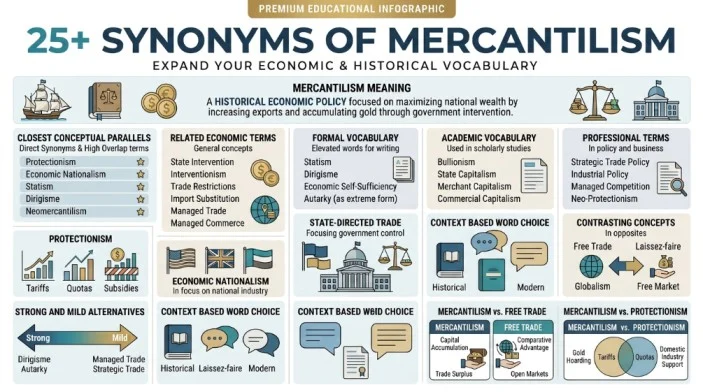
The right synonym can make a complex historical or economic idea much easier to explain. Synonyms of Mercantilism are especially useful when writing about trade, economic policy, colonial expansion, protectionism, or the belief that national wealth depends heavily on controlling commerce. However, not every related word carries exactly the same meaning or tone. Terms such as protectionism, commercialism, trade nationalism, and economic nationalism may overlap with mercantilism, but they can describe different ideas depending on the context.
This guide explores Synonyms of Mercantilism with clear meanings, practical examples, and context-based usage. The goal is not simply to provide a list of similar words, but to show where each alternative fits naturally. Whether you are writing a history assignment, economics article, research paper, or educational content, choosing the right term can make your explanation more precise, credible, and easier to understand.
What Are the Best Synonyms of “Mercantilism”?
Mercantilism is a historical economic doctrine associated with strong government involvement in trade, export promotion, import restrictions, and the pursuit of national wealth. There is no perfect one word synonym. Economic nationalism, protectionism, trade protection, and state directed trade are useful alternatives when their specific meanings match the context.
Meaning, Tone, and Context
Simple Definition
Mercantilism is an economic theory and policy approach associated especially with Europe from the 16th through the 18th centuries. It emphasized government control or influence over economic activity and sought to strengthen national wealth through trade policies, particularly by promoting exports and restricting imports.
The term is also used more broadly in modern economic and political discussion to describe policies involving strong state influence over trade, protection of domestic industries, and efforts to favor national economic interests.
Part of Speech
Mercantilism is a noun.
It is normally used as an uncountable noun:
“Mercantilism shaped European trade policy.”
You generally would not say “a mercantilism” when referring to the economic doctrine itself.
Overall Tone
The tone is generally neutral in historical and academic writing, although it can become critical when writers use the term to describe aggressive protectionism, trade restrictions, or policies that prioritize national commercial interests.
Formality Level
Mercantilism is a formal and specialized term. It is particularly common in:
- History
- Economics
- Political science
- International relations
- Trade studies
- Academic writing
- Government and policy analysis
It is less common in casual conversation.
Common Uses
The word commonly appears in phrases such as:
- Mercantilist policies
- Mercantilist theory
- Mercantilist system
- Mercantilist trade
- European mercantilism
- Colonial mercantilism
- Economic mercantilism
- Modern mercantilism
- Mercantilist government
- Mercantilist practices
Cambridge also notes the term’s use in business and economic contexts for government efforts to influence trade, particularly through encouraging exports and limiting imports.
Word Forms
| Word | Part of Speech | Example |
|---|---|---|
| Mercantilism | Noun | “Mercantilism influenced European trade.” |
| Mercantilist | Noun or adjective | “Mercantilist policies favored exports.” |
| Mercantilist | Adjective | “The government followed a mercantilist approach.” |
| Mercantile | Adjective | “The city became an important mercantile center.” |
Mercantile should not be treated as a direct synonym for mercantilism. Mercantile generally means related to trade or business, while mercantilism refers to a particular economic doctrine or policy tradition.
When and How to Use “Mercantilism”
Use mercantilism when you are referring specifically to the economic doctrine or to policies and practices that reflect its characteristic emphasis on state control, trade advantages, exports, and restrictions on imports.
Professional Context
“The report examines how modern trade restrictions can resemble certain features of mercantilism.”
This usage is appropriate when discussing economic policy.
Academic Context
“Mercantilism played an important role in the economic history of early modern Europe.”
This is a natural use in a history or economics essay.
Workplace Context
“The presentation compares modern industrial policy with historical mercantilism.”
The term works when the workplace discussion involves economics, international trade, or policy.
Personal Context
“I learned about mercantilism in my history class.”
This is appropriate for everyday discussion of a historical subject.
Email Context
“I’ve attached the section of the report covering mercantilism and colonial trade.”
This works in an academic or professional email.
Resume Context
“Researched mercantilism and colonial trade systems for a university history project.”
The word can appear on a resume when describing relevant academic research.
Social Media Context
“Studying mercantilism makes the history of international trade much easier to understand.”
This works for an educational social media post.
Best Synonyms of “Mercantilism”
A key point comes first: mercantilism does not have 25 perfect dictionary synonyms. It identifies a relatively specific economic doctrine, so replacing it with unrelated terms would create inaccurate writing.
Some expressions are close alternatives in particular contexts, while others describe one feature of mercantilism rather than the entire doctrine. The distinction matters, especially in academic writing.
Professional Writing: Economic Nationalism
Economic nationalism is often the strongest alternative when the emphasis is on using government policy to advance national economic interests.
“The policy reflected a form of economic nationalism.”
It is broader than mercantilism, so it should not automatically replace the historical term.
Academic Writing: Mercantilist Economic Policy
Mercantilist economic policy is useful when you want to retain the historical meaning while emphasizing government action.
“The monarchy adopted mercantilist economic policies to strengthen domestic trade.”
Business Communication: Protectionism
Protectionism works when the specific feature being discussed is the protection of domestic industries from foreign competition.
“The government introduced protectionist measures to support domestic manufacturers.”
Protectionism is not identical to mercantilism because protectionism can occur independently of the broader mercantilist system.
Casual Conversation: Trade Protection
Trade protection is easier to understand in general conversation when the discussion focuses on import restrictions or support for domestic producers.
“The government introduced trade protection to help local industries.”
Emotional Writing: Commercialism
Commercialism can work when the focus is on an excessive emphasis on commercial interests or profit.
“Critics viewed the policy as a form of commercialism.”
However, commercialism does not mean mercantilism. It carries a different emphasis.
Creative Writing: Merchant Driven Policy
Merchant driven policy can work in historical prose when the writer wants to emphasize the interests of merchants.
“The kingdom developed a merchant driven policy to expand overseas trade.”
This is descriptive rather than a true synonym.
Resume Writing: Trade Policy Analysis
For a resume, trade policy analysis is often more useful than simply writing mercantilism.
“Conducted trade policy analysis focusing on historical mercantilist systems.”
It describes the activity rather than pretending that mercantilism itself is a modern job function.
Workplace Communication: State Directed Trade
State directed trade is useful when government involvement in trade is the central point.
“The article examines the role of state directed trade in early modern economies.”
Stronger Meaning: Protectionist Economic Policy
Use protectionist economic policy when the discussion specifically emphasizes tariffs, import restrictions, or domestic industry protection.
Softer Meaning: State Guided Trade
State guided trade is a broader and less historically specific expression for government influence over commercial activity.
When Not to Use “Mercantilism”
When You Mean Any Form of Trade
It would be inaccurate to call ordinary commercial activity mercantilism.
Less Precise:
“International trade is a form of mercantilism.”
Better:
“International trade is a form of commerce.”
Why:
Trade itself is not mercantilism. Mercantilism refers to a particular approach to economic policy and national wealth.
When You Mean Protectionism Only
Protectionism overlaps with mercantilism but is narrower.
Less Precise:
“All protectionism is mercantilism.”
Better:
“Protectionism can be an important feature of mercantilist policy.”
Why:
Protectionism can exist without the broader mercantilist framework.
When You Mean Capitalism
Mercantilism and capitalism are related historically, but they are not interchangeable.
Less Precise:
“The country developed capitalism through mercantilism.”
Better:
“The country’s commercial development occurred during the period when mercantilist policies were influential.”
Why:
The two concepts describe different economic ideas and systems.
When You Mean Commercialism
Commercialism focuses on commercial interests or an emphasis on commerce and profit.
Less Precise:
“Modern advertising is mercantilism.”
Better:
“Modern advertising can be criticized for excessive commercialism.”
Why:
Commercialism is the more appropriate term when the focus is commercialization rather than state trade policy.
When You Need a Modern Policy Term
Using mercantilism for every modern trade intervention can sound historically loaded.
Less Precise:
“The government introduced mercantilism.”
Better:
“The government introduced protectionist trade policies.”
Why:
The second sentence identifies the specific modern policy instead of applying a broad historical label.
Words Commonly Confused With “Mercantilism”
Protectionism
Difference: Protectionism refers to policies that protect domestic industries from foreign competition, often through tariffs, quotas, or other trade barriers.
When to Use It: Use it when the central topic is restricting foreign competition.
Example:
“The government adopted protectionism to support domestic steel producers.”
Economic Nationalism
Difference: Economic nationalism prioritizes a nation’s economic interests in policymaking. It is broader than mercantilism.
When to Use It: Use it when national economic priorities are the main focus.
Example:
“The new policy reflected a stronger form of economic nationalism.”
Capitalism
Difference: Capitalism is a broader economic system centered on private ownership and market activity. It is not another name for mercantilism.
When to Use It: Use it when discussing market economies and private ownership.
Example:
“Capitalism developed in complex ways after the era of mercantilism.”
Commercialism
Difference: Commercialism emphasizes commercial activity, profit, or the tendency to treat things primarily as commercial opportunities.
When to Use It: Use it when discussing commercialization rather than state trade policy.
Example:
“Critics objected to the growing commercialism of the cultural industry.”
Mercantilism
Difference: Mercantilism refers specifically to a historical economic doctrine and related policies emphasizing state influence over trade and national wealth.
When to Use It: Use it for the historical doctrine or modern policies that clearly resemble its characteristics.
Example:
“Mercantilism influenced the trade policies of several European powers.”
Best Synonyms of “Mercantilism” by Context
| Context | Best Synonym or Alternative | Why It Works | Example |
|---|---|---|---|
| Formal writing | Economic nationalism | Emphasizes national economic interests. | “The policy reflected economic nationalism.” |
| Academic writing | Mercantilist economic policy | Preserves historical precision. | “Mercantilist economic policy shaped colonial trade.” |
| Professional communication | State directed trade | Highlights government influence. | “The study examines state directed trade.” |
| Business emails | Trade protection | Clear when discussing trade restrictions. | “The report covers recent trade protection measures.” |
| Resume writing | Trade policy analysis | Describes a research skill accurately. | “Conducted trade policy analysis.” |
| Workplace communication | Protectionist policy | Useful for domestic industry protection. | “The policy had protectionist features.” |
| Casual conversation | Trade protection | Easier for general audiences. | “The government used trade protection.” |
| Everyday speaking | Government controlled trade | Simple explanatory wording. | “The system involved government controlled trade.” |
| Creative writing | Merchant centered policy | Emphasizes commercial interests. | “The kingdom pursued a merchant centered policy.” |
| Storytelling | Trade control | Simple and readable. | “Trade control became central to the kingdom’s strategy.” |
| Emotional writing | Commercialism | Useful when commercial motives are criticized. | “The writer condemned excessive commercialism.” |
| Strong emphasis | Protectionist economic policy | Highlights restrictive trade measures. | “The government adopted aggressive protectionist economic policies.” |
| Mild tone | State guided trade | Describes government influence without strong judgment. | “The economy relied on state guided trade.” |
| Social media captions | Trade protection | Short and accessible. | “A quick look at the history of trade protection.” |
| American English | Protectionism | Common modern economic term. | “Protectionism remains a major trade policy issue.” |
| British English | Protectionism | Also natural in British economic writing. | “The debate centered on protectionism.” |
How to Choose the Best Synonym of “Mercantilism”
Choosing an alternative requires identifying the exact idea you want to communicate.
If You Mean the Historical Doctrine
Use mercantilism or mercantilist economic policy.
This is the safest choice when writing about early modern European economic thought.
If You Mean Import Restrictions
Use protectionism or trade protection.
These terms are more precise when tariffs, quotas, or barriers to foreign goods are the focus.
If You Mean National Economic Priorities
Use economic nationalism.
This term emphasizes the goal of advancing national economic interests.
If You Mean Government Control
Use state intervention, state directed trade, or government controlled trade, depending on the sentence.
If You Mean Commercial Motivation
Use commercialism when the focus is on commercial interests, commercialization, or excessive concern with profit.
If You Mean Merchant Activity
Use mercantile as an adjective when describing something related to trade or business.
For example:
“The city had a strong mercantile tradition.”
Do not replace mercantilism with mercantile when you mean the economic doctrine.
Real Life Examples of “Mercantilism”
School
Basic:
“Mercantilism was an important topic in our history class.”
More precise:
“Mercantilism was a major economic doctrine in early modern European history.”
College
“The professor explained how mercantilism influenced colonial trade.”
Here, mercantilism is more accurate than protectionism because the discussion concerns the broader historical doctrine.
Workplace
“Our research team is comparing modern protectionism with historical mercantilism.”
This sentence correctly distinguishes the modern policy concept from the historical system.
Business
“The presentation examines how economic nationalism can resemble certain features of mercantilism.”
This wording avoids treating the two concepts as exact synonyms.
“I’ve attached the research notes on mercantilism and colonial trade policies.”
This is appropriate for academic or professional communication.
Resume
“Researched mercantilism, colonial trade, and early modern economic policy.”
This gives the reader specific information about the subject of study.
Conversation
“Mercantilism was basically about using trade policy to strengthen national wealth.”
This is a simplified explanation suitable for casual discussion.
Storytelling
“Under mercantilism, trade policy became closely connected with the ambitions of the state.”
The sentence works well in historical narrative writing.
Blogging
“Mercantilism helps explain why governments once placed such strong emphasis on exports and trade controls.”
This phrasing makes the concept accessible to general readers.
Social Media
“Mercantilism offers a fascinating look at how governments once connected national wealth with trade policy.”
The wording is concise and educational.
25 Best Synonyms and Contextual Alternatives to “Mercantilism”
Because mercantilism is a specialized historical term, a responsible vocabulary guide should not falsely claim that 25 unrelated words are exact synonyms. The table below gives 25 useful synonyms, near synonyms, descriptive alternatives, and closely related terms, with the distinction made clear through their intended use.
| Synonym or Alternative | Simple Meaning | Best Used For | Example Sentence |
|---|---|---|---|
| Economic nationalism | Prioritizing national economic interests | Policy analysis | “The policy reflected economic nationalism.” |
| Protectionism | Protecting domestic industries from foreign competition | Trade discussions | “Protectionism affected the country’s import policy.” |
| Trade protection | Measures that shield domestic trade or industries | General economics | “Trade protection helped local producers.” |
| Protectionist policy | A policy restricting foreign competition | Modern policy writing | “The government adopted a protectionist policy.” |
| State directed trade | Trade strongly influenced by government | Academic analysis | “State directed trade shaped commercial relations.” |
| State intervention | Government involvement in the economy | Economics | “State intervention influenced the market.” |
| Government controlled trade | Trade subject to strong government control | Explanatory writing | “Government controlled trade was central to the system.” |
| State guided commerce | Commerce influenced by public policy | General explanation | “State guided commerce supported national goals.” |
| Mercantilist policy | Policy reflecting mercantilist principles | History | “The monarchy introduced mercantilist policy.” |
| Mercantilist system | An economic system based on mercantilist ideas | Historical writing | “The mercantilist system shaped colonial commerce.” |
| Mercantilist economics | Economic thought associated with mercantilism | Academic writing | “Mercantilist economics emphasized trade advantages.” |
| Mercantilist trade policy | Trade policy based on mercantilist principles | History and economics | “Mercantilist trade policy favored exports.” |
| Export promotion | Policies encouraging exports | Trade policy | “Export promotion became a major government objective.” |
| Import restriction | Limits placed on imported goods | Trade analysis | “Import restrictions protected domestic producers.” |
| Trade restriction | Government limits on trade | Policy writing | “Trade restrictions reduced foreign competition.” |
| Tariff protection | Protection using import taxes | Economics | “Tariff protection increased the cost of imported goods.” |
| Commercial nationalism | National goals pursued through commerce | Analytical writing | “Commercial nationalism influenced overseas expansion.” |
| Merchant centered policy | Policy emphasizing merchant interests | Historical explanation | “Merchant centered policy shaped the port economy.” |
| Trade nationalism | Using trade to advance national interests | International economics | “Trade nationalism affected diplomatic relations.” |
| Commercialism | Strong emphasis on commercial interests | Cultural or economic criticism | “The writer criticized excessive commercialism.” |
| Mercantile policy | Policy connected with trade and merchants | Historical prose | “The kingdom followed a mercantile policy.” |
| Bullionism | Emphasis on accumulating precious metals | Economic history | “Bullionism represented one strand of early modern economic thought.” |
| Cameralism | A related tradition of state economic administration | Historical scholarship | “Cameralism developed alongside other forms of state economic management.” |
| Colonial trade control | Government regulation of colonial commerce | Colonial history | “Colonial trade control benefited the imperial economy.” |
| State controlled commerce | Commerce strongly managed by the state | Historical explanation | “State controlled commerce limited independent trade.” |
Accuracy note: The terms in this table should not all be substituted for mercantilism mechanically. Some describe the entire doctrine only loosely, while others identify one particular feature of it. This distinction is especially important in academic writing.
Synonyms of “Mercantilism” by Usage
Professional vs Personal Synonyms
In professional and academic settings, precision matters more than finding a simple replacement.
Use economic nationalism, protectionism, state intervention, or state directed trade when the exact concept matches the subject.
In personal conversation, expressions such as government controlled trade or trade protection may be easier for a general audience to understand.
For example:
“The historian argues that the policy reflected mercantilism.”
can become:
“The historian argues that the policy reflected economic nationalism.”
The second version works only if national economic interests are the point being emphasized.
Formal vs Conversational Synonyms
Reports
Use protectionism, economic nationalism, or state intervention.
Essays
Use mercantilist policy, mercantilist system, economic nationalism, or protectionism, depending on the argument.
Business Writing
Use trade protection, protectionist policy, or state intervention.
Presentations
Use mercantilism when the audience understands the historical term. Otherwise, briefly explain it.
Emails
Use the original term when discussing a specific historical topic.
Casual Conversations
Use a simple phrase such as government controlled trade when explaining the idea to someone unfamiliar with economics.
Texting
A simple explanation is usually better than a specialized synonym:
“Mercantilism was a system where governments strongly controlled trade.”
Academic Synonyms
Academic writing benefits from distinguishing the doctrine from its individual characteristics.
Mercantilist Economic Policy
Best when discussing government actions associated with mercantilist thinking.
Economic Nationalism
Useful when focusing on the pursuit of national economic interests.
Protectionism
Appropriate when analyzing trade barriers and domestic industry protection.
State Intervention
Useful when discussing government involvement in economic activity more broadly.
Export Promotion
Appropriate when exports are the specific policy feature being analyzed.
Import Restriction
Best when the focus is on limiting foreign goods.
These terms sound more authoritative when they identify the precise feature under discussion rather than simply replacing mercantilism with a loosely related word.
Professional and Business Synonyms
Resumes
Use trade policy analysis, economic policy research, or international trade research when describing skills or academic projects.
“Conducted economic policy research on mercantilist trade systems.”
Interviews
If discussing an economics or history project, say:
“I researched mercantilist trade policies and their effects on colonial commerce.”
This is clearer than simply saying you studied “mercantilism.”
Meetings
Use protectionism when discussing modern import restrictions.
Presentations
Use economic nationalism when discussing national economic priorities.
Performance Reviews
Mercantilism is rarely relevant unless the job involves economics, policy, history, or research.
Client Communication
Use plain terms such as trade restrictions, tariff policy, or protectionism when those concepts are actually what the client needs to understand.
Business Emails
Avoid unnecessarily academic wording. Explain the historical term briefly if the audience may not know it.
Creative and Literary Synonyms
Creative writing can use descriptive alternatives, but accuracy should remain intact.
Storytelling
Trade control creates a simple historical image.
“Trade control became one of the kingdom’s most powerful tools.”
Fiction
Merchant centered policy can emphasize the role of commercial interests.
“The kingdom’s merchant centered policy transformed the harbor.”
Poetry
A writer might use phrases such as gold driven trade for imagery, but this is a creative description, not a synonym.
Descriptive Writing
State controlled commerce can help readers visualize the economic structure.
Speeches
Economic nationalism can be useful when discussing national economic interests.
Slang or Modern Synonyms
There is no widely accepted slang synonym for mercantilism.
Expressions such as trade control or government controlled trade are informal explanations, not slang synonyms.
Avoid replacing mercantilism with phrases such as “money game” or “trade hustle” in educational, historical, or professional writing. They may sound casual but do not communicate the actual economic concept accurately.
Strongest to Mildest Synonyms
Unlike emotional adjectives, mercantilism does not have a reliable intensity scale. Its related terms differ primarily by scope and emphasis, not emotional strength.
A useful conceptual scale is:
Mild or descriptive:
Trade activity, commercial policy
Moderate:
Trade protection, export promotion, import restriction
Stronger policy emphasis:
Protectionism, economic nationalism
Broad historical concept:
Mercantilism, mercantilist economic system
This is a scale of conceptual scope, not a claim that one term is inherently more intense than another.
Emotional vs Neutral Synonyms
Emotional or Critical Terms
Some words can carry a more negative tone depending on context.
Commercialism
May suggest excessive concern with profit or commercial interests.
Protectionism
Can sound critical when used in a debate about trade barriers.
Trade nationalism
May carry a politically charged tone in some discussions.
Neutral Terms
These are generally safer for objective academic writing.
Mercantilism
Neutral when describing the historical doctrine.
Economic policy
Broad and neutral.
State intervention
Analytical and relatively neutral.
Trade protection
Descriptive and policy focused.
Export promotion
Specific and neutral.
Choose neutral terminology when writing historical analysis unless the argument requires evaluative language.
Antonyms of “Mercantilism”
There is no single perfect antonym because mercantilism describes a broad historical doctrine rather than one simple quality. The following 15 terms represent contrasting economic approaches or policies and should be used according to context.
| Antonym or Contrasting Concept | Meaning | Example Sentence |
|---|---|---|
| Free trade | Trade with relatively few government restrictions | “The agreement promoted free trade between the countries.” |
| Free trade policy | Policy favoring fewer trade barriers | “The government shifted toward a free trade policy.” |
| Laissez faire | Limited government intervention in economic activity | “The reform reflected laissez faire principles.” |
| Economic liberalism | Emphasis on markets and economic freedom | “Economic liberalism challenged older trade doctrines.” |
| Free market economics | Economic activity guided largely by market forces | “The country adopted free market economics.” |
| Open trade | Trade with fewer restrictions | “Open trade expanded access to foreign markets.” |
| Trade liberalization | Reduction of trade barriers | “Trade liberalization increased international competition.” |
| Market liberalism | Greater reliance on market mechanisms | “Market liberalism reduced direct state control.” |
| Deregulation | Reduction of government rules | “Deregulation changed the structure of the industry.” |
| Noninterventionism | Limited government involvement | “The policy favored economic noninterventionism.” |
| Open markets | Markets accessible to foreign competition | “Open markets encouraged international investment.” |
| Free commerce | Commerce with limited restrictions | “The treaty encouraged free commerce.” |
| Import liberalization | Reduction of restrictions on imports | “Import liberalization increased consumer choice.” |
| Market driven trade | Trade determined mainly by market forces | “The country moved toward market driven trade.” |
| Economic openness | Greater openness to international commerce | “Economic openness increased foreign competition.” |
These are contrasting concepts rather than strict dictionary antonyms. In academic writing, it is better to call them opposing or contrasting approaches rather than claim that each is a direct antonym.
Comparison: “Mercantilism” vs Similar Words
Mercantilism vs Protectionism
Main Difference
Mercantilism is a broader historical doctrine involving state influence over economic activity and trade. Protectionism specifically focuses on protecting domestic industries from foreign competition.
Which Is Stronger?
Neither is inherently stronger. Mercantilism is broader, while protectionism is more specific.
Which Is More Formal?
Both are formal economic terms.
When to Use Each
Use mercantilism for the historical system. Use protectionism for policies involving trade barriers.
Examples
Mercantilism:
“Mercantilism influenced European colonial trade.”
Protectionism:
“Protectionism raised barriers against imported goods.”
Mercantilism vs Economic Nationalism
Main Difference
Economic nationalism emphasizes national economic interests. Mercantilism is a historically specific doctrine often associated with similar national economic goals.
Which Is Stronger?
Neither.
Which Is More Formal?
Both are appropriate for academic and professional writing.
When to Use Each
Use economic nationalism for broader modern political and economic analysis.
Examples
Mercantilism:
“Mercantilism shaped early modern trade policy.”
Economic nationalism:
“Economic nationalism influenced the government’s industrial strategy.”
Mercantilism vs Capitalism
Main Difference
Capitalism describes an economic system associated with private ownership and market activity. Mercantilism describes a historical economic doctrine and policy framework.
Which Is Stronger?
Neither. They describe different concepts.
Which Is More Formal?
Both are standard academic terms.
When to Use Each
Use capitalism when discussing economic systems based heavily on private ownership and markets.
Examples
Mercantilism:
“Mercantilism emphasized state influence over trade.”
Capitalism:
“Capitalism relies heavily on private ownership and market exchange.”
Mercantilism vs Commercialism
Main Difference
Mercantilism is a historical economic doctrine. Commercialism refers to a strong emphasis on commercial activity or profit.
Which Is Stronger?
Neither, although commercialism can carry a more critical tone.
Which Is More Formal?
Both can appear in formal writing, but they describe different concepts.
When to Use Each
Use commercialism when discussing commercialization or excessive commercial motives.
Examples
Mercantilism:
“Mercantilism influenced colonial trade.”
Commercialism:
“Critics objected to the commercialism of the industry.”
Mercantilism vs Laissez Faire
Main Difference
Mercantilism is associated with significant government involvement in trade, while laissez faire emphasizes limited government interference in economic activity.
Which Is Stronger?
They represent contrasting approaches rather than stronger versions of the same idea.
Which Is More Formal?
Both are formal economic concepts.
When to Use Each
Use laissez faire when emphasizing minimal government intervention.
Examples
Mercantilism:
“Mercantilism encouraged government involvement in trade.”
Laissez faire:
“Laissez faire emphasizes limited government intervention.”
Mercantilism vs Free Trade
Main Difference
Mercantilism is associated with policies designed to manage trade for national advantage. Free trade favors fewer government barriers to international commerce.
Which Is Stronger?
Neither. They represent different approaches.
Which Is More Formal?
Both are appropriate in economics and political science.
When to Use Each
Use free trade when discussing reduced tariffs and trade barriers.
Examples
Mercantilism:
“Mercantilism favored policies designed to strengthen national trade.”
Free trade:
“Free trade reduces barriers between participating economies.”
Common Phrases and Expressions with “Mercantilism”
Mercantilist Policy
Meaning: A government policy reflecting principles associated with mercantilism.
Example Sentence:
“The historian examined the effects of mercantilist policy on colonial commerce.”
Mercantilist System
Meaning: The broader economic and political framework associated with mercantilist thinking.
Example Sentence:
“The mercantilist system linked trade policy with national economic goals.”
Mercantilist Trade Policy
Meaning: Trade policy designed around mercantilist principles.
Example Sentence:
“Mercantilist trade policy often placed restrictions on imports.”
Modern Mercantilism
Meaning: A modern use of the term for policies that resemble selected features of historical mercantilism.
Example Sentence:
“The economist used the term modern mercantilism to describe certain trade strategies.”
Return to Mercantilism
Meaning: A phrase used when modern policies appear to resemble older mercantilist approaches.
Example Sentence:
“Some analysts described the new trade restrictions as a return to mercantilism.”
Mercantilist Approach
Meaning: An approach emphasizing government influence over trade and national economic interests.
Example Sentence:
“The government adopted a mercantilist approach to overseas commerce.”
Mercantilist Doctrine
Meaning: The body of ideas associated with mercantilist economic thought.
Example Sentence:
“The textbook explains how the mercantilist doctrine influenced European states.”
Common Mistakes to Avoid
Mistake 1: Treating Every Related Word as an Exact Synonym
Incorrect:
“Protectionism and mercantilism mean exactly the same thing.”
Better:
“Protectionism is one policy feature that can be associated with mercantilism.”
Why:
Protectionism is narrower than mercantilism.
Mistake 2: Confusing Mercantilism With Capitalism
Incorrect:
“Mercantilism is another word for capitalism.”
Better:
“Mercantilism and capitalism are different economic concepts.”
Why:
They describe different economic structures and ideas.
Mistake 3: Using Mercantile as a Noun for the Doctrine
Incorrect:
“The country followed mercantile.”
Better:
“The country followed mercantilist policies.”
Why:
Mercantile is normally an adjective describing trade or business. Mercantilist is the adjective associated with the doctrine.
Mistake 4: Using Modern Terms Without Checking Their Scope
Incorrect:
“The modern government practices mercantilism because it uses tariffs.”
Better:
“The government’s tariff policy has a protectionist feature that can be compared with aspects of mercantilism.”
Why:
A single tariff policy does not automatically constitute mercantilism.
Mistake 5: Using Casual Language in Academic Writing
Incorrect:
“Mercantilism was basically a money making system.”
Better:
“Mercantilism was an economic doctrine that emphasized government influence over trade and national wealth.”
Why:
The second sentence is more precise and appropriate for academic work.
Mistake 6: Treating Commercialism as a Direct Synonym
Incorrect:
“Commercialism is exactly the same as mercantilism.”
Better:
“Commercialism is related to commercial interests but does not have the same meaning as mercantilism.”
Why:
Commercialism focuses on commercial activity or profit, not the specific historical economic doctrine.
Mistake 7: Calling Free Trade a Synonym
Incorrect:
“Free trade is another word for mercantilism.”
Better:
“Free trade represents a contrasting approach to trade policy.”
Why:
Free trade and mercantilist approaches are conceptually different.
Frequently Asked Questions
What is another word for mercantilism?
A close alternative is economic nationalism, although the exact meaning depends on the historical context.
What are the main synonyms for mercantilism?
Common alternatives include commercialism, protectionism, economic nationalism, and trade nationalism.
What is the Spanish synonym for mercantilism?
The Spanish term is mercantilismo, which directly refers to the same historical economic system.
What is the antonym of mercantilism?
A commonly contrasted concept is free trade, which emphasizes fewer government restrictions on international trade.
What are non-examples of mercantilism?
Free-trade policies, unrestricted international commerce, and systems that do not prioritize accumulating national wealth through controlled trade are generally non-examples.
How do you use mercantilism in a sentence?
Example: “Mercantilism encouraged European governments to promote exports and restrict imports to strengthen national wealth.”
What is a synonym for mercantilism?
Depending on context, economic nationalism is one of the closest modern terms, while protectionism describes an important policy associated with mercantilist systems.
What are the best synonyms of “mercantilism”?
The closest alternatives include economic nationalism, protectionism, trade protection, state directed trade, and mercantilist economic policy. However, none is a perfect replacement in every context because mercantilism is a specialized historical concept.
What are the best formal synonyms of “mercantilism”?
For formal writing, use economic nationalism, mercantilist economic policy, state directed trade, or protectionist policy when their meanings fit. In historical writing, retaining mercantilism is usually the most precise choice.
What are common informal synonyms of “mercantilism”?
There is no common informal synonym for mercantilism. For general audiences, phrases such as government controlled trade or trade protection can explain specific aspects of the concept more clearly.
What is another word for “mercantilism” in professional writing?
Economic nationalism or protectionism can work in professional writing when the context supports them. For historical research, however, mercantilism is usually preferable because the alternatives do not carry exactly the same meaning.
What is the difference between “mercantilism” and “protectionism”?
Mercantilism is a broader historical economic doctrine involving state influence over trade and national wealth. Protectionism specifically focuses on shielding domestic industries from foreign competition through trade barriers or similar measures.
What is the opposite of “mercantilism”?
There is no single perfect antonym, but free trade, laissez faire, trade liberalization, and economic liberalism represent contrasting approaches that generally favor fewer government restrictions or less state control over economic activity.
Conclusion
Mercantilism is a specialized economic term describing a historical doctrine associated with strong government involvement in trade, national economic interests, export promotion, and restrictions on imports. Because the concept has a specific meaning, it is important not to replace it automatically with every word related to trade or government policy.
The most useful alternatives depend on the context. Economic nationalism works when national economic interests are central, protectionism fits trade barriers, state directed trade emphasizes government control, and commercialism is better when the focus is on commercial interests. In historical writing, keeping the original term mercantilism is often the most accurate choice.
The best vocabulary improvement strategy is simple: before replacing a specialized word, identify the exact idea you want to express. This makes your synonyms of mercantilism choices more accurate, natural, and useful for your audience.
Read More Related Articles:
- 25+ Synonyms of Resume | Meanings, Uses, Examples, and …
- 25+ Synonyms of Bridge | Meanings, Uses, Examples, and …
- 25+ Synonyms of Sincerely | Meanings, Uses, Examples, and …