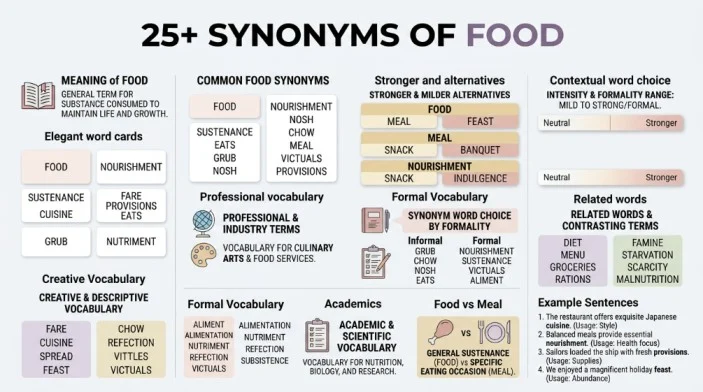
Food is one of the most common words in everyday English, but repeating it in every sentence can make writing feel plain and predictable. The right alternative can add detail, tone, and personality to your words. Depending on the context, words such as cuisine, meal, dish, fare, nourishment, sustenance, provisions, and refreshments can describe food from different angles. Choosing the correct synonym matters because these words are not always interchangeable.
This guide to Synonyms of Food explains useful alternatives with clear meanings, examples, tones, and practical contexts. Whether you are writing a menu, preparing an essay, improving vocabulary, creating content, or simply looking for a more precise word, understanding these distinctions can make your English sound more natural. Each synonym is presented according to its actual usage so you can choose a word that fits the situation rather than relying on a generic replacement.
What Are the Best Synonyms of “Food”?
The best synonyms of food depend on context. Use nourishment, sustenance, nutriment, or provisions in formal or informative writing; fare for food served in a setting; cuisine for a style of cooking; and grub, eats, or chow in casual speech. Some alternatives describe food supplies rather than food itself.
For quick reference:
| Context | Best Choice | Why It Works |
|---|---|---|
| Formal writing | Nourishment | Focuses on what food provides |
| Academic writing | Nutriment | Precise and formal |
| Professional communication | Provisions | Useful for food supplies |
| Business communication | Fare | Natural when discussing meals or offerings |
| Casual conversation | Eats | Friendly and informal |
| Emotional writing | Nourishment | Can suggest physical or figurative support |
| Creative writing | Fare | Adds descriptive or literary flavor |
| Restaurant writing | Cuisine | Describes a culinary style |
| Strongly informal | Grub | Casual and conversational |
Meaning, Tone, and Context
Simple Definition
Food is the general term for substances that people or animals eat or drink to provide nourishment and support life, health, and energy.
It is one of the broadest and most flexible words in English. Because of that, many so called synonyms only overlap with one particular meaning of food.
For example, nourishment focuses on the benefit food provides, while fare usually refers to the food being served or offered. Cuisine refers to a particular style or tradition of cooking rather than food in general.
Part of Speech
Food is primarily a noun.
Examples:
- We bought fresh food for the trip.
- The restaurant serves excellent food.
- Food prices have increased.
The plural form foods is also used when referring to different types or categories of food.
Example:
- The study compared several plant based foods.
Overall Tone
Food has a neutral tone.
It works comfortably in casual conversations, academic writing, professional communication, journalism, advertising, recipes, menus, and everyday speech.
Formality Level
The word food is neutral rather than strongly formal or informal.
More formal alternatives include:
- nourishment
- sustenance
- nutriment
- provisions
- victuals
More casual alternatives include:
- grub
- eats
- chow
- nosh
Common Uses
Native English speakers use food in many situations, including:
- meals and cooking
- nutrition
- restaurants
- grocery shopping
- agriculture
- food safety
- business
- health education
- travel
- family conversations
- social media
- journalism
Word Forms and Related Terms
Because food is mainly a noun, it does not have a large set of direct grammatical forms.
Related terms include:
- food
- foods
- foodie, a person who has a strong interest in food
- food related, describing something connected with food
- foodstuff, a type or item of food
When and How to Use “Food”
The word food is usually the safest choice when you want to communicate clearly without adding a special tone or meaning.
Professional
The company provides healthy food options for employees.
Academic
Access to nutritious food can influence student well being.
Workplace
Please let me know if you have any food allergies.
Personal
I bought some food before heading home.
We will provide food and drinks during the afternoon meeting.
Resume
Prepared and served food while maintaining a clean and organized kitchen.
Social Media
Great food, friendly service, and a relaxing evening.
Best Synonyms of “Food”
No synonym can replace food perfectly in every sentence. Most alternatives narrow the meaning by emphasizing nutrition, supply, style, quality, informality, or the setting in which food is served.
Best for Professional Writing: Nourishment
Nourishment works well when the subject is nutrition, health, or physical support. It sounds more polished than food without becoming unnecessarily complicated.
Example:
The program gives children access to nutritious nourishment.
A more natural sentence would often be:
The program gives children access to nutritious food.
This shows why synonyms should not be substituted mechanically.
Best for Academic Writing: Nutriment
Nutriment is formal and focuses on substances that nourish the body. It can work in specialized or academic discussions, although food or nutrition is usually more natural for general readers.
Best for Business Communication: Provisions
Provisions is useful when talking about food supplies prepared or obtained for a journey, group, event, or extended period.
Example:
The expedition team packed enough provisions for two weeks.
Best for Casual Conversation: Eats
Eats is informal and friendly. It is especially natural when talking about meals or places to eat.
Example:
There are some great eats downtown.
Best for Emotional Writing: Nourishment
Nourishment can sound warmer and more expressive than food, particularly when writing about care, family, childhood, or survival.
Example:
The kitchen became a place of nourishment and comfort.
Best for Creative Writing: Fare
Fare has a descriptive quality that can make prose sound more polished or literary.
Example:
The travelers were welcomed with hearty local fare.
Best for Resume Writing: Meals or Food
In a resume, precision matters more than unusual vocabulary. Food, meals, or a specific term such as prepared dishes is usually better than forcing a sophisticated synonym.
Example:
Prepared meals according to customer orders and food safety standards.
Best for Workplace Communication: Food
In many workplace situations, the original word is actually the best choice.
Example:
Please let us know about any food allergies.
Replacing food with nourishment would make this sentence sound unnecessarily formal.
For a Stronger Meaning: Sustenance
Sustenance emphasizes food as something necessary for survival, strength, or continued functioning.
Example:
The hikers carried enough food for basic sustenance.
For a Softer or More Positive Meaning: Nourishment
Nourishment can make the idea of food sound caring, health focused, and beneficial.
Example:
Fresh meals provide nourishment throughout the day.
When Not to Use “Food”
Although food is broadly useful, there are situations where a more specific word communicates the idea better.
When Food Is Too General
Weak:
The restaurant offers excellent food.
Better:
The restaurant offers excellent Italian cuisine.
Cuisine tells readers what kind of culinary tradition is involved.
When Food Is Too Vague
Weak:
We packed food for the trip.
Better:
We packed provisions for the trip.
Provisions emphasizes supplies prepared for future use.
When Food Is Too Basic for a Formal Description
Basic:
The program provides food to families.
More specific:
The program provides nourishment to families facing food insecurity.
The second version emphasizes the role of food in supporting health and well being.
When a Casual Synonym Is Too Informal
Weak in a report:
The cafeteria provides great grub.
Better:
The cafeteria provides affordable meals.
Grub is conversational and would usually be inappropriate in formal institutional writing.
When a Synonym Is Too Strong
Weak:
The hikers searched for sustenance at the restaurant.
Better:
The hikers searched for food at the restaurant.
Sustenance can suggest basic survival or essential support, which may be unnecessarily dramatic for an ordinary meal.
When a Synonym Changes the Meaning
Weak:
The restaurant specializes in Mexican food cuisine.
Better:
The restaurant specializes in Mexican cuisine.
Cuisine already refers to a style or tradition of cooking, so adding food is unnecessary.
Words Commonly Confused With “Food”
| Word | Difference | When to Use It | Example |
|---|---|---|---|
| Cuisine | A style or tradition of cooking | When discussing culinary traditions | Thai cuisine is known for its balance of flavors. |
| Meal | Food eaten at a particular time | When referring to breakfast, lunch, or dinner | We enjoyed a delicious meal together. |
| Dish | A particular prepared item | When naming one prepared food | The pasta dish was excellent. |
| Nourishment | Food viewed as something that supports health or strength | Health and nutrition contexts | Children need proper nourishment. |
| Nutrition | The process or science of obtaining nutrients | Health, biology, and academic contexts | Good nutrition supports overall health. |
| Provisions | Supplies, especially food prepared for future use | Travel, expeditions, emergencies | They stored provisions before winter. |
Best Synonyms of “Food” by Context
| Context | Best Synonym | Why It Works | Example |
|---|---|---|---|
| Formal writing | Nourishment | Focuses on nutritional support | Proper nourishment is essential for growth. |
| Academic writing | Nutriment | Formal term for nourishing substance | The body requires sufficient nutriment. |
| Professional communication | Food | Clear and universally understood | Please report any food allergies. |
| Business emails | Meals | Specific when discussing catered eating | Meals will be provided at noon. |
| Resume writing | Meals | Natural for hospitality roles | Prepared meals for large groups. |
| Workplace communication | Food | Direct and practical | Food will be available in the break room. |
| Casual conversation | Eats | Friendly and informal | Let’s find some good eats. |
| Everyday speaking | Food | The most natural general term | We need to buy food. |
| Creative writing | Fare | Adds descriptive character | The inn served hearty fare. |
| Storytelling | Fare | Works well for historical or descriptive settings | The travelers shared simple fare. |
| Emotional writing | Nourishment | Suggests care and support | Her cooking provided nourishment and comfort. |
| Strong emphasis | Sustenance | Suggests essential support or survival | They depended on the crops for sustenance. |
| Mild tone | Food | Neutral and straightforward | We brought food for everyone. |
| Social media captions | Eats | Short and conversational | Amazing eats from our weekend trip. |
| American English | Food | Standard and widely used | We ordered food online. |
| British English | Food | Also the normal general term | We bought some food for the picnic. |
How to Choose the Best Synonym of “Food”
Start by asking what aspect of food you want to emphasize.
- If you mean something people eat: use food.
- If you mean nutritional support: use nourishment.
- If you mean something necessary for survival: consider sustenance.
- If you mean food supplies: use provisions.
- If you mean a culinary tradition: use cuisine.
- If you mean food served at a particular setting: consider fare.
- If you mean an informal meal or food experience: use eats.
- If you mean one prepared item: use dish.
The best synonym is not necessarily the most sophisticated word. It is the word that expresses your intended meaning most accurately for your audience.
Real Life Examples of “Food”
School
Students should have access to healthy food during the school day.
College
The college offers affordable food options near the student center.
Workplace
Employees can bring their own food or purchase lunch nearby.
Business
The business supplies packaged food to local retailers.
Please confirm how much food we should order for the meeting.
Resume
Prepared high quality meals while following food safety procedures.
Conversation
We need to pick up some food before the movie.
Storytelling
After a long journey, the travelers were grateful for a warm meal.
Blogging
The article explores how regional food reflects local traditions.
Social Media
Amazing eats and an even better view made this weekend unforgettable.
25 Best Synonyms of “Food”
The following list includes words that genuinely overlap with food, while recognizing that several are narrower, more formal, regional, or context dependent.
| Synonym | Simple Meaning | Best Used For | Example Sentence |
|---|---|---|---|
| 1. Nourishment | Something that supports health and strength | Health and nutrition | Fresh meals provide essential nourishment. |
| 2. Sustenance | Something that supports life or survival | Survival and serious contexts | The crops provided sustenance during the winter. |
| 3. Nutriment | A substance that nourishes the body | Formal or academic writing | The body needs adequate nutriment to function. |
| 4. Fare | Food that is served or available | Restaurants and descriptive writing | The café offers traditional local fare. |
| 5. Provisions | Food supplies stored for future use | Travel and preparation | They packed provisions for the long journey. |
| 6. Victuals | Food or supplies of food | Literary or historical contexts | The travelers shared their remaining victuals. |
| 7. Edibles | Things suitable for eating | Labels and informal descriptions | Keep raw edibles separate from cleaning products. |
| 8. Comestibles | Items that can be eaten | Formal or humorous writing | The market displayed imported comestibles. |
| 9. Aliment | Food that provides nourishment | Very formal or specialized contexts | The text describes milk as an important aliment. |
| 10. Grub | Food, especially ordinary food | Casual American English | We grabbed some grub after work. |
| 11. Eats | Food or meals | Informal conversation | This neighborhood has excellent eats. |
| 12. Chow | Food or a meal | Informal speech | Let’s get some chow before the game. |
| 13. Nosh | A snack or light food | Informal conversation | We stopped for a quick nosh. |
| 14. Cuisine | A style or tradition of cooking | Restaurants and culinary writing | Korean cuisine offers a wide range of flavors. |
| 15. Foodstuff | A type or item of food | Formal, commercial, or technical writing | The warehouse stores packaged foodstuffs. |
| 16. Provisions | Supplies intended to meet food needs | Expeditions and emergency planning | The crew checked its provisions before departure. |
| 17. Victual | An individual item or supply of food | Historical or literary usage | Each victual was carefully stored. |
| 18. Refreshment | Food or drink served to people | Events and hospitality | Light refreshments were served after the presentation. |
| 19. Repast | A meal | Literary or formal descriptions | The guests enjoyed an evening repast. |
| 20. Dish | A prepared food item | Recipes and menus | The chef introduced a new vegetable dish. |
| 21. Meal | Food eaten at a particular time | Everyday communication | We shared a meal after the ceremony. |
| 22. Morsel | A small amount or piece of food | Descriptive writing | The child saved the last morsel of cake. |
| 23. Bite | A small amount of food | Casual conversation | I only had a quick bite before leaving. |
| 24. Snack | A small amount of food between meals | Everyday use | I packed a healthy snack for work. |
| 25. Groceries | Food and household goods bought from a store | Shopping contexts | I need to pick up groceries after work. |
Important usage note: Some entries in this table are contextual alternatives rather than perfect substitutes for food. For example, meal, dish, snack, and groceries describe particular categories or situations. Using them as universal replacements would change the meaning.
Synonyms of “Food” by Usage
Professional vs Personal Synonyms
Professional writing generally benefits from precise and neutral words such as food, meals, provisions, nourishment, or fare.
Personal and conversational writing allows more flexibility. Words such as eats, grub, chow, and nosh can sound natural when the setting is relaxed.
Formal vs Conversational Synonyms
- For reports and academic writing, prefer:
- nourishment
- sustenance
- nutriment
- provisions
- food
- For presentations and professional emails, prefer:
- food
- meals
- refreshments
- provisions
- For casual conversations and texting, consider:
- food
- eats
- grub
- chow
- bite
- nosh
Academic Synonyms
Academic writing usually benefits from precision rather than unusual vocabulary.
Useful terms include nourishment, nutriment, nutrition, food, and sustenance.
For example:
Adequate nutrition is associated with healthy development.
This is usually more precise than replacing nutrition with an ordinary synonym simply to vary vocabulary.
Professional and Business Synonyms
For resumes, interviews, meetings, and client communication, clarity should come first.
Good choices include:
- food
- meals
- refreshments
- provisions
- cuisine
- prepared dishes
For example:
Prepared meals for up to 100 guests while following established food safety procedures.
This is more professional than:
Made lots of grub for people.
Creative and Literary Synonyms
Creative writing gives you more freedom to choose words for atmosphere.
Useful options include:
- fare
- victuals
- repast
- nourishment
- sustenance
- morsel
Example:
The travelers sat beside the fire and shared a modest repast.
The word repast creates a more literary atmosphere than the everyday word meal.
Slang or Modern Synonyms
Several informal alternatives exist, but they should be used selectively.
Grub means food and is casual.
We found a great place to grab some grub.
Avoid it in academic papers, formal reports, resumes, and serious business communication.
Eats refers informally to food or places where food is available.
There are plenty of good eats around here.
Chow is another informal word for food or a meal.
Let’s grab some chow before we leave.
These words are appropriate for relaxed conversations, informal blogs, social posts, and friendly messages. They are generally unsuitable for formal academic or professional writing.
Strongest to Mildest Synonyms
Food itself does not have a simple emotional intensity scale because its alternatives often differ in meaning rather than strength. Still, when the focus is on necessity or survival, the following progression can help.
Mild
Food, meal, snack, bite
These words communicate ordinary eating without suggesting urgency.
Moderate
Nourishment, fare, provisions
These words add information about nutrition, serving, or supply.
Strong
Sustenance, nutriment
These emphasize the role of food in supporting the body or maintaining life.
Very Strong or Specialized
Sustenance in a survival context can carry the strongest sense of necessity.
Example:
The villagers depended on the harvest for sustenance.
The intensity comes from the context, not simply from the word itself.
Emotional vs Neutral Synonyms
Emotional Synonyms
Words such as nourishment, sustenance, and sometimes fare can carry more emotional or stylistic meaning.
Nourishment can suggest care and health.
Sustenance can suggest survival, hardship, or endurance.
Fare can create a sense of tradition, place, or atmosphere.
Neutral Synonyms
The most neutral options include:
- food
- meal
- dish
- groceries
- snack
- provisions
Use neutral words when your primary goal is clear information rather than emotional impact.
Antonyms of “Food”
There is an important vocabulary point here: food does not have 15 genuine one word antonyms in standard English. Treating words such as hunger, waste, or poison as direct antonyms would be linguistically inaccurate.
The closest useful contrasts are therefore terms that describe the absence of food, things that are not edible, or substances that should not be consumed.
| Contrasting Term | Meaning | Example Sentence |
|---|---|---|
| Hunger | The physical need or desire for food | Hunger made the long journey difficult. |
| Starvation | Severe lack of food | The region faced starvation after the crops failed. |
| Fasting | Deliberately going without food | She was fasting before the medical procedure. |
| Foodlessness | A condition of having no food | The story describes periods of foodlessness. |
| Inedibility | The quality of not being suitable for eating | The plant’s inedibility makes it unsuitable for consumption. |
| Inedible matter | Material that cannot safely be eaten | Remove all inedible matter before serving. |
| Nonfood | Something that is not food | The store separates food from nonfood products. |
| Waste | Material discarded because it is unwanted or unusable | The restaurant reduced food waste. |
| Garbage | Discarded material | The spoiled items were placed in the garbage. |
| Refuse | Waste or discarded material | The workers removed refuse from the site. |
| Poison | A substance capable of causing serious harm when consumed | The label warns that the substance is poison. |
| Toxin | A poisonous substance produced by an organism | Certain toxins can contaminate food. |
| Contaminant | An unwanted substance that makes something impure or unsafe | The test detected a chemical contaminant. |
| Pollutant | A harmful substance that contaminates the environment | The river contained dangerous pollutants. |
| Nonedible substance | A substance not intended for consumption | Keep nonedible substances away from food. |
These are contrasting terms, not strict dictionary antonyms. This distinction matters because English does not provide a neat opposite word for every noun.
Comparison: “Food” vs Similar Words
Food vs Cuisine
Main Difference: Food refers broadly to what people eat. Cuisine refers to a particular style, tradition, or system of cooking.
Which Is Stronger? Neither is stronger. They express different ideas.
Which Is More Formal? Cuisine often sounds more specialized.
When to Use Each: Use food for general eating and cuisine for culinary traditions.
Examples
Food:
We ordered food for the entire group.
Cuisine:
The restaurant specializes in Mediterranean cuisine.
Food vs Meal
Main Difference: Food is a broad category. A meal is food eaten at a particular time or as a particular occasion.
Which Is Stronger? Neither.
Which Is More Formal? Neither is especially formal.
When to Use Each: Use meal when breakfast, lunch, dinner, or another eating occasion is relevant.
Examples
Food:
We bought food for the weekend.
Meal:
We prepared a large meal for our guests.
Food vs Dish
Main Difference: Food is general. A dish is a specific prepared item.
Which Is Stronger? Neither.
Which Is More Formal? Neither.
When to Use Each: Use dish when identifying a particular prepared food.
Examples
Food:
The restaurant serves fresh food.
Dish:
The chef’s seafood dish was popular.
Food vs Nourishment
Main Difference: Food refers to what is eaten. Nourishment emphasizes the benefit food provides to the body.
Which Is Stronger? Nourishment can sound more focused on health and support.
Which Is More Formal? Nourishment is somewhat more formal.
When to Use Each: Use nourishment when discussing health, care, or nutrition.
Examples
Food:
The shelter provides food every evening.
Nourishment:
The meals provide nourishment to people in need.
Food vs Sustenance
Main Difference: Food is neutral. Sustenance emphasizes something necessary for continued life or strength.
Which Is Stronger? Sustenance usually carries a stronger sense of necessity.
Which Is More Formal? Sustenance is more formal.
When to Use Each: Use sustenance for survival, hardship, or serious descriptive writing.
Examples
Food:
They bought food before the trip.
Sustenance:
The supplies provided basic sustenance during the expedition.
Food vs Fare
Main Difference: Food is general. Fare often describes food served or offered in a particular place or tradition.
Which Is Stronger? Neither.
Which Is More Formal? Fare can sound more literary or polished.
When to Use Each: Use fare for restaurants, regional food, hospitality, or descriptive writing.
Examples
Food:
The hotel provides excellent food.
Fare:
The inn is known for its traditional country fare.
Common Phrases and Expressions with “Food”
Food for Thought
Meaning: An idea or information worth considering.
Example Sentence:
The professor’s comments gave us plenty of food for thought.
Comfort Food
Meaning: Food associated with emotional comfort or pleasant memories.
Example Sentence:
Macaroni and cheese is classic comfort food for many people.
Food Chain
Meaning: The sequence showing how organisms obtain energy by consuming other organisms.
Example Sentence:
The lesson explained how energy moves through a food chain.
Food Supply
Meaning: The amount of food available for people or animals.
Example Sentence:
The storm disrupted the local food supply.
Food Safety
Meaning: Practices designed to keep food safe for consumption.
Example Sentence:
Employees must complete annual food safety training.
Food Waste
Meaning: Food that is discarded rather than eaten or used.
Example Sentence:
The restaurant introduced new policies to reduce food waste.
Food Industry
Meaning: Businesses involved in producing, processing, distributing, selling, or serving food.
Example Sentence:
Technology is changing many parts of the food industry.
Food Culture
Meaning: The traditions, habits, beliefs, and practices surrounding food.
Example Sentence:
Travel can introduce people to a new food culture.
Common Mistakes to Avoid
1. Using a Fancy Synonym Just to Sound Intelligent
Incorrect:
The restaurant provides exceptional nutriment.
Better:
The restaurant provides excellent food.
Why: Nutriment is technically meaningful but unnecessarily formal for an ordinary restaurant review.
2. Confusing Food With Cuisine
Incorrect:
The restaurant offers excellent Italian food cuisine.
Better:
The restaurant offers excellent Italian cuisine.
Why: Cuisine already describes a style or tradition of cooking.
3. Using Slang in Formal Writing
Incorrect:
The school cafeteria serves great grub.
Better:
The school cafeteria serves nutritious meals.
Why: Grub is casual and does not fit the professional tone of a formal report.
4. Using Sustenance for an Ordinary Meal
Incorrect:
I ordered sustenance at the restaurant.
Better:
I ordered a meal at the restaurant.
Why: Sustenance suggests basic support or survival, making it unnecessarily serious here.
5. Replacing Food With Cuisine Everywhere
Incorrect:
I bought some cuisine at the grocery store.
Better:
I bought some food at the grocery store.
Why: Cuisine refers to a style of cooking, not ordinary groceries.
6. Using Provisions for Every Type of Food
Incorrect:
I ate provisions for lunch.
Better:
I ate lunch.
Why: Provisions generally suggests food supplies, especially food stored or prepared for future use.
7. Choosing a Synonym That Changes the Meaning
Incorrect:
The company donated several meals to the food bank.
Better:
The company donated several food supplies to the food bank.
Why: Depending on the intended meaning, meals suggests ready to eat portions, while food supplies can refer to a broader collection of food items.
Frequently Asked Questions
What is a common synonym for food?
Common synonyms for food include nourishment, sustenance, fare, cuisine, meal, and provisions, depending on the context.
What are some synonyms for food?
Useful synonyms for food include nourishment, sustenance, fare, cuisine, provisions, and edibles.
What is another word for food?
Nourishment is a common alternative, while fare, cuisine, sustenance, and provisions work in specific contexts.
Is “food” a formal or informal word?
Food is a neutral, everyday word. More formal alternatives include nourishment and sustenance.
What is a food synonym in slang?
In slang, grub, eats, chow, and munchies can refer to food, depending on the situation and region.
What does a food thesaurus include?
A food thesaurus provides related words and alternatives such as meal, cuisine, nourishment, fare, edibles, and provisions.
What are other words for food?
Other words for food include meal, fare, cuisine, nourishment, sustenance, provisions, edibles, and grub.
What are the best synonyms of “food”?
The best synonyms of food depend on context. Nourishment works for health, sustenance for survival, fare for served food, provisions for supplies, and eats for casual conversation.
What are the best formal synonyms of “food”?
Useful formal synonyms of food include nourishment, sustenance, nutriment, provisions, and comestibles. However, formal does not always mean better. In many professional situations, the simple word food remains the clearest choice.
What are common informal synonyms of “food”?
Common informal synonyms include grub, eats, and chow. Nosh can refer to a snack or light food. These expressions work well in casual conversations but should usually be avoided in formal or academic writing.
What is another word for “food” in professional writing?
Food, meals, refreshments, provisions, and nourishment can all work professionally depending on context. For resumes and business communication, choose the most precise word rather than replacing food simply for variety.
What is the difference between “food” and “cuisine”?
Food is a broad term for things people eat. Cuisine refers to a particular style or tradition of cooking. You can discuss Mexican cuisine, for example, but you would normally buy or eat Mexican food.
What is the opposite of “food”?
Food has no single exact opposite in standard English. The closest contrasts include hunger, starvation, foodlessness, nonfood, and inedible substances, depending on whether you mean absence of food or things that cannot be eaten.
Conclusion
Food is a broad, neutral noun that works naturally in almost every type of communication. When greater precision is useful, nourishment highlights health, sustenance emphasizes necessity, provisions describes supplies, fare describes food served in a setting, and cuisine identifies a cooking tradition.
The key is not to choose the most complicated alternative. Choose the word that matches your meaning, audience, tone, and purpose. A professional email may need simple food, while creative writing may benefit from fare or repast.
Use synonyms of food to make your vocabulary more precise, not merely more elaborate. A practical improvement tip is to ask yourself what you want the word to emphasize before replacing it.
Read More Related Articles:
- Synonyms for Empty | Meaning, Examples, and Better Word …
- Synonyms for Creativity | Meaning, Examples, and Better …
- 25+ Synonyms of Perseverance | Meanings, Uses, Examples …