You have probably written an email, essay, caption, resume, blog post, or school assignment and noticed that you keep using the word “relatable.” It works well, but repeating the same adjective can make your writing feel predictable. That is where knowing the synonyms of relatable becomes useful.
The best alternative depends on what you mean. A story can be familiar, a person can be approachable, an idea can be accessible, a character can feel realistic, and a message can be resonant. Choosing the right word makes your writing more precise while helping your audience understand exactly why something connects with them.
What Are the Best Synonyms of “Relatable”?
Featured Snippet Answer:
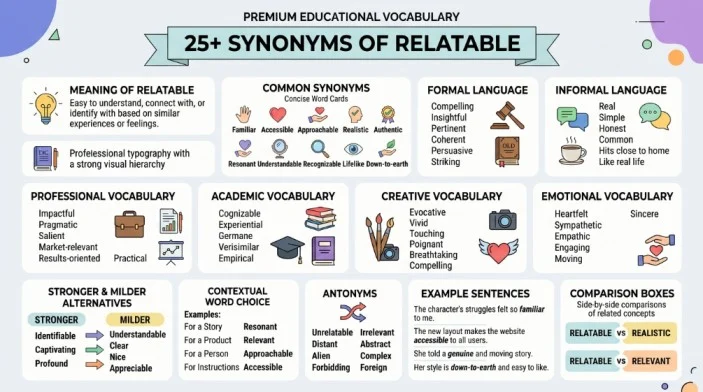
The best synonyms of relatable include familiar, understandable, recognizable, accessible, approachable, realistic, resonant, relevant, down to earth, authentic, and engaging. The right choice depends on context. Use accessible for ideas, approachable for people, realistic for characters, and resonant for emotional messages.
The word relatable usually describes something that people can understand, recognize, or connect with because it reflects experiences, emotions, situations, or qualities they know.
For formal and academic writing, relevant, understandable, accessible, recognizable, and representative are often more precise. In casual conversation, familiar, down to earth, real, and easy to connect with sound natural.
For emotional or creative writing, resonant, authentic, human, realistic, and genuine can communicate a deeper sense of connection.
Meaning, Tone, and Context
Simple Definition
Relatable describes a person, experience, idea, character, story, or situation that feels familiar or easy to identify with.
If readers see their own feelings or experiences reflected in something, they may describe it as relatable.
For example:
“The character’s struggles with starting a new job were relatable.”
This means the character’s experience felt familiar to people who had experienced something similar.
Part of Speech
Relatable is an adjective.
It commonly appears before a noun or after a linking verb.
Examples:
- a relatable character
- a relatable story
- relatable advice
- Her experience was relatable.
- The advertisement feels surprisingly relatable.
Overall Tone
Relatable is generally positive or neutral.
It often suggests familiarity, emotional connection, accessibility, or shared experience. In social media and everyday conversation, it can also have a warm, informal tone.
Formality Level
Relatable is generally neutral to informal.
It is completely natural in conversation, blogs, social media, marketing, interviews, and general writing. In highly formal academic or technical writing, a more precise alternative such as relevant, representative, understandable, or accessible may communicate the intended meaning more clearly.
Common Uses
Native English speakers commonly use relatable when discussing:
- people
- personalities
- characters
- stories
- emotions
- problems
- experiences
- social media posts
- advertisements
- advice
- everyday situations
- cultural experiences
Examples include:
“Her sense of humor makes her very relatable.”
“The article gives relatable examples of workplace stress.”
“That scene was relatable because it captured an ordinary family argument.”
Word Forms
The main word family is limited because relatable is primarily an adjective.
Related forms include:
- relate, verb
- relates, verb
- related, adjective or past participle
- relating, adjective or participle
- relation, noun
- relationship, noun
- relatability, noun
When and How to Use “Relatable”
Use relatable when you want to emphasize a recognizable human experience or an easy emotional connection.
It works especially well when the audience is likely to see themselves, their feelings, or their experiences reflected in something.
Professional
“The training examples are relatable because they reflect common workplace situations.”
Here, relatable shows that employees can easily recognize the situations.
Academic
“The study presents relatable examples to illustrate how students experience academic pressure.”
For academic writing, relatable can work in less formal contexts, although representative or relevant may be more precise in a research paper.
Workplace
“Her presentation was relatable because she used situations the team deals with every day.”
The word works naturally when discussing communication style.
Personal
“His story about moving to a new city was incredibly relatable.”
The focus is on shared personal experience.
“I included a few relatable examples so the new employees can understand the process.”
This works well in an informal or moderately professional email.
Resume
“Created relatable content that helped customers understand complex products.”
On a resume, relatable can work in creative or marketing roles, but measurable descriptions are often stronger.
Social Media
“That post about pretending to understand a complicated meeting was painfully relatable.”
This is a natural casual use of the word.
Best Synonyms of “Relatable”
No synonym replaces relatable perfectly in every sentence. The best alternative depends on the exact quality you want to emphasize.
Professional Writing
Use accessible, relevant, understandable, or representative.
These choices sound more precise than relatable when discussing professional information.
Academic Writing
Use relevant, representative, understandable, or accessible.
Academic writing usually benefits from identifying exactly why readers can connect with an example.
Business Communication
Use accessible, relevant, approachable, or familiar.
These words can describe communication, products, examples, or people without sounding overly casual.
Casual Conversation
Use familiar, real, down to earth, or easy to connect with.
These alternatives preserve the friendly quality of relatable.
Emotional Writing
Use resonant, human, authentic, or genuine.
These words highlight emotional connection rather than simple familiarity.
Creative Writing
Use realistic, authentic, human, lifelike, or resonant.
They can describe characters and stories with greater precision.
Resume Writing
Use accessible, audience focused, relevant, or engaging, depending on what you actually accomplished.
For example:
“Created engaging customer education materials.”
This is often more specific than:
“Created relatable customer education materials.”
Workplace Communication
Use approachable, familiar, accessible, or understandable.
The best choice depends on whether you are describing a person, message, example, or process.
Stronger Meaning
Use resonant when you want to suggest a deeper emotional connection.
“The campaign delivered a resonant message about family.”
Softer Meaning
Use familiar when you simply want to say that something feels known or recognizable.
“The situation felt familiar to many new employees.”
When Not to Use “Relatable”
When the Meaning Is Too General
Relatable can sometimes tell readers that something connects with people without explaining why.
Weak:
“The article contains relatable information.”
Better:
“The article contains practical examples of common workplace problems.”
The second sentence tells the reader what makes the material useful.
When You Mean “Relevant”
Relatable and relevant are not identical.
Weak:
“This statistic is relatable to the research.”
Better:
“This statistic is relevant to the research.”
Relevant means connected to the subject or purpose. Relatable usually involves personal or emotional recognition.
When You Mean “Understandable”
If your focus is ease of comprehension, use understandable or clear.
Weak:
“The instructions are relatable.”
Better:
“The instructions are easy to understand.”
When You Mean “Approachable”
When describing a person who is friendly and easy to talk to, approachable is usually better.
Weak:
“The manager is very relatable.”
Better:
“The manager is approachable and easy to talk to.”
When the Tone Is Too Formal
Relatable can sound slightly conversational in a highly technical paper.
Instead of:
“The results provide relatable examples.”
Consider:
“The results provide representative examples.”
When You Need a Stronger Emotional Effect
If the message creates a deep emotional response, resonant may be stronger.
Instead of:
“The campaign was relatable.”
Use:
“The campaign delivered a resonant message about belonging.”
Words Commonly Confused With “Relatable”
| Word | Difference | When to Use It | Example |
|---|---|---|---|
| Relevant | Connected to a particular subject, purpose, or situation | Reports, research, business writing | “The example is relevant to the discussion.” |
| Familiar | Known through previous experience or exposure | Everyday situations and experiences | “The setting felt familiar.” |
| Approachable | Easy and comfortable to talk to or interact with | People, leaders, teachers | “The professor is approachable.” |
| Accessible | Easy to understand, reach, use, or obtain | Information, products, services | “The guide makes technical information accessible.” |
| Realistic | Closely reflects real life or what is actually possible | Characters, stories, expectations | “The novel has realistic characters.” |
| Resonant | Produces a strong emotional or intellectual response | Speeches, campaigns, stories | “The message was deeply resonant.” |
Best Synonyms of “Relatable” by Context
| Context | Best Synonym | Why It Works | Example |
|---|---|---|---|
| Formal writing | Accessible | Focuses on ease of understanding | “The report presents accessible explanations.” |
| Academic writing | Relevant | Connects directly to the subject | “The example is relevant to the study.” |
| Professional communication | Approachable | Works naturally for people and communication | “Her leadership style is approachable.” |
| Business emails | Familiar | Suggests recognizable situations | “We used familiar examples for new staff.” |
| Resume writing | Engaging | Shows the ability to connect with an audience | “Developed engaging customer content.” |
| Workplace communication | Understandable | Emphasizes clarity | “The instructions are understandable.” |
| Casual conversation | Familiar | Sounds natural and conversational | “That situation feels familiar.” |
| Everyday speaking | Real | Emphasizes authenticity | “Her reaction felt real.” |
| Creative writing | Authentic | Suggests believable emotional truth | “The character has an authentic voice.” |
| Storytelling | Realistic | Highlights believable details | “The story uses realistic dialogue.” |
| Emotional writing | Resonant | Suggests deeper emotional connection | “The poem is emotionally resonant.” |
| Strong emphasis | Resonant | Indicates powerful connection | “The speech had a resonant theme.” |
| Mild tone | Familiar | Suggests recognition without strong emotion | “The setting was familiar.” |
| Social media captions | Down to earth | Creates a casual, human tone | “Her posts feel down to earth.” |
| American English | Relatable | Widely natural in casual modern American English | “That experience is so relatable.” |
| British English | Familiar | Often provides a more neutral alternative | “The situation may feel familiar to readers.” |
How to Choose the Best Synonym of “Relatable”
Start by asking what quality you actually want to describe.
- If something is easy to understand, choose accessible or understandable.
- If something connects directly to a subject, choose relevant.
- If something feels known from experience, choose familiar.
- If a person is easy to talk to, choose approachable.
- If a character resembles real life, choose realistic.
- If something creates a deep emotional response, choose resonant.
- If something feels sincere and believable, choose authentic or genuine.
The audience also matters. A social media caption can comfortably use relatable, while an academic report may benefit from a more specific word.
Real Life Examples of “Relatable”
School
Original:
“The teacher used relatable examples to explain fractions.”
More precise:
“The teacher used everyday examples to explain fractions.”
College
Original:
“The professor gave a relatable example of student debt.”
Alternative:
“The professor gave a realistic example of student debt.”
Workplace
Original:
“The manager shared a relatable story about making mistakes.”
Alternative:
“The manager shared a personal story about making mistakes.”
Business
Original:
“The company created a relatable advertisement.”
Alternative:
“The company created an authentic advertisement that reflected everyday customer experiences.”
Original:
“I added some relatable examples to the presentation.”
Alternative:
“I added some familiar examples to make the presentation easier to follow.”
Resume
Original:
“Wrote relatable content for customers.”
Stronger:
“Created engaging content that helped customers understand complex products.”
Conversation
“That feeling is so relatable.”
A natural alternative is:
“I know exactly what you mean.”
Storytelling
Original:
“The main character is relatable.”
More descriptive:
“The main character feels realistic because her fears and decisions resemble ordinary human experiences.”
Blogging
“The post became popular because readers found the examples relatable.”
Alternative:
“The post connected with readers because the examples reflected everyday experiences.”
Social Media
“Trying to look productive while checking your phone every five minutes is painfully relatable.”
This informal use is natural because social media frequently favors conversational language.
25 Best Synonyms of “Relatable”
The word relatable covers several overlapping ideas, so there is no single perfect replacement for every use. The following 25 alternatives are useful when they match the specific sense intended.
| Synonym | Simple Meaning | Best Used For | Example Sentence |
|---|---|---|---|
| Familiar | Known from previous experience | Experiences and situations | “The office routine felt familiar to everyone.” |
| Understandable | Easy to understand | Ideas and explanations | “Her frustration was understandable.” |
| Recognizable | Easy to identify as something known | Experiences, patterns, situations | “The character’s reaction was recognizable to many readers.” |
| Accessible | Easy to understand or use | Information and content | “The guide makes complex ideas accessible.” |
| Approachable | Easy to talk to or interact with | People and communication | “The new supervisor has an approachable manner.” |
| Relevant | Connected to a particular matter | Academic and professional writing | “The example is relevant to the discussion.” |
| Resonant | Producing a strong response or connection | Emotional and creative writing | “The film presents a resonant message about family.” |
| Realistic | Similar to real life | Characters and stories | “The novel portrays realistic family conflicts.” |
| Authentic | Genuine and believable | People, voices, brands, stories | “The campaign uses an authentic voice.” |
| Genuine | Sincere and real | Emotions and personalities | “Her concern for the team seemed genuine.” |
| Human | Showing ordinary human qualities | Characters and emotional writing | “The story gives its hero a deeply human weakness.” |
| Down to earth | Practical, natural, and unpretentious | People and casual writing | “The speaker has a down to earth personality.” |
| Personal | Connected to an individual’s experience | Stories and messages | “She shared a personal account of adjusting to college.” |
| Everyday | Ordinary and common in daily life | Situations and examples | “The article focuses on everyday financial problems.” |
| Common | Experienced or found by many people | Shared experiences | “The fear of public speaking is common among students.” |
| Ordinary | Typical rather than unusual | Stories and situations | “The film turns an ordinary family problem into a moving story.” |
| Similar | Having qualities in common | Experiences and comparisons | “His experience was similar to mine.” |
| Representative | Typical of a larger group or situation | Academic and professional contexts | “The survey included representative examples.” |
| Identifiable | Easy to recognize or identify with | Characters and situations | “Readers found the character’s struggles identifiable.” |
| Engaging | Holding attention and interest | Content and communication | “The writer uses engaging examples throughout the article.” |
| Appealing | Attractive or pleasing to an audience | Marketing and creative work | “The brand created an appealing message for young customers.” |
| Compelling | Strong enough to attract interest or attention | Stories, arguments, campaigns | “The documentary presents a compelling personal story.” |
| Inviting | Making people feel welcome or comfortable | Communication and environments | “The website has an inviting tone.” |
| Lifelike | Closely resembling real life | Characters and creative work | “The author creates lifelike characters.” |
| Contemporary | Reflecting current experiences or culture | Modern media and social topics | “The novel explores contemporary family pressures.” |
Some of these words overlap with only one particular sense of relatable. That distinction matters. For example, relevant is not a universal substitute for relatable, and approachable normally describes a person rather than an idea.
Synonyms of “Relatable” by Usage
Professional vs Personal Synonyms
Professional writing often benefits from precise alternatives.
Use accessible, relevant, understandable, representative, or engaging when discussing professional content.
Personal communication can use familiar, real, genuine, human, or down to earth.
Compare:
“The manager is relatable.”
with:
“The manager is approachable and easy to communicate with.”
The second version explains the exact quality being praised.
Formal vs Conversational Synonyms
- For reports and formal documents, consider:
- relevant
- accessible
- representative
- understandable
- realistic
- For presentations and professional emails, consider:
- approachable
- familiar
- engaging
- accessible
- understandable
- For casual conversations and texting, natural choices include:
- familiar
- real
- down to earth
- similar
- easy to connect with
Academic Synonyms
Academic writing requires precision, so avoid replacing every use of relatable with the same word.
- Use relevant when discussing a connection to the research topic.
- Use representative when an example reflects a wider population or pattern.
- Use accessible when information is easy for readers to understand.
- Use realistic when discussing situations that resemble real conditions.
- Use understandable when describing an idea, reaction, or explanation that readers can easily comprehend.
Professional and Business Synonyms
- For resumes, engaging, audience focused, accessible, and effective can be stronger than relatable when they accurately describe the work.
- For interviews, approachable, authentic, and genuine may describe a person’s communication style.
- For meetings and presentations, accessible, clear, engaging, and understandable are useful.
- For client communication, approachable and accessible can emphasize ease of interaction.
- For business emails, familiar and relevant often sound more precise.
Creative and Literary Synonyms
Creative writing gives you more room to emphasize emotional and descriptive qualities.
- Use realistic for believable characters.
- Use lifelike for vivid characterization.
- Use authentic for believable voices.
- Use human for recognizable emotional weaknesses and strengths.
- Use resonant when a story or theme creates a powerful emotional connection.
Slang or Modern Synonyms
There is no perfect slang synonym for relatable.
In casual American English, phrases such as so real, I feel that, and too real can communicate a similar reaction, especially on social media.
For example:
“That post about avoiding emails until the last minute is too real.”
These expressions should generally be avoided in academic papers, resumes, formal reports, and professional correspondence.
Strongest to Mildest Synonyms
There is no scientifically fixed intensity scale for these words because intensity depends heavily on context. However, this practical scale can help with writing choices.
Mild
Familiar, recognizable, understandable
These suggest that readers can identify with or understand something without necessarily feeling a strong emotional connection.
Moderate
Relevant, accessible, approachable, realistic
These communicate a clearer connection or practical ease of understanding.
Strong
Authentic, genuine, human, engaging
These suggest stronger personal or emotional qualities.
Very Strong
Resonant, compelling
These can suggest that something creates a particularly powerful intellectual or emotional response.
Emotional vs Neutral Synonyms
Emotional Synonyms
These alternatives can carry more feeling:
- resonant
- human
- authentic
- genuine
- compelling
- personal
- lifelike
Example:
“The character’s loneliness felt deeply human.”
These choices work well in storytelling, reviews, speeches, and emotional essays.
Neutral Synonyms
These generally communicate information more objectively:
- relevant
- familiar
- recognizable
- understandable
- accessible
- representative
- realistic
Example:
“The report uses representative examples.”
These choices are better suited to academic and professional contexts.
Antonyms of “Relatable”
Because relatable can mean familiar, understandable, emotionally recognizable, or easy to identify with, its opposites vary by context. The following are useful contextual antonyms.
| Antonym | Meaning | Example Sentence |
|---|---|---|
| Unfamiliar | Not previously known or experienced | “The unfamiliar situation made the new employee nervous.” |
| Alienating | Making people feel excluded or disconnected | “The technical language was alienating for beginners.” |
| Distant | Emotionally removed or difficult to connect with | “The character felt distant from the audience.” |
| Detached | Lacking emotional involvement | “His detached response made the conversation feel cold.” |
| Impersonal | Lacking personal warmth or connection | “The automated message sounded impersonal.” |
| Abstract | Focused on ideas rather than concrete experience | “The explanation was too abstract for younger students.” |
| Inaccessible | Difficult to understand, use, or approach | “The textbook made the subject feel inaccessible.” |
| Incomprehensible | Extremely difficult to understand | “The instructions were nearly incomprehensible.” |
| Unrealistic | Not resembling real life or practical conditions | “The movie presents an unrealistic view of office life.” |
| Strange | Unusual or unfamiliar | “The new environment initially felt strange.” |
| Foreign | Unfamiliar or outside one’s experience | “The customs seemed foreign to the visitors.” |
| Remote | Far removed from ordinary experience or connection | “The examples felt remote from everyday life.” |
| Obscure | Difficult to recognize or understand | “The reference was obscure to most readers.” |
| Inapproachable | Difficult to approach or interact with | “The manager appeared inapproachable during meetings.” |
| Unrecognizable | Not easy to identify or connect with as familiar | “The revised character became almost unrecognizable.” |
Comparison: “Relatable” vs Similar Words
Relatable vs Relevant
Main Difference: Relatable means easy to connect with through shared experience or feeling. Relevant means directly connected to a topic, purpose, or situation.
Which Is Stronger? Neither is inherently stronger. They describe different relationships.
Which Is More Formal? Relevant is more suitable for academic and professional writing.
When to Use Each: Use relatable for personal connection. Use relevant for logical or topical connection.
Examples
Relatable:
“The character’s fear of failure is relatable.”
Relevant:
“The study provides relevant evidence.”
Relatable vs Familiar
Main Difference: Familiar means known through experience or exposure. Relatable usually suggests that someone can identify with the experience or feeling.
Which Is Stronger? Relatable often carries more personal connection.
Which Is More Formal? Familiar is generally more neutral.
When to Use Each: Use familiar for recognition. Use relatable for personal identification.
Examples
Relatable:
“Her story about starting college was relatable.”
Familiar:
“The campus layout looked familiar.”
Relatable vs Approachable
Main Difference: Relatable suggests shared experience or understanding. Approachable means easy to talk to or interact with.
Which Is Stronger? Neither is inherently stronger.
Which Is More Formal? Approachable is natural in professional communication.
When to Use Each: Use approachable mainly for people, communication styles, or environments.
Examples
Relatable:
“The speaker shared a relatable experience.”
Approachable:
“The speaker was approachable after the presentation.”
Relatable vs Accessible
Main Difference: Accessible means easy to understand, use, reach, or obtain. Relatable emphasizes recognition or personal connection.
Which Is Stronger? They measure different qualities.
Which Is More Formal? Accessible is more common in formal and professional writing.
When to Use Each: Use accessible for information and systems. Use relatable for experiences and emotions.
Examples
Relatable:
“The story feels relatable to new parents.”
Accessible:
“The website makes legal information accessible.”
Relatable vs Realistic
Main Difference: Realistic means resembling real life or actual conditions. Relatable means easy for people to connect with personally.
Which Is Stronger? Realistic focuses on accuracy to life, while relatable focuses on personal recognition.
Which Is More Formal? Realistic is slightly more neutral.
When to Use Each: Use realistic for characters, situations, expectations, and portrayals.
Examples
Relatable:
“The character’s worries are relatable.”
Realistic:
“The character’s financial problems are realistic.”
Relatable vs Resonant
Main Difference: Relatable suggests recognition or identification. Resonant suggests a deeper emotional or intellectual response.
Which Is Stronger? Resonant can express a stronger effect.
Which Is More Formal? Resonant is more literary and sophisticated.
When to Use Each: Use resonant for speeches, stories, campaigns, themes, and ideas that have a powerful effect.
Examples
Relatable:
“The message about family was relatable.”
Resonant:
“The message about family was deeply resonant.”
Common Phrases and Expressions with “Relatable”
Relatable Content
Meaning: Content that audiences can recognize themselves or their experiences in.
Example:
“The creator specializes in relatable content about everyday work life.”
Relatable Character
Meaning: A fictional person whose experiences, emotions, or behavior feel recognizable.
Example:
“The protagonist is a relatable character because she makes ordinary mistakes.”
Relatable Story
Meaning: A story that reflects experiences familiar to its audience.
Example:
“Her relatable story about moving away from home connected with many readers.”
Relatable Experience
Meaning: An experience that others have experienced or can easily understand.
Example:
“Being nervous before your first interview is a relatable experience.”
Relatable Content Creator
Meaning: A creator whose personality or content feels familiar and authentic to an audience.
Example:
“His relatable style has helped him build a loyal audience.”
So Relatable
Meaning: A casual expression showing strong recognition or identification.
Example:
“That joke about opening your laptop and forgetting why is so relatable.”
Highly Relatable
Meaning: Very easy for many people to recognize or identify with.
Example:
“The advertisement uses highly relatable family situations.”
Painfully Relatable
Meaning: Extremely recognizable, often because the situation is awkward, frustrating, or embarrassing.
Example:
“Her description of procrastinating before a deadline was painfully relatable.”
Common Mistakes to Avoid
1. Using Relatable When You Mean Relevant
Incorrect:
“This statistic is relatable to the research.”
Better:
“This statistic is relevant to the research.”
Why: Relevant describes a direct connection to a subject or purpose. Relatable usually describes personal recognition.
2. Using Approachable for Ideas
Incorrect:
“The research question is approachable to readers.”
Better:
“The research question is understandable to readers.”
Why: Approachable is commonly used for people, communication styles, and things that can be comfortably interacted with.
3. Using an Informal Alternative in Academic Writing
Incorrect:
“The results are really real and easy to connect with.”
Better:
“The examples are representative and relevant to the study.”
Why: Formal writing needs precise vocabulary rather than conversational expressions.
4. Choosing an Overly Dramatic Synonym
Incorrect:
“The instruction manual was deeply resonant.”
Better:
“The instruction manual was accessible and easy to understand.”
Why: Resonant suggests meaningful emotional or intellectual impact. It is inappropriate for a simple usability claim.
5. Repeating Relatable Too Often
Incorrect:
“The relatable character has a relatable problem and gives relatable advice.”
Better:
“The realistic character faces a familiar problem and offers practical advice.”
Why: Varying vocabulary improves style while making each idea more specific.
6. Confusing Realistic With Relatable
Incorrect:
“The character is realistic, so every reader will relate to her.”
Better:
“The character feels realistic, which may make her struggles easier for some readers to recognize.”
Why: Realistic and relatable describe different qualities. A realistic character is believable, but that does not guarantee a shared experience.
7. Using Slang in Formal Communication
Incorrect:
“The proposal’s ideas are so real.”
Better:
“The proposal presents practical examples that are relevant to the target audience.”
Why: Casual expressions can weaken a formal document when a precise professional alternative is available.
Frequently Asked Questions
1. What are the best synonyms of “relatable”?
The best synonyms of relatable include familiar, understandable, accessible, recognizable, approachable, realistic, relevant, resonant, authentic, and genuine. The strongest choice depends on whether you mean familiarity, clarity, realism, or emotional connection.
2. What are the best formal synonyms of “relatable”?
The best formal alternatives include relevant, accessible, understandable, representative, realistic, and recognizable. These words allow you to explain exactly why an idea, example, or experience connects with its intended audience.
3. What are common informal synonyms of “relatable”?
Common informal alternatives include familiar, real, down to earth, personal, and easy to connect with. Expressions such as so real and I feel that can work in casual conversations and social media.
4. What is another word for “relatable” in professional writing?
Accessible, relevant, approachable, understandable, or engaging can replace relatable in professional writing, depending on the intended meaning. For resumes, engaging or audience focused may be more useful because they describe a specific communication skill.
5. What is the difference between “relatable” and “relevant”?
Relatable means something feels familiar or personally recognizable, while relevant means it has a direct connection to a topic, purpose, or situation. A fact can be relevant without being personally relatable.
6. What is the opposite of “relatable”?
Common contextual opposites include unfamiliar, alienating, distant, detached, impersonal, inaccessible, abstract, unrealistic, and incomprehensible. The best antonym depends on whether relatable means emotionally recognizable, understandable, or familiar.
Conclusion
Relatable describes something that people can recognize, understand, or connect with through shared experiences, emotions, or familiar situations. Its alternatives are more precise when you identify exactly what creates that connection.
Use familiar for recognizable experiences, accessible for easy-to-understand information, approachable for people, realistic for believable situations, relevant for topical connections, and resonant for deeper emotional impact.
The key is not to replace a word simply to sound more sophisticated. Choose the synonym that matches your audience, tone, purpose, and intended meaning. When exploring the synonyms of relatable, always ask what kind of connection you want the reader to notice.
Practical vocabulary tip: When revising your writing, replace repeated words only after identifying the exact meaning you want to preserve.
Read More Related Articles:
- Synonyms for Empty | Meaning, Examples, and Better Word …
- Synonyms for Creativity | Meaning, Examples, and Better …
- 25+ Synonyms of Perseverance | Meanings, Uses, Examples …