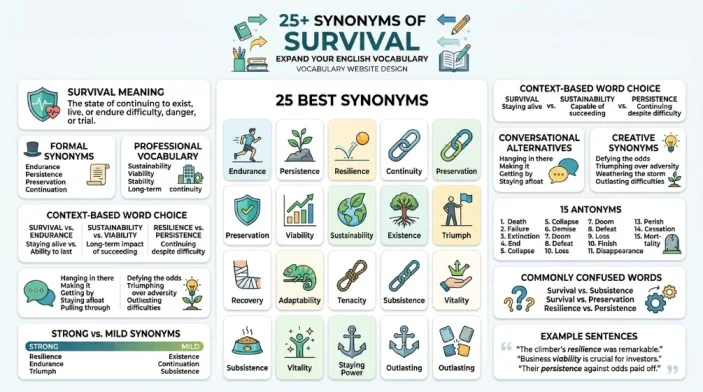
A writer may use the word survival several times in an essay, article, email, or story and quickly realize that repetition makes the writing feel flat. The same problem can appear in resumes, school assignments, social media captions, and professional communication. Learning the synonyms of survival gives you more precise ways to describe staying alive, continuing to exist, enduring hardship, or maintaining something despite difficulty.
The best alternative depends on what you actually mean. Existence works when you mean continuing to live or remain present, endurance emphasizes the ability to withstand hardship, and preservation focuses on protecting something from harm or loss. Choosing carefully makes your writing clearer and prevents different ideas from being treated as though they mean exactly the same thing.
What Are the Best Synonyms of “Survival”?
Survival means continuing to live, exist, function, or remain successful despite danger, hardship, or difficult conditions. The best alternatives include existence, endurance, persistence, continuation, and preservation. Formal writing often favors preservation or continuation, while everyday and emotional writing may use endurance, resilience, or perseverance.
Meaning, Tone, and Context
Simple Definition
Survival refers to the state or process of continuing to live or exist despite danger, hardship, scarcity, pressure, or difficult circumstances.
The word can describe people, animals, businesses, traditions, ideas, communities, or organizations. Its exact meaning changes according to context.
For example, a person may fight for physical survival after an accident, while a small business may focus on survival during an economic downturn.
Part of Speech
Survival is primarily a noun.
It can describe:
- The act of staying alive
- The ability to continue existing
- The ability to endure difficult conditions
- The continuation of an organization or tradition
- The state of remaining after a threat or challenge
Overall Tone
Survival is generally neutral, but it can carry a serious or emotional tone when it describes danger, suffering, conflict, poverty, illness, or extreme hardship.
In positive contexts, it can also suggest strength, determination, and resilience.
Formality Level
Survival is a neutral word that works naturally in formal, academic, professional, and casual communication.
It is common in phrases such as:
- Survival skills
- Survival rate
- Survival strategy
- Survival instinct
- Survival chances
- Survival needs
- Survival story
- Survival techniques
Common Uses
Native English speakers commonly use survival when discussing:
- Physical danger
- Natural disasters
- War and conflict
- Health and medicine
- Wildlife
- Poverty
- Business difficulties
- Economic pressure
- Personal hardship
- Historical events
- Cultural traditions
- Environmental challenges
- Human resilience
Word Forms
| Form | Word |
|---|---|
| Noun | survival |
| Verb | survive |
| Adjective | surviving |
| Adjective | survivable |
| Related noun | survivor |
The verb survive describes the action of continuing to live or exist, while survival describes the state, process, or concept.
When and How to Use “Survival”
Use survival when the central idea is continued life, existence, operation, or presence despite a threat or difficult condition.
Professional
“The company’s survival depends on controlling operating costs.”
Here, survival refers to the organization’s ability to continue operating.
Academic
“The study examines the survival of endangered species in changing environments.”
This use focuses on continued existence within a scientific context.
Workplace
“Effective planning is essential for the survival of a small business during difficult economic periods.”
The word refers to maintaining the business rather than physical life.
Personal
“After years of hardship, her survival became a symbol of strength.”
This use carries an emotional meaning and focuses on overcoming serious difficulties.
“We need a clear strategy to support the team’s survival during the transition.”
In this context, survival may sound dramatic if the situation is not genuinely serious. A softer word such as continuity may be better when appropriate.
Resume
“Developed emergency response procedures that improved team survival during field operations.”
This example works when physical safety is genuinely involved.
Social Media
“Her survival story inspired thousands of people to keep moving forward.”
Here, survival creates a strong emotional connection and highlights overcoming adversity.
Best Synonyms of “Survival”
No synonym can replace survival perfectly in every sentence. The word has several related meanings, including staying alive, continuing to exist, enduring hardship, maintaining an organization, and preserving something.
Professional Writing: Continuation
Continuation works when survival means something continuing rather than ending.
Example:
“The continuation of the program depends on long term funding.”
This is often better than survival when discussing ordinary organizational or administrative continuity.
Academic Writing: Persistence
Persistence works well when discussing something that continues despite resistance or changing conditions.
Example:
“The persistence of the species in the region surprised researchers.”
It emphasizes continued presence rather than physical survival alone.
Business Communication: Viability
Viability is useful when discussing whether a business, plan, system, or project can continue successfully.
Example:
“The company must improve its financial performance to maintain long term viability.”
It is more precise than survival in many business contexts.
Casual Conversation: Getting Through
Getting through is a natural conversational expression for successfully dealing with a difficult period.
Example:
“We just need to focus on getting through this difficult month.”
It sounds much more conversational than survival.
Emotional Writing: Resilience
Resilience emphasizes the ability to recover, adapt, and continue after hardship.
Example:
“Her resilience helped her rebuild her life after the disaster.”
Unlike survival, resilience focuses strongly on inner strength and recovery.
Creative Writing: Endurance
Endurance emphasizes the ability to withstand pain, pressure, hardship, or difficulty over time.
Example:
“His endurance carried him across the barren landscape.”
It creates a stronger sense of struggle and determination.
Resume Writing: Sustainability
Sustainability can be appropriate when discussing an organization’s ability to continue operating or maintain results over time.
Example:
“Developed a cost reduction strategy that improved long term sustainability.”
It sounds more constructive and professional than survival.
Workplace Communication: Continuity
Continuity is useful when the emphasis is on keeping operations, services, or processes functioning without interruption.
Example:
“The new system was designed to ensure business continuity.”
Stronger Meaning: Endurance
When you want to emphasize prolonged hardship, endurance can communicate more struggle than the neutral word survival.
Example:
“The expedition tested the team’s endurance.”
Softer Meaning: Continuity
When survival sounds too dramatic, continuity can provide a calmer alternative.
Example:
“We are developing a plan for business continuity.”
When Not to Use “Survival”
Although survival is flexible, it can sometimes make a situation sound more dramatic than intended.
When the Meaning Is Too General
Less Effective:
“The survival of the project depends on funding.”
Better:
“The continuation of the project depends on funding.”
Why:
If there is no serious threat to life or existence, continuation may communicate the idea more directly.
When the Meaning Is Too Dramatic
Less Effective:
“The survival of our department depends on this meeting.”
Better:
“The future of our department depends on this meeting.”
Why:
Survival suggests an extreme threat. Future sounds more measured.
When You Mean Recovery From Hardship
Less Effective:
“Her survival after the setback was inspiring.”
Better:
“Her resilience after the setback was inspiring.”
Why:
Resilience specifically emphasizes recovering and adapting after difficulty.
When You Mean Business Success
Less Effective:
“The survival of the company requires innovation.”
Better:
“The company’s long term viability requires innovation.”
Why:
Viability is more precise when discussing whether a business can remain financially or operationally successful.
When You Mean Protection
Less Effective:
“The survival of the historic building is our main goal.”
Better:
“The preservation of the historic building is our main goal.”
Why:
Preservation emphasizes protecting something from damage or loss.
When You Mean Ongoing Operations
Less Effective:
“The survival of essential services is our priority.”
Better:
“The continuity of essential services is our priority.”
Why:
Continuity focuses on uninterrupted operation.
Words Commonly Confused With “Survival”
Existence
Difference:
Existence simply means being present or continuing to be. It does not necessarily involve danger or hardship.
When to Use It:
Use existence when the situation is neutral.
Example:
“The existence of the species has been documented for centuries.”
Endurance
Difference:
Endurance emphasizes the ability to withstand difficulty over time.
When to Use It:
Use it for physical, emotional, or prolonged challenges.
Example:
“The marathon required remarkable endurance.”
Resilience
Difference:
Resilience focuses on adapting or recovering after difficulty.
When to Use It:
Use it when someone or something successfully responds to adversity.
Example:
“The community showed remarkable resilience after the storm.”
Preservation
Difference:
Preservation means protecting something so it remains in its existing condition.
When to Use It:
Use it for buildings, traditions, ecosystems, records, and cultural objects.
Example:
“The organization works toward the preservation of historic landmarks.”
Continuation
Difference:
Continuation means something keeps going rather than stopping.
When to Use It:
Use it for programs, projects, services, traditions, and activities.
Example:
“The continuation of the program depends on community support.”
Persistence
Difference:
Persistence highlights continued effort or presence despite obstacles.
When to Use It:
Use it for people, behaviors, problems, trends, and phenomena that continue despite resistance.
Example:
“Her persistence eventually led to a successful result.”
Best Synonyms of “Survival” by Context
| Context | Best Synonym | Why It Works | Example |
|---|---|---|---|
| Formal writing | Continuation | Sounds precise and neutral | The continuation of the program requires funding. |
| Academic writing | Persistence | Highlights continued presence or activity | Researchers studied the persistence of the population. |
| Professional communication | Viability | Fits organizational and financial contexts | The plan’s viability remains uncertain. |
| Business emails | Continuity | Emphasizes uninterrupted operations | We need a continuity plan for the transition. |
| Resume writing | Sustainability | Focuses on long term organizational success | Improved sustainability through cost controls. |
| Workplace communication | Continuity | Describes ongoing operations | The backup system protects service continuity. |
| Casual conversation | Getting through | Sounds natural and conversational | We are just trying to get through the week. |
| Everyday speaking | Enduring | Communicates lasting through difficulty | She has been enduring difficult circumstances. |
| Creative writing | Endurance | Adds a sense of struggle and strength | His endurance kept him moving forward. |
| Storytelling | Resilience | Highlights recovery and adaptation | Her resilience changed the course of her life. |
| Emotional writing | Resilience | Adds emotional depth | Their resilience inspired the entire community. |
| Strong emphasis | Endurance | Highlights prolonged hardship | The journey demanded extraordinary endurance. |
| Mild tone | Continuation | Avoids unnecessary drama | The continuation of the tradition matters to the community. |
| Social media captions | Resilience | Communicates strength concisely | Resilience is built through difficult seasons. |
| American English | Survival | Natural across most contexts | Survival required careful planning. |
| British English | Survival | The same standard term is widely understood | Survival depended on access to resources. |
How to Choose the Best Synonym of “Survival”
Choosing another word for survival starts with identifying the exact idea you want to communicate.
If You Mean Staying Alive
Choose survival itself, continued life, or existence.
Example:
“Access to clean water is essential for human survival.”
If You Mean Withstanding Difficulty
Choose endurance.
Example:
“The expedition tested their physical endurance.”
If You Mean Recovering From Hardship
Choose resilience.
Example:
“The community demonstrated remarkable resilience.”
If You Mean Continuing to Exist
Choose continuation, persistence, or existence.
Example:
“The persistence of the tradition surprised historians.”
If You Mean Protecting Something
Choose preservation or conservation.
Example:
“Preservation of the historic site remains a priority.”
If You Mean Business Success
Choose viability, sustainability, or continuity.
Example:
“The company needs a stronger strategy to maintain financial viability.”
Consider Your Audience
Academic readers generally respond well to precise terms such as persistence, continuation, and viability.
Everyday readers may prefer simpler expressions such as getting through, enduring, or staying alive, depending on the context.
Consider Emotional Strength
- Use survival when the situation involves a genuine threat or serious difficulty.
- Use resilience when you want to emphasize strength and recovery.
- Use continuity when you want a calm, professional tone.
Real Life Examples of “Survival”
School
Basic:
“Animals have different strategies for survival.”
Stronger:
“Animals have developed specialized adaptations that support their survival in harsh environments.”
College
Basic:
“The survival of the species is threatened.”
More precise:
“The continued existence of the species is threatened by habitat loss.”
Workplace
Basic:
“Survival in a competitive industry requires adaptation.”
Professional:
“Long term viability in a competitive industry requires continuous adaptation.”
Business
Basic:
“The company’s survival depends on reducing costs.”
More precise:
“The company’s financial viability depends on controlling costs.”
Basic:
“We need a plan for the survival of the project.”
Better:
“We need a plan to ensure the continuation of the project.”
Resume
Basic:
“Created strategies for business survival.”
Better:
“Created strategies that improved business sustainability during periods of financial pressure.”
Conversation
Basic:
“We are focused on survival during this difficult period.”
Natural:
“We are focused on getting through this difficult period.”
Storytelling
Basic:
“His survival seemed impossible.”
More vivid:
“His endurance seemed almost impossible to believe.”
Blogging
Basic:
“Survival in the digital marketplace requires adaptability.”
Improved:
“Long term viability in the digital marketplace requires constant adaptation.”
Social Media
Basic:
“Survival taught her valuable lessons.”
More expressive:
“Resilience taught her that difficult seasons can reveal unexpected strength.”
25 Best Synonyms of “Survival”
Not all of these words are interchangeable with survival in every sentence. They represent closely related meanings that become appropriate in specific contexts.
| Synonym | Simple Meaning | Best Used For | Example Sentence |
|---|---|---|---|
| Existence | Continuing to be | Life, species, ideas | The species’ existence depends on its habitat. |
| Endurance | Ability to withstand hardship | Physical or emotional challenges | The journey required incredible endurance. |
| Resilience | Ability to recover from difficulty | People and communities | Her resilience helped her rebuild her life. |
| Continuation | Keeping something going | Programs, traditions, operations | Funding will ensure the continuation of the program. |
| Persistence | Continuing despite obstacles | Effort, trends, conditions | His persistence eventually produced results. |
| Preservation | Protecting something from harm or loss | Culture, history, nature | The project supports the preservation of local history. |
| Sustenance | Support needed to maintain life | Food, resources, livelihood | The crops provided sustenance for the community. |
| Subsistence | Bare minimum needed to live | Poverty, agriculture, economics | The family depended on subsistence farming. |
| Livelihood | Means of supporting oneself | Employment and income | Fishing provides a livelihood for many families. |
| Viability | Ability to continue successfully | Business, projects, plans | The company questioned the viability of the proposal. |
| Sustainability | Ability to continue over time | Business, environment, development | The organization is focused on financial sustainability. |
| Continuance | Ongoing existence or activity | Formal writing | The agreement supports the continuance of services. |
| Maintenance | Keeping something in working condition | Systems and operations | Regular maintenance supports the maintenance of essential services. |
| Permanence | State of lasting | Institutions, structures, ideas | The monument was built with permanence in mind. |
| Persistence | Continued presence or effort | Problems, efforts, trends | The persistence of the problem requires attention. |
| Tenacity | Determined persistence | Personal struggle | Her tenacity helped her overcome repeated setbacks. |
| Perseverance | Continued effort despite difficulty | Education, work, personal goals | His perseverance helped him finish the degree. |
| Fortitude | Courage during hardship | Emotional and physical challenges | She faced the crisis with remarkable fortitude. |
| Durability | Ability to last without damage | Products, materials, systems | The equipment’s durability makes it suitable for harsh conditions. |
| Longevity | Long duration of existence | Life, organizations, systems | Good planning can improve the company’s longevity. |
| Conservation | Protection from waste or destruction | Nature and resources | Water conservation helps protect limited supplies. |
| Safeguarding | Protecting against danger | People, systems, information | The policy focuses on safeguarding customer data. |
| Protection | Keeping something safe | People, property, resources | The program provides protection for vulnerable families. |
| Sustaining | Maintaining something over time | Communities, systems, projects | New funding is needed for sustaining the service. |
| Abidance | Continuing to remain or endure | Formal or literary contexts | The tradition’s abidance through generations is notable. |
Synonyms of “Survival” by Usage
Professional vs Personal Synonyms
Professional writing often benefits from terms that describe the exact operational issue.
Use viability for financial or organizational health, sustainability for long term continuation, and continuity for uninterrupted operations.
Personal writing can use resilience, endurance, perseverance, and fortitude when the focus is on how someone responds to hardship.
Professional:
“The strategy will improve the company’s long term viability.”
Personal:
“Her perseverance helped her overcome years of difficulty.”
Formal vs Conversational Synonyms
Formal writing generally favors words such as continuation, preservation, viability, and persistence.
Conversational English is more likely to use expressions such as getting through, staying alive, making it, or simply surviving.
Formal:
“The policy supports the continuation of essential services.”
Conversational:
“We are just trying to make it through this difficult period.”
Academic Synonyms
- Academic writing requires precision because survival can refer to different processes.
- Use persistence when something remains present despite challenges.
- Use existence when discussing whether something continues to be present.
- Use viability when discussing whether something can remain functional or successful.
- Use conservation or preservation when discussing efforts to protect species, ecosystems, historical objects, or cultural practices.
Example:
“Habitat restoration may improve the long term viability of endangered populations.”
Professional and Business Synonyms
Resumes
Use sustainability, viability, continuity, or resilience when describing organizational performance.
Example:
“Implemented operational improvements that strengthened long term business sustainability.”
Interviews
Use precise language that explains the actual challenge.
Instead of saying:
“I helped the company survive.”
Try:
“I helped the company maintain operational continuity during a major transition.”
Meetings
Use continuity, viability, or sustainability depending on the subject.
Presentations
Viability is useful when evaluating whether an idea or business can succeed.
Performance Reviews
Resilience can describe a person’s ability to handle pressure and recover from setbacks.
Client Communication
Use continuity when discussing uninterrupted services.
Business Emails
Use sustainability or viability for long term concerns and continuity for operational issues.
Creative and Literary Synonyms
Creative writing gives you more freedom to choose emotionally powerful alternatives.
Storytelling
Endurance emphasizes prolonged struggle.
“Her endurance kept her moving through the frozen wilderness.”
Fiction
Resilience can describe a character who rebuilds after hardship.
“His resilience became the quiet force behind his recovery.”
Poetry
Persistence can suggest something continuing despite opposition.
“Hope remained through the persistence of every storm.”
Descriptive Writing
Fortitude adds a formal, serious sense of courage.
“She faced the uncertainty with extraordinary fortitude.”
Speeches
Perseverance works especially well when encouraging people to continue despite setbacks.
“Progress often depends on patience, courage, and perseverance.”
Slang or Modern Synonyms
There is no single slang word that directly replaces survival in every context.
In casual American English, expressions such as making it, getting through, staying alive, and hanging in there can communicate related ideas.
Making It
Meaning: Successfully reaching a goal or getting through a difficult situation.
Acceptable: Casual conversation, social media, personal storytelling.
Avoid: Formal reports and academic writing.
Example:
“We are finally making it through the toughest part.”
Getting Through
Meaning: Successfully dealing with a difficult period.
Acceptable: Everyday conversation.
Avoid: Formal academic writing.
Example:
“We will get through this together.”
Hanging In There
Meaning: Continuing despite difficulty.
Acceptable: Informal conversations and supportive messages.
Avoid: Professional reports and formal essays.
Example:
“Keep hanging in there. Things will improve.”
Strongest to Mildest Synonyms
The intensity of a synonym depends heavily on context, so this is a practical rather than absolute scale.
| Level | Useful Words | Main Emphasis |
|---|---|---|
| Mild | Continuation, existence | Simply remaining or continuing |
| Moderate | Persistence, longevity, durability | Lasting despite conditions |
| Strong | Endurance, perseverance, resilience | Withstanding hardship |
| Very Strong | Fortitude, tenacity | Determined strength under serious pressure |
Mild
Continuation and existence are relatively neutral.
Moderate
Persistence and longevity suggest that something continues over time.
Strong
Endurance, resilience, and perseverance suggest meaningful difficulty.
Very Strong
Fortitude and tenacity highlight exceptional determination or strength.
Emotional vs Neutral Synonyms
Emotional Synonyms
Use these when you want to highlight struggle, courage, or human strength.
- Resilience
- Endurance
- Perseverance
- Fortitude
- Tenacity
- Survival
Example:
“Her resilience became an inspiration to everyone around her.”
Neutral Synonyms
Use these when the goal is factual and objective communication.
- Existence
- Continuation
- Viability
- Sustainability
- Persistence
- Preservation
- Longevity
Example:
“The project’s long term viability depends on stable funding.”
Antonyms of “Survival”
Because survival has several meanings, its opposites depend on whether you mean continued life, continued existence, or continued operation.
| Antonym | Meaning | Example Sentence |
|---|---|---|
| Death | End of physical life | The injury could result in death without treatment. |
| Extinction | Complete disappearance of a species or group | Habitat loss can lead to extinction. |
| Destruction | Complete damage or ruin | The fire caused the destruction of the building. |
| Demise | End of existence or operation | The company faced an uncertain demise. |
| Failure | Inability to continue successfully | Poor planning led to the project’s failure. |
| Collapse | Sudden loss of structure or function | The financial collapse forced the business to close. |
| Termination | Formal ending | The contract’s termination ended the service. |
| Disappearance | No longer being present or visible | The species’ disappearance alarmed researchers. |
| Abandonment | Giving up or leaving something | The abandonment of the project halted development. |
| Ruin | Severe damage or destruction | Years of neglect left the building in ruin. |
| Loss | State of no longer having something | The loss of habitat threatened the animals. |
| Expiration | Coming to an end | The policy’s expiration ended its protection. |
| Cessation | Complete stopping of an activity | The cessation of funding affected the program. |
| Discontinuation | Ending something that was continuing | The discontinuation of the service affected customers. |
| Perishing | Dying or being destroyed | The animals were at risk of perishing without food. |
Comparison: “Survival” vs Similar Words
Survival vs Existence
Main Difference:
Survival usually suggests continuing despite danger or difficulty. Existence is broader and simply means being present or continuing to be.
Which Is Stronger?
Survival usually carries more pressure because it often implies a threat.
Which Is More Formal?
Both are suitable for formal writing.
When to Use Each:
Use survival when there is a challenge. Use existence for neutral statements about being.
Examples:
Survival:
“The animal’s survival depends on access to water.”
Existence:
“The existence of the species has been confirmed.”
Survival vs Endurance
Main Difference:
Survival focuses on continuing to live or exist. Endurance focuses on tolerating hardship over time.
Which Is Stronger?
Endurance can sound more active because it emphasizes the ability to withstand difficulty.
Which Is More Formal?
Both are appropriate, but endurance is especially useful in descriptive and literary writing.
When to Use Each:
Use survival for threats to existence. Use endurance for prolonged hardship.
Examples:
Survival:
“Food was necessary for their survival.”
Endurance:
“The journey tested their endurance.”
Survival vs Resilience
Main Difference:
Survival means continuing through hardship. Resilience emphasizes recovering, adapting, or becoming strong again after difficulty.
Which Is Stronger?
They emphasize different qualities. Resilience adds recovery to the idea.
Which Is More Formal?
Both work well in academic and professional contexts.
When to Use Each:
Use survival for staying alive or continuing to exist. Use resilience for recovery.
Examples:
Survival:
“The team’s survival depended on finding shelter.”
Resilience:
“The community showed remarkable resilience after the disaster.”
Survival vs Preservation
Main Difference:
Survival means continuing to exist. Preservation means actively protecting something from damage or loss.
Which Is Stronger?
Neither is inherently stronger.
Which Is More Formal?
Preservation is particularly useful in historical, environmental, and cultural writing.
When to Use Each:
Use preservation when protection is the central idea.
Examples:
Survival:
“The species’ survival is threatened by habitat loss.”
Preservation:
“Preservation of the habitat is a major conservation goal.”
Survival vs Persistence
Main Difference:
Persistence means continuing despite opposition, difficulty, or attempts to stop something.
Which Is Stronger?
Persistence often suggests deliberate continuation.
Which Is More Formal?
Both are suitable for academic and professional writing.
When to Use Each:
Use persistence for behaviors, trends, efforts, or conditions that continue.
Examples:
Survival:
“The group’s survival depended on cooperation.”
Persistence:
“The persistence of the problem required further investigation.”
Survival vs Continuity
Main Difference:
Survival emphasizes avoiding an end. Continuity emphasizes keeping something operating or connected without interruption.
Which Is Stronger?
Survival generally sounds more urgent.
Which Is More Formal?
Continuity is especially common in business and organizational writing.
When to Use Each:
Use continuity for services, operations, traditions, and processes.
Examples:
Survival:
“The business fought for survival.”
Continuity:
“The company developed a plan to ensure business continuity.”
Common Phrases and Expressions with “Survival”
Survival Skills
Meaning:
Practical abilities that help someone remain safe and meet basic needs in difficult conditions.
Example:
“The course teaches basic survival skills for outdoor emergencies.”
Survival Rate
Meaning:
The proportion of people or organisms that remain alive after a specified period or event.
Example:
“Early treatment can improve the survival rate for some conditions.”
Survival Instinct
Meaning:
A natural response that helps an organism protect itself from danger.
Example:
“His survival instinct took over when the situation became dangerous.”
Survival Strategy
Meaning:
A method used to remain alive, functional, or successful during difficult circumstances.
Example:
“The company adopted a new survival strategy during the economic downturn.”
Survival Guide
Meaning:
A resource containing practical advice for dealing with challenging circumstances.
Example:
“The hikers carried a survival guide in their backpacks.”
Survival Story
Meaning:
An account of someone continuing through a dangerous or extremely difficult situation.
Example:
“Her survival story gave hope to other disaster victims.”
Survival Mode
Meaning:
A state in which someone focuses mainly on dealing with immediate needs or threats.
Example:
“After losing his job, he felt as though he was operating in survival mode.”
Fight for Survival
Meaning:
A serious struggle to remain alive or continue existing.
Example:
“The endangered animals are in a fight for survival.”
Common Mistakes to Avoid
1. Treating Every Related Word as an Exact Synonym
Incorrect:
“The company needs resilience to remain profitable.”
Better:
“The company needs financial viability to remain profitable.”
Why:
Resilience describes recovery and adaptation. Viability describes the ability to continue successfully.
2. Using “Survival” When You Mean Recovery
Incorrect:
“Her survival after the setback inspired everyone.”
Better:
“Her resilience after the setback inspired everyone.”
Why:
If the person has already moved beyond the immediate threat, resilience better communicates recovery.
3. Using Informal Language in Formal Writing
Incorrect:
“The organization is just trying to get through the crisis.”
Better:
“The organization is working to maintain operational continuity during the crisis.”
Why:
The second version is more appropriate for a formal business context.
4. Making an Ordinary Problem Sound Extreme
Incorrect:
“The survival of the meeting depends on arriving five minutes early.”
Better:
“The success of the meeting depends on arriving prepared.”
Why:
Survival is too dramatic for an ordinary scheduling issue.
5. Confusing Preservation With Survival
Incorrect:
“The museum’s survival of the painting is important.”
Better:
“The museum’s preservation of the painting is important.”
Why:
The museum is protecting the painting, not personally surviving it.
6. Using “Endurance” for Simple Existence
Incorrect:
“The endurance of the building proves its existence.”
Better:
“The building’s longevity demonstrates its ability to last.”
Why:
Endurance usually involves tolerating hardship. Longevity focuses on lasting over time.
7. Repeating “Survival” When a More Precise Word Exists
Incorrect:
“Business survival requires financial survival and operational survival.”
Better:
“Business viability requires financial stability and operational continuity.”
Why:
The revised sentence communicates two distinct ideas instead of repeating the same broad term.
Frequently Asked Questions
1. What are the best synonyms of “survival”?
The best synonyms of survival depend on context. Existence, endurance, resilience, continuation, persistence, and preservation are useful alternatives, but each emphasizes a different aspect of continuing or overcoming difficulty.
2. What are the best formal synonyms of “survival”?
Formal alternatives include continuation, persistence, viability, preservation, sustainability, and continuance. The best choice depends on whether you are discussing life, organizations, traditions, resources, or continued activity.
3. What are common informal synonyms of “survival”?
Informal expressions related to survival include getting through, making it, staying alive, and hanging in there. These expressions work best in casual conversations, personal writing, and social media rather than academic documents.
4. What is another word for “survival” in professional writing?
In professional writing, viability, sustainability, and continuity are often more precise than survival. Use viability for long term success, sustainability for continued performance, and continuity for uninterrupted business operations.
5. What is the difference between “survival” and “resilience”?
Survival means continuing to live or exist despite danger or hardship. Resilience goes further by emphasizing the ability to recover, adapt, and regain strength after experiencing difficulty or disruption.
6. What is the opposite of “survival”?
The opposite of survival depends on context. Death is the clearest opposite when discussing life, while extinction, destruction, failure, collapse, and discontinuation can describe the end of species, systems, projects, or organizations.
Conclusion
Use existence for continued presence, endurance for prolonged hardship, resilience for recovery, preservation for protection, continuation for ongoing activity, and viability for business or organizational success. In professional writing, these alternatives can communicate your exact meaning more effectively than repeating survival.
There is no single synonym that works perfectly in every situation. Before replacing the word, consider your audience, tone, purpose, and the specific meaning you want to express. A useful vocabulary habit is to identify the reason something survives, then choose a word that names that exact idea.
Read More Related Articles:
- 25+ Synonyms of Resume | Meanings, Uses, Examples, and …
- 25+ Synonyms of Bridge | Meanings, Uses, Examples, and …
- 25+ Synonyms of Sincerely | Meanings, Uses, Examples, and …











1 thought on “25+ Synonyms of Survival | Powerful Alternatives, Meanings & Better Word Choices for Every Context in 2026”