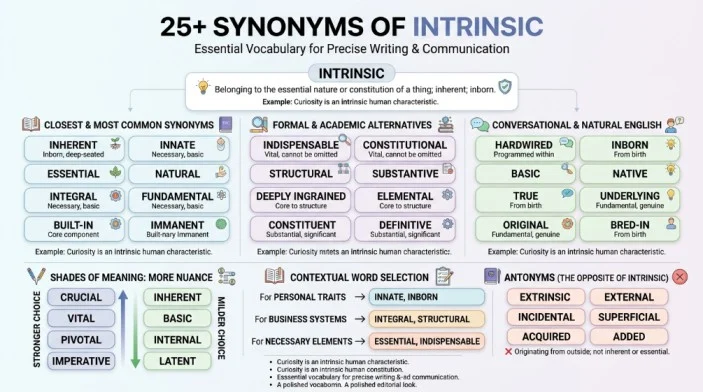
Synonym of Intrinsic can make your writing more precise when you need to describe something that is naturally part of a person, thing, or situation. The word intrinsic often appears in academic writing, professional communication, essays, and thoughtful discussions about qualities, value, and characteristics. Choosing the right alternative depends on the exact meaning and tone you want to express.
A strong vocabulary choice does more than replace one word with another. It preserves the original meaning while making your sentence clearer and more natural. Words such as inherent, innate, essential, fundamental, and built-in can work as alternatives, but each carries a slightly different sense. Understanding these distinctions helps you select the most accurate synonym of intrinsic for academic, formal, creative, or everyday writing in 2026.
What Are the Best Synonyms of “Intrinsic”?
The best synonyms of intrinsic include inherent, innate, essential, inborn, natural, fundamental, integral, built in, and immanent. Intrinsic describes something that belongs naturally to the essential nature of a person or thing. For formal and academic writing, inherent and essential are strong choices, while natural and built in are more conversational.
Meaning, Tone, and Context
Simple Definition
Intrinsic describes something that belongs to the essential nature of a person, object, system, or idea. It is not mainly produced by outside circumstances or added from the outside.
For example:
“The material has intrinsic strength.”
This means the strength is part of the material’s own nature rather than a quality added through an external treatment.
Cambridge defines intrinsic as an extremely important and basic characteristic of a person or thing. Collins similarly explains that something with intrinsic value or interest has that value because of its basic nature or character rather than its connection with something else.
Part of Speech
Intrinsic is an adjective.
It normally appears before a noun:
“intrinsic value”
“intrinsic quality”
“intrinsic motivation”
“intrinsic part”
It can also appear after linking verbs:
“The value is intrinsic.”
Overall Tone
The tone of intrinsic is generally neutral and analytical.
It does not automatically express positive or negative emotion. The emotional meaning comes from the noun it modifies.
For example:
“The artist’s intrinsic creativity”
has a positive meaning, while:
“The system has intrinsic weaknesses”
has a negative meaning.
Formality Level
Intrinsic is generally formal to neutral.
It is especially common in:
- Academic writing
- Philosophy
- Psychology
- Economics
- Business writing
- Scientific discussions
- Technical writing
- Formal essays
It can appear in everyday English, but simpler alternatives such as natural, inherent, or built in may sound more conversational.
Common Uses
Some of the most common expressions with intrinsic include:
| Expression | Meaning |
|---|---|
| Intrinsic value | Value that comes from the thing itself |
| Intrinsic quality | A quality naturally belonging to something |
| Intrinsic motivation | Motivation that comes from personal interest or satisfaction |
| Intrinsic worth | Value considered part of something’s nature |
| Intrinsic part | A part that naturally belongs to a whole |
| Intrinsic property | A property belonging to something itself |
| Intrinsic nature | The basic character of something |
| Intrinsic interest | Interest that exists because of the subject itself |
Word Forms
Adjective: intrinsic
Adverb: intrinsically
Noun: intrinsicness, though this form is uncommon in ordinary writing
Related word: extrinsic
Opposite: extrinsic
The adverb intrinsically means in a way that belongs naturally or essentially to something.
“The two concepts are intrinsically connected.”
When and How to Use “Intrinsic”
Use intrinsic when you want to show that a quality, value, feature, or characteristic belongs to something by its own nature.
It is especially useful when contrasting internal qualities with external influences.
Professional
“The company recognizes the intrinsic value of employee experience.”
Here, intrinsic suggests that employee experience has value in itself, rather than only because it produces another benefit.
Academic
“The study examines the intrinsic properties of the material.”
This is appropriate when discussing qualities that belong to the material itself.
Workplace
“Trust has intrinsic importance in effective teamwork.”
The word gives the statement a formal and analytical tone.
Personal
“She believes that every person has intrinsic worth.”
This sentence emphasizes value that exists naturally rather than value given by social status.
“The proposal has intrinsic strengths that deserve further consideration.”
This sounds more formal than simply saying the proposal is good.
Resume
“Recognized the intrinsic value of customer relationships and developed long term retention strategies.”
In a resume, intrinsic works best when the context genuinely involves an internal or inherent quality. Simpler words may be stronger when space is limited.
Social Media
“There is intrinsic beauty in creating something by hand.”
This works well in reflective or creative social media writing.
Best Synonyms of “Intrinsic”
No synonym is identical to intrinsic in every context. The closest alternative depends on whether you mean naturally present, essential to the nature of something, present from birth, built into a system, or deeply established.
Professional Writing: Inherent
Inherent is often the closest general replacement for intrinsic. It describes a quality that exists naturally as part of something.
“The technology has inherent limitations.”
This is especially effective in reports, business writing, and technical discussions.
Academic Writing: Essential
Essential works well when the intended meaning is closely connected with the basic nature or essence of something.
“Language is an essential part of human communication.”
It can also mean absolutely necessary, so the surrounding sentence should make your intended meaning clear.
Business Communication: Integral
Integral emphasizes that something is an important part of a larger whole.
“Data security is integral to the company’s operations.”
It is particularly useful when discussing systems, processes, teams, or organizational structures.
Casual Conversation: Natural
Natural is easier to understand in everyday English.
“Her ability to explain difficult ideas is natural.”
However, natural is broader than intrinsic, so it should be used when the context supports that broader meaning.
Emotional Writing: Inherent
Inherent can express a quality that belongs deeply and permanently to a person or thing.
“There is an inherent kindness in the way she treats people.”
For strongly emotional writing, innate or natural may sometimes sound warmer.
Creative Writing: Deep Seated
Deep seated describes a quality, feeling, belief, or tendency that is firmly established within someone.
“He carried a deep seated fear of failure.”
It is not a universal synonym for intrinsic, but it works when the idea concerns a deeply established internal characteristic.
Resume Writing: Built In
Built in is useful when describing a feature that is already part of a system, product, or process.
“Implemented software with built in security controls.”
For human qualities, inherent or innate is usually more appropriate.
Workplace Communication: Fundamental
Fundamental emphasizes something basic to the structure or nature of an issue.
“Respect is fundamental to a healthy workplace culture.”
It is especially useful in policies, presentations, and professional explanations.
Stronger Meaning: Essential
When you want to emphasize necessity rather than simple internal existence, essential is stronger.
“Reliable communication is essential to the project’s success.”
Be careful because essential can change the meaning from “naturally part of” to “absolutely necessary.”
Softer Meaning: Natural
Natural can be a softer and more familiar alternative.
“She has a natural ability to connect with audiences.”
It sounds less technical than intrinsic and is often easier for general readers.
When Not to Use “Intrinsic”
Although intrinsic is precise, it is not always the best word. Sometimes it sounds too formal, too technical, or simply changes the meaning of the original sentence.
When the Meaning Is Too General
If you simply mean that something is good, useful, or valuable, intrinsic may be unnecessarily specific.
Less Effective:
“This feature has intrinsic importance.”
Better:
“This feature is important to our customers.”
Use intrinsic when the importance comes from the thing itself.
When You Mean Absolutely Necessary
Intrinsic does not automatically mean “required.”
Less Effective:
“A passport is intrinsic to international travel.”
Better:
“A passport is essential for international travel.”
The second sentence clearly communicates necessity.
When You Mean Present From Birth
Intrinsic can describe a natural quality, but innate or inborn is more precise when the focus is something present from birth.
Less Effective:
“She has an intrinsic talent for music.”
Better:
“She has an innate talent for music.”
When the Audience Is Very General
Technical vocabulary may make simple writing harder to understand.
Less Effective:
“The product contains intrinsic safety mechanisms.”
Better:
“The product has built in safety features.”
When You Need a Casual Tone
Intrinsic can sound academic in a friendly conversation.
Less Effective:
“Her intrinsic kindness makes her a great friend.”
More Natural:
“Her natural kindness makes her a great friend.”
When You Mean External or Added Value
Do not use intrinsic when the quality comes from outside.
Incorrect:
“The product’s advertising campaign gives it intrinsic popularity.”
Better:
“The advertising campaign increased the product’s popularity.”
Popularity created by advertising is external rather than intrinsic.
When You Need a More Specific Technical Term
In scientific or economic writing, another specialized word may communicate the relationship more accurately.
For example, endogenous means originating from within a system, while intrinsic has a broader meaning. Cambridge identifies endogenous as a specialized term used in areas such as medicine, social science, and economics.
Words Commonly Confused With “Intrinsic”
Inherent
Difference: Inherent describes a quality that naturally exists as part of something. It is one of the closest alternatives to intrinsic.
When to Use It: Use it when describing permanent or inseparable characteristics.
Example:
“There are inherent risks in the process.”
Innate
Difference: Innate usually describes a quality, ability, or tendency that exists naturally in a person or organism, often from birth.
When to Use It: Use it for talents, abilities, instincts, and tendencies.
Example:
“The child showed an innate curiosity about animals.”
Essential
Difference: Essential can mean fundamental to the nature of something, but it also commonly means absolutely necessary.
When to Use It: Use it when necessity or basic importance is the main idea.
Example:
“Clean water is essential for human life.”
Integral
Difference: Integral emphasizes that something is a necessary or important part of a larger whole.
When to Use It: Use it for components, systems, processes, and relationships.
Example:
“Feedback is integral to the learning process.”
Natural
Difference: Natural is broader. It can mean existing in nature, normal, spontaneous, or not artificial.
When to Use It: Use it when a simpler and more conversational word is appropriate.
Example:
“She has a natural ability to lead.”
Extrinsic
Difference: Extrinsic refers to something whose value, effect, or origin comes from outside rather than from the thing itself.
When to Use It: Use it when directly contrasting internal and external qualities.
Example:
“The award provided extrinsic motivation, while personal satisfaction was intrinsic.”
Best Synonyms of “Intrinsic” by Context
| Context | Best Synonym | Why It Works | Example |
|---|---|---|---|
| Formal writing | Inherent | Closely matches the idea of a natural quality | “The policy has inherent limitations.” |
| Academic writing | Essential | Highlights a basic or fundamental characteristic | “Language is essential to human interaction.” |
| Professional communication | Integral | Shows that something belongs importantly to a larger system | “Training is integral to quality control.” |
| Business emails | Inherent | Sounds precise without being unnecessarily complex | “The proposal has inherent advantages.” |
| Resume writing | Built in | Useful for features already included in a product or system | “Designed software with built in security.” |
| Workplace communication | Fundamental | Highlights a basic principle | “Respect is fundamental to teamwork.” |
| Casual conversation | Natural | Easy to understand and conversational | “She has a natural talent for teaching.” |
| Everyday speaking | Built in | Familiar and straightforward for features or functions | “The phone has built in protection.” |
| Creative writing | Deep seated | Expresses a deeply established internal quality | “He struggled with a deep seated fear.” |
| Storytelling | Innate | Works well for natural abilities and tendencies | “Her innate curiosity drove the adventure.” |
| Emotional writing | Inherent | Suggests a deep quality that belongs naturally to someone | “There is an inherent goodness in her actions.” |
| Strong emphasis | Essential | Adds the idea of necessity | “Trust is essential to the relationship.” |
| Mild tone | Natural | Softer and less technical | “He has a natural confidence.” |
| Social media captions | Natural | Sounds accessible and expressive | “Finding beauty in the natural details of life.” |
| American English | Inherent | Common and broadly understood in formal American English | “The system has inherent weaknesses.” |
| British English | Inbuilt | A common British alternative to built in in relevant contexts | “The device has an inbuilt safety feature.” |
Cambridge lists inbuilt as a synonym of inherent and labels it mainly British, while American English commonly uses built in.
How to Choose the Best Synonym of “Intrinsic”
Choosing an alternative becomes easier when you first identify the exact relationship you want to describe.
If You Mean “Naturally Part of Something”
Choose inherent.
“The risks are inherent in the process.”
If You Mean “Present From Birth”
Choose innate or inborn.
“She has an innate ability to understand patterns.”
If You Mean “Absolutely Necessary”
Choose essential.
“Accurate records are essential for the audit.”
If You Mean “Important Part of a Whole”
Choose integral.
“Communication is integral to effective leadership.”
If You Mean “Already Included in a System”
Choose built in.
“The application has built in privacy controls.”
If You Mean “Coming From Within a System”
Choose endogenous in specialized contexts.
“The researchers examined endogenous factors affecting the market.”
If You Mean “Present as a Permanent Natural Part”
Choose immanent in formal philosophical or specialized writing.
Cambridge defines immanent as something present as a natural and permanent part of something.
Consider Your Audience
- For a general audience, natural, inherent, or built in may be easier to understand.
- For academic readers, inherent, integral, fundamental, or constitutive may be more suitable.
- For technical readers, endogenous can be appropriate when the specific meaning is “originating within a system.”
Consider Emotional Strength
Intrinsic itself is generally neutral. If you need emotional warmth, natural, meaningful, or deep seated may work better depending on the sentence.
Consider Formality
- Use inherent for a broadly formal but accessible tone.
- Use immanent for highly specialized philosophical contexts.
- Use natural for everyday readers.
- Use built in for accessible technical writing.
Check the Exact Meaning
Before replacing intrinsic, ask:
Is the quality natural?
- Use inherent or natural.
Is it present from birth?
- Use innate or inborn.
Is it necessary?
- Use essential.
Is it part of a larger whole?
- Use integral.
Does it originate inside a system?
- Use endogenous.
This approach prevents a synonym from changing the original meaning.
Real Life Examples of “Intrinsic”
School
Original:
“Reading has intrinsic value for students.”
Alternative:
“Reading has inherent value for students.”
The alternative sounds natural in an essay while preserving the idea that reading has value in itself.
College
Original:
“The intrinsic properties of the material were examined.”
Alternative:
“The inherent properties of the material were examined.”
Here, inherent is a strong academic alternative.
Workplace
Original:
“Trust is intrinsic to effective teamwork.”
Alternative:
“Trust is integral to effective teamwork.”
Integral works especially well because trust is being described as an important part of a larger process.
Business
Original:
“The product has intrinsic advantages.”
Alternative:
“The product has inherent advantages.”
The alternative keeps the focus on advantages that belong naturally to the product.
Original:
“The proposal has intrinsic strengths that we should consider.”
Alternative:
“The proposal has inherent strengths that we should consider.”
The second version remains professional while using a more familiar word.
Resume
Original:
“Identified the intrinsic value of customer feedback.”
Alternative:
“Identified the inherent value of customer feedback.”
For a resume, inherent may be clearer, although the best choice depends on what the achievement actually involved.
Conversation
Original:
“She has an intrinsic ability to make people feel comfortable.”
More natural:
“She has a natural ability to make people feel comfortable.”
The simpler alternative fits casual speech better.
Storytelling
Original:
“His intrinsic fear of failure shaped his decisions.”
Alternative:
“His deep seated fear of failure shaped his decisions.”
The second version creates a more emotionally expressive tone.
Blogging
Original:
“Good design has intrinsic value.”
Alternative:
“Good design has inherent value.”
This is useful when discussing design principles in a professional or educational article.
Social Media
Original:
“There is intrinsic beauty in simple moments.”
Alternative:
“There is natural beauty in simple moments.”
The second version feels softer and more accessible for a social media audience.
25 Best Synonyms of “Intrinsic”
The following list focuses on words that can genuinely replace intrinsic in at least a relevant context. Some are broad synonyms, while others are context specific. They should not be treated as interchangeable in every sentence.
| Synonym | Simple Meaning | Best Used For | Example Sentence |
|---|---|---|---|
| Inherent | Naturally belonging to something | General, professional, academic | “The method has inherent limitations.” |
| Innate | Present naturally, especially from birth | Abilities and traits | “She has an innate sense of rhythm.” |
| Inborn | Present from birth | Natural abilities or characteristics | “His inborn curiosity led him to explore.” |
| Inbred | Deeply established within a group or nature | Formal or specialized descriptions | “The culture had an inbred resistance to change.” |
| Ingrained | Deeply fixed or established | Habits, beliefs, tendencies | “The tradition is ingrained in the community.” |
| Natural | Existing or occurring without being added artificially | General and conversational writing | “She has a natural talent for teaching.” |
| Native | Naturally belonging to a place, person, or thing | Origins and characteristics | “The species has several native adaptations.” |
| Built in | Already included as part of something | Technology and systems | “The device has built in security.” |
| Inbuilt | Naturally included or incorporated | Mainly British usage | “The system has an inbuilt safety feature.” |
| Essential | Fundamental or necessary | Formal and academic writing | “Trust is essential to strong leadership.” |
| Fundamental | Basic to the nature or structure of something | Academic and professional writing | “Equality is a fundamental principle.” |
| Basic | Forming the foundation of something | General and educational writing | “These are basic features of the system.” |
| Integral | An important part of a whole | Business and academic writing | “Feedback is integral to improvement.” |
| Constitutive | Forming or helping make up something | Academic and technical writing | “Language is constitutive of social identity.” |
| Immanent | Existing naturally and permanently within something | Philosophy and formal writing | “The principle was immanent in the theory.” |
| Internal | Existing within something | Physical, technical, and organizational contexts | “The system has internal controls.” |
| Indwelling | Existing within something or someone | Literary, religious, and specialized writing | “The poem explores an indwelling sense of hope.” |
| Connatural | Natural or closely belonging to something | Highly formal or philosophical writing | “The qualities were considered connatural to human reason.” |
| Unacquired | Not gained through learning or outside experience | Specialized descriptions | “The researchers distinguished innate traits from unacquired responses.” |
| Constitutional | Belonging to the basic makeup of something or someone | Formal and specialized writing | “The condition may involve constitutional factors.” |
| Deep seated | Firmly established within a person | Emotions, beliefs, and tendencies | “He had a deep seated fear of failure.” |
| Deep rooted | Firmly established over time | Beliefs, traditions, and attitudes | “The custom is deep rooted in the community.” |
| Endogenous | Originating from within a system | Science, economics, and medicine | “The model includes endogenous factors.” |
| Organic | Developing naturally from within a system or process | Growth, development, and organizations | “The team experienced organic growth.” |
| Essentially | In a fundamental or basic sense | Adverbial reformulation | “The two arguments are essentially similar.” |
The strongest general replacements are usually inherent, innate, essential, natural, and integral. Specialized words such as immanent, endogenous, and constitutive should be used only when their more specific meanings fit the context. Dictionary sources support several of these relationships, including inherent, essential, natural, native, and innate.
Synonyms of “Intrinsic” by Usage
Professional vs Personal Synonyms
Professional writing benefits from precision.
Use inherent, integral, fundamental, or essential when discussing processes, policies, systems, or organizational principles.
Personal writing can use natural, innate, deep seated, or inborn, depending on the subject.
Compare:
“Communication is integral to effective management.”
with:
“She has a natural ability to communicate.”
The first sentence discusses an organizational relationship. The second describes a personal quality.
Formal vs Conversational Synonyms
For reports, essays, presentations, and business writing, favor:
Inherent, essential, integral, fundamental, constitutive, immanent
For casual conversations and accessible writing, favor:
Natural, built in, inborn, innate
A sentence such as:
“The software has an intrinsic security feature.”
can become:
“The software has a built in security feature.”
The second version is easier for a general audience.
Academic Synonyms
Academic writing benefits from terms that communicate exact relationships.
Inherent works for naturally existing characteristics.
Intrinsic works when discussing a property’s value or nature.
Integral works when something is an important part of a whole.
Fundamental works when discussing basic principles.
Constitutive works when something helps form or define another concept.
Immanent is appropriate in specialized philosophical discussions.
These words can make academic arguments more precise, but complexity should never replace clarity.
Professional and Business Synonyms
For resumes, interviews, meetings, presentations, performance reviews, client communication, and business emails, the strongest practical choices are usually:
Inherent: natural characteristic
Integral: important component
Essential: necessary element
Fundamental: basic principle
Built in: included feature
Strategic: useful for long term planning, although it is not a direct synonym of intrinsic
For example:
“Customer trust is integral to our retention strategy.”
is more precise than:
“Customer trust is important to our retention strategy.”
Creative and Literary Synonyms
Creative writing gives you more freedom to emphasize feeling and depth.
- Use innate for natural talent.
- Use deep seated for powerful internal emotions.
- Use deep rooted for beliefs or traditions.
Use natural for qualities that feel effortless.
Use inherent when you want a serious, reflective tone.
For example:
“Her innate curiosity pulled her toward the abandoned house.”
sounds more vivid than:
“Her intrinsic curiosity pulled her toward the abandoned house.”
Both are grammatically possible, but innate feels more natural in this narrative context.
Slang or Modern Synonyms
There is no reliable slang word that functions as a direct synonym for intrinsic.
Casual English usually replaces it with ordinary expressions such as:
Natural
Built in
Part of who someone is
Part of what something is
For example:
“That confidence is just part of who she is.”
This is much more conversational than:
“That confidence is intrinsic to her personality.”
Strongest to Mildest Synonyms
Because intrinsic describes a type of relationship rather than a simple level of intensity, synonyms cannot always be placed on a perfect strength scale. However, they can be grouped according to how strongly they emphasize internality, necessity, or permanence.
| Level | Useful Words | Main Emphasis |
|---|---|---|
| Mild | Natural, basic, internal | Simple internal or natural quality |
| Moderate | Inherent, native, integral | Belonging naturally to something |
| Strong | Fundamental, innate, deep rooted | Deep or essential connection |
| Very Strong | Essential, indispensable, constitutive | Necessity or defining structure |
The important distinction is that essential may sound stronger than intrinsic because it can mean absolutely necessary. Likewise, innate is stronger only when the context involves natural or birth related characteristics.
Emotional vs Neutral Synonyms
Emotional Synonyms
These words can add more personal or expressive meaning:
Natural
Innate
Deep seated
Deep rooted
Inborn
Use them when discussing feelings, personality, identity, memories, or personal qualities.
Example:
“She had a deep seated belief that everyone deserved a second chance.”
Neutral Synonyms
These words are better when the goal is objective communication:
Intrinsic
Inherent
Integral
Fundamental
Essential
Constitutive
Endogenous
Example:
“The researchers examined the inherent limitations of the model.”
Neutral vocabulary works particularly well in academic and professional contexts.
Antonyms of “Intrinsic”
The most direct opposite of intrinsic is extrinsic, meaning coming from outside or depending on external factors. Other opposites apply to specific meanings of intrinsic, such as natural origin, internal presence, or essential belonging.
| Antonym | Meaning | Example Sentence |
|---|---|---|
| Extrinsic | Coming from outside rather than from within | “The reward created extrinsic motivation.” |
| External | Existing or coming outside something | “The damage was caused by external forces.” |
| Extraneous | Coming from outside or not belonging to the essential part | “The report removed extraneous details.” |
| Incidental | Secondary rather than essential | “The cost was incidental to the main project.” |
| Accidental | Resulting from chance rather than essential nature | “The feature was accidental rather than intentional.” |
| Acquired | Gained through experience rather than naturally present | “The skill was acquired through years of training.” |
| Learned | Developed through teaching or experience | “The behavior was learned rather than innate.” |
| Superficial | Concerned with the surface rather than deeper nature | “The analysis offered only a superficial explanation.” |
| Artificial | Produced or created rather than naturally occurring | “The flowers were artificial rather than natural.” |
| Imposed | Added or forced from outside | “The rule was imposed by an external authority.” |
| Conditional | Dependent on a particular condition | “The benefit was conditional on continued membership.” |
| Contingent | Dependent on circumstances rather than existing inherently | “The agreement was contingent on funding.” |
| Dependent | Relying on something outside itself | “The outcome was dependent on market conditions.” |
| Outward | Relating to the external rather than internal aspect | “The outward appearance differed from the internal structure.” |
| Foreign | Coming from outside or not naturally belonging | “The researchers identified foreign material in the sample.” |
Comparison: “Intrinsic” vs Similar Words
Intrinsic vs Inherent
Main Difference
These words are extremely close. Intrinsic emphasizes a quality belonging to the essential nature of something, while inherent often emphasizes a natural or inseparable characteristic.
Which Is Stronger?
Neither is consistently stronger.
Which Is More Formal?
Both are formal and suitable for academic and professional writing.
When to Use Each
Use intrinsic when discussing value, properties, or essential nature. Use inherent when discussing risks, limitations, qualities, or characteristics.
Examples
Intrinsic:
“The painting has intrinsic artistic value.”
Inherent:
“The process has inherent risks.”
Intrinsic vs Innate
Main Difference
Innate usually concerns qualities present naturally in a person or organism, especially abilities, instincts, or tendencies.
Which Is Stronger?
Innate is more specific when the quality is natural from birth.
Which Is More Formal?
Both can be formal.
When to Use Each
Use innate for talents, instincts, and characteristics. Use intrinsic for broader properties and values.
Examples
Intrinsic:
“The material has intrinsic strength.”
Innate:
“She has an innate talent for music.”
Intrinsic vs Essential
Main Difference
Intrinsic means naturally belonging to something. Essential can mean fundamental to its nature or absolutely necessary.
Which Is Stronger?
Essential is often stronger because it can indicate necessity.
Which Is More Formal?
Both are appropriate for formal writing.
When to Use Each
Use essential when something is required. Use intrinsic when something belongs naturally to the thing itself.
Examples
Intrinsic:
“The object has intrinsic value.”
Essential:
“Accurate data is essential for the study.”
Intrinsic vs Integral
Main Difference
Integral emphasizes being an important part of a larger whole.
Which Is Stronger?
Neither is inherently stronger.
Which Is More Formal?
Both are suitable for professional and academic writing.
When to Use Each
Use integral when the relationship to the whole matters.
Examples
Intrinsic:
“The material has intrinsic properties.”
Integral:
“Testing is integral to the development process.”
Intrinsic vs Natural
Main Difference
Natural has several meanings, including not artificial, normal, spontaneous, and existing in nature. Intrinsic is narrower and focuses on essential internal qualities.
Which Is Stronger?
Intrinsic is more precise.
Which Is More Formal?
Intrinsic is more formal.
When to Use Each
Use natural for general audiences. Use intrinsic when precision matters.
Examples
Intrinsic:
“The system has intrinsic limitations.”
Natural:
“She has a natural ability to lead.”
Intrinsic vs Endogenous
Main Difference
Endogenous specifically means originating or coming from within a system, organism, or other defined structure. It is a specialized term.
Which Is Stronger?
Neither is stronger. They describe different relationships.
Which Is More Formal?
Endogenous is more specialized.
When to Use Each
Use endogenous in technical fields such as medicine, economics, and social science when the origin within a system is the key point.
Examples
Intrinsic:
“The material has intrinsic properties.”
Endogenous:
“The model includes endogenous economic factors.”
Common Phrases and Expressions with “Intrinsic”
Intrinsic Value
Meaning: Value that exists because of the nature or qualities of something itself.
Example:
“The artwork has intrinsic value beyond its market price.”
Intrinsic Worth
Meaning: Value considered to belong naturally to a person or thing.
Example:
“The argument recognizes the intrinsic worth of every individual.”
Intrinsic Motivation
Meaning: Motivation that comes from personal interest, satisfaction, or enjoyment rather than an outside reward.
Example:
“Students often learn more deeply when they have intrinsic motivation.”
Intrinsic Quality
Meaning: A quality that belongs naturally to something.
Example:
“The material’s intrinsic quality makes it suitable for demanding applications.”
Intrinsic Part
Meaning: A part that naturally belongs to a larger whole.
Example:
“Research is an intrinsic part of the course.”
Intrinsic Property
Meaning: A characteristic belonging to an object or system itself.
Example:
“Density is treated as an intrinsic property of the material.”
Intrinsic Nature
Meaning: The essential character of something.
Example:
“The debate concerns the intrinsic nature of consciousness.”
Intrinsic Interest
Meaning: Interest that comes from the subject itself rather than an external reward.
Example:
“The topic has intrinsic interest for students of history.”
Common Mistakes to Avoid
1. Treating Every Synonym as Identical
Incorrect
“She has an essential talent for music.”
Better
“She has an innate talent for music.”
Why
Innate is more precise for a natural ability, while essential often means necessary.
2. Confusing Intrinsic With Important
Incorrect
“The deadline is intrinsic.”
Better
“The deadline is important.”
Why
Intrinsic describes an internal or essential relationship. It does not simply mean important.
3. Using Intrinsic When You Mean Necessary
Incorrect
“A password is intrinsic to accessing the account.”
Better
“A password is essential for accessing the account.”
Why
The second sentence communicates necessity rather than inherent nature.
4. Using a Technical Word With a General Audience
Less Effective
“The device contains intrinsic security mechanisms.”
Better
“The device has built in security features.”
Why
The second sentence is easier for most readers to understand.
5. Using Intrinsic for an External Quality
Incorrect
“The company’s advertising gave the product intrinsic popularity.”
Better
“The company’s advertising increased the product’s popularity.”
Why
Popularity created by advertising is an external result, not an inherent property.
6. Using an Overly Strong Synonym
Incorrect
“The color is essential to the design.”
Better
“The color is integral to the design.”
Why
Essential can imply absolute necessity. Integral is often more accurate when something is an important component.
7. Confusing Immanent With Imminent
Incorrect
“The change was immanent.”
Better
“The change was imminent.”
Why
Immanent means existing naturally within something. Imminent means likely to happen very soon. Cambridge distinguishes the two meanings clearly.
Frequently Asked Questions
What is a synonym for intrinsic?
Common synonyms for intrinsic include inherent, innate, essential, natural, and internal. The best choice depends on the context.
What is a synonym for intrinsic motivation?
Useful alternatives for intrinsic motivation include internal motivation, inner drive, self-motivation, and personal motivation.
What are the common intrinsic synonyms in English?
Common intrinsic synonyms in English include inherent, innate, essential, natural, internal, and built-in.
What is the opposite of intrinsic?
The opposite of intrinsic is usually extrinsic, meaning something that comes from an external source rather than from within.
What is the intrinsic opposite?
Extrinsic is the most direct intrinsic opposite, especially when discussing motivation, value, or qualities.
What is another term for intrinsic?
Another term for intrinsic can be inherent, innate, essential, internal, or built-in, depending on the sentence.
What are the synonyms of intrinsic?
The main synonyms of intrinsic are inherent, innate, essential, natural, internal, and fundamental.
What are the best synonyms of “intrinsic”?
The best synonyms of intrinsic include inherent, innate, essential, inborn, natural, integral, fundamental, built in, and immanent. The closest choice depends on whether you mean natural, necessary, internal, or fundamental.
What are the best formal synonyms of “intrinsic”?
The strongest formal alternatives include inherent, integral, fundamental, constitutive, essential, and immanent. For most academic and professional writing, inherent is the safest direct replacement because it closely matches the original meaning.
What are common informal synonyms of “intrinsic”?
Common conversational alternatives include natural, built in, and phrases such as part of who someone is. These expressions are easier for general readers and usually sound less academic than intrinsic.
What is another word for “intrinsic” in professional writing?
Inherent is usually the best professional alternative. Depending on context, integral, essential, fundamental, or built in may be more precise when discussing systems, requirements, principles, or product features.
What is the difference between “intrinsic” and “inherent”?
Intrinsic and inherent are very close. Both describe qualities that belong naturally to something, but intrinsic often emphasizes essential nature or value, while inherent commonly describes natural or inseparable characteristics.
What is the opposite of “intrinsic”?
The direct opposite of intrinsic is extrinsic. Extrinsic describes something whose value, effect, or origin comes from outside rather than from the thing’s own nature. Other contextual opposites include external, acquired, and superficial.
Conclusion
Intrinsic describes something that belongs naturally to the essential nature of a person, object, system, or idea. The best alternative depends on the exact meaning you need. Inherent is usually the closest general synonym, while innate works for natural abilities, essential emphasizes necessity, integral highlights an important part of a whole, and built in works well for features already included in a system.
The best synonym of intrinsic is therefore not always the most sophisticated word. Choose based on meaning, audience, tone, and purpose. When the quality is naturally present, inherent may be ideal. When it exists from birth, choose innate. It is necessary, choose essential. When it forms an important part of something larger, integral may be better.
A useful vocabulary habit is to identify the exact relationship you want to express before replacing a word. Precision matters more than simply choosing a more advanced synonym.
Read More Related Articles:
- Synonyms for Creativity | Meaning, Examples, and Better …
- Synonyms for Empty | Meaning, Examples, and Better Word …