You are writing an email, essay, caption, or work message, and you keep using the word annoyed. The feeling is clear, but repeating the same word can make your writing sound flat. Finding the right synonym of annoyed can help you show whether someone is mildly bothered, openly frustrated, or genuinely angry.
The best alternative depends on the situation. Irritated works well in everyday writing, frustrated emphasizes difficulty or disappointment, exasperated shows stronger irritation, and peeved creates a casual tone. Understanding these differences helps you choose words that communicate the exact feeling instead of simply replacing one word with another.
What Are the Best Synonyms of “Annoyed”?
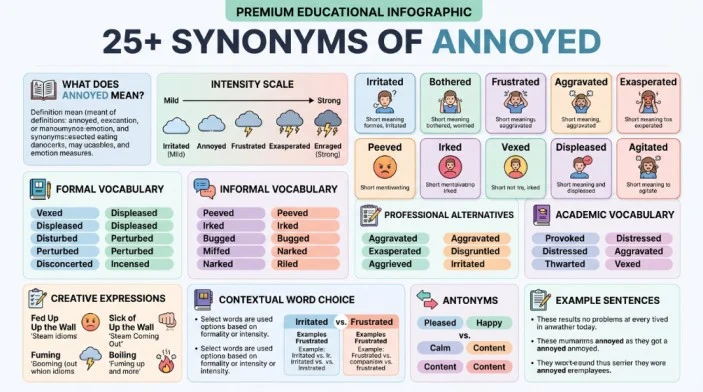
The best synonyms of annoyed include irritated, bothered, frustrated, aggravated, irked, peeved, exasperated, vexed, and displeased. For formal writing, choose irritated or displeased. For casual speech, bothered or peeved sounds natural. stronger emotions, use aggravated, exasperated, or incensed when the context supports greater intensity.
Meaning, Tone, and Context
Simple Definition
Annoyed describes a feeling of mild anger, irritation, or displeasure caused by something that is bothersome, inconvenient, frustrating, or unpleasant.
For example:
“She was annoyed by the constant interruptions.”
The sentence shows that the interruptions caused irritation. It does not necessarily mean she was extremely angry.
Part of Speech
Annoyed is an adjective.
It is commonly used to describe a person’s emotional state:
“He looked annoyed.”
It can also appear after linking verbs:
“They were annoyed about the delay.”
Overall Tone
The word annoyed usually has a negative tone because it describes an unpleasant emotional reaction.
However, it normally suggests a lower level of anger than words such as furious, enraged, or infuriated.
Formality Level
Annoyed is a neutral word. It works naturally in:
- Everyday conversations
- Emails
- Workplace communication
- School assignments
- Essays
- Blogs
- Social media
- Personal writing
It is not overly formal or overly casual, which makes it one of the most flexible words for describing irritation.
Common Uses
Native English speakers commonly use annoyed when someone is reacting negatively to:
- Repeated interruptions
- Loud noises
- Delays
- Poor service
- Rude behavior
- Repeated mistakes
- Unwanted questions
- Inconvenient situations
- Broken promises
- Distractions
Word Forms
| Form | Word | Example |
|---|---|---|
| Verb | annoy | “The noise began to annoy everyone.” |
| Adjective | annoyed | “She felt annoyed by the delay.” |
| Adjective | annoying | “The constant noise was annoying.” |
| Noun | annoyance | “His repeated calls caused annoyance.” |
A useful distinction is that annoyed usually describes the person experiencing the feeling, while annoying describes the thing or behavior causing it.
“I am annoyed by the noise.”
“The noise is annoying.”
When and How to Use “Annoyed”
Use annoyed when something has caused irritation or mild anger. It is especially useful when you want to describe a negative reaction without making the emotion sound extreme.
Professional
“The manager was annoyed by the repeated delays, but remained professional during the meeting.”
Academic
“Several students appeared annoyed by the repeated interruptions during the lecture.”
Workplace
“Maria was annoyed when the same technical issue occurred for the third time.”
Personal
“I was annoyed when my friend canceled our plans at the last minute.”
“I was disappointed and slightly annoyed by the unexpected change to the schedule.”
Resume
The word annoyed is rarely appropriate in a resume because resumes normally focus on achievements and professional abilities rather than personal irritation.
Instead of:
“Handled situations where customers became annoyed.”
Use:
“Resolved customer concerns calmly and professionally.”
Social Media
“Nothing is more annoying than spending twenty minutes looking for something that was right in front of me.”
Best Synonyms of “Annoyed”
No single alternative works perfectly in every sentence. The best synonym depends on the cause of the emotion, its intensity, the audience, and the style of your writing.
Professional Writing: Irritated
Irritated is one of the safest professional alternatives to annoyed. It communicates displeasure without sounding excessively emotional.
“The client was irritated by the repeated scheduling changes.”
Academic Writing: Frustrated
Frustrated works particularly well when the irritation comes from difficulty, failure, or an obstacle.
“Students became frustrated when the software repeatedly failed.”
Business Communication: Aggravated
Aggravated conveys stronger irritation and can work when a problem has continued or become increasingly difficult.
“The customer was aggravated by the unresolved billing issue.”
Casual Conversation: Bothered
Bothered sounds natural and conversational.
“I was bothered by how loudly they were talking.”
Emotional Writing: Upset
Upset is broader than annoyed and can communicate emotional distress, disappointment, or sadness as well as irritation.
“She was upset by the way her friend treated her.”
Creative Writing: Exasperated
Exasperated is useful when irritation has built up over time and someone feels they have little patience left.
“After explaining the same problem five times, he felt completely exasperated.”
Resume Writing: Frustrated
A resume should generally avoid describing yourself as annoyed or frustrated. However, when discussing problem solving, frustrated can describe a customer’s experience or a problem you successfully resolved.
“Developed solutions to address recurring customer frustrations.”
Workplace Communication: Irritated
Irritated is often safer than stronger words in professional settings because it communicates the problem without unnecessarily escalating the tone.
“The team was irritated by the repeated software outages.”
Stronger Meaning: Exasperated
Use exasperated when irritation has become intense because a difficult situation has continued.
“She was exasperated after receiving three incorrect invoices.”
Softer Meaning: Bothered
Use bothered when you want to describe discomfort or irritation without making the feeling sound severe.
“I was a little bothered by the comment.”
When Not to Use “Annoyed”
Although annoyed is flexible, another word may communicate your meaning more accurately.
When It Sounds Too General
Problem:
“He was annoyed about the situation.”
This tells the reader that he was unhappy, but it does not explain the nature of his reaction.
Better:
“He was frustrated by the repeated delays.”
Why:
Frustrated explains that the irritation came from an obstacle or failure.
When It Sounds Too Weak
If someone is extremely angry, annoyed may underestimate the emotion.
Less Effective:
“She was annoyed when the company canceled her order.”
Stronger:
“She was furious when the company canceled her order without explanation.”
Why:
Furious communicates a much higher level of anger.
When It Sounds Too Strong
The opposite problem can also occur.
Less Effective:
“I was furious because the meeting started five minutes late.”
Better:
“I was slightly annoyed because the meeting started five minutes late.”
Why:
A very strong word can make a minor inconvenience sound unnecessarily dramatic.
When You Need to Show Frustration
If the emotion comes from being unable to achieve something, frustrated may be more precise.
Less Effective:
“I was annoyed because the application would not load.”
Better:
“I was frustrated because the application would not load.”
When You Need a More Formal Tone
Annoyed is acceptable in formal writing, but irritated or displeased may sound more measured.
Less Formal:
“The customer was annoyed by the delay.”
More Formal:
“The customer was displeased with the delay.”
When You Need Emotional Depth
If the person feels hurt or disappointed as well as irritated, upset may communicate the situation better.
Example:
“She was upset by the criticism.”
This suggests more than simple annoyance.
Words Commonly Confused With “Annoyed”
Irritated
Difference:
Irritated usually means slightly angry or bothered by something unpleasant.
When to Use It:
Use it when you want a close, natural alternative to annoyed.
Example:
“He became irritated by the constant noise.”
Frustrated
Difference:
Frustrated usually involves difficulty, failure, delay, or an obstacle preventing someone from getting what they want.
When to Use It:
Use it when irritation comes from a problem that cannot easily be solved.
Example:
“She felt frustrated after trying to fix the printer several times.”
Angry
Difference:
Angry is a broader and generally stronger emotional response than annoyed.
When to Use It:
Use it when someone’s reaction involves genuine anger rather than simple irritation.
Example:
“He was angry about the unfair decision.”
Upset
Difference:
Upset can involve sadness, disappointment, distress, or anger. It is broader emotionally than annoyed.
When to Use It:
Use it when the situation affects someone emotionally in more than one way.
Example:
“She was upset after hearing the news.”
Agitated
Difference:
Agitated suggests emotional or physical restlessness combined with irritation or distress.
When to Use It:
Use it when someone appears visibly unsettled or unable to remain calm.
Example:
“The passenger became agitated after the flight was delayed again.”
Exasperated
Difference:
Exasperated suggests strong irritation caused by repeated problems, mistakes, or frustrating behavior.
When to Use It:
Use it when someone’s patience has nearly run out.
Example:
“The teacher looked exasperated after answering the same question repeatedly.”
Best Synonyms of “Annoyed” by Context
| Context | Best Synonym | Why It Works | Example |
|---|---|---|---|
| Formal writing | Irritated | Professional and measured | “The customer appeared irritated by the delay.” |
| Academic writing | Frustrated | Connects irritation with difficulty | “Participants became frustrated by the technical issue.” |
| Professional communication | Irritated | Clear without sounding overly emotional | “The employee was irritated by the repeated interruptions.” |
| Business emails | Displeased | Polite and formal | “We were displeased with the service provided.” |
| Resume writing | Frustrated | Useful when describing customer problems | “Resolved frustrated customer concerns efficiently.” |
| Workplace communication | Bothered | Natural and moderate | “The team was bothered by the repeated disruptions.” |
| Casual conversation | Peeved | Informal and expressive | “I’m pretty peeved about the cancellation.” |
| Everyday speaking | Bothered | Common and natural | “That comment really bothered me.” |
| Creative writing | Exasperated | Shows accumulated irritation | “He sighed, visibly exasperated.” |
| Storytelling | Aggravated | Adds stronger emotion | “She became aggravated after another failed attempt.” |
| Emotional writing | Upset | Covers broader emotional distress | “He was upset by her response.” |
| Strong emphasis | Incensed | Shows intense anger | “Residents were incensed by the sudden closure.” |
| Mild tone | Bothered | Keeps the reaction relatively soft | “I was a little bothered by what happened.” |
| Social media captions | Peeved | Casual and expressive | “Peeved after waiting an hour for delivery.” |
| American English | Irritated | Widely understood and natural | “He sounded irritated during the call.” |
| British English | Miffed | Informal British usage | “She was miffed about the last minute change.” |
How to Choose the Best Synonym of “Annoyed”
The easiest way to select the right word is to identify why the person feels annoyed and how strong the emotion is.
Step 1: Identify the Cause
If the problem involves an obstacle, frustrated may be best.
“I was frustrated because the website kept crashing.”
If the problem is simply bothersome, irritated or bothered may fit better.
“I was irritated by the constant noise.”
Step 2: Consider Emotional Strength
For mild irritation, choose:
bothered, peeved, irked
For moderate irritation, choose:
irritated, aggravated, frustrated
For strong irritation, choose:
exasperated, incensed, infuriated
3: Consider Your Audience
- For professional readers, choose irritated, displeased, or frustrated.
- For friends, bothered, peeved, or miffed may sound more natural.
- For academic writing, frustrated, agitated, or irritated can work depending on the context.
4: Consider Formality
- Use displeased for a more formal and restrained tone.
- Use irritated for neutral professional writing.
- Use peeved or miffed for informal communication.
5: Consider Natural Usage
Do not replace annoyed simply because another word looks more sophisticated. A synonym is useful only when it preserves the intended meaning.
“I was frustrated by the long line.”
This sounds natural because the delay created an obstacle.
“I was exasperated by the long line.”
This suggests the waiting became extremely irritating, perhaps because the situation continued for a long time.
Real Life Examples of “Annoyed”
School
Original:
“The students were annoyed by the noise.”
Improved:
“The students were distracted and irritated by the constant noise.”
College
Original:
“I was annoyed because the professor changed the deadline.”
Improved:
“I was frustrated because the professor changed the deadline without notice.”
Workplace
Original:
“The staff were annoyed by the repeated system errors.”
Improved:
“The staff were frustrated by the repeated system errors.”
Business
Original:
“The client was annoyed about the delay.”
Improved:
“The client was displeased with the delay.”
Original:
“I am annoyed that this issue has not been resolved.”
Improved:
“I am concerned and disappointed that this issue remains unresolved.”
Resume
Instead of:
“Helped annoyed customers.”
Use:
“Resolved frustrated customer concerns and provided timely solutions.”
Conversation
“I was a little bothered by what he said, but I decided not to argue.”
Storytelling
“After hearing the same excuse for the third time, she became visibly exasperated.”
Blogging
“Many readers become frustrated when a website takes too long to load.”
Social Media
“Pretty peeved after waiting almost an hour for a simple order.”
25 Best Synonyms of “Annoyed”
| Synonym | Simple Meaning | Best Used For | Example Sentence |
|---|---|---|---|
| Irritated | Slightly angry or bothered | General and professional writing | “She sounded irritated during the call.” |
| Bothered | Troubled or mildly annoyed | Everyday conversation | “I was bothered by the constant interruptions.” |
| Frustrated | Annoyed by difficulty or failure | Work, school, problems | “He felt frustrated by the repeated errors.” |
| Aggravated | More strongly irritated | Workplace and everyday use | “The customer was aggravated by the delay.” |
| Exasperated | Extremely irritated after repeated problems | Strong emotional writing | “She was exasperated by his repeated excuses.” |
| Irked | Mildly annoyed | Concise everyday writing | “His careless comment irked me.” |
| Peeved | Slightly angry or annoyed | Informal conversation | “She was peeved about the canceled plans.” |
| Vexed | Troubled or annoyed | Formal or literary writing | “He was vexed by the unexpected problem.” |
| Miffed | Slightly offended or annoyed | Informal conversation | “She was miffed that nobody told her.” |
| Agitated | Upset and unable to remain calm | Emotional situations | “The passenger became agitated after the delay.” |
| Perturbed | Worried or unsettled | Formal writing | “He seemed perturbed by the sudden change.” |
| Displeased | Unhappy or dissatisfied | Formal and business writing | “The client was displeased with the service.” |
| Disgruntled | Dissatisfied and annoyed | Workplace and customer contexts | “Several disgruntled customers requested refunds.” |
| Upset | Emotionally distressed or unhappy | Personal communication | “She was upset by the criticism.” |
| Disturbed | Troubled or bothered | Serious or emotional contexts | “He was disturbed by the unexpected behavior.” |
| Angered | Made angry | Formal and general writing | “The decision angered many residents.” |
| Provoked | Caused to react with anger | Conflict and formal writing | “The unfair accusation provoked an angry response.” |
| Incensed | Extremely angry | Strong emotional writing | “Residents were incensed by the sudden closure.” |
| Infuriated | Made extremely angry | Very strong emotion | “The false accusation infuriated her.” |
| Enraged | Extremely angry or furious | Very strong emotional situations | “The unfair treatment left him enraged.” |
| Discontented | Dissatisfied with a situation | Formal writing | “Employees became discontented with the new policy.” |
| Put out | Mildly annoyed or inconvenienced | Informal conversation | “She was put out by the last minute cancellation.” |
| Fed up | Tired and annoyed after repeated problems | Informal conversation | “I’m fed up with dealing with the same issue.” |
| Angry | Feeling strong displeasure | General communication | “He was angry about the unfair treatment.” |
| Aggrieved | Feeling unfairly treated or wronged | Formal writing | “The aggrieved customer filed a formal complaint.” |
Synonyms of “Annoyed” by Usage
Professional vs Personal Synonyms
Professional writing usually benefits from measured vocabulary. Irritated, displeased, frustrated, and aggravated can communicate negative reactions without making the situation sound unnecessarily dramatic.
Personal communication allows more expressive choices. Bothered, peeved, miffed, and upset often sound more natural when discussing feelings with friends or family.
Formal vs Conversational Synonyms
For reports, essays, and formal business writing, consider:
- Irritated
- Displeased
- Frustrated
- Perturbed
- Aggrieved
For casual conversations and texting, consider:
- Bothered
- Peeved
- Miffed
- Fed up
- Put out
The phrase fed up is especially conversational and should generally be avoided in formal academic or professional writing.
Academic Synonyms
Academic writing should explain the source of irritation rather than relying on dramatic emotional language.
Useful choices include frustrated, irritated, agitated, and perturbed.
“Participants reported feeling frustrated by the complexity of the task.”
This works because the sentence identifies a specific cause of the emotional reaction.
Professional and Business Synonyms
For resumes, interviews, meetings, performance reviews, client communication, and business emails, emotional vocabulary should be used carefully.
Good choices include:
- Irritated
- Frustrated
- Displeased
- Aggravated
- Disgruntled
In a customer service context, frustrated customer is often more useful than annoyed customer because it can suggest that the customer is experiencing a problem that needs to be resolved.
Creative and Literary Synonyms
Creative writing allows stronger emotional distinctions.
Irked can suggest mild irritation.
Vexed can create a more literary tone.
Exasperated suggests that patience is running out.
Aggravated gives the reaction more force.
Infuriated and enraged are suitable when the character experiences intense anger.
Slang or Modern Synonyms
There is no single slang word that perfectly replaces annoyed in every situation.
However, casual expressions such as fed up, put out, and miffed can work in informal American English.
Fed up means tired and annoyed because something has continued for too long.
“I’m fed up with these constant delays.”
Use it in conversation, texts, or informal social media. Avoid it in academic papers, formal reports, and professional documents.
Put out can mean mildly annoyed because something has caused inconvenience.
“She was put out when the appointment was canceled.”
It is casual and context dependent, so it should not automatically replace annoyed.
Strongest to Mildest Synonyms
The intensity of annoyance can vary significantly. A useful scale is:
| Level | Words | Typical Meaning |
|---|---|---|
| Mild | Bothered, irked, peeved, miffed | Small irritation |
| Moderate | Annoyed, irritated, displeased, frustrated | Noticeable negative reaction |
| Strong | Aggravated, exasperated, agitated, infuriated | Serious irritation or anger |
| Very Strong | Incensed, enraged | Intense anger |
The exact intensity depends on context. For example, frustrated does not always mean stronger than irritated. It describes a different cause of the emotion, especially when someone is prevented from achieving a goal.
Emotional vs Neutral Synonyms
Emotional Synonyms
These words can make the feeling more vivid:
- Peeved
- Miffed
- Exasperated
- Aggravated
- Incensed
- Infuriated
- Enraged
- Fed up
Use these when the emotional reaction itself matters.
Neutral Synonyms
These choices communicate irritation more objectively:
- Irritated
- Bothered
- Frustrated
- Displeased
- Perturbed
- Disturbed
Neutral alternatives are generally better for professional reports, academic writing, and factual descriptions.
Antonyms of “Annoyed”
| Antonym | Meaning | Example Sentence |
|---|---|---|
| Pleased | Feeling satisfied or happy | “She was pleased with the result.” |
| Satisfied | Content because expectations were met | “The customer was satisfied with the service.” |
| Content | Calmly satisfied | “He felt content after finishing the work.” |
| Calm | Free from agitation or anger | “She remained calm during the discussion.” |
| Relaxed | Free from tension or stress | “Everyone felt relaxed after the meeting.” |
| Happy | Feeling pleasure or positive emotion | “He was happy with the decision.” |
| Delighted | Very pleased | “The children were delighted by the surprise.” |
| Cheerful | Noticeably happy and positive | “She remained cheerful throughout the afternoon.” |
| Patient | Able to tolerate delay or difficulty calmly | “He was patient while waiting for assistance.” |
| Tolerant | Willing to accept differences or problems | “The manager was tolerant of minor mistakes.” |
| Accepting | Willing to receive or allow something without resistance | “She was accepting of the unexpected change.” |
| Unbothered | Not disturbed or concerned | “He seemed completely unbothered by the criticism.” |
| Peaceful | Calm and free from conflict | “The discussion ended on a peaceful note.” |
| Cooperative | Willing to work with others | “The customer remained cooperative throughout the process.” |
| Agreeable | Pleasant and willing to cooperate | “She was agreeable to the proposed changes.” |
Comparison: “Annoyed” vs Similar Words
Annoyed vs Irritated
Main Difference
Both words describe irritation, and they are often interchangeable. Irritated can sound slightly more formal or descriptive.
Which Is Stronger?
Neither is consistently stronger. The context determines the intensity.
Which Is More Formal?
Irritated often fits formal and professional writing slightly better.
When to Use Each
Use annoyed for general everyday language. Choose irritated when you want a polished or more measured tone.
Examples
Annoyed:
“I was annoyed by the constant interruptions.”
Irritated:
“The manager appeared irritated by the repeated questions.”
Annoyed vs Frustrated
Main Difference
Annoyed focuses on irritation. Frustrated usually involves an obstacle, failure, delay, or inability to achieve a goal.
Which Is Stronger?
Neither is automatically stronger.
Which Is More Formal?
Both work well in professional and academic contexts.
When to Use Each
Choose frustrated when something is preventing progress.
Examples
Annoyed:
“I was annoyed by the loud music.”
Frustrated:
“I was frustrated because the software kept crashing.”
Annoyed vs Angry
Main Difference
Angry usually describes a stronger emotional reaction than annoyed.
Which Is Stronger?
Angry is generally stronger.
Which Is More Formal?
Both are neutral, although professional writing may use displeased or concerned for a more measured tone.
When to Use Each
Use annoyed for mild irritation and angry when the emotional response is more intense.
Examples
Annoyed:
“She was annoyed by the delay.”
Angry:
“She was angry about the unfair decision.”
Annoyed vs Upset
Main Difference
Upset is broader. It can describe sadness, disappointment, distress, or anger, while annoyed specifically focuses on irritation.
Which Is Stronger?
It depends on the situation. Upset can describe a deeper emotional reaction.
Which Is More Formal?
Both are neutral and widely used.
When to Use Each
Use upset when the person’s feelings involve more than irritation.
Examples
Annoyed:
“He was annoyed by the noise.”
Upset:
“He was upset by the criticism.”
Annoyed vs Agitated
Main Difference
Agitated suggests visible restlessness, tension, or emotional disturbance.
Which Is Stronger?
Agitated can sound stronger because it suggests a more noticeable emotional state.
Which Is More Formal?
Agitated often works well in formal descriptions.
When to Use Each
Use agitated when someone seems unable to remain calm.
Examples
Annoyed:
“She was annoyed by the repeated calls.”
Agitated:
“She became agitated when the argument continued.”
Annoyed vs Exasperated
Main Difference
Exasperated describes strong irritation that often develops after repeated problems or failed attempts.
Which Is Stronger?
Exasperated is considerably stronger.
Which Is More Formal?
Both are acceptable, but exasperated can sound more literary or expressive.
When to Use Each
Use exasperated when someone’s patience has nearly disappeared.
Examples
Annoyed:
“He was annoyed by the mistake.”
Exasperated:
“He was exasperated after correcting the same mistake several times.”
Common Phrases and Expressions with “Annoyed”
Annoyed With Someone
Meaning:
Used when someone’s behavior causes irritation.
Example:
“She was annoyed with her brother for borrowing her laptop.”
Annoyed About Something
Meaning:
Used when a situation or event causes irritation.
Example:
“He was annoyed about the sudden schedule change.”
Annoyed By Something
Meaning:
Identifies the direct cause of the irritation.
Example:
“I was annoyed by the constant buzzing sound.”
Get Annoyed
Meaning:
To become irritated by something.
Example:
“I get annoyed when people interrupt me.”
Really Annoyed
Meaning:
Emphasizes that the irritation is stronger than usual.
Example:
“She was really annoyed when the delivery arrived late.”
Slightly Annoyed
Meaning:
Shows mild irritation.
Example:
“He was slightly annoyed, but he quickly moved on.”
Look Annoyed
Meaning:
Describes someone’s visible facial expression or behavior.
Example:
“You look annoyed. Is everything okay?”
Sound Annoyed
Meaning:
Describes irritation expressed through someone’s voice.
Example:
“She sounded annoyed when she answered the phone.”
Common Mistakes to Avoid
1. Choosing a Synonym Without Considering the Cause
Incorrect:
“I was furious because the website was slow.”
Better:
“I was frustrated because the website was slow.”
Why:
A slow website may create frustration, but furious could exaggerate the reaction unless the situation involved serious consequences.
2. Confusing “Annoyed” With “Annoying”
Incorrect:
“I am annoying by the noise.”
Better:
“I am annoyed by the noise.”
Why:
Annoyed describes the person experiencing the feeling. Annoying describes something that causes the feeling.
3. Using an Informal Word in Formal Writing
Incorrect:
“The client was really peeved about the delay.”
Better:
“The client was displeased with the delay.”
Why:
Peeved is informal. Displeased sounds more appropriate for formal business communication.
4. Using an Overly Dramatic Synonym
Incorrect:
“I was enraged because my coffee was slightly cold.”
Better:
“I was annoyed because my coffee was slightly cold.”
Why:
The stronger word makes the reaction sound disproportionate to the problem.
5. Repeating “Annoyed” Too Often
Incorrect:
“She was annoyed by the noise. She was annoyed by the delay. She was annoyed by the questions.”
Better:
“She was irritated by the noise, frustrated by the delay, and bothered by the constant questions.”
Why:
Different words can show how each situation affected her.
6. Using a Synonym With the Wrong Emotional Tone
Incorrect:
“His grandmother was incensed by the beautiful surprise.”
Better:
“His grandmother was delighted by the beautiful surprise.”
Why:
Incensed expresses extreme anger, while delighted expresses strong happiness.
7. Using Slang in Academic Writing
Incorrect:
“The participants were fed up with the repeated task.”
Better:
“The participants became frustrated by the repeated task.”
Why:
Fed up is conversational. Frustrated is more appropriate for academic research and formal discussion.
Frequently Asked Questions
What are the best synonyms of “annoyed”?
The best synonyms of annoyed include irritated, bothered, frustrated, aggravated, irked, peeved, exasperated, vexed, and displeased. The best choice depends on the intensity, cause, tone, and context of the irritation.
What are the best formal synonyms of “annoyed”?
The strongest formal synonyms include irritated, displeased, perturbed, aggravated, and aggrieved. For business or academic writing, irritated and displeased are usually safer choices because they communicate negative feelings without sounding overly emotional.
What are common informal synonyms of “annoyed”?
Common informal alternatives include bothered, peeved, miffed, fed up, and put out. These expressions work well in everyday conversations, texts, and casual social media posts, but some are too informal for academic or professional writing.
What is another word for “annoyed” in professional writing?
Irritated is one of the best professional alternatives to annoyed. Displeased works well in formal business communication, while frustrated is particularly useful when an employee or customer is dealing with an obstacle or unresolved problem.
What is the difference between “annoyed” and “irritated”?
Annoyed and irritated are very close in meaning and can often be substituted for each other. Irritated may sound slightly more formal, while annoyed is especially natural in everyday American English.
What is the opposite of “annoyed”?
Common opposites of annoyed include pleased, satisfied, content, calm, relaxed, happy, delighted, and unbothered. The best opposite depends on whether you want to emphasize emotional calm, satisfaction, happiness, or freedom from irritation.
Conclusion
The word annoyed describes a feeling of irritation or mild anger, but the best alternative depends on exactly what caused the reaction and how strongly the person feels it. Irritated is a reliable general synonym, frustrated works well for obstacles and difficulties, displeased suits formal communication, and exasperated expresses stronger irritation.
There is no single perfect synonym for every situation. Before replacing annoyed, consider your audience, tone, purpose, and emotional intensity. When you choose a word that explains the specific kind of irritation you mean, your writing becomes clearer and more natural.
A useful vocabulary habit is to learn synonyms in groups based on meaning rather than memorizing isolated lists. For example, connect bothered, irritated, frustrated, aggravated, and exasperated with different levels or causes of irritation. This makes it easier to select the right synonym of annoyed when you write or speak.
Read More Related Articles:
Synonyms for Empty | Meaning, Examples, and Better Word …
Synonyms for Creativity | Meaning, Examples, and Better …