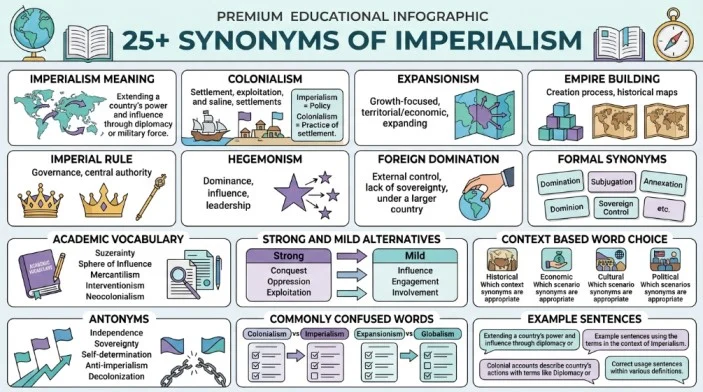
A student writing a history essay may use imperialism several times in the same paragraph. The same problem can appear in research papers, political discussions, blogs, presentations, and academic assignments. Finding the right synonym of imperialism can make the writing more precise, especially when the writer wants to emphasize territorial expansion, foreign control, colonial rule, or political domination.
The challenge is that imperialism does not have one perfect replacement in every sentence. Words such as colonialism, expansionism, hegemonism, and empire building overlap with imperialism but highlight different aspects of the concept. Understanding those differences helps writers choose vocabulary that accurately communicates the historical, political, or economic idea they intend.
What Is the Best Synonym of “Imperialism”?
A strong synonym of imperialism is expansionism, especially when the focus is on extending a country’s territory or power. Colonialism works when foreign rule involves colonies, while hegemonism emphasizes control by a dominant power. Empire building, foreign domination, and imperial rule are useful contextual alternatives.
Imperialism generally refers to a policy or system in which a powerful country extends its authority, control, or influence over other territories or peoples. Modern definitions also include political, economic, and cultural influence without direct territorial control.
Meaning, Tone, and Context
Simple Definition
Imperialism is the policy, practice, or system of extending a country’s power and influence over other countries or territories. This control can involve direct rule, territorial acquisition, political pressure, economic influence, or cultural influence.
The term is commonly associated with unequal relationships between a powerful state and less powerful societies. Depending on the context, imperialism can describe territorial conquest, colonial administration, economic control, or broader forms of influence.
Part of Speech
Imperialism is a noun.
It is generally used as an uncountable noun:
“Historians continue to debate the effects of imperialism.”
Overall Tone
Imperialism usually has a negative or disapproving tone, particularly when it describes domination, exploitation, forced control, or unequal political relationships. Major English dictionaries identify this negative or disapproving sense.
However, the word itself is not an insult. In academic and historical writing, it is often used as a descriptive term for a political system, policy, or historical process.
Formality Level
The word imperialism is formal and academic.
It commonly appears in:
- History textbooks
- Political science papers
- Academic essays
- International relations discussions
- Historical analysis
- Journalism
- Political commentary
- University lectures
- Research papers
It is less common in casual conversation unless people are discussing history, politics, international affairs, or social issues.
Common Uses
Imperialism is commonly used in phrases such as:
- European imperialism
- British imperialism
- American imperialism
- economic imperialism
- cultural imperialism
- political imperialism
- military imperialism
- colonial imperialism
- modern imperialism
- new imperialism
- imperialist expansion
- imperialist power
Word Forms
| Word Form | Meaning | Example |
|---|---|---|
| Imperialism | The policy or practice of extending power | “The course examines European imperialism.” |
| Imperialist | A person or state supporting or practicing imperialism | The empire became an imperialist power.” |
| Imperialistic | Related to or characterized by imperialism | “Critics described the policy as imperialistic.” |
| Imperialistically | In an imperialistic manner | “The territory was governed imperialistically.” |
| Empire | A political system or territory ruled by an emperor or dominant state | “The empire controlled several regions.” |
When and How to Use “Imperialism”
Use imperialism when you are discussing the extension of political, military, economic, or cultural power from one country or dominant power over other territories or societies.
It is particularly useful when the broader system or policy matters more than one individual action.
Professional Context
“Analysts examined how economic imperialism affected trade relationships between powerful and developing economies.”
Academic Context
“The essay examines the relationship between European imperialism and political change in Asia.”
Workplace Context
“The training session discussed the historical effects of imperialism on international institutions.”
Personal Context
“My interest in imperialism began when I studied world history in college.”
Email Context
“Please review the section on imperialism before submitting the history paper.”
Resume Context
“Completed advanced coursework on colonialism, imperialism, and international relations.”
Social Media Context
“Learning about imperialism changed how I understand modern global politics.”
Best Synonyms of “Imperialism”
No synonym has exactly the same meaning in every context. Imperialism can refer to a broad policy of extending power, while a related word may emphasize one particular mechanism, such as colonization, territorial expansion, domination, or economic control.
Professional Writing: Imperial Domination
Imperial domination is useful when the focus is on unequal political power and control.
Example:
“The study examines the effects of imperial domination on regional governments.”
Academic Writing: Expansionism
Expansionism works well when the discussion centers on a country’s attempt to increase its territory or political reach. Cambridge defines expansionism in political terms as increasing the amount of land ruled by a country or taking land from others.
Example:
“The government’s expansionism contributed to growing regional tensions.”
Business Communication: Economic Domination
When the discussion specifically concerns control through economic power, economic domination is more precise than imperialism.
Example:
“The report examines economic domination through trade and investment.”
Casual Conversation: Empire Building
Empire building is easier to understand in everyday language and can describe attempts to create or expand an empire.
Example:
“The documentary explains how empire building changed the region.”
Emotional Writing: Foreign Domination
Foreign domination emphasizes the experience of people living under external control.
Example:
“The novel portrays generations affected by foreign domination.”
Creative Writing: Empire Building
Empire building can give historical or narrative writing a strong sense of expansion and ambition.
Example:
“The ruler’s dream of empire building transformed the small kingdom into a regional power.”
Resume Writing: Colonial Studies
A resume should usually avoid replacing imperialism with a vague synonym. When describing academic experience, colonial studies or imperial history can be more precise depending on the actual subject.
Example:
“Conducted research in imperial history and colonial studies.”
Workplace Communication: Hegemonism
Hegemonism is appropriate in specialized political writing when the focus is on control exercised by the strongest power. Cambridge defines it as control by the strongest and most powerful group, particularly a powerful country.
Example:
“The article analyzes regional hegemonism and its effect on neighboring states.”
Stronger Meaning: Domination
Domination places stronger emphasis on control over others.
Example:
“The policy resulted in political domination of the smaller territory.”
Softer Meaning: Expansionism
When the evidence shows territorial or political expansion but does not establish direct domination, expansionism may be more precise and less loaded.
Example:
“The government pursued expansionism without formally establishing colonies.”
When Not to Use “Imperialism”
When the Meaning Is Too General
Imperialism can sometimes cover several different forms of influence. If your sentence is specifically about taking territory, a narrower word may communicate the idea better.
Less precise:
“The country pursued imperialism.”
Better:
“The country pursued territorial expansionism.”
The second sentence tells readers exactly what type of expansion is being discussed.
When the Meaning Is Too Vague
If the real issue is financial control, imperialism may not provide enough detail.
Less precise:
“The company was accused of imperialism.”
Better:
“The company was accused of economic domination.”
This version identifies the specific type of influence.
When a More Specific Historical Term Is Needed
If a country establishes and governs colonies, colonialism may be more specific.
Less precise:
“The policy created a system of imperialism.”
Better:
“The policy created a system of colonial rule.”
Colonialism and imperialism overlap significantly, but they can emphasize different aspects of foreign control. Merriam Webster notes that the two terms are often used together and can overlap, while imperialism tends to emphasize the ruling power and its expansion of dominion.
When the Word Sounds Too Formal
In casual conversation, imperialism may sound academic.
Formal:
“The lecture examined the consequences of imperialism.”
More conversational:
“The lecture looked at how powerful countries controlled other regions.”
When the Word Sounds Too Weak
If you specifically mean forceful control, imperialism may not communicate the intensity you want.
Weaker:
“The government exercised imperialism over the territory.”
Stronger:
“The government imposed foreign domination over the territory.”
When the Word Sounds Too Strong
Do not automatically call every international influence imperialism. If a country is simply increasing its territory or international role, expansionism or power projection may be more accurate.
Overstated:
“The trade agreement was an act of imperialism.”
More precise:
“The trade agreement increased the country’s economic influence.”
When the Term Is Historically Inaccurate
Imperialism should not be used simply because two countries have unequal economic relationships. The term usually implies a broader pattern of power, influence, control, or expansion.
Instead of labeling every unequal relationship imperialism, identify the specific mechanism involved.
Words Commonly Confused With “Imperialism”
Colonialism
Difference: Colonialism usually emphasizes the establishment, administration, or exploitation of colonies. Imperialism is broader and can include forms of control that do not involve formal colonies.
When to Use It: Use colonialism when the subject is colonial rule, settlement, administration, or the experiences of colonized populations.
Example:
“Colonialism reshaped the political and economic structures of many territories.”
Expansionism
Difference: Expansionism focuses on increasing territorial or political reach. Imperialism can include expansion, but it can also involve indirect economic or cultural influence.
When to Use It: Use expansionism when territorial growth or increased political reach is the main issue.
Example:
“The state’s expansionism increased tensions with neighboring countries.”
Hegemonism
Difference: Hegemonism focuses on control or dominance by the strongest power. It does not necessarily require direct territorial acquisition.
When to Use It: Use hegemonism in specialized political analysis involving dominant powers and international influence.
Example:
“The article criticized regional hegemonism and unequal political influence.”
Domination
Difference: Domination emphasizes control over another group or territory but does not necessarily describe a formal imperial policy.
When to Use It: Use it when the central idea is control rather than empire building.
Example:
“The population resisted foreign domination.”
Conquest
Difference: Conquest describes the act of taking control through military victory. Imperialism describes the broader policy or system that may involve conquest.
When to Use It: Use conquest when military takeover is the specific event being discussed.
Example:
“The conquest of the territory changed the balance of power.”
Neocolonialism
Difference: Neocolonialism refers to indirect forms of control or influence over formally independent countries, often through economic or political mechanisms.
When to Use It: Use it when discussing indirect influence that resembles colonial relationships after formal colonial rule has ended.
Example:
“The author argues that economic dependence can contribute to neocolonialism.”
Best Synonyms of “Imperialism” by Context
| Context | Best Synonym | Why It Works | Example |
|---|---|---|---|
| Formal writing | Imperial domination | Emphasizes power and control | “The study examines imperial domination.” |
| Academic writing | Expansionism | Precise for territorial growth | “Expansionism reshaped regional politics.” |
| Professional communication | Foreign domination | Clear and direct | “The report discusses foreign domination.” |
| Business emails | Economic domination | Useful for economic control | “The paper analyzes economic domination.” |
| Resume writing | Imperial history | More accurate for academic experience | “Studied imperial history and colonial policy.” |
| Workplace communication | Hegemonism | Fits specialized political analysis | “The report examines regional hegemonism.” |
| Casual conversation | Empire building | Easy to understand | “The documentary focuses on empire building.” |
| Everyday speaking | Foreign rule | Simple and direct | “The region experienced foreign rule.” |
| Creative writing | Empire building | Creates a historical sense of ambition | “His dream of empire building consumed him.” |
| Storytelling | Conquest | Strong when military takeover matters | “The conquest changed the kingdom forever.” |
| Emotional writing | Foreign domination | Highlights the experience of controlled people | “The story recalls years of foreign domination.” |
| Strong emphasis | Domination | Highlights force and control | “The movement opposed foreign domination.” |
| Mild tone | Expansionism | Focuses on expansion rather than oppression | “The state pursued expansionism.” |
| Social media captions | Empire building | Short and accessible | “A powerful lesson about empire building.” |
| American English | Imperialism | Standard and widely understood | “The class discusses American imperialism.” |
| British English | Imperialism | Also standard in British English | “The course examines British imperialism.” |
How to Choose the Best Synonym of “Imperialism”
Start by identifying what you actually mean. Do not choose a synonym simply because it sounds sophisticated.
If You Mean Territorial Expansion
Choose expansionism, territorial expansion, or annexationism.
If You Mean Colonial Control
Choose colonialism, colonial rule, or colonial domination.
If You Mean Political Control
Choose foreign domination, foreign rule, imperial domination, or hegemonic rule.
If You Mean Military Takeover
Choose conquest or subjugation.
If You Mean Dominance by a Powerful State
Choose hegemonism, hegemonic domination, or imperial domination.
If You Mean Building an Empire
Choose empire building or empire expansion.
If You Mean Economic Influence
Choose economic domination or economic imperialism when the specific concept is actually economic control.
If You Mean Cultural Influence
Choose cultural domination when the emphasis is cultural control or overwhelming influence.
The best synonym is therefore the one that preserves the exact idea rather than merely replacing the original word.
Real Life Examples of “Imperialism”
School
Original:
“The lesson explains imperialism.”
Improved:
“The lesson explains how expansionism allowed powerful states to extend their control over other territories.”
College
Original:
“My paper discusses imperialism.”
Improved:
“My paper examines colonialism and the political structures created by foreign rule.”
Workplace
Original:
“The presentation covers imperialism.”
Improved:
“The presentation examines hegemonism and its effect on regional political relationships.”
Business
Original:
“The company was accused of imperialism.”
Improved:
“The company faced criticism for economic domination in smaller markets.”
Original:
“Please revise the section about imperialism.”
Improved:
“Please revise the section discussing colonial rule and its political consequences.”
Resume
Original:
“Studied imperialism.”
Improved:
“Completed advanced coursework in imperial history, colonialism, and international relations.”
Conversation
Original:
“Imperialism changed the region.”
Improved:
“Foreign rule changed the region’s political and economic structure.”
Storytelling
Original:
“The king practiced imperialism.”
Improved:
“The king pursued empire building, extending his authority across neighboring lands.”
Blogging
Original:
“Imperialism affected global trade.”
Improved:
“Economic imperialism influenced trade relationships and patterns of resource extraction.”
Social Media
Original:
“Imperialism is an important part of history.”
Improved:
“Understanding colonialism and empire building can change how we read world history.”
25 Best Synonyms of “Imperialism”
Imperialism has relatively few perfect one word synonyms because its meaning can include territorial expansion, colonial rule, political control, economic influence, and cultural influence. The following 25 alternatives are therefore selected as close equivalents or context specific substitutes. They should not be treated as interchangeable in every sentence.
| Synonym | Simple Meaning | Best Used For | Example Sentence |
|---|---|---|---|
| Colonialism | Rule or control through colonies | Colonial history | “Colonialism transformed political systems across several regions.” |
| Expansionism | Policy of expanding territory or power | Territorial growth | “Expansionism brought the state into conflict with its neighbors.” |
| Empire building | Creating or expanding an empire | Historical writing | “Empire building became a major goal of the ruling dynasty.” |
| Imperial rule | Government by an imperial power | Political history | “Imperial rule changed local administrative systems.” |
| Imperial domination | Strong imperial control | Academic analysis | “The book examines the effects of imperial domination.” |
| Imperial control | Authority exercised by an imperial power | General historical writing | “Imperial control extended across several territories.” |
| Foreign domination | Control by an outside power | Political and emotional writing | “The population resisted foreign domination.” |
| Foreign rule | Government by an outside state | Accessible historical writing | “The region remained under foreign rule for decades.” |
| Colonial rule | Government over a colony | Colonial history | “Colonial rule affected education and local government.” |
| Colonial domination | Strong control over a colony | Critical analysis | “The article explores colonial domination and resistance.” |
| Colonial control | Authority exercised over a colony | Academic writing | “Colonial control extended into local economic institutions.” |
| Territorial expansionism | Policy of gaining more territory | Political history | “Territorial expansionism intensified the dispute.” |
| Annexationism | Policy favoring territorial annexation | Formal political writing | “Annexationism gained support among expansionist politicians.” |
| Conquest | Taking control through force | Military history | “The conquest brought the territory under imperial authority.” |
| Subjugation | Forcing another group under control | Strong critical writing | “The population resisted subjugation by the invading power.” |
| Domination | Exercise of superior control | General political analysis | “The policy created regional domination.” |
| Hegemonism | Control by the strongest power | Specialized political writing | “The paper examines hegemonism in international relations.” |
| Hegemonic rule | Leadership or control by a dominant power | Political theory | “Hegemonic rule shaped the region’s political order.” |
| Hegemonic domination | Dominance by a powerful state | Academic analysis | “The study focuses on hegemonic domination.” |
| Great power domination | Control exercised by a major power | International relations | “The treaty was criticized as great power domination.” |
| Empire expansion | Growth of an existing empire | Historical writing | “Empire expansion continued throughout the period.” |
| Overseas expansion | Extension of power into foreign regions | Colonial history | “Overseas expansion changed trade routes.” |
| Power projection | Extending national influence beyond borders | International relations | “Military bases can support a state’s power projection.” |
| Economic domination | Control through economic power | Economic analysis | “Economic domination can create unequal relationships.” |
| Cultural domination | Control or overwhelming influence through culture | Cultural studies | “The author examines cultural domination through language and media.” |
Synonyms of “Imperialism” by Usage
Professional vs Personal Synonyms
Professional writing benefits from precise political vocabulary.
Use imperial domination, hegemonism, expansionism, and economic domination when the subject requires analytical precision.
Personal or general writing often benefits from simpler expressions such as foreign rule, empire building, or conquest.
For example:
Professional:
“The study evaluates the economic mechanisms of imperial domination.”
General:
“The documentary explains how foreign rule affected local communities.”
Formal vs Conversational Synonyms
For reports, essays, and academic writing, use:
- Imperial domination
- Expansionism
- Colonialism
- Hegemonism
- Hegemonic rule
- Annexationism
For casual conversations, use:
- Empire building
- Foreign rule
- Conquest
- Expansion
- Control by a foreign power
Avoid using highly specialized words such as hegemonism when your audience may not understand them.
Academic Synonyms
Academic writing requires careful distinctions.
Expansionism is useful for territorial growth.
Colonialism is useful when colonies and colonial administration are central to the discussion.
Hegemonism works in political theory when dominant power is the central concept.
Imperial domination emphasizes unequal political relationships.
Annexationism is useful when the focus is specifically on the policy of incorporating territory into a state. Merriam Webster defines annexationism as the policy or advocacy of annexing territory.
These choices are more precise than simply replacing every instance of imperialism with another general word.
Professional and Business Synonyms
The word imperialism is uncommon in ordinary workplace communication unless the topic itself involves history, politics, economics, or international relations.
For professional writing, choose:
Economic domination when discussing control through financial relationships.
Expansionism when discussing aggressive growth into new markets or territories, but be careful because the word is primarily political in this context.
Hegemonism when discussing dominant political powers.
Foreign domination when discussing external control.
For a resume, avoid vague claims such as:
“Studied imperialism.”
A more informative version is:
“Researched imperial history and colonial political systems.”
Creative and Literary Synonyms
Creative writing can use more vivid alternatives depending on the scene.
Empire building emphasizes ambition and expansion.
Conquest creates a stronger military feeling.
Foreign domination emphasizes oppression.
Subjugation creates a stronger sense of forced submission.
Colonial rule gives the writing a historical and political focus.
Example:
“The novel follows a community struggling under years of foreign domination.”
This creates a different emotional effect from:
“The novel discusses imperialism.”
Slang or Modern Synonyms
There is no widely accepted slang synonym for imperialism that can safely replace the term in formal writing.
Expressions such as empire building are more conversational, but they are not slang in every context.
Use:
“Empire building changed the political landscape.”
Avoid replacing imperialism with informal phrases in academic essays unless the phrase is being used deliberately for a particular rhetorical effect.
Strongest to Mildest Synonyms
Because these words emphasize different aspects of imperialism, an exact intensity ranking is not always possible. A practical scale can still help writers choose the strength of their wording.
Mild
- Expansionism
- Overseas expansion
- Empire expansion
These terms can describe expansion without automatically emphasizing oppression.
Moderate
- Colonialism
- Imperial rule
- Foreign rule
- Empire building
These expressions clearly communicate external control or empire building.
Strong
- Imperial domination
- Foreign domination
- Subjugation
- Domination
These words emphasize unequal power and control.
Very Strong
- Conquest
- Hegemonic domination
- Colonial domination
These can create a more forceful or critical tone when the context supports them.
Emotional vs Neutral Synonyms
Emotional Synonyms
These terms can create a stronger critical or dramatic effect:
- Foreign domination
- Subjugation
- Conquest
- Colonial domination
- Imperial domination
Example:
“The community remembered generations of foreign domination.”
Neutral Synonyms
These terms can be more descriptive and analytical:
- Imperialism
- Expansionism
- Colonialism
- Imperial rule
- Empire building
- Hegemonism
Example:
“The course examines European expansionism during the nineteenth century.”
The choice depends on whether you want to emphasize the experience of domination or describe a historical process more neutrally.
Antonyms of “Imperialism”
There is no single perfect dictionary opposite of imperialism. Because imperialism describes external control and expansion, its strongest opposites are concepts such as self government, sovereignty, independence, and noninterference.
| Antonym | Meaning | Example Sentence |
|---|---|---|
| Self determination | The right of a people to determine its political status | “The movement demanded self determination.” |
| National sovereignty | A state’s authority over its own affairs | “The agreement protected national sovereignty.” |
| Independence | Freedom from external political control | “The country achieved independence.” |
| Autonomy | The ability to govern itself | “The region gained greater autonomy.” |
| Self government | Government by the people of a territory | “The reform increased self government.” |
| Nonintervention | Avoiding interference in another state’s affairs | “The policy emphasized nonintervention.” |
| Noninterference | Refraining from external intervention | “The agreement called for noninterference.” |
| Decolonization | Ending colonial control | “Decolonization transformed the political map.” |
| Anti imperialism | Opposition to imperialism | “The movement was strongly anti imperialist.” |
| Nonexpansionism | Opposition to territorial expansion | “The administration adopted a policy of nonexpansionism.” |
| Political independence | Freedom from external political authority | “Political independence became the central demand.” |
| Territorial sovereignty | A state’s authority over its territory | “The treaty recognized territorial sovereignty.” |
| Equal sovereignty | Recognition that states have equal political standing | “The organization emphasized equal sovereignty.” |
| Local self rule | Governance by local populations | “The reform restored local self rule.” |
| Liberation | Freedom from external control or oppression | “The struggle eventually led to liberation.” |
These are best understood as contextual opposites rather than 15 perfect dictionary antonyms. That distinction matters because political concepts often oppose one another by principle or system rather than through a simple one word dictionary relationship.
Comparison: “Imperialism” vs Similar Words
Imperialism vs Colonialism
Main Difference
Imperialism is the broader policy or practice of extending power over other territories or societies. Colonialism focuses more specifically on colonial rule, settlement, administration, or the relationship between colonizers and colonies.
Which Is Stronger?
Neither is automatically stronger. The emphasis is different.
Which Is More Formal?
Both are formal and common in academic writing.
When to Use Each
Use imperialism for the broader system of power expansion. Use colonialism when colonies and colonial structures are central.
Examples
Imperialism:
“Imperialism expanded the country’s influence across several regions.”
Colonialism:
“Colonialism changed the political institutions of the territory.”
Imperialism vs Expansionism
Main Difference
Expansionism focuses on increasing territory or influence. Imperialism can involve expansion but also includes systems of control and influence.
Which Is Stronger?
Imperialism usually carries a stronger implication of domination.
Which Is More Formal?
Both are formal.
When to Use Each
Use expansionism when growth is the central idea. Use imperialism when the expansion involves broader systems of power or control.
Examples
Imperialism:
“Imperialism affected political and economic relations.”
Expansionism:
“Expansionism increased the state’s territorial ambitions.”
Imperialism vs Hegemonism
Main Difference
Imperialism often suggests extending power beyond existing borders. Hegemonism focuses specifically on dominance by the strongest power.
Which Is Stronger?
Hegemonism can sound especially strong when it implies persistent dominance.
Which Is More Formal?
Hegemonism is more specialized and is especially suited to political theory.
When to Use Each
Use hegemonism when dominant international influence is the main point.
Examples
Imperialism:
“The book analyzes nineteenth century imperialism.”
Hegemonism:
“The article examines the effects of regional hegemonism.”
Imperialism vs Conquest
Main Difference
Conquest describes taking territory or control through force. Imperialism describes the broader policy or system that may include conquest.
Which Is Stronger?
Conquest sounds more immediate and forceful.
Which Is More Formal?
Both are appropriate in historical writing.
When to Use Each
Use conquest for a specific military takeover. Use imperialism for the larger political strategy or system.
Examples
Imperialism:
“Imperialism shaped the empire’s foreign policy.”
Conquest:
“The conquest brought the neighboring territory under imperial control.”
Imperialism vs Domination
Main Difference
Domination simply means exercising superior control. Imperialism adds the idea of extending power across territories or societies.
Which Is Stronger?
Domination often sounds more direct and forceful.
Which Is More Formal?
Both are suitable for academic writing.
When to Use Each
Use domination when control is the main issue.
Examples
Imperialism:
“Imperialism expanded the state’s international influence.”
Domination:
“The population opposed foreign domination.”
Imperialism vs Neocolonialism
Main Difference
Neocolonialism generally refers to indirect forms of influence or control over formally independent states. Imperialism is broader and can include both direct and indirect forms of control.
Which Is Stronger?
Neither is automatically stronger.
Which Is More Formal?
Both are specialized academic and political terms.
When to Use Each
Use neocolonialism only when the specific concept of indirect postcolonial control is relevant.
Examples
Imperialism:
“Imperialism can operate through political or economic influence.”
Neocolonialism:
“The author argues that financial dependence can create neocolonial relationships.”
Common Phrases and Expressions with “Imperialism”
Phrase: Age of Imperialism
Meaning
A historical period characterized by major imperial expansion and competition among powerful states.
Example Sentence
“The textbook devotes an entire chapter to the Age of Imperialism.”
Phrase: Cultural Imperialism
Meaning
The use or spread of cultural influence in ways that can overwhelm or displace another culture.
Example Sentence
“The essay examines cultural imperialism through language and media.”
Phrase: Economic Imperialism
Meaning
Imperial influence exercised through economic relationships, resources, trade, investment, or financial power.
Example Sentence
“The researcher examines economic imperialism in international trade.”
Phrase: Political Imperialism
Meaning
The extension of political authority or influence over another territory or society.
Example Sentence
“The paper explores political imperialism and regional resistance.”
Phrase: New Imperialism
Meaning
A term commonly used for a later period of intensified imperial expansion, particularly in historical discussions of the late nineteenth century.
Example Sentence
“The class studied New Imperialism and European expansion in Africa.”
Phrase: Imperialist Power
Meaning
A state or political power that practices or supports imperialism.
Example Sentence
“The empire emerged as a major imperialist power.”
Phrase: Imperialist Ambitions
Meaning
Plans or desires to expand political, territorial, or economic influence.
Example Sentence
“The ruler’s imperialist ambitions alarmed neighboring states.”
Common Mistakes to Avoid
Mistake 1: Treating Every Synonym as Identical
Incorrect:
“Colonialism and imperialism always mean exactly the same thing.”
Better:
“Colonialism and imperialism overlap, but each term can emphasize a different aspect of foreign control.”
Why:
The words are closely related, but imperialism can be broader than formal colonialism. Merriam Webster specifically notes this distinction.
Mistake 2: Using Expansionism for Every Form of Imperialism
Incorrect:
“Every form of imperialism is simply expansionism.”
Better:
“Expansionism is one important aspect of imperialism, but imperialism can also involve indirect political, economic, or cultural influence.”
Why:
Expansionism emphasizes growth, while imperialism can describe broader systems of control.
Mistake 3: Using an Informal Expression in Academic Writing
Incorrect:
“The country was busy building its empire.”
Better:
“The country pursued imperial expansion.”
Why:
Empire building can work in general writing, but more precise terminology is often preferable in academic analysis.
Mistake 4: Calling Every Powerful Country Imperialist
Incorrect:
“Any country with strong international influence is imperialist.”
Better:
“International influence does not automatically establish imperialism.”
Why:
The term involves a broader relationship involving power, control, expansion, or influence.
Mistake 5: Using “Conquest” as a Perfect Replacement
Incorrect:
“Imperialism and conquest are identical.”
Better:
“Conquest can be one method through which imperial expansion occurs.”
Why:
Conquest describes an act of taking control, while imperialism describes a broader policy or system.
Mistake 6: Using Strong Language Without Evidence
Incorrect:
“The agreement was definitely an act of imperial domination.”
Better:
“The agreement increased the stronger state’s economic influence over the region.”
Why:
Political terminology should match the evidence. A strong label should not be used simply to make a sentence sound more forceful.
Mistake 7: Repeating “Imperialism” in Every Sentence
Incorrect:
- “Imperialism affected trade.
- Imperialism affected politics.
- Imperialism affected culture.”
Better:
“Imperialism affected trade, politics, and culture. Its economic influence was especially visible in regional commerce.”
Why:
Strategic variation improves readability while preserving accuracy.
Frequently Asked Questions
What are the best synonyms of “imperialism”?
The strongest alternatives include expansionism, colonialism, empire building, imperial rule, foreign domination, and hegemonism. The best choice depends on whether the context emphasizes territory, colonies, political control, or dominant influence.
What are the best formal synonyms of “imperialism”?
Formal alternatives include expansionism, colonialism, imperial domination, hegemonism, hegemonic rule, and annexationism. Academic writers should select the term that describes the specific form of power or expansion being analyzed.
What are common informal synonyms of “imperialism”?
There are few true informal synonyms. Empire building, foreign rule, and taking control of other territories can make the idea easier to understand in everyday conversation, but they should not be treated as exact replacements.
What is another word for “imperialism” in professional writing?
In professional or academic writing, expansionism, imperial domination, hegemonism, or economic domination may work depending on the subject. Choose the term that identifies the specific type of power being discussed.
What is the difference between “imperialism” and “colonialism”?
Imperialism is the broader practice of extending power or influence over other territories or societies. Colonialism specifically emphasizes colonies and colonial relationships. The two terms often overlap, but they are not identical in every context.
What is the opposite of “imperialism”?
There is no single perfect opposite. Common conceptual opposites include self determination, independence, national sovereignty, autonomy, self government, nonintervention, decolonization, and anti imperialism.
Conclusion
Imperialism describes the extension of political, economic, military, or cultural power over other territories or societies. Because the concept covers several forms of influence and control, no single synonym works perfectly in every situation.
For territorial growth, expansionism is often the clearest choice. Folonial systems, colonialism is more precise. For dominant political control, hegemonism or imperial domination may work better, while foreign rule, conquest, and empire building can make historical writing more accessible.
When selecting a synonym of imperialism, focus on the exact relationship you want to describe. A useful vocabulary habit is to identify the specific idea first, such as expansion, colonization, domination, conquest, or economic influence, and then choose the word that expresses that idea most accurately.
Read More Related Articles:
Synonyms for Empty | Meaning, Examples, and Better Word …
Synonyms for Creativity | Meaning, Examples, and Better …