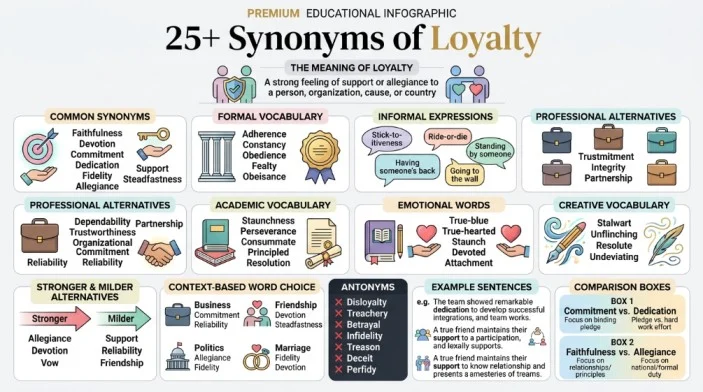
A writer may use the word loyalty several times in an essay, resume, email, or social media caption and then realize that every sentence sounds repetitive. Finding the right synonym of loyalty can make the message more precise by showing whether you mean faithfulness, commitment, devotion, allegiance, or trust.
The best alternative depends on context. A business report may need commitment, a personal message may sound warmer with devotion, and a historical discussion may require allegiance. Understanding these differences helps you choose words that communicate the exact kind of loyalty you mean without making your writing sound forced.
What Are the Best Synonyms of “Loyalty”?
The best synonyms of loyalty include faithfulness, devotion, allegiance, commitment, dedication, fidelity, steadfastness, allegiance, solidarity, and support. For formal writing, use fidelity or allegiance. For professional communication, commitment and dedication work well. In emotional writing, devotion and faithfulness usually express a deeper personal bond.
Meaning, Tone, and Context
Simple Definition
Loyalty means a strong sense of faithfulness, commitment, or support toward a person, group, organization, cause, or belief.
Someone who shows loyalty continues to support or remain faithful to something or someone, especially when circumstances become difficult.
For example:
“Her loyalty to the company remained strong during a difficult year.”
The sentence shows continued support and commitment.
Part of Speech
Loyalty is a noun.
The adjective is loyal, as in:
“He is a loyal employee.”
The adverb loyally describes an action performed with loyalty:
“She loyally supported her friend.”
The related noun loyalist can describe someone who strongly supports a particular person, group, government, or cause.
Overall Tone
Loyalty generally has a positive tone.
It is associated with trust, reliability, faithfulness, dedication, and continued support. However, loyalty can become negative in certain contexts when it involves unquestioning support for harmful behavior or a person who does not deserve it.
Formality Level
Loyalty is a neutral word that works across many levels of communication.
It is natural in:
- Academic writing
- Business communication
- Personal conversations
- Essays
- Resumes
- Marketing
- Workplace discussions
- Social media
- Speeches
- Creative writing
Common Uses
Native English speakers commonly discuss loyalty in relation to:
- Loyalty to family
- Loyalty to friends
- Customer loyalty
- Employee loyalty
- Brand loyalty
- Loyalty to a country
- Loyalty to a team
- Loyalty to a cause
- Loyalty to an organization
- Loyalty to personal values
- Loyalty in relationships
Word Forms
| Word | Part of Speech | Example |
|---|---|---|
| Loyalty | Noun | Her loyalty was appreciated. |
| Loyal | Adjective | He is a loyal friend. |
| Loyally | Adverb | She loyally defended her team. |
| Loyalist | Noun | The loyalists supported the leader. |
| Disloyal | Adjective | His behavior seemed disloyal. |
| Disloyalty | Noun | The manager was disappointed by the disloyalty. |
When and How to Use “Loyalty”
Use loyalty when you want to describe continued faithfulness, support, or commitment toward someone or something.
It is especially useful when the relationship involves trust over time.
Professional
“Her loyalty to the organization has made her a dependable member of the leadership team.”
Academic
“The study examines how loyalty influences long term customer behavior.”
Workplace
“Employee loyalty can develop when workers feel respected and valued.”
Personal
“I appreciate your loyalty during one of the most difficult periods of my life.”
“Thank you for your continued loyalty and support.”
Resume
“Built strong customer loyalty through responsive service and consistent communication.”
Social Media
“Grateful for the loyalty and support of everyone who has been part of this journey.”
Best Synonyms of “Loyalty”
No synonym is identical to loyalty in every situation. Each alternative emphasizes a slightly different part of the idea.
Professional Writing: Commitment
Commitment is one of the strongest professional alternatives because it emphasizes a willingness to remain dedicated to a responsibility, organization, goal, or relationship.
“Her commitment to the organization has been consistent for more than a decade.”
Academic Writing: Fidelity
Fidelity works well in formal and academic discussions when the focus is faithfulness to a person, principle, agreement, or original idea.
“The researcher examined the patient’s fidelity to the treatment plan.”
Business Communication: Dedication
Dedication emphasizes sustained effort and serious involvement.
“Her dedication to customer service has strengthened the company’s reputation.”
Casual Conversation: Faithfulness
Faithfulness sounds natural when discussing personal relationships, friendships, promises, or beliefs.
“His faithfulness to his friends has always impressed me.”
Emotional Writing: Devotion
Devotion carries a strong emotional meaning and suggests deep affection, commitment, or attachment.
“Her devotion to her family was evident in everything she did.”
Creative Writing: Steadfastness
Steadfastness gives writing a more literary quality and emphasizes remaining firm despite pressure or difficulty.
“His steadfastness never faded, even when everyone else abandoned the cause.”
Resume Writing: Commitment
Commitment is concise and professional, making it useful for describing dedication to customers, employers, teams, or organizational goals.
“Demonstrated strong commitment to client satisfaction.”
Workplace Communication: Dedication
Dedication is effective when recognizing an employee’s sustained effort and reliability.
“We appreciate your dedication to the team.”
Stronger Meaning: Devotion
Use devotion when loyalty involves deep emotional attachment or exceptional dedication.
“Her devotion to her children was unwavering.”
Softer Meaning: Support
Support can express loyalty without suggesting the deep or long term commitment associated with words such as devotion or fidelity.
“Thank you for your continued support.”
When Not to Use “Loyalty”
Although loyalty is flexible, it is not always the most precise word.
When It Sounds Too General
“Loyalty” may not explain exactly what the person does.
Less precise:
“Her loyalty helped the company.”
Better:
“Her dedication helped the company complete the project.”
Why:
Dedication emphasizes active effort rather than simply remaining faithful.
When You Mean Emotional Attachment
Less precise:
“His loyalty to his children was obvious.”
Better:
“His devotion to his children was obvious.”
Why:
Devotion communicates deeper emotional attachment.
When You Mean Support
Less precise:
“Thank you for your loyalty.”
Better:
“Thank you for your continued support.”
Why:
If you are thanking customers, readers, or followers, support often sounds warmer and more natural.
When You Mean Duty to a Country or Leader
Less precise:
“The soldiers showed loyalty to the nation.”
Better:
“The soldiers showed allegiance to the nation.”
Why:
Allegiance is more closely connected with formal duty and political or national loyalty.
When You Mean Keeping a Promise
Less precise:
“His loyalty to the agreement was impressive.”
Better:
“His fidelity to the agreement was impressive.”
Why:
Fidelity can emphasize faithful adherence to an agreement, principle, or obligation.
When a Stronger Emotional Word Is Needed
Less precise:
“Her loyalty to her partner was extraordinary.”
Better:
“Her devotion to her partner was extraordinary.”
Why:
Devotion conveys stronger emotional attachment.
Words Commonly Confused With “Loyalty”
| Word | Difference | When to Use It | Example |
|---|---|---|---|
| Commitment | Focuses on dedication to a responsibility or goal. | Work, relationships, goals | “His commitment to the project never changed.” |
| Devotion | Adds deep emotional attachment. | Family, relationships, causes | “Her devotion to her family was remarkable.” |
| Allegiance | Suggests formal loyalty to a group, leader, country, or cause. | Politics, history, military contexts | “The soldiers pledged allegiance to their country.” |
| Fidelity | Emphasizes faithfulness to a person, agreement, belief, or principle. | Formal and academic contexts | “The artist maintained fidelity to the original design.” |
| Dedication | Focuses on effort and sustained involvement. | Work, education, goals | “Her dedication to teaching inspired her students.” |
| Support | Means helping or backing someone without necessarily implying long term loyalty. | Everyday and professional communication | “Thank you for your continued support.” |
Best Synonyms of “Loyalty” by Context
| Context | Best Synonym | Why It Works | Example |
|---|---|---|---|
| Formal writing | Fidelity | Precise and formal | “The study considered fidelity to the original principle.” |
| Academic writing | Fidelity | Works well for adherence and faithfulness | “The analysis measured fidelity to the research protocol.” |
| Professional communication | Commitment | Highlights sustained dedication | “Her commitment to quality is evident.” |
| Business emails | Support | Sounds warm and natural | “Thank you for your continued support.” |
| Resume writing | Dedication | Shows sustained effort | “Recognized for dedication to client service.” |
| Workplace communication | Commitment | Connects loyalty with responsibility | “His commitment to the team is clear.” |
| Casual conversation | Faithfulness | Natural for personal relationships | “Her faithfulness as a friend means a lot.” |
| Everyday speaking | Support | Simple and flexible | “I appreciate your support.” |
| Creative writing | Steadfastness | Adds literary depth | “His steadfastness carried him through the crisis.” |
| Storytelling | Devotion | Creates emotional depth | “Her devotion kept the family together.” |
| Emotional writing | Devotion | Suggests deep attachment | “His devotion was impossible to question.” |
| Strong emphasis | Allegiance | Suggests firm, serious loyalty | “Their allegiance to the cause remained strong.” |
| Mild tone | Support | Less intense than loyalty | “Thank you for your support.” |
| Social media captions | Support | Conversational and approachable | “Thank you all for your continued support.” |
| American English | Loyalty | Most direct and widely understood | “Customer loyalty matters to every brand.” |
| British English | Loyalty | Equally natural and standard | “The company values customer loyalty.” |
How to Choose the Best Synonym of “Loyalty”
Start by identifying exactly what kind of loyalty you mean.
If You Mean Staying Dedicated
Choose commitment.
“Her commitment to the team is impressive.”
If You Mean Deep Emotional Attachment
Choose devotion.
“His devotion to his family is admirable.”
If You Mean Formal Duty
Choose allegiance.
“The officer pledged allegiance to the country.”
If You Mean Faithful Adherence
Choose fidelity.
“The translation maintains fidelity to the original text.”
If You Mean Persistent Effort
Choose dedication.
“Her dedication to the students is obvious.”
If You Mean General Help or Backing
Choose support.
“We appreciate your continued support.”
Consider Your Audience
A resume should sound professional, so commitment and dedication are usually better choices than emotional terms such as devotion.
A personal message can be warmer. Faithfulness, devotion, or support may fit better.
Consider Emotional Strength
- Use support for a mild expression.
- Use commitment for sustained dedication.
- Use dedication for strong effort.
- Use devotion for deep emotional attachment.
- Use allegiance for serious or formal loyalty to a group, cause, or authority.
Real Life Examples of “Loyalty”
School
Original:
“Loyalty is an important quality in a good friend.”
Improved:
“Faithfulness is an important quality in a good friend.”
College
Original:
“The essay discusses customer loyalty.”
Improved:
“The essay examines customer commitment and its influence on purchasing behavior.”
Workplace
Original:
“Her loyalty to the company was recognized.”
Improved:
“Her dedication to the company was recognized.”
Business
Original:
“The brand wants to increase customer loyalty.”
Improved:
“The brand wants to strengthen customer commitment and long term engagement.”
Original:
“Thank you for your loyalty.”
Improved:
“Thank you for your continued support.”
Resume
Original:
“Demonstrated loyalty to the organization.”
Improved:
“Demonstrated long term commitment to organizational goals.”
Conversation
Original:
“I value your loyalty.”
Improved:
“I really value your faithfulness as a friend.”
Storytelling
Original:
“His loyalty never disappeared.”
Improved:
“His steadfastness never faded, even when the situation became difficult.”
Blogging
Original:
“Building loyalty is important for online businesses.”
Improved:
“Building customer trust and commitment is essential for online businesses.”
Social Media
Original:
“Your loyalty means everything to us.”
Improved:
“Your continued support means everything to us.”
25 Best Synonyms of “Loyalty”
| Synonym | Simple Meaning | Best Used For | Example Sentence |
|---|---|---|---|
| Faithfulness | Remaining true and reliable | Relationships | “Her faithfulness made their friendship stronger.” |
| Devotion | Deep personal dedication | Family and relationships | “His devotion to his children was obvious.” |
| Allegiance | Formal or firm loyalty | Countries, groups, causes | “The soldiers showed allegiance to their nation.” |
| Commitment | Strong dedication to something | Work and relationships | “Her commitment to the project impressed everyone.” |
| Dedication | Serious and sustained effort | Work and goals | “His dedication to teaching is inspiring.” |
| Fidelity | Faithfulness or adherence | Formal and academic writing | “The translation preserves fidelity to the source.” |
| Steadfastness | Firm loyalty despite difficulty | Creative and formal writing | “Her steadfastness helped the team survive the crisis.” |
| Faith | Trust or confidence in someone or something | Personal and spiritual contexts | “He kept faith with his closest friends.” |
| Support | Helping or backing someone | Business and everyday speech | “We appreciate your continued support.” |
| Devotedness | Strong dedication and attachment | Emotional writing | “Her devotedness to her family was clear.” |
| Constancy | Remaining loyal or consistent | Literary and formal writing | “His constancy gave her confidence.” |
| Reliability | Being dependable and trustworthy | Workplace | “Her reliability earned the team’s trust.” |
| Dependability | Ability to be trusted consistently | Professional settings | “His dependability made him a valuable employee.” |
| Trust | Confidence in someone’s character | Relationships and business | “Trust is essential to a lasting partnership.” |
| Adherence | Faithful following of a rule or principle | Academic and professional writing | “Strict adherence to the policy was required.” |
| Obedience | Willingness to follow authority or instructions | Rules and authority | “His obedience to the instructions prevented mistakes.” |
| Solidarity | Unity and support within a group | Social and professional contexts | “The workers showed solidarity during negotiations.” |
| Partnership | Relationship based on mutual cooperation | Business and professional settings | “The companies built a strong partnership.” |
| Dedication | Continued effort toward a purpose | Careers and education | “Her dedication to the program produced excellent results.” |
| Faithful support | Consistent backing | Personal and public communication | “The team received faithful support from its community.” |
| Devoted support | Strong personal backing | Emotional contexts | “She offered devoted support throughout his recovery.” |
| Loyalty | Continued faithfulness and support | General use | “Customer loyalty is valuable to the business.” |
| Fidelity | Faithfulness to a person or principle | Formal contexts | “The document demonstrates fidelity to the original agreement.” |
| Commitment | Continued involvement and dedication | Business and personal life | “His commitment to the organization remained strong.” |
| Allegiance | Strong loyalty to a group or cause | Formal, political, and historical contexts | “Their allegiance to the movement remained firm.” |
Synonyms of “Loyalty” by Usage
Professional vs Personal Synonyms
Professional contexts usually favor words that emphasize responsibility, consistency, and sustained effort.
Commitment, dedication, reliability, and dependability are strong choices for workplaces and resumes.
Personal relationships often need warmer vocabulary. Faithfulness, devotion, support, and trust can communicate the emotional side of loyalty more effectively.
For example:
“Her commitment to the company was recognized.”
sounds professional.
“Her devotion to her family was inspiring.”
sounds personal and emotional.
Formal vs Conversational Synonyms
Formal writing often benefits from fidelity, allegiance, steadfastness, and adherence.
These words are useful in reports, academic discussions, historical writing, and formal speeches.
Conversational English usually favors support, commitment, faithfulness, and simply loyalty.
In texting, simple phrases such as “Thanks for always supporting me” often sound more natural than “Thank you for your steadfastness.”
Academic Synonyms
Academic writing requires precision. The best choice depends on the subject.
Fidelity
Use fidelity when discussing accurate adherence to an original source, principle, method, or agreement.
Adherence
Use adherence when the idea involves following rules, standards, procedures, or principles.
Commitment
Use commitment when discussing sustained involvement in a goal, institution, or cause.
Allegiance
Use allegiance when studying political, historical, military, or social relationships.
Constancy
Use constancy when discussing continued behavior or an enduring quality, especially in formal or literary analysis.
Professional and Business Synonyms
Resumes
Use commitment, dedication, and reliability.
Instead of:
“Loyal employee with strong loyalty to customers.”
Write:
“Dedicated professional committed to delivering exceptional customer service.”
Interviews
Use commitment when explaining why you want to remain with an organization.
“I value long term commitment and enjoy contributing to team goals.”
Meetings
Use support or commitment when discussing team relationships.
“We need everyone’s commitment to this plan.”
Presentations
Use customer commitment, customer retention, or brand loyalty, depending on the precise business meaning.
Performance Reviews
Dedication and reliability are useful when describing employee behavior.
“Her dedication and reliability have made her a trusted member of the department.”
Client Communication
Support usually sounds warmer and less transactional.
“We appreciate your continued support.”
Business Emails
Use continued support, commitment, or partnership depending on the relationship.
“Thank you for your continued support and partnership.”
Creative and Literary Synonyms
Creative writing can benefit from alternatives that communicate more than simple faithfulness.
Devotion
Adds emotional depth.
“Her devotion remained stronger than her fear.”
Steadfastness
Suggests strength under pressure.
“His steadfastness kept the family united.”
Constancy
Creates a more literary tone.
“She found comfort in his constancy.”
Allegiance
Works well in stories involving kingdoms, armies, political movements, or competing groups.
“The knight’s allegiance was tested by the rival king.”
Faithfulness
Works naturally in stories about friendships, romance, family, and promises.
“His faithfulness never wavered.”
Slang or Modern Synonyms
There is no single slang word that precisely replaces loyalty in every situation.
Modern casual English often uses phrases rather than direct synonyms.
“Having someone’s back”
This means supporting someone, especially when they face difficulty.
“I know she’ll always have my back.”
It works in casual conversations and social media, but it should generally be avoided in academic writing and formal business documents.
“Ride or die”
This informal expression describes extremely strong loyalty to a person.
“She’s my ride or die.”
It is highly casual and should be limited to informal conversations, social media, or creative dialogue.
Strongest to Mildest Synonyms
Loyalty does not have a perfect universal intensity scale because the synonyms emphasize different qualities. Still, they can be grouped by the strength of commitment they commonly suggest.
| Level | Words | Typical Meaning |
|---|---|---|
| Mild | Support, Trust | General backing or confidence |
| Moderate | Commitment, Reliability, Faithfulness | Consistent dedication |
| Strong | Dedication, Fidelity, Steadfastness | Firm and sustained loyalty |
| Very Strong | Devotion, Allegiance | Deep emotional or formal loyalty |
Support is usually the least intense.
Commitment suggests a stronger ongoing relationship.
Dedication emphasizes serious effort.
Devotion suggests deep emotional attachment.
Allegiance can express particularly firm loyalty to a group, authority, country, or cause.
Emotional vs Neutral Synonyms
Emotional Synonyms
These words add feelings or personal depth:
- Devotion
- Faithfulness
- Devotedness
- Steadfastness
- Constancy
- Support
They work well in personal letters, stories, speeches, relationship writing, and emotional social media content.
Neutral Synonyms
These words communicate loyalty more objectively:
- Commitment
- Dedication
- Fidelity
- Reliability
- Dependability
- Adherence
- Allegiance
They are better suited to reports, resumes, workplace communication, academic writing, and professional discussions.
Antonyms of “Loyalty”
| Antonym | Meaning | Example Sentence |
|---|---|---|
| Disloyalty | Failure to remain faithful | His disloyalty damaged their friendship. |
| Betrayal | Breaking someone’s trust | The betrayal ended their partnership. |
| Treachery | Deliberate betrayal of trust | The leader was accused of treachery. |
| Infidelity | Unfaithfulness, especially in a relationship | The novel explores the consequences of infidelity. |
| Unfaithfulness | Failure to remain faithful | Her unfaithfulness caused serious problems. |
| Disobedience | Refusal to follow authority or instructions | His disobedience violated the agreement. |
| Defection | Abandoning a group or cause | The official’s defection shocked the organization. |
| Desertion | Abandoning a person, group, or duty | The soldier was punished for desertion. |
| Abandonment | Leaving someone or something behind | The sudden abandonment hurt the team. |
| Rejection | Refusal to support or accept something | His rejection of the proposal surprised everyone. |
| Opposition | Active resistance against someone or something | The group expressed strong opposition to the plan. |
| Hostility | Unfriendly or antagonistic behavior | Years of hostility made cooperation difficult. |
| Distrust | Lack of confidence in someone | Their distrust made collaboration difficult. |
| Neglect | Failure to give proper attention or care | Neglect of the relationship weakened their bond. |
| Betraying | Acting against someone who expects your faithfulness | Betraying a trusted friend can cause lasting damage. |
Comparison: “Loyalty” vs Similar Words
Loyalty vs Commitment
Main Difference
Loyalty emphasizes faithfulness and continued support. Commitment emphasizes a decision or willingness to remain dedicated to something.
Which Is Stronger?
Neither is always stronger. Loyalty focuses more on the relationship, while commitment focuses more on dedication.
Which Is More Formal?
Commitment is especially common in professional writing.
When to Use Each
Use loyalty for relationships, customers, teams, and organizations.
Use commitment for goals, responsibilities, projects, and professional relationships.
Examples
Loyalty:
“Customer loyalty has grown over the past year.”
Commitment:
“Her commitment to customer service is impressive.”
Loyalty vs Devotion
Main Difference
Devotion suggests deeper emotional attachment than the general word loyalty.
Which Is Stronger?
Devotion is usually more emotionally intense.
Which Is More Formal?
Both can appear in formal writing, but devotion often has a stronger emotional tone.
When to Use Each
Use loyalty for general faithfulness.
Use devotion for deep personal or emotional attachment.
Examples
Loyalty:
“His loyalty to his team never changed.”
Devotion:
“Her devotion to her children shaped every decision she made.”
Loyalty vs Allegiance
Main Difference
Allegiance usually suggests formal or firm loyalty to a country, leader, group, institution, or cause.
Which Is Stronger?
Allegiance can sound stronger and more formal.
Which Is More Formal?
Allegiance is more formal.
When to Use Each
Use allegiance for political, military, historical, or institutional contexts.
Examples
Loyalty:
“Her loyalty to the team was obvious.”
Allegiance:
“The soldiers pledged allegiance to their country.”
Loyalty vs Fidelity
Main Difference
Fidelity emphasizes faithfulness or accurate adherence to a person, agreement, belief, or original standard.
Which Is Stronger?
Neither is inherently stronger.
Which Is More Formal?
Fidelity is more formal.
When to Use Each
Use fidelity when precision or faithful adherence is the main idea.
Examples
Loyalty:
“His loyalty to the organization was appreciated.”
Fidelity:
“The translation maintained fidelity to the original text.”
Loyalty vs Dedication
Main Difference
Dedication focuses on sustained effort and serious involvement. Loyalty focuses more on continued faithfulness or support.
Which Is Stronger?
Neither is automatically stronger.
Which Is More Formal?
Dedication works especially well in professional writing.
When to Use Each
Use dedication to praise someone’s effort.
Use loyalty to describe continued support.
Examples
Loyalty:
“The company values employee loyalty.”
Dedication:
“The company recognized her dedication to improving customer service.”
Loyalty vs Support
Main Difference
Support means helping, backing, or encouraging someone. It does not necessarily imply the long term faithfulness associated with loyalty.
Which Is Stronger?
Loyalty usually implies a deeper or more lasting relationship.
Which Is More Formal?
Both are neutral and suitable for professional writing.
When to Use Each
Use support for general help or encouragement.
Use loyalty when continued faithfulness matters.
Examples
Loyalty:
“The team appreciated his loyalty during the difficult period.”
Support:
“The team appreciated his support during the difficult period.”
Common Phrases and Expressions with “Loyalty”
Customer Loyalty
Meaning
Continued preference and support from customers toward a business or brand.
Example Sentence
“The company introduced a rewards program to strengthen customer loyalty.”
Brand Loyalty
Meaning
A customer’s tendency to continue choosing the same brand.
Example Sentence
“Strong brand loyalty can encourage customers to return.”
Employee Loyalty
Meaning
An employee’s continued commitment and attachment to an employer or organization.
Example Sentence
“The company improved employee loyalty by recognizing strong performance.”
Loyalty to Someone
Meaning
Continued faithfulness or support toward a particular person.
Example Sentence
“Her loyalty to her closest friends never changed.”
Loyalty to a Cause
Meaning
Continued support for an idea, movement, principle, or goal.
Example Sentence
“His loyalty to the cause remained strong despite criticism.”
Pledge of Loyalty
Meaning
A formal promise to remain faithful or supportive.
Example Sentence
“The members made a pledge of loyalty to the organization.”
Loyalty Program
Meaning
A business program designed to encourage customers to continue purchasing from a company.
Example Sentence
“The store launched a new loyalty program for returning customers.”
Common Mistakes to Avoid
Mistake 1: Treating Every Synonym as Identical
Incorrect:
“Her devotion to the company was purely professional.”
Better:
“Her commitment to the company was purely professional.”
Why:
Devotion can sound deeply emotional. Commitment is more neutral and appropriate for a workplace context.
Mistake 2: Using “Allegiance” for Every Personal Relationship
Incorrect:
“I appreciate your allegiance as my best friend.”
Better:
“I appreciate your loyalty as my best friend.”
Why:
Allegiance sounds formal and is more natural for groups, causes, countries, leaders, or institutions.
Mistake 3: Using “Faithfulness” in Every Business Context
Incorrect:
“Our company rewards employee faithfulness.”
Better:
“Our company rewards employee commitment.”
Why:
Commitment sounds more natural in professional communication.
Mistake 4: Using an Overly Dramatic Synonym
Incorrect:
“Thank you for your devotion to our newsletter.”
Better:
“Thank you for your continued support.”
Why:
Devotion may sound excessive for an ordinary business or content relationship.
Mistake 5: Confusing Loyalty With Reliability
Incorrect:
“Her reliability means she will always defend the company.”
Better:
“Her loyalty means she will continue to support the company.”
Why:
Reliability means being dependable. It does not automatically mean emotional or organizational loyalty.
Mistake 6: Using Casual Expressions in Formal Writing
Incorrect:
“Our customers always have our back.”
Better:
“Our customers continue to support our brand.”
Why:
“Have our back” is conversational and should generally be avoided in formal reports.
Mistake 7: Repeating the Same Word Too Often
Incorrect:
“The company values loyalty. Loyalty improves retention, and loyalty also strengthens relationships.”
Better:
“The company values customer loyalty. This continued commitment can improve retention and strengthen relationships.”
Why:
Careful variation makes the writing smoother without forcing unrelated synonyms.
Frequently Asked Questions
What are the best synonyms of “loyalty”?
The best synonyms of loyalty include faithfulness, commitment, devotion, dedication, fidelity, allegiance, steadfastness, and support. The best choice depends on whether you mean emotional attachment, professional dedication, formal allegiance, or general support.
What are the best formal synonyms of “loyalty”?
The strongest formal synonyms include fidelity, allegiance, steadfastness, adherence, and commitment. These alternatives work well in academic papers, formal reports, historical discussions, professional documents, and speeches.
What are common informal synonyms of “loyalty”?
Common informal alternatives include support, having someone’s back, and, in very casual language, ride or die. Use these expressions carefully because some are conversational and unsuitable for professional or academic writing.
What is another word for “loyalty” in professional writing?
Commitment is one of the best professional alternatives to loyalty. Dedication, reliability, dependability, and support can also work when they accurately describe the behavior or relationship being discussed.
What is the difference between “loyalty” and “commitment”?
Loyalty focuses on faithfulness and continued support, while commitment emphasizes dedication to a person, goal, responsibility, or organization. The two overlap, but commitment is especially common in professional and workplace contexts.
What is the opposite of “loyalty”?
The opposite of loyalty is generally disloyalty or betrayal. Depending on context, other opposites include infidelity, abandonment, defection, distrust, treachery, and opposition.
Conclusion
Loyalty describes continued faithfulness, support, or commitment toward a person, group, organization, cause, or belief. The best synonym of loyalty depends on the specific meaning you want to communicate.
Use commitment and dedication for professional situations, fidelity and allegiance for formal contexts, devotion for deep emotional relationships, and support for a softer everyday expression. No synonym works perfectly in every sentence, so the strongest choice is the one that matches your intended meaning, audience, tone, and purpose.
A useful vocabulary habit is to identify the exact quality you want to emphasize before replacing a word. Ask whether you mean emotional attachment, continued support, formal duty, or sustained dedication, then choose the synonym that expresses that idea most clearly.
Read More Related Articles:
Synonyms for Empty | Meaning, Examples, and Better Word …
Synonyms for Pros and Cons | Meaning, Examples, and Better …