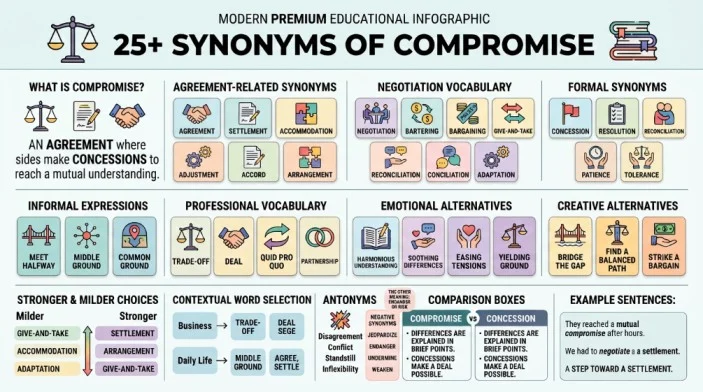
When writing an email, essay, resume, caption, or business message, using the word compromise repeatedly can make your writing feel less precise. Finding the right synonym of compromise can help you explain whether you mean an agreement, a concession, a middle ground, or a situation where something has been weakened or put at risk.
The best alternative depends on context. Words such as settlement, agreement, concession, and middle ground work when people find a solution together, while concede, yield, undermine, and endanger may fit different meanings of the verb. Understanding these distinctions helps you choose vocabulary that sounds natural, accurate, and appropriate for your audience.
What Are the Best Synonyms of “Compromise”?
A compromise is an agreement reached when people accept less than everything they originally wanted, or a situation in which something is weakened or put at risk. The best alternatives include agreement, settlement, concession, and middle ground for negotiation, while concede, yield, reconcile, and undermine fit specific verb meanings.
For formal writing, settlement or reconciliation can be effective. In professional communication, agreement, resolution, and concession are useful. Casual conversation often favors middle ground or give and take, while emotional or creative writing may benefit from sacrifice, accommodation, or trade off when the context supports them.
Meaning, Tone, and Context
Simple Definition
Compromise has two major meanings in modern English.
As a noun, it usually means an agreement in which each side gives up something to reach a solution.
“After several hours of discussion, they reached a compromise.”
As a verb, compromise can mean to settle a disagreement by making concessions. It can also mean to weaken, damage, or put something at risk.
“Both sides agreed to compromise.”
“Sharing the confidential information could compromise the investigation.”
Because these meanings are different, the best synonym depends heavily on the sentence.
Part of Speech
Compromise can function as both a noun and a verb.
Overall Tone
The tone of compromise is generally neutral.
Its meaning can become positive when it describes cooperation and agreement.
“The two teams reached a fair compromise.”
It can become negative when it means weakening something or putting it in danger.
“The security breach could compromise customer data.”
Formality Level
Compromise is a neutral word that works in casual conversation, academic writing, business communication, legal discussions, journalism, and professional documents.
It is flexible enough for most situations, although a more precise synonym can sometimes communicate the intended meaning more clearly.
Common Uses
Native English speakers commonly use compromise when discussing:
- Negotiations
- Relationships
- Business agreements
- Political decisions
- Workplace conflicts
- Family disagreements
- Contracts
- Security
- Safety
- Quality
- Principles
- Confidential information
- Competing interests
Word Forms
| Form | Example |
|---|---|
| Noun | “They reached a compromise.” |
| Verb | “Both sides agreed to compromise.” |
| Related noun | “The negotiation required compromise.” |
| Related adjective | “The proposal represented a compromised position.” |
The meaning should always be checked from context because compromise can describe either cooperation or damage.
When and How to Use “Compromise”
Use compromise when two or more sides need to move away from their original positions to reach an acceptable result. Use it carefully when the meaning involves damage or risk because the appropriate synonym will be very different.
Professional
“The two departments reached a compromise on how to divide the project budget.”
Academic
“The researchers reached a compromise that allowed both theories to be considered.”
Workplace
“After discussing the scheduling conflict, the employees found a compromise.”
Personal
“Good relationships often require both people to compromise.”
“I believe we can compromise by extending the deadline by two days.”
Resume
“Negotiated compromises between departments to resolve operational conflicts efficiently.”
Social Media
“Sometimes finding common ground requires everyone to compromise a little.”
Best Synonyms of “Compromise”
No single synonym can replace compromise in every sentence because the word has several meanings. The strongest choice depends on whether you are describing an agreement, a concession, cooperation, or damage.
Professional Writing: Agreement
Agreement works well when two sides reach the same decision or accept common terms.
“The companies reached an agreement after several meetings.”
It is broader than compromise, so it should be used when the sentence does not specifically require the idea of both sides giving something up.
Academic Writing: Reconciliation
Reconciliation is useful when discussing efforts to resolve differences between opposing ideas, groups, or positions.
“The paper explores the reconciliation of competing viewpoints.”
It sounds formal and analytical, which makes it useful in academic contexts.
Business Communication: Settlement
Settlement is especially appropriate when negotiations resolve a dispute.
“The parties reached a settlement after months of negotiations.”
It is particularly useful in legal, financial, and business contexts.
Casual Conversation: Middle Ground
Middle ground sounds natural when people are trying to find a position between two opposing views.
“We need to find some middle ground.”
It is conversational and easy to understand.
Emotional Writing: Sacrifice
Sacrifice works when someone gives up something valuable for another person or for a larger goal.
“Their relationship survived because both were willing to make sacrifices.”
It carries more emotional weight than compromise.
Creative Writing: Accommodation
Accommodation can describe adjusting to another person’s needs, preferences, or position.
“Their uneasy accommodation kept the peace for another year.”
It can create a more nuanced tone in descriptive writing.
Resume Writing: Negotiation
Negotiation is often stronger on a resume because it highlights a professional skill rather than simply stating that a compromise occurred.
“Led negotiations between cross functional teams to resolve project conflicts.”
Workplace Communication: Resolution
Resolution is useful when the emphasis is on solving a disagreement rather than on what each side gave up.
“The team reached a resolution that satisfied both departments.”
Stronger Meaning: Concession
Concession emphasizes what one side gives up or agrees to accept.
“The company made a major concession during the negotiations.”
Softer Meaning: Adjustment
Adjustment can work when the change is relatively small and does not involve a major dispute.
“We made a few adjustments to accommodate everyone’s schedule.”
When Not to Use “Compromise”
When You Mean a Simple Agreement
If both sides simply agree without giving anything up, compromise may suggest more negotiation than actually occurred.
Less precise:
“The team reached a compromise about the meeting time.”
Better:
“The team reached an agreement about the meeting time.”
Why:
Agreement does not imply that either side had to surrender part of its position.
When You Mean a Legal Settlement
In legal or financial contexts, settlement may be more precise.
Less precise:
“The two companies reached a compromise over the lawsuit.”
Better:
“The two companies reached a settlement over the lawsuit.”
Why:
Settlement clearly signals that a dispute has been formally resolved.
When You Mean One Side Gave Something Up
Use concession when the focus is specifically on what one party surrendered.
Less precise:
“The company made a compromise.”
Better:
“The company made a concession.”
Why:
Concession identifies the act of giving something up rather than the final agreement.
When You Mean Damage or Risk
The negative meaning of compromise requires a different vocabulary.
Less precise:
“The leaked password compromised the account.”
Better:
“The leaked password endangered the account.”
Why:
Endangered emphasizes risk, while compromise can mean that security or integrity has already been weakened.
When You Mean Weakening Quality
Weaken may be more direct.
Less precise:
“The changes compromised the quality of the product.”
Better:
“The changes weakened the quality of the product.”
Why:
Weakened clearly communicates a reduction in strength or effectiveness.
When You Mean Giving In During an Argument
Use yield or concede when one person accepts another person’s position.
Less precise:
“She compromised during the debate.”
Better:
“She conceded that the other side had a stronger argument.”
Why:
Concede clearly indicates that someone accepted a point made by another person.
Words Commonly Confused With “Compromise”
Agreement
Difference: An agreement means that people accept the same terms or decision. It does not necessarily mean that each side gave something up.
When to Use It: Use it for general shared decisions and accepted terms.
Example:
“The two companies reached an agreement on pricing.”
Concession
Difference: A concession is something one person or group gives up to help reach an agreement.
When to Use It: Use it when emphasizing what one side surrendered.
Example:
“The union made a concession during the negotiations.”
Settlement
Difference: A settlement is an arrangement that resolves a dispute, especially in legal or financial situations.
When to Use It: Use it for lawsuits, claims, and formal disputes.
Example:
“The parties reached a settlement before the trial.”
Negotiation
Difference: Negotiation is the process of discussing terms to reach an agreement. A compromise can be the result of that process.
When to Use It: Use it when describing discussions between opposing sides.
Example:
“The teams entered negotiations over the contract.”
Sacrifice
Difference: A sacrifice involves giving up something valuable, often for another person or a larger goal.
When to Use It: Use it when the personal cost matters.
Example:
“She made a sacrifice to support her family.”
Reconciliation
Difference: Reconciliation focuses on restoring harmony between people or ideas that have been in conflict.
When to Use It: Use it when the goal is to repair a relationship or resolve opposing positions.
Example:
“The meeting helped bring about reconciliation between the two groups.”
Best Synonyms of “Compromise” by Context
| Context | Best Synonym | Why It Works | Example |
|---|---|---|---|
| Formal writing | Reconciliation | Sounds precise when opposing positions are brought together. | “The proposal encourages reconciliation between the groups.” |
| Academic writing | Reconciliation | Works well for competing theories or viewpoints. | “The study examines reconciliation between competing models.” |
| Professional communication | Agreement | Clearly communicates accepted terms. | “The teams reached an agreement.” |
| Business emails | Resolution | Focuses on solving an issue. | “We hope to reach a resolution soon.” |
| Resume writing | Negotiation | Highlights a valuable professional skill. | “Led negotiations between project teams.” |
| Workplace communication | Resolution | Emphasizes a practical solution. | “The discussion produced a workable resolution.” |
| Casual conversation | Middle ground | Sounds natural and conversational. | “Let’s find some middle ground.” |
| Everyday speaking | Give and take | Emphasizes mutual flexibility. | “Healthy relationships require give and take.” |
| Creative writing | Accommodation | Adds nuance to interpersonal situations. | “Their accommodation kept the peace.” |
| Storytelling | Sacrifice | Highlights emotional cost. | “His sacrifice changed the family forever.” |
| Emotional writing | Sacrifice | Expresses personal loss or effort. | “Love sometimes requires sacrifice.” |
| Strong emphasis | Concession | Highlights what one side surrendered. | “The final concession changed the deal.” |
| Mild tone | Adjustment | Suggests a smaller change. | “A minor adjustment solved the problem.” |
| Social media captions | Middle ground | Simple and relatable. | “Finding middle ground takes patience.” |
| American English | Compromise | Natural across formal and informal settings. | “They agreed to compromise.” |
| British English | Compromise | The core meanings and common usage are broadly similar. | “Both sides were willing to compromise.” |
How to Choose the Best Synonym of “Compromise”
Choosing a synonym becomes easier when you first identify which meaning of compromise you need.
If You Mean an Agreement
Choose agreement, settlement, or resolution.
“The two sides reached a resolution.”
If You Mean Finding a Middle Position
Choose middle ground, accommodation, or reconciliation.
“The groups found middle ground.”
If You Mean Giving Something Up
Choose concession, sacrifice, or yielding, depending on the context.
“The company made a concession.”
If You Mean the Process of Reaching an Agreement
Choose negotiation or bargaining.
“The contract required extensive negotiation.”
If You Mean Weakening Something
Choose weaken, undermine, impair, or damage.
“The decision could undermine public confidence.”
If You Mean Putting Something at Risk
Choose endanger, jeopardize, or threaten.
“The security flaw could endanger sensitive information.”
Consider Your Audience
- For academic readers, use precise terms such as reconciliation, concession, or resolution.
- For business audiences, agreement, negotiation, settlement, and resolution are often more practical.
- For casual readers, middle ground and give and take usually sound more natural.
Consider Emotional Strength
Adjustment sounds mild.
Concession sounds moderately strong.
Sacrifice emphasizes personal cost.
Jeopardize creates a strong negative sense of risk.
Check Natural Usage
A synonym should fit the sentence grammatically and logically. Never replace compromise simply because another word looks similar in a thesaurus.
Real Life Examples of “Compromise”
School
Original:
“The students reached a compromise about their group presentation.”
Improved:
“The students found middle ground about how to organize their group presentation.”
College
Original:
“The researchers had to compromise on their approach.”
Improved:
“The researchers had to make an adjustment to their approach.”
Workplace
Original:
“The departments reached a compromise.”
Improved:
“The departments reached a resolution after discussing their competing priorities.”
Business
Original:
“The companies reached a compromise.”
Improved:
“The companies reached a settlement after several rounds of negotiation.”
Original:
“Perhaps we can compromise on the delivery date.”
Improved:
“Perhaps we can find middle ground by moving the delivery date forward by two days.”
Resume
Original:
“Helped teams compromise during conflicts.”
Improved:
“Facilitated negotiations between teams to resolve operational conflicts.”
Conversation
Original:
“Relationships require compromise.”
Improved:
“Healthy relationships require give and take.”
Storytelling
Original:
“She made a compromise for her family.”
Improved:
“She made a difficult sacrifice for her family.”
Blogging
Original:
“Successful teams need compromise.”
Improved:
“Successful teams need collaboration, flexibility, and mutual accommodation.”
Social Media
Original:
“Sometimes you have to compromise.”
Improved:
“Sometimes finding middle ground is more valuable than winning an argument.”
25 Best Synonyms of “Compromise”
Because compromise has more than one meaning, the table below identifies the specific sense each synonym can express. This prevents unrelated words from being treated as interchangeable.
| Synonym | Simple Meaning | Best Used For | Example Sentence |
|---|---|---|---|
| Agreement | A shared decision or accepted set of terms | General negotiation | “The two sides reached an agreement.” |
| Settlement | An arrangement that resolves a dispute | Legal and business disputes | “The parties reached a settlement.” |
| Resolution | A solution to a disagreement or problem | Workplace and professional settings | “The meeting produced a practical resolution.” |
| Concession | Something given up to reach an agreement | Negotiations | “The company offered a concession.” |
| Middle ground | A position between opposing views | Casual and interpersonal situations | “They finally found some middle ground.” |
| Reconciliation | Restoration of harmony between opposing sides | Academic and interpersonal contexts | “The talks encouraged reconciliation.” |
| Accommodation | Adjustment made to meet another side’s needs | Relationships and organizations | “The schedule allowed accommodation for both teams.” |
| Negotiation | Discussion aimed at reaching an agreement | Business and professional settings | “The contract required careful negotiation.” |
| Bargaining | Negotiating over terms or conditions | Business and everyday situations | “The two sides spent hours bargaining.” |
| Cooperation | Working together toward a shared result | Workplace and social contexts | “Cooperation helped resolve the dispute.” |
| Collaboration | Working jointly toward a goal | Professional and academic settings | “Collaboration produced a stronger solution.” |
| Give and take | Mutual willingness to adjust | Informal conversation | “A good partnership requires give and take.” |
| Trade off | Exchange in which one benefit is accepted for another | Decisions and planning | “The lower cost involved a trade off in speed.” |
| Concessionary agreement | Agreement involving accepted concessions | Formal negotiations | “The parties signed a concessionary agreement.” |
| Adjustment | A change made to fit new circumstances | Mild disagreements | “A small adjustment solved the scheduling issue.” |
| Sacrifice | Giving up something valuable for a goal | Emotional and personal writing | “Her sacrifice helped the family move forward.” |
| Yield | Giving way to another position | Arguments and negotiations | “He eventually agreed to yield on that point.” |
| Concede | Admit or accept another side’s point | Debate and discussion | “She conceded that the evidence was persuasive.” |
| Acquiesce | Accept something reluctantly or without protest | Formal writing | “He eventually acquiesced to the request.” |
| Reconcile | Bring opposing ideas or sides into agreement | Academic and interpersonal writing | “The theory attempts to reconcile two opposing views.” |
| Weaken | Reduce strength or effectiveness | Negative sense of compromise | “The change could weaken the security system.” |
| Undermine | Gradually reduce strength, confidence, or effectiveness | Professional and formal writing | “The error could undermine public trust.” |
| Impair | Damage or reduce proper function | Formal and technical contexts | “The disruption may impair system performance.” |
| Endanger | Put someone or something at risk | Safety and security | “The mistake could endanger customer information.” |
| Jeopardize | Put something valuable at serious risk | Formal and professional writing | “The delay could jeopardize the entire project.” |
Synonyms of “Compromise” by Usage
Professional vs Personal Synonyms
Professional communication usually benefits from precise terms such as agreement, resolution, settlement, negotiation, and concession.
Personal conversations often sound more natural with middle ground, give and take, sacrifice, and accommodation.
For example:
Professional: “The departments reached a resolution.”
Personal: “A healthy relationship requires give and take.”
The underlying idea is similar, but the vocabulary creates a different tone.
Formal vs Conversational Synonyms
- For reports and essays, use words such as reconciliation, resolution, settlement, and concession when their meanings fit.
- For business writing and presentations, agreement, negotiation, and resolution are practical choices.
- For casual conversations and texting, middle ground, give and take, and meet halfway are more natural.
Academic Synonyms
Academic writing often requires precision rather than emotional language.
Reconciliation
Use reconciliation when discussing opposing theories, interpretations, or positions.
“The article proposes a reconciliation of two competing approaches.”
Resolution
Use resolution when describing how an academic disagreement or research problem is addressed.
“The resolution of the debate requires additional evidence.”
Concession
Use concession when one argument accepts part of another position.
“The author makes a concession to the opposing argument.”
Accommodation
Use accommodation when different theories or positions are adjusted to coexist.
“The model allows accommodation of conflicting evidence.”
These terms are often more precise than simply repeating compromise.
Professional and Business Synonyms
Resumes
Use negotiation, conflict resolution, and agreement to describe professional abilities.
“Led negotiations between senior stakeholders to resolve project conflicts.”
Interviews
Use negotiation when discussing how you handle disagreements.
“I focus on negotiation and practical problem solving when priorities conflict.”
Meetings
Use resolution or agreement when discussing outcomes.
“The meeting ended with a clear resolution.”
Presentations
Use concession when explaining what each side accepted.
“The final proposal included several concessions from both parties.”
Performance Reviews
Use collaboration, negotiation, and conflict resolution to describe interpersonal skills.
“Demonstrated strong conflict resolution skills during cross departmental projects.”
Client Communication
Use agreement or resolution when communicating a finalized outcome.
“We reached an agreement that meets both parties’ needs.”
Business Emails
Use middle ground for a friendly tone or resolution for a more formal tone.
“I hope we can find a resolution that works for everyone.”
Creative and Literary Synonyms
Creative writing allows more expressive choices.
Sacrifice
Use sacrifice when the character gives up something personally valuable.
“He made a quiet sacrifice that nobody noticed.”
Accommodation
Use accommodation when characters tolerate or adapt to one another.
“Their uneasy accommodation lasted through the winter.”
Reconciliation
Use reconciliation when separated characters repair a relationship.
“Their reconciliation came after years of silence.”
Middle Ground
Use middle ground for accessible dialogue.
“They searched for middle ground before the argument became permanent.”
Give and Take
Use this phrase when emphasizing the natural balance of relationships.
“Their friendship survived through years of give and take.”
Slang or Modern Synonyms
There is no single true slang replacement for compromise. However, several informal expressions are common in modern American English.
Meet Halfway
Meaning: Both sides make adjustments to reach a solution.
Acceptable In: Conversation, texting, social media, personal communication.
Avoid In: Formal academic writing and highly formal business documents.
“We don’t have to agree on everything, but we can meet halfway.”
Give and Take
Meaning: Both sides make concessions rather than expecting everything to go their way.
Acceptable In: Everyday conversation, relationships, workplace discussions.
Avoid In: Technical or highly formal writing when a precise term is available.
“A good partnership takes some give and take.”
A Big Give
This informal expression can describe something being surrendered in a negotiation, but it is not a direct synonym for compromise. Use it only when the conversational context makes the meaning clear.
Strongest to Mildest Synonyms
The intensity of a synonym depends on which meaning of compromise you are expressing.
| Level | Synonyms | General Effect |
|---|---|---|
| Mild | Adjustment, accommodation | Suggests limited change. |
| Moderate | Agreement, middle ground, resolution | Suggests a practical solution. |
| Strong | Concession, sacrifice, settlement | Highlights what was given up or resolved. |
| Very Strong | Jeopardize, endanger, undermine | Expresses serious risk in the negative sense. |
For the positive negotiation sense, adjustment often sounds mild, while sacrifice suggests a much greater personal cost.
For the negative sense, undermine, endanger, and jeopardize communicate progressively serious consequences depending on context.
Emotional vs Neutral Synonyms
Emotional Synonyms
These words can carry stronger personal or emotional associations:
- Sacrifice
- Middle ground
- Give and take
- Reconciliation
- Accommodation
They work well when relationships, personal values, or emotional consequences are central to the message.
Neutral Synonyms
These alternatives communicate the idea more objectively:
- Agreement
- Resolution
- Settlement
- Negotiation
- Concession
- Adjustment
Neutral terms are generally better for reports, business documents, academic writing, and professional communication.
Antonyms of “Compromise”
Because compromise has both a negotiation meaning and a weakening or risk meaning, its opposites depend on which sense is intended.
| Antonym | Meaning | Example Sentence |
|---|---|---|
| Refusal | Declining to accept a proposal | “His refusal ended the negotiation.” |
| Rejection | Choosing not to accept an offer or position | “The board issued a rejection of the proposal.” |
| Disagreement | Lack of shared opinion | “Their disagreement continued throughout the meeting.” |
| Conflict | Active opposition between people or groups | “The conflict prevented an agreement.” |
| Rigidity | Refusal to change one’s position | “Her rigidity made negotiation difficult.” |
| Inflexibility | Unwillingness to adapt | “His inflexibility blocked progress.” |
| Opposition | Active resistance to another position | “The proposal faced strong opposition.” |
| Resistance | Refusal or effort to prevent change | “Employee resistance slowed the process.” |
| Preservation | Maintaining something without weakening it | “The policy focuses on the preservation of data integrity.” |
| Protection | Keeping something safe from harm | “Strong controls provide protection for customer information.” |
| Safeguarding | Protecting something from damage or risk | “Safeguarding confidential data is a priority.” |
| Strengthening | Making something stronger | “The update focuses on strengthening security.” |
| Reinforcement | Adding support or strength | “The changes provide reinforcement for existing safeguards.” |
| Maintenance | Keeping something in its existing condition | “Regular maintenance protects system reliability.” |
| Security | A condition of being protected from harm or risk | “The new system improves data security.” |
Comparison: “Compromise” vs Similar Words
Compromise vs Agreement
Main Difference
A compromise usually involves both sides giving something up. An agreement simply means the sides accept the same terms.
Which Is Stronger?
Neither is inherently stronger. Compromise carries the additional idea of mutual concessions.
Which Is More Formal?
Both are suitable for formal writing.
When to Use Each
Use agreement when you only need to describe shared acceptance. Use compromise when concessions are important.
Examples
Compromise:
“Both teams reached a compromise after changing their original proposals.”
Agreement:
“Both teams reached an agreement on the final schedule.”
Compromise vs Concession
Main Difference
A compromise is usually the overall arrangement. A concession is something one side gives up within that arrangement.
Which Is Stronger?
Concession can sound stronger because it focuses on the cost of giving something up.
Which Is More Formal?
Both are common in formal negotiation language.
When to Use Each
Use concession when highlighting a specific sacrifice.
Examples
Compromise:
“The two sides reached a compromise.”
Concession:
“The company made a significant concession.”
Compromise vs Settlement
Main Difference
A settlement is a formal solution to a dispute. A compromise can happen in everyday disagreements without any legal or formal process.
Which Is Stronger?
Settlement often sounds more formal.
Which Is More Formal?
Settlement is particularly common in legal and business contexts.
When to Use Each
Use settlement for disputes, claims, and formal negotiations.
Examples
Compromise:
“The neighbors reached a compromise.”
Settlement:
“The companies reached a settlement.”
Compromise vs Negotiation
Main Difference
Negotiation is the process of discussing terms. Compromise is often an outcome of that process.
Which Is Stronger?
Neither is stronger because they describe different things.
Which Is More Formal?
Both work well in professional settings.
When to Use Each
Use negotiation for the discussion process and compromise for the resulting adjustment.
Examples
Compromise:
“The teams reached a compromise.”
Negotiation:
“The teams entered negotiations.”
Compromise vs Sacrifice
Main Difference
Compromise generally involves mutual concessions. Sacrifice emphasizes giving up something valuable, often for someone else.
Which Is Stronger?
Sacrifice usually has greater emotional intensity.
Which Is More Formal?
Both can appear in formal writing, but sacrifice often carries more emotional meaning.
When to Use Each
Use sacrifice when the personal cost matters.
Examples
Compromise:
“Both partners compromised on the decision.”
Sacrifice:
“She made a sacrifice for her family.”
Compromise vs Reconciliation
Main Difference
Compromise focuses on reaching an acceptable arrangement. Reconciliation focuses on restoring harmony after disagreement.
Which Is Stronger?
Reconciliation can carry stronger emotional meaning.
Which Is More Formal?
Reconciliation is common in academic, political, legal, and interpersonal writing.
When to Use Each
Use reconciliation when repairing relationships or bringing opposing views together.
Examples
Compromise:
“The groups reached a compromise.”
Reconciliation:
“The talks encouraged reconciliation between the groups.”
Common Phrases and Expressions with “Compromise”
Reach a Compromise
Meaning: Arrive at an agreement after both sides make concessions.
Example Sentence:
“After several meetings, the two departments reached a compromise.”
Find a Compromise
Meaning: Look for an acceptable solution between opposing positions.
Example Sentence:
“We need to find a compromise before the deadline.”
Make a Compromise
Meaning: Accept less than your original preference to reach an agreement.
Example Sentence:
“Each side had to make a compromise to move forward.”
Reach a Compromise on Something
Meaning: Agree on a particular issue after negotiation.
Example Sentence:
“The partners reached a compromise on the new schedule.”
Compromise on a Principle
Meaning: Give up part of a belief or standard to reach an agreement.
Example Sentence:
“She refused to compromise on the principle of fairness.”
Compromise Your Values
Meaning: Act against beliefs or standards that matter to you.
Example Sentence:
“He would not compromise his values for financial gain.”
Compromise Security
Meaning: Weaken or expose security.
Example Sentence:
“Sharing the password could compromise security.”
Compromise Confidentiality
Meaning: Put private information at risk of being exposed.
Example Sentence:
“The careless email could compromise confidentiality.”
Common Mistakes to Avoid
1. Treating Every Synonym as Identical
Incorrect
“The company reached a concession.”
Better
“The company reached an agreement.”
Why
A concession is something given up, while an agreement is the accepted outcome.
2. Confusing Compromise With Negotiation
Incorrect
“The negotiation was the final compromise.”
Better
“The negotiation led to a final compromise.”
Why
Negotiation describes the process. Compromise can describe the resulting arrangement.
3. Using “Settlement” for Every Disagreement
Incorrect
“My brother and I reached a settlement about dinner.”
Better
“My brother and I reached a compromise about dinner.”
Why
Settlement can sound unnecessarily formal for a simple personal disagreement.
4. Using “Middle Ground” in Formal Academic Writing
Incorrect
“The researchers found a middle ground between the two models.”
Better
“The researchers found a reconciliation between the two models.”
Why
Middle ground is understandable but more conversational. Reconciliation can be more suitable for formal academic analysis.
5. Using a Positive Synonym for the Negative Meaning
Incorrect
“The security flaw resulted in a settlement of customer data.”
Better
“The security flaw compromised customer data.”
Why
The sentence describes exposure or weakening, not an agreement.
6. Using “Sacrifice” When Both Sides Adjusted
Incorrect
“Both departments made a sacrifice to reach the agreement.”
Better
“Both departments made concessions to reach the agreement.”
Why
Concession more directly describes adjustments made during negotiation.
7. Overusing “Compromise”
Incorrect
“The team discussed the compromise, the compromise changed the plan, and the compromise affected the schedule.”
Better
“The team discussed the agreement, which changed the plan and affected the schedule.”
Why
Strategic variation makes professional writing smoother without replacing the word unnecessarily.
Frequently Asked Questions
1. What are the best synonyms of “compromise”?
The best synonyms of compromise depend on its meaning. For negotiation, use agreement, settlement, concession, resolution, or middle ground. For the negative sense, use undermine, weaken, endanger, or jeopardize.
2. What are the best formal synonyms of “compromise”?
Formal alternatives include settlement, reconciliation, resolution, concession, and accommodation. The best choice depends on whether you are describing a negotiated outcome, a concession, or the process of resolving opposing positions.
3. What are common informal synonyms of “compromise”?
Common informal alternatives include middle ground, give and take, and meet halfway. These expressions work well in everyday conversations, personal discussions, texting, and social media but may be less suitable for formal academic writing.
4. What is another word for “compromise” in professional writing?
In professional writing, useful alternatives include agreement, resolution, settlement, negotiation, and concession. Choose resolution when emphasizing a solution and negotiation when emphasizing the process.
5. What is the difference between “compromise” and “agreement”?
A compromise usually involves both sides accepting less than their original positions. An agreement simply means that the parties accept the same terms, whether or not anyone had to make concessions.
6. What is the opposite of “compromise”?
The opposite depends on the meaning. For negotiation, useful opposites include refusal, rejection, rigidity, and inflexibility. For the negative sense of weakening or endangering something, protection, preservation, and strengthening can express the opposite idea.
Conclusion
The word compromise can describe a negotiated agreement, a concession, or the act of weakening or putting something at risk. Because these meanings are different, the best synonym of compromise depends on what you actually want to communicate.
Negotiations, agreement, settlement, resolution, concession, and middle ground are useful choices. For professional writing, negotiation and resolution can highlight specific skills or outcomes. Emotional writing, sacrifice may be more expressive, while undermine, endanger, and jeopardize are better choices when compromise has a negative meaning.
No synonym works perfectly in every sentence. The most effective vocabulary choice considers the meaning, audience, tone, and purpose of the writing. A useful vocabulary habit is to identify the exact idea behind a word before replacing it, then choose the alternative that expresses that idea most precisely.
Read More Related Articles:
Synonyms for Empty | Meaning, Examples, and Better Word …
Synonyms for Pros and Cons | Meaning, Examples, and Better …