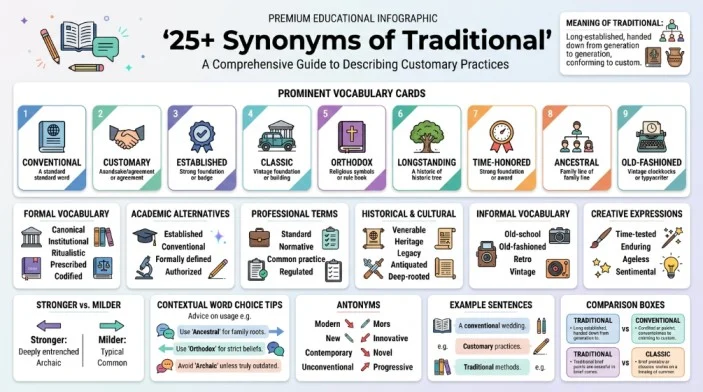
When you use the word traditional repeatedly in an essay, email, blog, caption, or school assignment, your writing can start to feel predictable. Finding the right synonym of traditional can make your message more precise while helping you describe customs, methods, beliefs, styles, and practices with the exact tone you intend.
The best alternative depends on what you mean. Conventional may fit a standard approach, customary can describe a usual practice, classic often works for an admired style, and time honored emphasizes something respected because it has lasted for generations. Choosing carefully makes your vocabulary more natural and expressive.
What Are the Best Synonyms of “Traditional”?
A synonym of traditional can describe something based on long established customs, beliefs, methods, or styles. The best alternatives include conventional, customary, established, classic, orthodox, longstanding, and old fashioned. Formal writing often favors established or conventional, while creative and cultural writing may benefit from heritage, ancestral, or time honored.
Meaning, Tone, and Context
Simple Definition
Traditional describes something connected with customs, beliefs, practices, methods, or styles that have been followed or passed down over a long period. It can also describe something that follows an accepted or familiar way of doing things.
For example, a traditional wedding may follow customs that have been practiced by a community for generations. A traditional teaching method may refer to an established approach rather than a newer or experimental one.
Part of Speech
Traditional is an adjective.
It modifies a noun by describing its connection with tradition, established customs, or familiar practices.
Overall Tone
The tone of traditional is generally neutral, although context can make it sound positive or negative.
In a cultural context, it can suggest heritage, continuity, identity, and respect for the past. In discussions about technology or business, it can sometimes suggest that something is conventional rather than innovative.
Formality Level
Traditional is a neutral word that works comfortably in formal, professional, academic, and everyday English.
It is common in phrases such as:
- traditional values
- traditional methods
- traditional clothing
- traditional food
- traditional music
- traditional medicine
- traditional education
- traditional beliefs
- traditional architecture
- traditional ceremonies
Common Uses
Native English speakers commonly use traditional when discussing:
- Cultural practices
- Family customs
- Religious ceremonies
- Food and cooking
- Clothing
- Art and music
- Architecture
- Education
- Business practices
- Social values
- Methods of production
- Celebrations
- Beliefs and customs
Word Forms
| Word | Part of Speech | Example |
|---|---|---|
| Traditional | Adjective | They prepared a traditional meal. |
| Tradition | Noun | The festival is an important tradition. |
| Traditionally | Adverb | The dish is traditionally served warm. |
The most useful related forms are tradition, traditional, and traditionally.
When and How to Use “Traditional”
Use traditional when you want to show that something follows customs, practices, methods, or styles that have been established over time. It is especially useful when the connection with the past matters.
Professional
“The company still uses a traditional approach to customer service.”
Here, traditional describes an established method rather than necessarily an outdated one.
Academic
“The study examines traditional teaching methods in elementary schools.”
This use is neutral and clearly identifies an established educational approach.
Workplace
“Some employees prefer traditional office arrangements.”
The word describes a familiar workplace structure without automatically judging it.
Personal
“My grandmother taught me how to prepare traditional family recipes.”
Here, traditional emphasizes family heritage and practices passed from one generation to another.
“We are considering both traditional and digital marketing strategies.”
This example uses traditional to contrast established methods with newer approaches.
Resume
“Experienced in traditional and digital project management techniques.”
In a resume, the word can help distinguish established methods from newer systems.
Social Media
“Celebrating the holiday with traditional food, music, and family traditions.”
The word works naturally in social media when discussing culture, celebrations, or heritage.
Best Synonyms of “Traditional”
No single synonym perfectly replaces traditional in every sentence. The best choice depends on whether you want to emphasize long history, common practice, accepted standards, cultural heritage, or resistance to change.
Professional Writing: Established
Established is useful when describing a method, process, system, or practice that has been accepted or used for a considerable period.
Example:
“The company relies on established quality control procedures.”
It sounds professional without suggesting that the method is old or outdated.
Academic Writing: Conventional
Conventional works well when comparing an accepted or familiar approach with a newer, alternative, or experimental approach.
Example:
“The researchers compared conventional treatment with an alternative method.”
It is especially useful when the contrast between established and innovative approaches matters.
Business Communication: Standard
Standard works when traditional means normal, accepted, or commonly expected.
Example:
“The company follows standard procedures for handling customer complaints.”
It focuses on accepted practice rather than cultural history.
Casual Conversation: Usual
Usual is a natural choice when traditional simply means something commonly done or expected.
Example:
“We had our usual family dinner on Sunday.”
It is less formal and more conversational.
Emotional Writing: Time Honored
Time honored emphasizes a practice or tradition that has survived for many years and is respected because of its history.
Example:
“The ceremony followed a time honored family tradition.”
This expression adds warmth and respect.
Creative Writing: Heritage
Heritage works when the focus is cultural history, identity, or inherited customs.
Example:
“The village proudly preserved its rich cultural heritage.”
It is not a direct replacement in every sentence because it is primarily a noun, but it can communicate the cultural idea behind traditional more effectively.
Resume Writing: Established
Established is usually more professional than traditional when describing proven processes or methods.
Example:
“Implemented established procedures to improve operational consistency.”
It suggests familiarity and reliability without sounding resistant to change.
Workplace Communication: Conventional
Conventional works when comparing familiar workplace practices with newer approaches.
Example:
“The team moved beyond conventional methods to improve efficiency.”
Stronger Meaning: Time Honored
Use time honored when you want to emphasize longevity and respect.
Example:
“The organization continues a time honored annual ceremony.”
Softer Meaning: Familiar
Familiar is useful when you want to describe something recognizable or well known without strongly emphasizing its historical roots.
Example:
“The restaurant combines familiar cooking techniques with modern presentation.”
When Not to Use “Traditional”
Although traditional is flexible, it can sometimes be too broad. A more precise word may communicate your meaning better.
When the Meaning Is Simply “Usual”
Less precise:
“We followed the traditional procedure.”
Better:
“We followed the usual procedure.”
Why:
If the procedure is simply what normally happens, usual is clearer. Traditional can imply a historical or cultural connection that may not exist.
When You Mean “Accepted Standard”
Less precise:
“The company uses a traditional reporting format.”
Better:
“The company uses a standard reporting format.”
Why:
Standard emphasizes an accepted format rather than one inherited from the past.
When You Mean “Long Established”
Less precise:
“The organization follows a traditional process.”
Better:
“The organization follows an established process.”
Why:
Established emphasizes that the process has been proven or accepted.
When You Mean “Old and No Longer Modern”
Less precise:
“They use a traditional computer system.”
Better:
“They use an outdated computer system.”
Why:
Traditional does not automatically mean obsolete. If the system is genuinely behind current standards, outdated is more accurate.
When You Mean “Not Innovative”
Less precise:
“The company has a traditional strategy.”
Better:
“The company has a conventional strategy.”
Why:
Conventional can clearly contrast with innovative or unconventional approaches.
When You Mean Cultural Heritage
Less precise:
“The museum protects traditional artifacts.”
Better:
“The museum protects heritage artifacts and cultural objects.”
Why:
The second version focuses more directly on historical and cultural inheritance.
Words Commonly Confused With “Traditional”
| Word | Difference | When to Use It | Example |
|---|---|---|---|
| Conventional | Describes an accepted or usual approach. | Comparing normal methods with alternatives. | “They chose a conventional solution.” |
| Customary | Describes something normally done because of custom or practice. | Social or cultural practices. | “It is customary to greet guests warmly.” |
| Classic | Describes something recognized as enduring, admired, or characteristic of a style. | Art, fashion, literature, design, food. | “She wore a classic black dress.” |
| Old fashioned | Suggests something associated with an earlier period and often implies that it is no longer modern. | Informal descriptions of styles or attitudes. | “His views seem old fashioned.” |
| Orthodox | Describes beliefs or practices that conform to accepted doctrine or established views. | Religion, academic thought, established systems. | “The treatment follows orthodox medical practice.” |
| Established | Describes something firmly accepted, recognized, or developed. | Business, professional, and academic writing. | “The company has an established procedure.” |
Best Synonyms of “Traditional” by Context
| Context | Best Synonym | Why It Works | Example |
|---|---|---|---|
| Formal writing | Established | Sounds precise and professional. | “The study examines established practices.” |
| Academic writing | Conventional | Clearly contrasts familiar and alternative methods. | “The conventional model has several limitations.” |
| Professional communication | Established | Suggests an accepted process. | “We use established quality standards.” |
| Business emails | Standard | Works well for normal procedures. | “Please follow the standard approval process.” |
| Resume writing | Established | Shows experience with proven systems. | “Managed established operational procedures.” |
| Workplace communication | Conventional | Useful when contrasting old and new approaches. | “The team replaced conventional methods.” |
| Casual conversation | Usual | Sounds natural and simple. | “We had our usual dinner.” |
| Everyday speaking | Familiar | Emphasizes recognition rather than history. | “The recipe uses familiar ingredients.” |
| Creative writing | Time honored | Adds a sense of history and respect. | “They followed a time honored ritual.” |
| Storytelling | Ancestral | Highlights inherited cultural practices. | “The family preserved its ancestral customs.” |
| Emotional writing | Time honored | Adds warmth and historical value. | “They honored a time honored tradition.” |
| Strong emphasis | Deep rooted | Highlights a strong connection with history or culture. | “The community has deep rooted customs.” |
| Mild tone | Familiar | Avoids suggesting strict adherence to tradition. | “The design uses familiar elements.” |
| Social media captions | Classic | Short, recognizable, and expressive. | “A classic family recipe for the holidays.” |
| American English | Traditional | Natural and widely understood. | “We prepared a traditional holiday meal.” |
| British English | Traditional | The word has the same core meaning and is widely used. | “They serve a traditional Sunday meal.” |
How to Choose the Best Synonym of “Traditional”
The easiest way to choose the right alternative is to identify what aspect of traditional you actually want to communicate.
If You Mean “Passed Down Through Generations”
Choose ancestral, heritage, or time honored.
Example:
“Her family follows a time honored wedding custom.”
If You Mean “Commonly Accepted”
Choose conventional, standard, or established.
Example:
“The company uses an established process for evaluating applications.”
If You Mean “Normally Done”
Choose customary or usual.
Example:
“It is customary to exchange gifts during the celebration.”
If You Mean “Old but Still Respected”
Choose classic, time honored, or longstanding.
Example:
“The restaurant is known for its classic recipes.”
If You Mean “Old and No Longer Modern”
Choose old fashioned or outdated, depending on the meaning.
Example:
“Some of the equipment is outdated.”
If You Mean “Following Accepted Beliefs”
Choose orthodox.
Example:
“The scholar challenged the orthodox interpretation.”
If You Mean “Strongly Connected to Culture”
Choose heritage, ancestral, or deep rooted.
Example:
“The festival celebrates the region’s deep rooted cultural identity.”
Real Life Examples of “Traditional”
School
Original:
“The school uses traditional teaching methods.”
More precise:
“The school uses conventional teaching methods alongside digital resources.”
The revised version makes the contrast with newer methods clearer.
College
Original:
“Students studied traditional theories.”
Improved:
“Students studied established theories before examining newer interpretations.”
This version distinguishes accepted theories from newer ideas.
Workplace
Original:
“The company uses traditional management practices.”
Improved:
“The company relies on established management practices.”
The alternative sounds more neutral and professional.
Business
Original:
“We use traditional marketing methods.”
Improved:
“We use conventional marketing methods alongside digital campaigns.”
Here, conventional clearly identifies the established side of a comparison.
Original:
“We will use the traditional approval process.”
Improved:
“We will follow the standard approval process.”
Standard is more precise when referring to an official procedure.
Resume
Original:
“Experienced with traditional accounting methods.”
Improved:
“Experienced with established accounting procedures and modern financial software.”
The revised version provides more useful professional information.
Conversation
Original:
“We always eat traditional food during the holiday.”
Improved:
“We always prepare family recipes during the holiday.”
The alternative sounds warmer and more specific.
Storytelling
Original:
“The village followed traditional customs.”
Improved:
“The village preserved its ancestral customs.”
The revised wording gives the sentence stronger cultural meaning.
Blogging
Original:
“Traditional advertising still has value.”
Improved:
“Conventional advertising still has a place alongside digital marketing.”
The alternative creates a clearer contrast.
Social Media
Original:
“Making traditional food with my family today.”
Improved:
“Keeping our family traditions alive with a homemade meal.”
The revised caption feels more personal and expressive.
25 Best Synonyms of “Traditional”
| Synonym | Simple Meaning | Best Used For | Example Sentence |
|---|---|---|---|
| Conventional | Following an accepted or usual approach | Professional and academic writing | The company adopted a conventional business model. |
| Customary | Normally done because of custom | Culture and social practices | It is customary to greet guests before dinner. |
| Established | Accepted or developed over time | Business and professional writing | We followed the established procedure. |
| Classic | Enduring and widely recognized | Art, fashion, food, and design | She chose a classic style for the event. |
| Orthodox | Following accepted beliefs or practices | Religion and established thought | The scholar questioned the orthodox interpretation. |
| Longstanding | Existing for a long time | Organizations, relationships, practices | The club has a longstanding community tradition. |
| Time honored | Respected because it has lasted for generations | Culture and ceremonies | The family follows a time honored custom. |
| Old fashioned | Associated with an earlier period | Informal descriptions | His old fashioned manners surprised everyone. |
| Usual | Normally occurring or done | Everyday conversation | We ordered our usual meal. |
| Standard | Commonly accepted or expected | Procedures and business | Please use the standard format. |
| Familiar | Well known or recognizable | Everyday speech and writing | The recipe uses familiar cooking techniques. |
| Ancestral | Passed down from earlier generations | Culture and family history | They preserved their ancestral traditions. |
| Heritage | Connected with inherited cultural history | Culture and identity | The museum celebrates local heritage. |
| Deep rooted | Firmly established in culture or history | Social and cultural writing | The community has deep rooted customs. |
| Long established | Existing and accepted for a long period | Formal writing | The institution has a long established policy. |
| Conventionalized | Made to follow an accepted pattern | Academic and specialized writing | The symbols became conventionalized over time. |
| Custom based | Built around established customs | Cultural explanation | The ceremony follows a custom based structure. |
| Ceremonial | Connected with formal established rituals | Events and traditions | The leader wore ceremonial clothing. |
| Ritualistic | Characterized by repeated rituals | Cultural and descriptive writing | The practice has a strongly ritualistic character. |
| Conservative | Favoring established practices over rapid change | Social, political, and business contexts | The organization takes a conservative approach to change. |
| Canonical | Accepted as an authoritative example within a tradition | Literature, religion, and academic fields | The course examines canonical works of literature. |
| Received | Accepted from an established tradition or authority | Formal and academic contexts | The theory challenges received ideas about language. |
| Conventionalized | Shaped into a recognized conventional form | Specialized academic contexts | The gesture became conventionalized within the culture. |
| Time tested | Proven through long use or experience | Methods and systems | The company relies on a time tested process. |
| Traditionalist | Favoring or supporting traditional practices | People, movements, and viewpoints | The traditionalist group opposed the proposed changes. |
Usage note: Some entries above, such as heritage, ceremonial, ritualistic, canonical, received, and traditionalist, are context dependent rather than interchangeable with traditional in every sentence. They are useful alternatives only when their specific meaning matches the intended context.
Synonyms of “Traditional” by Usage
Professional vs Personal Synonyms
Professional writing usually benefits from precise words such as established, conventional, standard, and longstanding.
For personal or cultural writing, ancestral, time honored, familiar, classic, and heritage can provide more warmth and context.
Compare:
“She uses a traditional business process.”
“She uses an established business process.”
The second sentence sounds more specific because it emphasizes an accepted process rather than cultural tradition.
Formal vs Conversational Synonyms
For reports and academic essays, choose conventional, established, orthodox, or longstanding when their meanings fit.
For casual conversations and texting, usual, familiar, classic, or old fashioned may sound more natural.
A business email might say:
“We will follow the standard procedure.”
A casual conversation might say:
“We’ll do it the usual way.”
Academic Synonyms
Academic writing often needs a distinction between established ideas and newer approaches.
Useful choices include:
- Conventional, for accepted methods
- Established, for recognized knowledge or practices
- Orthodox, for accepted beliefs or interpretations
- Canonical, for authoritative works or texts
- Received, for ideas accepted from an established intellectual tradition
Example:
“The researchers challenged the conventional explanation of the phenomenon.”
This is more informative than simply saying:
“The researchers challenged the traditional explanation.”
Professional and Business Synonyms
For resumes, interviews, meetings, presentations, performance reviews, client communication, and business emails, established, standard, conventional, longstanding, and conservative can be useful.
- Use established when you want to emphasize proven procedures.
- Use standard when referring to official or expected processes.
- Use conventional when contrasting familiar approaches with innovative ones.
- Use longstanding when describing relationships, practices, or policies that have existed for many years.
- Use conservative only when the intended meaning involves caution or a preference for limited change. It is not a universal synonym for traditional.
Creative and Literary Synonyms
Creative writing gives you more room to emphasize cultural memory, history, and emotion.
Useful choices include:
- Ancestral
- Time honored
- Heritage
- Deep rooted
- Classic
- Longstanding
For example:
“The family gathered beneath the old oak tree to honor their ancestral customs.”
This creates a stronger sense of history than the more general:
“The family followed their traditional customs.”
Slang or Modern Synonyms
There is no widely accepted slang word that directly means traditional in all contexts.
Informal speakers may use expressions such as old school to describe someone or something that follows older styles, methods, or attitudes.
Old School
Meaning:
An informal expression for something associated with an earlier style, method, or generation.
Acceptable in:
Casual conversation, social media, informal blogs, and friendly discussions.
Avoid in:
Academic papers, formal reports, resumes, and official business documents.
Example:
“My dad still prefers the old school way of doing things.”
For formal writing, traditional, conventional, or established is usually more appropriate.
Strongest to Mildest Synonyms
There is no universal strength scale for traditional because the alternatives emphasize different aspects of tradition. However, they can be grouped according to how strongly they highlight continuity or adherence to established practices.
Mild
- Familiar
- Usual
- Standard
- Classic
These words can describe recognizable or common practices without strongly emphasizing history.
Moderate
- Conventional
- Customary
- Established
- Longstanding
These alternatives more clearly suggest accepted or repeated practices.
Strong
- Time honored
- Ancestral
- Deep rooted
- Orthodox
These words emphasize history, cultural continuity, or adherence to established beliefs.
Very Strong or Highly Specific
- Canonical
- Received
- Traditionalist
These words have narrower meanings and should be selected only when the context supports them.
Emotional vs Neutral Synonyms
Emotional Synonyms
These words can create stronger feelings about heritage, memory, identity, or continuity:
- Time honored
- Ancestral
- Heritage
- Deep rooted
- Classic
Example:
“The community gathered to celebrate its deep rooted cultural traditions.”
This feels more emotional than:
“The community followed its established practices.”
Neutral Synonyms
These alternatives communicate information with less emotional emphasis:
- Conventional
- Established
- Standard
- Customary
- Usual
- Longstanding
Example:
“The company uses an established procedure for reviewing applications.”
Neutral vocabulary is generally better for reports, instructions, business communication, and academic writing.
Antonyms of “Traditional”
| Antonym | Meaning | Example Sentence |
|---|---|---|
| Modern | Reflecting current styles or conditions | The restaurant has a modern interior. |
| Contemporary | Existing or occurring in the present period | The gallery features contemporary art. |
| Innovative | Introducing new ideas or methods | The company developed an innovative solution. |
| New | Recently created, introduced, or discovered | The team tested a new approach. |
| Unconventional | Different from usual accepted practice | She took an unconventional approach to the problem. |
| Unorthodox | Not following accepted beliefs or practices | The researcher proposed an unorthodox theory. |
| Progressive | Favoring new ideas and change | The organization adopted progressive policies. |
| Experimental | Based on testing new ideas or methods | The designers used an experimental technique. |
| Avant garde | Highly innovative and ahead of established styles | The museum displayed avant garde artwork. |
| Cutting edge | Extremely advanced or innovative | The laboratory uses cutting edge technology. |
| Radical | Fundamentally different from established approaches | The proposal called for radical reform. |
| Original | New or independently created | The artist developed an original style. |
| Nontraditional | Not following established traditions | The school offers nontraditional learning options. |
| Modernist | Associated with modernist ideas or styles | The architect preferred a modernist design. |
| Novel | New, unusual, or previously unfamiliar | The researchers introduced a novel method. |
Comparison: “Traditional” vs Similar Words
Traditional vs Conventional
Main Difference
Traditional often connects something with customs or practices passed through time. Conventional focuses more on what is accepted, usual, or standard.
Which Is Stronger?
Neither is inherently stronger. They emphasize different qualities.
Which Is More Formal?
Both are suitable for formal writing, but conventional is especially useful in academic and professional comparisons.
When to Use Each
Use traditional for cultural practices and inherited customs. Use conventional for accepted methods or approaches.
Examples
Traditional:
“The festival includes traditional dances.”
Conventional:
“The researchers used a conventional testing method.”
Traditional vs Customary
Main Difference
Customary means something is normally done because of custom or established practice.
Which Is Stronger?
Neither is stronger.
Which Is More Formal?
Customary can sound slightly more formal in some contexts.
When to Use Each
Use customary when describing a repeated social practice. Use traditional when the connection with history or culture is more important.
Examples
Traditional:
“They prepared a traditional holiday meal.”
Customary:
“It is customary to exchange gifts during the celebration.”
Traditional vs Classic
Main Difference
Classic often means enduring, admired, or widely recognized as a strong example of a style. Traditional emphasizes established custom or practice.
Which Is Stronger?
Neither is stronger.
Which Is More Formal?
Both are flexible, although classic is particularly common in discussions of design, literature, fashion, food, and art.
When to Use Each
Use classic for enduring styles or examples. Use traditional for customs and practices.
Examples
Traditional:
“They serve traditional dishes during the festival.”
Classic:
“The restaurant is famous for its classic burger.”
Traditional vs Old Fashioned
Main Difference
Traditional can be neutral or positive. Old fashioned often suggests that something belongs to an earlier period and may imply that it is no longer modern.
Which Is Stronger?
Old fashioned can carry a stronger judgment.
Which Is More Formal?
Traditional is more suitable for formal writing.
When to Use Each
Use traditional when you want to remain neutral. Use old fashioned when the older style itself is relevant.
Examples
Traditional:
“The ceremony follows traditional customs.”
Old fashioned:
“Some people consider the rule old fashioned.”
Traditional vs Established
Main Difference
Established means accepted, recognized, or firmly developed. Traditional adds a stronger connection with custom or long term practice.
Which Is Stronger?
Neither is stronger.
Which Is More Formal?
Established is particularly useful in professional and academic writing.
When to Use Each
Use established for procedures, systems, and accepted ideas. Use traditional when heritage or custom matters.
Examples
Traditional:
“The community protects its traditional crafts.”
Established:
“The company follows established safety procedures.”
Traditional vs Orthodox
Main Difference
Orthodox means conforming to accepted beliefs, doctrines, or established views. It is more specialized than traditional.
Which Is Stronger?
Orthodox can sound more specific because it implies conformity to an accepted doctrine or viewpoint.
Which Is More Formal?
Orthodox is common in academic, religious, and specialized discussions.
When to Use Each
Use traditional for broad cultural practices. Use orthodox when established beliefs or doctrines are central.
Examples
Traditional:
“The community follows traditional religious customs.”
Orthodox:
“The scholar defended the orthodox interpretation.”
Common Phrases and Expressions with “Traditional”
Traditional Values
Meaning:
Beliefs or principles associated with established social or cultural practices.
Example:
“The organization emphasizes traditional values such as responsibility and community service.”
Traditional Methods
Meaning:
Established ways of completing a task.
Example:
“The farmers still use traditional methods of cultivation.”
Traditional Culture
Meaning:
Customs, beliefs, arts, and practices associated with a particular community or heritage.
Example:
“The festival celebrates the region’s traditional culture.”
Traditional Food
Meaning:
Food associated with the customs or history of a particular culture or region.
Example:
“We prepared traditional food for the holiday celebration.”
Traditional Approach
Meaning:
A familiar or established way of dealing with a situation.
Example:
“The company moved away from its traditional approach to advertising.”
Traditional Role
Meaning:
A role based on established social expectations or customs.
Example:
“The discussion examined traditional roles within the family.”
Traditional Style
Meaning:
A design or appearance based on established characteristics.
Example:
“The house combines a traditional style with modern features.”
Traditional Practice
Meaning:
An activity or method that has been followed as part of an established custom.
Example:
“The ceremony includes several traditional practices.”
Common Mistakes to Avoid
1. Treating Every Synonym as Identical
Incorrect:
“The company uses a customary software system.”
Better:
“The company uses a conventional software system.”
Why:
Customary usually relates to practices that people normally follow, while conventional is more natural for accepted systems or approaches.
2. Using “Traditional” When You Mean “Outdated”
Incorrect:
“The company’s traditional software is no longer compatible.”
Better:
“The company’s outdated software is no longer compatible.”
Why:
Traditional does not necessarily mean obsolete. Something can be traditional and still effective.
3. Using Informal Vocabulary in Formal Writing
Incorrect:
“The researchers studied the old school method.”
Better:
“The researchers studied the conventional method.”
Why:
Old school is informal and may sound inappropriate in an academic paper.
4. Using “Classic” for Every Traditional Practice
Incorrect:
“The community follows a classic marriage ceremony.”
Better:
“The community follows a traditional marriage ceremony.”
Why:
Classic usually describes an enduring or admired style, while traditional better expresses cultural custom.
5. Confusing “Conservative” With “Traditional”
Incorrect:
“The traditional design uses dark colors.”
Better:
“The conventional design uses dark colors.”
Why:
Conservative can describe cautious attitudes or limited change, but it is not a general synonym for traditional.
6. Choosing a Word That Is Too Specific
Incorrect:
“The company uses an ancestral management system.”
Better:
“The company uses an established management system.”
Why:
Ancestral is strongly associated with family or generational inheritance. It is not suitable for every old or established business practice.
7. Assuming “Traditional” Always Has a Positive Meaning
Incorrect:
“The traditional system is automatically better.”
Better:
“The traditional system remains widely used, although newer alternatives are available.”
Why:
Traditional describes a connection with established practice. It does not automatically mean better, worse, more effective, or more valuable.
Frequently Asked Questions
1. What is the best synonym of “traditional”?
The best synonym of traditional depends on context. Conventional fits accepted methods, customary suits social practices, established works professionally, and classic often describes enduring styles, designs, or cultural products.
2. What are the best formal synonyms of “traditional”?
The best formal alternatives include conventional, established, longstanding, orthodox, customary, and canonical. Choose according to meaning because these words emphasize accepted methods, duration, custom, belief, or authoritative tradition.
3. What are common informal synonyms of “traditional”?
Common informal alternatives include usual, familiar, old fashioned, and old school, although they are not interchangeable in every context. Usual describes normal practice, while old school emphasizes an earlier style or approach.
4. What is another word for “traditional” in professional writing?
Established is often an excellent professional alternative to traditional. Conventional works well when contrasting standard methods with innovative ones, while standard is better when referring to an accepted procedure or format.
5. What is the difference between “traditional” and “conventional”?
Traditional usually emphasizes customs, history, or practices passed down over time. Conventional focuses on what is accepted, normal, or standard. A traditional ceremony has historical roots, while a conventional method is simply widely accepted.
6. What is the opposite of “traditional”?
Common opposites include modern, contemporary, innovative, unconventional, unorthodox, progressive, experimental, and nontraditional. The best antonym depends on whether you mean new, advanced, unusual, innovative, or resistant to established practices.
Conclusion
The word traditional describes customs, methods, beliefs, styles, and practices connected with established ways of doing things. However, the best synonym of traditional depends on the exact meaning you want to communicate.
Use conventional for accepted approaches, customary for established social practices, established for professional processes, classic for enduring styles, time honored for respected traditions, and ancestral when something has been inherited across generations.
No alternative works perfectly in every sentence. Before replacing traditional, consider the audience, context, tone, and specific idea you want to express. A useful vocabulary habit is to identify the precise quality behind a word, such as history, custom, familiarity, or acceptance, and then choose the synonym that communicates that quality most clearly.
Read More Related Articles:
Synonyms for Creativity | Meaning, Examples, and Better …
Synonyms for Pros and Cons | Meaning, Examples, and Better …