You finish an email, essay, caption, or blog post and notice that you have described something as bland more than once. Finding the right synonym of bland can make the difference between a vague description and one that clearly communicates what is missing, whether that means flavor, excitement, personality, or originality.
The best alternative depends on context. Food may be flavorless or insipid, while writing can be uninspired, dull, or lifeless. A person may seem colorless or uninteresting, and a design may look generic or nondescript. Choosing a precise word gives readers a clearer picture of what you mean.
What Is the Best Synonym of “Bland”?
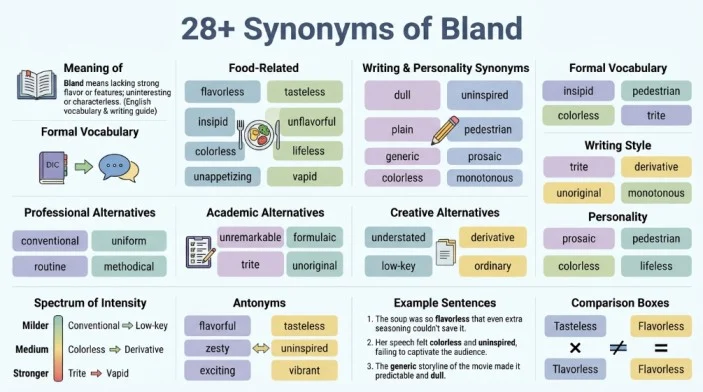
Bland usually describes something that lacks strong flavor, excitement, character, or distinctive qualities. The best alternatives include flavorless for food, insipid for weak flavor or ideas, dull for writing or experiences, uninspired for creative work, and generic for something lacking individuality.
For a quick choice, use flavorless when discussing food, dull for boring content, colorless for personality or style, and uninspired for weak creative work.
Meaning, Tone, and Context
Simple Definition
Bland describes something that lacks a strong, interesting, distinctive, or stimulating quality.
The word is especially common when talking about food that has little flavor. It can also describe writing, conversation, personality, design, experiences, opinions, or other things that feel dull or lacking in character.
For example:
“The soup was bland because it needed more seasoning.”
In another context:
“The article was informative but bland.”
The first sentence refers to taste. The second describes writing that fails to create interest or personality.
Part of Speech
Bland is an adjective.
It modifies nouns to describe a lack of flavor, excitement, character, or distinctiveness.
Examples:
“The sauce tastes bland.”
“The presentation felt bland.”
“He has a bland personality.”
Overall Tone
Bland usually has a negative or mildly critical tone.
When describing food, it suggests that the taste is weak or uninteresting. When describing writing, people, or experiences, it can suggest a lack of energy, originality, emotion, or personality.
The criticism is often relatively mild, but its strength depends on context.
Formality Level
Bland is a neutral English word. It works in casual conversations, professional writing, reviews, essays, blogs, and everyday communication.
Some alternatives are more formal:
Anodyne, insipid, and lackluster can sound more sophisticated depending on the sentence.
Other alternatives are more conversational:
Boring, plain, and dull are common in everyday speech.
Common Uses
Native English speakers commonly use bland to describe:
- Food
- Drinks
- Sauces
- Meals
- Writing
- Stories
- Presentations
- Conversations
- Personalities
- Opinions
- Designs
- Advertising
- Experiences
- Descriptions
- Visual styles
Word Forms
| Word | Part of Speech | Example |
|---|---|---|
| Bland | Adjective | The soup tastes bland. |
| Blandness | Noun | The blandness of the meal was disappointing. |
| Blandly | Adverb | He answered blandly without showing much interest. |
When and How to Use “Bland”
Use bland when something feels noticeably lacking in flavor, excitement, personality, emotion, or distinctive qualities.
The word is flexible, but the intended meaning should be clear from context.
Professional
“The presentation was accurate, but the delivery felt bland.”
Here, bland means the presentation lacked energy or engaging qualities.
Academic
“The essay presents useful information, but some sections are bland and repetitive.”
In academic criticism, the word can describe writing that communicates information without much originality or engagement.
Workplace
“The training materials were helpful but somewhat bland.”
This suggests that the materials were useful but not engaging or memorable.
Personal
“The soup tasted bland, so I added some herbs and spices.”
Here, the meaning is directly related to flavor.
“The first draft sounds a little bland and could use a stronger opening.”
In this context, bland means the writing lacks energy or personality.
Resume
“A bland resume can make strong qualifications less memorable.”
Here, the word describes a resume that looks generic or fails to communicate a candidate’s distinctive strengths.
Social Media
“The caption feels bland compared with the rest of the campaign.”
This means the caption lacks personality, creativity, or impact.
Best Synonyms of “Bland”
No single synonym works perfectly in every situation because bland has several related meanings. A word that accurately replaces it when describing food may sound unnatural when describing a personality or a piece of writing.
Professional Writing: Lackluster
Lackluster is useful when professional content, performance, results, or presentation is disappointing because it lacks energy or impact.
Example:
“The campaign delivered lackluster results.”
It works especially well in business reviews and professional criticism.
Academic Writing: Insipid
Insipid can describe writing, discussion, ideas, or arguments that lack interest or stimulating quality. It can also describe food with little flavor.
Example:
“The discussion became insipid after the initial debate.”
Use it carefully because it can sound more strongly critical than bland.
Business Communication: Generic
Generic works when something lacks individuality or distinctive qualities.
Example:
“The proposal feels generic and does not clearly communicate our competitive advantage.”
It is particularly useful for branding, marketing, presentations, and business writing.
Casual Conversation: Dull
Dull is one of the most natural alternatives in everyday English.
Example:
“The movie was dull.”
It can describe food, writing, conversations, people, weather, and experiences, although the exact meaning changes by context.
Emotional Writing: Colorless
Colorless can describe a personality, life, description, or writing style that lacks emotional richness or character.
Example:
“The character seemed colorless compared with the others.”
It creates a more expressive contrast than the basic word bland.
Creative Writing: Uninspired
Uninspired is especially useful for creative work that lacks fresh ideas, imagination, or energy.
Example:
“The final scene felt uninspired.”
It is a strong choice when reviewing stories, designs, writing, artwork, or performances.
Resume Writing: Generic
For resume discussions, generic is often more useful than bland because it identifies a lack of individuality.
Example:
“Avoid generic descriptions that do not show what makes your experience distinctive.”
Workplace Communication: Lackluster
Lackluster works well when describing weak performance, engagement, results, or presentations.
Example:
“The team’s lackluster response suggested that the proposal needed revision.”
Stronger Meaning: Insipid
When you want to criticize something more strongly for being dull, weak, or lacking stimulation, insipid can work.
Example:
“The review was criticized as insipid and repetitive.”
Softer Meaning: Plain
Plain is often a gentler alternative when something is simple or lacking strong qualities without necessarily being poor.
Example:
“The meal was plain but comforting.”
This distinction is important because plain does not always carry the negative judgment that bland can carry.
When Not to Use “Bland”
When You Mean “Without Flavor” but Need Precision
Bland is acceptable for food, but flavorless is more precise when the food has almost no detectable flavor.
Less precise:
“The sauce was bland.”
More specific:
“The sauce was nearly flavorless.”
Use flavorless when the absence of flavor is the main point.
When You Mean “Boring”
If something fails to hold attention, boring or dull may communicate the idea more directly.
Less effective:
“The lecture was bland.”
Better:
“The lecture was dull.”
Dull makes the lack of interest clearer.
When You Mean “Lacking Originality”
If a design or idea resembles many others, generic is usually more accurate.
Less effective:
“The logo looks bland.”
Better:
“The logo looks generic.”
The second sentence specifically identifies a lack of distinctiveness.
When You Mean “Lacking Creativity”
For creative work, uninspired may be more precise.
Less effective:
“The article was bland.”
Better:
“The article felt uninspired.”
The revised sentence focuses on the quality of the ideas and presentation.
When You Need a More Formal Critical Term
In analytical writing, anodyne, insipid, or lackluster may sometimes be more precise.
Less effective:
“The commentary was bland.”
Better:
“The commentary was anodyne and offered little new insight.”
When “Plain” Is Actually Neutral
Do not automatically replace plain with bland.
A plain meal may be simple but pleasant. A bland meal is generally considered lacking in flavor.
“She prepared a plain rice dish.”
This does not necessarily mean the rice tasted bad.
Words Commonly Confused With “Bland”
Dull
Difference: Dull generally means lacking interest, excitement, brightness, or sharpness.
When to Use It: Use it for movies, conversations, lectures, writing, experiences, and sometimes colors or surfaces.
Example:
“The meeting became dull after the main discussion ended.”
Tasteless
Difference: Tasteless can mean lacking flavor, but it can also mean offensive or lacking good judgment, especially when discussing behavior, jokes, or art.
When to Use It: Use it for food when flavor is weak, but remember its second meaning.
Example:
“The vegetables were tasteless without the sauce.”
Insipid
Difference: Insipid suggests a stronger lack of flavor, interest, energy, or stimulating quality.
When to Use It: Use it in more sophisticated criticism of food, writing, ideas, or conversation.
Example:
“The novel’s dialogue was insipid and predictable.”
Boring
Difference: Boring directly means causing someone to lose interest.
When to Use It: Use it for activities, stories, movies, conversations, classes, and experiences.
Example:
“The documentary was informative but boring.”
Plain
Difference: Plain often means simple, ordinary, or undecorated. It is not always negative.
When to Use It: Use it for food, clothing, design, appearance, and language when simplicity is the focus.
Example:
“She wore a plain white shirt.”
Flavorless
Difference: Flavorless specifically means lacking noticeable flavor.
When to Use It: Use it primarily for food and drinks.
Example:
“The broth was flavorless until we added vegetables and herbs.”
Best Synonyms of “Bland” by Context
| Context | Best Synonym | Why It Works | Example |
|---|---|---|---|
| Formal writing | Insipid | Gives precise critical emphasis | The commentary was insipid. |
| Academic writing | Dull | Clearly describes weak engagement | The lecture became dull. |
| Professional communication | Lackluster | Highlights weak impact or performance | The campaign produced lackluster results. |
| Business emails | Generic | Identifies a lack of individuality | The proposal sounds generic. |
| Resume writing | Generic | Describes overly common wording | The summary feels generic. |
| Workplace communication | Lackluster | Works for weak performance or engagement | The response was lackluster. |
| Casual conversation | Dull | Natural and familiar | The movie was dull. |
| Everyday speaking | Boring | Direct and widely understood | The class was boring. |
| Creative writing | Uninspired | Focuses on weak creativity | The ending felt uninspired. |
| Storytelling | Lifeless | Suggests a lack of energy or emotion | The dialogue felt lifeless. |
| Emotional writing | Colorless | Suggests weak emotional character | His description seemed colorless. |
| Strong emphasis | Insipid | Strongly criticizes lack of interest | The review was insipid. |
| Mild tone | Plain | Can describe simplicity without harsh criticism | The meal was plain. |
| Social media captions | Generic | Highlights lack of personality | The caption sounds generic. |
| American English | Bland | Common and natural across contexts | The soup tastes bland. |
| British English | Bland | Also standard and widely understood | The food was bland. |
How to Choose the Best Synonym of “Bland”
Choosing the right alternative starts with identifying what feels lacking.
If Food Lacks Flavor
Choose:
Flavorless, tasteless, insipid, or unseasoned.
Example:
“The chicken was unseasoned.”
This is more specific than simply saying the chicken was bland.
If Writing Lacks Interest
Choose:
Dull, boring, lifeless, or uninspired.
Example:
“The introduction was dull and failed to capture attention.”
If Something Lacks Originality
Choose:
Generic, ordinary, characterless, or nondescript.
Example:
“The branding looks generic.”
If a Person Lacks Personality
Choose:
Colorless, dull, uninteresting, or characterless.
Example:
“The character came across as colorless.”
If You Want a Stronger Criticism
Choose:
Insipid, vapid, lifeless, or uninspired, depending on context.
If You Want a Softer Description
Choose:
Plain, simple, or ordinary.
These words can describe something without sounding unnecessarily harsh.
Consider Your Audience
For children or English learners, plain, dull, and boring are easy to understand.
For academic or professional audiences, uninspired, lackluster, generic, and insipid can provide more precise distinctions when appropriate.
Consider Emotional Strength
- If you want a neutral observation, use plain.
- If you want clear criticism, use dull.
- If you want stronger criticism, use insipid or vapid, depending on the subject.
Consider Natural Usage
Do not choose a synonym simply because it sounds sophisticated. A word is useful only when it accurately expresses the intended meaning.
For example, flavorless is better than uninspired when describing soup because it specifically addresses taste.
Real Life Examples of “Bland”
School
Original:
“The essay was bland.”
Improved:
“The essay was informative but uninspired, with few original ideas.”
College
Original:
“The presentation was bland.”
Improved:
“The presentation was dull because it relied heavily on text and lacked engaging examples.”
Workplace
Original:
“The training session was bland.”
Improved:
“The training session felt lifeless because there was little interaction.”
Business
Original:
“The marketing campaign was bland.”
Improved:
“The marketing campaign felt generic and failed to distinguish the brand.”
Original:
“The email sounds bland.”
Improved:
“The email sounds flat, so adding a more engaging opening could make it more effective.”
Resume
Original:
“The resume is bland.”
Improved:
“The resume feels generic because it lists responsibilities without highlighting measurable achievements.”
Conversation
Original:
“The conversation was bland.”
Improved:
“The conversation felt dull because neither person introduced a new topic.”
Storytelling
Original:
“The story was bland.”
Improved:
“The story felt lifeless because the characters showed little emotion.”
Blogging
Original:
“The article sounds bland.”
Improved:
“The article feels uninspired because the examples are predictable.”
Social Media
Original:
“The caption is bland.”
Improved:
“The caption feels generic, so a more personal detail could make it memorable.”
25 Best Synonyms of “Bland”
| Synonym | Simple Meaning | Best Used For | Example Sentence |
|---|---|---|---|
| Flavorless | Having little or no flavor | Food | The soup was flavorless without seasoning. |
| Tasteless | Lacking noticeable taste | Food | The rice tasted tasteless on its own. |
| Insipid | Lacking flavor, interest, or energy | Food, writing, ideas | The commentary felt insipid and repetitive. |
| Unseasoned | Not given enough seasoning | Food | The vegetables were completely unseasoned. |
| Dull | Lacking interest or excitement | Writing, experiences | The lecture became dull after an hour. |
| Boring | Failing to hold attention | Conversation, entertainment | The movie was boring from the beginning. |
| Uninspired | Lacking creativity or fresh ideas | Writing, art, design | The campaign looked uninspired. |
| Lifeless | Lacking energy, emotion, or vitality | Writing, performance, design | The dialogue sounded lifeless. |
| Colorless | Lacking character, emotion, or variety | Personality, writing | His description was colorless. |
| Lackluster | Disappointing because of weak energy or impact | Performance, results | The team delivered a lackluster performance. |
| Generic | Lacking individuality or originality | Branding, writing, design | The website looked generic. |
| Ordinary | Not unusual or distinctive | Experiences, objects | The meal was pleasant but ordinary. |
| Characterless | Lacking a distinctive personality or identity | People, places, writing | The building felt characterless. |
| Uninteresting | Not attracting attention or curiosity | Ideas, conversations | The discussion became uninteresting. |
| Tame | Lacking excitement or intensity | Entertainment, events | The concert felt tame compared with last year. |
| Vanilla | Plain, conventional, or lacking distinctive qualities | Ideas, designs, experiences | The design felt a little vanilla. |
| Mundane | Ordinary and lacking excitement | Routines, experiences, writing | The story focused on mundane details. |
| Pedestrian | Ordinary and unimaginative | Writing, ideas, style | The article offered a pedestrian analysis. |
| Anodyne | Inoffensive but lacking strong character or impact | Commentary, writing | The statement was safe but anodyne. |
| Vapid | Lacking intelligence, liveliness, or substance | Conversation, writing, ideas | The interview contained several vapid comments. |
| Spiritless | Lacking enthusiasm or energy | People, performances, writing | The speech sounded spiritless. |
| Nondescript | Lacking distinctive features | Appearance, places, design | The building had a nondescript exterior. |
| Flat | Lacking flavor, energy, or emotional effect | Food, writing, performance | The dialogue felt flat. |
| Unremarkable | Not especially interesting or distinctive | Events, objects, experiences | It was an unremarkable afternoon. |
| Plain | Simple and lacking strong qualities | Food, appearance, design | The meal was plain but satisfying. |
Synonyms of “Bland” by Usage
Professional vs Personal Synonyms
Professional settings often require precise descriptions. Lackluster, generic, uninspired, and unremarkable can explain weaknesses without sounding excessively emotional.
Personal conversations allow simpler choices such as dull, boring, plain, or bland.
For example:
Professional:
“The proposal appears generic and needs stronger differentiation.”
Personal:
“The movie was pretty boring.”
The first sounds analytical. The second sounds natural in casual speech.
Formal vs Conversational Synonyms
Use insipid, anodyne, lackluster, and pedestrian carefully in formal writing when they accurately describe the problem.
Use boring, dull, plain, and bland in everyday communication.
For texting, simple phrases are usually more natural:
“The movie was kind of boring.”
There is no need to replace every familiar word with a sophisticated synonym.
Academic Synonyms
Academic writing benefits from precise criticism.
Useful alternatives include:
Insipid: for writing or discussion that lacks intellectual stimulation.
Pedestrian: for ideas that are ordinary or unimaginative.
Unremarkable: for results or observations that do not stand out.
Dull: for material that fails to engage readers.
Example:
“Although the paper provides useful background information, its analysis remains pedestrian.”
This is more specific than simply calling the paper bland.
Professional and Business Synonyms
Resumes
Use generic when criticizing vague resume language.
“Avoid generic statements that do not demonstrate measurable achievements.”
Interviews
Use unremarkable when discussing an answer that fails to stand out.
“The response was accurate but unremarkable.”
Meetings
Use dull when a meeting lacks engagement.
“The discussion became dull after the presentation.”
Presentations
Use lifeless or uninspired when delivery lacks energy.
“The presentation felt uninspired despite strong research.”
Performance Reviews
Use lackluster when describing disappointing performance.
“The quarter produced lackluster results.”
Client Communication
Use generic when messaging does not reflect the client’s specific needs.
“The proposal feels generic and should address the client’s priorities more directly.”
Business Emails
Use flat or generic when the message lacks personality or impact.
“The email sounds flat and could benefit from a more confident opening.”
Creative and Literary Synonyms
Creative writing often needs words that distinguish between different kinds of weakness.
Lifeless suggests a lack of energy or emotion.
Colorless suggests a lack of personality or vividness.
Uninspired suggests weak imagination or originality.
Pedestrian suggests conventional or unimaginative ideas.
Vapid suggests a lack of substance or intellectual energy.
Example:
“The setting was beautifully described, but the dialogue remained lifeless.”
This tells the reader exactly what part of the writing needs improvement.
Slang or Modern Synonyms
There is no single slang word that perfectly replaces bland across all contexts.
However, vanilla is a common informal expression for something conventional, predictable, or lacking distinctive qualities.
Example:
“The design feels a little vanilla.”
Vanilla works well in casual conversation, marketing discussions, social media, and informal reviews.
Avoid it in formal academic writing unless the context specifically calls for informal language.
Strongest to Mildest Synonyms
The intensity of a synonym depends heavily on context, but a useful general scale is:
Mild
Plain, ordinary, unremarkable
These words may describe something without strongly criticizing it.
“The meal was plain.”
Moderate
Bland, dull, generic, tame
These words more clearly suggest that something lacks interest, flavor, or character.
“The presentation was dull.”
Strong
Uninspired, lifeless, lackluster, pedestrian
These choices communicate a clearer criticism of quality or impact.
“The campaign was uninspired.”
Very Strong
Insipid, vapid
These words can sound sharply critical, especially when used for ideas, writing, conversation, or intellectual content.
“The discussion was vapid and offered little substance.”
Intensity should always match the situation. Calling a mildly plain meal vapid would sound unnatural because vapid is usually better suited to ideas, conversation, writing, or personality.
Emotional vs Neutral Synonyms
Emotional Synonyms
These alternatives can communicate a stronger judgment:
- Insipid
- Vapid
- Lifeless
- Uninspired
- Spiritless
- Pedestrian
Example:
“The speech was lifeless.”
The speaker is not merely describing the speech. They are clearly criticizing its energy.
Neutral Synonyms
These alternatives can communicate a more measured observation:
- Plain
- Ordinary
- Unremarkable
- Generic
- Nondescript
- Flavorless
Example:
“The design was generic.”
This gives a specific criticism without making the judgment overly dramatic.
Antonyms of “Bland”
Because bland has several meanings, its opposites depend on whether you are discussing flavor, excitement, personality, or distinctiveness.
| Antonym | Meaning | Example Sentence |
|---|---|---|
| Flavorful | Full of noticeable flavor | The stew was rich and flavorful. |
| Tasty | Pleasant to eat | The homemade bread was surprisingly tasty. |
| Delicious | Very enjoyable in flavor | The dessert was delicious. |
| Spicy | Having a strong spicy flavor | The curry was hot and spicy. |
| Savory | Rich and pleasantly flavorful | The soup had a deep savory taste. |
| Vibrant | Full of energy or vivid qualities | The restaurant had a vibrant atmosphere. |
| Exciting | Creating strong interest or enthusiasm | The final scene was exciting. |
| Interesting | Holding attention or curiosity | The speaker presented an interesting idea. |
| Engaging | Successfully attracting and maintaining attention | Her presentation was engaging. |
| Lively | Full of energy and activity | The discussion became lively. |
| Colorful | Rich in variety, character, or expression | The story contains colorful characters. |
| Distinctive | Clearly different from others | The brand has a distinctive visual style. |
| Stimulating | Encouraging thought or interest | The lecture was intellectually stimulating. |
| Dynamic | Energetic and constantly active | The team has a dynamic working environment. |
| Compelling | Extremely interesting or persuasive | The documentary presented a compelling argument. |
Comparison: “Bland” vs Similar Words
Bland vs Dull
Main Difference
Bland can describe a lack of flavor, character, or excitement. Dull more strongly focuses on a lack of interest, energy, brightness, or stimulation.
Which Is Stronger?
Dull often sounds stronger when criticizing entertainment or conversation.
Which Is More Formal?
Both are neutral. Dull is extremely common in both everyday and formal English.
When to Use Each
Use bland for food and things lacking distinctive qualities. Use dull for experiences, writing, conversations, and entertainment.
Examples
Bland:
“The soup was bland.”
Dull:
“The lecture was dull.”
Bland vs Flavorless
Main Difference
Flavorless specifically means that something has little or no flavor. Bland can describe flavor but has many broader meanings.
Which Is Stronger?
Flavorless is more precise about taste.
Which Is More Formal?
Both are neutral.
When to Use Each
Use flavorless when taste is the only issue.
Examples
Bland:
“The sauce was bland.”
Flavorless:
“The broth was almost flavorless.”
Bland vs Insipid
Main Difference
Insipid can mean lacking flavor, interest, energy, or intellectual stimulation. It often sounds more critical than bland.
Which Is Stronger?
Insipid is generally stronger.
Which Is More Formal?
Insipid is more literary or formal in many contexts.
When to Use Each
Use bland for everyday descriptions. Use insipid when a stronger or more sophisticated criticism is appropriate.
Examples
Bland:
“The meal tasted bland.”
Insipid:
“The commentary was insipid.”
Bland vs Boring
Main Difference
Boring specifically describes something that causes a lack of interest. Bland can describe a lack of flavor or character without necessarily being boring.
Which Is Stronger?
Boring is more direct when discussing entertainment.
Which Is More Formal?
Bland can sound slightly more measured.
When to Use Each
Use boring for movies, activities, conversations, and experiences. Use bland when the problem is broader or less direct.
Examples
Bland:
“The presentation felt bland.”
Boring:
“The presentation was boring.”
Bland vs Plain
Main Difference
Plain often means simple or undecorated, while bland usually suggests that something lacks flavor or stimulating qualities.
Which Is Stronger?
Bland is generally more negative.
Which Is More Formal?
Both are neutral.
When to Use Each
Use plain when simplicity is neutral. Use bland when the lack of flavor or character is disappointing.
Examples
Bland:
“The sauce tasted bland.”
Plain:
“She chose a plain black dress.”
Bland vs Tasteless
Main Difference
Tasteless can mean lacking flavor, but it can also describe something offensive, vulgar, or lacking good judgment.
Which Is Stronger?
When describing food, they can be similar. In social contexts, tasteless can be much more negative.
Which Is More Formal?
Both are neutral, but context determines their effect.
When to Use Each
Use bland for weak flavor or weak character. Use tasteless for food or behavior that is offensive or inappropriate.
Examples
Bland:
“The soup was bland.”
Tasteless:
“The joke was tasteless.”
Common Phrases and Expressions with “Bland”
Bland Food
Meaning: Food with weak or limited flavor.
Example:
“The doctor recommended bland food while his stomach recovered.”
Bland Diet
Meaning: A diet consisting of mild foods that are generally easy to tolerate.
Example:
“She temporarily followed a bland diet after feeling unwell.”
Bland Taste
Meaning: A flavor that lacks strength or character.
Example:
“The dish has a bland taste without the sauce.”
Bland Writing
Meaning: Writing that lacks personality, energy, originality, or interest.
Example:
“The facts are useful, but the bland writing makes the article less engaging.”
Bland Personality
Meaning: A personality perceived as lacking energy, individuality, or strong character.
Example:
“The character initially seemed to have a bland personality.”
Bland Response
Meaning: A reply that is vague, unenthusiastic, or lacking personality.
Example:
“His bland response did not reveal how he actually felt.”
Bland Design
Meaning: A visual design that lacks distinctive or memorable qualities.
Example:
“The website has a clean layout, but the overall design feels bland.”
Bland Statement
Meaning: A statement that is safe, general, or lacking strong substance.
Example:
“The candidate gave a bland statement instead of addressing the issue directly.”
Common Mistakes to Avoid
1. Using “Bland” for Every Type of Boredom
Incorrect:
“The roller coaster was bland.”
Better:
“The roller coaster was boring.”
Why:
Boring directly communicates a lack of excitement. Bland is possible in some figurative contexts, but it is less natural here.
2. Confusing Bland With Flavorless
Incorrect:
“The food was flavorless because it was too mildly seasoned.”
Better:
“The food was bland because it was too mildly seasoned.”
Why:
Flavorless suggests almost no flavor at all. Bland can describe food that has some flavor but lacks enough strength or character.
3. Using “Vanilla” in Formal Writing
Incorrect:
“The research proposal was vanilla.”
Better:
“The research proposal was generic.”
Why:
Vanilla is informal and figurative. Generic is clearer and more appropriate for formal or academic contexts.
4. Choosing an Overly Dramatic Synonym
Incorrect:
“The sandwich was vapid.”
Better:
“The sandwich was bland.”
Why:
Vapid is normally better for ideas, writing, conversation, or personality. It is not a natural choice for ordinary food criticism.
5. Confusing Plain With Bland
Incorrect:
“The room was bland because it had simple furniture.”
Better:
“The room was plain because it had simple furniture.”
Why:
Plain can describe simplicity without negative judgment. Bland suggests that the lack of character is undesirable.
6. Repeating Bland Too Often
Incorrect:
“The bland introduction leads to a bland discussion about a bland topic.”
Better:
“The dull introduction leads to a generic discussion about an ordinary topic.”
Why:
Using precise alternatives prevents repetitive writing and helps distinguish different weaknesses.
7. Using Slang in Academic Writing
Incorrect:
“The research discussion was pretty vanilla.”
Better:
“The research discussion was conventional and lacked distinctive ideas.”
Why:
Academic writing usually benefits from precise, explicit vocabulary rather than casual figurative expressions.
Frequently Asked Questions
1. What is the best synonym of bland?
The best synonym of bland depends on context. Flavorless works best for food, dull for boring experiences, uninspired for creative work, generic for a lack of originality, and colorless for weak personality or expression.
2. What are the best formal synonyms of bland?
Formal alternatives include insipid, lackluster, anodyne, pedestrian, unremarkable, and uninspired. The best choice depends on whether you are describing food, writing, ideas, performance, personality, or results.
3. What are common informal synonyms of bland?
Common informal alternatives include plain, dull, boring, and vanilla. Bland itself is also natural in everyday English, especially when discussing food or something that lacks personality.
4. What is another word for bland in professional writing?
In professional writing, generic, lackluster, uninspired, or unremarkable may work better than bland. Choose the word that identifies the specific weakness, such as weak originality, energy, or impact.
5. What is the difference between bland and dull?
Bland can describe weak flavor, character, or excitement, while dull usually focuses on a lack of interest, energy, or stimulation. Therefore, dull is often better for boring lectures, movies, and conversations.
6. What is the opposite of bland?
The opposite of bland depends on the meaning. For food, use flavorful, tasty, or delicious. For writing or experiences, use engaging, exciting, vibrant, stimulating, or compelling.
Conclusion
Bland describes something that lacks strong flavor, excitement, personality, originality, or distinctive qualities. The best synonym of bland depends on exactly what is missing. Use flavorless for food, dull for weak entertainment or experiences, uninspired for creative work, generic for a lack of individuality, and colorless for weak personality or expression.
No synonym works perfectly in every situation. A strong vocabulary choice should match the meaning, audience, tone, and purpose of your sentence rather than simply replacing one word with another.
A useful vocabulary habit is to identify the exact problem before choosing a synonym. If something lacks flavor, choose a taste related word. It lacks excitement, choose an engagement related word. If it lacks originality, choose a word that specifically communicates that weakness.
Read More Related Articles:
Synonyms for Empty | Meaning, Examples, and Better Word …
Synonyms for Creativity | Meaning, Examples, and Better …