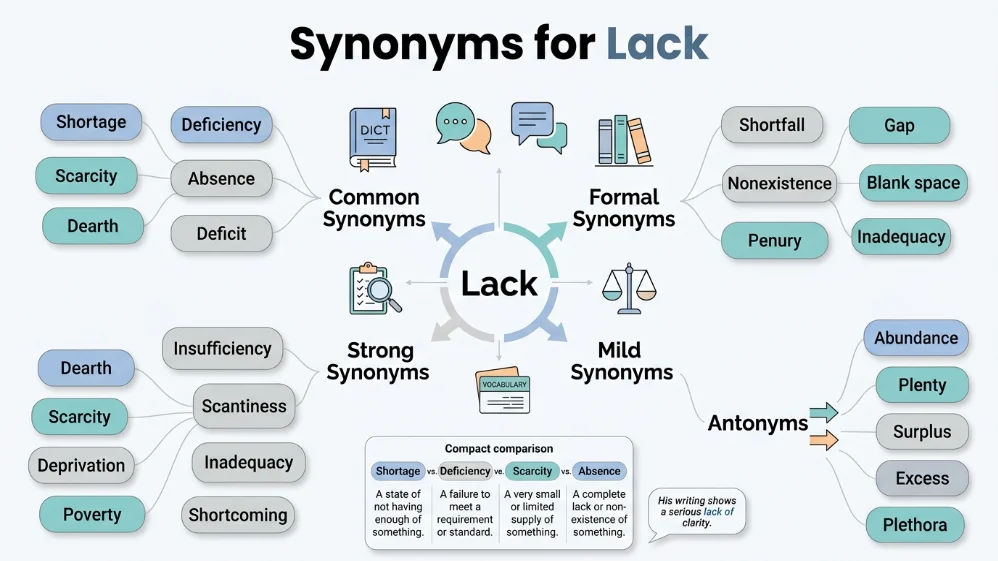
A strong vocabulary makes writing clearer, more precise, and easier to understand. The word lack is common, but repeating it can make an essay, article, or professional message feel flat. Knowing the right lack synonym helps you express ideas with greater accuracy, whether you are describing an absence, shortage, deficiency, or insufficient supply. This guide explains practical synonyms of lack and shows how their meanings change with context.
Finding the right other term for lack also depends on tone and sentence structure. In formal writing, words such as deficiency or absence may work better, while shortage or need can fit everyday situations. If you need another word for lack in an essay, choosing a precise alternative can make your argument sound more polished. You will also find useful options for lack of synonym, another word for lack of, and common lack synonyms.
Best Synonyms for Lack
The best synonyms for lack are absence, deficiency, shortage, scarcity, deficit, and insufficiency. For general absence, use absence or want. not having enough, use shortage or scarcity. For a missing quality, use deficiency or lack itself. The right choice depends on tone, context, and what type of lack you mean.
What Does Lack Mean?
Lack has several related meanings. First, it means the state of being without or not having something. Second, it means a shortage or insufficiency. Third, it means a need or deficiency.
Part of speech: Noun and Verb
Simple definition 1 (noun): The state of not having something or not having enough of something.
Simple definition 2 (verb): To be without or not have enough of something.
Example sentences:
- The lack of funding affected the project. (noun)
- She lacks confidence in public speaking. (verb)
Core Meaning of Lack
The word “lack” comes from Middle English and has always been about absence or insufficiency. At its heart, lack is about something missing that should be there. It can be a physical shortage, like a lack of food. It can be an internal deficiency, like a lack of confidence. can be a structural problem, like a lack of resources. The best synonym captures the specific nature of that missing thing. Is it complete absence? Then it is absence or want. Is it not enough? Then it is shortage or scarcity. Is it a missing quality? Then it is deficiency or inadequacy.
Grammar and Usage Notes
Lack can be used as a noun and a verb. This is important for choosing the right synonym.
Noun uses:
- Lack + of: The lack of sleep affected his performance.
- A lack + of: There is a lack of evidence.
Verb uses:
- Lack + noun: She lacks the necessary skills.
- Lack + for (rare): They lack for nothing.
Common phrases:
- lack of
- for lack of
- lack of interest
- lack of experience
- lack of resources
- lack of support
- lack of confidence
- lack of evidence
Common mistake to avoid:
Do not use “lack of” with a verb. Incorrect: He lacks of motivation. Correct: He lacks motivation.
When lack sounds natural: Use it for general absence, shortage, or deficiency. It fits almost everywhere.
When a synonym may work better: Use absence when something is completely missing. Use shortage when there is not enough. Use deficiency when a quality is missing.
Best Synonyms for Lack
| Synonym | Meaning | Tone | Best Use Case | Example Sentence |
|---|---|---|---|---|
| Absence | The state of being absent or missing | Neutral to formal | Complete missing of something | The absence of evidence was concerning. |
| Deficiency | A lack or shortage, especially of something needed | Formal | Health, nutrition, skills | The deficiency in vitamins caused health issues. |
| Shortage | Not enough of something needed | Neutral | Resources, supplies, time | The shortage of water affected the crops. |
| Scarcity | Insufficiency or shortage, often in supply | Formal to neutral | Resources, goods, opportunities | The scarcity of resources was a major problem. |
| Deficit | A shortage, especially in amount | Formal | Finance, budget, skills | The budget deficit was larger than expected. |
| Insufficiency | Not enough to meet a need | Formal | Resources, evidence, capacity | The insufficiency of the data was problematic. |
| Want | The state of not having something | Formal to literary | Needs, desires, conditions | The want of basic necessities was widespread. |
| Dearth | A scarcity or lack of something | Formal, literary | Resources, opportunities | There was a dearth of information on the topic. |
| Paucity | A small number or insufficient amount | Formal, literary | Information, resources | The paucity of evidence made the case weak. |
| Need | A requirement or necessity | Neutral | Basic requirements, conditions | The need for clean water is urgent. |
Common Synonyms for Lack
These everyday words work in most situations. They are not too formal or too casual.
Absence
Meaning: The state of being absent or not present.
Best context: Complete missing of something.
Example:
The absence of his usual cheerfulness was noticeable.
Shortage
Meaning: A situation where there is not enough of something.
Best context: Resources, supplies, time, money.
Example:
The shortage of staff caused delays.
Scarcity
Meaning: Insufficiency or shortage, especially in supply.
Best context: Resources, goods, opportunities.
Example:
The scarcity of clean water is a global issue.
Deficiency
Meaning: A lack or shortage, especially of something needed.
Best context: Health, nutrition, skills, qualities.
Example:
A deficiency in vitamin D can cause health problems.
Need
Meaning: A requirement or necessity.
Best context: Basic requirements, conditions.
Example:
The need for better education is clear.
Deficit
Meaning: A shortage, especially in amount.
Best context: Finance, budget, skills.
Example:
The trade deficit has been growing for years.
Formal Synonyms for Lack
Use these in academic papers, business reports, legal documents, and professional communication.
Deficiency
Best for: Health, nutrition, skills, qualities
Deficiency means a lack or shortage, especially of something needed for proper functioning. It is common in medical and technical contexts.
Example:
The deficiency in essential nutrients caused health problems.
The report highlighted deficiencies in the current system.
Insufficiency
Best for: Resources, evidence, capacity
Insufficiency means not enough to meet a need or requirement. It is formal and precise.
Example:
The insufficiency of the data made the analysis difficult.
The insufficiency of funds delayed the project.
Dearth
Best for: Resources, information, opportunities
Dearth means a scarcity or lack of something. It is formal and somewhat literary.
Example:
There was a dearth of reliable information on the topic.
The dearth of affordable housing is a serious issue.
Paucity
Best for: Information, evidence, resources
Paucity means a small number or insufficient amount. It is formal and often used in academic writing.
Example:
The paucity of evidence weakened the argument.
The paucity of resources limited the project’s scope.
Deficit
Best for: Finance, budget, skills
Deficit means a shortage, especially in amount. It is common in financial and professional contexts.
Example:
The budget deficit was larger than expected.
There is a deficit in leadership skills among the team.
Want
Best for: Needs, desires, conditions
Want means the state of not having something. It is formal and somewhat literary.
Example:
The want of basic necessities was widespread.
For want of a better solution, they chose the original plan.
Informal Synonyms for Lack
These work in conversation, social media, friendly writing, and personal messages.
Shortage
Tone: Neutral to casual
Shortage is common in everyday conversation.
Example:
There’s a shortage of good restaurants in this area.
Absence
Tone: Neutral to casual
Absence is widely used in everyday contexts.
Example:
The absence of your usual energy was noticeable.
Need
Tone: Casual and direct
Need is a common everyday word.
Example:
We have a real need for more volunteers.
Not enough
Tone: Very casual
Not enough is a simple phrase for lack.
Example:
There’s not enough time to finish the project.
Missing
Tone: Casual
Missing suggests something is absent.
Example:
Something is missing from this recipe.
Without
Tone: Casual
Without suggests the absence of something.
Example:
He went through the day without any coffee.
Strong Synonyms for Lack
These words carry more weight, intensity, or seriousness. Use them when you want to emphasize severity.
Deficiency
Strong and formal: Emphasizes that something needed is missing. The deficiency in the system caused major problems.
Dearth
Strong and formal: Emphasizes a serious scarcity. The dearth of qualified candidates was concerning.
Paucity
Strong and formal: Emphasizes an insufficient amount. The paucity of evidence made the case weak.
Deficit
Strong and formal: Emphasizes a measurable shortage. The deficit in funding was significant.
Scarcity
Strong and formal: Emphasizes limited availability. The scarcity of resources created competition.
Famine
Very strong: Emphasizes extreme scarcity, especially of food. The famine affected millions.
Absence
Strong: Emphasizes complete missing. The absence of any explanation was frustrating.
When Strong Synonyms May Be Too Much:
Words like dearth, paucity, and famine can make ordinary situations sound dramatic.
Example:
❌ The dearth of sugar in my coffee was disappointing.
✔ The lack of sugar in my coffee was disappointing.
Choose stronger alternatives only when the situation truly involves significant scarcity or serious deficiency.
Mild Synonyms for Lack
These words soften the meaning. Use them when you want to be gentle, casual, or less severe.
Need
Tone: Neutral to mild
Need suggests a requirement without severe scarcity.
Example:
There is a need for more volunteers.
Shortage
Tone: Neutral
Shortage suggests not enough but not necessarily severe.
Example:
There is a slight shortage of supplies.
Absence
Tone: Neutral
Absence suggests something missing without judgment.
Example:
The absence of his usual humor was noticeable.
Want
Tone: Mild to literary
Want suggests a lack of something needed.
Example:
For want of a better plan, they improvised.
Gap
Tone: Neutral
Gap suggests a missing piece.
Example:
There is a gap in his knowledge of history.
Hole
Tone: Casual
Hole suggests a missing part.
Example:
There’s a hole in his argument.
Why Mild Synonyms Matter:
Not every situation involves severe scarcity. If the lack is minor or neutral, a softer synonym often sounds more natural.
Compare these examples:
❌ The deficiency of my coffee was noticeable.
✔ The lack of my coffee was noticeable.
Synonyms for Lack by Context
Everyday Conversation
Use shortage, not enough, missing, or need.
Example:
There’s a shortage of good coffee around here.
Professional Writing
Use deficiency, insufficiency, deficit, or shortage.
Example:
The deficiency in resources affected the project timeline.
Academic Writing
Use paucity, dearth, insufficiency, or absence.
Example:
The paucity of research on this topic is concerning.
Health and Nutrition
Use deficiency, lack, or insufficiency.
Example:
A deficiency in iron can cause fatigue.
Financial Contexts
Use deficit, shortage, or lack.
Example:
The budget deficit was larger than anticipated.
Personal Descriptions
Use absence, need, or want.
Example:
The absence of enthusiasm was obvious.
Legal and Formal Contexts
Use absence, deficiency, or insufficiency.
Example:
The absence of evidence led to the dismissal of the case.
Another Word for Lack in a Sentence
Here are 15 natural example sentences using different synonyms for lack.
- The absence of evidence made the case weak.
- There is a deficiency of vitamin D in many people.
- The shortage of water affected the crops.
- The scarcity of resources created competition.
- The budget deficit was larger than expected.
- The insufficiency of the data was problematic.
- There was a dearth of information on the topic.
- The paucity of evidence weakened the argument.
- For want of a better solution, they chose the original plan.
- There is a need for better education.
- The lack of sleep affected his performance.
- There is a gap in his knowledge of history.
- There’s a hole in his argument.
- The deficiency in the system caused problems.
- The scarcity of jobs was a major concern.
Lack Synonyms Compared
Some synonyms for lack are very close but have small, important differences.
| Synonym | Primary Difference | When to Choose This |
|---|---|---|
| Lack vs. Absence | Absence is complete missing; lack can be partial. | Choose absence when something is completely missing. |
| Lack vs. Deficiency | Deficiency is a shortage of something needed. | Choose deficiency for health or skills. |
| Lack vs. Shortage | Shortage is not having enough supply. | Choose shortage for resources or supplies. |
| Lack vs. Scarcity | Scarcity emphasizes limited availability. | Choose scarcity when supply is very limited. |
| Lack vs. Deficit | Deficit is a measurable shortage. | Choose deficit for financial contexts. |
| Lack vs. Insufficiency | Insufficiency is not enough to meet a need. | Choose insufficiency when a requirement is unmet. |
| Lack vs. Dearth | Dearth is a severe scarcity. | Choose dearth for formal, serious contexts. |
| Lack vs. Paucity | Paucity emphasizes a small number. | Choose paucity for formal, academic contexts. |
Words Similar to Lack
These words belong to the same semantic field but are not always exact synonyms. Use them carefully.
Want
Related because it means the state of not having something. But want often implies a need or desire, not just absence. The want of necessities is a serious problem.
Need
Related because it suggests a requirement. But need is about what is required, not necessarily what is missing. The need for clean water is urgent.
Omission
Related because it means something left out. But omission is about leaving out, not necessarily scarcity. The omission of his name was an oversight.
Poverty
Related because it suggests lack of resources. But poverty is more specific and severe. The poverty of the region was concerning.
Famine
Related because it suggests extreme scarcity. But famine is specifically about food. The famine affected millions.
Hole
Related because it suggests a missing part. But hole is more casual and specific. There’s a hole in his argument.
Gap
Related because it suggests a missing piece. But gap is neutral and specific. There is a gap in his knowledge.
Exclusion
Related because it suggests leaving out. But exclusion is about intentional leaving out. The exclusion of certain groups was unfair.
Antonyms of Lack
| Antonym | Meaning | Example Sentence |
|---|---|---|
| Abundance | A large amount of something | There is an abundance of resources available. |
| Plenty | Enough or more than enough | We have plenty of time to finish. |
| Surplus | An excess of something | The surplus of food was donated. |
| Excess | An amount beyond what is needed | The excess of inventory was sold. |
| Sufficiency | Enough to meet a need | There is a sufficiency of evidence. |
| Adequacy | Enough to meet requirements | The adequacy of the funding was confirmed. |
| Wealth | A large amount of resources | The wealth of resources was impressive. |
How to Choose the Right Synonym for Lack
Picking the best word is not hard if you ask yourself a few questions.
Match the meaning. Do you mean complete absence, not enough, or a missing quality? This is the most important question.
Match the context. A health context needs “deficiency.” A financial context needs “deficit.” A general context needs “shortage” or “scarcity.”
Match the tone. Do you want to sound formal, literary, casual, or neutral? Choose your word accordingly.
Check the intensity. Do you need a strong word like “dearth” or a mild word like “need? Overstating sounds dramatic. Understating sounds vague.
Think about the reader. If you are writing for experts, “paucity” works. For a general audience, “shortage” is clearer. Know your audience.
Check whether the synonym is exact or only related. “Omission” is related but not exact. Use it only when you mean leaving out.
Keep the sentence natural. Read the sentence aloud. If the synonym sounds strange or forced, pick a different one.
When in doubt, use “lack.” It is clear, versatile, and understood everywhere. Only switch to a synonym when you need a specific tone, intensity, or meaning.
Common Mistakes When Using Synonyms for Lack
Confusing absence and scarcity. Absence means completely missing; scarcity means not enough. They are not the same.
Using “deficiency” for general contexts. Deficiency is often used for health or specific needs. For general lack, use “shortage” or “scarcity.”
Using “dearth” in casual writing. “The dearth of coffee in my kitchen” sounds overly formal. Just say “lack.”
Using “paucity” incorrectly. Paucity is formal and often academic. Do not use it in everyday conversation.
Replacing “lack” without checking meaning. “Need” is not a synonym for all types of lack. Use it only when something is required.
Making the sentence sound unnatural. “The insufficiency of my patience” sounds odd. Use simpler words for simple situations.
Using “want” incorrectly. Want can mean lack, but it can also mean desire. Use it carefully to avoid confusion.
Forgetting that “lack” can be a verb. “She lacks confidence” cannot be replaced with “she deficiencies.” Keep the part of speech in mind.
Quick Synonym List for Lack
Common synonyms
- absence
- shortage
- scarcity
- deficiency
- need
Formal synonyms
- deficiency
- insufficiency
- dearth
- paucity
- deficit
Informal synonyms
- shortage
- not enough
- missing
- absence
- need
Strong synonyms
- deficiency
- dearth
- paucity
- deficit
- scarcity
Mild synonyms
- need
- shortage
- absence
- want
- gap
Related words (not exact)
- want
- need
- omission
- poverty
- gap
FAQs
What is another word for lack?
A useful other term for lack is absence, shortage, deficiency, or scarcity, depending on the context.
What is a synonym for lack of?
Common synonyms for lack of include absence of, shortage of, deficiency of, and insufficient supply of.
What are the best synonyms of lack?
Common synonyms of lack include absence, shortage, deficiency, scarcity, insufficiency, and need.
What is another word for lack?
Another word for lack can be absence, shortage, deficiency, insufficiency, or deprivation.
What is another word for lack of something?
You can use absence of, shortage of, deficiency of, or insufficiency of as another word for lack of.
What is another word for lack in writing?
In formal writing, deficiency, shortage, absence, or insufficiency can replace lack, depending on the intended meaning.
What is a synonym for lack?
A common synonym for lack is absence. Other options include shortage, deficiency, scarcity, and insufficiency.
What are common lack synonyms?
Common lack synonyms include absence, shortage, deficiency, scarcity, insufficiency, and deprivation.
What are synonyms for lack of?
Useful synonyms for lack of include absence of, shortage of, deficiency of, and insufficiency of.
What is another word for lack in a formal document?
Deficiency, insufficiency, dearth, paucity, and deficit are excellent formal alternatives commonly used in academic, legal, and professional writing.
What is an informal synonym for lack?
Shortage, not enough, missing, and need are all casual alternatives.
What is a stronger word for lack?
Deficiency, dearth, paucity, deficit, and scarcity are stronger. Use them for serious or significant lack.
What is a milder word for lack?
Need, shortage, absence, want, and gap provide softer alternatives that work well when the lack is minor.
What words are similar to lack but not exact synonyms?
Want, need, omission, poverty, and gap are related but not direct replacements.
What is the opposite of lack?
The most direct opposites are abundance, plenty, surplus, excess, and sufficiency.
How do I choose the right synonym for lack?
First, decide what kind of lack you mean (complete absence, not enough, or missing quality). Then match the word to your context, tone, and audience. When unsure, use “lack” itself.
Is “absence” the same as “lack”?
Mostly, but “absence” means completely missing, while “lack” can also mean not having enough. “Absence” is often stronger.
Can “lack” be used as a verb?
Yes. “She lacks confidence” is correct. The verb form cannot be replaced with most synonyms, which are nouns.
Conclusion
There is no single perfect synonym for lack because the word has different shades of meaning. When you mean complete absence, use absence or want. you mean not enough, use shortage or scarcity. When you mean a missing quality, use deficiency or insufficiency. you need formal language, use dearth or paucity. Keep your meaning clear, match your tone to your audience, and choose the word that fits the situation. When you do that, your writing will never lack precision.
Read More Related Articles:
- Synonyms for Mature| Smart, Professional, and Everyday …
- Synonyms for Critique |Better Words for Reviews, Analysis …










1 thought on “Lack of Synonym | 25+ Better Words, Meanings, Uses & Smart Alternatives in 2026”