When writing an essay, email, blog post, presentation, or social media caption, repeating the word concept can make your language feel predictable. Searching for synonyms of concept can help you find a word that communicates your exact meaning, whether you are describing an idea, theory, principle, viewpoint, or mental understanding.
The best alternative depends on context. Idea sounds natural in everyday conversation, notion can describe a general understanding, conception often refers to the way something is understood, and theory suggests an organized explanation. Choosing the right word makes your writing more precise without making it unnecessarily complicated.
What Are the Best Synonyms of “Concept”?
A concept is an abstract idea, understanding, or general notion about something. The best synonyms include idea for everyday use, notion for a general thought, conception for an understanding, principle for a guiding idea, theory for an explanatory system, and construct for academic or technical writing.
Meaning, Tone, and Context
Simple Definition
A concept is an abstract idea or general understanding of something. It can represent a thought, principle, category, or mental framework that helps people understand or organize information.
For example, the concept of equality refers to the general idea or principle of treating people fairly and giving them equal consideration.
Part of Speech
Concept is a noun.
It refers to an idea or understanding rather than an action. You can describe, explain, develop, understand, introduce, or apply a concept.
Overall Tone
The word concept has a neutral tone.
It does not normally express a positive or negative emotion by itself. Its tone depends on what concept is being discussed.
For example:
“She explained the concept clearly.”
“The concept of fairness is important.”
Both sentences are neutral in tone.
Formality Level
Concept is a neutral to moderately formal word. It is especially common in academic, professional, technical, business, and educational contexts.
It also works in everyday English.
For example:
“That’s an interesting concept.”
This sounds completely natural in conversation.
Common Uses
Native English speakers commonly use concept when discussing:
- Ideas
- Principles
- Theories
- Academic subjects
- Business models
- Design ideas
- Scientific explanations
- Philosophical topics
- Social ideas
- Creative projects
- General understandings
- Abstract categories
The word is especially useful when an idea is more developed or abstract than a simple passing thought.
Word Forms
| Form | Word |
|---|---|
| Noun | concept |
| Plural noun | concepts |
| Related noun | conception |
| Related adjective | conceptual |
| Related adverb | conceptually |
When and How to Use “Concept”
Use concept when you are referring to an abstract idea, general principle, or mental framework. It is particularly useful when the subject involves something people need to understand, explain, develop, or apply.
Professional
“The team discussed the concept before creating the final proposal.”
This works well because business teams often discuss ideas or frameworks before turning them into practical plans.
Academic
“The essay examines the concept of social responsibility.”
Here, concept sounds appropriate because the sentence discusses an abstract academic idea.
Workplace
“Everyone needs to understand the concept behind the new workflow.”
The word works because the sentence refers to the underlying idea behind a process.
Personal
“I like the concept of spending less time online.”
In everyday conversation, concept can describe a general idea or approach.
“Thank you for sharing the concept for the new campaign.”
This sounds professional without being overly formal.
Resume
“Developed a marketing concept for a new product launch.”
In a resume, concept can describe an original idea or creative direction.
Social Media
“I love the concept behind this new community project.”
Here, concept refers to the basic idea or purpose of the project.
Best Synonyms of “Concept”
No synonym for concept works perfectly in every situation. Some alternatives are broader, some are more specific, and others change the emphasis from an abstract idea to a theory, principle, framework, or personal understanding.
Professional Writing: Idea or Framework
Use idea when referring to a proposed thought or suggestion.
Use framework when the concept provides an organized structure for understanding or doing something.
Example:
“The team presented a new framework for improving customer service.”
Academic Writing: Conception or Construct
Conception works when you mean a particular way of understanding something.
Construct is useful in academic and research contexts when an idea is developed as an analytical or theoretical category.
Example:
“The study examines the social construct of identity.”
Business Communication: Strategy or Model
Strategy is appropriate when the concept involves a planned method for reaching a goal.
Model works when the concept represents a system, process, or way of explaining how something operates.
Example:
“The company introduced a new business model.”
Casual Conversation: Idea or Thought
Idea is usually more natural than concept in everyday conversation.
Example:
“That’s a great idea.”
This is more conversational than:
“That’s a great concept.”
Emotional Writing: Belief or Vision
Belief works when the concept reflects something a person considers true or meaningful.
Vision is useful when the idea describes a desired future or inspiring possibility.
Example:
“Her vision of a better community inspired everyone.”
Creative Writing: Vision or Conception
Vision can describe an artist’s overall creative direction.
Conception can describe the way an artist imagines or develops a creative work.
Example:
“The director had a clear vision for the film.”
Resume Writing: Strategy or Approach
On a resume, approach, strategy, or model may be more specific than concept.
Example:
“Created a customer engagement strategy that improved retention.”
Workplace Communication: Approach or Framework
Use approach for a practical way of handling a task.
Use framework for an organized structure that guides decisions or actions.
Example:
“We need a consistent approach to employee training.”
Stronger Meaning: Principle or Fundamental Idea
Principle can sound stronger when the concept represents a rule or belief that guides behavior.
Example:
“Transparency is a core principle of the organization.”
Softer Meaning: Notion or Thought
Notion and thought can sound less structured than concept.
Example:
“I had a notion that the project might take longer than expected.”
When Not to Use “Concept”
Although concept is flexible, it is not always the clearest word. Sometimes another term communicates the intended meaning more directly.
When “Concept” Is Too General
If you mean a simple suggestion, idea is usually better.
Less effective:
“We discussed a concept for the weekend.”
Better:
“We discussed an idea for the weekend.”
The second sentence sounds more natural because a casual suggestion does not need the slightly more formal concept.
When “Concept” Is Too Vague
If you mean a specific method, use approach, strategy, or method.
Less effective:
“We need a better concept for solving this problem.”
Better:
“We need a better approach to solving this problem.”
The replacement tells the reader that you mean a practical method.
When “Concept” Is Too Formal
In casual conversation, idea is often more natural.
Less effective:
“That is an interesting concept for dinner.”
Better:
“That’s an interesting idea for dinner.”
The simpler word fits everyday speech better.
When “Concept” Is Too Weak
If the idea functions as a rule or guiding belief, principle may be more accurate.
Less effective:
“Honesty is an important concept in our company.”
Better:
“Honesty is a core principle in our company.”
The revised sentence gives honesty a stronger guiding role.
When “Concept” Is Too Strong
If you only mean a vague thought, notion or thought may be better.
Less effective:
“She developed a detailed concept about where the company might go.”
Better:
“She had a notion about where the company might go.”
The second version makes it clear that the idea is not yet fully developed.
When a More Specific Word Is Available
Avoid using concept when the subject has a more precise name.
Less effective:
“The company introduced a new concept for managing employees.”
Better:
“The company introduced a new management strategy.”
The word strategy tells readers what kind of concept is being discussed.
Words Commonly Confused With “Concept”
| Word | Difference | When to Use It | Example |
|---|---|---|---|
| Idea | A thought, suggestion, or possible solution. | Everyday conversation and brainstorming. | “She had an idea for the project.” |
| Notion | A general or sometimes uncertain belief or thought. | Casual or descriptive contexts. | “He had a notion that the plan would fail.” |
| Theory | An organized explanation of something. | Academic, scientific, or analytical writing. | “The theory explains how the system works.” |
| Principle | A basic rule or belief that guides action. | Ethics, education, business, and philosophy. | “Fairness is an important principle.” |
| Conception | A particular way of understanding or imagining something. | Formal, academic, and intellectual writing. | “Her conception of leadership changed over time.” |
| Framework | An organized structure for understanding or approaching something. | Research, business, and professional writing. | “The framework helps researchers analyze the data.” |
Best Synonyms of “Concept” by Context
| Context | Best Synonym | Why It Works | Example |
|---|---|---|---|
| Formal writing | Conception | Emphasizes a particular understanding. | “His conception of justice differs from hers.” |
| Academic writing | Construct | Useful for an analytical or theoretical idea. | “The study examines identity as a social construct.” |
| Professional communication | Framework | Suggests an organized structure. | “The framework guides our decision making.” |
| Business emails | Idea | Natural and clear for proposals. | “I would like to discuss an idea for the campaign.” |
| Resume writing | Strategy | Shows practical planning and purpose. | “Developed a marketing strategy for product growth.” |
| Workplace communication | Approach | Refers to a practical way of handling something. | “We need a new approach to training.” |
| Casual conversation | Idea | Sounds natural and familiar. | “That’s a great idea.” |
| Everyday speaking | Thought | Fits simple personal expressions. | “That thought crossed my mind.” |
| Creative writing | Vision | Expresses an artistic direction. | “The director had a bold vision.” |
| Storytelling | Conception | Highlights how something was imagined. | “The original conception of the story was darker.” |
| Emotional writing | Belief | Connects an idea with personal conviction. | “Her belief in kindness shaped her choices.” |
| Strong emphasis | Principle | Presents an idea as a guiding rule. | “Equality is a fundamental principle.” |
| Mild tone | Notion | Suggests a less developed thought. | “He had a notion that something was wrong.” |
| Social media captions | Idea | Short, familiar, and conversational. | “Love this idea for a weekend project.” |
| American English | Idea | Common and natural in everyday use. | “I have an idea.” |
| British English | Idea | Also natural and widely understood. | “That’s an interesting idea.” |
How to Choose the Best Synonym of “Concept”
Choosing another word for concept starts with identifying what you actually mean.
If You Mean a Simple Thought
Choose idea or thought.
Example:
“I have an idea for our next blog post.”
If You Mean a General Belief
Choose notion or belief.
Example:
“He rejected the notion that success happens overnight.”
If You Mean an Organized Explanation
Choose theory.
Example:
“The theory explains why the results changed.”
If You Mean a Guiding Rule
Choose principle.
Example:
“Integrity is a core principle of the organization.”
If You Mean an Organized Structure
Choose framework.
Example:
“The framework gives researchers a way to evaluate the results.”
If You Mean a Planned Business Direction
Choose strategy or model.
Example:
“The company developed a new business model.”
If You Mean an Artistic Direction
Choose vision.
Example:
“The designer’s vision shaped the entire project.”
Consider Your Audience
A teacher may expect precise academic language, while a friend usually prefers simple conversational vocabulary.
For an essay, concept, conception, construct, or principle may work well.
For a text message, idea or thought will usually sound more natural.
Consider Emotional Strength
- Words such as vision and belief can carry more personal meaning.
- Words such as principle can suggest a strong commitment.
Consider Formality
- Use idea for neutral and casual situations.
- Use conception, construct, and framework when the context is academic or specialized.
- Use strategy and model when the context is business or professional.
Real Life Examples of “Concept”
School
Original:
“The concept of fractions can be difficult for some students.”
Alternative:
“The idea of fractions can be difficult for some students.”
Both work, but concept sounds slightly more academic.
College
“The professor explained the concept of social identity.”
A more academic alternative is:
“The professor explained the construct of social identity.”
The second version is appropriate when the term refers to an analytical category in a field of study.
Workplace
“The manager introduced the concept during the training session.”
More specifically:
“The manager introduced the framework during the training session.”
Framework works when the concept provides an organized structure.
Business
“The company tested a new concept for its online store.”
A more specific alternative is:
“The company tested a new business model for its online store.”
“I wanted to share a concept for our next campaign.”
More naturally:
“I wanted to share an idea for our next campaign.”
Resume
“Created a new concept for a customer loyalty program.”
Stronger:
“Developed a strategy for a customer loyalty program.”
The replacement communicates practical responsibility more clearly.
Conversation
“I like the concept of working four days a week.”
More conversational:
“I like the idea of working four days a week.”
Storytelling
“The concept of the story centered on a family searching for home.”
More literary:
“The central idea of the story centered on a family searching for home.”
Blogging
“The concept behind this article is simple.”
Alternative:
“The idea behind this article is simple.”
Social Media
“The concept behind this photo series is self expression.”
More conversational:
“The idea behind this photo series is self expression.”
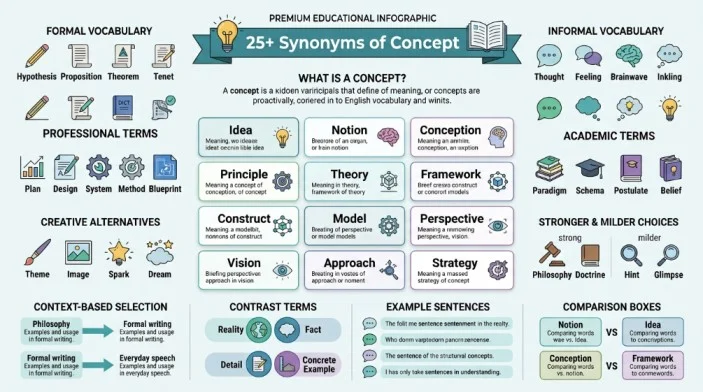
25 Best Synonyms of “Concept”
Some words in this table overlap with concept only in particular contexts. The best synonym depends on whether you mean an idea, belief, explanation, structure, creative direction, or theoretical category.
| Synonym | Simple Meaning | Best Used For | Example Sentence |
|---|---|---|---|
| Idea | A thought or suggestion | Everyday use | “She had a great idea for the event.” |
| Notion | A general thought or belief | Informal and descriptive writing | “He rejected the notion that money guarantees happiness.” |
| Thought | Something considered mentally | Conversation and personal writing | “That thought stayed with her all day.” |
| Conception | A particular understanding or interpretation | Formal and academic writing | “His conception of leadership evolved over time.” |
| Abstraction | A general idea separated from physical details | Philosophy and academic writing | “Justice can be difficult to define as an abstraction.” |
| Principle | A basic rule or guiding idea | Ethics, education, business | “Respect is a fundamental principle of the organization.” |
| Theory | An organized explanation | Academic and scientific contexts | “The theory provides a possible explanation for the findings.” |
| Belief | An idea accepted as true | Personal and social contexts | “Her belief in fairness influenced her decisions.” |
| Understanding | A person’s grasp of an idea or subject | Education and communication | “The lesson improved my understanding of the topic.” |
| Perception | A way of viewing or interpreting something | Psychology and social discussion | “Public perception changed after the announcement.” |
| Construct | An idea created for analysis or theory | Research and academic writing | “Identity is often studied as a social construct.” |
| Framework | An organized structure for thinking or action | Business and research | “The framework gives the team a consistent method.” |
| Model | A representation or system used to explain something | Business, science, education | “The company developed a new business model.” |
| Proposition | An idea or statement put forward for consideration | Formal and academic writing | “The paper challenges the central proposition.” |
| Premise | An idea used as the basis for reasoning | Logic and argument | “The argument depends on a questionable premise.” |
| Formulation | The way an idea is expressed or developed | Academic and technical writing | “The new formulation of the problem clarified the issue.” |
| Representation | Something that expresses or stands for an idea | Academic and visual contexts | “The diagram is a visual representation of the concept.” |
| Interpretation | A particular explanation or understanding | Literature and analysis | “Her interpretation of the poem was convincing.” |
| Impression | An initial or general understanding | Everyday and descriptive writing | “My first impression was positive.” |
| Perspective | A particular way of viewing something | Analysis and discussion | “The article offers a different perspective on education.” |
| Viewpoint | A person’s position or opinion | Discussion and writing | “His viewpoint differed from that of the other researchers.” |
| Vision | An imagined future or creative direction | Business and creative work | “The founder shared her vision for the company.” |
| Approach | A way of dealing with something | Professional and practical writing | “The team adopted a new approach to customer service.” |
| Strategy | A planned method for achieving a goal | Business and professional writing | “The marketing strategy focused on younger customers.” |
| Design | A planned arrangement or intended idea | Creative and product contexts | “The product’s design reflects the company’s values.” |
Synonyms of “Concept” by Usage
Professional vs Personal Synonyms
Professional writing often benefits from precise terms that identify the role an idea plays.
Use strategy when it describes a plan for reaching an objective.
Use model when it represents how a business, system, or process operates.
In personal communication, simpler choices usually sound more natural.
Use idea, thought, or notion when discussing ordinary thoughts or suggestions.
For example:
Professional:
“The team developed a strategic framework for customer retention.”
Personal:
“I had an idea for our weekend trip.”
Formal vs Conversational Synonyms
Formal writing can use conception, construct, proposition, framework, and formulation when their specific meanings fit.
Conversational English usually favors idea, thought, notion, or view.
For reports:
“The framework provides a basis for evaluating performance.”
For essays:
“The concept of identity is central to the argument.”
For business writing:
“The strategy focuses on customer retention.”
For presentations:
“The model demonstrates how the process works.”
For emails:
“I have an idea for improving the schedule.”
For casual conversation:
“That’s a good idea.”
For texting:
“I like that idea.”
Academic Synonyms
Academic writing requires precision, so the best synonym depends on the intellectual role of the word.
Construct
Use construct when discussing an abstract category developed for research or analysis.
Theory
Use theory when the idea provides an explanation for observations or events.
Proposition
Use proposition when referring to a statement or claim presented for consideration.
Premise
Use premise when the idea serves as a basis for an argument.
Conception
Use conception when discussing a particular way of understanding a subject.
Framework
Use framework when the concept organizes ideas, variables, or analytical methods.
These terms sound authoritative because they tell readers more precisely how an idea functions within an academic argument.
Professional and Business Synonyms
Resumes
Use strategy, approach, model, or framework when describing work you actually performed.
Instead of:
“Created a concept for marketing.”
Use:
“Developed a marketing strategy.”
Interviews
Use approach when explaining how you solve problems.
“I use a collaborative approach to project management.”
Meetings
Use idea, proposal, or strategy depending on what you are presenting.
Presentations
Use framework, model, or strategy when the concept has a clear structure.
Performance Reviews
Use approach, strategy, or framework to describe methods and processes.
Client Communication
Use idea, proposal, or strategy because clients often need practical rather than abstract language.
Business Emails
Use idea for suggestions and strategy for planned actions.
Creative and Literary Synonyms
Creative writing often needs language that gives an idea emotional or visual character.
Vision
Use vision for an artist’s or writer’s intended creative direction.
Conception
Use conception when discussing how a creative work was originally imagined.
Idea
Use idea for a simple creative premise.
Perspective
Use perspective when the creative work presents a particular way of seeing the world.
Interpretation
Use interpretation when discussing how an artist or reader understands an existing work.
For example:
“The novel explores the concept of memory.”
A more expressive version could be:
“The novel explores a haunting vision of memory.”
The second version changes the meaning slightly and adds a stronger creative quality.
Slang or Modern Synonyms
There is no widely accepted slang word that serves as a direct synonym for concept in all situations.
Expressions such as idea, thought, or big idea may be used casually, but they are ordinary vocabulary rather than strict slang.
For example:
“What’s the big idea behind the project?”
This is acceptable in casual conversation, but a formal report would be better with:
“What is the central concept behind the project?”
Strongest to Mildest Synonyms
Unlike words that describe emotion or physical intensity, concept does not have a simple strength scale. Its alternatives become stronger or more specific depending on what the idea represents.
| Level | Useful Terms | Typical Meaning |
|---|---|---|
| Mild | Thought, notion, impression | A general or less developed idea |
| Moderate | Idea, perspective, viewpoint | A recognizable thought or way of seeing something |
| Strong | Concept, principle, theory | A developed or structured idea |
| Very Strong | Framework, proposition, fundamental principle | An idea with a defined analytical or guiding role |
The scale should not be treated as a strict dictionary ranking. A framework is not automatically more important than an idea. It simply describes a more structured form of thinking.
Emotional vs Neutral Synonyms
Emotional Synonyms
Some alternatives can carry personal or expressive meaning.
Vision can suggest hope or ambition.
Belief can express personal conviction.
Thought can feel reflective.
Perspective can suggest personal experience.
Impression can communicate an individual’s reaction.
These words work well in personal essays, speeches, storytelling, and reflective writing.
Neutral Synonyms
For objective communication, choose words such as:
Concept
Idea
Framework
Model
Theory
Construct
Proposition
These terms are useful in academic papers, professional reports, presentations, and technical explanations.
Antonyms of “Concept”
Concept does not have a set of 15 strict dictionary antonyms. It describes an abstract idea, so its opposite is usually expressed through concrete reality, physical objects, specific instances, or actual events.
For accuracy, the following are best understood as contrast terms, not strict lexical antonyms.
| Contrast Term | Meaning | Example Sentence |
|---|---|---|
| Reality | What actually exists or happens | “The concept sounded good, but reality was different.” |
| Actuality | The state of being real or actual | “The plan differed from its actuality.” |
| Fact | Something that is true or known to be true | “The theory must be tested against fact.” |
| Object | A physical thing | “The concept became a physical object.” |
| Entity | Something that exists as a distinct thing | “The abstract concept was applied to a real entity.” |
| Specific | A particular thing rather than a general idea | “Give me a specific example rather than a broad concept.” |
| Example | A concrete instance that illustrates an idea | “The teacher used an example to explain the concept.” |
| Instance | A particular occurrence or case | “This instance shows how the idea works.” |
| Detail | A specific piece of information | “The general concept needs more detail.” |
| Event | Something that actually happens | “The historical event inspired the concept.” |
| Experience | Something personally encountered or lived through | “Her experience gave the concept practical meaning.” |
| Action | Something done rather than merely imagined | “The proposal requires action, not just a concept.” |
| Practice | Actual application of an idea | “The principle becomes clearer in practice.” |
| Concrete thing | Something physically or specifically identifiable | “The abstract concept refers to a concrete thing in this example.” |
| Substance | Something with tangible or material existence | “The discussion moved from abstract concepts to physical substance.” |
These terms should not be presented as interchangeable opposites in every sentence. They are useful contrasts when explaining the difference between an abstract concept and something concrete, specific, or actual.
Comparison: “Concept” vs Similar Words
Concept vs Idea
Main Difference
Concept usually refers to an abstract or developed idea. Idea is broader and can describe anything from a simple thought to a detailed proposal.
Which Is Stronger?
Concept can sound more developed, but neither word is inherently stronger.
Which Is More Formal?
Concept is generally more formal or academic.
When to Use Each
Use idea for everyday conversation, suggestions, and brainstorming.
Use concept for abstract subjects, academic topics, designs, and developed ideas.
Examples
Concept:
“The concept of sustainability affects many industries.”
Idea:
“I have an idea for our next project.”
Concept vs Notion
Main Difference
A notion is often a general, uncertain, or loosely formed thought. A concept is usually more clearly defined.
Which Is Stronger?
Concept generally suggests greater structure.
Which Is More Formal?
Both can work in formal writing, but concept is more neutral.
When to Use Each
Use notion for beliefs or thoughts that may not be fully developed.
Use concept for established or explainable ideas.
Examples
Concept:
“The concept of equality is central to the discussion.”
Notion:
“He rejected the notion that success comes easily.”
Concept vs Theory
Main Difference
A concept is an abstract idea. A theory is a more developed explanation intended to account for something.
Which Is Stronger?
Theory is more specific because it provides an explanatory structure.
Which Is More Formal?
Theory is strongly associated with academic and scientific writing.
When to Use Each
Use concept for an abstract idea.
Use theory when the idea explains relationships, causes, or observations.
Examples
Concept:
“The concept of gravity is taught in basic science.”
Theory:
“The theory explains how gravitational forces interact.”
Concept vs Principle
Main Difference
A principle is a fundamental rule, belief, or guideline. A concept is a broader abstract idea.
Which Is Stronger?
A principle often carries greater authority because it can guide behavior or decisions.
Which Is More Formal?
Both are suitable for formal communication.
When to Use Each
Use principle for rules and guiding beliefs.
Use concept for general ideas.
Examples
Concept:
“The concept of fairness can be interpreted differently.”
Principle:
“Fairness is a core principle of the organization.”
Concept vs Framework
Main Difference
A framework is an organized structure used to understand or approach something. A concept can be much simpler and less structured.
Which Is Stronger?
A framework is more structured rather than simply stronger.
Which Is More Formal?
Framework is common in academic, technical, and professional writing.
When to Use Each
Use framework when an idea organizes other ideas or actions.
Use concept for the underlying abstract idea.
Examples
Concept:
“The concept of leadership has changed.”
Framework:
“The framework helps managers evaluate leadership skills.”
Concept vs Perspective
Main Difference
A perspective is a particular way of viewing or interpreting something. A concept is the underlying idea itself.
Which Is Stronger?
Neither is inherently stronger.
Which Is More Formal?
Both work well in academic and professional writing.
When to Use Each
Use perspective when emphasizing viewpoint.
Use concept when emphasizing the abstract idea.
Examples
Concept:
“The concept of success varies across cultures.”
Perspective:
“Her perspective on success changed after traveling.”
Common Phrases and Expressions with “Concept”
| Phrase | Meaning | Example Sentence |
|---|---|---|
| The concept of | Introduces an abstract idea or principle | “The concept of equality appears in many discussions.” |
| Basic concept | A simple foundational idea | “Students should understand the basic concept first.” |
| Core concept | A central idea | “Trust is a core concept in the course.” |
| Key concept | An especially relevant idea | “The teacher explained each key concept clearly.” |
| Central concept | The main idea around which something is organized | “Identity is the central concept of the novel.” |
| New concept | A newly introduced idea or approach | “The company tested a new concept for its store.” |
| Concept behind | The idea that explains something | “The concept behind the campaign is community.” |
| Concept of operations | A planned description of how an operation is intended to work | “The team reviewed the concept of operations before launch.” |
Common Mistakes to Avoid
Mistake 1: Using “Concept” for Every Idea
Incorrect:
“I have a concept for dinner tonight.”
Better:
“I have an idea for dinner tonight.”
Why:
Idea sounds more natural for ordinary suggestions.
Mistake 2: Confusing a Concept With a Theory
Incorrect:
“The theory of kindness is simple.”
Better:
“The concept of kindness is simple.”
Why:
If you are discussing the general idea of kindness rather than an explanatory theory, concept is more accurate.
Mistake 3: Using Informal Vocabulary in Academic Writing
Incorrect:
“The big idea of the research is interesting.”
Better:
“The central concept of the research is significant.”
Why:
The revised version better matches academic style.
Mistake 4: Using “Concept” When You Mean a Strategy
Incorrect:
“We created a concept to increase sales.”
Better:
“We created a strategy to increase sales.”
Why:
A strategy is a planned method for achieving an objective.
Mistake 5: Treating Every Synonym as Identical
Incorrect:
“The concept is a theory.”
Better:
“The concept provides the basis for the theory.”
Why:
A concept and a theory can be related, but they do not perform the same function.
Mistake 6: Making a Simple Sentence Unnecessarily Formal
Incorrect:
“I developed a conceptual notion for dinner.”
Better:
“I have an idea for dinner.”
Why:
Simple situations usually benefit from simple vocabulary.
Mistake 7: Using “Concept” When You Mean a Concrete Example
Incorrect:
“Can you give me another concept from the experiment?”
Better:
“Can you give me another example from the experiment?”
Why:
An example is a specific instance, while a concept is an abstract idea.
Frequently Asked Questions
What are the best synonyms of “concept”?
The best synonyms of concept include idea, notion, thought, conception, principle, theory, construct, framework, and model. The most suitable choice depends on the meaning and context.
What are the best formal synonyms of “concept”?
Formal alternatives include conception, construct, framework, proposition, formulation, and abstraction. These are particularly useful in academic, technical, philosophical, and professional writing when their specific meanings fit.
What are common informal synonyms of “concept”?
The most natural informal alternatives are idea, thought, and notion. Among these, idea is usually the safest choice for everyday conversations, casual emails, social media, and ordinary discussions.
What is another word for “concept” in professional writing?
In professional writing, framework, strategy, model, approach, and idea can replace concept depending on the intended meaning. Choose framework for structure and strategy for a planned method.
What is the difference between “concept” and “idea”?
A concept is usually an abstract or developed idea, while idea has a broader meaning and can describe a simple thought, suggestion, plan, or creative possibility. Idea is also more common in casual conversation.
What is the opposite of “concept”?
There is no single exact antonym for concept. In context, words such as reality, fact, specific example, object, and actuality can contrast with an abstract concept because they refer to concrete or actual things.
Conclusion
A concept is an abstract idea, general understanding, principle, or mental framework. Its best alternative depends on what you are trying to communicate. Idea is usually the most natural everyday choice, while conception, construct, and framework suit more formal or academic contexts.
For professional writing, strategy, model, and approach can be more precise when discussing practical plans. In creative or personal writing, vision, belief, perspective, and thought can add a more specific emotional or expressive meaning.
No synonym works perfectly in every situation. When choosing among the synonyms of concept, consider the exact meaning, audience, tone, and purpose of your sentence. A useful vocabulary habit is to identify the role of the idea first, then choose the word that describes that role most precisely.
Read More Related Articles:
- Synonyms for Pros and Cons | Meaning, Examples, and Better …
- Synonyms for Creativity | Meaning, Examples, and Better …
- Synonyms for Empty | Meaning, Examples, and Better Word …