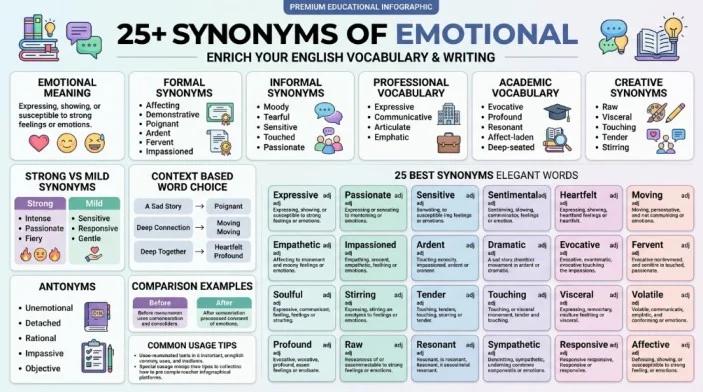
Choosing the right word for feelings can completely change the meaning, tone, and impact of your writing. The Synonym of Emotional depends on what you want to express, such as deep feelings, sensitivity, affection, excitement, vulnerability, or a strong personal reaction. Words like sentimental, sensitive, passionate, expressive, heartfelt, and intense may seem similar, but each carries a slightly different meaning and emotional strength. Understanding these differences helps you communicate with greater clarity and confidence.
In everyday conversations, academic writing, professional communication, storytelling, and creative content, the best alternative is not always the most obvious one. This guide explores the Synonym of Emotional through practical meanings, tone differences, context-based examples, and common usage situations. You will discover which alternatives sound natural, which are more formal, and which words work best when you want your message to feel precise, sincere, or powerful.
What Are the Best Synonyms of “Emotional”?
The best synonym of emotional depends on context. Expressive, passionate, sentimental, sensitive, heartfelt, moving, and poignant are useful alternatives. Formal writing often favors expressive or significant, while casual speech may use sensitive or passionate. Creative and personal writing can benefit from heartfelt, touching, moving, or poignant.
Meaning, Tone, and Context
Simple Definition
Emotional generally describes something connected with feelings or something strongly influenced by feelings. It can describe a person, reaction, conversation, experience, speech, piece of writing, or situation.
The exact meaning changes with context. Calling a speech emotional may mean that it strongly expresses feelings, while saying someone is emotional may suggest that the person reacts strongly or easily to feelings.
Part of Speech
Emotional is an adjective.
Examples:
- “She gave an emotional speech.”
- “The movie has an emotional ending.”
- “He became emotional while discussing his childhood.”
The related noun is emotion, and the adverb is emotionally.
Overall Tone
The tone of emotional is usually neutral, but it can become positive or negative depending on the sentence.
A positive use might describe a heartfelt speech:
“Her emotional speech inspired everyone in the room.”
A neutral use might simply describe a strong reaction:
“The discussion became emotional.”
A negative use can suggest that someone is reacting without enough calm judgment:
“He became too emotional during the negotiation.”
Formality Level
Emotional is a neutral, widely used English adjective. It works in:
- Academic writing
- Professional communication
- Personal conversations
- Journalism
- Creative writing
- Social media
- Everyday speech
However, a more precise synonym can make formal writing stronger. For example, expressive, sentimental, passionate, subjective, or impassioned may communicate the intended meaning more accurately.
Common Uses
Native English speakers commonly use emotional to describe:
- Emotional reactions
- Emotional support
- Emotional responses
- Emotional conversations
- Emotional experiences
- Emotional speeches
- Emotional scenes
- Emotional stories
- Emotional decisions
- Emotional situations
- Emotional writing
- Emotional connections
- Emotional pain
- Emotional strength
- Emotional sensitivity
Word Forms
| Word | Part of Speech | Example |
|---|---|---|
| Emotion | Noun | “Her voice showed strong emotion.” |
| Emotional | Adjective | “It was an emotional conversation.” |
| Emotionally | Adverb | “He reacted emotionally to the news.” |
| Emotionality | Noun | “The emotionality of the scene was striking.” |
| Unemotional | Adjective | “She remained unemotional during the discussion.” |
When and How to Use “Emotional”
Use emotional when you want to communicate that feelings play a strong role in a person, response, experience, or piece of communication. It is especially useful when the exact emotion is less important than the fact that feelings are prominent.
Professional
“The meeting became emotional after the team discussed the layoffs.”
Here, emotional describes a situation in which people expressed strong feelings.
Academic
“The study examines how emotional responses influence decision making.”
This use is neutral and appropriate for academic discussion.
Workplace
“Managers should be prepared for emotional reactions when introducing major changes.”
The word describes reactions influenced by strong feelings.
Personal
“It was an emotional moment when my family surprised me.”
Here, emotional communicates happiness, affection, surprise, or another strong feeling without naming one specific emotion.
“Thank you for your emotional support during a difficult time.”
In this context, emotional support refers to comfort, understanding, and encouragement.
Resume
“Developed strong emotional intelligence while managing diverse teams.”
For a resume, the related phrase emotional intelligence is more precise than simply using emotional.
Social Media
“Today was an emotional day filled with gratitude, memories, and new beginnings.”
This natural use works well when sharing a personal experience.
Best Synonyms of “Emotional”
No synonym is identical to emotional in every context. Some alternatives describe the expression of feelings, while others focus on sensitivity, intensity, affection, sentiment, or the effect something has on an audience.
Professional Writing: Expressive
Expressive is useful when you want to describe someone or something that clearly communicates feelings.
“Her expressive presentation connected with the audience.”
It is more precise than emotional when the main idea is visible or noticeable expression.
Academic Writing: Affective
Affective is a specialized academic term relating to feelings, moods, and emotional responses.
“The researchers measured affective responses to the new learning environment.”
It is particularly useful in psychology, education, and research contexts, but it can sound technical in everyday writing.
Business Communication: Sensitive
Sensitive works when discussing a person, subject, or situation that requires careful handling because it may provoke strong feelings.
“This is a sensitive issue that requires careful communication.”
It does not simply mean emotional, so use it when care, vulnerability, or potential offense is central to the meaning.
Casual Conversation: Passionate
Passionate is a natural choice when someone shows strong enthusiasm or intense feelings about something.
“She’s passionate about helping young entrepreneurs.”
It is usually more positive than emotional.
Emotional Writing: Heartfelt
Heartfelt is excellent when describing genuine and deeply felt emotion.
“He wrote a heartfelt message to his parents.”
It works especially well for letters, tributes, thank you notes, speeches, and personal messages.
Creative Writing: Poignant
Poignant describes something that creates a strong emotional response, often involving sadness, tenderness, or bittersweet feelings.
“The novel ends with a poignant reflection on lost friendship.”
It adds more emotional nuance than the general word emotional.
Resume Writing: Empathetic
Empathetic is useful when describing the ability to understand and respond to other people’s feelings.
“Built empathetic relationships with clients from diverse backgrounds.”
It is a better professional choice when emotional refers to interpersonal understanding.
Workplace Communication: Impassioned
Impassioned describes speech or communication delivered with intense feeling.
“The director gave an impassioned speech about the company’s future.”
It is stronger than emotional and works best when the speaker shows powerful conviction.
Stronger Meaning: Intense
Intense emphasizes the strength of a feeling or experience.
“The team experienced an intense emotional reaction.”
When you want to stress the degree of feeling, intense can be more informative.
Softer Meaning: Sentimental
Sentimental can describe gentle, tender feelings connected with memories, people, or meaningful objects.
“She kept the old photograph for sentimental reasons.”
It is softer than many alternatives, although it can sometimes suggest excessive emotion depending on context.
When Not to Use “Emotional”
When the Meaning Is Too General
Emotional can leave readers wondering what kind of feeling is involved.
Less precise:
“It was an emotional speech.”
More precise:
“It was a heartfelt speech about the importance of family.”
Why the change works: Heartfelt tells the reader that the speech expressed sincere personal feeling.
When You Mean Enthusiasm
Calling someone emotional is not always appropriate when you mean they care deeply about an activity.
Less precise:
“She is emotional about environmental protection.”
Better:
“She is passionate about environmental protection.”
Why: Passionate communicates enthusiasm and strong commitment.
When You Mean Sensitivity
If someone is easily affected by criticism or other people’s behavior, sensitive may be more accurate.
Less precise:
“He is very emotional about criticism.”
Better:
“He is sensitive to criticism.”
Why: Sensitive specifically describes a tendency to react strongly to something.
When You Mean Genuine Personal Feeling
For thank you notes, tributes, or personal messages, heartfelt may sound warmer.
Less precise:
“She sent an emotional message.”
Better:
“She sent a heartfelt message.”
Why: Heartfelt emphasizes sincerity.
When You Need Formal Precision
In an academic context, emotional can sometimes be too broad.
Less precise:
“The emotional response was different between the two groups.”
More precise:
“The affective response was different between the two groups.”
Why: Affective is more specialized and appropriate when discussing emotions as a research concept.
When the Word Sounds Too Strong
Sometimes you only mean that something contains personal feeling.
Too strong:
“He gave an emotional response.”
Softer:
“He gave a personal response.”
Why: Personal does not automatically imply intense feelings.
When the Word Sounds Too Negative
In some contexts, calling a person emotional can unintentionally suggest that they are unable to remain calm.
Instead of:
“She’s too emotional to manage the project.”
Consider:
“She brings a highly empathetic approach to managing the team.”
Why: The second version focuses on a useful interpersonal quality rather than making a broad judgment about someone’s emotional control.
Words Commonly Confused With “Emotional”
Sensitive
Difference: Sensitive describes someone or something easily affected by feelings, criticism, physical conditions, or other influences.
When to Use It: Use it when vulnerability or responsiveness is central.
Example:
“He’s sensitive to negative feedback.”
Sentimental
Difference: Sentimental usually relates to tender feelings, memories, affection, or nostalgia.
When to Use It: Use it when something has emotional value because of personal memories.
Example:
“She has a sentimental attachment to her childhood home.”
Passionate
Difference: Passionate describes strong enthusiasm, commitment, or intense feeling toward a person, activity, or cause.
When to Use It: Use it for strong positive enthusiasm.
Example:
“She is passionate about teaching.”
Empathetic
Difference: Empathetic describes the ability to understand or share another person’s feelings.
When to Use It: Use it for interpersonal understanding and emotional awareness.
Example:
“The counselor took an empathetic approach.”
Sentient
Difference: Sentient means capable of experiencing sensations or feelings. It is not a direct synonym for emotional.
When to Use It: Use it when discussing the capacity to experience sensations or consciousness.
Example:
“Many philosophical discussions examine whether animals are sentient.”
Expressive
Difference: Expressive means clearly showing thoughts or feelings through words, facial expressions, actions, art, or other forms of communication.
When to Use It: Use it when the focus is on how feelings are communicated.
Example:
“Her expressive writing made the character feel realistic.”
Best Synonyms of “Emotional” by Context
| Context | Best Synonym | Why It Works | Example |
|---|---|---|---|
| Formal writing | Expressive | Clearly communicates feeling without sounding overly dramatic. | “The author uses expressive language.” |
| Academic writing | Affective | Relates specifically to feelings and emotional responses. | “The study measured affective responses.” |
| Professional communication | Sensitive | Signals that careful treatment is needed. | “This is a sensitive subject.” |
| Business emails | Sensitive | Appropriate for delicate workplace matters. | “We understand that this is a sensitive issue.” |
| Resume writing | Empathetic | Highlights interpersonal awareness. | “Provided empathetic customer support.” |
| Workplace communication | Expressive | Describes clear communication of feelings. | “She is an expressive communicator.” |
| Casual conversation | Passionate | Sounds natural when describing strong enthusiasm. | “He’s passionate about music.” |
| Everyday speaking | Sensitive | Common and easy to understand. | “She’s sensitive to criticism.” |
| Creative writing | Poignant | Creates a strong emotional effect. | “The story has a poignant ending.” |
| Storytelling | Moving | Highlights an experience that affects the audience. | “It was a moving story.” |
| Emotional writing | Heartfelt | Emphasizes sincere personal feeling. | “She wrote a heartfelt letter.” |
| Strong emphasis | Impassioned | Communicates intense feeling and conviction. | “He delivered an impassioned speech.” |
| Mild tone | Sentimental | Suggests gentle emotional attachment. | “The song has sentimental value.” |
| Social media captions | Heartfelt | Sounds warm and personal. | “A heartfelt thank you to everyone.” |
| American English | Emotional | Remains the most natural general term. | “It was an emotional experience.” |
| British English | Emotional | The same general usage applies. | “It was an emotional moment.” |
How to Choose the Best Synonym of “Emotional”
The best alternative depends on the specific meaning you want to communicate.
If You Mean “Showing Feelings”
Choose expressive.
“She has an expressive face.”
If You Mean “Strongly Enthusiastic”
Choose passionate.
“He is passionate about education.”
If You Mean “Easily Affected”
Choose sensitive.
“The child is sensitive to criticism.”
If You Mean “Connected to Memories”
Choose sentimental.
“The old letter has sentimental value.”
If You Mean “Genuine and Sincere”
Choose heartfelt.
“She offered a heartfelt apology.”
If You Mean “Deeply Affecting”
Choose moving or poignant.
“The documentary was deeply moving.”
If You Mean “Intensely Expressed”
Choose impassioned.
“The activist delivered an impassioned speech.”
If You Mean “Understanding Other People’s Feelings”
Choose empathetic.
“The manager was empathetic toward the employee.”
If You Mean “Related to Feelings in Research”
Choose affective.
“The researchers examined affective responses.”
The most useful rule is simple: do not replace emotional just to avoid repetition. Replace it when another word communicates the intended meaning more precisely.
Real Life Examples of “Emotional”
School
Original:
“The teacher gave an emotional speech at graduation.”
Improved:
“The teacher gave a heartfelt speech at graduation.”
Why: Heartfelt emphasizes sincerity and personal feeling.
College
Original:
“Students had an emotional response to the documentary.”
Improved:
“Students had a strong emotional response to the documentary.”
Why: Keeping emotional is appropriate when the exact type of feeling is not specified.
Workplace
Original:
“The conversation became emotional.”
Improved:
“The conversation became tense and highly charged.”
Why: If the real issue is conflict rather than emotion generally, a more specific description is better.
Business
Original:
“The founder gave an emotional presentation.”
Improved:
“The founder gave an impassioned presentation about the company’s mission.”
Why: Impassioned emphasizes conviction and enthusiasm.
Original:
“Thank you for your emotional support.”
Improved:
“Thank you for your heartfelt support.”
Why: Heartfelt sounds warmer when expressing gratitude.
Resume
Original:
“I am an emotional manager.”
Improved:
“I am an empathetic manager who builds strong relationships with team members.”
Why: Emotional can sound negative or unclear on a resume. Empathetic communicates a professional strength.
Conversation
Original:
“She’s very emotional about music.”
Improved:
“She’s very passionate about music.”
Why: Passionate communicates enthusiasm more naturally.
Storytelling
Original:
“The ending was emotional.”
Improved:
“The ending was poignant and deeply moving.”
Why: The alternatives explain the emotional effect more vividly.
Blogging
Original:
“The article tells an emotional story.”
Improved:
“The article tells a deeply personal and moving story.”
Why: Personal identifies the nature of the story, while moving describes its effect on readers.
Social Media
Original:
“It was an emotional day.”
Improved:
“It was a deeply meaningful day filled with gratitude and memories.”
Why: The revised sentence gives readers more information about the feeling involved.
25 Best Synonyms of “Emotional”
| Synonym | Simple Meaning | Best Used For | Example Sentence |
|---|---|---|---|
| Expressive | Clearly showing feelings | Communication and art | “Her expressive writing revealed the character’s fears.” |
| Passionate | Showing strong enthusiasm or feeling | Causes, interests, relationships | “He is passionate about animal welfare.” |
| Sentimental | Connected with tender or nostalgic feelings | Memories and personal objects | “The necklace has sentimental value.” |
| Sensitive | Easily affected by feelings or criticism | People and delicate subjects | “She is sensitive to criticism.” |
| Heartfelt | Sincere and deeply felt | Messages, speeches, apologies | “He gave a heartfelt thank you.” |
| Moving | Causing strong feelings | Stories, films, speeches | “The film was incredibly moving.” |
| Poignant | Deeply affecting, often bittersweet | Literature and storytelling | “The final scene was poignant.” |
| Impassioned | Filled with intense feeling | Speeches and arguments | “She made an impassioned appeal for change.” |
| Affective | Relating to feelings or moods | Academic and scientific writing | “The research examined affective development.” |
| Evocative | Bringing strong feelings or memories to mind | Art and descriptive writing | “The photograph is evocative of childhood summers.” |
| Touching | Causing affection or sympathy | Personal stories | “His letter was touching.” |
| Affecting | Producing a strong emotional effect | Literature and speeches | “It was an affecting account of loss.” |
| Intense | Extremely strong in degree | Reactions and experiences | “She experienced an intense reaction to the news.” |
| Fervent | Showing very strong feeling or enthusiasm | Beliefs and causes | “The organization received fervent public support.” |
| Fervid | Extremely passionate or enthusiastic | Literary and formal writing | “The debate produced a fervid exchange of ideas.” |
| Ardent | Showing strong devotion or enthusiasm | Beliefs and interests | “He is an ardent supporter of public education.” |
| Feeling | Showing or expressing emotion | Literary and conversational contexts | “She gave a feeling performance.” |
| Demonstrative | Openly showing feelings | Personal behavior | “He is more demonstrative with affection than his brother.” |
| Responsive | Reacting strongly or readily to something | People and situations | “The audience was highly responsive to the speaker.” |
| Impressionable | Easily influenced by experiences or people | Personality and development | “Young children can be highly impressionable.” |
| Susceptible | Easily affected by something | Formal and technical contexts | “Some people are more susceptible to emotional stress.” |
| Tender | Showing gentleness and affection | Relationships and creative writing | “The novel captures a tender family moment.” |
| Dramatic | Markedly expressive or emotionally striking | Stories and performances | “The actor gave a dramatic performance.” |
| Excitable | Easily stimulated or emotionally energized | Personality and behavior | “The puppy is energetic and excitable.” |
| Empathetic | Understanding another person’s feelings | Relationships and professional settings | “An empathetic leader listens carefully to employees.” |
These words are not interchangeable in every sentence. Some, such as passionate and heartfelt, are close alternatives in particular contexts, while others, such as affective and impressionable, describe narrower meanings associated with emotion.
Synonyms of “Emotional” by Usage
Professional vs Personal Synonyms
Professional writing benefits from precision. Personal writing often benefits from warmth and emotional nuance.
For professional contexts, expressive, empathetic, sensitive, and affective can be useful when their specific meanings fit.
For personal communication, heartfelt, moving, touching, sentimental, and passionate often sound more natural.
Compare:
“She gave an emotional response to the client.”
with:
“She responded empathetically to the client’s concerns.”
The second sentence identifies the behavior more clearly.
Formal vs Conversational Synonyms
Reports
Use affective, expressive, or significant, depending on the intended meaning.
Essays
Use passionate, sentimental, poignant, or expressive when they accurately describe the subject.
Business Writing
Use sensitive, empathetic, or impassioned where appropriate.
Presentations
Use passionate, expressive, or impassioned to describe strong delivery.
Emails
Use heartfelt for sincere personal messages and sensitive for delicate subjects.
Casual Conversations
Use emotional, passionate, sensitive, or touching because they are familiar and natural.
Texting
Simple expressions are usually better:
“That was so emotional.”
“That was really touching.”
“She’s really passionate about it.”
Academic Synonyms
Academic writing often requires a distinction between ordinary feelings and technical concepts.
Affective
Affective is particularly useful when discussing emotional processes, attitudes, moods, and responses in academic research.
“The intervention produced positive affective outcomes.”
Expressive
Use expressive when the focus is on how feelings are communicated.
“The poem uses expressive language to convey grief.”
Passionate
Use passionate when describing strong enthusiasm or commitment.
“The author presents a passionate argument for educational reform.”
Poignant
Use poignant in literary analysis when a text or scene creates a particularly powerful emotional effect.
“The final chapter offers a poignant reflection on family and loss.”
Academic writing should not use an advanced synonym simply because it sounds sophisticated. Precision is more valuable than complexity.
Professional and Business Synonyms
Resumes
Use empathetic, responsive, or expressive when describing interpersonal skills.
“Developed empathetic relationships with clients.”
This is stronger than simply saying:
“Was emotional with clients.”
Interviews
Use passionate to communicate enthusiasm.
“I am passionate about developing accessible technology.”
Meetings
Use sensitive when a topic requires careful communication.
“We need to approach the issue as a sensitive matter.”
Presentations
Use expressive or impassioned when describing delivery.
“She gave an impassioned presentation about the organization’s mission.”
Performance Reviews
Use empathetic to describe understanding and people skills.
“He demonstrates an empathetic approach to employee concerns.”
Client Communication
Use empathetic when acknowledging customer feelings.
“Our representatives take an empathetic approach to customer complaints.”
Business Emails
Use heartfelt only for genuinely personal messages.
“Please accept my heartfelt thanks for your assistance.”
For routine business communication, simpler language is usually more appropriate.
Creative and Literary Synonyms
Creative writing gives emotional vocabulary more room to express nuance.
Storytelling
Poignant can describe a scene that leaves a lasting emotional impression.
“The reunion was poignant rather than dramatic.”
Fiction
Heartfelt works well for sincere dialogue.
“Her heartfelt confession changed the direction of the story.”
Poetry
Evocative is useful when words create emotional associations or vivid memories.
“The poet uses evocative images of winter and childhood.”
Descriptive Writing
Tender can create a gentle emotional atmosphere.
“He watched the tender scene between the father and daughter.”
Speeches
Impassioned works when the speaker communicates intense conviction.
“The activist delivered an impassioned speech about equality.”
Slang or Modern Synonyms
There is no single slang word that perfectly replaces emotional in every context.
Casual speakers may use expressions such as in their feelings to describe someone experiencing or expressing strong personal emotions.
“She’s really in her feelings after hearing that song.”
This expression is informal and works best in casual conversation, texting, and social media.
Avoid it in:
- Academic papers
- Resumes
- Business reports
- Formal emails
- Professional presentations
For formal communication, use emotional, sensitive, expressive, or another precise alternative.
Strongest to Mildest Synonyms
There is no universal intensity ranking because the synonyms emphasize different aspects of emotion. However, they can be grouped according to how strongly they usually convey emotional intensity.
Mild
- Sentimental
- Tender
- Sensitive
- Feeling
These often communicate emotion without necessarily suggesting extreme intensity.
Moderate
- Expressive
- Touching
- Moving
- Evocative
- Passionate
These words communicate noticeable emotional involvement.
Strong
- Intense
- Heartfelt
- Impassioned
- Fervent
- Ardent
These suggest powerful feelings or strong conviction.
Very Strong
- Fervid
- Impassioned
- Intense
These can communicate exceptionally powerful emotion, especially in literary, rhetorical, or descriptive contexts.
The important distinction is that stronger does not always mean better. A heartfelt sentence may be more effective than an impassioned one if the situation calls for warmth rather than intensity.
Emotional vs Neutral Synonyms
Emotional Synonyms
These words tend to add noticeable feeling to a sentence:
- Heartfelt
- Poignant
- Touching
- Moving
- Passionate
- Tender
- Impassioned
- Sentimental
Example:
“She gave a heartfelt tribute to her grandfather.”
The word heartfelt adds warmth and sincerity.
Neutral Synonyms
These alternatives communicate the idea more objectively:
- Expressive
- Sensitive
- Affective
- Responsive
- Empathetic
- Emotional
Example:
“The study examined affective responses to stress.”
The language is more analytical and less personal.
Choose emotional vocabulary for stories, personal messages, speeches, and creative work. Choose neutral vocabulary when clarity and objectivity matter more than emotional impact.
Antonyms of “Emotional”
The opposite of emotional depends on which meaning is intended. If emotional means strongly affected by feelings, the opposite may be calm, composed, or unemotional. If it means openly expressive, restrained or reserved may be more appropriate.
| Antonym | Meaning | Example Sentence |
|---|---|---|
| Unemotional | Not showing strong feelings | “She remained unemotional during the interview.” |
| Impassive | Showing little or no outward emotion | “He maintained an impassive expression.” |
| Stoic | Remaining calm despite difficulty | “She stayed stoic throughout the ordeal.” |
| Detached | Emotionally separated from a situation | “The analyst remained detached from the dispute.” |
| Dispassionate | Calm and not influenced by strong feelings | “The report offers a dispassionate analysis.” |
| Indifferent | Showing little concern or feeling | “He seemed indifferent to the criticism.” |
| Apathetic | Lacking interest or emotional involvement | “The audience appeared apathetic toward the proposal.” |
| Unresponsive | Showing little reaction | “He was unresponsive to the emotional appeal.” |
| Insensitive | Showing little awareness of others’ feelings | “The comment sounded insensitive.” |
| Restrained | Controlled rather than openly expressive | “Her response was restrained.” |
| Composed | Calm and in control of emotions | “She remained composed during the interview.” |
| Calm | Not agitated or emotionally disturbed | “He stayed calm during the disagreement.” |
| Objective | Based on facts rather than personal feelings | “The journalist provided an objective account.” |
| Rational | Guided mainly by reason and logic | “They tried to make a rational decision.” |
| Reserved | Not openly expressing feelings | “He is reserved when discussing personal matters.” |
Comparison: “Emotional” vs Similar Words
Emotional vs Sensitive
Main Difference
Emotional describes strong involvement or expression of feelings. Sensitive suggests being easily affected by something, particularly criticism, treatment, or emotional situations.
Which Is Stronger?
Neither is automatically stronger. They describe different characteristics.
Which Is More Formal?
Both are common in formal and informal English.
When to Use Each
Use emotional when feelings are prominent. Use sensitive when responsiveness or vulnerability is the main idea.
Examples
Emotional:
“The farewell was emotional.”
Sensitive:
“She is sensitive to criticism.”
Emotional vs Sentimental
Main Difference
Emotional is broad. Sentimental usually refers to tender, nostalgic, or affectionate feelings.
Which Is Stronger?
Emotional can cover a wider range of intensity.
Which Is More Formal?
Both are neutral enough for general writing, although sentimental can sound more personal.
When to Use Each
Use sentimental when memories or affection are important to the meaning.
Examples
Emotional:
“The reunion was emotional.”
Sentimental:
“The old photograph has sentimental value.”
Emotional vs Passionate
Main Difference
Passionate emphasizes enthusiasm, dedication, or intense interest. Emotional has a broader meaning.
Which Is Stronger?
Passionate is stronger when describing enthusiasm or commitment.
Which Is More Formal?
Both are appropriate in professional and everyday communication.
When to Use Each
Use passionate for causes, interests, careers, hobbies, and beliefs.
Examples
Emotional:
“He became emotional while discussing his family.”
Passionate:
“He is passionate about education.”
Emotional vs Empathetic
Main Difference
Emotional concerns feelings generally. Empathetic describes understanding another person’s feelings.
Which Is Stronger?
Neither is stronger because they express different ideas.
Which Is More Formal?
Empathetic is especially useful in professional settings involving communication and relationships.
When to Use Each
Use empathetic when describing interpersonal understanding.
Examples
Emotional:
“The conversation became emotional.”
Empathetic:
“The counselor was empathetic toward the client.”
Emotional vs Expressive
Main Difference
Expressive focuses on showing or communicating feelings. Emotional focuses on the presence or influence of feelings.
Which Is Stronger?
Emotional can suggest stronger internal feeling, while expressive emphasizes outward communication.
Which Is More Formal?
Expressive can sound more precise in academic and professional descriptions.
When to Use Each
Use expressive for writing, art, speech, facial expressions, and communication styles.
Examples
Emotional:
“It was an emotional speech.”
Expressive:
“Her expressive delivery captured the audience’s attention.”
Emotional vs Poignant
Main Difference
Poignant describes something that produces a strong emotional effect, often with sadness, tenderness, or bittersweet feeling.
Which Is Stronger?
Poignant is more specific and often more evocative.
Which Is More Formal?
Poignant is common in literary criticism, reviews, journalism, and creative writing.
When to Use Each
Use poignant when describing the emotional effect of a story, image, speech, scene, or memory.
Examples
Emotional:
“The ending was emotional.”
Poignant:
“The ending was poignant and unforgettable.”
Common Phrases and Expressions with “Emotional”
Emotional Support
Meaning: Comfort, encouragement, understanding, or companionship provided during difficult circumstances.
Example Sentence:
“Her friends provided emotional support after she lost her job.”
Emotional Response
Meaning: A reaction strongly influenced by feelings.
Example Sentence:
“The announcement produced a strong emotional response.”
Emotional Reaction
Meaning: A visible or internal response involving strong feelings.
Example Sentence:
“He had an emotional reaction to the unexpected news.”
Emotional Connection
Meaning: A strong feeling of attachment or understanding between people, or between a person and something meaningful.
Example Sentence:
“The brand has created an emotional connection with its customers.”
Emotional Intelligence
Meaning: The ability to recognize, understand, and manage emotions while responding effectively to other people’s feelings.
Example Sentence:
“Emotional intelligence is useful for effective leadership.”
Emotional Moment
Meaning: A moment involving strong or meaningful feelings.
Example Sentence:
“Graduation was an emotional moment for her family.”
Emotional Appeal
Meaning: A communication strategy that attempts to influence people through feelings.
Example Sentence:
“The advertisement uses emotional appeal to connect with viewers.”
Emotional Experience
Meaning: An experience that produces or involves strong feelings.
Example Sentence:
“Moving to a new country was an emotional experience.”
Common Mistakes to Avoid
1. Treating Every Synonym as Identical
Incorrect:
“She is passionate to criticism.”
Better:
“She is sensitive to criticism.”
Why: Passionate expresses strong enthusiasm, while sensitive describes being easily affected.
2. Using “Emotional” When You Mean “Passionate”
Incorrect:
“He is emotional about his career.”
Better:
“He is passionate about his career.”
Why: Passionate communicates enthusiasm and commitment more clearly.
3. Using “Sensitive” When You Mean “Heartfelt”
Incorrect:
“She wrote a sensitive thank you note.”
Better:
“She wrote a heartfelt thank you note.”
Why: Heartfelt expresses sincerity. Sensitive usually describes responsiveness or careful handling.
4. Using an Informal Expression in Formal Writing
Incorrect:
“The speaker was really in his feelings.”
Better:
“The speaker expressed strong emotions.”
Why: In his feelings is casual and unsuitable for most academic or professional documents.
5. Using “Emotional” as a Negative Label
Incorrect:
“She is too emotional to lead the team.”
Better:
“She responds strongly to workplace situations and would benefit from additional conflict management training.”
Why: The improved version describes a specific behavior rather than making a broad judgment about someone’s personality.
6. Choosing a Dramatic Word Without Enough Intensity
Incorrect:
“The employee gave an impassioned explanation about being five minutes late.”
Better:
“The employee explained the reason for being late.”
Why: Impassioned suggests powerful emotion and would sound exaggerated here.
7. Repeating “Emotional” Too Often
Incorrect:
“The emotional movie had an emotional ending and an emotional soundtrack.”
Better:
“The moving film had a poignant ending and a heartfelt soundtrack.”
Why: Varied vocabulary creates a more precise and engaging description.
Frequently Asked Questions
What is a synonym for emotional?
Common synonyms include sensitive, expressive, passionate, sentimental, heartfelt, and moving. The best choice depends on the exact context.
What are some words for emotional?
Useful words include sensitive, passionate, sentimental, expressive, intense, heartfelt, and touching.
What is the emotional antonym?
Depending on the context, antonyms include unemotional, detached, indifferent, calm, rational, and reserved.
What are emotional synonyms in English?
Common emotional synonyms in English include sensitive, passionate, sentimental, expressive, heartfelt, and intense.
What are the best synonyms for emotional?
The best synonym depends on meaning. Sensitive suits feelings, passionate suggests strong enthusiasm, while sentimental often relates to personal feelings or memories.
What are synonyms of emotionally?
Common alternatives to emotionally include sentimentally, passionately, sensitively, deeply, and personally, depending on the sentence.
What is another word for emotional?
Sensitive is a common alternative, but passionate, sentimental, expressive, or heartfelt may be more accurate in specific contexts.
What are the best synonyms of “emotional”?
The best synonyms of emotional include expressive, passionate, sensitive, sentimental, heartfelt, moving, poignant, impassioned, empathetic, and affective. The best choice depends on whether you mean strong feelings, sensitivity, sincerity, or emotional expression.
What are the best formal synonyms of “emotional”?
Formal alternatives include affective, expressive, impassioned, poignant, sensitive, and empathetic, depending on context. In academic writing, affective can be particularly useful when discussing emotions, moods, or emotional responses.
What are common informal synonyms of “emotional”?
Common informal alternatives include sensitive, passionate, touching, moving, sentimental, and heartfelt. Casual speakers may also say someone is “in their feelings,” although that expression should be avoided in formal writing.
What is another word for “emotional” in professional writing?
In professional writing, empathetic, sensitive, expressive, passionate, or impassioned may work better than emotional, depending on meaning. For resumes, empathetic often communicates interpersonal ability more positively and precisely.
What is the difference between “emotional” and “sensitive”?
Emotional describes strong involvement or expression of feelings, while sensitive describes being easily affected by something. For example, a farewell can be emotional, while a person can be sensitive to criticism.
What is the opposite of “emotional”?
Common opposites include unemotional, impassive, stoic, composed, calm, restrained, detached, and dispassionate. The best opposite depends on whether you mean a lack of emotional expression, emotional control, or distance from feelings.
Conclusion
Emotional is a broad adjective used for strong feelings, emotional reactions, personal experiences, and expressive communication. The best synonym of emotional depends on the exact meaning you want to convey.
Use passionate for enthusiasm, sensitive for emotional responsiveness, heartfelt for sincere feeling, sentimental for tender or nostalgic attachment, expressive for visible communication of emotion, and poignant or moving when something deeply affects an audience. In professional settings, empathetic can be a much more useful choice when you mean understanding other people’s feelings.
No synonym works perfectly in every sentence. Before replacing emotional, identify the feeling, intensity, audience, and purpose you want to communicate. A practical vocabulary habit is to ask yourself, “Am I describing the feeling, the expression of the feeling, or the effect it creates?” That small distinction will help you choose the most accurate synonym of emotional.
Read More Related Articles:
- 25+ Synonyms, Meanings, Uses, Examples, and Best …
- Meaning, Uses, Examples, and the Best Synonym of Complain
- 25+ Synonyms of Frequency | Meanings, Uses, Examples …











3 thoughts on “Synonym of Emotional | 25+ Meaningful Alternatives, Usage & Better Word Choices for Every Context in 2026”