Disagreements are part of everyday communication, but the word dispute does not always fit every situation. Choosing the right dispute synonym can make your writing more precise, whether you are describing a personal disagreement, a legal conflict, a business issue, or a serious argument. The dispute meaning can change slightly depending on context, so words such as argument, disagreement, conflict, controversy, and debate are not always interchangeable.
Finding a synonym for dispute is useful when you want to avoid repetition or match a specific tone. If you need another word for dispute, the best choice depends on the level of disagreement and the setting. This guide explains dispute synonyms, disputes synonym options, and related forms such as another word for disputes and another word for disputed. It also clarifies dispute meaning synonyms so you can choose accurate alternatives confidently. The spelling dispute synonyme may also appear in searches, but the standard English term is “synonym.”
What Are the Best Synonyms of “Dispute”?
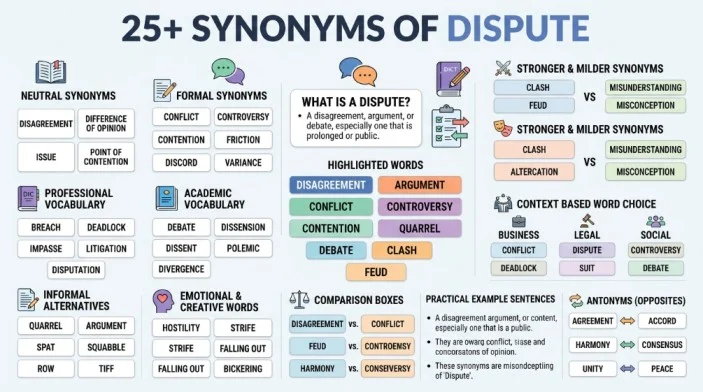
A dispute is a disagreement, conflict, or argument between people or groups, or an act of questioning or challenging a claim. The best alternatives include disagreement for neutral writing, conflict for serious opposition, controversy for public issues, argument for everyday use, and contention for formal or academic writing.
Meaning, Tone, and Context
Simple Definition
A dispute is a disagreement in which two or more people or groups have opposing views, claims, interests, or positions.
The word can also function as a verb. To dispute something means to question, challenge, deny, or argue against its truth, accuracy, validity, or ownership.
For example:
The two neighbors were involved in a property dispute.
Here, dispute refers to the disagreement itself.
The researchers disputed the accuracy of the report.
Here, disputed means they challenged whether the report was accurate.
Part of Speech
Dispute can be used as both a noun and a verb.
Noun:
“The dispute lasted several months.”
Verb:
“The company disputed the charge.”
Overall Tone
The tone of dispute is generally neutral, although it can become negative depending on the situation.
It does not automatically suggest anger. A dispute can involve a formal disagreement between organizations, a legal disagreement over property, or a simple argument between individuals.
Formality Level
Dispute is a neutral to semi formal word. It works comfortably in everyday speech, journalism, business writing, legal contexts, and academic discussions.
It is often more formal than words such as fight or squabble.
Common Uses
Native English speakers commonly use dispute when discussing:
- Legal disagreements
- Property disagreements
- Business conflicts
- Contract disagreements
- Political controversies
- Workplace disagreements
- Financial claims
- Historical disagreements
- Academic disagreements
- Personal arguments
Common combinations include:
- labor dispute
- legal dispute
- property dispute
- contract dispute
- financial dispute
- family dispute
- territorial dispute
- political dispute
- bitter dispute
- ongoing dispute
Word Forms
| Form | Example |
|---|---|
| Noun | “The dispute continued for weeks.” |
| Verb | “She disputed the claim.” |
| Noun, plural | “Several disputes were reported.” |
| Related adjective | “disputed territory” |
| Related noun | “disagreement” |
When and How to Use “Dispute”
Use dispute when you want to describe a disagreement that involves competing opinions, claims, rights, interests, or positions. It is particularly useful when the disagreement has some substance or consequence rather than being a momentary emotional reaction.
Professional
“The two companies entered a dispute over the terms of the contract.”
Academic
“Scholars continue to dispute the interpretation of the historical evidence.”
Workplace
“The employees and management were involved in a dispute over scheduling.”
Personal
“The siblings had a dispute about how to divide their parents’ belongings.”
“We are contacting you regarding a dispute concerning the recent invoice.”
Resume
“Resolved customer disputes while maintaining professional relationships.”
Social Media
“The announcement sparked a public dispute among community members.”
Best Synonyms of “Dispute”
No single synonym works perfectly in every context. The best word depends on what kind of disagreement you are describing and how strong, formal, emotional, or public you want the wording to sound.
Professional Writing: Conflict
Conflict is useful when opposing interests or goals create a serious disagreement.
“The manager helped resolve a conflict between two departments.”
It sounds professional and works well in workplace and organizational contexts.
Academic Writing: Contention
Contention is especially useful when describing a disputed position, claim, or point of argument.
“The author’s central contention is challenged by recent evidence.”
It gives academic writing a more precise and formal tone.
Business Communication: Disagreement
Disagreement is often the safest professional alternative because it sounds neutral and does not automatically suggest hostility.
“The teams reached an agreement after discussing their disagreement.”
Casual Conversation: Argument
Argument is more natural than dispute in many everyday situations.
“They had an argument about where to go for dinner.”
Emotional Writing: Quarrel
Quarrel suggests a personal and often emotional disagreement.
“The old friends had a bitter quarrel.”
Creative Writing: Clash
Clash creates a stronger sense of opposing personalities, ideas, or forces.
“Their opposing ambitions eventually led to a dramatic clash.”
Resume Writing: Conflict
Conflict is useful when describing a professional skill such as conflict resolution.
“Successfully resolved workplace conflicts and improved team communication.”
Workplace Communication: Disagreement
Use disagreement when you want to acknowledge different views without making the situation sound hostile.
“The team had a disagreement about the proposed timeline.”
Stronger Meaning: Conflict
Conflict can suggest deeper or more sustained opposition than a simple disagreement.
Softer Meaning: Difference of Opinion
Difference of opinion is a diplomatic alternative when people disagree but remain respectful.
“The committee members had a difference of opinion regarding the proposal.”
When Not to Use “Dispute”
When You Mean a Simple Difference of Opinion
Dispute can sound more serious than necessary.
Less suitable:
“We had a dispute about which movie to watch.”
Better:
“We had a difference of opinion about which movie to watch.”
When the Situation Is Highly Emotional
If people are shouting or behaving aggressively, dispute may not fully capture the emotional intensity.
Less vivid:
“The two men had a dispute outside the restaurant.”
Better:
“The two men had a heated altercation outside the restaurant.”
When You Mean a Publicly Debated Issue
A disagreement that attracts widespread public attention may be better described as a controversy.
Less precise:
“The policy caused a dispute.”
Better:
“The policy caused a public controversy.”
When You Mean a Formal Academic Position
In scholarly writing, contention may communicate the specific disputed claim more precisely.
General:
“The paper disputes this idea.”
More precise:
“The paper challenges this contention.”
When You Mean a Friendly Discussion
Dispute can sound unnecessarily serious.
Less natural:
“We had a dispute about the best restaurant.”
Better:
“We had a debate about the best restaurant.”
When You Need a Stronger Word
If the disagreement involves sustained hostility, feud may be more appropriate.
General:
“The families have been in a dispute for years.”
Stronger:
“The families have been involved in a long running feud.”
Words Commonly Confused With “Dispute”
| Word | Difference | When to Use It | Example |
|---|---|---|---|
| Argument | Usually an exchange of opposing opinions, sometimes emotional. | Everyday disagreements. | “They had an argument over money.” |
| Conflict | Broader and often more serious opposition between people or groups. | Workplace, political, or organizational problems. | “The conflict affected the entire department.” |
| Controversy | A disputed issue that attracts public discussion. | Politics, media, public debates. | “The decision created controversy.” |
| Debate | A structured discussion involving opposing views. | Schools, politics, formal discussions. | “The students held a debate about climate policy.” |
| Quarrel | A personal and often emotional disagreement. | Friends, couples, or family members. | “The couple had a quarrel.” |
| Feud | A prolonged and often hostile conflict. | Families, groups, organizations. | “The two families have been in a feud for years.” |
Best Synonyms of “Dispute” by Context
| Context | Best Synonym | Why It Works | Example |
|---|---|---|---|
| Formal writing | Contention | Clearly identifies a disputed position. | “The contention requires further evidence.” |
| Academic writing | Disagreement | Neutral and objective. | “The researchers expressed disagreement.” |
| Professional communication | Conflict | Useful for workplace opposition. | “The manager resolved the conflict.” |
| Business emails | Disagreement | Diplomatic and professional. | “We hope to resolve this disagreement.” |
| Resume writing | Conflict | Common in conflict resolution language. | “Resolved customer conflicts efficiently.” |
| Workplace communication | Difference of opinion | Reduces unnecessary hostility. | “The team had a difference of opinion.” |
| Casual conversation | Argument | Natural everyday vocabulary. | “They had an argument yesterday.” |
| Everyday speaking | Disagreement | Simple and neutral. | “We had a disagreement about the plan.” |
| Creative writing | Clash | Adds dramatic force. | “Their ambitions created a clash.” |
| Storytelling | Quarrel | Suggests personal emotion. | “The siblings had a bitter quarrel.” |
| Emotional writing | Feud | Shows lasting hostility. | “The families were trapped in a bitter feud.” |
| Strong emphasis | Conflict | Suggests serious opposition. | “The conflict threatened the partnership.” |
| Mild tone | Difference of opinion | Sounds respectful and diplomatic. | “It was simply a difference of opinion.” |
| Social media captions | Controversy | Useful for public disputes. | “The decision sparked controversy.” |
| American English | Disagreement | Common and natural across contexts. | “They reached an agreement after a disagreement.” |
| British English | Disagreement | Also natural and widely understood. | “The disagreement was discussed by both sides.” |
How to Choose the Best Synonym of “Dispute”
Choosing a synonym becomes easier when you identify exactly what kind of disagreement you mean.
If the disagreement is neutral
Choose disagreement.
“The two experts had a disagreement about the results.”
If the disagreement is serious
Choose conflict.
“The conflict affected several departments.”
If it is publicly discussed
Choose controversy.
“The decision caused widespread controversy.”
If it is a structured exchange of ideas
Choose debate.
“The candidates participated in a televised debate.”
If it is personal and emotional
Choose quarrel or argument.
“The couple had a heated argument.”
If it has continued for a long time
Choose feud.
“The two families have been involved in a feud for decades.”
If you are challenging a claim
Use question, challenge, contest, or dispute as a verb.
“The lawyer challenged the accuracy of the evidence.”
Consider Your Audience
A business email usually benefits from diplomatic language such as disagreement or difference of opinion.
An academic paper may require contention, disagreement, or controversy, depending on the subject.
Real Life Examples of “Dispute”
School
Basic:
“The students had a dispute about the project.”
More precise:
“The students had a disagreement about how to divide the project.”
College
Basic:
“The researchers disputed the conclusion.”
More precise:
“The researchers challenged the study’s conclusion.”
Workplace
Basic:
“The employees had a dispute with management.”
More precise:
“The employees had a conflict with management over scheduling.”
Business
Basic:
“The companies had a dispute over payment.”
More precise:
“The companies entered a commercial dispute over payment terms.”
Basic:
“We received your dispute.”
More professional:
“We received your objection regarding the invoice and are reviewing the matter.”
Resume
Basic:
“Handled disputes.”
Stronger:
“Resolved customer conflicts while maintaining positive client relationships.”
Conversation
Basic:
“My brother and I had a dispute.”
Natural:
“My brother and I had an argument.”
Storytelling
Basic:
“The two leaders had a dispute.”
More vivid:
“The two leaders became locked in a bitter clash.”
Blogging
Basic:
“The proposal caused a dispute.”
More precise:
“The proposal sparked a public controversy.”
Social Media
Basic:
“The announcement led to a dispute.”
More natural:
“The announcement triggered a heated online debate.”
25 Best Synonyms of “Dispute”
| Synonym | Simple Meaning | Best Used For | Example Sentence |
|---|---|---|---|
| Argument | An exchange of opposing views | Everyday disagreements | “They had an argument about the budget.” |
| Disagreement | A difference between opinions | Neutral communication | “The two managers had a disagreement.” |
| Conflict | Serious opposition between people or groups | Workplace and organizational situations | “The conflict affected team performance.” |
| Controversy | A public disagreement about an issue | Politics, media, public matters | “The decision created considerable controversy.” |
| Contention | A disputed claim or position | Academic and formal writing | “This contention requires stronger evidence.” |
| Quarrel | A personal and often emotional disagreement | Family and personal situations | “The friends had a quarrel over money.” |
| Altercation | A heated verbal or physical confrontation | Serious personal incidents | “Police responded to an altercation outside the venue.” |
| Wrangle | A prolonged or difficult disagreement | Informal and journalistic writing | “The two sides continued to wrangle over the contract.” |
| Feud | A long lasting hostile disagreement | Families, groups, organizations | “The companies became involved in a lengthy feud.” |
| Clash | A forceful disagreement between opposing sides | Ideas, personalities, groups | “Their political views often clash.” |
| Squabble | A petty or relatively unimportant argument | Informal situations | “The children had a squabble over the toy.” |
| Strife | Serious or prolonged conflict | Formal and literary writing | “Years of political strife weakened the region.” |
| Dissension | Disagreement within a group | Formal and organizational writing | “Dissension within the committee delayed the decision.” |
| Discord | A lack of agreement or harmony | Formal, social, and literary contexts | “The dispute created discord among the members.” |
| Friction | Tension caused by repeated disagreement | Workplace and relationships | “Friction developed between the two departments.” |
| Debate | A discussion involving opposing views | Academic and public discussion | “The proposal sparked a lively debate.” |
| Difference of opinion | A polite disagreement | Diplomatic communication | “They had a difference of opinion about the plan.” |
| Contest | An act of challenging a claim, decision, or result | Legal and formal contexts | “The company decided to contest the ruling.” |
| Challenge | An act of questioning validity or authority | Formal and professional writing | “The lawyer challenged the evidence.” |
| Question | To express doubt about something | Claims, evidence, decisions | “Experts questioned the reliability of the data.” |
| Oppose | To actively disagree with or resist something | Policies, proposals, decisions | “Several members opposed the proposal.” |
| Contradict | To state that something is incorrect or untrue | Statements and claims | “The evidence contradicts his account.” |
| Impugn | To challenge the truth, validity, or integrity of something | Very formal writing | “The article impugned the reliability of the findings.” |
| Take issue with | To disagree with something | Professional and conversational writing | “The reviewer took issue with the author’s conclusion.” |
| Refute | To show that a claim is false or incorrect | Academic and argumentative writing | “The evidence refuted the original claim.” |
Synonyms of “Dispute” by Usage
Professional vs Personal Synonyms
Professional situations generally benefit from neutral and controlled language.
Use disagreement, conflict, contention, and difference of opinion when you want to describe an issue without unnecessarily escalating its tone.
Personal situations can use argument, quarrel, squabble, or feud, depending on the seriousness and duration.
Formal vs Conversational Synonyms
For reports and essays, consider:
- Contention
- Disagreement
- Controversy
- Dissension
- Conflict
For casual conversations, consider:
- Argument
- Disagreement
- Quarrel
- Squabble
- Clash
A phrase such as difference of opinion is particularly useful when you want to sound diplomatic.
Academic Synonyms
Academic writing benefits from precise distinctions.
Contention works when referring to a specific claim.
Controversy works when discussing a widely debated issue.
Debate works when opposing positions are being discussed systematically.
Challenge works when a researcher questions an established interpretation.
Refute is appropriate when evidence is used to demonstrate that a claim is incorrect.
Professional and Business Synonyms
- For resumes, conflict is useful in phrases such as conflict resolution.
- For interviews, disagreement can help describe a professional difference without sounding unnecessarily negative.
- For meetings, difference of opinion can keep the tone diplomatic.
- For client communication, disagreement or issue may be more tactful than quarrel.
- For business emails involving formal claims, dispute itself is often the most precise choice.
Creative and Literary Synonyms
Creative writing has more freedom to use emotionally expressive alternatives.
Clash suggests opposing forces or personalities.
Quarrel suggests a personal emotional disagreement.
Feud implies a long history of hostility.
Strife creates a more serious or literary tone.
Wrangle can give a scene a persistent, sometimes slightly humorous quality.
Slang or Modern Synonyms
There is no single slang word that perfectly replaces dispute in every situation.
Expressions such as beef can refer informally to an ongoing grievance or conflict, especially in casual speech and online culture.
“The two influencers have some beef.”
However, beef should generally be avoided in academic papers, resumes, formal emails, legal writing, and professional reports.
Strongest to Mildest Synonyms
There is no universal intensity ranking because context changes the strength of a word. Still, the following scale provides a useful general guide.
| Level | Useful Words | Typical Effect |
|---|---|---|
| Mild | Difference of opinion, disagreement | Neutral and controlled |
| Moderate | Argument, debate, contention | Clear opposition |
| Strong | Conflict, clash, controversy | Serious or public opposition |
| Very Strong | Altercation, feud, strife | Intense, prolonged, or hostile disagreement |
A difference of opinion may involve two respectful people who simply see an issue differently.
A feud usually suggests a much deeper and longer lasting relationship problem.
Emotional vs Neutral Synonyms
Emotional Synonyms
These words can make a disagreement sound more intense:
- Quarrel
- Altercation
- Feud
- Clash
- Squabble
- Strife
Use them when the emotional character of the disagreement matters.
Neutral Synonyms
These alternatives communicate disagreement without adding unnecessary emotional force:
- Disagreement
- Difference of opinion
- Contention
- Debate
- Conflict
- Dispute
Neutral vocabulary is usually the better choice for professional, academic, and diplomatic communication.
Antonyms of “Dispute”
Because dispute can describe both disagreement and the act of challenging something, its opposites vary slightly by context.
| Antonym | Meaning | Example Sentence |
|---|---|---|
| Agreement | Shared acceptance of an idea or decision | “The teams reached an agreement.” |
| Accord | Formal or harmonious agreement | “The countries finally reached an accord.” |
| Consensus | General agreement among a group | “The committee reached a consensus.” |
| Harmony | A state of peaceful agreement | “The neighbors lived together in harmony.” |
| Acceptance | Willingness to recognize something as valid | “The company showed acceptance of the proposal.” |
| Approval | Positive support for something | “The board gave its approval.” |
| Consent | Permission or agreement | “The participants provided their consent.” |
| Concurrence | Agreement with an opinion or decision | “The director expressed concurrence with the recommendation.” |
| Cooperation | Working together toward a shared goal | “Both departments agreed to cooperate.” |
| Unity | Agreement and togetherness | “The organization emphasized unity.” |
| Compliance | Acting according to a rule or request | “The company demonstrated compliance with the regulations.” |
| Reconciliation | Restoration of friendly relations | “The families worked toward reconciliation.” |
| Understanding | Shared recognition or agreement | “Both sides reached an understanding.” |
| Peace | Absence of conflict or hostility | “The agreement brought peace to the region.” |
| Conformity | Agreement with established standards or expectations | “The design meets industry conformity standards.” |
Comparison: “Dispute” vs Similar Words
Dispute vs Argument
Main Difference
A dispute can be formal, legal, financial, or organizational. An argument is usually a direct exchange of opposing views and is more common in everyday speech.
Which Is Stronger?
Neither is always stronger. Argument can sound more emotional, while dispute can sound more formal.
Which Is More Formal?
Dispute is generally more formal.
When to Use Each
Use argument for ordinary personal disagreements. Use dispute for formal disagreements involving claims, rights, money, contracts, or competing interests.
Examples
Dispute: “The companies entered a dispute over the contract.”
Argument: “The brothers had an argument about the car.”
Dispute vs Conflict
Main Difference
A conflict usually suggests broader or deeper opposition. A dispute often focuses on a particular issue.
Which Is Stronger?
Conflict often sounds stronger.
Which Is More Formal?
Both are suitable for formal writing.
When to Use Each
Use dispute for a specific disagreement. Use conflict for broader tension or opposing interests.
Examples
Dispute: “The parties had a dispute over ownership.”
Conflict: “The conflict damaged their relationship.”
Dispute vs Controversy
Main Difference
A controversy usually involves an issue that attracts public attention or disagreement. A dispute can remain private.
Which Is Stronger?
They describe different qualities rather than simple levels of strength.
Which Is More Formal?
Both are common in formal writing.
When to Use Each
Use controversy for public issues and dispute for specific disagreements.
Examples
Dispute: “The neighbors had a dispute over the boundary.”
Controversy: “The decision caused a national controversy.”
Dispute vs Debate
Main Difference
A debate is generally a structured discussion between opposing positions. A dispute emphasizes disagreement or conflict.
Which Is Stronger?
Dispute can sound more confrontational.
Which Is More Formal?
Both can be formal.
When to Use Each
Use debate when opposing views are being discussed. Use dispute when the disagreement itself is the focus.
Examples
Dispute: “The researchers disputed the conclusion.”
Debate: “The researchers debated the best interpretation.”
Dispute vs Quarrel
Main Difference
A quarrel is usually personal and emotional. A dispute can be impersonal and formal.
Which Is Stronger?
Quarrel can sound more emotionally charged.
Which Is More Formal?
Dispute is more formal.
When to Use Each
Use quarrel for personal relationships. Use dispute for formal or substantive disagreements.
Examples
Dispute: “The companies had a dispute over payment.”
Quarrel: “The couple had a quarrel about money.”
Dispute vs Feud
Main Difference
A feud usually refers to a prolonged and hostile conflict. A dispute can be temporary.
Which Is Stronger?
Feud generally suggests greater hostility and duration.
Which Is More Formal?
Dispute is more neutral and formal.
When to Use Each
Use feud when the disagreement has continued over time and involves hostility.
Examples
Dispute: “The neighbors had a dispute over the property line.”
Feud: “The families have been involved in a bitter feud for years.”
Common Phrases and Expressions with “Dispute”
Legal Dispute
Meaning: A disagreement involving legal rights, responsibilities, or claims.
Example:
“The two companies settled their legal dispute.”
Property Dispute
Meaning: A disagreement about ownership, boundaries, or rights involving property.
Example:
“The neighbors became involved in a property dispute.”
Contract Dispute
Meaning: A disagreement concerning the terms or interpretation of a contract.
Example:
“The contract dispute was eventually resolved through negotiation.”
Labor Dispute
Meaning: A disagreement between workers and employers, often involving pay, conditions, or employment terms.
Example:
“The labor dispute resulted in a temporary strike.”
Financial Dispute
Meaning: A disagreement involving money, payments, charges, or financial obligations.
Example:
“The customer opened a financial dispute over the charge.”
Bitter Dispute
Meaning: A disagreement marked by strong negative feelings.
Example:
“The two organizations remained locked in a bitter dispute.”
Settle a Dispute
Meaning: To resolve a disagreement.
Example:
“The mediator helped the parties settle the dispute.”
Resolve a Dispute
Meaning: To find a solution to a disagreement.
Example:
“The managers met to resolve the dispute.”
Common Mistakes to Avoid
Mistake 1: Using “Dispute” for Every Small Argument
Incorrect:
“My friends had a dispute about which pizza to order.”
Better:
“My friends had a difference of opinion about which pizza to order.”
Why:
Dispute can make a trivial disagreement sound more serious than it really is.
Mistake 2: Confusing “Dispute” With “Controversy”
Incorrect:
“The private disagreement between the coworkers became a national controversy.”
Better:
“The issue became a national controversy after receiving widespread attention.”
Why:
Controversy normally involves broader public discussion.
Mistake 3: Using “Quarrel” in Professional Writing
Incorrect:
“The managers had a quarrel about the budget.”
Better:
“The managers had a disagreement about the budget.”
Why:
Quarrel sounds personal and emotional, which may be inappropriate in formal workplace writing.
Mistake 4: Using “Conflict” When You Mean a Simple Difference
Incorrect:
“The two students had a conflict over which color to use.”
Better:
“The two students had a disagreement over which color to use.”
Why:
Conflict can imply a deeper or more serious problem.
Mistake 5: Using “Debate” for a Hostile Disagreement
Incorrect:
“The two companies had a debate over the contract.”
Better:
“The two companies had a dispute over the contract.”
Why:
Debate usually suggests a structured exchange of ideas rather than a substantive conflict over rights or obligations.
Mistake 6: Using Strong Language for a Mild Situation
Incorrect:
“The committee was involved in a bitter feud over the meeting time.”
Better:
“The committee had a difference of opinion about the meeting time.”
Why:
Feud implies prolonged hostility and is far too strong for a minor scheduling issue.
Mistake 7: Treating Every Synonym as Identical
Incorrect:
“The public controversy was simply an argument.”
Better:
“The public controversy involved a broader disagreement over the policy.”
Why:
Related words often overlap in meaning but differ in scope, tone, intensity, or context.
Frequently Asked Questions
What is a good synonym for dispute?
A good synonym for dispute depends on context. Common choices include argument, disagreement, conflict, controversy, and debate.
What are the main dispute synonyms?
Common dispute synonyms include argument, disagreement, conflict, quarrel, controversy, and contention. Each can have a slightly different tone or meaning.
What is another word for dispute?
Disagreement is a common another word for dispute, especially when two people or groups have different opinions.
What is another word for disputes?
Depending on the context, disagreements, conflicts, arguments, controversies, or quarrels can be used as another word for disputes.
What is another word for disputed?
Possible alternatives include challenged, contested, questioned, opposed, and debated. The best choice depends on the sentence.
What does dispute mean?
Dispute means a disagreement, argument, or conflict between people or groups. It can also mean to question or challenge whether something is true or correct.
What are dispute meaning synonyms?
Dispute meaning synonyms include disagreement, argument, conflict, controversy, quarrel, and contention. The most accurate synonym depends on the situation.
Is “dispute” formal or informal?
Dispute is generally neutral and can sound moderately formal. It is common in everyday English as well as academic, legal, business, and professional writing.
What is “dispute synonyme” in English?
Dispute synonyme is likely a search variation for “dispute synonym.” In English, common alternatives include disagreement, argument, conflict, and controversy.
What are the best synonyms of “dispute”?
The best alternatives include disagreement, argument, conflict, controversy, contention, quarrel, and clash. Choose based on whether the disagreement is neutral, personal, public, formal, or intense.
What are the best formal synonyms of “dispute”?
Strong formal alternatives include contention, disagreement, conflict, controversy, dissension, and discord. In academic writing, contention is especially useful when referring to a specific disputed claim.
What are common informal synonyms of “dispute”?
Common informal alternatives include argument, quarrel, squabble, and clash. Argument is the most natural everyday choice, while squabble suggests a relatively minor disagreement.
What is another word for “dispute” in professional writing?
Disagreement, conflict, and difference of opinion are useful professional alternatives. For formal claims or contractual matters, however, dispute itself may be more precise and appropriate.
What is the difference between “dispute” and “argument”?
A dispute can be formal, legal, business related, or personal, while an argument usually refers to an exchange of opposing opinions. Argument is generally more common in casual conversation.
What is the opposite of “dispute”?
The clearest opposites are agreement, accord, consensus, and harmony. For the verb dispute, related opposites include accept, approve, and agree, depending on the sentence.
Conclusion
A dispute is a disagreement, conflict, or challenge involving opposing views, claims, interests, or positions. Its meaning can range from a private disagreement to a formal legal or business conflict, so context matters when selecting an alternative.
The best synonym of dispute depends on what you want to communicate. Use disagreement for a neutral tone, argument for everyday situations, conflict for serious opposition, controversy for public issues, contention for formal claims, and quarrel or feud when personal emotion or prolonged hostility is central.
No synonym works perfectly in every sentence. Before replacing dispute, consider the meaning, audience, emotional strength, and level of formality. A useful vocabulary habit is to identify the exact type of disagreement first, then choose the word that describes it most precisely.
Read More Related Articles:
- 25+ Synonyms, Meanings, Uses, Examples, and Best …
- Meaning, Uses, Examples, and the Best Synonym of Complain
- 25+ Synonyms of Frequency | Meanings, Uses, Examples …