Words like “and” seem simple, but they do a lot of work. They connect ideas, combine details, and keep sentences flowing. Still, repeating the same conjunction can make writing feel flat. That is where synonyms of and become useful. Depending on the context, writers may need a phrase that adds information, shows a relationship, or creates a smoother transition.
Finding an and synonym is not always as simple as replacing one word with another. English has several alternatives, but many work only in specific situations. An and thesaurus can offer options, while understanding grammar helps you choose the right one. This guide explores and synonyms, the synonym of and, and another word for and with clear examples. It also covers synonym and, synonyms and, and other words for and so you can use each option naturally. For readers searching for and ka synonym, the goal is simple: find accurate alternatives that fit the sentence, tone, and meaning.
What Are the Best Synonyms of “And”?
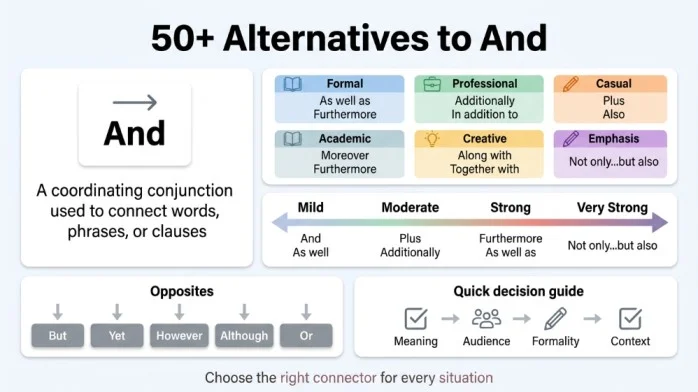
And is a coordinating conjunction used to join words, phrases, or clauses. Since it is a grammatical function word, it does not have direct synonyms in the traditional sense. However, in many contexts, you can replace and with alternatives like as well as, along with, together with, plus, in addition to, furthermore, moreover, besides, also, too, additionally, including, not to mention, with, coupled with, combined with, accompanied by, and also, plus also, alongside, next to, together, as well, in conjunction with, not only…but also, both…and, apart from, other than, aside from, besides, beyond, and in addition. The right choice depends on the context, meaning, and level of formality you want to convey.
Meaning, Tone, and Context
Simple Definition
And is a coordinating conjunction used to connect words, phrases, or clauses that have equal grammatical weight or importance.
Part of Speech
Coordinating conjunction
Overall Tone
The word is neutral. It simply connects ideas without adding emotion or emphasis.
Formality Level
And is considered neutral and appears naturally in all types of communication, from casual conversations to formal academic writing.
Common Uses
Native English speakers commonly use and when:
- Connecting two or more items in a list
- Showing addition or combination
- Linking related ideas or actions
- Connecting causes and effects
- Joining two parts of a compound subject or object
Alternatives by Function
| Function | Alternatives |
|---|---|
| Addition | As well as, along with, in addition to, plus, furthermore, moreover |
| Consequence | And so, therefore, thus, consequently |
| Comparison | Both…and, as well as, equally |
| Contrast | While, whereas, but, yet |
| Condition | Provided that, as long as |
When and How to Use “And”
The word and works well whenever you want to connect related ideas or items. However, choosing a more specific alternative can make your message clearer and more impactful.
Professional
“The report includes sales data, customer feedback, and recommendations for improvement.”
Academic
“The study examined both quantitative and qualitative data to draw meaningful conclusions.”
Workplace
“We need to review the proposal, approve the budget, and begin implementation.”
Personal
“I love traveling, reading, and spending time with my family.”
“Please review the attached document and send me your feedback by Friday.”
Resume
“Managed project timelines, coordinated team efforts, and delivered results on schedule.”
Social Media
“Today was filled with laughter, joy, and unforgettable moments with friends.”
Best Alternatives to “And”
The word and is useful because it appears in almost every type of writing, but no single alternative works perfectly in every situation. Some alternatives emphasize addition, while others highlight contrast, consequence, or inclusion. Choosing the right connector helps your writing sound more natural and precise.
Professional Writing: As well as
As well as is one of the strongest professional alternatives to and. It connects items while emphasizing inclusion.
Example:
“The manager, as well as the team, contributed to the project’s success.”
Why it works:
Business writing benefits from precise language, and as well as clearly communicates inclusion.
Academic Writing: Furthermore
In essays, research papers, and reports, furthermore is often a better choice than and because it connects ideas while adding emphasis.
Example:
“The results were consistent. Furthermore, they aligned with previous research.”
Why it works:
It sounds objective, formal, and academically appropriate.
Business Communication: Additionally
Additionally indicates that something is being added to what has already been stated.
Example:
“The company increased revenue. Additionally, it expanded into new markets.”
Why it works:
It immediately communicates that new information is being introduced.
Casual Conversation: Plus
For everyday speaking, plus sounds natural without becoming overly formal.
Example:
“I love this restaurant, plus the prices are reasonable.”
Why it works:
Native English speakers frequently use plus to add information in conversation.
Emotional Writing: Along with
When discussing personal experiences or emotions, along with is usually more expressive than and.
Example:
“Her kindness, along with her patience, made a lasting impression on me.”
Why it works:
It emphasizes the combination of qualities.
Creative Writing: Together with
Creative writing often benefits from descriptive vocabulary. Together with helps create stronger imagery.
Example:
“The wind, together with the rain, created a haunting melody.”
Why it works:
It captures the reader’s attention and adds depth to storytelling.
Resume Writing: Alongside
Recruiters frequently see alongside because it highlights collaboration and combined efforts.
Example:
“Worked alongside cross-functional teams to deliver innovative solutions.”
Why it works:
It sounds concise, professional, and achievement-focused.
Workplace Communication: In addition to
In addition to emphasizes that something is extra or supplementary.
Example:
“In addition to managing the team, she developed new training programs.”
Why it works:
It communicates additional responsibility while maintaining a professional tone.
Stronger Emphasis: Not only…but also
When you need stronger emphasis, not only…but also is one of the best replacements for and.
Example:
“She not only completed the project but also exceeded expectations.”
Why it works:
It suggests that both items are significant and worthy of attention.
Softer Emphasis: Along with
Sometimes you want to connect items without making them sound equally important.
Example:
“The manager, along with the team, attended the conference.”
Why it works:
It gives moderate emphasis without exaggeration.
When Not to Use “And”
Although and is versatile, it is not always the most effective word. In many situations, a more specific connector communicates your message more clearly.
When It Sounds Too Repetitive
Sometimes and is used too often and makes writing feel choppy.
Less Effective
“I went to the store and bought milk and bread and eggs.”
Better
“I went to the store to buy milk, bread, and eggs.”
Why
Using commas to separate items creates a smoother flow.
When Connecting Too Many Ideas
Using and repeatedly can make sentences confusing.
Less Effective
“She studied hard and passed the exam and got a scholarship and started her career.”
Better
“She studied hard, passed the exam, and started her career.”
Why
Limiting the number of connected ideas improves clarity.
In Academic Writing
Academic writing usually favors more precise connectors.
Less Effective
“The data was analyzed and the results were published.”
Better
“The data was analyzed, and the results were published.”
Why
Using a comma before and in a compound sentence is often preferred in formal writing.
On a Resume
General wording often reduces the impact of your achievements.
Less Effective
“Managed projects and teams.”
Better
“Managed projects alongside cross-functional teams.”
Why
Alongside adds a more collaborative tone.
In Creative Writing
Using and repeatedly can make storytelling feel flat.
Less Effective
“The sun set and the stars appeared and the moon rose.”
Better
“The sun set, stars appeared, and the moon rose.”
Why
Using commas creates stronger imagery and a more sophisticated style.
When Expressing Contrast
If you want to show contrast, and is not the right word.
Less Effective
“He was tired and he continued working.”
Better
“He was tired, yet he continued working.”
Why
Yet clearly indicates the contrast between being tired and continuing to work.
Words Commonly Confused with “And”
| Word | Difference | When to Use It | Example |
|---|---|---|---|
| As well as | Emphasizes inclusion along with the main item | Formal writing | “The CEO, as well as the board, approved the plan.” |
| Additionally | Adds new information | Academic, professional writing | “The report was accurate. Additionally, it was thorough.” |
| Furthermore | Adds information with emphasis | Formal, academic writing | “The research was groundbreaking. Furthermore, it was replicable.” |
| Moreover | Adds information with stronger emphasis | Formal writing | “The plan was ambitious. Moreover, it was achievable.” |
| Plus | Adds information in a casual way | Everyday conversation | “I love the food here, plus the service is great.” |
| Along with | Emphasizes togetherness | Personal, professional writing | “Her dedication, along with her skills, made her successful.” |
| Together with | Emphasizes combination | Creative, formal writing | “His passion, together with his talent, created something amazing.” |
| Not only…but also | Emphasizes both items strongly | Formal, persuasive writing | “She not only led the team but also mentored new employees.” |
Best Alternatives to “And” by Context
| Context | Best Alternative | Why It Works | Example |
|---|---|---|---|
| Formal Writing | As well as | Sounds precise and professional. | “The findings, as well as the recommendations, were presented.” |
| Academic Writing | Furthermore | Fits research and essays naturally. | “The results were consistent. Furthermore, they were statistically significant.” |
| Professional Communication | Additionally | Highlights added information. | “The project was completed on time. Additionally, it was under budget.” |
| Business Emails | Also | Concise and professional. | “Please review the report and also share your feedback.” |
| Resume Writing | Alongside | Emphasizes collaboration. | “Worked alongside engineers to develop software solutions.” |
| Workplace Communication | In addition to | Stresses extra responsibilities. | “In addition to her regular duties, she managed the new initiative.” |
| Casual Conversation | Plus | Sounds natural in daily speech. | “I love that movie, plus the soundtrack is amazing.” |
| Everyday Speaking | Also | Common informal alternative. | “I also think we should wait.” |
| Creative Writing | Together with | Adds vivid description. | “The music, together with the lighting, created a magical atmosphere.” |
| Storytelling | Not only…but also | Shows multiple significant elements. | “He not only saved the day but also inspired others.” |
| Emotional Writing | Along with | Expresses personal connection. | “Her kindness, along with her wisdom, guided me.” |
| Strong Emphasis | Not only…but also | Indicates both items are important. | “She not only excelled but also led others to excellence.” |
| Mild Tone | As well | Gives moderate emphasis. | “I’ll bring the food as well.” |
| Social Media Captions | Plus | Sounds engaging and natural. | “Great weather today, plus amazing company!” |
| American English | Also | Frequently used in business and media. | “We also need to consider the budget.” |
| British English | As well | Common in formal and everyday usage. | “The project was successful as well.” |
Alternatives to “And” by Usage
The word and works in almost every situation, but choosing a more specific alternative makes your writing stronger and more natural. The sections below explain which alternatives fit different types of communication.
Professional vs Personal Alternatives
Professional communication requires precise vocabulary, while personal conversations sound better with simpler, more relatable words.
Professional Alternatives
| Alternative | Best Used For | Why It Works |
|---|---|---|
| As well as | Reports, policies | Shows inclusion and addition. |
| Additionally | Business priorities | Introduces new information. |
| Furthermore | Presentations | Adds emphasis to ideas. |
| In addition to | Professional documents | Highlights extra items. |
| Alongside | Workplace communication | Emphasizes collaboration. |
Recommendation
Use as well as, additionally, or in addition to in resumes, business emails, presentations, and reports because they sound more precise than and.
Personal Alternatives
| Alternative | Best Used For | Example |
|---|---|---|
| Plus | Daily conversations | “I love this place, plus it’s affordable.” |
| Also | Casual speaking | “I also think we should go.” |
| As well | Casual speaking | “I’ll come as well.” |
| Together with | Personal events | “Her laugh, together with her smile, brightened the room.” |
Recommendation
In conversations with friends and family, natural words like plus, also, and as well often sound better than overly formal alternatives.
Formal vs Conversational Alternatives
Choosing the right level of formality helps your writing match the audience.
| Situation | Best Alternatives |
|---|---|
| Reports | Furthermore, Additionally, As well as |
| Essays | Moreover, Furthermore, Additionally |
| Business Writing | Additionally, In addition to, As well as |
| Presentations | Furthermore, Additionally, As well as |
| Professional Emails | Also, Additionally, As well as |
| Casual Conversations | Plus, Also, As well |
| Text Messages | Plus, Also, Too |
Example
Formal:
“The results were promising. Furthermore, they were consistent with previous studies.”
Conversational:
“I loved the movie, plus the acting was great.”
Academic Alternatives
Academic writing benefits from vocabulary that sounds precise and objective.
Furthermore
Commonly used when adding information with emphasis.
Example
“The methodology was sound. Furthermore, the results were replicable.”
Moreover
Best for adding information with stronger emphasis.
Example
“The study was comprehensive. Moreover, it addressed all key variables.”
Additionally
Ideal when introducing new information.
Example
“The sample was representative. Additionally, the data collection was thorough.”
As well as
Appropriate when connecting items of equal importance.
Example
“The researcher collected quantitative, as well as qualitative, data.”
In addition to
Useful when highlighting supplementary information.
Example
“In addition to the survey, interviews were conducted.”
Recommendation
For essays and research papers, furthermore, moreover, and additionally usually sound stronger and more authoritative than and.
Professional and Business Alternatives
Business communication often requires concise and specific language.
Additionally
Perfect for introducing new points in reports and presentations.
Example
“The company increased sales. Additionally, it expanded into new markets.”
As well as
Highlights inclusion and combination.
Example
“The marketing team, as well as the sales team, contributed to the growth.”
In addition to
Shows supplementary information.
Example
“In addition to her regular duties, she managed the new initiative.”
Furthermore
Adds emphasis to important points.
Example
“The proposal was thorough. Furthermore, it was cost-effective.”
Alongside
Emphasizes collaboration and combined effort.
Example
“Worked alongside clients to develop customized solutions.”
Recommendation
Use these alternatives in resumes, interviews, meetings, presentations, business emails, and client communication to sound more professional.
Creative and Literary Alternatives
Creative writing benefits from expressive vocabulary that creates emotion and imagery.
Together with
Adds a sense of unity and combination.
Example
“The moonlight, together with the gentle breeze, created a perfect evening.”
Along with
Emphasizes accompaniment.
Example
“Her laughter, along with her warm smile, made everyone feel welcome.”
Not only…but also
Adds dramatic emphasis.
Example
“She not only painted the portrait but also captured the subject’s soul.”
As well as
Connects items smoothly.
Example
“The colors, as well as the textures, brought the painting to life.”
Moreover
Adds depth to descriptions.
Example
“The landscape was breathtaking. Moreover, it was untouched by development.”
These words make stories, speeches, and descriptive writing more engaging.
Slang or Modern Alternatives
There are very few true slang alternatives for and, but native speakers often use casual expressions.
| Expression | Meaning | Appropriate For | Avoid In |
|---|---|---|---|
| Plus | In addition | Everyday conversations | Academic papers |
| Also | In addition | Friends, social media | Formal reports |
| And whatnot | And other similar things | Casual speech | Formal writing |
Example
Casual:
“I need to buy groceries, plus some snacks.”
Formal:
“I need to purchase groceries, as well as some snacks.”
Strongest to Mildest Alternatives
The following scale shows how different alternatives express different levels of connection and emphasis.
| Emphasis | Alternatives |
|---|---|
| Very Strong | Not only…but also, Moreover, Furthermore |
| Strong | Additionally, As well as, In addition to |
| Moderate | Plus, Also, Along with |
| Mild | As well, And, Together with |
Understanding the Scale
- Not only…but also strongly emphasizes both items.
- Moreover and Furthermore add strong emphasis to new information.
- Additionally and As well as add moderate emphasis.
- Plus and Also add casual emphasis.
- As well and Together with add mild emphasis.
Emotional vs Neutral Alternatives
Some alternatives express feelings, while others simply communicate information.
Emotional Alternatives
| Alternative | Best Used For |
|---|---|
| Together with | Personal experiences |
| Along with | Shared experiences |
| Not only…but also | Inspirational messages |
| As well as | Meaningful combinations |
These words add emotion and help readers connect with the message.
Neutral Alternatives
| Alternative | Best Used For |
|---|---|
| Additionally | Information |
| Furthermore | Academic writing |
| Moreover | Formal writing |
| Also | General writing |
| As well | General writing |
Neutral alternatives communicate information without adding unnecessary emotion.
Antonyms of “And”
Since and is a coordinating conjunction, it does not have true antonyms. However, the following words express opposite relationships such as contrast or separation.
| Antonym | Meaning | Example Sentence |
|---|---|---|
| But | Shows contrast | “She wanted to go, but she was too tired.” |
| Yet | Shows contrast despite expectation | “He tried hard, yet he failed.” |
| Or | Shows an alternative | “Would you like tea or coffee?” |
| Nor | Shows a negative alternative | “Neither the manager nor the team approved.” |
| Although | Shows contrast | “Although it was raining, they went outside.” |
| Despite | Shows contrast without prevention | “Despite the challenges, they succeeded.” |
| However | Shows contrast | “The plan was ambitious. However, it was feasible.” |
| Nevertheless | Shows contrast despite previous statement | “The weather was bad. Nevertheless, they continued.” |
| Whereas | Shows difference or contrast | “She prefers coffee, whereas he prefers tea.” |
| While | Shows contrast or simultaneity | “She was working, while he was relaxing.” |
Comparison: “And” vs Similar Words
Although and is the most common connector, several similar words carry different shades of meaning. Understanding these differences helps you choose the most accurate word for each situation.
And vs As well as
Main Difference
And connects items of equal weight. As well as emphasizes inclusion along with the main item.
Which Is Stronger?
As well as adds emphasis to the additional item.
Which Is More Formal?
As well as is more formal and precise.
When to Use Each
Use and for simple connections.
Use as well as for more formal connections.
Examples
And:
“I need milk and eggs.”
As well as:
“I need milk, as well as eggs.”
And vs Additionally
Main Difference
And connects within a sentence. Additionally connects between sentences or clauses.
Which Is Stronger?
Additionally adds more emphasis to the new information.
Which Is More Formal?
Additionally is more formal.
When to Use Each
Use and for connecting items.
Use additionally for adding new points.
Examples
And:
“We need to review the budget and make adjustments.”
Additionally:
“The budget was reviewed. Additionally, adjustments were made.”
And vs Furthermore
Main Difference
And is simple. Furthermore adds emphasis to the new information.
Which Is Stronger?
Furthermore is much stronger.
Which Is More Formal?
Furthermore is more formal and academic.
When to Use Each
Use and for casual connections.
Use furthermore for academic or formal writing.
Examples
And:
“The results were consistent, and they were significant.”
Furthermore:
“The results were consistent. Furthermore, they were significant.”
And vs Plus
Main Difference
And is neutral. Plus is casual and conversational.
Which Is Stronger?
Plus adds a conversational emphasis.
Which Is More Formal?
And is more formal.
When to Use Each
Use plus in casual conversation.
Use and in formal writing.
Examples
And:
“I need to finish this project and submit it.”
Plus:
“I need to finish this project, plus I have another meeting.”
And vs Not only…but also
Main Difference
And connects equally. Not only…but also emphasizes both items strongly.
Which Is Stronger?
Not only…but also is much stronger.
Which Is More Formal?
Both are suitable for formal writing, but not only…but also is more emphatic.
When to Use Each
Use and for simple connections.
Use not only…but also for strong emphasis.
Examples
And:
“She is talented and hardworking.”
Not only…but also:
“She is not only talented but also hardworking.”
And vs Along with
Main Difference
And connects equally. Along with emphasizes togetherness and accompaniment.
Which Is Stronger?
Along with adds a sense of unity.
Which Is More Formal?
Along with is more formal and expressive.
When to Use Each
Use along with to emphasize collaboration or combination.
Examples
And:
“The manager and the team attended.”
Along with:
“The manager, along with the team, attended.”
Common Phrases and Expressions with “And”
| Phrase | Meaning | Example Sentence |
|---|---|---|
| And so on | And continuing in the same way | “We need supplies like paper, pens, and so on.” |
| And so forth | And continuing in the same way | “The store sells books, magazines, and so forth.” |
| And the like | And similar things | “She enjoys outdoor activities like hiking, biking, and the like.” |
| And then | After that | “We went to dinner, and then we saw a movie.” |
| And yet | Despite that | “He was tired, and yet he kept working.” |
| And whatnot | And other similar things (informal) | “We need to buy decorations, food, and whatnot.” |
| And all | Everything included (informal) | “She brought her whole family and all.” |
| And such | And similar things (informal) | “We had cake, cookies, and such.” |
Common Mistakes to Avoid
1. Using “And” Instead of a Comma in Lists
Incorrect
“I need to buy milk and bread and eggs and butter.”
Better
“I need to buy milk, bread, eggs, and butter.”
Why
Using commas to separate items creates a smoother flow.
2. Overusing “And” in Sentences
Incorrect
“She went to the store and bought milk and then she came home and made breakfast.”
Better
“She went to the store, bought milk, came home, and made breakfast.”
Why
Limiting the number of ands improves readability.
3. Using “And” When “But” Is Needed
Incorrect
“She wanted to go, and she was too tired.”
Better
“She wanted to go, but she was too tired.”
Why
But clearly indicates the contrast between wanting and being tired.
4. Using “And” When “So” Is Needed
Incorrect
“He was tired, and he went to bed.”
Better
“He was tired, so he went to bed.”
Why
So clearly shows the cause and effect relationship.
5. Using “And” at the Beginning of a Sentence in Formal Writing
Incorrect
“And the results were significant.”
Better
“The results were significant.”
Why
Formal writing generally avoids starting sentences with conjunctions.
6. Confusing “And” with “Also”
Incorrect
“I also the manager approved the plan.”
Better
“The manager, as well as the team, approved the plan.”
Why
As well as connects items more naturally than also in formal writing.
7. Using Too Many “Ands” in Creative Writing
Incorrect
“The sun set and the stars appeared and the moon rose and the night grew quiet.”
Better
“The sun set, stars appeared, the moon rose, and the night grew quiet.”
Why
Varying sentence structure improves style and flow.
Frequently Asked Questions
What is a synonym for “and”?
Common alternatives include also, as well as, along with, together with, additionally, and plus, depending on the sentence.
What is another word for “and”?
Another word for and can be also, plus, additionally, or along with. The best choice depends on the context.
Does an “and thesaurus” include different alternatives?
Yes. An and thesaurus can provide alternatives such as also, moreover, furthermore, and as well as, but each has a slightly different use.
What are the common synonyms of “and”?
Common and synonyms include also, plus, as well as, along with, additionally, and moreover.
What is the synonym of “and” in formal writing?
In formal writing, alternatives such as additionally, furthermore, moreover, and as well as can work when they fit the sentence naturally.
What is “and ka synonym”?
And ka synonym can be also, plus, as well as, or along with, depending on the meaning and sentence structure.
What are the best alternatives to “and”?
The best alternatives depend on context. For addition, use as well as, along with, plus, or in addition to. For adding new information, use furthermore, moreover, or additionally. For emphasis, use not only…but also.
What are the best formal alternatives to “and”?
Strong formal alternatives include as well as, additionally, furthermore, moreover, and in addition to. These words work well in academic papers, reports, and business communication.
What are common informal alternatives to “and”?
Common informal alternatives include plus, also, as well, and too. These expressions sound natural in everyday conversations and social media posts.
What is another word for “and” in professional writing?
In professional communication, excellent alternatives include as well as, additionally, in addition to, and alongside. These words make reports, emails, resumes, and presentations sound more precise and polished.
What is the difference between “and” and “as well as”?
And connects items of equal weight. As well as emphasizes inclusion along with the main item. As well as is more formal and precise.
What is the opposite of “and”?
Since and is a coordinating conjunction, it does not have a direct opposite. However, words that express contrast like but, yet, however, and nevertheless serve as opposites in terms of relationship.
Conclusion
The word and is one of the most common words in English, but using it repeatedly can make your writing feel repetitive. Learning the best alternatives to and helps you express your ideas with greater accuracy, stronger style, and better clarity.
You’re writing an essay, preparing a business presentation, updating your resume, or having a casual conversation, no single alternative fits every situation. Words like as well as, additionally, furthermore, moreover, plus, and along with each carry unique meanings and should be chosen based on your audience, tone, and purpose.
A simple way to improve your vocabulary is to pause before writing and and ask yourself whether a more specific connector would communicate your message more clearly. Choosing the most appropriate alternative will make your writing more engaging, professional, and natural.
Read More Related Articles:
- Synonyms for Involved | Meaning, Examples, and Better Word Choices
- Synonyms for Liked| Meaning, Examples, and Better Word …