A writer can use the same word several times in an essay, blog post, caption, or school assignment without realizing how repetitive the writing has become. The same problem appears in professional communication when someone wants to describe emotional impact but cannot find a more precise expression.
Understanding synonyms of pathos makes that choice easier. Pathos refers to an emotional quality that creates feelings such as pity, sadness, sympathy, or tenderness. Depending on the situation, words such as poignancy, sorrow, compassion, sympathy, and emotional appeal can express related ideas, but they do not all carry the same meaning or emotional force.
The best alternative depends on what you want readers to feel. A formal essay may need poignancy, a personal story may call for tenderness, while persuasive communication may be better described as an emotional appeal. Choosing carefully makes writing more precise, natural, and effective.
What Are the Best Synonyms of “Pathos”?
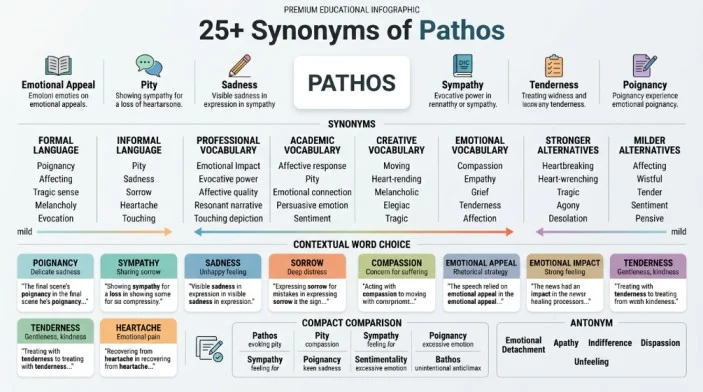
Pathos is an emotional quality that evokes pity, sadness, sympathy, or tenderness. The closest alternatives include poignancy, sadness, sorrow, pity, compassion, sympathy, and emotional appeal.Formal writing, poignancy works well. For persuasive writing, use emotional appeal. For literary writing, pathos or poignancy is often most precise.
The best word changes with context. Academic writing often favors poignancy or emotional appeal, professional communication usually benefits from clearer phrases such as emotional impact, and creative writing may use poignancy, sorrow, or tenderness.
Casual conversation tends to favor simpler words such as sadness, pity, or sympathy. No alternative perfectly replaces pathos because the word can describe both an emotional quality and the deliberate use of emotion in rhetoric.
Meaning, Tone, and Context
Simple Definition
Pathos describes an emotional quality that makes people feel pity, sympathy, sadness, tenderness, or sorrow.
It is especially common when discussing literature, speeches, films, advertising, storytelling, or persuasive communication. A scene has pathos when it moves an audience emotionally, particularly by creating sympathy for someone experiencing suffering or loss.
For example:
The final scene has considerable pathos because it shows the character saying goodbye to her family.
The sentence does not simply mean that the scene is sad. It suggests that the scene creates a powerful emotional response in the audience.
Part of Speech
Pathos is primarily a noun.
Example:
The novel uses pathos to make the character’s loss feel personal.
The plural form is rarely needed in ordinary writing. In most contexts, pathos functions as an uncountable concept referring to emotional appeal or emotional poignancy.
Overall Tone
Pathos is generally emotional and often serious.
It commonly carries associations with:
- sadness
- pity
- sympathy
- suffering
- tenderness
- loss
- vulnerability
- emotional appeal
Pathos is not automatically negative, however. A touching story can contain pathos without being entirely tragic.
Formality Level
Pathos is formal to semi formal.
It appears frequently in literary criticism, rhetoric, academic writing, journalism, film criticism, speeches, and discussions of persuasive communication.
It is less common in casual conversation. Instead of saying, “The movie uses pathos,” someone might say, “The movie is really moving” or “That scene was heartbreaking.”
Common Uses
Native English speakers commonly use pathos when discussing:
- literature
- poetry
- novels
- films
- theater
- speeches
- advertising
- political rhetoric
- storytelling
- journalism
- persuasive writing
- emotional scenes
- tragic situations
Word Forms
The main word is the noun pathos.
Related vocabulary includes:
- pathetic, which can mean evoking pity, although modern English often uses it to mean inadequate or contemptible
- pathetically, an adverb related to the emotional or pity producing sense
- pathos, the noun describing the emotional quality itself
Because pathetic has developed a strong negative meaning in everyday English, it should not automatically be treated as a simple adjective form of pathos.
When and How to Use “Pathos”
Pathos works best when you are describing emotional impact, especially when an audience is encouraged to feel sympathy, sadness, tenderness, or pity.
It is particularly useful when analyzing how a writer, speaker, filmmaker, or advertiser creates an emotional response.
Professional Context
The campaign uses pathos carefully to connect the organization with families affected by the crisis.
Here, pathos describes an intentional emotional element in communication.
Academic Context
The author creates pathos through the repeated depiction of the protagonist’s isolation.
This works well in literary analysis because it identifies an emotional technique.
Workplace Context
The presentation included some pathos by sharing a personal account from an employee.
In workplace writing, the word is appropriate when discussing presentations, campaigns, leadership communication, or storytelling.
Personal Context
There was genuine pathos in the way he described leaving his childhood home.
This use highlights the emotional quality of a personal experience.
Email Context
The customer story adds pathos to the proposal without making the message overly dramatic.
This is suitable when discussing the emotional effect of written communication.
Resume Context
Pathos is rarely a good word to place directly in a resume. Resumes usually benefit from concrete descriptions of results rather than literary terminology.
A better example is:
Developed customer stories that strengthened the emotional impact of fundraising campaigns.
The phrase emotional impact is clearer and more useful to a hiring manager.
Social Media Context
The final photograph adds real pathos to the tribute.
This is grammatically correct, but many social media users would naturally choose emotion, sadness, or heartbreak instead.
Best Synonyms of “Pathos”
No synonym is identical to pathos in every situation. Some alternatives describe the emotion itself, while others describe the audience’s response or the technique used to create that response.
Best for Professional Writing: Emotional Impact
Emotional impact is usually clearer than pathos in workplace communication.
It communicates the effect of a message without requiring the reader to understand a specialized rhetorical term.
Best for Academic Writing: Poignancy
Poignancy is a strong choice for literary or academic analysis when a passage creates a sharp, deeply moving emotional response.
The poem gains its poignancy from the speaker’s acceptance of loss.
Best for Business Communication: Emotional Appeal
Emotional appeal is useful when discussing advertising, marketing, fundraising, presentations, or persuasion.
It clearly identifies emotion as part of a communication strategy.
Best for Casual Conversation: Sadness
Sadness is much more familiar in everyday speech.
The ending was filled with sadness.
It is simpler than pathos but less specific about the rhetorical or artistic quality involved.
Best for Emotional Writing: Poignancy
Poignancy works particularly well when you want to describe emotion that feels deep, touching, and memorable without sounding overly dramatic.
Best for Creative Writing: Tenderness
Tenderness is useful when the emotional effect comes from affection, vulnerability, care, or a gentle relationship rather than pure sorrow.
Best for Resume Writing: Emotional Impact
For resumes, emotional impact is generally more practical than pathos.
Created stories that increased the emotional impact of donor communications.
Best for Workplace Communication: Sympathy
When discussing how an audience responds to another person’s difficulty, sympathy can be more direct.
The manager’s message expressed sympathy for employees affected by the closure.
Stronger Meaning: Heartache
Heartache communicates personal emotional pain more strongly than neutral terms such as sadness.
Softer Meaning: Tenderness
Tenderness creates a gentler emotional tone. It can suggest affection and vulnerability without emphasizing suffering.
When Not to Use “Pathos”
When the Meaning Is Too General
Pathos can be vague when the reader simply needs to know that something created an emotional response.
Less precise:
The campaign used pathos.
Better:
The campaign created an emotional connection with donors.
The second sentence tells the reader what the communication actually achieved.
When the Word Sounds Too Formal
In casual conversation, pathos can sound academic.
Less natural:
Your story contains considerable pathos.
More natural:
Your story is really moving.
When You Need to Describe Sympathy
Pathos and sympathy are related but different.
Less precise:
The audience felt pathos for the victims.
Better:
The audience felt sympathy for the victims.
Sympathy describes the audience’s feeling toward someone. Pathos more often describes the quality or technique that produces an emotional response.
When You Mean Simple Sadness
If you only mean that something is sad, sadness is usually clearer.
Less precise:
The song contains pathos.
Better:
The song expresses deep sadness.
When the Emotion Is Extremely Personal
If you are describing intense personal suffering, heartache or grief may communicate the experience more directly.
Less precise:
She felt pathos after losing her father.
Better:
She felt profound grief after losing her father.
When the Tone Is Too Dramatic
Pathos can sound excessive if the subject is ordinary.
Less natural:
The email about the meeting cancellation was filled with pathos.
Better:
The email expressed disappointment about the cancellation.
Words Commonly Confused With “Pathos”
| Word | Difference | When to Use It | Example |
|---|---|---|---|
| Pity | A feeling of sorrow or concern for someone else’s suffering. | Use it when focusing on the feeling directed toward another person. | She felt pity for the injured animal. |
| Sympathy | Understanding or sharing another person’s distress. | Use it when showing concern for someone’s situation. | We expressed sympathy after the loss. |
| Compassion | Concern for suffering combined with a desire to help. | Use it when kindness and helpful action matter. | The nurse treated every patient with compassion. |
| Poignancy | A deeply moving quality, often connected with sadness or beauty. | Use it in literary, artistic, or reflective writing. | The photograph has remarkable poignancy. |
| Sentimentality | Emotion that may feel excessive, overly sweet, or deliberately touching. | Use it when discussing emotion that seems exaggerated. | The film sometimes slips into sentimentality. |
| Bathos | An abrupt movement from serious emotion to something trivial or ridiculous. | Use it when analyzing an anticlimactic emotional effect. | The dramatic speech ended in comic bathos. |
Best Synonyms of “Pathos” by Context
| Context | Best Synonym | Why It Works | Example |
|---|---|---|---|
| Formal writing | Poignancy | Sounds precise and literary. | The passage has considerable poignancy. |
| Academic writing | Emotional appeal | Clearly describes the persuasive function. | The speech relies on emotional appeal. |
| Professional communication | Emotional impact | Easy for a broad audience to understand. | The story increased the emotional impact of the campaign. |
| Business emails | Emotional appeal | Works when discussing persuasion. | The proposal uses an emotional appeal carefully. |
| Resume writing | Emotional impact | Describes a useful communication outcome. | Developed stories with strong emotional impact. |
| Workplace communication | Sympathy | Directly describes concern for others. | The team expressed sympathy for affected employees. |
| Casual conversation | Sadness | Simple and natural. | The ending had a lot of sadness. |
| Everyday speaking | Pity | Common when discussing another person’s suffering. | I felt pity for the character. |
| Creative writing | Tenderness | Adds warmth and vulnerability. | The scene is filled with tenderness. |
| Storytelling | Poignancy | Captures a moving emotional quality. | The story gains poignancy from the final goodbye. |
| Emotional writing | Sorrow | Clearly communicates deep sadness. | Her letter expresses profound sorrow. |
| Strong emphasis | Heartache | Suggests intense personal pain. | The character speaks openly about his heartache. |
| Mild tone | Tenderness | Creates a softer emotional effect. | The memory is recalled with tenderness. |
| Social media captions | Emotion | Simple and immediately understood. | The image carries so much emotion. |
| American English | Emotional impact | Natural across professional and general writing. | The story had a strong emotional impact. |
| British English | Poignancy | Commonly understood in literary discussion. | The scene has a quiet poignancy. |
How to Choose the Best Synonym of “Pathos”
Start with the exact meaning you want to communicate.
- If you mean the emotional quality of a story, consider poignancy.
- If you mean sadness itself, choose sadness or sorrow.
- If you mean concern for another person, use sympathy or compassion.
- If you mean a persuasive communication technique, choose emotional appeal.
- If you mean a strong emotional effect, use emotional impact.
- If you mean deep personal pain, heartache may be more accurate.
Also consider your audience. A literary critic may understand pathos immediately, while a business client may respond more naturally to emotional impact.
The strongest synonym is not necessarily the most dramatic one. The best word is the one that communicates the intended emotion without adding a meaning you did not intend.
Real Life Examples of “Pathos”
School
The student explained how the novel uses pathos to make readers sympathize with the main character.
For a school assignment, pathos is useful because it identifies an emotional technique.
College
The essay argues that the filmmaker creates pathos through silence, music, and close up shots of the family.
This is appropriate for analytical writing because the writer explains how the emotional effect is created.
Workplace
The manager’s presentation used personal stories to add pathos to the discussion about employee retention.
Business
The nonprofit’s campaign combines factual evidence with pathos to encourage donations.
Adding one brief customer story could give the proposal more emotional impact.
This is often more natural than using pathos directly.
Resume
Created customer focused stories that increased the emotional impact of fundraising materials.
Conversation
That scene had so much sadness that I could barely watch it.
This everyday version is more conversational than pathos.
Storytelling
The final paragraph gives the story a quiet poignancy without becoming overly sentimental.
Blogging
The writer uses personal details to create emotional resonance without distracting from the main argument.
Social Media
The old family photograph adds a sense of tenderness and nostalgia to the post.
25 Best Synonyms of “Pathos”
The following list includes the closest practical alternatives and closely related expressions used to communicate the emotional quality, feeling, or persuasive effect associated with pathos. Because pathos has a specialized rhetorical meaning, some alternatives match one aspect of the word more closely than others.
| Synonym | Simple Meaning | Best Used For | Example Sentence |
|---|---|---|---|
| Poignancy | A deeply moving emotional quality. | Literary and emotional writing. | The poem’s poignancy comes from its quiet treatment of loss. |
| Pity | Sorrow or concern for someone suffering. | Everyday and emotional contexts. | The audience felt pity for the abandoned child. |
| Sympathy | Concern for another person’s difficulty or pain. | Personal and professional communication. | Her message expressed sincere sympathy for the family. |
| Compassion | Concern for suffering combined with kindness. | Humanitarian and professional contexts. | The story encourages compassion for vulnerable people. |
| Sadness | The feeling of being unhappy or sorrowful. | Everyday language. | The song captures the sadness of saying goodbye. |
| Sorrow | Deep sadness, especially after loss. | Serious and emotional writing. | His speech expressed genuine sorrow over the tragedy. |
| Melancholy | A quiet, reflective form of sadness. | Creative and descriptive writing. | The empty house gives the story a sense of melancholy. |
| Heartache | Deep emotional pain or distress. | Personal and strongly emotional writing. | The character describes the heartache of losing her brother. |
| Distress | Strong emotional suffering or difficulty. | Formal and practical contexts. | The letter reveals the distress caused by the sudden separation. |
| Tenderness | Gentle affection mixed with emotional sensitivity. | Creative and personal writing. | The scene is remembered with tenderness. |
| Sentiment | An attitude or feeling toward something. | General and analytical writing. | The speech expresses strong sentiment about community service. |
| Sentimentality | Emotion that may be overly soft or deliberately touching. | Literary criticism. | The reviewer criticized the movie for excessive sentimentality. |
| Emotional appeal | A persuasive attempt to influence feelings. | Rhetoric, advertising, and business. | The advertisement relies on emotional appeal. |
| Emotional force | The strength with which something affects feelings. | Literary and analytical writing. | The short story gains emotional force from its simple language. |
| Plaintiveness | A quality suggesting sadness or a mournful appeal. | Literary and descriptive writing. | Her plaintiveness gives the song its distinctive mood. |
| Mournfulness | A deeply sorrowful quality. | Poetry, music, and creative writing. | The mournfulness of the melody reinforces the scene. |
| Wistfulness | Gentle sadness mixed with longing or reflection. | Personal and creative writing. | His wistfulness is clear when he recalls his childhood. |
| Touchingness | The quality of causing an emotional response. | Informal literary discussion. | The touchingness of the final scene stayed with the audience. |
| Emotional resonance | The ability to create a lasting emotional response. | Professional and creative communication. | The story has emotional resonance because its conflict feels familiar. |
| Tragic feeling | A sense of sadness connected with suffering or loss. | Literary analysis. | The novel develops a strong tragic feeling near the conclusion. |
| Moving quality | An ability to affect people emotionally. | General and accessible writing. | The speech has a moving quality that keeps the audience engaged. |
| Compassionate appeal | An emotional appeal based on concern for suffering. | Fundraising and advocacy. | The campaign makes a compassionate appeal on behalf of displaced families. |
| Sympathetic appeal | An appeal designed to create understanding or concern. | Persuasive communication. | The advertisement makes a sympathetic appeal to parents. |
| Lamentation | An expression of grief or sorrow. | Poetry, literature, and formal writing. | The poem becomes a lamentation for a vanished generation. |
| Emotional appeal through suffering | A persuasive emotional effect created by showing hardship. | Rhetorical and media analysis. | The documentary creates an emotional appeal through suffering without exaggerating the facts. |
Synonyms of “Pathos” by Usage
Professional vs Personal Synonyms
Professional writing usually benefits from direct terms such as emotional impact, emotional appeal, and emotional resonance.
Personal writing can use more expressive choices such as heartache, tenderness, sorrow, and wistfulness.
For example:
The campaign had a strong emotional impact.
sounds more professional than:
The campaign was full of heartache.
The second sentence is more suitable for personal or creative writing.
Formal vs Conversational Synonyms
Formal writing can comfortably use:
- poignancy
- emotional appeal
- emotional force
- emotional resonance
- plaintiveness
- mournfulness
Conversational writing usually favors:
- sadness
- pity
- sympathy
- heartache
- emotion
- moving quality
A business report might say:
The campaign generated significant emotional resonance.
A casual speaker might say:
That story was really moving.
Academic Synonyms
For research, essays, and literary analysis, precise vocabulary is important.
Useful choices include poignancy, emotional appeal, emotional force, sentimentality, and mournfulness.
These terms allow writers to explain not only that something is emotional, but also how the emotion functions.
For example:
The author’s use of poignancy encourages readers to sympathize with the protagonist.
This is more analytical than simply writing:
The author’s story is sad.
Professional and Business Synonyms
In resumes, interviews, meetings, presentations, performance reviews, client communication, and business emails, clarity usually matters more than literary sophistication.
Useful alternatives include:
- emotional impact
- emotional resonance
- emotional appeal
- sympathy
- compassion
- moving quality
A marketing professional might write:
Developed campaign narratives that increased emotional resonance with customers.
A literary term such as pathos may be accurate, but emotional resonance is often easier for a broad professional audience to understand.
Creative and Literary Synonyms
Creative writers have more freedom to use expressive alternatives.
Strong choices include:
- poignancy
- melancholy
- tenderness
- wistfulness
- sorrow
- mournfulness
- heartache
- plaintiveness
These words help distinguish different emotional shades.
Melancholy suggests reflective sadness. Tenderness suggests gentle affection. Wistfulness suggests longing. Heartache suggests deeper personal pain.
Slang or Modern Synonyms
There is no direct slang synonym for pathos that works reliably across situations.
Expressions such as “really sad,” “heartbreaking,” and “moving” are more conversational, but they are not exact replacements.
Avoid trying to force slang into academic or professional writing. A simple modern expression is usually better than an artificial slang equivalent.
Strongest to Mildest Synonyms
The emotional strength of a synonym depends heavily on context, but a practical scale can help.
Mild
Tenderness, wistfulness, moving quality
These words can describe emotion without suggesting severe suffering.
Moderate
Sadness, sympathy, poignancy, melancholy
These communicate noticeable emotion while leaving room for different degrees of intensity.
Strong
Sorrow, distress, mournfulness, emotional force
These words suggest a deeper emotional response.
Very Strong
Heartache, tragic feeling
These choices can communicate intense emotional pain or a powerful sense of loss.
Pathos itself can range from subtle to intense. The surrounding context determines its strength.
Emotional vs Neutral Synonyms
Emotional Synonyms
These alternatives add a noticeable emotional quality:
- poignancy
- sorrow
- heartache
- melancholy
- mournfulness
- wistfulness
- tenderness
Use them when the emotional experience matters to the reader.
Neutral Synonyms
These alternatives communicate the idea more objectively:
- emotional impact
- emotional appeal
- emotional force
- sympathy
- sentiment
Neutral wording is often preferable in professional or analytical writing because it gives readers information without making the prose unnecessarily dramatic.
Antonyms of “Pathos”
Pathos does not have a single perfect opposite because it can refer to an emotional quality, an emotional response, or a rhetorical technique. The following are useful contextual opposites, especially when the intended contrast is emotional detachment, lack of sympathy, or an absence of emotional appeal.
| Antonym | Meaning | Example Sentence |
|---|---|---|
| Apathy | Lack of emotional interest or concern. | His apathy made the serious situation seem unimportant to him. |
| Indifference | Lack of concern or emotional involvement. | She responded with indifference to the tragic announcement. |
| Dispassion | A calm lack of strong emotion. | The report examines the issue with deliberate dispassion. |
| Impassivity | A state of showing little or no emotion. | His impassivity made the difficult news hard to interpret. |
| Emotional detachment | Separation from strong emotional involvement. | The narrator maintains emotional detachment throughout the account. |
| Insensitivity | Lack of awareness or concern about another person’s feelings. | His comment showed surprising insensitivity toward the grieving family. |
| Callousness | Lack of sympathy for suffering. | The character’s callousness makes the scene especially disturbing. |
| Coldness | A lack of warmth or emotional connection. | Her response was marked by emotional coldness. |
| Stoicism | Endurance without openly expressing emotion. | His stoicism prevented him from showing how deeply the loss affected him. |
| Objectivity | An approach based on facts rather than personal emotion. | The journalist maintained objectivity throughout the report. |
| Detachment | A lack of emotional involvement. | The narrator describes the event with noticeable detachment. |
| Unconcern | A lack of worry or interest. | His unconcern surprised everyone in the room. |
| Unresponsiveness | A failure to react emotionally or otherwise. | Her unresponsiveness made the audience uncertain about her feelings. |
| Dryness | A deliberately plain style without emotional coloring. | The report uses a dry style instead of emotional storytelling. |
| Matter of factness | A plain presentation without emotional emphasis. | His matter of factness kept the account focused on the evidence. |
Comparison: “Pathos” vs Similar Words
Pathos vs Pity
Main Difference
Pathos is the emotional quality that can evoke feelings of pity. Pity is the feeling itself.
Which Is Stronger?
Neither is automatically stronger. They describe different parts of the emotional process.
Which Is More Formal?
Pathos is more formal and specialized.
When to Use Each
Use pathos when analyzing a story, speech, or scene. Use pity when describing how someone feels toward a suffering person.
Examples
Pathos: The director uses pathos to make the character’s final moments more powerful.
Pity: The audience felt pity for the character.
Pathos vs Sympathy
Main Difference
Pathos describes an emotional quality, while sympathy describes concern or understanding for another person’s suffering.
Which Is Stronger?
Pathos can be stronger rhetorically, but the words do not measure the same thing.
Which Is More Formal?
Both are appropriate in formal writing, although pathos is more specialized.
When to Use Each
Choose pathos for literary or rhetorical analysis. Choose sympathy for interpersonal situations.
Examples
Pathos: The novel uses pathos to deepen the reader’s emotional connection.
Sympathy: Her friends offered sympathy after the loss.
Pathos vs Compassion
Main Difference
Compassion combines concern with a desire to help. Pathos describes emotional impact or emotional appeal.
Which Is Stronger?
Compassion can suggest a more active response.
Which Is More Formal?
Both are suitable for formal writing.
When to Use Each
Use compassion when discussing humane treatment or helping behavior.
Examples
Pathos: The campaign uses pathos to draw attention to poverty.
Compassion: The volunteers showed compassion toward displaced families.
Pathos vs Poignancy
Main Difference
Poignancy describes something deeply moving, often because it contains sadness or emotional beauty. Pathos has a stronger rhetorical and pity related meaning.
Which Is Stronger?
Poignancy can feel more refined and subtle, while pathos can emphasize deliberate emotional appeal.
Which Is More Formal?
Both are formal enough for academic writing.
When to Use Each
Use poignancy when analyzing the emotional quality of art or literature.
Examples
Pathos: The speech uses pathos to encourage public support.
Poignancy: The final scene has extraordinary poignancy.
Pathos vs Sentimentality
Main Difference
Pathos can describe effective emotional appeal. Sentimentality often suggests emotion that feels excessive, artificial, or overly sweet.
Which Is Stronger?
Sentimentality can imply a stronger criticism of emotional excess.
Which Is More Formal?
Both commonly appear in literary criticism.
When to Use Each
Use sentimentality when you believe emotional content has gone too far.
Examples
Pathos: The writer creates pathos through the character’s final letter.
Sentimentality: The adaptation sometimes relies too heavily on sentimentality.
Pathos vs Bathos
Main Difference
Pathos creates or represents serious emotional feeling. Bathos occurs when serious emotional material suddenly falls into something trivial, ridiculous, or anticlimactic.
Which Is Stronger?
They are not intensity levels of the same idea. They describe contrasting rhetorical effects.
Which Is More Formal?
Both are specialized literary terms.
When to Use Each
Use pathos for serious emotional appeal. Use bathos when an emotional buildup collapses into an unexpectedly weak or comic ending.
Examples
Pathos: The final speech creates powerful pathos.
Bathos: The dramatic conclusion turns into bathos when the character slips on the doorstep.
Common Phrases and Expressions with “Pathos”
A Touch of Pathos
Meaning
A small amount of emotional sadness or tenderness added to something.
Example Sentence
The director adds a touch of pathos to an otherwise humorous film.
Evoke Pathos
Meaning
To create feelings of pity, sadness, or sympathy.
Example Sentence
The author uses the child’s perspective to evoke pathos.
Create Pathos
Meaning
To deliberately produce an emotional response.
Example Sentence
The campaign creates pathos by focusing on families affected by the disaster.
Use Pathos
Meaning
To employ emotional appeal as part of communication.
Example Sentence
The speaker uses pathos alongside factual evidence.
With Pathos
Meaning
In an emotionally moving or sympathetic manner.
Example Sentence
She described the loss with remarkable pathos.
A Sense of Pathos
Meaning
An overall feeling of sadness, pity, or emotional poignancy.
Example Sentence
The abandoned theater gives the story a strong sense of pathos.
Pathos and Humor
Meaning
A combination of emotional sadness and comedy.
Example Sentence
The novel balances pathos and humor without allowing either to overwhelm the story.
The Pathos of the Situation
Meaning
The emotional sadness or pity associated with a particular circumstance.
Example Sentence
The pathos of the situation became clear when the family had to leave their home.
Common Mistakes to Avoid
Mistake 1: Treating Pathos as a Direct Synonym for Sadness
Incorrect
The movie has pathos because everyone feels sad.
Better
The movie creates pathos by making viewers sympathize with the characters.
Why
Pathos is more specific than ordinary sadness. It often describes the emotional quality that produces sympathy or pity.
Mistake 2: Confusing Pathos With Sympathy
Incorrect
The writer uses sympathy to make readers feel sorry for the character.
Better
The writer uses pathos to make readers feel sympathy for the character.
Why
The writer creates the emotional effect through pathos. The reader experiences sympathy.
Mistake 3: Using Pathos in Casual Conversation
Incorrect
Your birthday message contains remarkable pathos.
Better
Your birthday message is really touching.
Why
Pathos is correct but unusually formal for everyday conversation.
Mistake 4: Using an Informal Synonym in Academic Writing
Incorrect
The author makes the scene super sad.
Better
The author creates poignancy through the character’s final farewell.
Why
The revised version uses more precise academic vocabulary.
Mistake 5: Choosing an Overly Dramatic Synonym
Incorrect
The canceled meeting caused profound heartache among the employees.
Better
The canceled meeting caused considerable disappointment among the employees.
Why
Heartache suggests deep emotional pain and is too strong for an ordinary inconvenience.
Mistake 6: Repeating Pathos Too Often
Incorrect
The novel uses pathos in chapter one. The pathos continues in chapter two. The pathos becomes stronger in chapter three.
Better
The novel introduces emotional tension in chapter one. This poignancy deepens in chapter two and becomes more powerful in chapter three.
Why
Using related but precise vocabulary improves flow and avoids repetition.
Mistake 7: Confusing Pathos With Sentimentality
Incorrect
Any emotional scene is sentimental.
Better
An emotional scene can create pathos without becoming sentimental.
Why
Sentimentality often suggests excessive or artificial emotion. Pathos does not necessarily carry that criticism.
Frequently Asked Questions
What are the best synonyms of “pathos”?
The best synonyms of pathos include poignancy, pity, sympathy, sadness, sorrow, emotional appeal, and emotional impact. The right choice depends on whether you mean emotional quality, audience response, sadness, or persuasion.
What are the best formal synonyms of “pathos”?
The strongest formal synonyms of pathos include poignancy, emotional force, emotional resonance, emotional appeal, and mournfulness. These choices work particularly well in literary criticism, academic analysis, and rhetorical discussions.
What are common informal synonyms of “pathos”?
Common informal alternatives include sadness, pity, emotion, heartache, and being moved. These are easier to understand in ordinary conversation and usually sound more natural than the specialized term pathos.
What is another word for “pathos” in professional writing?
In professional writing, emotional impact is often the clearest alternative to pathos. Emotional appeal also works well when discussing marketing, fundraising, presentations, advertising, or persuasive communication.
What is the difference between “pathos” and “pity”?
Pathos describes an emotional quality or rhetorical technique that can evoke feelings of sadness or concern. Pity is the feeling itself, usually directed toward someone experiencing suffering or misfortune.
What is the opposite of “pathos”?
There is no single perfect antonym for pathos. Depending on context, useful opposites include apathy, indifference, dispassion, emotional detachment, impassivity, and insensitivity, especially when contrasting emotional engagement with emotional distance.
Conclusion
Pathos describes an emotional quality that can evoke pity, sadness, sympathy, tenderness, or a strong emotional response. It is especially useful in literary criticism, rhetoric, storytelling, speeches, film analysis, advertising, and persuasive communication.
The best alternative depends on the intended meaning. Choose poignancy for deeply moving literary emotion, sympathy for concern toward another person, compassion when kindness and care are central, sadness for simple sorrow, and emotional impact for clear professional communication.
No synonym works perfectly in every situation. Before replacing a word, consider your audience, tone, purpose, and the exact emotion you want to communicate. A practical vocabulary improvement tip is to ask whether you are describing the emotion itself, the audience’s response, or the technique that creates that response. That small distinction will help you choose the most accurate synonyms of pathos.
Read More Related Articles:
- Synonyms for Everything | Meaning, Examples, and Better …
- Synonyms for Unexpected | Meaning, Examples, and Better …
- 50+ Synonyms of This | Meanings, Uses, Examples, and Best …