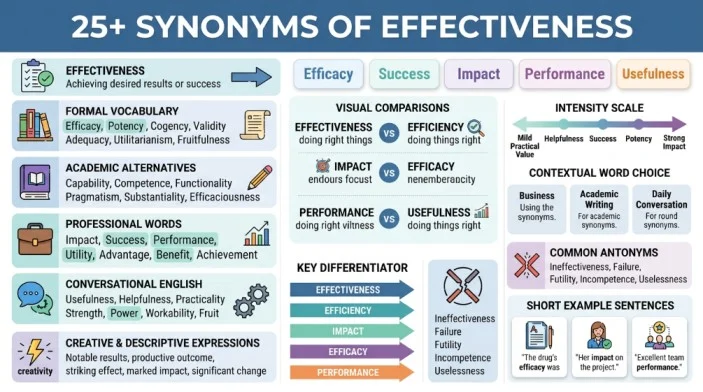
A writer may use the word effectiveness several times in the same essay, report, resume, or business email and quickly notice that the wording feels repetitive. Finding the right synonym of effectiveness can make the sentence more precise because different alternatives emphasize results, usefulness, impact, efficiency, or success.
The best replacement depends on what you actually mean. In academic writing, efficacy can sound more precise. In business communication, performance or impact may fit better. Everyday English, success or usefulness is often more natural. Choosing carefully helps your writing communicate not just that something works, but how well and in what way it works.
What Are the Best Synonyms of “Effectiveness”?
The best synonyms for effectiveness include efficacy, success, impact, potency, usefulness, performance, capability, and effectuality. Efficacy is especially useful in academic and technical writing, while success works naturally in everyday English. Impact emphasizes results, and potency highlights strength or power.
Meaning, Tone, and Context
Simple Definition
Effectiveness means the degree to which something successfully produces the result it is intended to produce.
If a teaching method helps students understand a difficult concept, its effectiveness refers to how successfully that method achieves its purpose. If a marketing campaign generates the desired response, its effectiveness describes how well the campaign works.
The word focuses primarily on results and outcomes.
Part of Speech
Effectiveness is a noun.
Example:
“The effectiveness of the new training program was evaluated after six months.”
Overall Tone
The word effectiveness is generally neutral and positive when used to describe something that works well.
It can appear in objective evaluations, positive recommendations, critical reviews, academic research, workplace discussions, and technical reports.
Formality Level
Effectiveness is a neutral to formal word. It is especially common in:
- Academic writing
- Business reports
- Research papers
- Workplace evaluations
- Government documents
- Marketing analysis
- Technical writing
- Professional communication
It is also understandable in everyday conversation, although simpler words such as success or how well something works may sound more conversational.
Common Uses
Native English speakers commonly use effectiveness when evaluating:
- Treatments
- Strategies
- Policies
- Programs
- Products
- Teaching methods
- Marketing campaigns
- Communication techniques
- Management approaches
- Security measures
- Training programs
- Business processes
- Tools and technologies
Word Forms
| Word | Part of Speech | Example |
|---|---|---|
| Effectiveness | Noun | “We measured the effectiveness of the campaign.” |
| Effective | Adjective | “The campaign was effective.” |
| Effectively | Adverb | “The team communicated effectively.” |
| Effect | Noun or verb | “The change had a positive effect.” |
| Effectual | Adjective | “The approach proved effectual.” |
The most common related form is effective, which describes something that successfully produces a desired result.
When and How to Use “Effectiveness”
Use effectiveness when you are discussing how successfully a person, method, system, strategy, or action achieves its intended purpose.
The word is especially useful when the result can be evaluated, compared, measured, or discussed.
Professional
“The manager reviewed the effectiveness of the new customer service strategy.”
Here, effectiveness refers to how successfully the strategy achieves its business purpose.
Academic
“The researchers examined the effectiveness of the teaching intervention.”
This usage is appropriate because academic writing often evaluates whether a method produces its intended result.
Workplace
“The team discussed the effectiveness of the current workflow.”
The word works well when employees are evaluating a process.
Personal
“I was surprised by the effectiveness of the study routine.”
In personal writing, effectiveness can describe whether a habit or approach actually works.
“We would like to evaluate the effectiveness of the updated communication process.”
This sounds professional and objective.
Resume
“Improved the effectiveness of customer retention initiatives through data driven analysis.”
For a resume, it is often better to show the actual result rather than simply claim effectiveness.
Social Media
“The campaign showed impressive effectiveness in reaching new audiences.”
For casual social media, however, impact or success may sound more natural.
Best Synonyms of “Effectiveness”
No single synonym perfectly replaces effectiveness in every context. The best choice depends on whether you want to emphasize successful results, practical value, strength, influence, performance, or the ability to achieve a specific purpose.
Professional Writing: Performance
Performance works well when evaluating how well a system, employee, process, product, or strategy operates.
“The company evaluated the performance of its new software system.”
Use performance when the focus is on measurable operation rather than effectiveness in a broad sense.
Academic Writing: Efficacy
Efficacy is one of the closest formal alternatives to effectiveness. It emphasizes the ability of a method, treatment, intervention, or approach to produce an intended result.
“The study examined the efficacy of the new treatment.”
It is particularly useful in scientific, medical, and academic contexts.
Business Communication: Impact
Impact emphasizes the effect or influence something produces.
“The training program had a significant impact on employee productivity.”
Choose impact when the outcome matters more than the process of determining whether something works.
Casual Conversation: Success
Success is usually more natural than effectiveness in everyday speech.
“The new study method has been a real success.”
It works especially well when the intended result has clearly been achieved.
Emotional Writing: Value
Value can replace effectiveness when the focus is on the benefit or usefulness something provides.
“The true value of the program became clear after several months.”
It is not an exact substitute in every sentence, but it works when effectiveness is being discussed as practical benefit.
Creative Writing: Power
Power can emphasize the strength of something’s ability to produce an effect.
The power of her words changed the audience’s mood.
It is more expressive than effectiveness and is better suited to literary or persuasive writing.
Resume Writing: Performance
Performance is particularly useful on resumes because it connects naturally with measurable achievements.
“Improved team performance by streamlining internal communication.”
Whenever possible, combine the word with a specific result.
Workplace Communication: Efficiency
Efficiency can work when effectiveness involves accomplishing a goal with minimal wasted time, effort, or resources.
“The new workflow improved operational efficiency.”
However, efficiency and effectiveness are not identical. Something can be effective but inefficient if it achieves the goal while wasting considerable resources.
Stronger Meaning: Potency
Potency emphasizes strength or the capacity to produce a powerful effect.
“The researchers tested the potency of the new formula.”
It is particularly appropriate for medicines, chemicals, persuasive forces, and other contexts involving strength.
Softer Meaning: Usefulness
Usefulness is a gentler, more practical alternative.
“The usefulness of the guide depends on the reader’s needs.”
It emphasizes practical benefit rather than successful achievement of a specific goal.
When Not to Use “Effectiveness”
When the Word Is Too General
Effectiveness can be too broad when you really mean measurable results.
Less precise:
“The effectiveness of the campaign was good.”
Better:
“The campaign generated a 20 percent increase in qualified leads.”
A specific result communicates more information than a general statement about effectiveness.
When You Mean Efficiency
Do not automatically use effectiveness when you mean that something saves time, money, effort, or resources.
Less precise:
“The new system improved effectiveness by reducing processing time.”
Better:
“The new system improved efficiency by reducing processing time.”
The second sentence makes the resource saving clearer.
When You Mean Influence
If the focus is on how strongly something affects people or events, impact or influence may be better.
Less precise:
“The leader’s effectiveness on public opinion was substantial.”
Better:
“The leader’s influence on public opinion was substantial.”
When You Mean Strength
If you are describing the strength of a substance or treatment, potency may be more accurate.
Less precise:
“The effectiveness of the medication was very strong.”
Better:
“The medication had high potency.”
When You Mean Personal Ability
If you are discussing someone’s ability to perform a task, capability, competence, or skill may be more suitable.
Less precise:
“Her effectiveness as a designer is impressive.”
Better:
“Her design skills are impressive.”
When the Word Sounds Too Formal
In casual conversation, effectiveness can sound more formal than necessary.
Formal:
“We should evaluate the effectiveness of this approach.”
Conversational:
“Let’s see how well this approach works.”
When You Need a Stronger Emotional Effect
Creative writing may benefit from more vivid vocabulary.
Neutral:
“The effectiveness of his speech surprised everyone.”
More expressive:
“The power of his speech moved the entire audience.”
Words Commonly Confused With “Effectiveness”
| Word | Difference | When to Use It | Example |
|---|---|---|---|
| Efficiency | Focuses on achieving results while minimizing time, effort, or resources. | Operations, business, productivity. | “The software improved workflow efficiency.” |
| Efficacy | Focuses on the ability to produce an intended result, often in technical or scientific contexts. | Research, medicine, academic writing. | “The researchers tested the drug’s efficacy.” |
| Success | Usually refers to achieving a desired result rather than the quality of the method itself. | Everyday and professional communication. | “The project was a success.” |
| Performance | Describes how well a person, system, product, or process operates. | Business, technology, workplace evaluation. | “The software’s performance improved.” |
| Impact | Focuses on the effect or influence produced by something. | Business, social issues, research. | “The policy had a major impact.” |
| Potency | Emphasizes strength or power to produce an effect. | Medicine, chemistry, persuasive contexts. | “The formula has greater potency.” |
Best Synonyms of “Effectiveness” by Context
| Context | Best Synonym | Why It Works | Example |
|---|---|---|---|
| Formal writing | Efficacy | Precise and formal | “The efficacy of the program was evaluated.” |
| Academic writing | Efficacy | Fits research based evaluation | “Researchers measured treatment efficacy.” |
| Professional communication | Performance | Focuses on measurable operation | “The team’s performance improved.” |
| Business emails | Success | Sounds direct and natural | “The project has been a success.” |
| Resume writing | Performance | Connects with measurable achievements | “Improved sales team performance.” |
| Workplace communication | Efficiency | Useful when resources and productivity matter | “The process improved efficiency.” |
| Casual conversation | Success | More natural in everyday speech | “The plan was a success.” |
| Everyday speaking | Usefulness | Simple and practical | “The usefulness of this tool is obvious.” |
| Creative writing | Power | Adds expressive force | “The power of her message was unforgettable.” |
| Storytelling | Impact | Highlights the effect on people or events | “His words had a lasting impact.” |
| Emotional writing | Value | Emphasizes benefit or significance | “The value of her support was immense.” |
| Strong emphasis | Potency | Highlights strength | “The treatment showed greater potency.” |
| Mild tone | Usefulness | Less forceful than effectiveness | “The guide has practical usefulness.” |
| Social media captions | Impact | Concise and engaging | “Small actions can have a huge impact.” |
| American English | Effectiveness | Standard and widely understood | “We need to measure its effectiveness.” |
| British English | Effectiveness | Also standard and natural | “The effectiveness of the policy was reviewed.” |
How to Choose the Best Synonym of “Effectiveness”
Choosing the right alternative becomes easier when you identify the exact idea behind the sentence.
If You Mean “It Works”
Choose efficacy, success, or effectuality.
“The study confirmed the efficacy of the treatment.”
If You Mean “It Produces a Strong Effect”
Choose impact, potency, or power.
“The campaign had a powerful impact on public awareness.”
If You Mean “It Uses Resources Well”
Choose efficiency.
“The new process increased efficiency.”
If You Mean “It Performs Well”
Choose performance.
“The software demonstrated excellent performance.”
If You Mean “It Is Useful”
Choose usefulness, utility, or value.
“The usefulness of the tool depends on the task.”
If You Mean “It Achieves Its Intended Purpose”
Choose efficacy or effectuality.
“The researchers evaluated the efficacy of the intervention.”
Consider Your Audience
Academic readers generally respond better to precise terms such as efficacy and performance.
Business audiences often prefer impact, performance, success, and efficiency because these words connect naturally with outcomes.
Everyday readers usually understand success, usefulness, and impact more immediately.
Consider Formality
- For a research paper:
“The efficacy of the intervention was assessed.”
- For a business report:
“The program’s performance exceeded expectations.”
- For casual conversation:
“The new method really works.”
Each sentence communicates a similar general idea, but the vocabulary matches the audience.
Consider Emotional Strength
Usefulness is relatively mild.
Effectiveness is neutral.
Impact can be stronger because it emphasizes consequences.
Potency is stronger when the context involves force or strength.
Power can be especially expressive in emotional or creative writing.
Real Life Examples of “Effectiveness”
School
Basic:
“The teacher studied the effectiveness of the new reading exercise.”
More precise:
“The teacher evaluated the efficacy of the new reading exercise.”
College
Basic:
“The research examined the effectiveness of online learning.”
Improved:
“The research examined the effectiveness of online learning across different student groups.”
Here, effectiveness remains appropriate because the study is evaluating how well the method achieves its intended educational purpose.
Workplace
Basic:
“The manager discussed the effectiveness of the team’s workflow.”
Improved:
“The manager reviewed the team’s performance and identified areas for improvement.”
Business
Basic:
“The company measured the effectiveness of its advertising campaign.”
Alternative:
“The company measured the campaign’s impact on customer acquisition.”
The second version makes the specific outcome clearer.
Basic:
“We would like to discuss the effectiveness of the new process.”
Alternative:
“We would like to review the performance of the new process and identify opportunities for improvement.”
Resume
Basic:
“Improved the effectiveness of the sales process.”
Stronger:
“Improved sales team performance by redesigning the customer follow up process.”
The second version is stronger because it focuses on an observable professional result.
Conversation
Formal:
“We need to evaluate the effectiveness of this strategy.”
Natural:
“We need to see how well this strategy works.”
Storytelling
Neutral:
“The effectiveness of her speech was obvious.”
Creative:
“The power of her speech silenced the room.”
Blogging
General:
“The effectiveness of content marketing depends on several factors.”
More specific:
“The success of content marketing depends on audience needs, consistency, and useful information.”
Social Media
General:
“The effectiveness of a short video can be impressive.”
More engaging:
“A short video can have a powerful impact when it reaches the right audience.”
25 Best Synonyms of “Effectiveness”
| Synonym | Simple Meaning | Best Used For | Example Sentence |
|---|---|---|---|
| Efficacy | Ability to produce an intended result | Academic and scientific writing | “The study evaluated the efficacy of the treatment.” |
| Effectuality | Quality of being effective | Formal and specialized writing | “The researchers questioned the effectuality of the proposed method.” |
| Success | Achievement of a desired result | Everyday and professional English | “The campaign was a clear success.” |
| Impact | Effect or influence produced | Business, social, and academic writing | “The program had a measurable impact on attendance.” |
| Performance | How well something operates or functions | Business and workplace writing | “The software showed strong performance.” |
| Usefulness | Practical value or benefit | Everyday and professional writing | “The usefulness of the guide became clear immediately.” |
| Utility | Practical usefulness or value | Technical and formal writing | “The utility of the tool depends on its intended purpose.” |
| Potency | Strength or power to produce an effect | Medicine and technical contexts | “The researchers compared the potency of two formulas.” |
| Power | Ability to produce a strong effect | Creative and persuasive writing | “The power of the message inspired action.” |
| Force | Strength of an influence or effect | Persuasive and descriptive writing | “The force of the argument was difficult to ignore.” |
| Capability | Ability to achieve a result | Technology and professional contexts | “The system has the capability to process large datasets.” |
| Capacity | Ability or potential to produce an outcome | Organizations and systems | “The department has the capacity to handle additional work.” |
| Ability | General skill or power to accomplish something | Everyday and professional English | “The tool has the ability to identify errors quickly.” |
| Productivity | Amount of useful output produced | Workplace and business contexts | “The new system increased employee productivity.” |
| Efficiency | Ability to achieve results with limited waste | Business and operations | “The revised process improved efficiency.” |
| Practicality | Suitability for real use | Everyday and professional writing | “The practicality of the solution made it attractive to small businesses.” |
| Utility | Degree of usefulness | Technical and academic contexts | “The utility of the application was tested with several user groups.” |
| Value | Usefulness, benefit, or worth | Business and general writing | “The value of the training became clear over time.” |
| Influence | Ability to affect people or outcomes | Social, business, and leadership writing | “The campaign increased the organization’s influence.” |
| Effect | Result produced by an action | General and academic writing | “The policy had a positive effect on attendance.” |
| Fruitfulness | Ability to produce useful results | Academic and literary writing | “The discussion proved fruitful for future research.” |
| Productiveness | Ability to produce useful results | Formal and less common writing | “The productiveness of the collaboration exceeded expectations.” |
| Resultfulness | Quality of producing results | Rare formal usage | “The resultfulness of the approach was assessed over several trials.” |
| Successfulness | Degree of achieving success | Formal but less common usage | “The successfulness of the project depended on careful planning.” |
| Effectiveness | Degree of successfully producing a desired result | General, academic, and professional writing | “The effectiveness of the strategy was evaluated.” |
Usage note: Some entries in this table are close contextual alternatives rather than interchangeable substitutes in every sentence. In particular, efficiency, productivity, influence, impact, value, and performance describe related aspects of effectiveness rather than exactly the same concept.
Synonyms of “Effectiveness” by Usage
Professional vs Personal Synonyms
Professional writing usually benefits from precise terms that explain what kind of result is being discussed.
Use efficacy when discussing whether an intervention works. Use performance for systems or people, impact for outcomes, and efficiency when resource use matters.
In personal writing, simpler alternatives are often more natural.
“The success of my study plan surprised me.”
This sounds more conversational than:
“The effectiveness of my study plan was substantial.”
Formal vs Conversational Synonyms
- For reports and essays, use efficacy, effectuality, performance, or impact when appropriate.
- For presentations, effectiveness, impact, and performance are useful because they are clear and professional.
- For emails, effectiveness, success, or performance can work depending on the topic.
- For casual conversations and texting, success, usefulness, or “how well it works” usually sounds more natural.
Academic Synonyms
Academic writing requires careful distinctions.
Efficacy
Use efficacy when examining whether an intervention produces its intended outcome.
“The researchers evaluated the efficacy of the intervention.”
Effectuality
Effectuality is a formal and relatively uncommon term referring to the quality or condition of being effective.
It can be appropriate in specialized writing, but efficacy or effectiveness is usually more natural for most readers.
Impact
Use impact when discussing consequences or influence.
“The policy had a substantial impact on student participation.”
Performance
Use performance when evaluating how well a system, method, or model functions.
“The model’s performance improved after optimization.”
Productivity
Use productivity when the relevant outcome involves useful output.
“The study examined whether the new system increased employee productivity.”
Professional and Business Synonyms
Resumes
Use performance, impact, productivity, or success.
Instead of:
“Improved the effectiveness of the sales department.”
Write:
“Improved sales team performance through targeted training.”
Even better, include a measurable result when available.
Interviews
Use effectiveness, performance, or impact to describe professional achievements.
“I focused on improving team performance and reducing unnecessary delays.”
Meetings
Use effectiveness or efficiency depending on the point being discussed.
“We should evaluate the effectiveness of the current process.”
Presentations
Use impact when discussing audience or business outcomes.
“The campaign had a measurable impact on brand awareness.”
Performance Reviews
Use performance, productivity, and effectiveness.
“The new workflow improved overall team performance.”
Client Communication
Use results, impact, or success because these terms are easy for clients to understand.
“The strategy produced strong results during the first quarter.”
Business Emails
Choose the simplest accurate term.
“We would like to review the effectiveness of the current process.”
Or:
“We would like to review the results of the current process.”
The second sentence is more direct when actual outcomes are available.
Creative and Literary Synonyms
Creative writing does not always benefit from technical terms such as efficacy. More expressive alternatives can create stronger imagery.
Power
“The power of her voice filled the theater.”
Force
“The force of his argument changed the mood of the room.”
Impact
“The final scene had a lasting impact on everyone who watched it.”
Influence
“Her influence reached far beyond the small town where she began.”
Effect
“The effect of the music was immediate.”
These words help writers describe consequences, emotional responses, and persuasive strength rather than simply stating that something was effective.
Slang or Modern Synonyms
There is no single widely accepted slang equivalent of effectiveness.
In casual American English, speakers commonly use phrases such as:
- “How well it works”
- “It gets the job done”
- “It works”
- “It’s effective”
- “It’s a success”
“Gets the Job Done”
This expression means something successfully accomplishes its purpose.
“The simple software isn’t fancy, but it gets the job done.”
It is appropriate for casual conversations but should generally be avoided in formal academic or professional writing.
Strongest to Mildest Synonyms
There is no universal intensity scale for all effectiveness related words because they emphasize different dimensions. A practical scale can still help when the goal is to communicate strength.
Mild
Usefulness, value, practicality
These words suggest that something provides a benefit without necessarily claiming outstanding results.
Moderate
Effectiveness, performance, success
These words communicate that something works or achieves results without adding strong emotional force.
Strong
Impact, potency, power
These alternatives emphasize a substantial effect or strong ability to produce an outcome.
Very Strong
High efficacy, exceptional potency, overwhelming power
These phrases should be used only when the context genuinely supports strong emphasis.
Emotional vs Neutral Synonyms
Emotional Synonyms
Words such as power, force, and impact can carry greater emotional weight.
“The power of her story moved the audience.”
These are useful in speeches, storytelling, persuasive writing, and social media content.
Neutral Synonyms
Effectiveness, efficacy, performance, efficiency, and usefulness are generally more objective.
“The researchers evaluated the effectiveness of the program.”
Use neutral terms when accuracy and objectivity matter more than emotional expression.
Antonyms of “Effectiveness”
The opposite of effectiveness is not always expressed by one single word. The following terms describe genuine forms or dimensions of failure to produce an intended result.
| Antonym | Meaning | Example Sentence |
|---|---|---|
| Ineffectiveness | Failure to produce the desired result | “The review revealed the ineffectiveness of the strategy.” |
| Inefficacy | Lack of ability to produce an intended result | “The researchers reported the drug’s inefficacy.” |
| Effectlessness | Lack of noticeable effect | “The treatment’s effectlessness became apparent over time.” |
| Futility | Inability to achieve a useful purpose | “The team recognized the futility of continuing the failed approach.” |
| Uselessness | Lack of practical value or usefulness | “The uselessness of the outdated tool became obvious.” |
| Failure | Lack of success in achieving a desired result | “The project ended in failure.” |
| Fruitlessness | Failure to produce useful results | “The discussion became fruitless after several hours.” |
| Pointlessness | Lack of useful purpose or result | “They questioned the pointlessness of repeating the same test.” |
| Impotence | Lack of power to produce an effect | “The policy showed impotence when faced with widespread resistance.” |
| Powerlessness | Lack of ability to influence or change something | “The organization felt powerless to change the decision.” |
| Inutility | Lack of usefulness | “The inutility of the damaged equipment was clear.” |
| Worthlessness | Lack of practical or meaningful value | “The document proved worthless for the investigation.” |
| Unproductiveness | Failure to generate useful output or results | “The meeting was criticized for its unproductiveness.” |
| Counterproductiveness | Tendency to produce results opposite to those intended | “The excessive restrictions became counterproductive.” |
| Inefficiency | Failure to use time, effort, or resources effectively | “The process suffered from serious inefficiency.” |
Comparison: “Effectiveness” vs Similar Words
Effectiveness vs Efficiency
Main Difference
Effectiveness asks whether something achieves its intended goal. Efficiency asks whether it achieves that goal with appropriate use of time, effort, money, or resources.
Which Is Stronger?
Neither is stronger. They measure different qualities.
Which Is More Formal?
Both are common in professional and academic writing.
When to Use Each
Use effectiveness when the outcome matters.
Use efficiency when the outcome and resource use both matter.
Examples
Effectiveness:
“The training program was effective in improving employee skills.”
Efficiency:
“The new training platform reduced the time required for employee training.”
Effectiveness vs Efficacy
Main Difference
Effectiveness is a broad term for how well something achieves its intended purpose. Efficacy is a more specialized term often used when evaluating the ability of a treatment, intervention, or method to produce a particular result.
Which Is Stronger?
Neither is inherently stronger.
Which Is More Formal?
Efficacy is more specialized and technical.
When to Use Each
Use efficacy in scientific or technical contexts when it fits the subject.
Examples
Effectiveness:
“The effectiveness of the training program was evaluated.”
Efficacy:
“The efficacy of the treatment was examined in a controlled study.”
Effectiveness vs Success
Main Difference
Effectiveness describes how well something achieves its intended purpose. Success usually describes the achievement of a desired outcome.
Which Is Stronger?
Neither.
Which Is More Formal?
Effectiveness is more formal and analytical.
When to Use Each
Use success for natural everyday communication.
Examples
Effectiveness:
“We evaluated the effectiveness of the campaign.”
Success:
“The campaign was a major success.”
Effectiveness vs Performance
Main Difference
Performance describes how well something functions or operates. Effectiveness specifically concerns whether it achieves its intended purpose.
Which Is Stronger?
Neither.
Which Is More Formal?
Both are common in professional contexts.
When to Use Each
Use performance for systems, employees, products, and processes.
Examples
Effectiveness:
“The effectiveness of the strategy was reviewed.”
Performance:
“The team’s performance improved significantly.”
Effectiveness vs Impact
Main Difference
Effectiveness focuses on successful achievement of a goal. Impact focuses on the effect or influence something has.
Which Is Stronger?
Impact can sound stronger because it often emphasizes noticeable consequences.
Which Is More Formal?
Both work in academic and professional writing.
When to Use Each
Use impact when discussing consequences or influence.
Examples
Effectiveness:
“The effectiveness of the policy was evaluated.”
Impact:
“The policy had a significant impact on employment.”
Effectiveness vs Potency
Main Difference
Effectiveness is broad. Potency emphasizes the strength of something’s ability to produce an effect.
Which Is Stronger?
Potency usually carries stronger force.
Which Is More Formal?
Both can be formal, but potency is especially common in technical and scientific contexts.
When to Use Each
Use potency when strength matters.
Examples
Effectiveness:
“The effectiveness of the medication was assessed.”
Potency:
“The researchers measured the potency of the medication.”
Common Phrases and Expressions with “Effectiveness”
Effectiveness of a Strategy
Meaning: How successfully a strategy achieves its intended goal.
Example:
“The company evaluated the effectiveness of its marketing strategy.”
Effectiveness of a Program
Meaning: How well a program produces its planned results.
Example:
“The school reviewed the effectiveness of the tutoring program.”
Measure Effectiveness
Meaning: Assess how successfully something works.
Example:
“The team created several metrics to measure effectiveness.”
Improve Effectiveness
Meaning: Make something better at achieving its intended result.
Example:
“The company introduced new procedures to improve effectiveness.”
Evaluate Effectiveness
Meaning: Examine how well something works.
Example:
“Researchers evaluated the effectiveness of the intervention.”
Effectiveness of Treatment
Meaning: How well a treatment achieves its intended health related outcome.
Example:
“The study examined the effectiveness of the treatment.”
Effectiveness of Communication
Meaning: How successfully communication conveys information or achieves its purpose.
Example:
“The manager assessed the effectiveness of internal communication.”
Effectiveness of a Method
Meaning: How well a particular method produces the desired result.
Example:
“The researchers compared the effectiveness of two teaching methods.”
Common Mistakes to Avoid
1. Confusing Effectiveness With Efficiency
Incorrect:
“The new system is effective because it uses less electricity.”
Better:
“The new system is efficient because it uses less electricity.”
Why:
Lower resource consumption is primarily an issue of efficiency. The system’s effectiveness would concern whether it successfully performs its intended function.
2. Using Efficacy in Every Context
Incorrect:
“The efficacy of my new vacuum cleaner is amazing.”
Better:
“The effectiveness of my new vacuum cleaner is impressive.”
Why:
Efficacy is formal and specialized. Effectiveness is more natural for ordinary products and everyday situations.
3. Treating Impact and Effectiveness as Exact Synonyms
Incorrect:
“The impact of the software means that it successfully performs its intended task.”
Better:
“The effectiveness of the software means that it successfully performs its intended task.”
Why:
Impact describes the effect produced, while effectiveness evaluates how well something achieves its purpose.
4. Using Effectiveness Without Explaining the Result
Weak:
“The strategy was highly effective.”
Better:
“The strategy was highly effective, increasing qualified leads by 18 percent.”
Why:
Specific evidence makes the claim more informative and persuasive.
5. Using a Technical Synonym in Casual Writing
Awkward:
“The efficacy of this study method is great.”
Better:
“This study method works really well.”
Why:
The second version sounds more natural in everyday conversation.
6. Using Effectiveness When You Mean Personal Skill
Less Accurate:
“Her effectiveness as a writer is impressive.”
Better:
“Her writing ability is impressive.”
Why:
Ability focuses directly on personal skill, while effectiveness usually evaluates successful results.
7. Using Strong Language Without Evidence
Weakly Supported:
“The strategy has extraordinary effectiveness.”
Better:
“The strategy produced strong results in the initial trial.”
Why:
Specific outcomes are more credible than exaggerated descriptions.
Frequently Asked Questions
1. What is a synonym of effectiveness?
A useful synonym of effectiveness is efficacy, especially in academic, scientific, and technical writing. Other alternatives include success, impact, performance, usefulness, potency, and effectuality, depending on the intended meaning.
2. What are the best formal synonyms of effectiveness?
The strongest formal alternatives include efficacy, effectuality, performance, impact, potency, and utility. Choose based on context because these words emphasize different aspects of effectiveness rather than replacing it identically.
3. What are common informal synonyms of effectiveness?
In informal English, success, usefulness, and phrases such as how well something works are usually more natural than effectiveness. The best choice depends on whether you mean results, value, or practical performance.
4. What is another word for effectiveness in professional writing?
Performance is useful for systems and employees, impact works for outcomes, efficiency fits resource use, and efficacy suits technical contexts. Effectiveness itself remains a clear professional choice.
5. What is the difference between effectiveness and efficiency?
Effectiveness concerns whether something achieves its intended goal, while efficiency concerns how economically it achieves that goal. A process can be effective without being efficient if it produces results while wasting time or resources.
6. What is the opposite of effectiveness?
The most direct opposite is ineffectiveness, meaning failure to produce the desired result. Other related opposites include inefficacy, futility, uselessness, failure, fruitlessness, and inefficiency, depending on the context.
Conclusion
Effectiveness refers to how successfully something produces its intended result. Depending on the context, useful alternatives include efficacy for technical and academic writing, performance for systems and workplaces, impact for influence and outcomes, success for everyday language, and potency when strength is the focus.
The best synonym of effectiveness is not always the most formal or impressive word. Choose the alternative that accurately reflects your meaning, audience, tone, and purpose. A simple vocabulary habit can help: before replacing effectiveness, identify whether you mean results, efficiency, influence, usefulness, performance, or strength.
Read More Related Articles:
Synonyms for Empty | Meaning, Examples, and Better Word …
Synonyms for Pros and Cons | Meaning, Examples, and Better …











3 thoughts on “25+ Synonyms of Effectiveness | Meanings, Uses, Examples, and Best Alternatives”