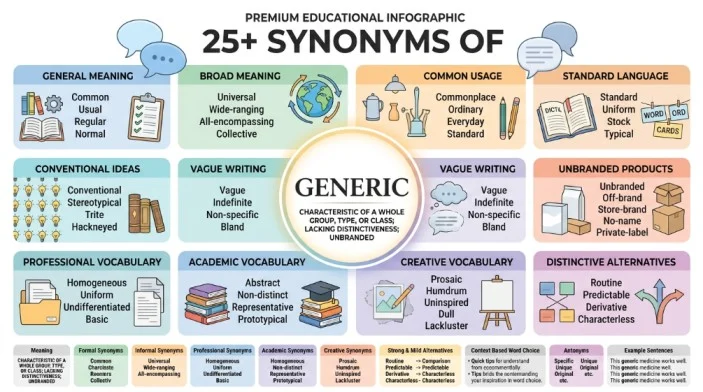
The word generic is useful when something feels broad, common, standard, or lacking specific detail. But depending on the context, a more precise word can make your writing clearer and stronger. This guide explores generic synonyms with practical explanations, so you can choose the right alternative for emails, academic writing, business communication, and everyday English. If you are searching for a generic synonym, another word may fit better depending on whether you mean ordinary, general, common, or nonspecific.
Understanding the synonyms of generic also helps explain terms such as “generic response meaning” and “generic answer meaning.” A generic response is usually broad and not tailored to a particular person or situation. Likewise, a generic answer may provide basic information without addressing specific details. Below, you will find generic synonyms in English, including a synonym for generic, plus clear examples that show what is another name for generic and when each alternative works best.
What Are the Best Synonyms of “Generic”?
The best synonyms of generic depend on its meaning. Use general, broad, or common when something applies widely; choose standard or conventional for established forms; use ordinary, plain, or nondescript when something lacks distinctive qualities; and choose nonproprietary when discussing products or medicines that are not sold under a specific brand name.
Meaning, Tone, and Context
Simple Definition
Generic has several closely related meanings.
It can describe something that belongs to a general category rather than a particular brand, name, or individual. It can also describe something that is broad rather than specific.
In another common use, generic means ordinary, predictable, or lacking distinctive characteristics. This meaning can sometimes sound negative because it suggests that something is not original or memorable.
For example:
“The store sells generic cleaning products.”
Here, generic refers to products that are not associated with a particular brand.
Compare that with:
“The article uses generic language.”
In this sentence, generic suggests that the language is broad, predictable, or lacking specificity.
Part of Speech
Generic is primarily an adjective.
Examples include:
- generic product
- generic term
- generic advice
- generic response
- generic design
- generic medicine
- generic description
- generic statement
The related noun generic can also be used in some specialized contexts, particularly when discussing products or brand names.
The noun generality is related to the broader idea of being general rather than specific.
Overall Tone
The tone of generic depends strongly on context.
It can be neutral when referring to a general category, such as a generic drug or generic product.
It can become negative when describing writing, design, advice, branding, or ideas that seem unoriginal or lacking in detail.
For example:
“This is a generic category of software.”
This is relatively neutral.
“The campaign feels generic.”
This is more critical because it suggests that the campaign lacks originality.
Formality Level
Generic is a neutral word that works in formal, professional, academic, and everyday English.
It is especially useful when discussing categories, products, language, ideas, or descriptions.
The word does not sound excessively formal or informal, which makes it versatile.
Common Uses
Native English speakers commonly use generic in several areas.
Products
“The generic version costs less than the branded product.”
Medicine
“The doctor prescribed a generic medication.”
Language
“The description is too generic to be useful.”
Advice
“The article gives generic advice instead of practical recommendations.”
Branding
“The company wants to avoid a generic visual identity.”
Categories
“This is a generic term for several types of equipment.”
Writing
“The introduction sounds generic and could use more specific details.”
Word Forms
| Word | Form | Example |
|---|---|---|
| Generic | Adjective | The description is generic. |
| Generically | Adverb | The products were described generically. |
| Generality | Related noun | The generality of the statement makes it difficult to apply. |
When and How to Use “Generic”
Use generic when you want to describe something that is broad, non specific, widely applicable, unbranded, or lacking distinctive characteristics.
The key is understanding which sense you mean. A generic product and a generic piece of writing may both use the same adjective, but the intended meaning is different.
Professional
“The report contains several generic recommendations that need to be adapted to our industry.”
Here, generic means broad and not specifically tailored.
Academic
“The author provides a generic explanation without examining the issue in sufficient detail.”
In this context, generic suggests a lack of specificity.
Workplace
“Please replace the generic instructions with steps that apply to our current process.”
The word identifies instructions that are too broad for the situation.
Personal
“His response felt generic, so I was not sure whether he had considered my situation.”
Here, generic suggests that the response was not personalized.
“Thank you for the information, but the answer seems somewhat generic and does not address the specific issue.”
This is appropriate when politely pointing out that a response lacks detail.
Resume
“Instead of using generic descriptions, highlight the specific results you achieved.”
In resume advice, generic describes vague statements that do not demonstrate individual value.
Social Media
“The caption feels generic, so adding a personal detail could make it more engaging.”
Here, the word suggests that the caption lacks personality or originality.
Best Synonyms of “Generic”
No single synonym works perfectly for every meaning of generic. The best alternative depends on whether you mean broad, common, standard, unbranded, predictable, ordinary, or lacking originality.
Professional Writing: General
General is often the safest alternative when generic means broad or not limited to a particular case.
“The report provides general recommendations for improving productivity.”
This sounds neutral and professional.
Academic Writing: Broad
Broad works well when discussing ideas, categories, or statements that cover many situations without focusing on one specific case.
“The study offers a broad overview of the subject.”
It is useful when you want to emphasize range rather than criticism.
Business Communication: Standard
Standard is a strong choice when something follows an accepted or established format.
“Please use the standard procedure when processing these requests.”
Unlike generic, standard does not necessarily suggest poor quality or lack of originality.
Casual Conversation: Common
Common sounds natural when referring to something frequently seen, used, or encountered.
“That is a common mistake among new writers.”
Emotional Writing: Impersonal
When generic means something lacks personal connection, impersonal can be more precise.
“The message sounded impersonal rather than genuinely supportive.”
Creative Writing: Conventional
Conventional is useful when something follows familiar patterns or established ideas.
“The story uses a conventional plot structure.”
It is more precise than simply calling the story generic.
Resume Writing: Vague
When discussing weak resume language, vague is usually more accurate than generic.
“Avoid vague descriptions of your responsibilities.”
The problem is often a lack of specific evidence rather than simply being general.
Workplace Communication: Broad
Broad works well when recommendations or instructions apply across many situations.
“The policy provides broad guidance for handling customer complaints.”
Stronger Meaning: Nondescript
Nondescript is stronger when something is difficult to distinguish because it has few noticeable characteristics.
“The building had a nondescript exterior.”
Softer Meaning: General
General is a softer alternative when you want to point out that something is not highly specific without criticizing it.
“The presentation provides a general introduction to the topic.”
When Not to Use “Generic”
Although generic is flexible, it is not always the most precise choice.
When You Mean “General”
If something simply covers a wide range of situations, general may be clearer.
Less precise:
“The guide gives generic information about budgeting.”
Better:
“The guide gives general information about budgeting.”
Why: General communicates broad coverage without suggesting that the information is low quality or unoriginal.
When You Mean “Vague”
If the real problem is a lack of detail, vague is more accurate.
Less precise:
“His explanation was generic.”
Better:
“His explanation was vague.”
Why: Vague directly identifies the lack of clear details.
When You Mean “Common”
If something happens frequently, use common.
Less precise:
“This is a generic problem.”
Better:
“This is a common problem.”
Why: Common focuses on frequency, while generic focuses on generality or lack of specificity.
When You Mean “Standard”
If something follows an accepted process or established format, standard is better.
Less precise:
“Use the generic procedure.”
Better:
“Use the standard procedure.”
Why: Standard communicates that the procedure is established or accepted.
When You Mean “Ordinary”
If something is not unusual or exceptional, ordinary may fit better.
Less precise:
“It was a generic day.”
Better:
“It was an ordinary day.”
Why: Ordinary focuses on normality rather than generality.
When You Mean “Unoriginal”
If an idea lacks creativity, unoriginal is more direct.
Less precise:
“The concept feels generic.”
Better:
“The concept feels unoriginal.”
Why: Unoriginal clearly identifies the lack of new or creative thinking.
When You Mean “Unbranded”
When discussing products, unbranded may be more accurate.
Less precise:
“They sell generic clothing.”
Better:
“They sell unbranded clothing.”
Why: Unbranded specifically describes the absence of a recognizable brand identity.
Words Commonly Confused With “Generic”
General
Difference: General describes something that covers many cases or is not limited to one specific situation.
When to Use It: Use it for broad information, ideas, instructions, or statements.
Example:
“The teacher gave us some general advice about the assignment.”
Common
Difference: Common means something occurs frequently or is widely encountered.
When to Use It: Use it when frequency or widespread occurrence matters.
Example:
“This is a common error in English writing.”
Standard
Difference: Standard refers to something accepted, established, or normally used.
When to Use It: Use it for procedures, formats, expectations, or established practices.
Example:
“Employees must follow the standard safety procedure.”
Ordinary
Difference: Ordinary means normal and not unusual or exceptional.
When to Use It: Use it when describing everyday people, events, objects, or experiences.
Example:
“It looked like an ordinary office from the outside.”
Vague
Difference: Vague describes something that is unclear because it lacks enough specific information.
When to Use It: Use it when criticizing unclear instructions, explanations, descriptions, or statements.
Example:
“The instructions were too vague to follow.”
Conventional
Difference: Conventional describes something that follows traditional, familiar, or accepted patterns.
When to Use It: Use it for ideas, methods, designs, customs, or approaches that are established rather than innovative.
Example:
“The company took a conventional approach to advertising.”
Best Synonyms of “Generic” by Context
| Context | Best Synonym | Why It Works | Example |
|---|---|---|---|
| Formal writing | General | Neutral and precise | The report provides general guidance. |
| Academic writing | Broad | Describes wide coverage | The paper presents a broad discussion. |
| Professional communication | Standard | Suggests an accepted process | Follow the standard procedure. |
| Business emails | General | Sounds polite and neutral | I have included some general information. |
| Resume writing | Vague | Identifies weak detail | Avoid vague descriptions of your duties. |
| Workplace communication | Standard | Fits established processes | Use the standard reporting format. |
| Casual conversation | Common | Natural in everyday speech | That is a common problem. |
| Everyday speaking | Ordinary | Describes something normal | It was an ordinary afternoon. |
| Creative writing | Conventional | Describes familiar patterns | The novel follows a conventional structure. |
| Storytelling | Predictable | Highlights expected development | The ending felt predictable. |
| Emotional writing | Impersonal | Shows lack of personal connection | His response sounded impersonal. |
| Strong emphasis | Nondescript | Strongly suggests lack of distinction | The building looked nondescript. |
| Mild tone | General | Avoids unnecessary criticism | This is a general overview. |
| Social media captions | Common | Sounds conversational | This is a common experience for many people. |
| American English | General | Very natural and widely understood | The article gives general advice. |
| British English | General | Also natural in British usage | The guide offers general information. |
How to Choose the Best Synonym of “Generic”
The best synonym depends on what you want your reader to understand.
Choose “General” for Broad Meaning
Use general when something applies to many cases.
“The book provides general information about investing.”
Choose “Common” for Frequency
Use common when something occurs often.
“This is a common misunderstanding.”
Choose “Standard” for Established Practice
Use standard when something follows an accepted method.
“The company uses a standard application process.”
Choose “Vague” for Lack of Detail
Use vague when the problem is unclear or insufficient information.
“The job description is too vague.”
Choose “Conventional” for Familiar Patterns
Use conventional when something follows traditional or established ideas.
“The business uses a conventional marketing strategy.”
Choose “Nondescript” for Lack of Distinction
Use nondescript when something does not stand out visually or stylistically.
“The restaurant had a nondescript entrance.”
Consider Your Audience
A professional audience may respond better to standard, general, or broad.
An academic audience may prefer broad, general, or conventional, depending on the meaning.
In everyday conversation, common and ordinary often sound more natural.
Consider Emotional Strength
General is relatively neutral.
Common is usually neutral.
Conventional can be neutral or mildly critical.
Vague is more critical.
Nondescript often carries a negative or dismissive tone.
Consider Your Writing Purpose
- For a research paper, choose broad or general when discussing scope.
- For a resume, choose vague when criticizing weak descriptions.
- For business procedures, choose standard.
- For creative criticism, choose conventional, predictable, or unoriginal, depending on the exact problem.
The most effective synonym is the one that explains why something is generic rather than simply replacing the word.
Real Life Examples of “Generic”
School
Original:
“The student gave a generic answer.”
Improved:
“The student gave a vague answer without supporting details.”
The revised sentence tells the reader exactly what was wrong.
College
Original:
“The essay contains generic ideas.”
Improved:
“The essay presents broad ideas but does not develop them with specific evidence.”
This is more useful because it identifies the weakness.
Workplace
Original:
“The instructions are generic.”
Improved:
“The instructions are too general for our current workflow.”
The new version is more precise and constructive.
Business
Original:
“The company needs to avoid generic branding.”
Improved:
“The company needs a more distinctive brand identity.”
The replacement emphasizes the desired quality.
Original:
“Your answer seems generic.”
Improved:
“Your response is quite general and does not address the specific issue.”
This version sounds more professional and less dismissive.
Resume
Original:
“I have strong communication skills.”
Improved:
“I presented weekly project updates to cross functional teams and reduced reporting delays.”
The second version replaces a generic claim with specific evidence.
Conversation
Original:
“He gave me a generic response.”
Improved:
“He gave me a vague response that did not really answer my question.”
Storytelling
Original:
“The character lived in a generic apartment.”
Improved:
“The character lived in a plain, nondescript apartment above a crowded street.”
The revised sentence creates a clearer image.
Blogging
Original:
“The article provides generic tips.”
Improved:
“The article provides general tips without explaining how to apply them.”
Social Media
Original:
“The caption sounds generic.”
Improved:
“The caption feels predictable, so adding a personal detail could make it more memorable.”
25 Best Synonyms of “Generic”
| Synonym | Simple Meaning | Best Used For | Example Sentence |
|---|---|---|---|
| General | Covering many situations | Formal and everyday writing | The article provides general guidance for beginners. |
| Broad | Covering a wide range | Academic writing | The research takes a broad view of the issue. |
| Common | Frequently seen or experienced | Everyday communication | This is a common mistake among learners. |
| Standard | Accepted or established | Workplace communication | Please follow the standard procedure. |
| Conventional | Following familiar practices | Academic and creative writing | The company chose a conventional approach. |
| Ordinary | Normal and not unusual | Everyday descriptions | It looked like an ordinary house. |
| Vague | Lacking clear details | Writing criticism | The instructions were too vague to follow. |
| Nondescript | Not distinctive or noticeable | Descriptive writing | They entered through a nondescript doorway. |
| Typical | Representative of a usual example | General descriptions | This is a typical example of the problem. |
| Universal | Applying to everyone or everything | Broad concepts | The desire for security is a nearly universal concern. |
| Inclusive | Covering a wide range of people or things | Professional and social contexts | The policy uses inclusive language. |
| Comprehensive | Covering many aspects thoroughly | Reports and guides | The guide provides a comprehensive overview. |
| Widespread | Found across many places or groups | Research and news | The practice is widespread across the industry. |
| Prevailing | Most common or widely accepted | Formal writing | The prevailing view has changed over time. |
| Routine | Regular and familiar | Workplace contexts | The task became part of the routine process. |
| Predictable | Easy to anticipate | Creative criticism | The story had a predictable ending. |
| Unoriginal | Not new or creative | Creative and professional criticism | The concept seemed unoriginal to the audience. |
| Impersonal | Lacking personal connection | Emails and communication | The automated message sounded impersonal. |
| Distinctive | Clearly different or recognizable | Positive replacement | The brand has a distinctive visual identity. |
| Plain | Simple and lacking decoration | Descriptive writing | The package had a plain design. |
| Typical | Characteristic of a particular group or situation | General descriptions | The response was typical of the industry. |
| Nonproprietary | Not owned under an exclusive brand or system | Technical and product contexts | The software uses a nonproprietary format. |
| Unbranded | Without a recognized brand name | Products and retail | The store sells unbranded accessories. |
| Formulaic | Following a repeated pattern | Writing and creative criticism | The advertisement felt formulaic. |
| Undistinguished | Not especially notable or distinctive | Formal description | The building had an undistinguished appearance. |
Synonyms of “Generic” by Usage
Professional vs Personal Synonyms
Professional settings often require precision. Personal conversations usually allow simpler and more natural alternatives.
- For professional writing, standard, general, broad, conventional, and nonproprietary can be useful depending on the intended meaning.
- For personal communication, common, ordinary, plain, or predictable may sound more natural.
For example:
Professional:
“The document contains general recommendations that can be adapted to different departments.”
Personal:
“His answer sounded pretty vague.”
The first sentence is neutral and professional. The second sounds natural in conversation.
Formal vs Conversational Synonyms
For reports, essays, and formal communication, consider:
- General
- Broad
- Standard
- Conventional
- Prevailing
- Widespread
- Nonproprietary
For casual conversations and texting, consider:
- Common
- Ordinary
- Plain
- Predictable
- Vague
Avoid using highly formal alternatives simply to sound sophisticated. Precision is more valuable than complexity.
Academic Synonyms
Academic writing benefits from words that clearly communicate scope, frequency, or lack of specificity.
Broad
Use broad when discussing the range of a topic.
“The study provides a broad overview of consumer behavior.”
General
Use general when presenting information that applies to many cases.
“The findings support several general conclusions.”
Conventional
Use conventional when discussing accepted theories, established methods, or familiar approaches.
“The researchers used a conventional analytical framework.”
Widespread
Use widespread when something occurs across many groups, places, or situations.
“The practice remains widespread in several industries.”
Prevailing
Use prevailing when referring to the dominant or most widely accepted view.
“The prevailing theory has been challenged by recent findings.”
These alternatives are more informative than automatically replacing every occurrence of generic with another broad adjective.
Professional and Business Synonyms
Resumes
Avoid saying:
“Performed generic administrative duties.”
Be more specific:
“Managed scheduling, prepared weekly reports, and coordinated client communications.”
For resume writing, vague is often the most useful word for describing weak content because it identifies the actual problem.
Interviews
Instead of saying:
“I have generic leadership skills.”
Use:
“I have experience leading project teams and coordinating cross departmental initiatives.”
Specific evidence is more persuasive than broad claims.
Meetings
Use key, central, major, or essential when you want to identify priorities.
“The key issue is the project timeline.”
Presentations
Use general or broad when introducing a topic.
“This presentation provides a broad overview of our strategy.”
Performance Reviews
Avoid vague statements such as:
“She makes important contributions.”
A more useful description is:
“She consistently improves team coordination and resolves client issues quickly.”
Client Communication
Use general when describing broad information.
“I can provide general pricing information before we discuss your specific requirements.”
Business Emails
Use standard when referring to established processes.
“Please complete the standard onboarding form.”
Use general when the information is broad.
“I have attached some general guidance for your review.”
Creative and Literary Synonyms
Creative writing often needs more expressive vocabulary than ordinary business communication.
Conventional
Use conventional when an idea follows familiar patterns.
“The novel begins with a conventional family drama.”
Predictable
Use predictable when the outcome is easy to anticipate.
“The plot became predictable after the second chapter.”
Formulaic
Use formulaic when something follows a repeated structure without much variation.
“The commercial relied on a formulaic storyline.”
Nondescript
Use nondescript for characters, places, objects, or settings that lack noticeable features.
“He waited outside a nondescript office building.”
Distinctive
Although distinctive is not an exact synonym for generic, it is often the best positive replacement when the goal is to express the opposite quality.
“The author developed a distinctive narrative voice.”
Slang or Modern Synonyms
There is no single widely accepted slang word that directly replaces generic in every situation.
In casual online communication, people may use expressions such as basic to criticize something as ordinary, predictable, or lacking originality.
For example:
“The design looks pretty basic.”
However, basic is not a complete synonym for generic. It can also mean simple or uncomplicated.
It is acceptable in casual conversations, social media, and informal commentary, but it should generally be avoided in academic papers, formal reports, resumes, and professional criticism unless the tone specifically calls for casual language.
Strongest to Mildest Synonyms
Because generic has several meanings, there is no single universal intensity scale. The following scale applies when criticizing something for being insufficiently distinctive.
| Intensity | Word | Effect |
|---|---|---|
| Mild | General | Neutral and broad |
| Mild | Common | Focuses on frequency |
| Moderate | Conventional | Suggests familiar patterns |
| Moderate | Ordinary | Suggests lack of distinction |
| Moderate | Predictable | Suggests an expected result |
| Strong | Formulaic | Suggests excessive reliance on a repeated pattern |
| Strong | Vague | Criticizes lack of useful detail |
| Very Strong | Unoriginal | Directly criticizes lack of creativity |
| Very Strong | Nondescript | Strongly emphasizes lack of distinctive qualities |
When you want to remain diplomatic, general is usually safer than vague, formulaic, or unoriginal.
Emotional vs Neutral Synonyms
Emotional Synonyms
These alternatives can communicate criticism or personal judgment.
- Unoriginal
- Predictable
- Formulaic
- Impersonal
- Nondescript
- Plain
Example:
“The campaign felt formulaic and failed to create an emotional connection.”
These words are useful when reviewing creative work, branding, communication, or experiences.
Neutral Synonyms
These alternatives usually communicate information without strong criticism.
- General
- Broad
- Common
- Standard
- Typical
- Widespread
- Conventional
Example:
“The report provides a general overview of the market.”
Use neutral alternatives when you want to be informative rather than judgmental.
Antonyms of “Generic”
Because generic has multiple meanings, its opposites depend on the sense being discussed. The following words represent genuine contrasts in contexts involving generality, lack of distinction, or lack of branding.
| Antonym | Meaning | Example Sentence |
|---|---|---|
| Specific | Clearly limited to one particular case | The instructions are specific to this project. |
| Particular | Referring to one individual case or item | She needs advice for a particular situation. |
| Distinctive | Clearly different from others | The company has a distinctive visual style. |
| Unique | Unlike anything else of its kind | The artist developed a unique technique. |
| Individual | Relating to one person or case | Each student received individual feedback. |
| Specialized | Designed for a particular purpose or group | The clinic offers specialized treatment. |
| Personalized | Adapted to one person’s needs | The program provides personalized recommendations. |
| Branded | Associated with a recognizable brand | The store sells branded athletic equipment. |
| Original | New and independently created | The writer presented an original idea. |
| Specific | Clearly defined rather than broad | Please provide specific examples. |
| Detailed | Containing precise information | The report includes a detailed explanation. |
| Customized | Modified for a particular need | We created a customized training program. |
| Exceptional | Unusually good or distinctive | She delivered an exceptional performance. |
| Innovative | Introducing a new method or idea | The company developed an innovative solution. |
| Particularized | Made specific to a certain case | The recommendations were particularized for the client. |
Comparison: “Generic” vs Similar Words
Generic vs General
Main Difference
Generic can mean broad, unbranded, or lacking distinctive qualities. General primarily means broad or applicable to many cases.
Which Is Stronger?
Generic can sound more critical when it describes writing or ideas. General is usually more neutral.
Which Is More Formal?
Both are suitable for formal writing.
When to Use Each
Use general when you simply mean broad.
Use generic when you want to emphasize that something is not specific, personalized, branded, or distinctive.
Examples
Generic:
“The article gives generic advice.”
General:
“The article gives general advice.”
The second sentence is more neutral.
Generic vs Common
Main Difference
Generic focuses on generality or lack of specificity. Common focuses on frequency or widespread occurrence.
Which Is Stronger?
Neither is inherently stronger.
Which Is More Formal?
Both work well in formal and informal English.
When to Use Each
Use common when something happens frequently.
Use generic when something is broad or insufficiently specific.
Examples
Generic:
“The response was generic.”
Common:
“The response reflected a common concern.”
Generic vs Standard
Main Difference
Standard suggests something accepted, established, or normally used. Generic does not necessarily imply acceptance or quality.
Which Is Stronger?
Neither is stronger, but standard is more positive when describing an established process.
Which Is More Formal?
Both are appropriate in professional communication.
When to Use Each
Use standard for procedures and established formats.
Use generic when something is broad or lacks distinct characteristics.
Examples
Generic:
“The instructions were generic.”
Standard:
“The instructions followed the standard procedure.”
Generic vs Ordinary
Main Difference
Ordinary means normal or not unusual. Generic can mean broad, unbranded, or lacking individuality.
Which Is Stronger?
Ordinary can sound more dismissive when describing something as unremarkable.
Which Is More Formal?
Both are neutral, but generic is more common in professional and technical contexts.
When to Use Each
Use ordinary for everyday things.
Use generic for categories, products, language, or concepts.
Examples
Generic:
“The product uses a generic design.”
Ordinary:
“It looked like an ordinary kitchen.”
Generic vs Vague
Main Difference
Vague means unclear because there is not enough specific information. Generic means broad or lacking distinctive detail.
Which Is Stronger?
Vague is usually more directly critical when evaluating communication.
Which Is More Formal?
Both work in formal writing.
When to Use Each
Use vague when the reader cannot clearly understand the intended meaning.
Use generic when the content is broad or not tailored to the situation.
Examples
Generic:
“The article offers generic suggestions.”
Vague:
“The article offers vague suggestions.”
The second version emphasizes a lack of clarity.
Generic vs Conventional
Main Difference
Conventional describes something based on established or traditional patterns. Generic emphasizes generality or lack of distinctiveness.
Which Is Stronger?
Generic can be more critical, while conventional can be neutral.
Which Is More Formal?
Conventional is particularly useful in academic and professional writing.
When to Use Each
Use conventional for methods, beliefs, designs, and approaches.
Use generic for descriptions, products, advice, or content that lacks specificity.
Examples
Generic:
“The marketing message sounds generic.”
Conventional:
“The company uses a conventional marketing strategy.”
Common Phrases and Expressions with “Generic”
Generic Product
Meaning: A product sold without a distinctive brand identity or under a non branded name.
Example:
“The generic product was less expensive than the branded alternative.”
Generic Drug
Meaning: A medicine marketed using its established active ingredient rather than a particular brand name.
Example:
“The pharmacist offered a generic drug as an alternative.”
Generic Term
Meaning: A broad term that can refer to a category rather than one specific item.
Example:
“The word is often used as a generic term for several related products.”
Generic Advice
Meaning: Advice that is broad and not tailored to a particular person’s situation.
Example:
“The website offers generic advice instead of addressing individual needs.”
Generic Response
Meaning: A response that does not directly address a specific situation.
Example:
“The customer received a generic response from the support team.”
Generic Description
Meaning: A description that lacks specific or distinctive details.
Example:
“The listing uses a generic description that could apply to many products.”
Generic Design
Meaning: A design that does not have distinctive or original characteristics.
Example:
“The website has a clean layout, but the overall design feels generic.”
Generic Language
Meaning: Broad or predictable language that lacks specificity.
Example:
“Avoid generic language when describing your professional achievements.”
Common Mistakes to Avoid
1. Treating Every Synonym as Identical
Incorrect:
“Common means exactly the same thing as generic.”
Better:
“Common often describes something frequently encountered, while generic can describe something broad or lacking distinctive qualities.”
Why:
The two words overlap in some contexts but emphasize different ideas.
2. Using Generic When You Mean Vague
Incorrect:
“The instructions are generic, so nobody understands them.”
Better:
“The instructions are vague, so nobody understands them.”
Why:
The real problem is lack of clarity, making vague more precise.
3. Using Basic as a Universal Synonym
Incorrect:
“Basic is always another word for generic.”
Better:
“Basic can describe something simple, while generic can describe something broad, unbranded, or lacking individuality.”
Why:
The words overlap only in certain informal contexts.
4. Using a Negative Word When You Want a Neutral Tone
Incorrect:
“The guide contains vague information.”
Better:
“The guide contains general information.”
Why:
Vague suggests that the information is unclear. General simply means broad.
5. Using Generic in a Resume Without Specific Evidence
Incorrect:
“I provided generic customer service support.”
Better:
“Resolved customer inquiries through email and phone support while maintaining response time targets.”
Why:
Professional writing becomes stronger when broad claims are replaced with measurable or specific information.
6. Using Formal Vocabulary When Simple English Is Better
Incorrect:
“The document presents a comprehensive universalized framework.”
Better:
“The document provides general guidance.”
Why:
Complex vocabulary does not automatically improve writing. Clear language is usually more effective.
7. Using Generic When You Mean Unbranded
Incorrect:
“This generic label has no brand.”
Better:
“This unbranded label has no recognizable brand identity.”
Why:
Unbranded directly communicates the absence of branding.
Frequently Asked Questions
What is a synonym for generic?
Common synonyms for generic include general, common, broad, standard, ordinary, and non-specific.
What is another word for generic?
Another word for generic is general. Depending on context, common, standard, ordinary, or non-specific may also fit.
What does generic response mean?
A generic response is a broad or standard reply that does not address a specific person, situation, or question in detail.
What does generic answer mean?
A generic answer gives general information without providing specific details, examples, or personalized guidance.
What are the synonyms of generic in English?
Useful synonyms of generic include general, common, broad, standard, universal, ordinary, and non-specific.
What is the best synonym of “generic”?
The best synonym of generic depends on the intended meaning. General works for broad information, common for frequent occurrence, standard for accepted procedures, and vague when something lacks sufficient detail.What are the best formal synonyms of “generic”?
Strong formal alternatives include general, broad, standard, conventional, widespread, and prevailing. The best choice depends on whether you are describing scope, accepted practice, frequency, or established ideas.
What are common informal synonyms of “generic”?
In casual English, words such as common, ordinary, plain, and basic may overlap with generic. However, each has a slightly different meaning, so the context should determine the best choice.
What is another word for “generic” in professional writing?
In professional writing, general, standard, broad, conventional, or vague may be appropriate. Use vague when criticizing a lack of detail and standard when referring to an accepted process.
What is the difference between “generic” and “general”?
Generic can mean broad, unbranded, or lacking distinctive qualities. General usually means broad or applicable to many cases and has a more neutral tone, making it safer when no criticism is intended.
What is the opposite of “generic”?
Common opposites include specific, distinctive, unique, personalized, specialized, original, and customized. The best antonym depends on whether generic refers to broadness, lack of originality, or lack of personalization.
Conclusion
Generic can describe something broad, common, unbranded, non specific, predictable, or lacking distinctive qualities. Because it has several meanings, the best synonym of generic depends on the exact idea you want to communicate.
Use general for neutral broad information, common for frequent situations, standard for established practices, vague for unclear content, conventional for familiar approaches, and nondescript when something lacks noticeable characteristics. In professional and academic writing, precision matters more than simply finding a replacement word.
Before choosing an alternative, identify the exact weakness or quality you want to describe. Ask whether you mean broad, frequent, standard, unclear, unoriginal, or unbranded. That simple step will help you choose a synonym that sounds natural and communicates your meaning accurately.
Read More Related Articles:
- 50+ Synonyms of Autonomy | Meanings, Uses, Examples, and …
- Synonyms for Pros and Cons | Meaning, Examples, and Better …
- 25+ Synonyms, Meanings, Uses, and Best Alternatives










2 thoughts on “Synonyms of Generic |25+ From Common to Precise, Find the Right Word 2026”