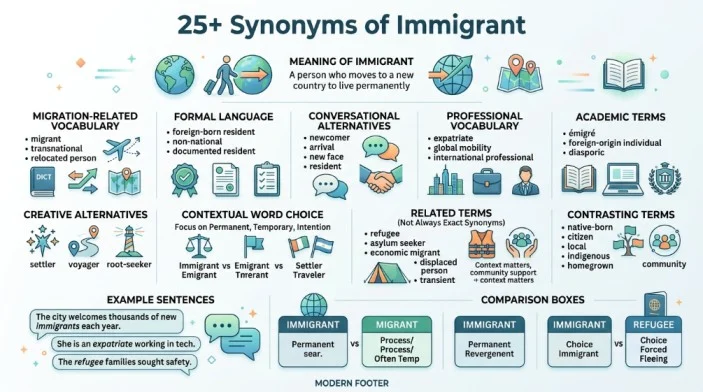
When writing an essay, resume, news article, business email, or social media caption, repeating the word immigrant can make your language feel limited. Searching for a synonym of immigrant can help you find a more precise term that reflects whether you mean a newcomer, migrant, settler, foreign born resident, or someone who has moved permanently to another country.
The best word depends on context. Some alternatives focus on movement, some on settlement, and others on a person’s relationship with the country they left or entered. Choosing carefully can make your writing more accurate, respectful, and natural while avoiding terms that accidentally change the meaning.
What Is the Best Synonym of “Immigrant”?
An immigrant is a person who moves to another country with the intention of living there, often permanently. Depending on context, useful alternatives include migrant, newcomer, settler, and émigré. In formal writing, descriptive phrases such as foreign born resident may provide greater precision.
For everyday communication, newcomer can sound friendly and neutral. Migrant is broader and can describe people who move between places for work or other reasons. Settler emphasizes establishing a home, while émigré focuses on someone who has left their former country.
Meaning, Tone, and Context
Simple Definition
An immigrant is a person who comes to a country from another country to live there.
The word normally describes the person from the perspective of the country they enter. For example, someone who moves from India to the United States may be described as an immigrant in the United States.
The word does not automatically explain the person’s legal status, reason for moving, length of stay, or exact immigration category.
Part of Speech
Immigrant is primarily a noun.
It can also function as an adjective when it describes something connected with immigrants, as in:
“She works with immigrant families.”
The related verb is immigrate, which means to move into another country to live.
The related noun immigration refers to the process or phenomenon of people moving into a country.
Overall Tone
Immigrant is generally a neutral descriptive term. Its emotional effect can change depending on the surrounding language and the context in which it appears.
For respectful communication, it is usually better to use the most accurate term rather than choosing a synonym simply because it sounds more sophisticated.
Formality Level
Immigrant is a standard word used in:
- Academic writing
- Government documents
- News reporting
- Business communication
- Everyday conversation
- Educational materials
- Professional discussions
It is neither unusually formal nor particularly informal.
Common Uses
Native English speakers commonly use immigrant when discussing:
- People who move to another country
- Immigration policy
- Immigrant communities
- Immigrant families
- Immigrant workers
- Immigrant experiences
- Immigration history
- New immigrant populations
- Immigrant rights
- Immigrant integration
Word Forms
| Word | Part of Speech | Meaning |
|---|---|---|
| Immigrant | Noun | A person who moves to another country to live there |
| Immigrate | Verb | To move into another country to live |
| Immigration | Noun | The process of moving into another country |
| Immigratory | Adjective | Related to immigration or migration, though relatively uncommon |
| Emigrant | Noun | A person who leaves one country to live elsewhere |
One important distinction is immigrant versus emigrant. The same person can be an immigrant from the perspective of the country they enter and an emigrant from the perspective of the country they leave.
When and How to Use “Immigrant”
Use immigrant when you specifically need to describe someone who has moved to another country to establish residence there.
The word is especially useful when the destination country matters. It is often more precise than the broader word migrant.
Professional
“She is an immigrant entrepreneur who founded a technology company in Chicago.”
This use identifies her background without making assumptions about her legal status or personal circumstances.
Academic
“The study examines how immigrant students adapt to a new educational environment.”
Here, immigrant identifies the population being studied.
Workplace
“Our company provides language resources for immigrant employees.”
The term clearly identifies employees who have moved from another country.
Personal
“My grandparents were immigrants who built a new life in the United States.”
This sentence uses the word naturally to describe a family’s history.
“We are developing resources to support immigrant families in the local community.”
The term works well in professional and community communication.
Resume
“Provided educational support to immigrant students from diverse cultural backgrounds.”
This wording is clear and appropriate for a resume.
Social Media
“Immigrant communities have contributed so much to the culture and character of our city.”
The word works naturally in public communication when the topic specifically concerns immigration.
Best Synonyms of “Immigrant”
There is an important vocabulary point to understand before replacing immigrant.
Not every word associated with immigration is a perfect synonym. Migrant, newcomer, settler, and émigré overlap with immigrant but emphasize different aspects of movement or residence. Other expressions, such as foreign born resident, describe a similar group without being exact lexical synonyms.
Choosing the closest alternative is therefore more useful than treating every related word as interchangeable.
Professional Writing: Foreign Born Resident
Foreign born resident is useful when accuracy and neutral description are more important than brevity.
Example:
“The program provides healthcare information to foreign born residents.”
This expression can be useful in reports, demographic discussions, and institutional writing because it describes birthplace without automatically stating why or how someone moved.
Academic Writing: Migrant
Migrant can work in academic writing when the discussion concerns movement between places rather than permanent immigration alone.
Example:
“The researchers examined the experiences of migrant workers.”
Use caution because migrant is broader than immigrant.
Business Communication: Newcomer
Newcomer is useful when discussing people who have recently arrived in a community, organization, or country.
Example:
“The program helps newcomers develop professional networks.”
It sounds welcoming and avoids unnecessary emphasis on immigration status.
Casual Conversation: Newcomer
In everyday conversation, newcomer can sound more natural and friendly than a formal immigration related term.
Example:
“The city has welcomed many newcomers over the past few years.”
Emotional Writing: New Arrival
New arrival can work when the focus is on the experience of arriving somewhere new.
Example:
“Every new arrival brings a unique story and a different perspective.”
This phrase is more descriptive than immigrant and can create a softer tone.
Creative Writing: Settler
Settler can work in historical or literary contexts when the emphasis is on establishing a home in a new place.
Example:
“The early settlers built homes along the river.”
It should not automatically replace immigrant because its historical and political implications can be much more specific.
Resume Writing: Immigrant Professional
For a resume, replacing immigrant is not always necessary. If the background is relevant, immigrant professional can be clear, while a more specific description of the person’s skills is often stronger.
Example:
“Supported immigrant professionals through career development workshops.”
Workplace Communication: Newcomer
Newcomer can be appropriate when discussing people who have recently joined a community or workforce.
Example:
“The orientation program helps newcomers understand workplace expectations.”
Stronger Meaning: Émigré
Émigré is not simply a stronger version of immigrant. It specifically describes someone who has left their country, often with an emphasis on exile or departure.
Example:
“The author spent decades abroad as an émigré.”
Softer Meaning: Newcomer
Newcomer often provides a softer and more welcoming alternative when the exact immigration category is not important.
Example:
“Local organizations created programs for newcomers.”
When Not to Use “Immigrant”
Although immigrant is accurate in many situations, it should not automatically replace every related term.
When the Person Is Moving Temporarily
If someone moves for a short period and does not intend to establish residence, immigrant may not be the best word.
Less precise:
“He is an immigrant worker who came for a three month assignment.”
Better:
“He is a temporary worker who came for a three month assignment.”
The second sentence tells readers more about the person’s actual situation.
When the Focus Is Movement
If the subject is moving between places for work, family, seasonal activity, or another reason, migrant may be more appropriate.
Less precise:
“The study examined immigrant farm workers who move between regions.”
Better:
“The study examined migrant farm workers who move between regions.”
The second sentence emphasizes mobility.
When the Focus Is Recent Arrival
If the main point is that someone has recently joined a community, newcomer can sound more natural.
Less precise:
“The organization offers services to immigrants who recently arrived.”
Better:
“The organization offers services to newcomers who recently arrived.”
When Historical Settlement Is the Focus
In historical contexts, settler may be more precise if the emphasis is on establishing a permanent community.
General:
“Immigrants established homes in the region.”
More specific:
“Settlers established homes in the region.”
The second sentence focuses on settlement rather than immigration alone.
When Departure From the Home Country Matters
Use émigré when the important detail is that a person left their country, especially when exile or political circumstances are relevant.
General:
“The writer became an immigrant in France.”
More specific:
“The writer became an émigré after leaving his homeland.”
When Birthplace Is the Only Relevant Fact
Sometimes foreign born resident is more precise than immigrant.
General:
“The survey included immigrants living in the city.”
More precise when appropriate:
“The survey included foreign born residents living in the city.”
The second expression focuses on birthplace rather than immigration history.
Words Commonly Confused With “Immigrant”
Migrant
Difference: Migrant is broader. It can describe people who move from one place to another, within a country or across borders, often temporarily or repeatedly.
When to use it: Use migrant when movement itself is central to the discussion.
Example:
“Many migrant workers travel to different regions during the harvest season.”
Emigrant
Difference: Emigrant describes a person from the perspective of the country they leave.
When to use it: Use it when the departure from the original country is the focus.
Example:
“Thousands of emigrants left the country during that period.”
Expatriate
Difference: Expatriate, often shortened to expat, usually describes someone living outside their home country, frequently for work or another temporary arrangement.
When to use it: Use it when overseas residence is the main idea and permanent immigration is not necessarily intended.
Example:
“The company provides housing assistance for expatriate employees.”
Refugee
Difference: A refugee is a person who has been forced to leave their country because of persecution, conflict, violence, or other serious circumstances recognized under relevant legal definitions.
When to use it: Use refugee only when the circumstances support that specific term.
Example:
“The organization provides legal assistance to refugees.”
Settler
Difference: Settler emphasizes establishing a home or community in a new place. It is particularly common in historical contexts.
When to use it: Use it when settlement rather than migration is the main focus.
Example:
“The settlers established farms along the frontier.”
Best Synonyms of “Immigrant” by Context
| Context | Best Synonym or Alternative | Why It Works | Example |
|---|---|---|---|
| Formal writing | Foreign born resident | Describes birthplace precisely | “The program serves foreign born residents.” |
| Academic writing | Migrant | Useful when mobility is central | “The research examines migrant populations.” |
| Professional communication | Newcomer | Neutral and welcoming | “The organization supports newcomers.” |
| Business emails | Newcomer | Friendly and practical | “We created resources for newcomers.” |
| Resume writing | Immigrant professional | Keeps the immigration context clear | “Mentored immigrant professionals.” |
| Workplace communication | Newcomer | Works well for recent arrivals | “Newcomers receive workplace orientation.” |
| Casual conversation | Newcomer | Friendly and natural | “The neighborhood welcomed several newcomers.” |
| Everyday speaking | Newcomer | Simple and approachable | “She’s a newcomer to the city.” |
| Creative writing | New arrival | Focuses on arrival and transition | “The new arrival watched the city from the train.” |
| Storytelling | Settler | Useful for historical settlement | “The settlers built homes near the river.” |
| Emotional writing | Newcomer | Can create a welcoming tone | “Every newcomer deserves a sense of belonging.” |
| Strong emphasis | Émigré | Highlights departure or exile | “The émigré writer lived abroad for years.” |
| Mild tone | Newcomer | Less bureaucratic in general contexts | “The community welcomed newcomers.” |
| Social media captions | Newcomer | Short and approachable | “Celebrating the stories of newcomers.” |
| American English | Immigrant | Standard and widely understood | “Immigrant families contribute to communities.” |
| British English | Immigrant | Also standard in British English | “The report discusses immigrant communities.” |
How to Choose the Best Synonym of “Immigrant”
The most accurate choice depends on what you want the reader to understand.
If You Mean Permanent Movement
Use immigrant when someone has moved to another country to live there.
Example:
“Her parents were immigrants who settled in California.”
If You Mean Movement in General
Use migrant when the person’s movement between locations is more important than permanent settlement.
Example:
“The report focuses on migrant workers.”
If You Mean a Recent Arrival
Use newcomer when the person has recently arrived in a community or country.
Example:
“The city offers language classes for newcomers.”
If You Mean Settlement
Use settler when establishing a home or community is the central idea.
Example:
“The settlers established a permanent community.”
If You Mean Someone Who Left Their Country
Use émigré when departure is the focus.
Example:
“The poet lived abroad as an émigré.”
If You Mean Someone Living Abroad Temporarily
Use expatriate when overseas residence is relevant but permanent immigration is not necessarily intended.
Example:
“The company relocated several expatriate employees.”
If You Mean Forced Displacement
Use refugee only when the person meets the relevant meaning of that term.
Example:
“The agency provides housing assistance to refugees.”
If You Mean Birthplace
Use foreign born resident when birthplace is the relevant characteristic.
Example:
“The survey compared foreign born residents with US born residents.”
Real Life Examples of “Immigrant”
School
Original:
“Many immigrant students learn English after moving to the United States.”
More specific:
“Many newcomer students receive English language support after arriving in the United States.”
The second sentence focuses on recent arrival rather than immigration history.
College
Original:
“The university offers services for immigrant students.”
Alternative:
“The university offers services for international and immigrant students.”
This version can be more useful when the institution serves several groups with different backgrounds.
Workplace
Original:
“The company employs many immigrants.”
Alternative:
“The company employs professionals who immigrated from several countries.”
The alternative focuses on the employees’ movement rather than labeling them as a group.
Business
Original:
“The business was founded by an immigrant entrepreneur.”
Alternative:
“The business was founded by an entrepreneur who immigrated to the United States.”
The second version is useful when a more descriptive sentence is preferred.
Original:
“We are expanding services for immigrant families.”
Alternative:
“We are expanding services for families who have recently immigrated to the area.”
The second version specifies the relevant circumstance.
Resume
Original:
“Worked with immigrant communities.”
Alternative:
“Provided community outreach services to immigrant families.”
The improved version explains the actual professional activity.
Conversation
Original:
“He’s an immigrant from Brazil.”
Alternative:
“He moved to the United States from Brazil a few years ago.”
The second sentence may sound more conversational when immigration status is not the main point.
Storytelling
Original:
“The immigrant arrived in New York with one suitcase.”
Alternative:
“The newcomer arrived in New York carrying one suitcase and a folder of family photographs.”
The alternative adds a storytelling focus and avoids repeating a formal category.
Blogging
Original:
“Immigrants have different experiences when adapting to a new country.”
Alternative:
“People who move to a new country can experience very different paths of adjustment.”
The second version is broader and more descriptive.
Social Media
Original:
“Immigrants make valuable contributions to American communities.”
Alternative:
“Immigrant families, workers, students, and entrepreneurs enrich communities across the country.”
The second version gives the statement more specificity.
25 Best Synonyms and Alternatives for “Immigrant”
Because immigrant has a specific meaning, some related terms are alternatives rather than perfect one word synonyms. The table below distinguishes useful choices so readers do not accidentally change the meaning.
| Synonym or Alternative | Simple Meaning | Best Used For | Example Sentence |
|---|---|---|---|
| Migrant | Person who moves from one place to another | Mobility and migration | “The program supports migrant workers.” |
| Newcomer | Person who has recently arrived | Community and everyday language | “The city welcomed its newest newcomers.” |
| Settler | Person who establishes a home in a new place | Historical or settlement contexts | “The settlers built homes near the river.” |
| Émigré | Person who has left their country to live elsewhere | Departure, exile, literary contexts | “The émigré writer lived abroad for decades.” |
| Foreign born resident | Resident born in another country | Formal and demographic writing | “The report studied foreign born residents.” |
| New arrival | Person who has recently arrived | General and descriptive writing | “The center provides services for new arrivals.” |
| New resident | Person who has recently begun living somewhere | Community contexts | “New residents can register for local services.” |
| Recent arrival | Person who arrived relatively recently | Reports and descriptive writing | “The program assists recent arrivals.” |
| Transplant | Person who moves to a new place | Informal American English | “She’s a recent transplant from Texas.” |
| Incomer | Person who comes into a place to live | Regional or British usage | “The town has attracted many incomers.” |
| Migrant resident | Person who has moved to another area and resides there | Descriptive contexts | “The survey included migrant residents.” |
| Foreign national | Person who is a citizen of another country | Legal and administrative contexts | “The company hired several foreign nationals.” |
| Foreign citizen | Citizen of another country | Administrative contexts | “The rules apply to foreign citizens.” |
| Overseas resident | Person living outside their home country | International contexts | “The organization serves overseas residents.” |
| International resident | Resident with an international background | Institutions and organizations | “The university supports international residents.” |
| Immigrant newcomer | Recent immigrant who has newly arrived | Community programs | “The center provides classes for immigrant newcomers.” |
| Resettled person | Person who has moved and established residence elsewhere | Resettlement contexts | “The program assists resettled families.” |
| Resettled resident | Person who has established residence after relocation | Institutional writing | “Resettled residents received housing assistance.” |
| New community member | Person who has recently joined a community | Friendly public communication | “Every new community member receives a welcome guide.” |
| New country resident | Person now living in another country | Explanatory writing | “New country residents often need local information.” |
| International newcomer | New arrival from another country | Education and community programs | “The school created resources for international newcomers.” |
| Migrating person | Person who is moving between places | Descriptive writing | “The study follows migrating people across regions.” |
| Relocated resident | Person who has moved residence | Workplace and relocation contexts | “Relocated residents received information about local services.” |
| New resident from abroad | Resident who came from another country | Clear descriptive writing | “The survey included new residents from abroad.” |
| Person who immigrated | Person who moved to another country to live | Maximum clarity | “She is a person who immigrated to the United States.” |
The alternatives above are not interchangeable in every sentence. For example, refugee, expatriate, emigrant, and migrant have distinct meanings and should be selected according to the facts being described.
Synonyms of “Immigrant” by Usage
Professional vs Personal Synonyms
Professional writing usually benefits from precise terminology. Immigrant, foreign born resident, newcomer, and migrant can all work, but each communicates something different.
In personal writing, newcomer, new arrival, or a direct description such as “someone who moved here from Mexico” can sound warmer and more natural.
Formal vs Conversational Synonyms
- For reports and formal documents, use immigrant, foreign born resident, or another precise descriptive term.
- For casual conversations, newcomer or a direct description of where someone moved from may sound more natural.
- For texting, a simple phrase such as “someone who recently moved here” is often clearer than a formal label.
Academic Synonyms
Academic writing requires precision. Migrant is useful when mobility is the focus, while immigrant is better when settlement in another country is central.
Foreign born resident can be useful in demographic or statistical contexts when birthplace is the relevant variable.
Avoid replacing immigrant with migrant simply to make academic writing sound more sophisticated. The two terms do not always refer to exactly the same population.
Professional and Business Synonyms
For resumes and interviews, it is usually better to focus on skills, achievements, and experience rather than replacing immigrant with a vague synonym.
For example:
“Managed customer accounts for a diverse immigrant client base.”
This is more informative than simply saying:
“Worked with newcomers.”
In business emails, newcomer can be appropriate for community programs, while immigrant may be better when the subject specifically concerns immigration.
Creative and Literary Synonyms
Creative writing gives you more freedom to describe the person without relying on a category.
Words such as newcomer, new arrival, settler, and émigré can create different narrative effects.
For example:
“The newcomer stood quietly at the station, watching the unfamiliar streets.”
This focuses on experience rather than classification.
Slang or Modern Synonyms
There is no universal slang synonym for immigrant that works across American English.
Transplant is an informal American expression for someone who has moved to a new place, but it is broader than immigrant and can describe someone who moved between states within the United States.
Example:
“She’s a New York transplant living in Los Angeles.”
Do not use transplant in formal immigration writing because it does not specifically identify international immigration.
Strongest to Mildest Synonyms
Unlike adjectives such as important, the alternatives for immigrant are not naturally arranged on a simple intensity scale. They describe different aspects of a person’s movement or residence.
A more useful scale is based on specificity:
| Category | Term | Main Focus |
|---|---|---|
| Broad | Migrant | Movement |
| Broad | Newcomer | Recent arrival |
| Neutral | Immigrant | Moving to another country to live |
| Specific | Foreign born resident | Birthplace and residence |
| Specific | Settler | Establishing residence |
| Specific | Émigré | Leaving a country |
| Circumstantial | Refugee | Forced displacement under specific circumstances |
| Circumstantial | Expatriate | Living abroad, often temporarily |
The key lesson is that these words do not represent stronger and weaker versions of immigrant. They represent different meanings.
Emotional vs Neutral Synonyms
Emotional or Warmer Alternatives
Newcomer, new arrival, and new community member can create a welcoming tone.
Example:
“Our community is proud to welcome newcomers.”
These expressions may be useful in community outreach, speeches, and public messaging.
Neutral Alternatives
Immigrant, migrant, and foreign born resident are more descriptive and objective when used accurately.
Example:
“The report examines the employment outcomes of immigrant workers.”
Neutral language is generally preferable when writing academic, professional, or informational content.
Antonyms of “Immigrant”
There is no single perfect grammatical opposite of immigrant because the word describes a person entering another country to live rather than a simple quality that has one opposite.
However, the following terms can express contrasting positions or situations when the context supports them.
| Antonym or Contrast | Meaning | Example Sentence |
|---|---|---|
| Native born person | Person born in the country being discussed | “The study compared immigrant and native born participants.” |
| Native resident | Person who is native to the place | “Native residents discussed changes in the neighborhood.” |
| Nonimmigrant | Person who is not classified as an immigrant in a particular context | “The program serves both immigrant and nonimmigrant residents.” |
| Emigrant | Person viewed from the country they leave | “The emigrant left his home country years ago.” |
| Nonmigrant | Person who does not migrate | “The researchers compared migrants with nonmigrants.” |
| Stay at home resident | Person who remains in the original location | “The survey compared movers with stay at home residents.” |
| Local resident | Person who already lives in the local area | “Local residents attended the meeting.” |
| Lifelong resident | Person who has lived in the same area throughout life | “She is a lifelong resident of the town.” |
| Long term resident | Person who has lived in a place for an extended period | “Long term residents welcomed the newcomers.” |
| Indigenous resident | Person belonging to an indigenous population of the area | “The program was developed with indigenous residents.” |
| Citizen born in country | Citizen born in the country being discussed | “The report compared immigrants with citizens born in the country.” |
| Home country resident | Person who remains in their country of origin | “Home country residents responded to the survey.” |
| Local | Person belonging to or living in the local area | “Locals helped the new family find housing.” |
| Native | Person originating from the place being discussed | “The museum included stories from native residents.” |
| Established resident | Person already established in the community | “Established residents participated in the welcome event.” |
Some of these are contextual contrasts rather than dictionary antonyms. That distinction matters because immigrant is a category based on movement and residence, so its opposite depends heavily on what comparison is being made.
Comparison: “Immigrant” vs Similar Words
“Immigrant” vs “Migrant”
Main Difference
Immigrant usually emphasizes moving to another country to live there. Migrant is broader and emphasizes movement from one place to another.
Which Is Stronger?
Neither is inherently stronger. They communicate different ideas.
Which Is More Formal?
Both are standard in formal writing.
When to Use Each
Use immigrant when permanent or long term international settlement is relevant.
Use migrant when movement, mobility, or temporary migration is central.
Examples
Immigrant:
“Immigrant families settled in the city.”
Migrant:
“Migrant workers traveled between regions for seasonal employment.”
“Immigrant” vs “Emigrant”
Main Difference
Immigrant focuses on entering a country. Emigrant focuses on leaving a country.
Which Is Stronger?
Neither.
Which Is More Formal?
Both are formal enough for academic and historical writing.
When to Use Each
Use immigrant from the destination country’s perspective.
Use emigrant from the origin country’s perspective.
Examples
Immigrant:
“She became an immigrant after moving to Canada.”
Emigrant:
“She was one of many emigrants who left her homeland.”
“Immigrant” vs “Expatriate”
Main Difference
Immigrant generally suggests moving to another country to establish residence. Expatriate often refers to someone living outside their home country, frequently for work or a temporary period.
Which Is Stronger?
Neither.
Which Is More Formal?
Expatriate can sound more formal, especially in corporate contexts.
When to Use Each
Use immigrant when long term settlement is relevant.
Use expatriate when living abroad is the main idea.
Examples
Immigrant:
“He immigrated to the United States with his family.”
Expatriate:
“She works overseas as an expatriate manager.”
“Immigrant” vs “Refugee”
Main Difference
Immigrant describes international movement for residence. Refugee refers to a person who has been forced to flee because of circumstances such as persecution or conflict and meets the relevant legal definition.
Which Is Stronger?
Neither. Refugee is more specific.
Which Is More Formal?
Both are appropriate in formal writing when accurately used.
When to Use Each
Use refugee only when the circumstances justify that term.
Examples
Immigrant:
“The immigrant moved to the United States for family reasons.”
Refugee:
“The refugee fled the country because of persecution.”
“Immigrant” vs “Settler”
Main Difference
Immigrant emphasizes international movement and residence. Settler emphasizes establishing a home or community in a particular place.
Which Is Stronger?
Neither.
Which Is More Formal?
Both are standard, but settler can carry important historical or political implications.
When to Use Each
Use settler when settlement is central to the discussion.
Examples
Immigrant:
“The immigrants arrived from several countries.”
Settler:
“The settlers established farms in the region.”
“Immigrant” vs “Newcomer”
Main Difference
Immigrant specifically relates to moving to another country. Newcomer simply describes someone who is new to a place or community.
Which Is Stronger?
Immigrant is more specific.
Which Is More Formal?
Immigrant is more precise for formal immigration discussions. Newcomer often sounds warmer.
When to Use Each
Use newcomer when recent arrival is more relevant than immigration status.
Examples
Immigrant:
“The organization supports immigrant families.”
Newcomer:
“The organization helps newcomers find local services.”
Common Phrases and Expressions with “Immigrant”
Immigrant Community
Meaning: A group of immigrants living in or connected to a particular community.
Example:
“The city has a large immigrant community.”
Immigrant Family
Meaning: A family in which one or more members have immigrated to another country.
Example:
“She grew up in an immigrant family.”
Immigrant Worker
Meaning: A worker who has immigrated to another country.
Example:
“The program provides legal information for immigrant workers.”
Immigrant Experience
Meaning: The experiences associated with moving to and living in another country.
Example:
“The novel explores the immigrant experience through several generations.”
Immigrant Population
Meaning: The group of immigrants living in a particular area.
Example:
“The immigrant population has grown over the past decade.”
Immigrant Background
Meaning: A person’s family or personal history involving immigration.
Example:
“She comes from an immigrant background.”
Immigrant Rights
Meaning: Rights and protections discussed in relation to immigrants.
Example:
“The organization provides information about immigrant rights.”
Immigrant Services
Meaning: Services designed to support people who have immigrated.
Example:
“The center offers immigrant services, including language classes.”
Common Mistakes to Avoid
Choosing “Migrant” as an Exact Replacement Every Time
Incorrect:
“Her family became migrant when they moved permanently to the United States.”
Better:
“Her family immigrated to the United States.”
Why:
Migrant is broader and can suggest temporary or repeated movement. Immigrate is more precise when permanent international residence is the point.
Using “Refugee” Without the Relevant Circumstances
Incorrect:
“Every immigrant is a refugee.”
Better:
“Some immigrants are refugees, while others move for work, family, education, or other reasons.”
Why:
Refugee has a specific meaning and should not be used as a general synonym for immigrant.
Confusing Immigrant With Emigrant
Incorrect:
“She was an emigrant when she arrived in the United States.”
Better:
“She was an immigrant when she arrived in the United States.”
Why:
The destination perspective calls her an immigrant. The origin country perspective would describe her as an emigrant.
Using Expatriate as a Perfect Synonym
Incorrect:
“Every immigrant is an expatriate.”
Better:
“Some people who live abroad are expatriates, while others immigrate permanently.”
Why:
Expatriate often suggests overseas residence without necessarily implying permanent immigration.
Using Settler in Every Historical Context
Incorrect:
“The modern immigrant community consists of settlers.”
Better:
“The modern immigrant community includes people who recently moved to the country.”
Why:
Settler emphasizes establishing a home or community and may carry historical or political meanings that immigrant does not.
Choosing a Vague Synonym
Incorrect:
“The program supports people from other places.”
Better:
“The program supports immigrant families.”
Why:
The vague phrase does not tell readers what kind of movement or background is being discussed.
Overusing Labels
Incorrect:
“The immigrant employee helped the immigrant manager contact an immigrant client about an immigrant community.”
Better:
“The employee helped the manager contact a client about services for the local immigrant community.”
Why:
Repeating the same label can make prose awkward. Once the context is clear, use names, roles, pronouns, or more specific descriptions.
Frequently Asked Questions
What Is the Best Synonym of “Immigrant”?
The best synonym of immigrant depends on context. Migrant emphasizes movement, newcomer emphasizes recent arrival, settler emphasizes establishing a home, and émigré emphasizes leaving one’s country.
What Are the Best Formal Synonyms of “Immigrant”?
Formal alternatives include migrant, foreign born resident, new arrival, and émigré, depending on meaning. For academic or official writing, choose the term that describes the person’s movement, residence, or background most precisely.
What Are Common Informal Synonyms of “Immigrant”?
Newcomer is one of the most natural informal alternatives when someone has recently arrived in a community. Transplant can also work in American English, but it is broader and can describe domestic moves.
What Is Another Word for “Immigrant” in Professional Writing?
Immigrant, foreign born resident, and newcomer can all work professionally, but their meanings differ. Use immigrant for immigration specifically, foreign born resident for demographic precision, and newcomer for recent arrival.
What Is the Difference Between “Immigrant” and “Migrant”?
An immigrant generally moves to another country to live there, often permanently. A migrant is a broader term for someone who moves from one place to another, including temporary, seasonal, domestic, or repeated movement.
What Is the Opposite of “Immigrant”?
There is no single perfect opposite of immigrant. Depending on context, contrasting terms include native born person, nonimmigrant, local resident, lifelong resident, or nonmigrant.
Conclusion
An immigrant is a person who moves to another country to live there. Although words such as migrant, newcomer, settler, émigré, and foreign born resident can sometimes serve as alternatives, they are not identical in meaning.
The best synonym of immigrant depends on what you want to emphasize. Use migrant for movement, newcomer for recent arrival, settler for establishment in a place, émigré for departure, and foreign born resident when birthplace is the relevant detail.
The most useful vocabulary habit is to identify the exact idea you want to communicate before replacing a word. A precise alternative is always better than a more complicated word that changes the original meaning.
Read More Related Articles:
50+ Synonyms of Autonomy | Meanings, Uses, Examples, and …
Synonyms for Pros and Cons | Meaning, Examples, and Better …
25+ Synonyms, Meanings, Uses, and Best Alternatives