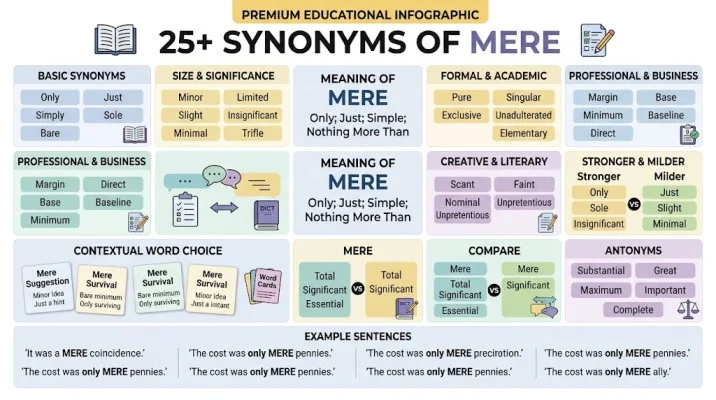
The word mere can look simple, but its meaning changes subtly with context. It often describes something as small, unimportant, or existing only in a limited sense. Choosing the right alternative can make your writing more precise and natural. The best synonyms of mere include only, just, simple, slight, insignificant, minimal, and bare. Each word carries a slightly different tone, so replacing mere mechanically can change the intended meaning.
Understanding the mere meaning synonyms also helps with everyday writing, academic work, and professional communication. A suitable mere synonym should match both the sentence and the level of emphasis. In mere conversation meaning, for example, just or only may sound more natural than insignificant. This guide explores mere synonyms, their meanings, usage, examples, and the opposite of mere, helping you choose another word for mere with confidence.
What Are the Best Synonyms of “Mere”?
The best synonyms of mere include only, just, simply, sole, bare, sheer, slight, minor, insignificant, and nothing more than. For formal writing, sole and nothing more than are useful, while only, just, and simply sound natural in everyday English. The best choice depends on whether mere means only, small, limited, or insignificant.
Meaning, Tone, and Context
Simple Definition
Mere is an adjective used to emphasize that someone or something is no more than what is stated. It can also suggest that something is small, limited, ordinary, or less important than it may appear.
Consider these examples:
“He was a mere child.”
Here, mere emphasizes that he was only a child.
“It took a mere five minutes.”
Here, mere emphasizes that five minutes is a very small amount of time.
“She was not a mere employee.”
In this sentence, mere suggests that describing her as simply an employee would fail to recognize her greater role or value.
Part of Speech
Mere is an adjective.
It normally appears before a noun:
“a mere suggestion”
“a mere formality”
“a mere coincidence”
“a mere teenager”
Overall Tone
The tone of mere is generally neutral, but it can become dismissive depending on the context.
For example:
“It was a mere misunderstanding.”
This can suggest that the misunderstanding was small or not serious.
However:
“He is a mere assistant.”
may sound dismissive because it reduces the person’s role to a limited position.
Formality Level
Mere is a neutral to moderately formal word. It is common in everyday English, journalism, academic writing, literature, business communication, and formal speech.
It can sound especially polished when used to emphasize contrast:
“The project required more than mere technical knowledge.”
Common Uses
Native English speakers commonly use mere before nouns involving:
- Quantity
- Time
- Age
- Status
- Ability
- Importance
- Appearance
- Achievement
- Possibility
- Explanation
- Description
Common expressions include:
“a mere five minutes”
“a mere suggestion”
“a mere child”
“mere coincidence”
“mere words”
“mere speculation”
“mere appearance”
“mere formality”
“mere chance”
“a mere detail”
Word Forms
Mere does not have common noun, verb, or adverb forms that function as direct grammatical equivalents.
The word is primarily used as an adjective.
Related expressions include:
merely, an adverb meaning only or simply.
“She was merely trying to help.”
mere, adjective.
“It was a mere suggestion.”
The opposite meaning depends on the context. Words such as substantial, significant, considerable, major, and important can contrast with mere when it means small, limited, or insignificant.
When and How to Use “Mere”
Use mere when you want to reduce the perceived importance, size, amount, status, or extent of something. It often creates a contrast between what something appears to be and what it actually represents.
Professional
“The proposal is more than a mere cost saving measure.”
Here, mere emphasizes that the proposal has a broader purpose.
Academic
“The findings cannot be explained by mere coincidence.”
The word suggests that coincidence alone is not enough to explain the results.
Workplace
“This is not a mere administrative task.”
The sentence emphasizes that the task has greater importance than it might initially seem.
Personal
“What started as a mere friendship eventually became a close relationship.”
Here, mere means the relationship was initially nothing more than a friendship.
“This is not a mere update. It contains several changes that require your attention.”
The word creates a contrast between a simple update and something more substantial.
Resume
“The role involved more than mere data entry.”
This phrasing shows that the position required additional skills and responsibilities.
Social Media
“What looked like a mere idea turned into a successful project.”
The sentence highlights the transformation from a small beginning to something more significant.
Best Synonyms of “Mere”
No single synonym can replace mere in every sentence because the word has several related uses. Sometimes it means only, sometimes just, and sometimes it emphasizes that something is small, insignificant, or less substantial than expected.
Professional Writing: Sole
Sole works well when mere means the only one.
“The sole purpose of the meeting was to review the contract.”
It is more precise than mere when exclusivity is the main idea.
Academic Writing: Simply
Simply can work when mere introduces a basic or insufficient explanation.
“The problem cannot be solved simply through additional funding.”
It is useful when the writer wants to distinguish a simple explanation from a more complex one.
Business Communication: Only
Only is usually the clearest choice when mere means no more than a particular amount or thing.
“The delay was only two days.”
Casual Conversation: Just
Just is one of the most natural conversational alternatives.
“It was just a suggestion.”
Emotional Writing: Nothing More Than
Nothing more than can emphasize emotional or conceptual limitation.
“To him, the promise was nothing more than empty words.”
Creative Writing: Bare
Bare can emphasize something minimal or lacking in addition.
“He survived on the bare necessities.”
Resume Writing: Limited
Limited is useful when you want to describe restricted experience, resources, or scope.
“Despite limited resources, she completed the project successfully.”
Workplace Communication: Minor
Minor works when mere suggests something small or relatively unimportant.
“The team resolved a minor technical issue.”
Stronger Meaning: Insignificant
Insignificant is stronger when the intended meaning is that something has very little importance or influence.
“The difference was statistically insignificant.”
Softer Meaning: Simple
Simple can work when you want to describe something as uncomplicated without making it sound dismissive.
“It began with a simple idea.”
When Not to Use “Mere”
Although mere is useful, it can sometimes make writing less accurate or more dismissive.
When It Sounds Too General
Less Effective:
“It was a mere problem.”
Better:
“It was a minor problem.”
Why:
Minor directly communicates that the problem was small in seriousness or impact.
When It Sounds Too Dismissive
Less Effective:
“She is a mere assistant.”
Better:
“She is an assistant who manages several important operations.”
Why:
Mere can unintentionally diminish a person’s role. A neutral description is often more respectful.
When You Mean “Only”
Less Effective:
“The sole reason was a mere desire to help.”
Better:
“The only reason was a desire to help.”
Why:
Only is clearer when exclusivity is the main point.
When You Need Strong Professional Precision
Less Effective:
“The company faced a mere increase in costs.”
Better:
“The company faced a minor increase in costs.”
Why:
Minor gives the reader a clearer idea about the scale of the increase.
When You Mean Something Is Truly Insignificant
Less Effective:
“The difference was mere.”
Better:
“The difference was insignificant.”
Why:
Mere normally modifies a noun and does not function naturally as a standalone description in this sentence.
When You Want an Informal Tone
Less Effective:
“It was a mere five minutes.”
Natural Casual Version:
“It was only five minutes.”
Why:
Only sounds more conversational and direct.
Words Commonly Confused With “Mere”
| Word | Difference | When to Use It | Example |
|---|---|---|---|
| Only | Emphasizes limitation or exclusivity. | Everyday and formal writing. | “It took only five minutes.” |
| Just | Often means only, simply, or recently. | Casual conversation. | “It was just a suggestion.” |
| Simply | Emphasizes straightforwardness or limitation. | Explanations and formal writing. | “The issue cannot be simply ignored.” |
| Sole | Means one and only. | Formal and professional writing. | “She was the sole applicant.” |
| Minor | Means small in importance, size, or seriousness. | Problems, changes, issues, and details. | “The system experienced a minor error.” |
| Insignificant | Means having little importance, effect, or value. | Academic and analytical contexts. | “The difference was insignificant.” |
Best Synonyms of “Mere” by Context
| Context | Best Synonym | Why It Works | Example |
|---|---|---|---|
| Formal writing | Sole | Clearly expresses exclusivity. | “The sole purpose was research.” |
| Academic writing | Simply | Helps distinguish basic explanations from complex ones. | “The result cannot be simply attributed to chance.” |
| Professional communication | Only | Clear and direct. | “The process requires only two approvals.” |
| Business emails | Only | Sounds natural and precise. | “We need only one additional document.” |
| Resume writing | Limited | Describes restricted experience or resources. | “Worked successfully with limited resources.” |
| Workplace communication | Minor | Appropriate for small problems or changes. | “There was a minor scheduling issue.” |
| Casual conversation | Just | Natural and conversational. | “It was just an idea.” |
| Everyday speaking | Only | Simple and widely understood. | “I need only a few minutes.” |
| Creative writing | Bare | Creates a sense of minimalism or lack. | “He had only the bare essentials.” |
| Storytelling | Simple | Highlights a modest beginning. | “It started with a simple thought.” |
| Emotional writing | Nothing more than | Emphasizes emotional limitation. | “The apology felt like nothing more than words.” |
| Strong emphasis | Insignificant | Clearly expresses lack of importance. | “The difference was insignificant.” |
| Mild tone | Small | Avoids excessive negativity. | “It was a small mistake.” |
| Social media captions | Just | Short and natural. | “Just a little reminder.” |
| American English | Only | Common across everyday and formal contexts. | “It was only a temporary problem.” |
How to Choose the Best Synonym of “Mere”
The easiest way to choose an alternative is to identify exactly what mere means in your sentence.
If You Mean “Only”
Choose only or just.
“It was mere coincidence.”
Better:
“It was only a coincidence.”
If You Mean “The Only One”
Choose sole.
“He was the sole owner.”
This is clearer than using mere because the focus is exclusivity.
If You Mean “Small in Importance”
Choose minor or insignificant.
“It was a minor issue.”
This gives the reader a clearer sense of scale.
If You Mean “Simple”
Choose simple or basic, depending on context.
“It began with a simple idea.”
If You Mean “Limited”
Choose limited.
“The team succeeded despite limited resources.”
If You Mean “Nothing More Than”
Use nothing more than.
“His explanation was nothing more than an excuse.”
Consider Your Audience
For academic and professional readers, significant, sole, limited, minor, and insignificant may provide greater precision.
For casual readers, only, just, and simple often sound more natural.
Consider Emotional Strength
Only is usually neutral.
Just can sound casual.
Minor suggests small importance.
Insignificant can sound strongly dismissive.
Nothing more than can create a sharper emotional contrast.
Real Life Examples of “Mere”
School
Original:
“The assignment was a mere exercise.”
Improved:
“The assignment was simply an exercise designed to practice the new skill.”
The revised version makes the purpose clearer.
College
Original:
“The result was not mere coincidence.”
Improved:
“The result was not simply a coincidence.”
This sounds natural in academic discussion.
Workplace
Original:
“The issue was a mere technical problem.”
Improved:
“The issue was a minor technical problem.”
Minor gives a clearer indication of seriousness.
Business
Original:
“The project was more than a mere investment.”
Improved:
“The project was more than a simple investment.”
The revised sentence emphasizes broader value.
Original:
“This is not a mere update.”
Improved:
“This is more than a simple update.”
This sounds natural and clear in professional communication.
Resume
Original:
“I gained more than mere experience.”
Improved:
“I gained practical experience and developed valuable leadership skills.”
The second version gives concrete information instead of relying on an abstract expression.
Conversation
Original:
“It was a mere joke.”
More natural:
“It was just a joke.”
Just is more conversational.
Storytelling
Original:
“It started as a mere idea.”
Improved:
“It started as a simple idea and eventually became a successful business.”
The contrast makes the story more engaging.
Blogging
Original:
“This is not a mere writing mistake.”
Improved:
“This is more than a minor writing mistake because it changes the meaning of the sentence.”
The revised sentence explains the actual consequence.
Social Media
Original:
“A mere thought can change everything.”
Alternative:
“Even a simple thought can change everything.”
Simple creates a more accessible and conversational tone.
25 Best Synonyms of “Mere”
| Synonym | Simple Meaning | Best Used For | Example Sentence |
|---|---|---|---|
| Only | No more than | General writing | “It took only ten minutes.” |
| Just | Only or simply | Casual conversation | “It was just an idea.” |
| Simply | Only or in a straightforward way | Formal explanations | “The issue cannot be simply ignored.” |
| Sole | One and only | Formal writing | “She was the sole decision maker.” |
| Bare | Minimal or without extras | Descriptive writing | “They had only the bare necessities.” |
| Minor | Small in importance or seriousness | Workplace communication | “It was a minor error.” |
| Insignificant | Having little importance | Academic and analytical writing | “The difference was insignificant.” |
| Limited | Restricted in amount or scope | Business and professional writing | “The team worked with limited resources.” |
| Simple | Basic or uncomplicated | Everyday and creative writing | “It began with a simple plan.” |
| Basic | Fundamental or not advanced | Education and practical writing | “The course covers basic concepts.” |
| Small | Limited in size or amount | General conversation | “It was a small contribution.” |
| Slight | Small in degree | Changes and differences | “There was a slight increase in demand.” |
| Trivial | Very unimportant | Informal and analytical contexts | “They argued over a trivial detail.” |
| Negligible | So small it barely matters | Technical and formal writing | “The cost difference was negligible.” |
| Insufficient | Not enough | Formal and professional contexts | “The evidence was insufficient.” |
| Inconsiderable | Not substantial | Formal writing | “The change was inconsiderable.” |
| Unimportant | Not important | Direct descriptions | “The detail was unimportant to the investigation.” |
| Basic | Simple or fundamental | Educational contexts | “The guide explains basic principles.” |
| Modest | Small or limited | Amounts and achievements | “The project began with modest funding.” |
| Minimal | As little as possible | Technical and professional writing | “The procedure requires minimal equipment.” |
| Barely | Only just | Degree or amount | “The change was barely noticeable.” |
| Slightest | Very smallest degree | Emphasis | “There was not the slightest doubt.” |
| Unadorned | Simple and without extras | Creative and descriptive writing | “The room had an unadorned appearance.” |
| Unpretentious | Simple and not showy | People, places, and styles | “They chose an unpretentious design.” |
| Nothing more than | Only or no more than | Emphasis and contrast | “It was nothing more than a misunderstanding.” |
Important usage note: Not every synonym above can replace mere in every sentence. Words such as only, just, simply, sole, minor, limited, slight, minimal, and nothing more than are especially useful because they cover the major meanings of mere. Other alternatives apply only in specific contexts.
Synonyms of “Mere” by Usage
Professional vs Personal Synonyms
Professional writing usually benefits from precision.
- Use sole when you mean one and only.
“The sole objective was to reduce costs.”
- Use limited when describing restricted resources or opportunities.
“The company operated with limited funding.”
- Use minor when describing a small problem.
“The department experienced a minor delay.”
Personal writing can use simpler alternatives.
“It was just a misunderstanding.”
“It started with a simple idea.”
Formal vs Conversational Synonyms
For reports and essays, sole, insignificant, minimal, limited, and minor can be useful when their meanings fit.
For emails and conversations, only, just, and simply often sound more natural.
Compare:
Formal:
“The difference was negligible.”
Conversational:
“The difference was tiny.”
The choice should depend on the audience rather than simply choosing the most sophisticated word.
Academic Synonyms
Academic writing requires precision. Strong alternatives to mere include:
Simply: useful when rejecting an overly simple explanation.
Significantly: useful when discussing meaningful effects, although it is not a direct synonym in every context.
Insignificant: appropriate when something has little measurable importance.
Minimal: useful for very small amounts.
Sole: appropriate when something is the only factor or purpose.
Example:
“The observed difference cannot be explained by a mere coincidence.”
More precise:
“The observed difference cannot be explained simply as a coincidence.”
Professional and Business Synonyms
For resumes, interviews, meetings, and business emails, the strongest alternatives depend on the intended meaning.
Resume: use limited when describing resources or experience.
“Succeeded despite limited resources.”
Interview: use simple when discussing an uncomplicated solution.
“We developed a simple solution to the problem.”
Meeting: use minor for small concerns.
“The team resolved a minor scheduling issue.”
Presentation: use sole when identifying one purpose.
“The sole objective of this presentation is to explain the new process.”
Performance review: use limited or minor when accurately describing a restriction or small issue.
Client communication: use only for clear quantities.
“Only two documents are required.”
Business email: use just for a friendly conversational tone, or only for a more neutral professional tone.
Creative and Literary Synonyms
Creative writing often uses mere effectively because the word can create contrast.
“She arrived with nothing more than a worn suitcase.”
Other useful alternatives include bare, simple, modest, and unadorned.
Bare emphasizes the absence of extras.
Simple suggests an uncomplicated beginning.
Modest can describe something limited without sounding negative.
Unadorned emphasizes a lack of decoration or embellishment.
These words allow writers to show simplicity without repeating mere.
Slang or Modern Synonyms
There is no single slang word that consistently replaces mere.
In casual American English, just is usually the most natural alternative.
“It was just a thought.”
Just is appropriate in conversations, texts, casual posts, and friendly messages.
It should generally be replaced with more precise vocabulary when writing academic papers, formal reports, or professional documents.
Strongest to Mildest Synonyms
Because mere has several meanings, there is no universal intensity scale. The following scale applies when mere suggests that something has little importance or significance.
| Intensity | Word | Effect |
|---|---|---|
| Mild | Simple | Describes something basic without strong dismissal. |
| Mild | Small | Indicates limited size or amount. |
| Mild | Minor | Suggests relatively low importance. |
| Moderate | Limited | Emphasizes restricted scope or quantity. |
| Moderate | Slight | Indicates a small degree. |
| Strong | Trivial | Suggests very little importance. |
| Strong | Insignificant | Clearly communicates low importance or impact. |
| Very Strong | Negligible | Suggests something is too small to have meaningful effect. |
| Very Strong | Worthless | Suggests complete lack of value, when appropriate. |
The strongest option should be used carefully. Calling something worthless is much more negative than calling it minor.
Emotional vs Neutral Synonyms
Emotional Synonyms
Some alternatives add judgment or emotional force.
Trivial can suggest that something deserves little attention.
“They wasted time arguing about a trivial detail.”
Insignificant can sound dismissive.
“The mistake was insignificant compared with the overall achievement.”
Nothing more than can create emotional contrast.
“His apology seemed like nothing more than an attempt to avoid responsibility.”
These words are useful when the writer intentionally wants to communicate judgment.
Neutral Synonyms
Neutral alternatives are better when the goal is clarity rather than emotional judgment.
Only
“Only three applicants attended.”
Sole
“She was the sole applicant.”
Limited
“The organization had limited resources.”
Minor
“The team corrected a minor error.”
Minimal
“The procedure requires minimal preparation.”
Use neutral vocabulary in reports, professional communication, academic work, and objective explanations.
Antonyms of “Mere”
The opposite of mere depends on which sense is intended. When mere suggests something is small, limited, simple, or insignificant, these words can provide contextual opposites.
| Antonym | Meaning | Example Sentence |
|---|---|---|
| Substantial | Large or significant in amount or effect | “The company made a substantial investment.” |
| Considerable | Fairly large or important | “The project required considerable effort.” |
| Significant | Important or meaningful | “The study found significant changes.” |
| Important | Having substantial value or influence | “The decision was important to the organization.” |
| Major | Large in importance or scale | “The company announced a major expansion.” |
| Serious | Requiring attention because of importance or consequences | “The team faced a serious problem.” |
| Extensive | Large in range or scope | “The researchers conducted extensive testing.” |
| Elaborate | Detailed and developed | “The event required an elaborate plan.” |
| Complex | Involving many connected parts | “The organization developed a complex system.” |
| Impressive | Producing strong admiration | “She achieved an impressive result.” |
| Remarkable | Unusually notable or exceptional | “The team made remarkable progress.” |
| Exceptional | Far above ordinary | “He demonstrated exceptional ability.” |
| Abundant | Existing in large quantities | “The region has abundant natural resources.” |
| Numerous | Existing in large numbers | “The study included numerous participants.” |
| Meaningful | Having significant value or purpose | “The experience had a meaningful impact on her career.” |
These are contextual opposites rather than universal dictionary antonyms because mere changes meaning according to the sentence.
Comparison: “Mere” vs Similar Words
Mere vs Only
Main Difference
Mere often emphasizes that something is less than expected, while only primarily limits quantity, number, or scope.
Which Is Stronger?
Mere can sound more dismissive. Only is usually more neutral.
Which Is More Formal?
Both are common in formal writing, but mere can create a more rhetorical or literary effect.
When to Use Each
Use only when you simply want to state a limitation.
Use mere when you want to emphasize that the thing mentioned is surprisingly small, simple, or insufficient.
Examples
Mere:
“It was a mere five-minute delay.”
Only:
“It was only a five-minute delay.”
Mere vs Just
Main Difference
Just is more conversational and has many meanings. Mere specifically emphasizes limitation or reduced significance.
Which Is Stronger?
Mere often creates stronger emphasis.
Which Is More Formal?
Mere is generally more suitable for formal or literary writing.
When to Use Each
Use just in casual conversation.
Use mere when you want deliberate emphasis.
Examples
Mere:
“It was a mere suggestion.”
Just:
“It was just a suggestion.”
Mere vs Sole
Main Difference
Sole means one and only. Mere does not necessarily mean only one.
Which Is Stronger?
They emphasize different ideas. Sole emphasizes exclusivity, while mere emphasizes limitation.
Which Is More Formal?
Sole is particularly useful in formal and professional writing.
When to Use Each
Use sole when something is the only one.
Use mere when something is being presented as less than it might appear.
Examples
Mere:
“He was a mere assistant.”
Sole:
“He was the sole assistant assigned to the project.”
Mere vs Minor
Main Difference
Minor means small in importance, seriousness, size, or effect. Mere has a broader range of meanings.
Which Is Stronger?
Minor is more precise when discussing low seriousness or importance.
Which Is More Formal?
Both are appropriate in formal writing.
When to Use Each
Use minor for problems, changes, injuries, errors, and concerns.
Use mere for broader contrast.
Examples
Mere:
“It was more than a mere mistake.”
Minor:
“It was a minor mistake.”
Mere vs Insignificant
Main Difference
Insignificant directly means having little importance, effect, or value. Mere can imply this idea but does not always mean it.
Which Is Stronger?
Insignificant is usually stronger and more direct.
Which Is More Formal?
Insignificant is common in academic, analytical, and professional writing.
When to Use Each
Use insignificant when lack of importance is the exact meaning.
Use mere when you want to create contrast.
Examples
Mere:
“It was a mere detail.”
Insignificant:
“The detail was insignificant to the final result.”
Mere vs Simple
Main Difference
Simple describes something uncomplicated or basic. Mere emphasizes limitation or reduced significance.
Which Is Stronger?
Neither is universally stronger.
Which Is More Formal?
Both can work in formal writing.
When to Use Each
Use simple for uncomplicated ideas, methods, designs, or situations.
Use mere when contrasting something with a larger or more significant reality.
Examples
Mere:
“It was not a mere coincidence.”
Simple:
“It was a simple explanation.”
Common Phrases and Expressions with “Mere”
Mere Coincidence
Meaning: Something that appears to be connected but may simply have happened by chance.
Example:
“Their meeting was more than a mere coincidence.”
Mere Possibility
Meaning: Something that is possible but has not been established as fact.
Example:
“The mere possibility of failure made the team reconsider its plan.”
Mere Suggestion
Meaning: An idea offered without being a firm proposal or demand.
Example:
“I made a mere suggestion, not a formal recommendation.”
Mere Words
Meaning: Spoken or written statements without meaningful action behind them.
Example:
“Promises are mere words unless they are followed by action.”
Mere Formality
Meaning: Something done mainly because a procedure requires it.
Example:
“The final signature was treated as a mere formality.”
Mere Chance
Meaning: Random opportunity or accidental occurrence.
Example:
“They met through mere chance.”
Mere Appearance
Meaning: What something looks like rather than its deeper reality.
Example:
“The decision should not be based on mere appearance.”
Mere Detail
Meaning: A small piece of information that is not central to the larger matter.
Example:
“The exact color was a mere detail compared with the overall design.”
Common Mistakes to Avoid
1. Treating Every Synonym as Identical
Incorrect:
“She was the only applicant” means exactly the same as “She was a mere applicant.”
Better:
“She was the sole applicant.”
Why:
Only and sole emphasize exclusivity, while mere emphasizes limitation or reduced status.
2. Using “Mere” When You Mean “Minor”
Incorrect:
“The company experienced a mere technical problem.”
Better:
“The company experienced a minor technical problem.”
Why:
Minor directly communicates that the problem was small or not serious.
3. Using “Mere” to Describe People in a Dismissive Way
Incorrect:
“He is a mere employee.”
Better:
“He is an employee with significant responsibilities.”
Why:
Mere can unnecessarily reduce someone’s status or contribution.
4. Using “Just” in Formal Writing Without Considering Tone
Incorrect:
“The research was just an experiment.”
Better:
“The research was a preliminary experiment.”
Why:
Just can sound casual or dismissive. Preliminary provides more useful academic information.
5. Choosing an Overly Strong Synonym
Incorrect:
“The difference was insignificant.”
Better:
“The difference was slight.”
Why:
If the difference was simply small rather than meaningless, slight is more accurate.
6. Repeating “Mere” Too Often
Incorrect:
“It was a mere idea, a mere possibility, and a mere suggestion.”
Better:
“It began as a simple idea and remained only a possibility before becoming a practical proposal.”
Why:
Varying vocabulary improves readability and gives each idea a more precise description.
7. Using a Formal Synonym in Casual Conversation
Incorrect:
“It was an insignificant delay.”
Better:
“It was just a small delay.”
Why:
The second version sounds more natural in everyday conversation.
Frequently Asked Questions
What is a synonym for “mere”?
A synonym for “mere” can be only, just, simple, slight, or nothing more than, depending on the context.
What are the common synonyms of “mere”?
Common mere synonyms include only, just, merely, simple, slight, minor, and insignificant.
What are the synonyms of “mere” in English?
Useful synonyms of mere in English include only, just, merely, simple, minor, slight, and nominal.
What is another word for “mere”?
Only or just can often be another word for “mere,” especially when emphasizing that something is limited or insignificant.
What is the mere meaning in synonyms?
The meaning of “mere” varies by context, but it often means nothing more than, only, or simply.
What does “mere” mean in conversation?
In conversation, mere usually emphasizes that something is only what it is and nothing more, often making it sound limited or less important.
What is a mere other term?
Depending on the sentence, other terms for mere include only, just, simple, slight, minor, or minimal.
What are other words for “mere”?
Other words for “mere” include only, just, merely, simple, basic, minor, slight, and minimal.
What is a good synonym for “mere”?
A good synonym for mere is only, just, simple, or slight, depending on the context.
What does “mere” mean in conversation?
In conversation, mere usually means something is only or nothing more than what is stated, often emphasizing that something is small, limited, or less important.
What is another word for “mere”?
Common alternatives include only, just, simple, minor, slight, and insignificant.
What are the synonyms of “mere” in English?
Common mere synonyms in English include only, just, nothing but, simple, slight, minor, and minimal.
What are the best synonyms for “mere”?
The best synonym depends on context. Only and just are common in everyday English, while minor, slight, or insignificant may fit more specific contexts.
Can “mere” and “only” be used interchangeably?
Often, yes. Both can emphasize limitation, but mere can add a stronger sense that something is small, unimportant, or less significant.
What are the best synonyms of “mere”?
The best synonyms of mere include only, just, simply, sole, bare, minor, limited, slight, minimal, and nothing more than. The best option depends on whether mere means only, simple, small, or insignificant.
What are the best formal synonyms of “mere”?
Useful formal alternatives include sole, limited, minimal, insignificant, negligible, and nothing more than. Choose based on meaning because these words emphasize different ideas such as exclusivity, small size, or low importance.
What are common informal synonyms of “mere”?
The most natural informal alternatives are just and only. For example, “It was a mere suggestion” can become “It was just a suggestion” in casual conversation without changing the basic meaning.
What is another word for “mere” in professional writing?
In professional writing, only, sole, minor, limited, and minimal are useful alternatives. The best choice depends on whether you are emphasizing quantity, exclusivity, seriousness, scope, or the absence of extras.
What is the difference between “mere” and “only”?
Mere emphasizes that something is surprisingly small, simple, limited, or less significant than expected. Only primarily expresses limitation or exclusivity and is generally more neutral in everyday English.
What is the opposite of “mere”?
Contextual opposites of mere include substantial, significant, considerable, major, important, extensive, and meaningful. The correct opposite depends on whether mere refers to small size, limited importance, simplicity, or reduced significance.
Conclusion
Mere is a flexible adjective that commonly emphasizes limitation, simplicity, small quantity, or reduced importance. The best synonym of mere depends on the exact meaning you want to communicate.
Use only or just when you mean no more than something. Choose sole when you mean the only one, minor for something relatively small or unimportant, limited for restricted scope, and insignificant when something has very little importance or effect.
The most effective vocabulary choice always depends on your audience, tone, and purpose. Before replacing mere, identify the idea it expresses in your sentence, then choose the alternative that preserves that meaning most accurately.
A useful vocabulary habit is to learn synonyms in context rather than memorizing isolated lists. This makes it easier to recognize subtle differences and choose natural words when you write or speak.
Read More Related Articles:
- 50+ Synonyms of Autonomy | Meanings, Uses, Examples, and …
- Synonyms for Pros and Cons | Meaning, Examples, and Better …
- 25+ Synonyms, Meanings, Uses, and Best Alternatives