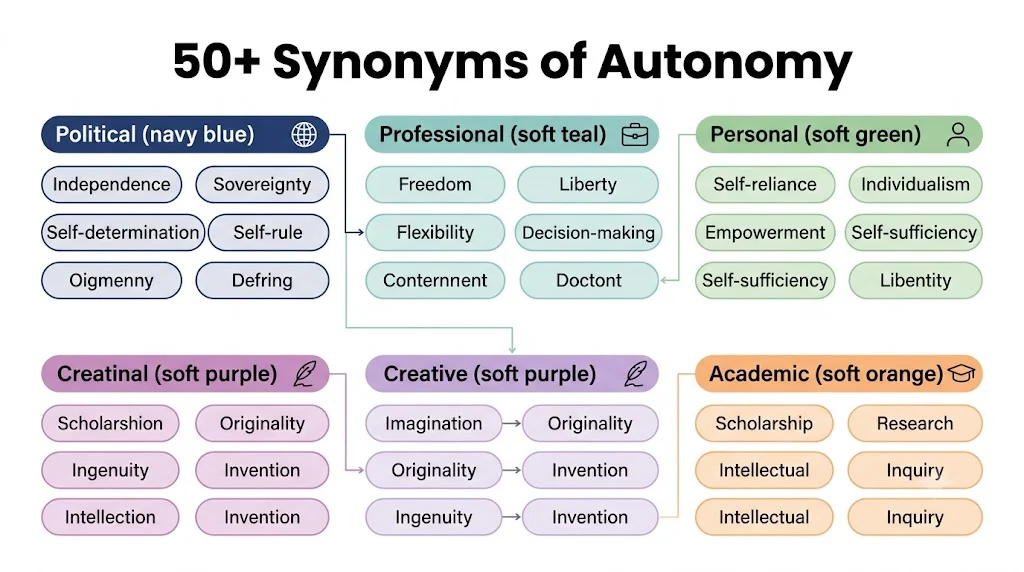
Autonomy is about having the freedom and authority to make your own decisions. It can describe a person, a workplace, a government, or even a system that operates with a degree of independence. Finding the right autonomy synonyms can make your writing more precise, especially when you need to show whether that freedom is personal, professional, legal, or political. A strong autonomy synonym may include independence, self-governance, self-determination, or self-rule, depending on the context. If you are searching for another word for autonomy or a synonym for autonomy, choosing the closest match matters because these terms are not always interchangeable.
This guide explains the synonyms of autonomy, including practical words like autonomy, along with the autonomy antonyms and the opposite of autonomy. It also covers the Hindi search term स्वायत्तता का पर्यायवाची, helping readers understand the concept across languages and contexts. Each alternative is explained by meaning, tone, and appropriate usage so you can choose confidently.
What Are the Best Synonyms of “Autonomy”?
Autonomy means having the freedom and authority to govern oneself or make independent decisions. The best synonyms depend on context. For formal writing, use self-governance or self-determination. Professional settings, use independence or self rule.Personal growth, use self-reliance or self sufficiency. For creative contexts, use sovereignty or liberty.
Meaning, Tone, and Context
Understanding the word autonomy is the first step to using it effectively.
Simple Definition:
Autonomy means having the freedom, authority, and ability to make your own decisions without external control. It can refer to individuals, groups, or nations.
Part of Speech:
Noun
Overall Tone:
Positive. Autonomy suggests empowerment, freedom, and self-determination.
Formality Level:
Semi-formal to formal. Autonomy is commonly used in professional, academic, and political contexts.
Common Uses:
Native English speakers use autonomy to describe personal independence, workplace empowerment, political self-governance, and academic freedom.
Word Forms:
- Noun: autonomy (the state of being self-governing)
- Adjective: autonomous (having autonomy)
- Adverb: autonomously (in an autonomous way)
- Verb: autonomize (to make autonomous)
Opposite Form:
Dependence, subjugation, control, coercion.
When and How to Use “Autonomy”
The word autonomy fits many situations where self-governance or independent decision-making is important.
Professional Context:
Employees value autonomy in their daily work tasks.
Academic Context:
The university grants academic autonomy to its faculty members.
Workplace Context:
Giving teams more autonomy often increases productivity.
Personal Context:
She valued her autonomy and made decisions without outside influence.
Email Context:
We are committed to preserving the autonomy of each department.
Resume Context:
Demonstrated autonomy in managing complex projects from start to finish.
Social Media Context:
True autonomy means owning your choices and your life.
Best Synonyms of “Autonomy”
No single synonym works perfectly in every situation because autonomy has nuanced meanings. The best choice depends on the context and what aspect of independence you want to emphasize.
For Professional Writing:
Use independence or self-governance. These words sound professional and clear. They fit business reports and formal communication perfectly.
For Academic Writing:
Use self-determination or sovereignty. These words sound scholarly and precise. They work well in research papers and essays.
For Business Communication:
Use self-rule or empowerment. These words emphasize control and authority in organizational contexts.
For Casual Conversation:
Use freedom or independence. These words are simple and natural. They feel comfortable in everyday speech.
For Emotional Writing:
Use liberation or self-reliance. These words emphasize personal growth and emotional strength.
For Creative Writing:
Use sovereignty or liberty. These words add depth and imagery to storytelling.
For Resume Writing:
Use self-direction or autonomy itself. These words highlight your ability to work independently.
For Workplace Communication:
Use empowerment or self-management. These words suggest trust and responsibility.
For Stronger Meaning:
Use sovereignty or liberation. These words emphasize complete freedom and control.
For Softer Meaning:
Use independence or freedom. These words are less intense but still convey self-rule.
When Not to Use “Autonomy”
Even though autonomy is a useful word, there are times when it is not the best choice.
When the Word Sounds Too Formal:
In casual conversation, autonomy can feel stiff and academic.
Original:
I need autonomy in my daily schedule.
Better Recommendation:
Use freedom or independence.
Rewritten Sentence:
I need freedom in my daily schedule.
When the Word Is Too Broad:
Autonomy sometimes lacks specificity. It does not always clarify what kind of independence you mean.
Original:
The region sought autonomy.
Better Recommendation:
Use self-governance or self-rule.
Rewritten Sentence:
The region sought self-governance.
When the Word Sounds Too Intense:
Autonomy can feel too strong for small everyday choices.
Original:
I need autonomy to choose my lunch.
Better Recommendation:
Use freedom or choice.
Rewritten Sentence:
I need freedom to choose my lunch.
When the Word Is Overused:
Using autonomy repeatedly in a single document can sound monotonous.
Original:
We value autonomy. Autonomy helps us innovate. Autonomy improves morale.
Better Recommendation:
Use independence and self-direction.
Rewritten Sentence:
We value autonomy. Independence helps us innovate. Self-direction improves morale.
Words Commonly Confused With “Autonomy”
Several words are often confused with autonomy because they share similar meanings.
- Autonomy vs Independence
- Difference: Independence means freedom from external control. Autonomy emphasizes the right and ability to govern oneself.
- When to Use It: Use independence for general freedom. Use autonomy for structured self-governance.
- Example: She gained independence after moving out. / The department was granted autonomy.
- Autonomy vs Freedom
- Difference: Freedom is a broad term for being able to act without restriction. Autonomy is more specific and implies self-rule.
- When to Use It: Use freedom for general situations. Use autonomy for formal or structured contexts.
- Example: He valued his freedom. / The employees were given autonomy over their projects.
- Autonomy vs Self-Governance
- Difference: Self-governance is a direct synonym for autonomy, often used in political contexts.
- When to Use It: Use self-governance when discussing political or organizational structures.
- Example: The country achieved self-governance after decades of struggle.
- Autonomy vs Sovereignty
- Difference: Sovereignty usually refers to a nation’s supreme authority. Autonomy can apply to individuals and groups.
- When to Use It: Use sovereignty for nations or states. Use autonomy for individuals or organizations.
- Example: The nation fought for sovereignty. / The committee has full autonomy.
- Autonomy vs Self-Reliance
- Difference: Self-reliance focuses on depending on oneself. Autonomy includes the right to make decisions.
- When to Use It: Use self-reliance for personal strength. Use autonomy for decision-making authority.
- Example: She developed self-reliance through hard work. / The team has autonomy in decision-making.
- Autonomy vs Empowerment
- Difference: Empowerment means giving someone authority or power. Autonomy is the state of having that power.
- When to Use It: Use empowerment when discussing giving authority. Use autonomy when describing the state of having it.
- Example: The manager focused on employee empowerment. / Employees enjoy autonomy in their roles.
Best Synonyms of “Autonomy” by Context
| Context | Best Synonym | Why It Works | Example |
|---|---|---|---|
| Formal Writing | Self-governance | Sounds precise and official | The colony demanded self-governance. |
| Academic Writing | Self-determination | Scholarly and precise | Self-determination is a key human right. |
| Professional Communication | Independence | Clear and professional | We value employee independence. |
| Business Emails | Empowerment | Positive and motivating | We aim to foster empowerment in teams. |
| Resume Writing | Self-direction | Highlights initiative | Demonstrated self-direction in projects. |
| Workplace Communication | Self-management | Emphasizes responsibility | Self-management leads to better results. |
| Casual Conversation | Freedom | Simple and natural | I love the freedom of working remotely. |
| Everyday Speaking | Independence | Easy to understand | She values her independence. |
| Creative Writing | Sovereignty | Adds depth and imagery | The kingdom fought for sovereignty. |
| Storytelling | Liberty | Emphasizes justice and rights | The hero fought for liberty. |
| Emotional Writing | Liberation | Emphasizes personal growth | His journey was about liberation. |
| Strong Emphasis | Self-rule | Sounds powerful and determined | They demanded self-rule. |
| Mild Tone | Independence | Soft and approachable | She enjoys her independence. |
| Social Media Captions | Freedom | Short and impactful | Freedom is everything. |
How to Choose the Best Synonym of “Autonomy”
Choosing the right synonym depends on several factors. Use this practical guide to make the best decision.
Meaning:
What aspect of autonomy are you describing? Is it political, personal, or professional? Choose a synonym that reflects the specific type of independence.
Tone:
Do you want to sound formal, casual, or emotional? Formal words like self-governance fit professional writing. Casual words like freedom fit conversation.
Audience:
Who is reading your writing? Business executives expect professional language. Friends expect natural language. Academic readers expect formal vocabulary.
Emotional Strength:
Do you want to emphasize personal growth or political authority? Strong words like sovereignty suggest complete control. Milder words like independence suggest general freedom.
Writing Purpose:
Are you writing a report, an email, a story, or a social media post? Match your synonym to the purpose.
Level of Formality:
Consider the formality of your situation. Reports, essays, and official documents require formal synonyms. Texting and social media allow casual language.
Natural Sounding Usage:
Always read your sentence aloud. If the synonym sounds forced or awkward, choose a different word.
Real Life Examples of “Autonomy”
School Context:
Students need autonomy to develop critical thinking skills.
Stronger Version:
Students need self-direction to develop critical thinking skills.
College Context:
The research department was granted autonomy to pursue innovative studies.
Stronger Version:
The research department was granted self-governance to pursue innovative studies.
Workplace Context:
Giving employees autonomy improves job satisfaction.
Stronger Version:
Giving employees independence improves job satisfaction.
Business Context:
The company values autonomy in its regional offices.
Stronger Version:
The company values self-rule in its regional offices.
Email Context:
We are committed to preserving the autonomy of our creative teams.
Stronger Version:
We are committed to preserving the independence of our creative teams.
Resume Context:
Demonstrated autonomy in managing cross-functional projects.
Stronger Version:
Demonstrated self-direction in managing cross-functional projects.
Conversation Context:
I appreciate the autonomy my new job gives me.
Stronger Version:
I appreciate the freedom my new job gives me.
Storytelling Context:
The fought for autonomy against the empire.
Stronger Version:
The fought for self governance against the empire.
Blogging Context:
Autonomy is essential for personal growth and happiness.
Stronger Version:
Self-reliance is essential for personal growth and happiness.
Social Media Context:
True autonomy means owning your decisions and your life.
Stronger Version:
True independence means owning your decisions and your life.
25 Best Synonyms of “Autonomy”
| Synonym | Simple Meaning | Best Used For | Example Sentence |
|---|---|---|---|
| Independence | Freedom from control | General use | She valued her independence. |
| Self-governance | Governing oneself | Political, formal | The country achieved self-governance. |
| Self-determination | Making your own choices | Academic, human rights | Self-determination is a basic right. |
| Self-rule | Ruling oneself | Political, organizational | The region demanded self-rule. |
| Sovereignty | Supreme authority | Nations, states | The nation fought for sovereignty. |
| Liberty | Freedom from oppression | Creative, emotional | They fought for liberty and justice. |
| Freedom | Ability to act without restraint | Everyday use | He loved the freedom of travel. |
| Liberation | Freedom from control | Emotional, personal growth | Her journey was about liberation. |
| Self-reliance | Depending on oneself | Personal development | Self-reliance builds character. |
| Self-sufficiency | Being able to provide for oneself | Practical, personal | Self-sufficiency is a valuable skill. |
| Empowerment | Being given authority | Workplace, motivation | Empowerment leads to engagement. |
| Self-direction | Directing your own life | Professional, personal | Self-direction is key to success. |
| Self-management | Managing yourself | Workplace, personal | Self-management improves productivity. |
| Self-command | Control over oneself | Emotional, personal | Self-command requires discipline. |
| Autarchy | Absolute self-government | Political, historical | The nation practiced autarchy. |
| Home rule | Local self-government | Political, regional | The region was granted home rule. |
| Self-determination | Making your own decisions | Academic, human rights | Self-determination is fundamental. |
| Self-government | Governing oneself | Political, formal | The colony wanted self-government. |
| Autarky | Economic independence | Economic, political | The country sought autarky. |
| Independence | Freedom from external control | General use | She achieved independence early. |
| Self-sufficiency | Providing for oneself | Practical, personal | Self-sufficiency is empowering. |
| Authority | Power to make decisions | Professional, organizational | Managers have decision authority. |
| Control | Power to direct | General use | She took control of her life. |
| Mastery | Complete control or skill | Creative, personal | Mastery over one’s own life. |
| Emancipation | Freedom from restrictions | Social, political | Emancipation was a turning point. |
Synonyms of “Autonomy” by Usage
Professional vs Personal Synonyms
Professional Synonyms:
Independence, self-governance, self-direction, self-management, empowerment.
Why They Work:
These words sound serious and results oriented. They fit reports, emails, and professional communication.
Personal Synonyms:
Freedom, independence, self-reliance, liberty, self-sufficiency.
Why They Work:
These words feel natural in conversation, personal writing, and storytelling. They focus on personal growth and emotional well-being.
Formal vs Conversational Synonyms
Formal Synonyms:
Self-governance, self-determination, sovereignty, self-rule, autarchy.
Why They Fit:
These words sound authoritative and precise. They work in academic papers, business reports, and official documents.
Conversational Synonyms:
Freedom, independence, self-reliance, liberty.
Why They Fit:
These words feel natural in everyday speech, texting, and casual writing.
Academic Synonyms
Recommended Words:
Self-determination, self-governance, sovereignty, autarchy.
Why They Work:
These words sound precise and scholarly. They show attention to detail and accurate communication.
Professional and Business Synonyms
Recommended Words:
Independence, self-direction, empowerment, self-management.
Why They Fit:
These words are specific and professional. They fit business emails, reports, and presentations.
Creative and Literary Synonyms
Recommended Words:
Sovereignty, liberty, liberation, emancipation.
Why They Fit:
These words add imagery, emotion, and variety to storytelling, poetry, and descriptive writing.
Modern English Synonyms
Recommended Words:
Independence, freedom, self-reliance, self-direction.
These words are widely used in modern American English. They are clear, direct, and easy to understand.
Strongest to Mildest Synonyms
Mild (Soft Freedom):
Independence, freedom, self-reliance.
Moderate (Clear Self-Governance):
Self-direction, self-management, self-sufficiency.
Strong (Formal Authority):
Self-governance, self-determination, self-rule.
Very Strong (Complete Control):
Sovereignty, autarchy, liberation, emancipation.
Emotional vs Neutral Synonyms
Emotional Synonyms:
Liberation, emancipation, liberty, sovereignty.
When to Use Emotional Synonyms:
Use them in personal writing, creative writing, and situations where freedom, justice, or personal growth matters.
Neutral Synonyms:
Independence, self-governance, self-determination, self-direction.
When to Use Neutral Synonyms:
Use them in professional writing, academic papers, and factual communication.
Antonyms of “Autonomy”
| Antonym | Meaning | Example Sentence |
|---|---|---|
| Dependence | Reliance on others | Her dependence on others was challenging. |
| Subjugation | Being controlled by others | The subjugation of the people was unjust. |
| Control | External direction | The manager maintained control over decisions. |
| Coercion | Force or pressure | Coercion was used to gain compliance. |
| Conformity | Following rules without question | Conformity limited their creativity. |
| Obedience | Following orders | Obedience was expected from all members. |
| Submission | Accepting control | Submission to authority was required. |
| Domination | Control over others | Domination was the goal of the regime. |
| Oppression | Unjust control | The oppression of the people was cruel. |
| Restriction | Limitation of freedom | Restrictions were placed on their activities. |
| Subjection | Being under control | The subjection of the people was complete. |
| Servitude | Being a servant | Servitude was their daily reality. |
| Bondage | Slavery or captivity | They lived in bondage for years. |
| Enslavement | Being made a slave | Enslavement was a brutal reality. |
| Heteronomy | Being governed by external rules | Heteronomy limited their choices. |
Comparison: “Autonomy” vs Similar Words
Autonomy vs Independence
Main Difference:
Independence means freedom from external control. Autonomy emphasizes the right and ability to govern oneself.
Which Is Stronger?
Autonomy suggests structured self-governance. Independence suggests general freedom.
Which Is More Formal?
Autonomy is more formal and academic.
When to Use Each:
Use independence for general situations. Use autonomy for formal or structured contexts.
Examples:
Autonomy: The department was granted full autonomy.
Independence: She valued her independence.
Autonomy vs Freedom
Main Difference:
Freedom is broad. Autonomy is more specific and implies self-rule.
Which Is Stronger?
Autonomy is more precise. Freedom is more general.
Which Is More Formal?
Autonomy is more formal.
When to Use Each:
Use freedom for general situations. Use autonomy for structured contexts.
Examples:
Autonomy: The committee has decision-making autonomy.
Freedom: He cherishes his freedom.
Autonomy vs Self-Governance
Main Difference:
Self-governance is a direct synonym for autonomy, often used in political contexts.
Which Is Stronger?
Self-governance emphasizes political or organizational control.
Which Is More Formal?
Self-governance is very formal.
When to Use Each:
Use self-governance when discussing political or organizational structures.
Examples:
Autonomy: The region demanded autonomy.
Self-governance: The region demanded self-governance.
Autonomy vs Sovereignty
Main Difference:
Sovereignty usually refers to a nation’s supreme authority. Autonomy can apply to individuals and groups.
Which Is Stronger?
Sovereignty is stronger and implies absolute authority.
Which Is More Formal?
Sovereignty is very formal.
When to Use Each:
Use sovereignty for nations or states. Use autonomy for individuals or organizations.
Examples:
Autonomy: The team was given autonomy over its budget.
Sovereignty: The nation defended its sovereignty.
Autonomy vs Self-Reliance
Main Difference:
Self-reliance focuses on depending on oneself. Autonomy includes the right to make decisions.
Which Is Stronger?
Self-reliance emphasizes personal strength.
Which Is More Formal?
Autonomy is more formal.
When to Use Each:
Use self-reliance for personal strength. Use autonomy for decision-making authority.
Examples:
Autonomy: The employee has autonomy in decision-making.
Self-reliance: Self-reliance is a valuable life skill.
Autonomy vs Empowerment
Main Difference:
Empowerment means giving someone authority or power. Autonomy is the state of having that power.
Which Is Stronger?
Empowerment is about the act of giving. Autonomy is about the state of having.
Which Is More Formal?
Both are formal.
When to Use Each:
Use empowerment when discussing giving authority. Use autonomy when describing the state of having it.
Examples:
Autonomy: Employees enjoy autonomy in their roles.
Empowerment: The manager focused on employee empowerment.
Common Phrases and Expressions with “Autonomy”
| Phrase | Meaning | Example Sentence |
|---|---|---|
| Personal autonomy | Individual self-governance | Personal autonomy is essential for well-being. |
| Political autonomy | Self-governance of a region | The region demanded political autonomy. |
| Autonomy of thought | Independent thinking | Academic freedom requires autonomy of thought. |
| Autonomy in decision-making | Freedom to make choices | Employees need autonomy in decision-making. |
| Full autonomy | Complete self-governance | The team was granted full autonomy. |
| Autonomy and independence | Self-governance and freedom | Autonomy and independence go hand in hand. |
| Respect autonomy | Acknowledge self-governance | We must respect patient autonomy in healthcare. |
Common Mistakes to Avoid
Choosing a Vague Synonym Instead of a Precise One
Incorrect:
The team needs more autonomy.
Better:
The team needs more self-direction.
Why:
Self-direction is more specific about independent decision-making.
Confusing “Autonomy” With “Independence”
Incorrect:
The country fought for independence from the empire.
Better:
The country fought for autonomy from the empire.
Why:
Autonomy emphasizes self-governance. Independence emphasizes freedom from control.
Using an Informal Synonym in Formal Writing
Incorrect:
The department was given freedom over its budget.
Better:
The department was given autonomy over its budget.
Why:
Autonomy is more appropriate for professional contexts.
Selecting an Overly Dramatic Synonym
Incorrect:
She sought liberation in choosing her dinner.
Better:
She sought freedom in choosing her dinner.
Why:
Liberation is too strong for a small everyday choice.
Repeating the Same Word Too Often
Incorrect:
Autonomy improves morale. Autonomy increases productivity. Autonomy encourages innovation.
Better:
Autonomy improves morale. Independence increases productivity. Self-direction encourages innovation.
Why:
Using synonyms improves flow and reduces repetition.
Choosing a Word With the Wrong Emotional Tone
Incorrect:
The team was given sovereignty over the project.
Better:
The team was given autonomy over the project.
Why:
Sovereignty is too strong for a team project.
Frequently Asked Questions
What is another word for autonomy?
Common alternatives include independence, self-determination, freedom, sovereignty, and self-governance.
What is an autonomy synonym?
An autonomy synonym is a word with a similar meaning to autonomy, such as independence or self-rule.
What is the autonomy antonym?
The main antonyms of autonomy are dependence, control, subordination, and restriction.
What is the opposite of autonomy?
The opposite of autonomy is dependence, where a person or group has limited control over its own decisions.
What are some autonomy synonyms?
Useful synonyms of autonomy include independence, freedom, self-rule, self-determination, sovereignty, and self-governance.
What are some autonomy antonyms?
Common autonomy antonyms include dependence, domination, control, submission, and subordination.
What are words like autonomy?
Words like autonomy include independence, liberty, self-rule, self-determination, and sovereignty.
What is a synonym for autonomy?
A strong synonym for autonomy is independence, especially when referring to the ability to make decisions freely.
What is स्वायत्तता का पर्यायवाची?
स्वायत्तता के पर्यायवाची शब्द स्वतंत्रता, आत्मनिर्भरता, स्वशासन, और स्वतंत्र निर्णय लेने की क्षमता हैं।
What are the best synonyms of “autonomy”?
The best synonyms of autonomy are independence, self-governance, self-determination, and self-rule. The right choice depends on context. Professional use, choose independence. For political use, choose self-governance. For personal growth, choose self-reliance.
What are the best formal synonyms of “autonomy”?
The best formal synonyms of autonomy are self-governance, self-determination, sovereignty, and self-rule. These words sound precise and authoritative. They fit academic papers, business reports, legal documents, and official communications.
What are common informal synonyms of “autonomy”?
Common informal synonyms of autonomy include freedom, independence, and self-reliance. These words are used in casual conversations, texting, and friendly writing. They are simple and natural.
What is another word for “autonomy” in professional writing?
In professional writing, use independence, self-direction, or empowerment. These words are specific, clear, and results oriented. They fit reports, emails, and presentations perfectly.
What is the difference between “autonomy” and “independence”?
Autonomy emphasizes the right and ability to govern oneself. Independence emphasizes freedom from external control. Use autonomy for structured self-governance. Use independence for general freedom.
What is the opposite of “autonomy”?
The opposite of autonomy is dependence. Other antonyms include subjugation, control, coercion, and oppression. Choose the most accurate opposite based on the context.
Conclusion
Autonomy is a powerful word that expresses freedom, self governance, and independent decision-making. The best synonyms of autonomy help you communicate clearly, match the right tone, and avoid repetition. Whether you write a business report, a college essay, a personal reflection, or a social media post, there is a perfect synonym for every situation.
The more you practice choosing the right synonym, the more natural and confident your writing will become. A strong vocabulary helps you connect with readers, express your ideas clearly, and make a lasting impression.
Definitions, meanings, and usage recommendations should be verified with trusted language references before publication. Recommended sources include Cambridge Dictionary, Oxford English Dictionary, Merriam Webster, Collins Dictionary, and Britannica.
Read More Related Articles:
- Synonyms for Thus | Meaning, Examples, and Better Word …
- 50+ Synonyms of Significant | Meanings, Uses, Examples, and …