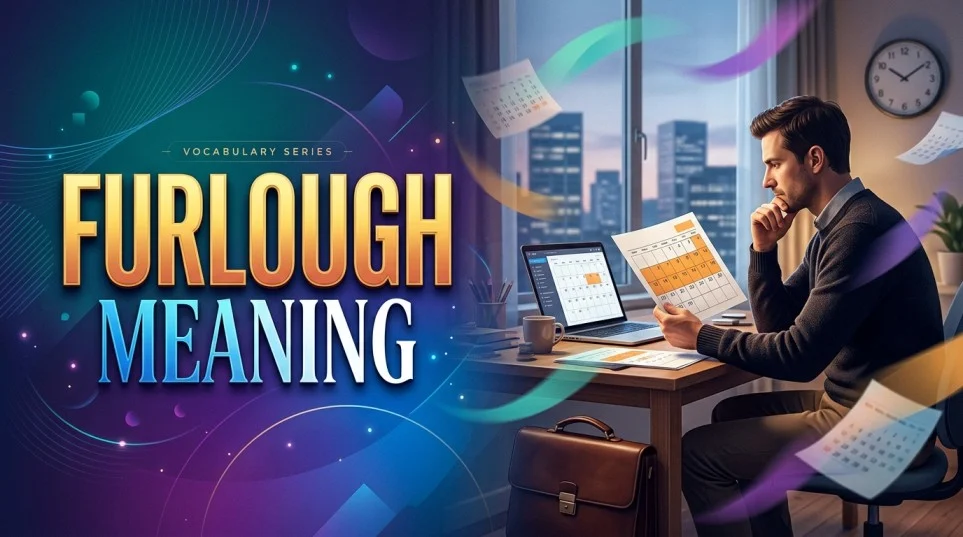
Imagine arriving at work and learning that your employer cannot afford to keep everyone working their usual hours. Instead of ending your employment, the company temporarily tells some employees to stop working. You may still have a job, but your income and daily routine could change. This situation is commonly known as a furlough.
The furlough meaning is a temporary period of leave or suspension from work, often used when an employer faces financial pressure, reduced demand, or an operational disruption. In many workplace situations, employees remain employed during a furlough, although they may receive reduced pay or no wages for the time they do not work. The exact rules depend on the employer, employment agreement, and applicable law. Understanding what a furlough means can help you distinguish it from a layoff, prepare for possible income changes, and know which questions to ask your employer before making financial decisions.
What Does Furlough Mean in Simple Terms?
A furlough is a temporary period when someone is required or permitted to stop working. In employment, employers often use furloughs to reduce labor costs without immediately ending employees’ jobs.
For example, a hotel may experience fewer bookings during the off-season. Instead of dismissing several employees, management might place them on furlough for two weeks and bring them back when business improves.
Here is the simple distinction:
- Furlough: You temporarily stop working under an arrangement that may allow you to return to your job.
- Layoff: Your employer ends your current employment or removes your position, sometimes because of financial difficulties.
- Termination: Your employment ends, either voluntarily or involuntarily.
These terms are not interchangeable. A furlough does not guarantee that your job will remain available indefinitely, and a layoff does not always mean an employee can never be rehired.
What Is a Furlough in the Workplace?
An employee furlough is a temporary work interruption used to manage staffing costs, operational needs, or unusual circumstances. Depending on the organization, it may affect an individual employee, a department, or an entire workforce.
Employers may introduce furloughs for several reasons:
- Financial difficulties: The business needs to reduce spending during a difficult period.
- Lower customer demand: Fewer orders, reservations, or projects mean less work is available.
- Government shutdowns: Certain government employees may be required to stop working during a funding interruption.
- Temporary operational problems: A facility may close because of repairs, supply shortages, or other disruptions.
- Seasonal business changes: Some industries experience predictable periods of reduced activity.
How Does an Employee Furlough Work?
The process depends on the workplace, but a typical arrangement follows these steps:
- The employer announces the furlough. Employees receive information about the reason, expected duration, and affected roles.
- Work schedules change. Some employees stop working completely, while others may have reduced hours or designated unpaid days.
- Pay and benefits are reviewed. The employer explains how wages, insurance, leave accrual, and other benefits may be affected.
- Employees follow the stated restrictions. Depending on the arrangement and applicable law, they may be prohibited from performing normal duties during furlough hours.
- Work resumes if the arrangement ends as planned. Employees return according to the employer’s instructions, although an expected return date is not always guaranteed.
Before accepting the arrangement, ask for the details in writing. A verbal statement that the furlough is temporary may not answer important questions about pay, benefits, or your return to work.
Furlough Examples in Real Life
The easiest way to understand the furlough definition is to see how it applies in different situations.
| Situation | Example | What it means |
|---|---|---|
| Private company | A manufacturer pauses production for one week because orders have dropped. | Employees temporarily stop working. |
| Retail business | A store reduces employees’ scheduled days during a slow season. | Staff members work fewer hours under the arrangement. |
| Government employment | A government office suspends certain employees’ work during a funding lapse. | Employees may be furloughed under applicable rules. |
| Hospitality | A resort temporarily closes part of its operations during the off-season. | Some employees may be placed on temporary leave. |
| Individual workplace | A department places an employee on an approved temporary furlough. | The employee pauses work under specific conditions. |
Example sentence: “Several employees were placed on furlough after the company experienced a sharp decline in sales.”
In everyday language, you might also hear, “She has been furloughed until business improves.” This usually indicates a temporary interruption in work, not necessarily the permanent loss of her job.
Do You Get Paid During a Furlough?
One of the biggest concerns about a furlough is income. Employees do not automatically receive their regular wages for time they are not working during a furlough. The answer depends on the employment arrangement, local laws, and whether the employee is covered by special pay rules.
A furlough may be unpaid, partially paid, or structured around reduced working hours. Some employers continue certain benefits, while others change coverage according to their policies and legal obligations.
Consider these possibilities:
- Unpaid furlough: You stop working and do not receive wages for the affected time, subject to applicable pay laws.
- Reduced-hours furlough: You work fewer hours and receive pay for the hours worked.
- Paid leave arrangement: An employer may allow or require the use of accrued paid leave where permitted.
- Special government arrangements: Pay treatment may depend on the governing law and the specific circumstances.
What Happens to Employee Benefits?
Health insurance, retirement contributions, paid time off, and other benefits may continue, change, or pause during a furlough. There is no single rule that applies to every employer and every country.
Ask your HR department these questions:
- Will my health insurance remain active?
- Will I continue earning paid leave?
- Are retirement contributions affected?
- Can I apply for unemployment benefits or other income support?
- When should I expect my next paycheck?
- Will I receive back pay if the applicable law or policy provides for it?
In the United States, unemployment benefit eligibility is determined by state rules and individual circumstances. Some workers experiencing reduced hours or temporary unemployment may qualify, but approval is not automatic.
For current guidance, consult your state’s unemployment agency or the U.S. Department of Labor.
Furlough vs. Layoff: What Is the Difference?
The terms sound similar because both can arise when an employer needs to reduce costs. The important distinction is the intended employment outcome.
| Feature | Furlough | Layoff |
|---|---|---|
| Basic meaning | Temporary interruption of work | Employment or a position is ended or eliminated |
| Employment status | Often remains active | Often ends, depending on the arrangement |
| Expected return | May be planned | May be possible, but is not guaranteed |
| Pay | May stop or decrease | Regular wages generally stop when employment ends, subject to final-pay rules |
| Benefits | May continue or change | May end or transition under applicable rules |
| Main purpose | Manage temporary costs or disruptions | Reduce staffing or eliminate positions |
Example: A company asks employees to take two unpaid weeks while it waits for new orders. That may be a furlough. If the company permanently removes their positions because the business no longer needs them, that may be a layoff.
Terminology varies by employer, country, and legal context. Do not assume that a label alone determines your legal status. Read the written notice and check the rules that apply to your employment.
Furlough vs. Termination
A termination generally means the employment relationship has ended. A furlough usually means work has paused temporarily while the employment relationship may continue.
For example, an employee who is told not to work for ten days and is given a return date may be furloughed. An employee whose employer confirms that their employment has ended has generally been terminated.
However, an employer may later end employment after a furlough. The initial temporary arrangement is not a promise of permanent job security.
Furlough vs. Leave of Absence
A leave of absence is a broader term for time away from work. It can be voluntary, approved for personal reasons, or required under a particular policy or law.
A furlough is often initiated by the employer to address business or operational needs. A personal leave of absence, by contrast, may be requested by an employee for family, education, health, or other reasons.
What Are Your Rights During a Furlough?
Employee rights during furlough depend on the country, state, employment contract, and type of employer. A furlough notice does not automatically remove legal protections.
In the United States, important issues may include minimum-wage and overtime requirements, salary rules for certain exempt employees, benefit-plan terms, collective bargaining agreements, and government-specific pay laws.
For example, federal employees affected by a government shutdown may be covered by special federal legislation. Their circumstances can differ from those of private-sector workers.
If you receive a furlough notice, take these practical steps:
- Save the notice. Keep the written explanation, dates, expected return information, and relevant messages.
- Confirm your status. Ask if you remain employed and whether your position is expected to continue.
- Clarify work restrictions. Find out if you may check email, attend meetings, answer calls, or complete any work during furlough hours.
- Review pay and benefits. Request specific information about wages, insurance, leave, and final or delayed payments.
- Check available assistance. Contact the relevant government agency to understand unemployment benefits or other support.
- Seek reliable advice if necessary. If the arrangement appears to conflict with wage laws, a contract, or a collective agreement, contact the appropriate labor authority or a qualified employment attorney.
Do not rely only on general online explanations for a legal decision. Rules can differ substantially between jurisdictions.
What Does Government Furlough Mean?
A government furlough is a temporary interruption of work affecting government employees. In the United States, the term is often associated with a funding gap or government shutdown.
During a shutdown, some federal employees may be furloughed because their work is not authorized to continue under the applicable funding rules. Other employees may be designated to continue working under different rules.
A furlough is not the same as a permanent dismissal. The employee’s work status, duties, and compensation depend on the circumstances and the laws that apply.
Government employees should follow official agency instructions rather than assume that normal workplace rules apply. For federal employment information, consult the U.S. Office of Personnel Management.
What Does Military Furlough Mean?
In military contexts, a furlough generally refers to authorized time away from duty. The precise meaning and conditions depend on the country’s military system and the applicable regulations.
This use differs from an employee furlough caused by financial pressure. A service member receiving authorized leave is not necessarily experiencing an employment suspension.
Example: “The service member received a furlough to spend several days with family.”
Context matters when interpreting the word. If the term appears in a military document, do not automatically apply the workplace meaning.
What Does Furloughed Mean?
Furloughed is the past tense and past participle of furlough. It describes a person who has been placed on furlough or a period during which someone was temporarily away from work.
Examples include:
- “The company furloughed 40 employees during the slowdown.”
- “He was furloughed for two weeks but expected to return afterward.”
- “Several government workers were furloughed during the funding interruption.”
The word can also function as an adjective, as in “furloughed employees.”
Furlough Synonyms and Related Words
No single synonym fits every use of furlough. The best alternative depends on whether you mean temporary leave, reduced working hours, or the end of employment.
| Related word or phrase | Meaning | When to use it |
|---|---|---|
| Temporary leave | A limited period away from work | When emphasizing a temporary absence |
| Unpaid leave | Time off without wages | When the arrangement is specifically unpaid |
| Work suspension | A pause in work activity | When describing a formal interruption |
| Reduced hours | A decrease in scheduled working time | When employees continue working fewer hours |
| Leave of absence | An authorized period away from work | When describing a broader leave arrangement |
| Layoff | Removal from a job or position | When employment or the role is ended |
| Termination | The end of employment | When the employment relationship has ended |
These terms are related, not exact replacements. For example, “unpaid leave” may describe a furlough accurately in one situation but fail to capture an employer-wide work suspension in another.
Common Mistakes About Furloughs
A few assumptions can create unnecessary confusion.
Mistake 1: Assuming furlough means you have been fired.
A furlough often preserves the employment relationship, although a later layoff or termination remains possible.
Mistake 2: Assuming every furlough is unpaid.
Pay arrangements differ. Check the written policy and applicable law.
Mistake 3: Assuming benefits always continue.
Insurance, retirement contributions, and leave accrual depend on the plan and relevant rules.
Mistake 4: Assuming you can work normally during furlough hours.
Some arrangements restrict work during unpaid periods. Ask for clear instructions and follow applicable wage laws.
Mistake 5: Assuming a promised return date guarantees your job.
A planned return is useful information, but business conditions and employment rules can change.
The safest approach is to confirm your employment status, pay arrangements, benefits, work restrictions, and expected return date in writing.
Frequently Asked Questions
1. What does furlough mean in simple terms?
Furlough means a temporary period away from work, often arranged or required by an employer. It is commonly used to reduce costs or manage disruptions while potentially keeping the employee’s position available.
2. Does furlough mean you are fired?
No. A furlough usually involves a temporary pause in work rather than an immediate end to employment. However, a furlough does not guarantee that the employee will never be laid off or terminated later.
3. Do employees get paid during furlough?
Not always. Some furloughs are unpaid, while others involve reduced hours or different pay arrangements. Your employer’s policy, employment status, and applicable law determine the rules.
4. How long can a furlough last?
There is no universal duration for every furlough. It may last a few days, several weeks, or longer, depending on the circumstances and applicable rules. Ask your employer for an expected return date and updates if plans change.
5. Can you work another job while furloughed?
Possibly. It depends on your employment agreement, outside-work policies, confidentiality obligations, and any restrictions that apply to your role. Government and military employees may face additional rules.
6. Do benefits continue during a furlough?
They may, but continuation is not automatic in every situation. Check your health insurance, retirement plan, paid leave, and other benefit documents, and ask HR how the furlough affects each one.
7. What is the difference between furlough and layoff?
A furlough generally pauses work temporarily while the employment relationship may continue. A layoff often ends employment or eliminates a position. Employers and legal systems use these terms differently, so check your official notice.
8. What does furloughed mean on a job application or resume?
It usually indicates that an employee was temporarily placed on furlough. If you need to explain it on a resume or in an interview, describe the situation accurately and clarify if your employment continued or later ended.
9. Can you collect unemployment benefits during a furlough?
You may qualify in some circumstances, particularly if your hours or income have been reduced, but eligibility varies by jurisdiction and individual situation. Contact your relevant unemployment agency for an official decision.
Conclusion:
The furlough meaning is straightforward: it usually describes a temporary interruption of work, often intended to help an employer manage costs or an operational disruption. Unlike a typical layoff or termination, a furlough may allow the employment relationship to continue.
The details matter most when your income, benefits, and job security are affected. Read your employer’s notice carefully, ask questions about pay and work restrictions, and confirm your expected return date. If you need to understand your legal rights, consult an official labor authority in your jurisdiction.
Knowing the difference between furlough, layoff, termination, and ordinary leave helps you interpret workplace announcements accurately and make better-informed decisions.
Read More Related Articles:
- Decode the Hidden Code, Context & Symbolism in 2026
- Definition, Examples, Synonyms, Tone & How to Use It in 2026
- HVAC Meaning | What It Stands For, How It Works & Why It …