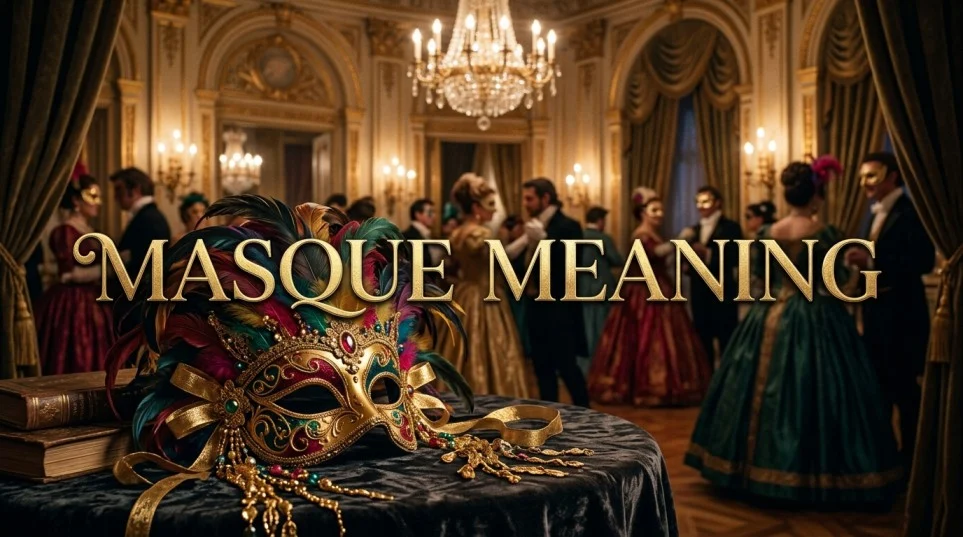
A masque is a type of elaborate theatrical entertainment that combines poetry, music, dance, acting, costumes, scenery, and visual spectacle. The form became especially important in 16th- and 17th-century England, where it was performed mainly for royal courts and wealthy aristocratic audiences.
The word can look like a fancy spelling of mask, but the two have different meanings. A mask is something worn over the face, while a masque is a historical form of dramatic performance.
Understanding the masque meaning is useful when reading Renaissance or Jacobean literature because a masque was more than a simple play. It was a carefully designed spectacle that brought together several art forms and often presented ideas about power, morality, harmony, beauty, or social order.
What Does Masque Mean?
Masque means a formal theatrical performance that traditionally combines music, poetry, dance, acting, costumes, scenery, and elaborate stage effects.
Masques were particularly associated with the English court during the Renaissance and Jacobean periods. They were often performed for kings, queens, nobles, and invited guests.
In literature, the term usually refers to this distinctive type of court entertainment rather than simply a person wearing a mask.
Masque Definition in Literature
In literary terms, a masque is a dramatic genre built around spectacle and performance.
Unlike an ordinary play, a masque places considerable emphasis on visual presentation. Characters may appear in elaborate costumes, musicians may perform alongside dancers, and the setting can involve specially designed scenery or theatrical machinery.
Many masques also contain allegory. Characters and events may represent abstract ideas such as virtue, beauty, peace, disorder, or political power.
A typical masque might therefore contain:
- Poetry or spoken verse
- Music and songs
- Dancing
- Acting
- Elaborate costumes
- Decorative scenery
- Mythological characters
- Allegorical figures
- Stage machinery
- Symbolic imagery
- A formal court setting
This mixture of elements made the masque an unusually ambitious form of entertainment for its period.
Where Did the Masque Come From?
The masque developed from European traditions of masked entertainment, pageantry, dance, and ceremonial performance.
Its development in England was closely connected with the royal and aristocratic courts. By the late 16th century and especially during the early 17th century, the form had become a significant part of elite entertainment.
The Stuart court played an important role in the development of the English masque. Royal performances could be extravagant events involving professional artists, musicians, dancers, poets, designers, and members of the court.
The setting mattered almost as much as the written text.
A masque could transform a court room or specially prepared hall into an imaginary world filled with gods, heroes, spirits, exotic landscapes, and symbolic figures.
Masque in the Renaissance and Jacobean Period
The English masque reached one of its most influential stages during the Jacobean era, particularly under King James I.
This period produced some of the best-known examples of the form.
One of the most important figures was Ben Jonson, who wrote numerous masques for the court. His work demonstrated how poetry and dramatic writing could work together with music, dance, architecture, costume, and stage design.
Another major figure was Inigo Jones, a designer and architect whose stage designs helped transform the visual possibilities of the English masque.
Their collaboration is especially important because it shows that a masque was not simply something written by a playwright. It was a multidisciplinary performance.
Jonson supplied much of the literary material, while Jones became famous for the spectacular visual world surrounding the performance.
What Were Masques Used For?
Masques served several purposes at once.
1. Entertainment
At the most basic level, a masque was entertainment for an elite audience.
It offered music, dancing, costumes, poetry, scenery, and spectacle in a single event.
2. Celebration
Masques could be connected with weddings, royal occasions, holidays, diplomatic events, and other important celebrations.
Their elaborate nature made them suitable for occasions that required something more impressive than ordinary entertainment.
3. Political Symbolism
Masques could also communicate ideas about monarchy and social order.
A performance might portray a ruler or royal court as a source of harmony and stability. Disorder could appear as something that must be defeated by virtue, reason, or rightful authority.
This political dimension is one reason literary scholars take masques seriously. They were entertainment, but they could also communicate messages about society and power.
4. Social Prestige
Participation in a court masque could itself be prestigious.
Members of the court might perform alongside professional artists, making the event both entertainment and a display of social status.
Key Characteristics of a Masque
The easiest way to recognize a masque is to look at its combination of features.
| Characteristic | Role in a Masque |
|---|---|
| Music | Creates atmosphere and supports the performance |
| Dance | Adds movement and visual expression |
| Poetry | Communicates ideas, stories, and symbolism |
| Costumes | Helps establish characters and themes |
| Scenery | Creates an imaginative setting |
| Allegory | Gives characters or events symbolic meaning |
| Mythology | Provides gods, heroes, and legendary figures |
| Spectacle | Makes the performance visually impressive |
| Court setting | Connects the form with elite and royal culture |
| Stage effects | Creates transformations and dramatic reveals |
The combination is what makes the form distinctive. A poem alone is not a masque. A dance alone is not a masque. The masque brings several artistic forms together.
Famous Examples of Masques
Several works are especially important when studying the English masque.
The Masque of Queens
The Masque of Queens was written by Ben Jonson and first performed in 1609.
The work is notable for its use of powerful female figures, mythological imagery, elaborate costumes, dance, and symbolic conflict.
It demonstrates the form’s ability to combine literary writing with visual spectacle.
- The Masque of Blackness
- The Masque of Blackness, written by Ben Jonson, was performed in 1605.
- The masque was designed by Inigo Jones and featured elaborate costumes and stage imagery. It was performed at the court of James I.
The work is also studied today in discussions of race, representation, colonial ideas, and early modern theatrical culture. Its historical importance therefore goes beyond its original function as court entertainment.
Comus
Comus, written by John Milton, was first performed in 1634.
Its full title, A Maske Presented at Ludlow Castle, directly identifies it with the masque tradition.
The work combines poetry, music, allegory, moral themes, and performance. It remains an important example for students studying Milton and early English drama.
Masque vs. Mask
The similarity between masque and mask causes frequent confusion.
Here is the simplest distinction:
| Word | Meaning | Example |
|---|---|---|
| Masque | A historical theatrical performance | The court presented a masque. |
| Mask | A covering for the face | She wore a mask at the costume party. |
| Mask | To hide or conceal something | The trees masked the house from view. |
A masque may involve masks or masked characters, but masque itself refers to the performance tradition.
So these sentences do not mean the same thing:
Correct:
The king attended a masque at court.
Correct:
The performer wore a decorative mask.
The first sentence describes a theatrical event. The second describes an object worn on the face.
Masque Meaning in Modern English
Today, masque is relatively uncommon in everyday conversation.
You are most likely to encounter it in:
- English literature
- Literary criticism
- Theater history
- Renaissance studies
- Academic writing
- Historical discussions
- Books about British royal culture
- Discussions of early modern drama
For modern readers, the word often signals a historical or literary context.
For example:
The students studied the masque as an important form of Jacobean court entertainment.
Here, masque clearly refers to the theatrical genre.
How Is a Masque Different From a Play?
A masque and a conventional play can both include characters, dialogue, costumes, and a storyline. The major difference is the importance given to spectacle, music, dance, and ceremonial presentation.
| Masque | Conventional Play |
|---|---|
| Strong emphasis on spectacle | Often centered on dramatic action |
| Music is important | Music may be secondary |
| Dance is often central | Dance may be absent |
| Allegory is common | Allegory varies by genre |
| Elaborate scenery may be used | Scenery varies |
| Often connected with court culture | Performed for broader audiences |
| Designed as a total spectacle | Usually built primarily around drama |
The boundary is not absolute. Some dramatic works contain features of both traditions.
Still, the masque’s unusual mixture of literary, musical, visual, and ceremonial elements is its defining characteristic.
Why Were Masques So Elaborate?
Part of the answer lies in their audience.
Masques were frequently created for people at the top of the social hierarchy. A spectacular production could demonstrate wealth, artistic sophistication, technological skill, and political authority.
Theatrical design therefore became part of the message.
Imagine entering a royal hall and seeing the ordinary space transformed into a mythological landscape. Music begins. Dancers appear in elaborate costumes. The scenery changes. Allegorical figures enter. Poetry describes a world in which disorder gives way to harmony.
That experience was the point.
The masque was designed to be seen, heard, and experienced, not simply read on a page.
The Role of Ben Jonson
Ben Jonson is one of the central names associated with the English masque.
His masques demonstrate how literary language could be integrated into elaborate performances. He frequently drew on classical mythology, symbolism, political themes, and ideas about virtue and order.
Some important Jonson masques include:
- The Masque of Blackness
- The Masque of Beauty
- The Masque of Queens
- Pleasure Reconciled to Virtue
- The Masque of Hymen
Studying Jonson’s masques can help readers understand how literature, politics, performance, and court culture overlapped in early modern England.
The Role of Inigo Jones
If Jonson represents the literary side of the masque, Inigo Jones represents much of its visual innovation.
Jones was an architect and designer who created elaborate scenery and stage effects for court performances.
His contribution helped establish the idea that stage design could be an essential part of dramatic storytelling.
This collaboration between writer and designer is one of the most interesting aspects of the masque tradition.
The written text was only one part of the finished experience.
Masque as Allegory
Allegory is another important concept connected with the masque meaning.
In an allegorical performance, a character or event can stand for an idea beyond its literal identity.
For example:
- A goddess might represent beauty.
- A monster might represent disorder.
- A peaceful landscape might represent harmony.
- A conflict between characters might symbolize a conflict between virtue and vice.
This allowed a masque to tell a story on two levels.
The audience could enjoy the spectacle while also interpreting its deeper symbolic meaning.
Examples of “Masque” in a Sentence
Here are some natural examples:
- The students examined the masque as part of their study of Jacobean drama.
- The royal court commissioned an elaborate masque for the celebration.
- Ben Jonson became one of the most influential writers of the English masque.
- The masque combined poetry, music, dance, and elaborate scenery.
- The performance used mythology and allegory to praise order and virtue.
- Unlike an ordinary play, the masque placed unusual importance on spectacle.
- Inigo Jones designed scenery for several famous court masques.
- Milton’s Comus is often discussed in relation to the English masque tradition.
These examples show that masque is normally used as a noun referring to a type of performance.
Common Mistakes With “Masque”
Mistake 1: Treating masque as another spelling of mask
They are connected historically, but their modern meanings differ.
Masque refers to the theatrical form.
Mask generally refers to something that covers the face or to the act of concealing something.
Mistake 2: Assuming every masked performance is a masque
A performance can involve masks without being a masque.
The historical masque is defined by its broader combination of poetry, music, dance, spectacle, and ceremonial presentation.
Mistake 3: Thinking masques were ordinary public theater
The English court masque was strongly associated with royal and aristocratic culture.
That setting was an important part of its historical identity.
Mistake 4: Ignoring the visual side
Reading a masque only as poetry can leave out an important part of its meaning.
Costumes, scenery, music, dance, and stage effects were central to the experience.
Why the Masque Still Matters
The masque may seem distant from modern entertainment, but its influence is easier to recognize when you think about large-scale performance.
Modern productions often combine:
- Music
- Dance
- Acting
- Visual design
- Costumes
- Lighting
- Special effects
- Symbolic storytelling
The technology has changed dramatically, but the basic idea of combining multiple art forms into one spectacular experience is not unfamiliar.
The masque is therefore valuable not simply as an old theatrical genre, but as an example of how art, politics, technology, and performance can work together.
How to Remember the Meaning of Masque
A simple memory trick is:
Masque = a grand historical performance.
Think of a royal court, elaborate costumes, poetry, music, dancers, mythology, and spectacular scenery.
That mental picture will usually help you distinguish masque from mask.
Frequently Asked Questions
What is the simple meaning of masque?
A masque is an elaborate theatrical performance that combines poetry, music, dance, costumes, acting, scenery, and spectacle. It was especially popular in the English royal court during the Renaissance and Jacobean periods.
What does masque mean in literature?
In literature, masque refers to a dramatic genre associated with elaborate court performances. It commonly uses music, dance, poetry, mythology, allegory, costumes, and visual spectacle.
Is masque the same as mask?
No. A mask is usually a covering for the face or something that conceals. A masque is a historical form of theatrical performance.
Who wrote famous English masques?
Ben Jonson is one of the best-known English masque writers. His important works include The Masque of Blackness and The Masque of Queens. John Milton also wrote Comus, an important work associated with the masque tradition.
What are the main features of a masque?
Major features include poetry, music, dance, costumes, scenery, allegory, mythology, stage effects, and spectacle. Courtly or ceremonial presentation was also important.
When were masques popular?
Masques became particularly important in England during the late Renaissance and early 17th century. They flourished at the royal court during the Jacobean and early Stuart periods.
Why were masques performed?
Masques were created for entertainment, celebrations, royal occasions, and displays of courtly culture. They could also communicate political or moral ideas through allegory and symbolism.
What is an example of a famous masque?
The Masque of Blackness by Ben Jonson is one of the most famous English masques. The Masque of Queens and Milton’s Comus are also important examples.
Final Takeaway
The masque meaning goes far beyond the idea of a face covering. A masque was a highly elaborate form of theatrical entertainment that brought poetry, music, dance, acting, costume, scenery, symbolism, and spectacle together.
Its strongest association is with the royal and aristocratic culture of early modern England, particularly the Jacobean court. Writers such as Ben Jonson and designers such as Inigo Jones helped make the form an important part of English cultural history.
The easiest distinction to remember is simple: a mask is something you wear or use to conceal; a masque is a historical theatrical performance.
Read More Related Articles:
- What This Viral Slang Really Means in Texts, TikTok & Online …
- SMH Meaning in Text | Decode the Tone, Emotion, and Real …