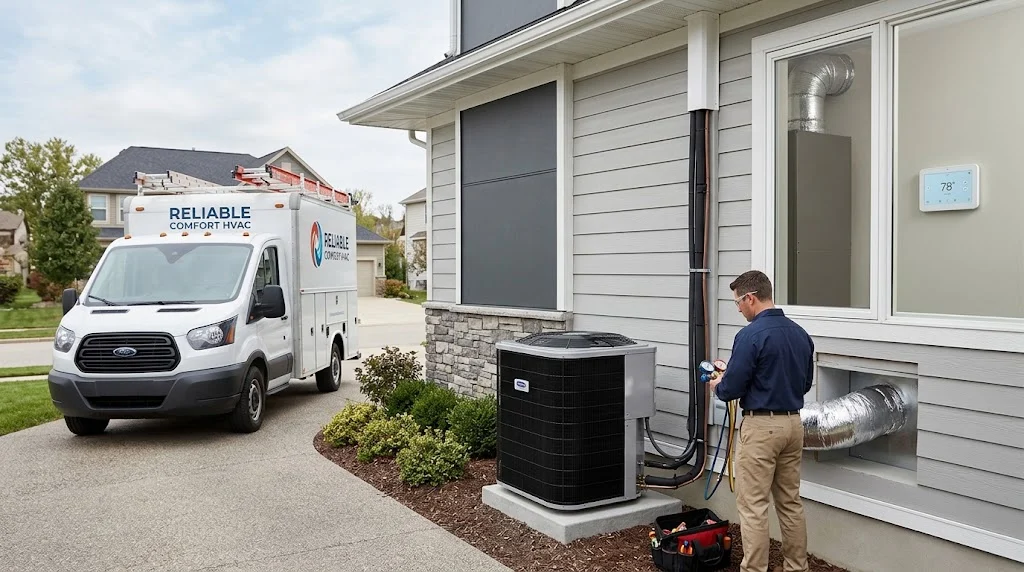
HVAC meaning is Heating, Ventilation, and Air Conditioning. The term describes the systems used to control indoor temperature, move and filter air, provide heating or cooling, and support comfortable indoor conditions.
An HVAC system can be as simple as a furnace and air conditioner in a house or as complex as a large network of chillers, boilers, ducts, fans, sensors, and controls in a commercial building.
Understanding HVAC is useful because the term appears in home listings, construction documents, maintenance agreements, engineering plans, job descriptions, and conversations about heating and cooling.
What Does HVAC Stand For?
HVAC stands for Heating, Ventilation, and Air Conditioning.
Each part has a specific function:
| Letter | Stands For | Main Function |
|---|---|---|
| H | Heating | Raises indoor temperature |
| V | Ventilation | Brings in, removes, or circulates air |
| A | Air | Refers to the air being treated or moved |
| C | Conditioning | Controls temperature, humidity, and air quality |
The three areas work together as part of a broader indoor climate control system.
For example, during a cold winter day, the heating component may warm the building while fans distribute the conditioned air through ducts. During hot weather, the cooling component removes heat from indoor air and sends cooled air back into the rooms.
HVAC Definition in Simple English
In simple terms, an HVAC system controls the indoor environment.
It can:
- Heat a room or building
- Cool indoor spaces
- Move air from one area to another
- Bring outdoor air inside
- Remove stale air
- Filter airborne particles
- Control humidity in some systems
- Maintain a comfortable indoor temperature
This makes HVAC much broader than air conditioning alone.
An air conditioner mainly provides cooling. An HVAC system can include cooling, heating, ventilation, air movement, filtration, and related controls.
What Is an HVAC System?
An HVAC system is a collection of equipment designed to manage indoor heating, cooling, ventilation, and air movement.
A typical residential system might include:
- Furnace or heat pump
- Air conditioner or heat pump
- Indoor air handler
- Outdoor condenser
- Ductwork
- Air filters
- Thermostat
- Supply vents
- Return vents
Large commercial systems can include additional equipment such as:
- Chillers
- Boilers
- Cooling towers
- Variable air volume systems
- Air handling units
- Exhaust fans
- Building automation controls
- Humidity control equipment
The exact combination depends on the building, climate, size, energy requirements, and design.
HVAC Meaning in Construction
In construction, HVAC refers to the systems responsible for heating, ventilation, and air conditioning within a building.
The term is common in architectural and engineering plans. HVAC work can involve designing duct routes, selecting equipment, calculating heating and cooling loads, installing pipes and ducts, and setting up ventilation systems.
For example, a construction plan may show:
- Supply air ducts
- Return air ducts
- Exhaust ducts
- Mechanical rooms
- Air handling units
- Heating equipment
- Cooling equipment
- Ventilation openings
HVAC planning matters because equipment needs adequate space, electrical connections, drainage, airflow, access for maintenance, and proper installation.
A poorly planned system can result in uneven temperatures, excessive energy use, uncomfortable rooms, or difficult maintenance.
HVAC Meaning in a House
In a home, HVAC usually refers to the equipment that keeps indoor temperatures comfortable and manages air circulation.
A common residential setup may use a central air conditioner and furnace connected to a network of ducts.
During summer:
- The thermostat detects that the indoor temperature is above the selected setting.
- The cooling system starts.
- Warm indoor air moves through return ducts.
- The system removes heat from the air.
- Cooler air travels through supply ducts.
- The conditioned air enters the rooms.
During winter, the heating equipment warms the air before it is distributed throughout the home.
Some homes use a heat pump, which can provide both heating and cooling from one primary system.
HVAC Meaning in Real Estate
You may also see HVAC mentioned in real estate listings.
For example:
“Property features central HVAC.”
This generally means the property has a centralized heating and cooling system.
Real estate descriptions may mention:
- Central HVAC
- New HVAC system
- Updated HVAC
- Forced-air heating
- Heat pump
- Central air
- Gas furnace
- HVAC replaced in a certain year
A listing that says a home has a newer HVAC system does not automatically tell you its exact condition or expected lifespan. Buyers may want to check maintenance records, installation dates, equipment specifications, and inspection findings.
The term identifies the type of building system, but it does not by itself prove that the system is efficient or problem-free.
How Does an HVAC System Work?
HVAC systems work by transferring heat, moving air, and controlling indoor conditions.
The process differs based on the equipment.
Heating
A furnace may generate heat by burning fuel or using electricity. A blower then moves heated air through the duct system.
A heat pump works differently. Instead of creating heat in the same way as a conventional furnace, it transfers heat between the indoor and outdoor environment.
Cooling
An air conditioner removes heat from indoor air.
The refrigeration cycle uses components such as:
- Compressor
- Condenser coil
- Expansion device
- Evaporator coil
- Refrigerant
Heat is absorbed from indoor air and transferred outside.
Ventilation
Ventilation introduces fresh outdoor air and removes indoor air.
This can help manage:
- Odors
- Excess moisture
- Indoor pollutants
- Stale air
- Carbon dioxide levels
Ventilation may occur naturally through openings or mechanically through fans and dedicated ventilation equipment.
Air Distribution
Fans and blowers move conditioned air around the building.
In ducted systems, air travels through supply and return ducts. The design of these ducts affects airflow, comfort, noise, and system performance.
Main Types of HVAC Systems
There is no single HVAC design that fits every building. Different systems suit different spaces and requirements.
Central Air Conditioning and Furnace
This is a familiar setup in many homes.
A furnace provides heating, while a central air conditioner provides cooling. Ductwork distributes the conditioned air.
Best known for: whole-home heating and cooling through ducts.
Heat Pump
A heat pump can provide both heating and cooling.
It transfers heat instead of relying on a conventional heating process for every heating cycle.
Best known for: combined heating and cooling using one primary system.
Ductless Mini-Split
A ductless mini-split system typically has an outdoor unit connected to one or more indoor units.
It can be useful in buildings without existing ductwork or in rooms requiring individual temperature control.
Best known for: zoned comfort and buildings where installing ducts is impractical.
Packaged HVAC System
In a packaged system, major components are housed in one outdoor cabinet.
These systems are common in certain residential and commercial applications.
Best known for: compact equipment arrangements.
Commercial HVAC Systems
Commercial buildings often require larger and more sophisticated systems.
A commercial HVAC setup may use air handling units, chillers, boilers, rooftop units, pumps, ducts, sensors, and automated controls.
Best known for: managing large spaces and multiple zones.
HVAC vs. AC: What Is the Difference?
HVAC and AC are not the same thing.
AC means air conditioning, while HVAC is a broader term that includes heating, ventilation, and air conditioning.
| HVAC | AC |
|---|---|
| Heating, ventilation, and air conditioning | Air conditioning |
| Covers multiple indoor climate functions | Primarily associated with cooling |
| May include heating equipment | Does not necessarily provide heating |
| May include ventilation equipment | Mainly conditions indoor air |
| Can describe an entire building system | Can describe a cooling system or process |
A person might say, “I need to replace my AC,” when the actual project involves only the cooling component of a larger HVAC system.
HVAC Equipment and Components
HVAC systems contain many different components. The equipment depends on system design.
Thermostat
The thermostat monitors indoor temperature and tells the system when heating or cooling is needed.
Modern thermostats can provide scheduling, remote control, temperature sensing, and other functions.
Furnace
A furnace provides heat, commonly by burning natural gas or using electricity.
Heat Pump
A heat pump transfers heat between locations and can often provide both heating and cooling.
Air Conditioner
An air conditioner removes heat from indoor air and transfers it outdoors.
Air Handler
An air handler moves and sometimes conditions air. It may contain a blower, filters, coils, dampers, and other components.
Ductwork
Ducts carry air between the HVAC equipment and occupied spaces.
Leaks, poor sizing, restrictions, or inadequate insulation can affect system performance.
Air Filter
Filters capture particles from the air passing through the system. Filter type and replacement frequency depend on the equipment and household conditions.
Vents and Registers
Supply vents deliver conditioned air into rooms. Return vents bring air back toward the HVAC equipment.
Why Ventilation Is Part of HVAC
The word ventilation is sometimes overlooked when people talk about HVAC.
Heating and cooling alone do not explain the complete purpose of indoor air management.
Ventilation helps exchange indoor and outdoor air. Mechanical ventilation may use exhaust fans, supply fans, or balanced systems.
For example, bathrooms commonly use exhaust fans to remove moisture and odors. Kitchens may use exhaust systems to remove cooking pollutants and heat.
In larger buildings, dedicated ventilation equipment can be integrated with heating and cooling systems.
Good ventilation design depends on the building and its use. More outdoor air is not automatically better in every situation because outdoor air may also introduce heat, humidity, pollutants, or allergens. HVAC design balances these factors.
HVAC and Indoor Air Quality
HVAC systems can influence indoor air quality, but HVAC equipment alone does not guarantee clean indoor air.
Several factors matter:
- Filtration
- Outdoor air ventilation
- Humidity
- Duct cleanliness and condition
- Combustion safety
- Moisture control
- Building materials
- Indoor pollutant sources
For example, cooking, cleaning products, smoke, moisture, and certain building materials can affect indoor air independently of the HVAC system.
This is why indoor air quality should be considered as a broader building issue rather than simply an air conditioner issue.
HVAC Technician Meaning
An HVAC technician is a professional who works with heating, ventilation, air conditioning, and related equipment.
Depending on their training and local requirements, HVAC technicians may work on:
- Installation
- Inspection
- Troubleshooting
- Maintenance
- Repairs
- Electrical components
- Refrigeration systems
- Heating equipment
- Ventilation equipment
For complex repairs or refrigerant-related work, qualifications and legal requirements can vary by location and type of equipment.
Common HVAC Problems
HVAC problems can have many causes. A few common symptoms include:
| Symptom | Possible Causes |
|---|---|
| Weak airflow | Dirty filter, duct issue, blower problem, restriction |
| Uneven temperatures | Duct imbalance, insulation problems, zoning issues |
| System cycles frequently | Thermostat issue, sizing problem, airflow restriction |
| No cooling | Electrical issue, refrigerant problem, compressor issue |
| No heating | Ignition, electrical, thermostat, airflow, or equipment problem |
| Unusual noise | Loose component, motor issue, airflow problem |
| Excess moisture | Drainage, humidity, ventilation, or equipment issue |
A symptom does not identify the exact fault. Professional diagnosis may be necessary before replacing parts or equipment.
How to Choose the Right HVAC System
Choosing an HVAC system involves more than selecting the largest or newest unit.
Important factors include:
1. Building Size
Equipment should match the heating and cooling requirements of the building.
Oversized equipment can create its own problems, including inefficient cycling and poor humidity control in some conditions.
2. Local Climate
Heating and cooling requirements vary significantly by climate.
A system designed for a cold region may have different priorities from one designed for a hot and humid environment.
3. Existing Infrastructure
Existing ducts, electrical capacity, gas connections, insulation, windows, and available equipment space can influence the practical options.
4. Energy Use
Efficiency ratings and operating costs can affect long-term expenses.
5. Maintenance
Every HVAC system needs appropriate maintenance. Access to filters, coils, drains, electrical components, and other service points matters.
6. Zoning Requirements
A building with several areas may benefit from separate temperature zones instead of treating the entire building as one space.
Common HVAC Terms You May See
Understanding related terminology makes HVAC information easier to read.
| Term | Simple Meaning |
|---|---|
| BTU | Unit commonly used to describe heating or cooling capacity |
| SEER | Seasonal efficiency rating associated with cooling equipment |
| Heat pump | System that transfers heat for heating or cooling |
| Air handler | Equipment that moves and conditions air |
| Ductwork | Network used to distribute air |
| Thermostat | Device that controls temperature settings |
| Refrigerant | Fluid used in many cooling and heat-transfer systems |
| Ventilation | Exchange or movement of indoor and outdoor air |
| Indoor air quality | Overall condition of indoor air |
| Zoning | Dividing a building into separately controlled areas |
Specific rating systems and regulatory requirements can change over time, so equipment documentation and current local requirements should be checked when making an installation decision.
Common Mistakes About HVAC
Mistake 1: Thinking HVAC Means Only Air Conditioning
HVAC includes more than cooling. Heating and ventilation are also part of the term.
Mistake 2: Using HVAC and AC as Exact Synonyms
AC is one part of the broader HVAC concept.
Mistake 3: Assuming Every HVAC System Uses Ducts
Ducted systems are common, but ductless systems also exist.
Mistake 4: Assuming a New System Needs No Maintenance
New equipment still requires proper maintenance, filter care, inspection, and correct operation.
Mistake 5: Choosing Equipment Based Only on Size
Bigger equipment is not automatically better. Proper sizing and system design are important for comfort and performance.
HVAC Examples in Everyday Sentences
Here are natural examples showing how the word is used:
- “The house has a new HVAC system.”
- “The HVAC technician inspected the furnace.”
- “We need to schedule HVAC maintenance before winter.”
- “The building uses a central HVAC system.”
- “The HVAC unit is making an unusual noise.”
- “The contractor included HVAC installation in the renovation plan.”
- “The office HVAC system controls temperature in several zones.”
- “The property listing mentions recently replaced HVAC equipment.”
- “Poor ventilation can affect indoor air quality.”
- “The HVAC system provides both heating and cooling.”
HVAC Meaning in Different Contexts
The basic meaning remains the same, but the practical meaning changes by context.
- In a home: HVAC usually refers to residential heating, cooling, ventilation, and air distribution equipment.
- In construction: HVAC refers to the design and installation of mechanical systems that manage indoor environmental conditions.
- In engineering: HVAC involves system design, heat transfer, airflow, equipment selection, controls, energy use, and building performance.
- In real estate: HVAC usually identifies the property’s heating and cooling system or its condition as described in a listing or inspection.
- In a job description: HVAC may refer to a technician’s work with heating, ventilation, refrigeration, air conditioning, maintenance, installation, or repair.
What Does HVAC Mean?
HVAC means Heating, Ventilation, and Air Conditioning. It refers to systems that manage indoor temperature, airflow, heating, cooling, and ventilation. HVAC can include equipment such as furnaces, air conditioners, heat pumps, air handlers, thermostats, filters, ducts, fans, and related controls.
Frequently Asked Questions
What does HVAC stand for?
HVAC stands for Heating, Ventilation, and Air Conditioning. It is a broad term for systems that manage indoor heating, cooling, air movement, and ventilation.
Is HVAC the same as AC?
No. AC means air conditioning, while HVAC includes heating, ventilation, and air conditioning. Air conditioning is one component of the broader HVAC category.
What does HVAC mean in a house?
In a house, HVAC generally refers to the equipment used for heating, cooling, ventilation, and air distribution. A home may use a furnace, central AC, heat pump, ductwork, thermostat, or a combination of these.
What does HVAC mean in construction?
In construction, HVAC refers to the heating, ventilation, and air conditioning systems designed and installed as part of a building. This can include ducts, mechanical equipment, ventilation, controls, and related infrastructure.
What does an HVAC technician do?
An HVAC technician may install, inspect, maintain, troubleshoot, and repair heating, cooling, ventilation, and related equipment. The exact work depends on training, equipment type, and local requirements.
What are the main types of HVAC systems?
Common types include central air and furnace systems, heat pumps, ductless mini-splits, packaged systems, and larger commercial HVAC systems. The appropriate design depends on the building and its requirements.
Does HVAC include ventilation?
Yes. Ventilation is represented by the V in HVAC. It involves managing the exchange and movement of indoor and outdoor air.
Why is HVAC important?
HVAC systems help maintain comfortable indoor temperatures and manage airflow. Properly designed systems can also support ventilation, humidity management, and indoor air quality.
What is the difference between HVAC and heating?
Heating is one part of HVAC. HVAC is a broader category that includes heating, ventilation, and air conditioning.
Key Takeaway
The simplest HVAC meaning is Heating, Ventilation, and Air Conditioning. The term covers the systems that help control indoor temperature, airflow, heating, cooling, and ventilation.
The important distinction is that HVAC is a broad building-system category, not simply another name for an air conditioner. A complete HVAC setup can involve several pieces of equipment working together, from thermostats and filters to furnaces, heat pumps, air conditioners, fans, and ductwork.
Understanding that distinction makes terms found in construction documents, property listings, equipment manuals, and HVAC service information much easier to understand.
Discover More Post:
- MK Meaning in Text | Decode the Hidden Tone Behind This …
- WYA Meaning in Text | Decode This Popular Texting Slang …
- YH Meaning in Text | What It Really Means in Modern Chats …