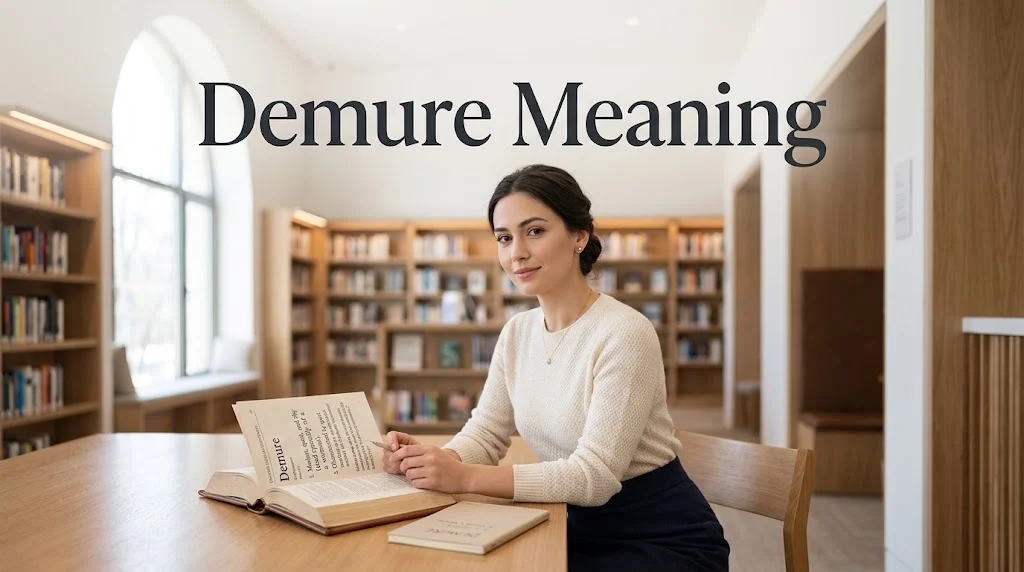
Some words describe more than appearance. Demure meaning captures a particular style of being modest, reserved, and quietly composed. It is often used for someone whose behavior or appearance feels gentle and restrained rather than bold or attention-seeking. Understanding the word clearly helps you use it naturally in conversations, writing, descriptions, and social media.
Today, demure can carry slightly different shades depending on context. It may describe clothing, facial expressions, manners, or a person’s overall behavior. It can sound elegant and complimentary, but its meaning depends on how it is used. This guide explains the definition, pronunciation, tone, examples, synonyms, common contexts, and modern usage of demure so you can recognize it and use it with confidence in 2026.
What Does Demure Mean?
Demure is an adjective used to describe someone who is reserved, modest, quiet, or composed, particularly in their behavior or appearance.
A simple definition is:
Demure means modest and reserved in behavior, manner, or appearance.
The word usually suggests controlled behavior rather than complete shyness. A demure person can be confident and socially capable while still presenting themselves in a calm and restrained way.
Demure at a Glance
| Aspect | Meaning |
|---|---|
| Part of speech | Adjective |
| Core idea | Modest and reserved |
| Tone | Usually positive or neutral |
| Common contexts | Behavior, personality, clothing, appearance |
| Similar words | Modest, reserved, shy, restrained |
| Opposite ideas | Bold, loud, attention-seeking, outspoken |
| Modern use | Personality, fashion, beauty, social media |
Demure Meaning in Simple English
In simple English, demure means quiet, modest, and well-mannered without trying to attract too much attention.
For example:
- She gave a demure smile.
- He admired her demure manner.
- The dress has a demure design.
- She looked elegant and demure at the event.
The exact meaning depends on what the word describes. With a person, it usually focuses on behavior or manner. With clothing, it usually refers to a modest or understated appearance.
What Does It Mean to Be Demure?
Being demure generally means behaving in a reserved, composed, and modest way.
A demure person may:
- Speak calmly.
- Avoid excessive attention.
- Use polite manners.
- Have a reserved personality.
- Dress in a modest or understated way.
- Maintain a composed expression.
- Avoid exaggerated behavior.
However, being demure does not automatically mean being shy or lacking confidence.
Someone can be confident while still choosing to behave in a restrained and graceful manner.
Demure Examples in Everyday English
Here are practical examples showing how the word works in different situations.
1. Demure Personality
Maria has a demure personality and usually lets others speak first.
Here, demure describes her reserved and quiet manner.
2. Demure Smile
She responded with a demure smile.
The expression suggests a restrained, modest, or slightly shy-looking smile.
3. Demure Dress
She wore a demure dress to the formal dinner.
Here, demure describes the clothing as modest and understated.
4. Demure Behavior
His demure behavior made him seem calm and respectful.
The word focuses on controlled and reserved conduct.
5. Demure Appearance
Her demure appearance gave her a graceful and polished look.
In this sentence, the word combines modesty with a refined appearance.
6. Demure Manner
She answered the compliment in a demure manner.
The response was probably modest rather than overly enthusiastic.
7. Demure Style
The collection uses soft colors and simple shapes for a demure style.
Here, demure describes an understated fashion aesthetic.
Is Demure a Compliment?
Demure can be a compliment, especially when it describes someone as modest, graceful, composed, or well-mannered.
For example:
She looked elegant and demure at the ceremony.
This normally presents the person positively.
Still, context matters. Calling someone demure can sometimes suggest that they are too reserved, overly traditional, or less expressive. In modern conversation, the word can also be used playfully.
So the emotional meaning depends on the speaker, situation, and subject.
Demure vs. Shy
These words are related, but they are not identical.
Shy usually describes discomfort, nervousness, or a lack of confidence around other people.
Demure focuses more on outward behavior, modesty, and restraint.
| Word | Main idea | Example |
|---|---|---|
| Demure | Reserved and modest | She gave a demure smile. |
| Shy | Nervous or uncomfortable socially | She is shy around strangers. |
| Reserved | Not openly expressive | He is reserved with new people. |
| Modest | Not showing off | She is modest about her achievements. |
| Coy | Pretending to be shy or hesitant | She gave a coy response. |
A person can be demure without being shy.
For instance, a confident professional might speak clearly in a meeting but maintain a calm, understated manner.
Demure vs. Modest
Demure and modest overlap, especially when discussing clothing or behavior.
However, modest is broader.
Modest can describe a person’s behavior, clothing, achievements, expectations, or lifestyle.
Demure is more strongly associated with reserved behavior, appearance, and manner.
Compare:
She wore a modest dress.
This mainly tells us that the dress is not revealing or excessive.
She wore a demure dress.
This can suggest modesty along with a quiet, elegant, understated style.
Demure vs. Reserved
Reserved generally means someone does not openly express their feelings or thoughts.
Demure adds an idea of modesty and controlled presentation.
For example:
He is reserved in large groups.
This focuses on his social behavior.
She has a demure manner.
This suggests a more specific combination of quietness, modesty, and restraint.
Demure vs. Coy
Coy can describe behavior that appears shy or modest, sometimes in a deliberately playful or flirtatious way.
Demure usually sounds more sincere and restrained.
For example:
She gave a demure smile.
This suggests modesty or quietness.
She gave a coy smile.
This may suggest playful hesitation or flirtation.
The two words should not always be treated as interchangeable.
Demure Synonyms
Depending on the context, useful synonyms include:
- Modest
- Reserved
- Shy
- Quiet
- Retiring
- Restrained
- Unassuming
- Subdued
- Composed
- Polite
- Mild
- Discreet
- Dignified
- Understated
- Self-effacing
The best synonym depends on the intended meaning.
For example, modest works well for clothing, while reserved often works better for personality.
Demure Style and Fashion
The phrase demure style usually refers to an understated and polished appearance.
Common features may include:
- Modest necklines
- Longer skirts or dresses
- Simple silhouettes
- Soft or neutral colors
- Minimal decoration
- Refined accessories
- Clean, polished presentation
A demure outfit does not have to look old-fashioned. Modern fashion can combine modest pieces with contemporary cuts, fabrics, and accessories.
For example:
Her demure outfit featured a simple midi dress, understated jewelry, and a structured jacket.
The emphasis is on the overall impression rather than one specific item of clothing.
What Is a Demure Personality?
A demure personality is generally associated with someone who is:
- Calm
- Quiet
- Polite
- Reserved
- Modest
- Composed
- Understated
- Not overly attention-seeking
However, personality labels should be used carefully.
A person may behave demurely in one situation and be highly expressive in another. The word describes a particular manner or presentation, not necessarily someone’s entire personality.
Demure Meaning in Social Media
On social media, demure can have a more playful or trend-driven meaning than its traditional dictionary sense.
People may use it to describe:
- A polished appearance
- Modest fashion
- Feminine presentation
- Calm behavior
- An elegant aesthetic
- A deliberately understated look
Social media usage can also be humorous or exaggerated. A caption describing something as “very demure” may not be a serious statement about someone’s personality.
This is an important distinction when interpreting the word online. Traditional dictionary meaning and internet usage can overlap without being exactly the same.
When Should You Use the Word Demure?
Use demure when you want to emphasize modesty, restraint, quietness, or an understated presentation.
It works particularly well in:
- Descriptive writing
- Fashion writing
- Character descriptions
- Reviews
- Lifestyle content
- Formal or polished writing
- Fiction and storytelling
For everyday casual conversation, simpler words such as quiet, modest, or reserved may sound more natural.
Good Uses
The bride chose a demure dress.
Her demure manner suited the formal setting.
The character has a quiet and demure personality.
Less Natural Uses
Avoid using demure simply as a replacement for every instance of “nice,” “pretty,” or “quiet.”
The word carries a specific idea of restraint and modesty.
Common Mistakes With Demure
1. Treating Demure as Exactly the Same as Shy
Shyness can involve nervousness or social discomfort. Demure behavior is more about reserved presentation and modesty.
2. Assuming Demure Always Means Feminine
The word is often used to describe women and feminine fashion, but its meaning is not restricted to women.
3. Using Demure to Mean Boring
Demure does not necessarily mean dull. A demure appearance can be elegant, sophisticated, and carefully styled.
4. Assuming Demure Means Weak
Reserved behavior does not automatically indicate a lack of confidence or strength.
5. Using It for Any Modest Clothing
A modest outfit may be demure, but modest and demure are not exact synonyms. Demure often adds a sense of understated elegance or restraint.
Demure in Professional and Academic Writing
In professional writing, demure can be useful when describing someone’s presentation, manner, or appearance, but it should be used precisely.
For example:
The character is portrayed as demure and reserved.
In academic writing, a more specific word may sometimes be preferable. If you mean “quiet,” use quiet. If you mean “not revealing,” use modest. You mean “not openly expressive,” use reserved.
Precise vocabulary makes writing clearer.
Demure in Storytelling
Demure is particularly useful in creative writing because it can describe more than simple silence.
For example:
She entered the room with a demure smile, keeping her hands neatly folded as the conversation continued.
The word helps establish a character’s manner without requiring a long explanation.
It can also create a contrast:
Her demure appearance hid a remarkably confident personality.
This shows why context matters. A character can look demure while being strong, ambitious, or outspoken when circumstances change.
Demure: Mild to Strong Meaning
The word can communicate different levels of restraint depending on the sentence.
| Expression | Suggested impression |
|---|---|
| Slightly demure | A little reserved |
| Demure smile | Quietly modest |
| Demure manner | Controlled and polite |
| Very demure | Strongly understated or modest |
| Demure appearance | Refined and reserved |
| Demure style | Modest and elegant |
The surrounding words determine how strong the impression becomes.
Quick Decision Guide
Choose the word based on what you actually mean:
- Demure: modest, reserved, understated
- Shy: nervous or socially hesitant
- Reserved: emotionally or socially restrained
- Modest: not showing off or not revealing
- Coy: deliberately shy or playfully hesitant
- Quiet: making little noise or speaking little
- Subdued: restrained in energy, color, or expression
- Elegant: graceful and refined
This makes your writing more precise than simply searching for a synonym.
Frequently Asked Questions
What is the exact meaning of demure?
Demure means modest, reserved, quiet, or restrained in behavior, manner, or appearance.
Is demure a positive word?
It is often positive or neutral when used to suggest modesty, elegance, politeness, or composure. Context can change the impression.
Does demure mean shy?
Not exactly. Shy often suggests nervousness or social discomfort, while demure focuses more on modest and reserved behavior.
What is an example of demure?
“She gave a demure smile during the ceremony” is a simple example. Here, demure suggests a restrained and modest expression.
What does demure mean in fashion?
In fashion, demure usually describes a modest, understated, polished, or refined style. It can involve simple silhouettes, less revealing designs, and restrained details.
Can a man be demure?
Yes. Demure is not limited to women. It can describe anyone whose behavior or presentation is notably reserved and modest.
Is demure the same as modest?
They have similar meanings but are not identical. Modest is broader, while demure often combines modesty with quietness, restraint, or understated presentation.
Is demure still used today?
Yes. The word remains part of standard English and is also used in modern fashion, lifestyle, creative writing, and social media contexts.
Final Takeaway
The simplest way to understand demure meaning is to think of quiet confidence, modest presentation, and restrained behavior. It can describe a person’s manner, a facial expression, an outfit, or an overall aesthetic.
The most important distinction is context. Demure is not simply another word for shy or modest. It often combines those ideas with a sense of composure and understated elegance. Using the word accurately can make descriptions more specific and expressive.
Read More Related Articles:
- HRU Meaning in Text | What It Really Means, How to Use It …
- TTYL Meaning in Text | What It Really Means & How to Use It …
- FW Meaning in Text | What It Really Means in Chat …