Strong writing often depends on small word choices, and repeated use of “because” can make sentences feel predictable. Finding fresh alternatives adds variety, improves flow, and helps your ideas sound more precise. Whether you are writing an essay, email, report, or everyday message, choosing the right connector can make your reasoning clearer and more polished and impact naturally.
This guide to synonyms of because brings together natural alternatives for different tones and situations. You will find options for formal writing, casual conversation, academic work, and professional communication, along with useful examples that show how each choice works in context. Exploring synonyms of because can also strengthen vocabulary and help you express cause, reason, and explanation with greater confidence and style.
What Are the Best Synonyms of “Because”?
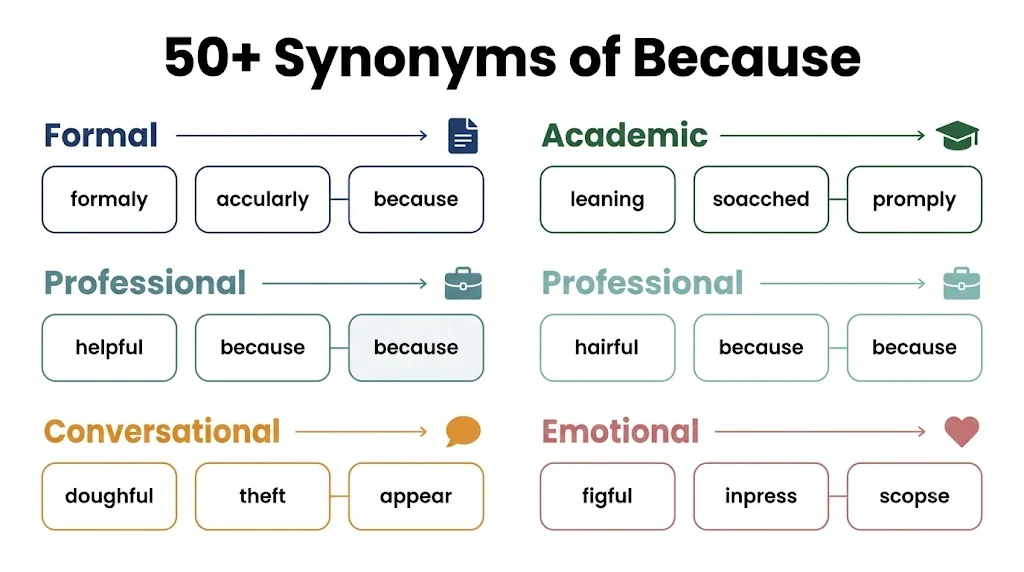
Because is a conjunction used to explain reasons or causes. The best synonyms depend on context. For formal writing, use due to or owing to. Casual conversation, use since or as. For academic writing, use in light of or on account of. Emotional emphasis, use given that or considering that. The right choice improves clarity and flow.
Meaning, Tone, and Context
Understanding the word because is the first step to using it effectively.
Simple Definition:
Because is a conjunction that introduces the reason or cause for something. It connects a result with its explanation.
Part of Speech:
Conjunction (subordinating)
Overall Tone:
Neutral. Because is a functional word that does not carry strong emotion.
Formality Level:
Neutral. Because works in formal, semi-formal, and informal contexts. Some alternatives are more formal.
Common Uses:
Native English speakers use because to explain reasons, justify actions, provide evidence, and connect ideas in every type of communication.
Word Forms:
- Conjunction: because (connecting a cause to a result)
- Related forms: because of (prepositional phrase), the reason because (nonstandard, avoid)
Opposite Forms:
Therefore, consequently, hence, thus (these express results rather than causes).
When and How to Use “Because”
The word because fits many situations because it explains causes clearly. However, overusing it can make your writing feel repetitive and simple.
Professional Context:
The project was delayed because the team encountered unexpected challenges.
Academic Context:
The experiment was unsuccessful because the equipment malfunctioned.
Workplace Context:
We decided to reschedule the meeting because several key members were unavailable.
Personal Context:
She stayed home because she was feeling unwell.
Email Context:
I am writing to follow up because I have not received your response yet.
Resume Context:
Increased sales by 30 percent because I implemented a new marketing strategy.
Social Media Context:
I love this book because it tells such an inspiring story.
Best Synonyms of “Because”
No single synonym works perfectly in every situation because because is a direct and simple connector. The best choice depends on the tone and context of your writing.
For Professional Writing:
Use due to or owing to. These phrases sound formal and precise. They work well in reports, business communication, and official documents.
For Academic Writing:
Use in light of or on account of. These phrases sound scholarly and authoritative. They fit research papers, essays, and academic discussions.
For Business Communication:
Use as or since. These words are professional but not overly formal. They work well in emails, presentations, and meetings.
For Casual Conversation:
Use since or as. These words are simple and natural. They fit everyday speech, texting, and casual writing.
For Emotional Writing:
Use given that or considering that. These phrases add depth and empathy. They work well in personal letters, storytelling, and reflective writing.
For Creative Writing:
Use for or as. These words add variety and rhythm to sentences. They fit fiction, poetry, and descriptive writing.
For Resume Writing:
Use by or through. These words emphasize the actions you took. They fit resumes and professional profiles.
For Workplace Communication:
Use since or as. These words are clear and direct. They work well in meetings, emails, and team discussions.
For Stronger Meaning:
Use in view of or considering that. These phrases emphasize the importance of the reason.
For Softer Meaning:
Use as or for. These words are gentle and understated.
When Not to Use “Because”
Even though because is a useful word, there are times when it is not the best choice.
When the Word Sounds Too Repetitive:
Using because repeatedly in the same paragraph makes your writing feel monotonous.
Original:
She was tired because she worked late, and she was hungry because she skipped dinner.
Better Recommendation:
Use since and rephrase.
Rewritten Sentence:
She was tired since she worked late, and she was hungry because she skipped dinner.
When Reason Needs to Be Emphasized:
Because can feel weak when the reason is important.
Original:
The project failed because of poor planning.
Better Recommendation:
Use due to or owing to.
Rewritten Sentence:
The project failed due to poor planning.
When the Sentence Sounds Too Simple:
Because can make your writing feel basic in formal contexts.
Original:
The experiment was successful because the team worked hard.
Better Recommendation:
Use as a result of or owing to.
Rewritten Sentence:
The experiment was successful as a result of the team’s hard work.
When Reason Needs to Be Introduced Indirectly:
Because is direct. Sometimes indirect phrasing sounds better.
Original:
He left the party because he was tired.
Better Recommendation:
Use as or since.
Rewritten Sentence:
He left the party, as he was tired.
Words Commonly Confused With “Because”
Several words are often confused with because because they relate to reasons or results.
- Because vs Since
- Difference: Since can mean “because” or “from that time.” Because only means “for the reason that.”
- When to Use It: Use since when there is no ambiguity about time. Use because when you want to be clear about reason.
- Example: Since it was raining, we stayed inside. (could mean time or reason) / Because it was raining, we stayed inside. (clearly reason)
- Because vs As
- Difference: As can mean “because,” “while,” or “like.” Because is always about reason.
- When to Use It: Use as when the meaning is clear from context. Use because for precision.
- Example: As it was raining, we stayed inside. (could mean because or while) / Because it was raining, we stayed inside. (clear)
- Because vs Due To
- Difference: Due to is a prepositional phrase that should modify a noun. Because introduces a clause.
- When to Use It: Use due to when it follows a noun. Use because when it introduces a clause.
- Example: The cancellation was due to rain. / The event was canceled because it rained.
- Because vs Owing To
- Difference: Owing to is formal and means “because of.” Because is more direct.
- When to Use It: Use owing to in formal writing. Use because in everyday writing.
- Example: The delay was owing to technical issues. / The delay was because of technical issues.
- Because vs For
- Difference: For as a conjunction means “because” but sounds old-fashioned.
- When to Use It: Avoid for in modern writing. Use because instead.
- Example: He left, for he was tired. (old-fashioned) / He left because he was tired. (modern)
- Because vs As a Result Of
- Difference: As a result of emphasizes the outcome. Because focuses on the reason.
- When to Use It: Use as a result of when the outcome is important. Use because when the reason is important.
- Example: As a result of the storm, the game was canceled. / The game was canceled because of the storm.
Best Synonyms of “Because” by Context
| Context | Best Synonym | Why It Works | Example |
|---|---|---|---|
| Formal Writing | Due to | Sounds precise and professional | The event was canceled due to bad weather. |
| Academic Writing | In light of | Sounds scholarly and authoritative | In light of recent findings, we revised our approach. |
| Professional Communication | Owing to | Sounds formal and clear | The delay was owing to unforeseen circumstances. |
| Business Emails | As | Clear and professional | As we discussed, the project is on track. |
| Resume Writing | Through | Emphasizes action | Achieved success through dedicated teamwork. |
| Workplace Communication | Since | Direct and professional | Since the deadline is approaching, please submit soon. |
| Casual Conversation | Because | Simple and natural | I stayed home because I felt sick. |
| Everyday Speaking | As | Natural and easy | As it’s getting late, let’s go. |
| Creative Writing | For | Adds variety and rhythm | She wept, for she knew the truth. |
| Storytelling | Given that | Adds depth and context | Given that he was injured, he performed well. |
| Emotional Writing | Considering that | Adds empathy and care | Considering that she lost her job, she handled it well. |
| Strong Emphasis | In view of | Sounds important and weighty | In view of the evidence, we made a decision. |
| Mild Tone | As | Gentle and understated | As it was early, we waited. |
| Social Media Captions | Because | Short and clear | I love this song because it makes me happy. |
How to Choose the Best Synonym of “Because”
Choosing the right synonym depends on several factors. Use this practical guide to make the best decision.
Meaning:
Are you explaining a cause, a justification, or an evidence-based reason? Choose a synonym that matches the specific type of reason.
Tone:
Do you want to sound formal, casual, or emotional? Formal words like owing to fit professional writing. Casual words like since fit conversation.
Audience:
Who is reading your writing? Business executives expect precise language. Friends expect natural language. Academic readers expect formal vocabulary.
Emotional Strength:
Do you want to emphasize the importance of the reason? Strong words like in view of suggest careful consideration.
Writing Purpose:
Are you writing a report, an email, a story, or a social media post? Match your synonym to the purpose.
Level of Formality:
Consider the formality of your situation. Reports, essays, and official documents require formal synonyms. Texting and social media allow casual language.
Natural Sounding Usage:
Always read your sentence aloud. If the synonym sounds forced or awkward, choose a different word.
Real Life Examples of “Because”
School Context:
She passed the exam because she studied every day.
Stronger Version:
She passed the exam by studying every day.
College Context:
The research was delayed because funding was insufficient.
Stronger Version:
The research was delayed due to insufficient funding.
Workplace Context:
We hired her because she had excellent qualifications.
Stronger Version:
We hired her since she had excellent qualifications.
Business Context:
Sales increased because the marketing campaign was effective.
Stronger Version:
Sales increased as a result of the effective marketing campaign.
Email Context:
I am writing because I need your approval on the document.
Stronger Version:
I am writing to request your approval on the document.
Resume Context:
Increased efficiency because I implemented new software.
Stronger Version:
Increased efficiency by implementing new software.
Conversation Context:
I’m tired because I stayed up late last night.
Stronger Version:
I’m tired since I stayed up late last night.
Storytelling Context:
He succeeded because he never gave up.
Stronger Version:
He succeeded through persistence and determination.
Blogging Context:
This topic matters because it affects everyone.
Stronger Version:
This topic matters since it affects everyone.
Social Media Context:
I love this place because it reminds me of home.
Stronger Version:
I love this place since it reminds me of home.
25 Best Synonyms of “Because”
| Synonym | Simple Meaning | Best Used For | Example Sentence |
|---|---|---|---|
| Since | Because or from that time | Formal, casual | Since it was raining, we stayed inside. |
| As | Because or while | Formal, casual | As she was tired, she went to bed early. |
| Due to | Because of | Formal, professional | The cancellation was due to bad weather. |
| Owing to | Because of | Formal, academic | Owing to technical issues, the system failed. |
| In light of | Considering | Formal, academic | In light of the evidence, we changed course. |
| On account of | Because of | Formal, professional | The event was postponed on account of rain. |
| In view of | Considering | Formal, strong | In view of the circumstances, we acted quickly. |
| Given that | Considering | Formal, emotional | Given that she was injured, she performed well. |
| Considering that | Taking into account | Formal, emotional | Considering that he is new, he did a great job. |
| For the reason that | Because | Formal, precise | She left for the reason that she was tired. |
| In as much as | Because | Formal, legal | In as much as the evidence supports this view. |
| Whereas | Considering that | Formal, legal | Whereas the defendant acted negligently. |
| Being that | Since | Formal, older | Being that he was late, he missed the start. |
| Seeing that | Since | Formal, slightly old | Seeing that she was tired, she went home. |
| Now that | Because of a change | Formal, conversational | Now that we know the truth, we can act. |
| As a result of | Because of | Formal, professional | As a result of the storm, flights were canceled. |
| By reason of | Because of | Formal, legal | By reason of his age, he was exempt. |
| On the grounds that | Because | Formal, legal | She objected on the grounds that it was unfair. |
| For | Because (old-fashioned) | Literary, poetic | He wept, for he was sorrowful. |
| Since | Because | Formal, casual | Since you are here, let’s begin. |
| Considering | Taking into account | Formal, thoughtful | Considering the circumstances, we agreed. |
| In consequence of | Because of | Formal, official | In consequence of the accident, the road was closed. |
| Thanks to | Because of (positive) | Formal, positive | Thanks to her hard work, we succeeded. |
| Through | By means of | Professional, resume | We succeeded through collaboration. |
| Via | By way of | Professional, modern | The message was sent via email. |
Synonyms of “Because” by Usage
Professional vs Personal Synonyms
Professional Synonyms:
Due to, owing to, as a result of, in light of, on account of.
Why They Work:
These words sound precise and results oriented. They fit reports, emails, and professional communication.
Personal Synonyms:
Since, as, because, considering that, given that.
Why They Work:
These words feel natural in conversation, personal writing, and storytelling. They focus on relationships and experiences.
Formal vs Conversational Synonyms
Formal Synonyms:
Due to, owing to, in light of, on account of, in view of, by reason of.
Why They Fit:
These words sound authoritative and precise. They work in academic papers, business reports, and official documents.
Conversational Synonyms:
Since, as, because, considering that.
Why They Fit:
These words feel natural in everyday speech, texting, and casual writing.
Academic Synonyms
Recommended Words:
In light of, owing to, on account of, in view of, given that.
Why They Work:
These words sound precise and scholarly. They show attention to detail and accurate communication.
Professional and Business Synonyms
Recommended Words:
Due to, owing to, as a result of, on account of.
Why They Fit:
These words are specific and professional. They fit business emails, reports, and presentations.
Creative and Literary Synonyms
Recommended Words:
For, since, as, in light of.
Why They Fit:
These words add imagery, emotion, and variety to storytelling, poetry, and descriptive writing.
Modern English Synonyms
Recommended Words:
Since, as, due to, because.
These words are widely used in modern American English. They are clear, direct, and easy to understand.
Strongest to Mildest Synonyms
Mild (Soft Reason):
As, for, since.
Moderate (Clear Reason):
Because, considering that, given that.
Strong (Formal Reason):
Due to, owing to, in light of, on account of.
Very Strong (Emphatic Reason):
In view of, by reason of, on the grounds that.
Emotional vs Neutral Synonyms
Emotional Synonyms:
Given that, considering that, in light of.
When to Use Emotional Synonyms:
Use them in personal writing, creative writing, and situations where empathy, care, or deep thought matters.
Neutral Synonyms:
Because, since, as, due to, owing to.
When to Use Neutral Synonyms:
Use them in professional writing, academic papers, and factual communication.
Antonyms of “Because”
| Antonym | Meaning | Example Sentence |
|---|---|---|
| Therefore | As a result | The weather was bad; therefore, we stayed inside. |
| Consequently | As a result | She worked hard; consequently, she succeeded. |
| Hence | For this reason | The evidence was clear; hence, we acted. |
| Thus | In this way | He studied hard; thus, he passed. |
| Accordingly | In a suitable way | The rules changed; accordingly, we adjusted. |
| So | As a result | It was raining, so we stayed home. |
| Henceforth | From this time forward | The policy changed; henceforth, we follow new rules. |
| Ergo | Therefore | He was honest; ergo, he told the truth. |
| Then | After that | We finished; then we celebrated. |
| Subsequently | Later | The event happened; subsequently, we reacted. |
| In consequence | As a result | The storm arrived; in consequence, we canceled. |
| As a result | Because of this | The team worked together; as a result, they won. |
| For that reason | Because of that | She was tired; for that reason, she rested. |
| On that account | For that reason | The plan failed; on that account, we changed it. |
| That being so | Since that is true | The evidence was clear; that being so, we agreed. |
Comparison: “Because” vs Similar Words
Because vs Since
Main Difference:
Since can mean “because” or “from that time.” Because only means “for the reason that.”
Which Is Stronger?
Because is stronger for stating clear reasons.
Which Is More Formal?
Since is slightly more formal.
When to Use Each:
Use since when there is no ambiguity. Use because for clarity.
Examples:
Because: She left because she was tired.
Since: Since it was raining, we stayed inside.
Because vs As
Main Difference:
As can mean “because,” “while,” or “like.” Because is always about reason.
Which Is Stronger?
Because is stronger for stating clear reasons.
Which Is More Formal?
As is slightly more formal.
When to Use Each:
Use as when the meaning is clear. Use because for precision.
Examples:
Because: He left because he was tired.
As: As he was tired, he left.
Because vs Due To
Main Difference:
Due to is a prepositional phrase that modifies nouns. Because introduces clauses.
Which Is Stronger?
Due to is more formal and precise.
Which Is More Formal?
Due to is more formal.
When to Use Each:
Use due to after a noun. Use because before a clause.
Examples:
Because: The game was canceled because it rained.
Due to: The cancellation was due to rain.
Because vs Owing To
Main Difference:
Owing to is more formal than due to and means “because of.”
Which Is Stronger?
Owing to is stronger in formal contexts.
Which Is More Formal?
Owing to is more formal.
When to Use Each:
Use owing to in formal writing. Use due to in neutral writing.
Examples:
Owing to: Owing to technical issues, the system failed.
Due to: The failure was due to technical issues.
Because vs For
Main Difference:
For as a conjunction means “because” but sounds old-fashioned.
Which Is Stronger?
Because is stronger in modern writing.
Which Is More Formal?
For is old-fashioned and literary.
When to Use Each:
Avoid for in modern writing. Use because instead.
Examples:
Because: He left because he was tired.
For: He left, for he was tired.
Because vs As a Result Of
Main Difference:
As a result of emphasizes the outcome. Because focuses on the reason.
Which Is Stronger?
As a result of is stronger when the outcome matters.
Which Is More Formal?
As a result of is more formal.
When to Use Each:
Use as a result of when the outcome is important. Use because when the reason is important.
Examples:
Because: The game was canceled because of the rain.
As a result of: As a result of the rain, the game was canceled.
Common Phrases and Expressions with “Because”
| Phrase | Meaning | Example Sentence |
|---|---|---|
| Because of | Due to | The game was canceled because of the rain. |
| Just because | For no particular reason | I like it just because. |
| Because I said so | Used to end an argument | You have to do it because I said so. |
| Not because… but because | Contrasting reasons | I came not because I had to, but because I wanted to. |
| Because of that | As a result | It was raining; because of that, we stayed inside. |
| It is because | Used for explanation | It is because of her that we succeeded. |
| That is because | Used to explain | He was late; that is because of traffic. |
Common Mistakes to Avoid
Choosing a Vague Synonym Instead of a Precise One
Incorrect:
The event was canceled as the weather.
Better:
The event was canceled because of the weather.
Why:
Because of is the correct phrase for causal relationships.
Confusing “Because” With “Since”
Incorrect:
Since he was tired, he left. (ambiguous: reason or time?)
Better:
Because he was tired, he left.
Why:
Because clearly states the reason.
Using “Due To” Incorrectly
Incorrect:
Due to it rained, the game was canceled.
Better:
Due to the rain, the game was canceled.
Why:
Due to modifies nouns, not clauses.
Selecting an Overly Formal Synonym
Incorrect:
Owing to I was tired, I left.
Better:
Because I was tired, I left.
Why:
Owing to cannot introduce a clause.
Repeating the Same Word Too Often
Incorrect:
I was tired because I worked late because I had a deadline.
Better:
I was tired because I worked late since I had a deadline.
Why:
Using different synonyms improves flow.
Choosing a Word With the Wrong Emotional Tone
Incorrect:
In view of my hunger, I ate a sandwich.
Better:
Because I was hungry, I ate a sandwich.
Why:
In view of is too formal for a simple reason.
Frequently Asked Questions
What are the best synonyms of “because”?
The best synonyms of because depend on context. For formal writing, use due to or owing to. Casual conversation, use since or as. For academic writing, use in light of or on account of. For emotional writing, use given that or considering that.
What are the best formal synonyms of “because”?
The best formal synonyms of because are due to, owing to, in light of, on account of, and in view of. These words sound precise and professional. They fit academic papers, business reports, legal documents, and official communications.
What are common informal synonyms of “because”?
Common informal synonyms of because include since and as. These words are used in casual conversations, texting, and friendly writing. They are simple and natural.
What is another word for “because” in professional writing?
In professional writing, use due to, owing to, as a result of, or on account of. These words are specific, clear, and results oriented. They fit reports, emails, and presentations perfectly.
What is the difference between “because” and “since”?
Because always states a reason. Since can mean “because” or “from that time.” Use because for clarity. Use since when the meaning is clear from context.
What is the opposite of “because”?
The opposite of because is therefore, consequently, or as a result. These words express outcomes rather than causes. Use them when explaining results rather than reasons.
Conclusion
Because is a useful word for explaining reasons, but overusing it makes your writing feel repetitive and simple. The best synonyms of because help you communicate clearly, match the right tone, and avoid repetition. you write a business email, a college essay, a personal reflection, or a social media post, there is a perfect synonym for every situation.
The more you practice choosing the right synonym, the more natural and confident your writing will become. A strong vocabulary helps you connect with readers, express your ideas clearly, and make a lasting impression.
Definitions, meanings, and usage recommendations should be verified with trusted language references before publication. Recommended sources include Cambridge Dictionary, Oxford English Dictionary, Merriam Webster, Collins Dictionary, and Britannica.
Read More Related Articles:
Synonyms for Thus | Meaning, Examples, and Better Word …
50+ Synonyms of Significant | Meanings, Uses, Examples, and …
50+ Synonyms of To | Meanings, Uses, Examples, and Best …